Hydraulic Power Hydraulics The use of a liquid





- Slides: 22
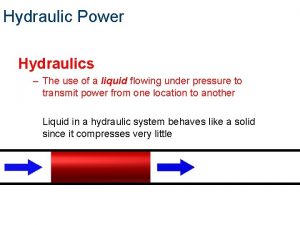
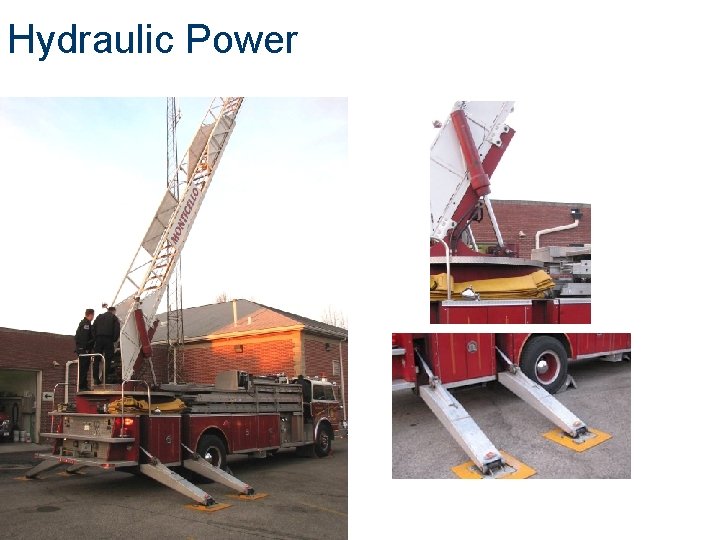
Hydraulic Power Hydraulics – The use of a liquid flowing under pressure to transmit power from one location to another Liquid in a hydraulic system behaves like a solid since it compresses very little
Hydraulic Power
Hydraulics vs. Pneumatics Hydraulic Systems. . . • • • Use a relatively incompressible liquid Have a slower, smoother motion Are generally more precise Lubricate naturally Are not as clean as pneumatics when leakage occurs • Often operate at pressures of 500 - 5000 psi • Generally produce more power
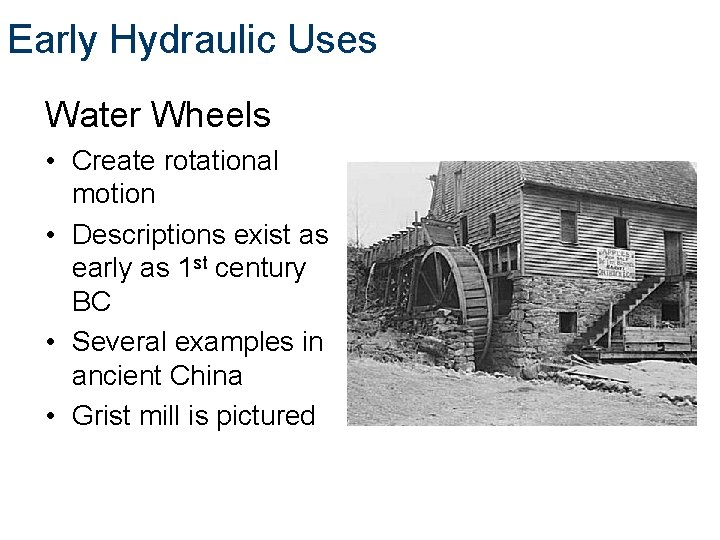
Early Hydraulic Uses Water Wheels • Create rotational motion • Descriptions exist as early as 1 st century BC • Several examples in ancient China • Grist mill is pictured
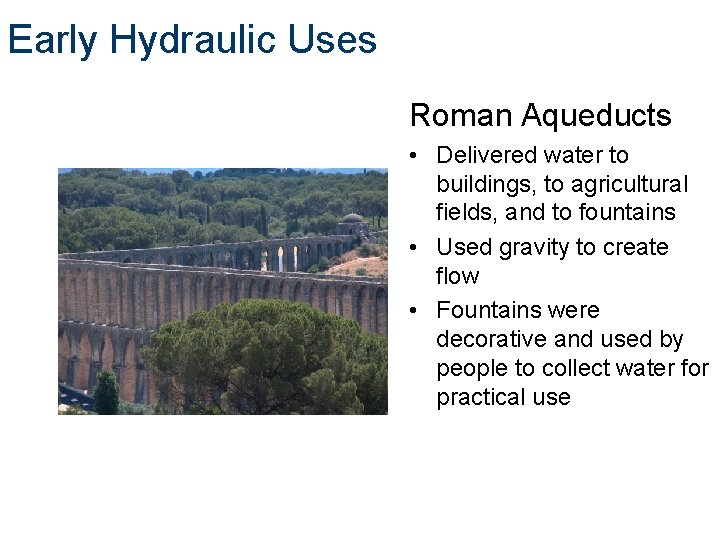
Early Hydraulic Uses Roman Aqueducts • Delivered water to buildings, to agricultural fields, and to fountains • Used gravity to create flow • Fountains were decorative and used by people to collect water for practical use
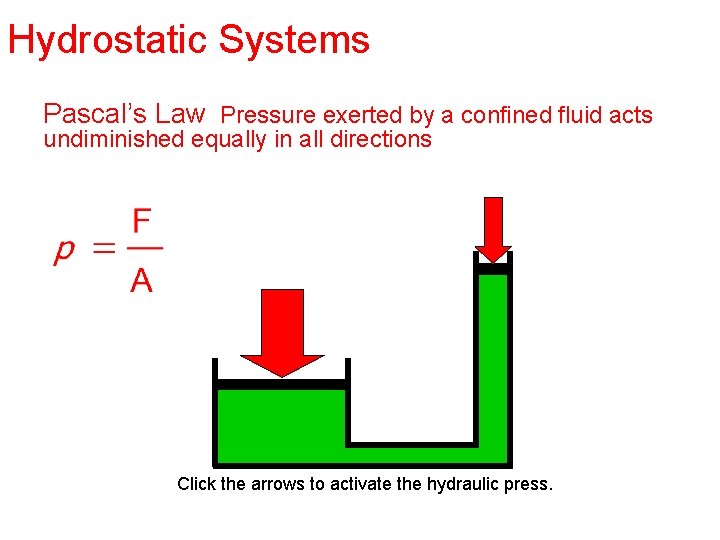
Hydrostatic Systems Pascal’s Law Pressure exerted by a confined fluid acts undiminished equally in all directions Click the arrows to activate the hydraulic press.
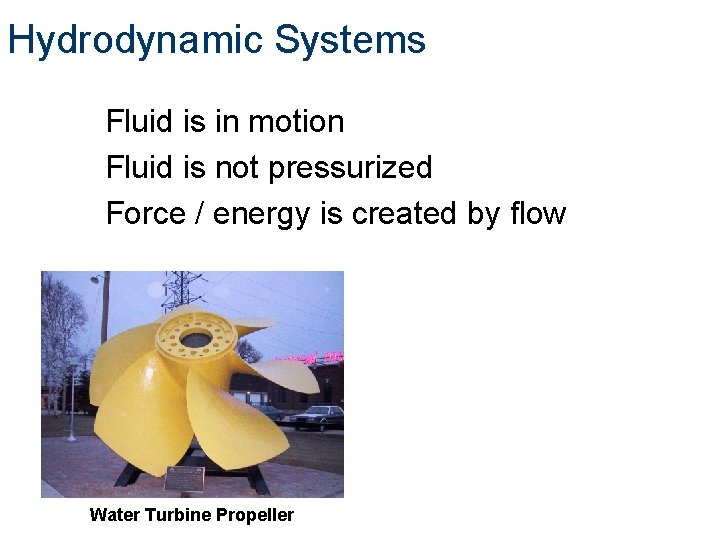
Hydrodynamic Systems Fluid is in motion Fluid is not pressurized Force / energy is created by flow Water Turbine Propeller
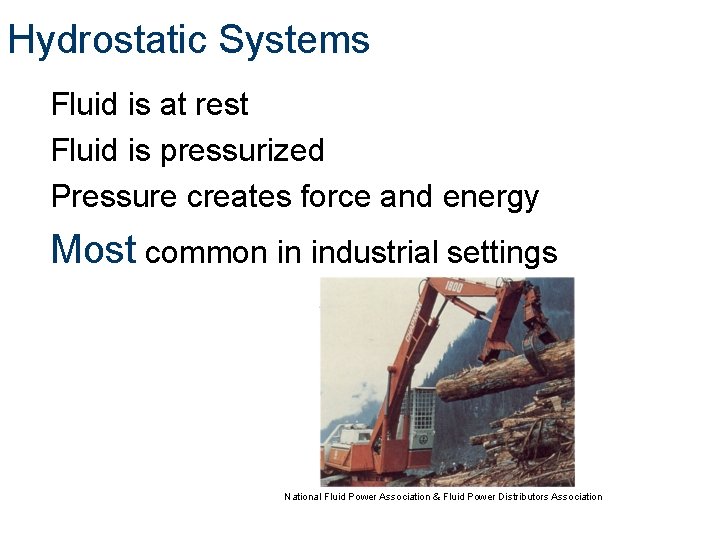
Hydrostatic Systems Fluid is at rest Fluid is pressurized Pressure creates force and energy Most common in industrial settings National Fluid Power Association & Fluid Power Distributors Association
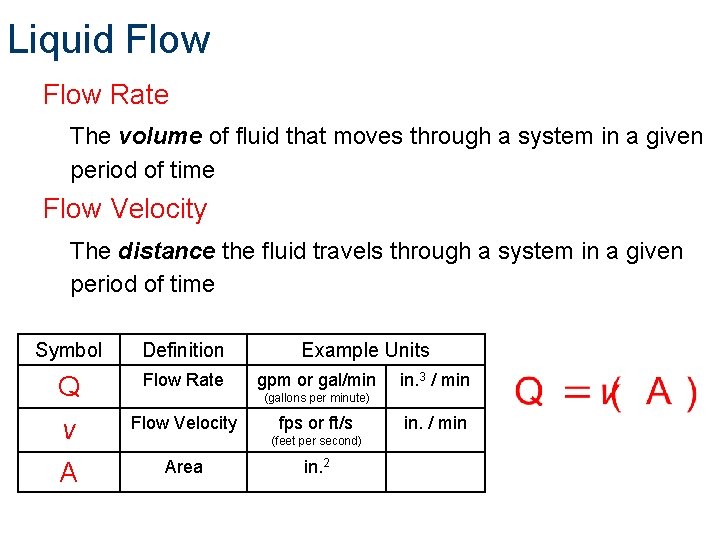
Liquid Flow Rate The volume of fluid that moves through a system in a given period of time Flow Velocity The distance the fluid travels through a system in a given period of time Symbol Definition Q Flow Rate v Flow Velocity A Area Example Units gpm or gal/min in. 3 / min (gallons per minute) fps or ft/s (feet per second) in. 2 in. / min
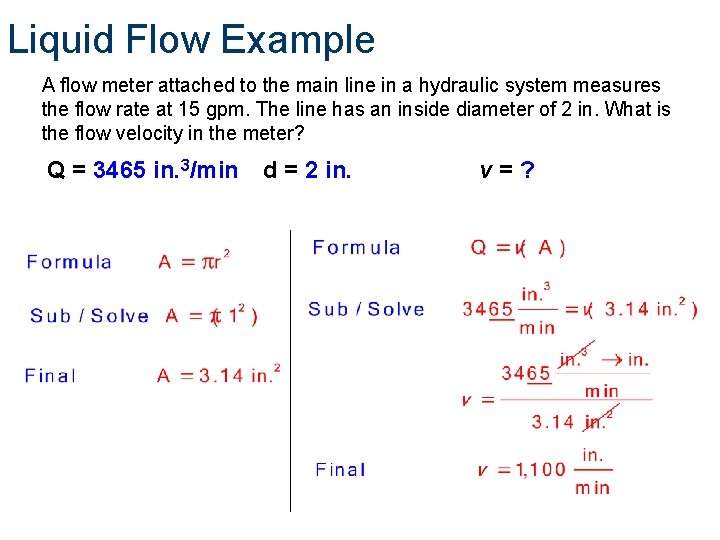
Liquid Flow Example A flow meter attached to the main line in a hydraulic system measures the flow rate at 15 gpm. The line has an inside diameter of 2 in. What is the flow velocity in the meter? Q = 15 gal/min d = 2 in. v=? Convert 15 gal/min to in. 3 /min Float 1 gal = 231 in. 3 Reprinted with permission from Introduction to Fluid Power, by James L. Johnson. Copyright © 2002 Thomson Delmar Learning.
Liquid Flow Example A flow meter attached to the main line in a hydraulic system measures the flow rate at 15 gpm. The line has an inside diameter of 2 in. What is the flow velocity in the meter? Q = 3465 in. 3/min d = 2 in. v=?
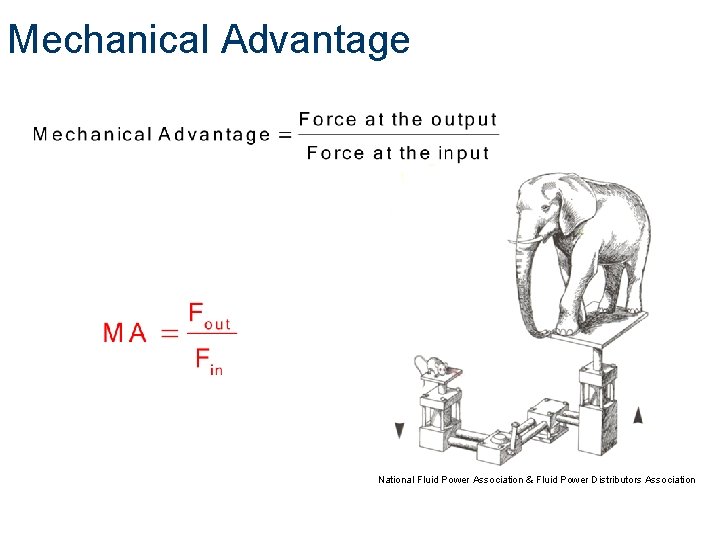
Mechanical Advantage National Fluid Power Association & Fluid Power Distributors Association
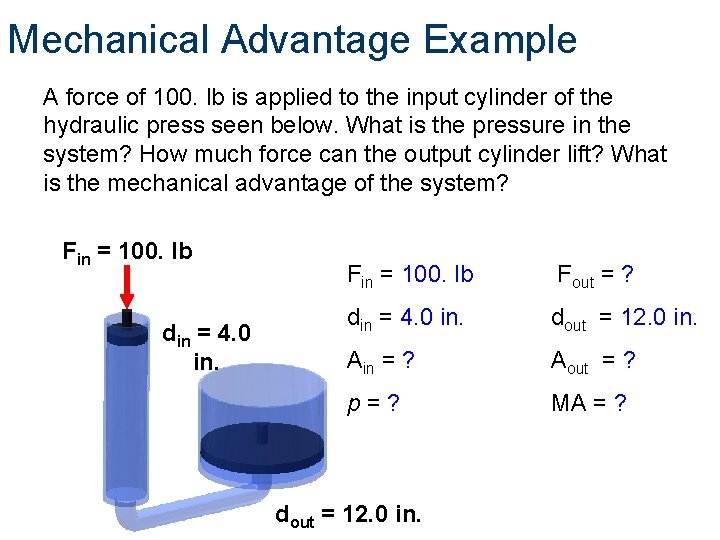
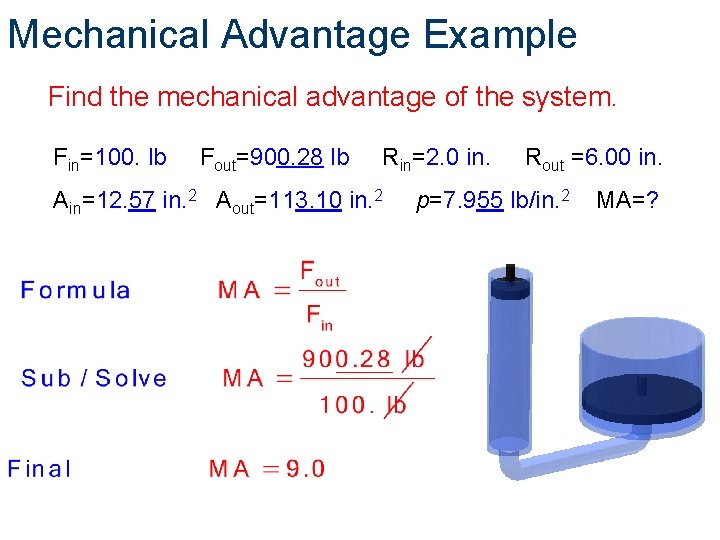
Mechanical Advantage Example A force of 100. lb is applied to the input cylinder of the hydraulic press seen below. What is the pressure in the system? How much force can the output cylinder lift? What is the mechanical advantage of the system? Fin = 100. lb din = 4. 0 in. Fin = 100. lb Fout = ? din = 4. 0 in. dout = 12. 0 in. Ain = ? Aout = ? p=? MA = ? dout = 12. 0 in.
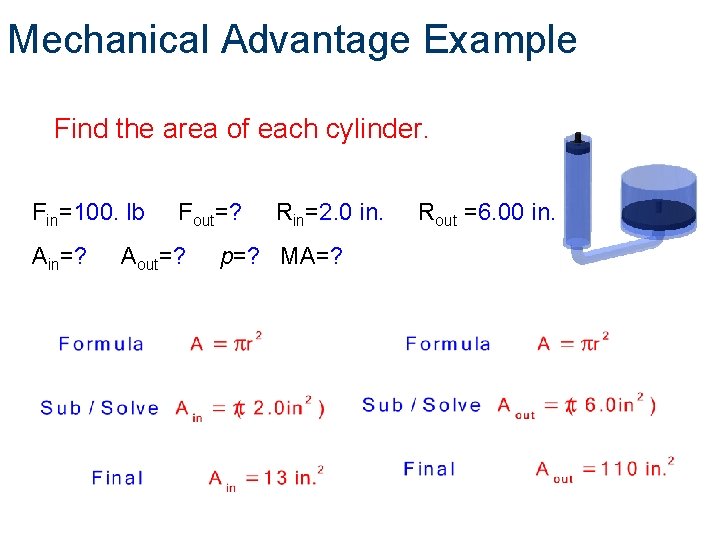
Mechanical Advantage Example Find the area of each cylinder. Fin=100. lb Ain=? Fout=? Aout=? Rin=2. 0 in. p=? MA=? Rout =6. 00 in.
Mechanical Advantage Example Find the pressure in the system. Fin=100. lb Ain=12. 57 in. 2 Fout=? Rin=2. 0 in. Aout=113. 10 in. 2 Rout=6. 00 in. p=? MA=?
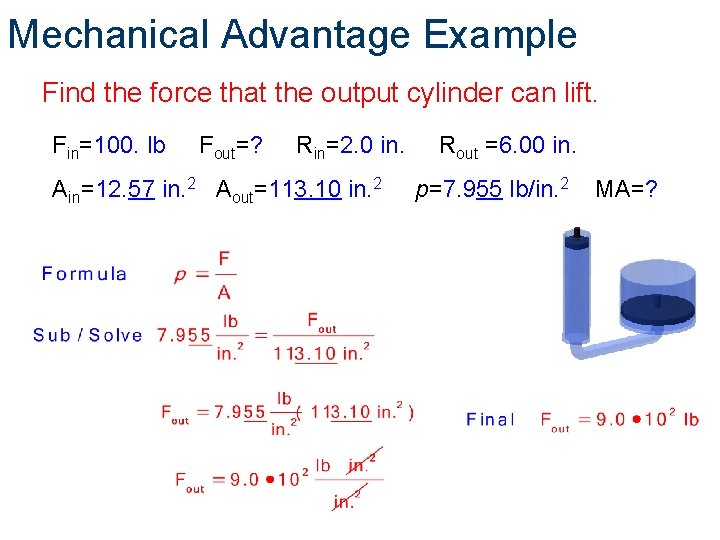
Mechanical Advantage Example Find the force that the output cylinder can lift. Fin=100. lb Fout=? Rin=2. 0 in. Ain=12. 57 in. 2 Aout=113. 10 in. 2 Rout =6. 00 in. p=7. 955 lb/in. 2 MA=?
Mechanical Advantage Example Find the mechanical advantage of the system. Fin=100. lb Fout=900. 28 lb Rin=2. 0 in. Ain=12. 57 in. 2 Aout=113. 10 in. 2 Rout =6. 00 in. p=7. 955 lb/in. 2 MA=?
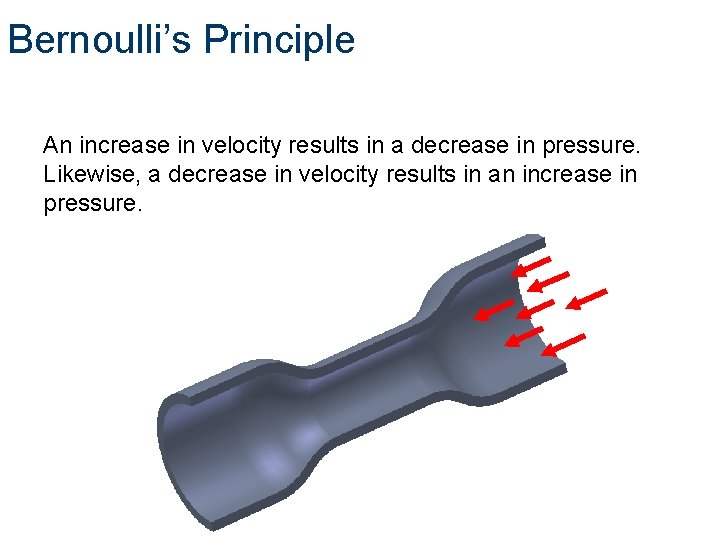
Bernoulli’s Principle An increase in velocity results in a decrease in pressure. Likewise, a decrease in velocity results in an increase in pressure.
Viscosity The measure of a fluid’s thickness or resistance to flow Crucial for lubricating a system Measured in slugs/ft 3 (US) or centistokes (metric) – Hydraulic oil is usually around 1. 4 slugs/ft 3 Decreases as temperature increases
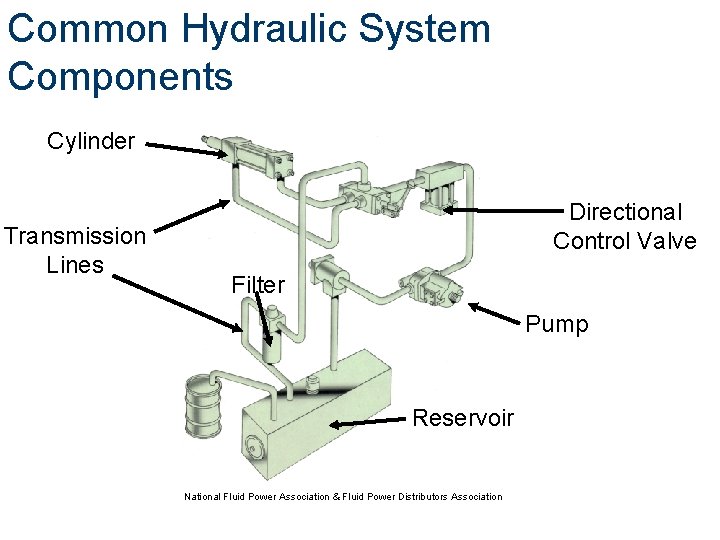
Common Hydraulic System Components Cylinder Transmission Lines Directional Control Valve Filter Pump Reservoir National Fluid Power Association & Fluid Power Distributors Association
Common Hydraulic System Components Click the lever on the valve to extend and retract the cylinder. Cylinder Valve Reservoir Pump
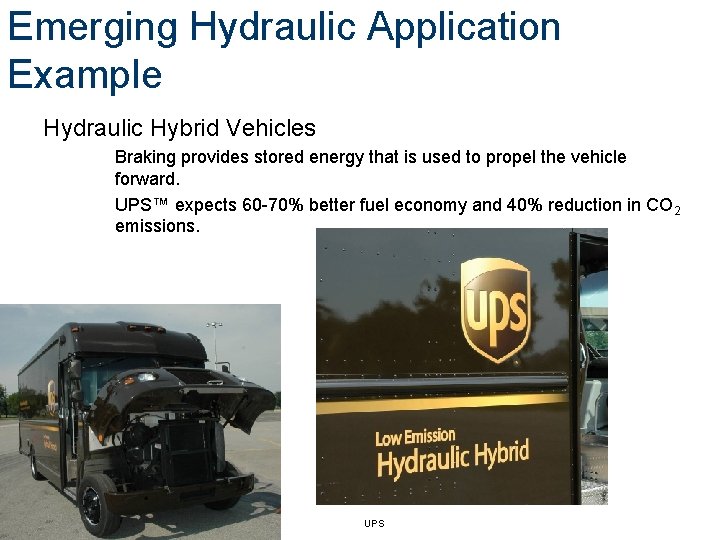
Emerging Hydraulic Application Example Hydraulic Hybrid Vehicles Braking provides stored energy that is used to propel the vehicle forward. UPS™ expects 60 -70% better fuel economy and 40% reduction in CO 2 emissions. UPS