
HYDRAULICS 1 Hydraulics Teaching Objectives Learn basic concepts

HYDRAULICS 1

Hydraulics • Teaching Objectives – Learn basic concepts • • • Water properties Open channel flow Culvert (or Pipe) flow Variation in hydraulic conditions Temperature and ice effects Flow measurements 2

Hydraulics Definition • Wikipedia: Hydraulics is a topic in applied science and engineering dealing with the mechanical properties of liquids. Fluid mechanics provides theoretical foundation for hydraulics, which focuses on the engineering uses of fluid properties. • From Elementary Fluid Mechanics, Vennard and Street, 1975. “Because of the conflict between theory and experiment, two schools of thought arose in the treatment of fluid mechanics, one dealing with theoretical and the other with the practical aspects of fluid flow. In a sense, these two schools of thought have persisted to the present day, resulting in the mathematical field of hydrodynamics and the practical science of hydraulics. ” 3

DESCRIPTION OF HYDRAULICS SECTION, St. Paul District Responsible for hydraulic engineering associated with the planning, design, construction, operation, and maintenance for various civil works water resources programs and projects. The water resources areas covered include navigation, flood risk management, ecosystem restoration, dam and levee safety, bank stabilization, flood reconnaissance……. The work includes: • modeling and design for levees, bank stabilization, channel improvements, interior flood control, habitat projects, and hydraulic structures • collecting and analyzing hydraulic and sediment transport data • ice reconnaissance and data collection • reconnaissance and support for flood emergencies • support to periodic inspections at locks and dams • wetlands permit reviews • dredge material management • coastal engineering • agency technical reviews 4
Water Properties • Heavy - 1 cubic foot weighs 62. 4 lbs – – – Gasoline weighs 42. 5 lbs/ft 3 Rock weighs 110 lbs/ft 3 Concrete weighs 165 lbs/ft 3 Wood: White Oak = 48 lbs/ft 3 White Pine = 26 lbs/ft 3 Temperature Affects: Important in lakes and reservoirs • Why does something float? • The laws of buoyancy (Archimedes’ Principle, 250 BC) and floatation are usually stated: – A body immersed in a fluid is buoyed up by a force equal to the weight of fluid displaced – A floating body displaces its own weight of the liquid in which it floats 5
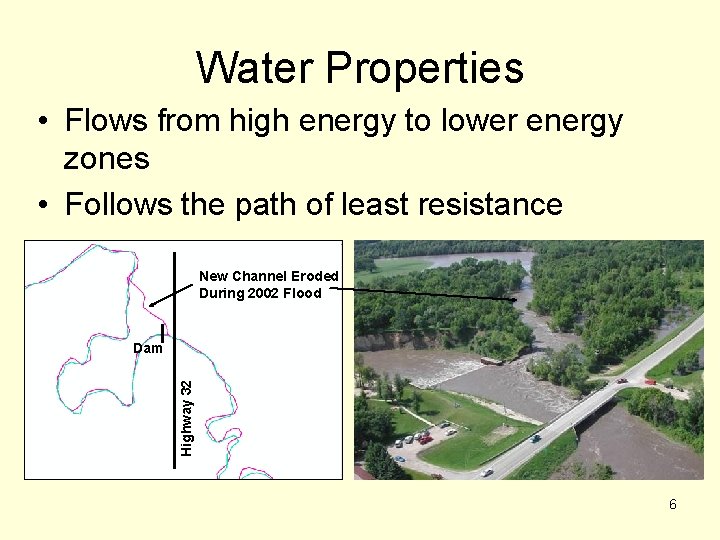
Water Properties • Flows from high energy to lower energy zones • Follows the path of least resistance New Channel Eroded During 2002 Flood Highway 32 Dam 6
Water Properties • Water Seeks its Own level – If it’s at elevation 100 on one side of a dam or levee, it wants to be the same elevation on the other side. • Incompressible- So It Transmits Energy Well • Liquid at normal temperature • Heating to 212 °F (boiling point) raises the vapor pressure to atmospheric pressure and liquid turns to gas • Lowering the pressure (for instance in a pipe or on a spinning propeller) can cause gas formation at lower temperatures – Cavitation: Low pressure conditions results in liquid to gas and then collapse back to liquid which plucks metal off turbine blades and concrete off spillways 7
Water Properties • Density doesn’t change significantly with ambient temperature range. – 1. 9385 slugs/ft 3 at 32 °F – 1. 9388 slugs/ft 3 at 40 °F (water is heaviest) – 1. 9348 slugs/ft 3 at 70 °F (0. 2% lighter than at 40 °F) • This means we can usually ignore density changes in flowing rivers because of mixing • But in lakes these slight density differences result in thermal stratification 8
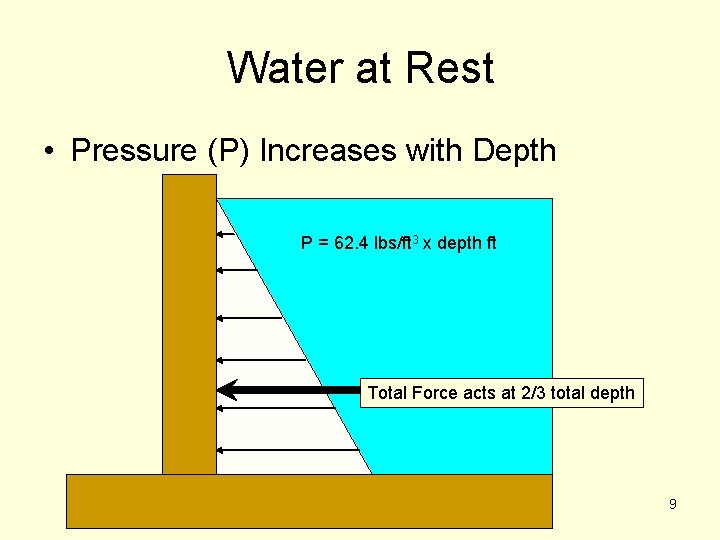
Water at Rest • Pressure (P) Increases with Depth P = 62. 4 lbs/ft 3 x depth ft Total Force acts at 2/3 total depth 9
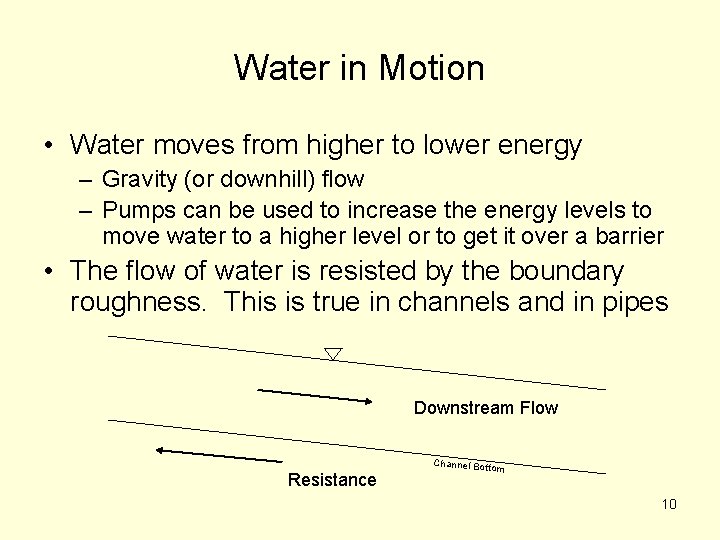
Water in Motion • Water moves from higher to lower energy – Gravity (or downhill) flow – Pumps can be used to increase the energy levels to move water to a higher level or to get it over a barrier • The flow of water is resisted by the boundary roughness. This is true in channels and in pipes Downstream Flow Resistance Channel Botto m 10
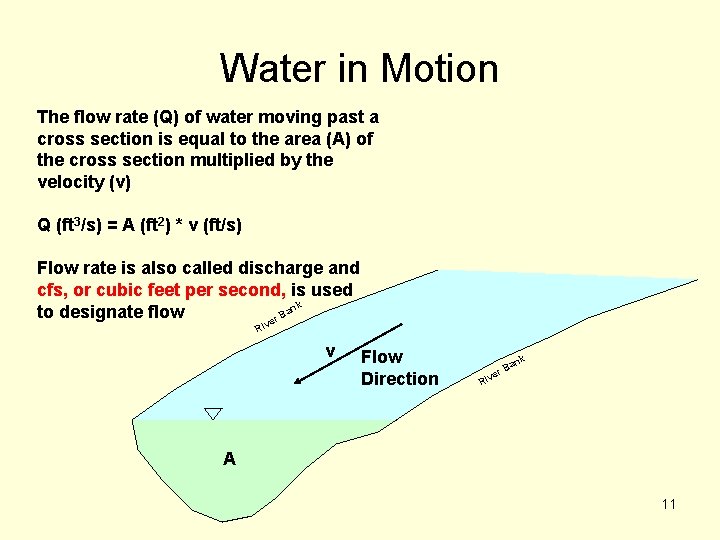
Water in Motion The flow rate (Q) of water moving past a cross section is equal to the area (A) of the cross section multiplied by the velocity (v) Q (ft 3/s) = A (ft 2) * v (ft/s) Flow rate is also called discharge and cfs, or cubic feet per second, is used nk to designate flow Ba r e Riv v Flow Direction k an r. B ive R A 11
Ways to describe water in motion • The next few images attempt to define common terms that H&H people use when describing the movement of water. • In a multi-discipline team setting you don’t need to be an expert in H&H, but you should understand some of the lingo. 12
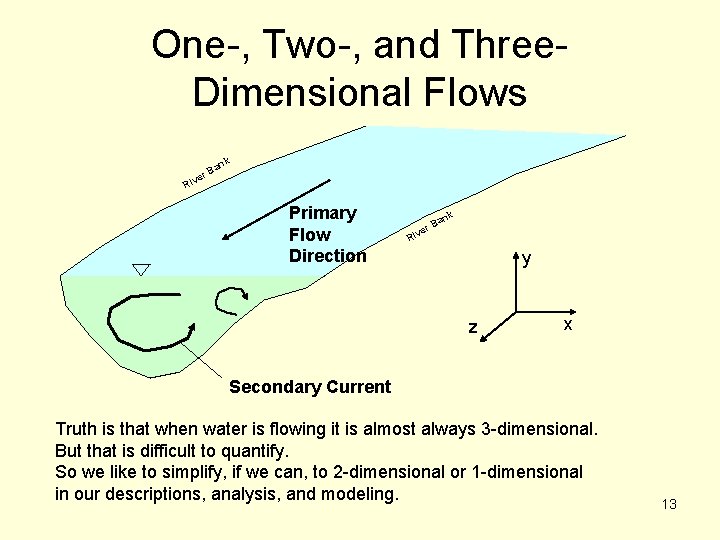
One-, Two-, and Three. Dimensional Flows k an Riv B er Primary Flow Direction an r. B ive k R y z x Secondary Current Truth is that when water is flowing it is almost always 3 -dimensional. But that is difficult to quantify. So we like to simplify, if we can, to 2 -dimensional or 1 -dimensional in our descriptions, analysis, and modeling. 13
One-, Two-, and Three. Dimensional Flows • When planners talk to hydraulic modelers they will hear the terms 1 -D, 2 -D, 3 -D flow and models. – In a one-dimensional flow, the change of fluid variables (velocity, temperature, etc. ) in one direction dominates over the change in the other two directions. – In two- and three-dimensional flows, the change in fluid variables is important in multiple directions. – Coefficients, model calibration, and past experience are used to account for simplifying assumptions. 14
Change of Flow with Respect to Time - no change: steady - changing: unsteady 15
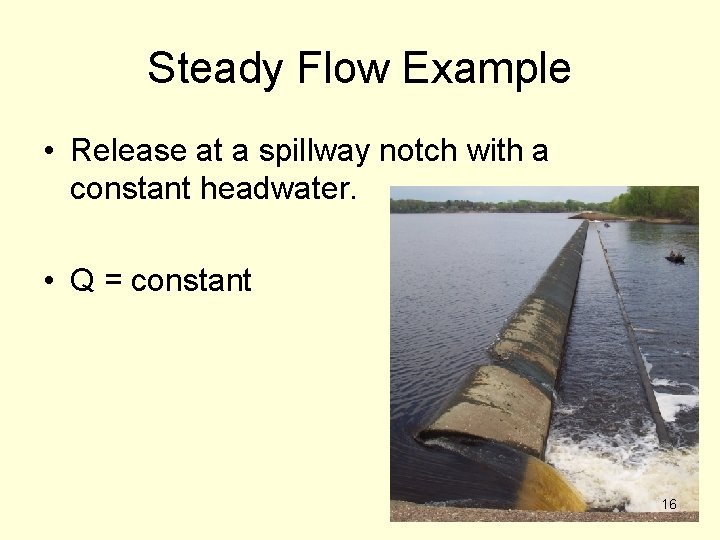
Steady Flow Example • Release at a spillway notch with a constant headwater. • Q = constant 16
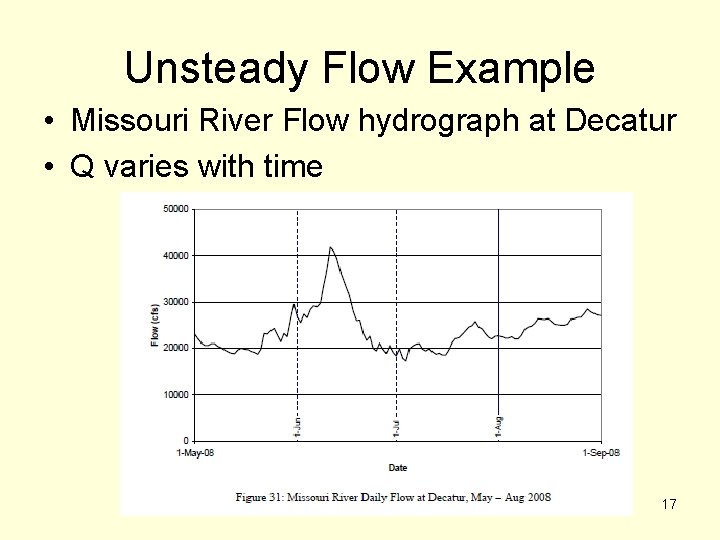
Unsteady Flow Example • Missouri River Flow hydrograph at Decatur • Q varies with time 17
Change of Flow Conditions with Respect to Spatial Position? 18
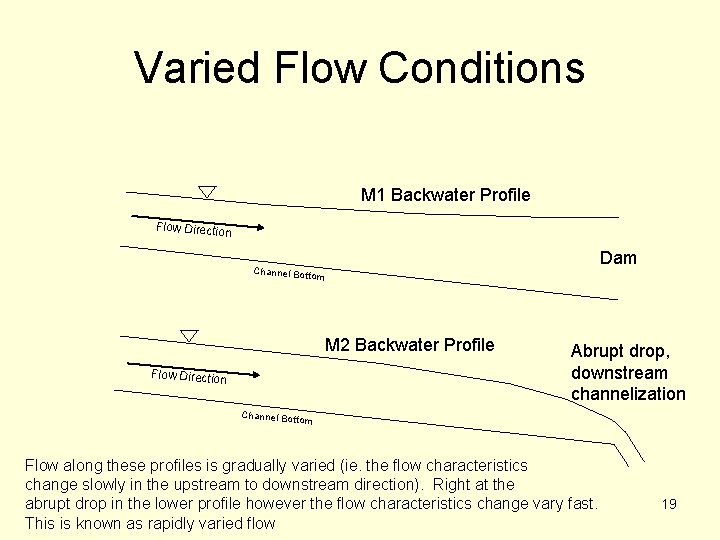
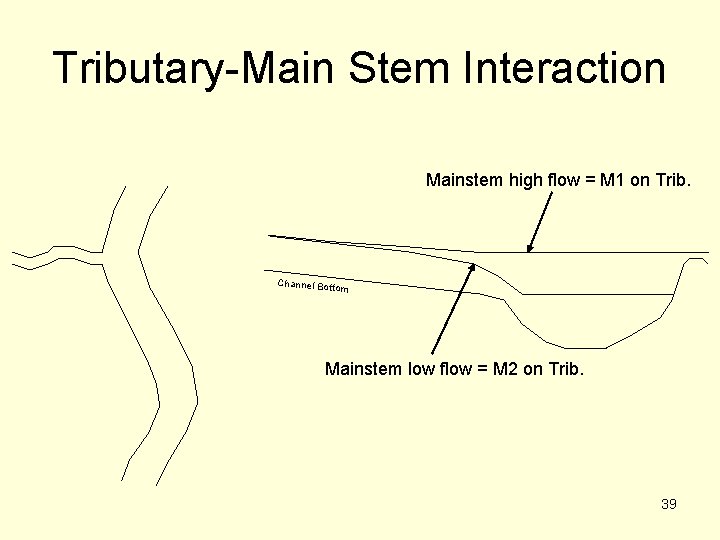
Varied Flow Conditions M 1 Backwater Profile Flow Directio n Dam Channel Botto m M 2 Backwater Profile Flow Directio n Abrupt drop, downstream channelization Channel Botto m Flow along these profiles is gradually varied (ie. the flow characteristics change slowly in the upstream to downstream direction). Right at the abrupt drop in the lower profile however the flow characteristics change vary fast. This is known as rapidly varied flow 19
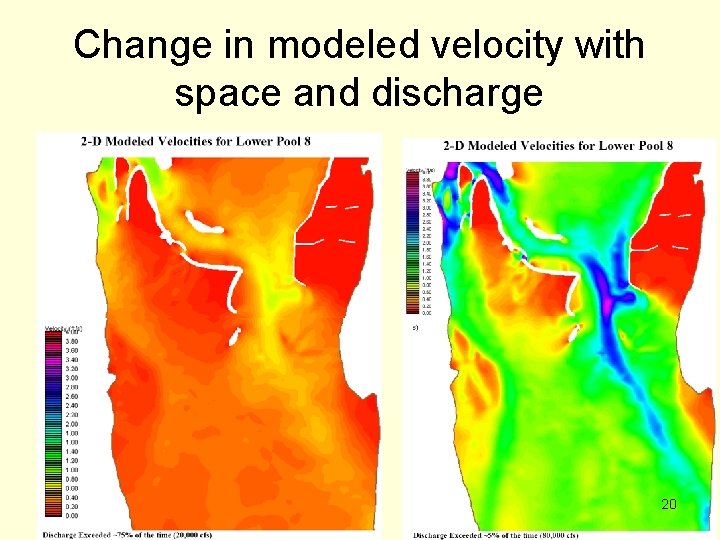
Change in modeled velocity with space and discharge 20
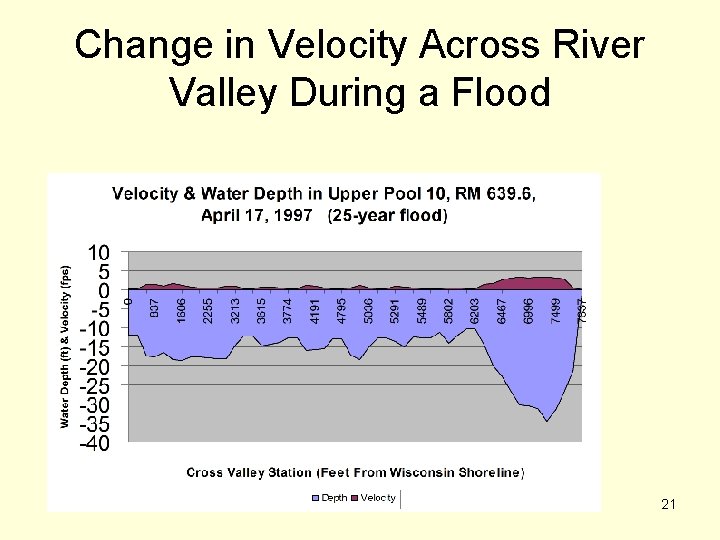
Change in Velocity Across River Valley During a Flood 21
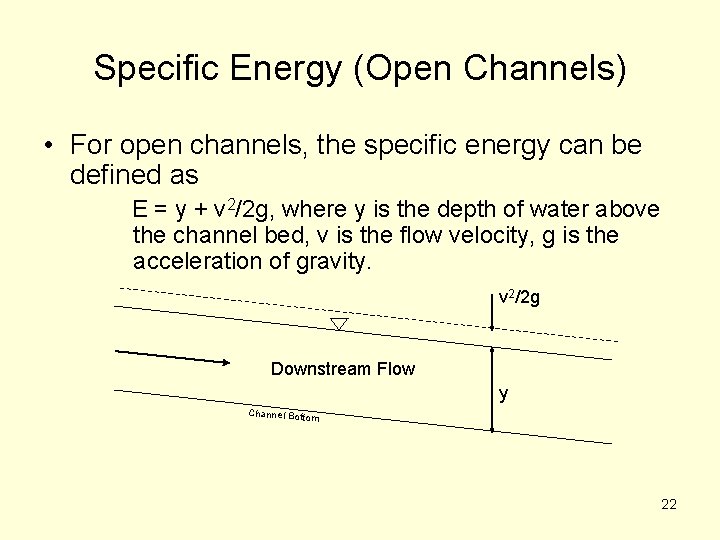
Specific Energy (Open Channels) • For open channels, the specific energy can be defined as E = y + v 2/2 g, where y is the depth of water above the channel bed, v is the flow velocity, g is the acceleration of gravity. v 2/2 g Downstream Flow y Channel Botto m 22
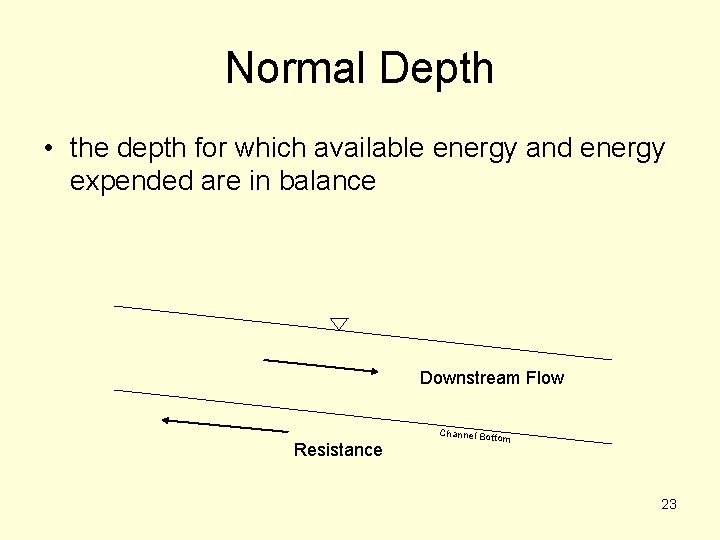
Normal Depth • the depth for which available energy and energy expended are in balance Downstream Flow Resistance Channel Botto m 23
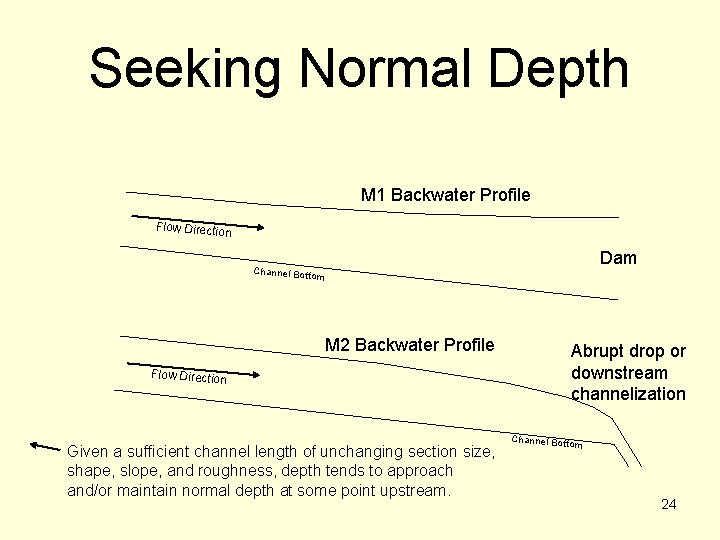
Seeking Normal Depth M 1 Backwater Profile Flow Directio n Dam Channel Botto m M 2 Backwater Profile Flow Directio n Given a sufficient channel length of unchanging section size, shape, slope, and roughness, depth tends to approach and/or maintain normal depth at some point upstream. Abrupt drop or downstream channelization Channel Botto m 24
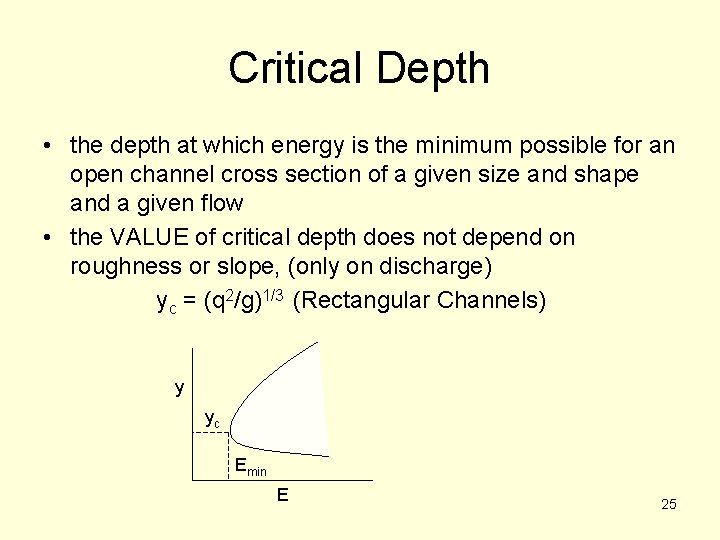
Critical Depth • the depth at which energy is the minimum possible for an open channel cross section of a given size and shape and a given flow • the VALUE of critical depth does not depend on roughness or slope, (only on discharge) yc = (q 2/g)1/3 (Rectangular Channels) y yc Emin E 25
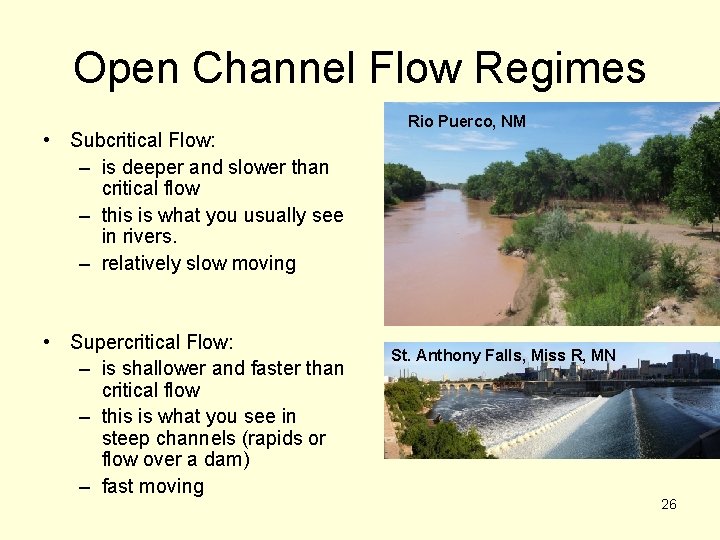
Open Channel Flow Regimes • Subcritical Flow: – is deeper and slower than critical flow – this is what you usually see in rivers. – relatively slow moving • Supercritical Flow: – is shallower and faster than critical flow – this is what you see in steep channels (rapids or flow over a dam) – fast moving Rio Puerco, NM St. Anthony Falls, Miss R, MN 26
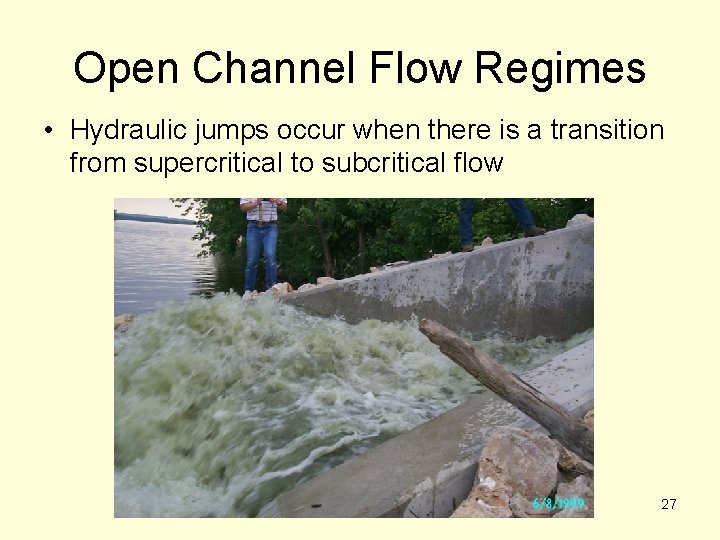
Open Channel Flow Regimes • Hydraulic jumps occur when there is a transition from supercritical to subcritical flow 27
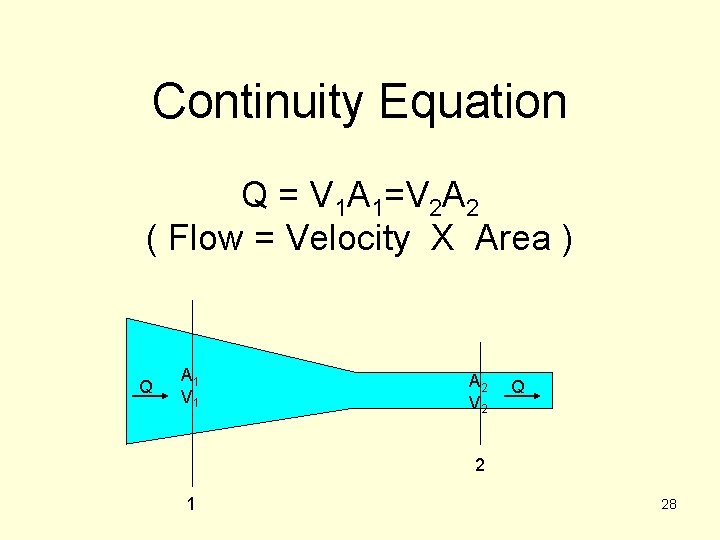
Continuity Equation Q = V 1 A 1=V 2 A 2 ( Flow = Velocity X Area ) Q A 1 V 1 A 2 V 2 Q 2 1 28
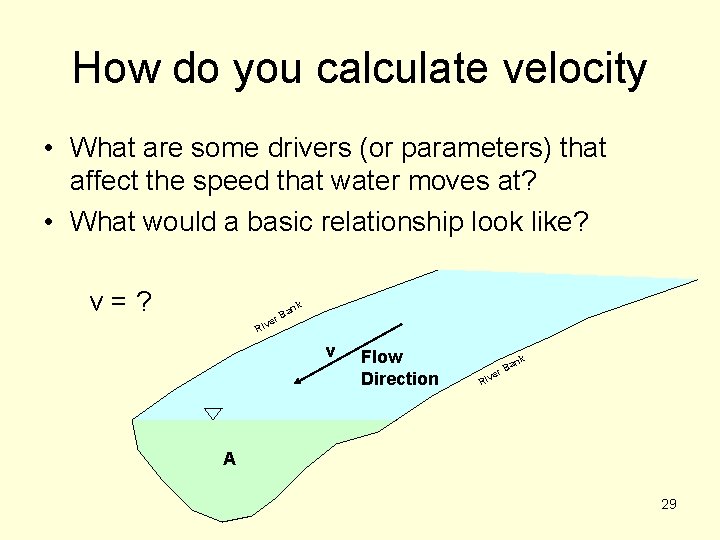
How do you calculate velocity • What are some drivers (or parameters) that affect the speed that water moves at? • What would a basic relationship look like? v=? an r. B ive k R v Flow Direction k an r. B ive R A 29
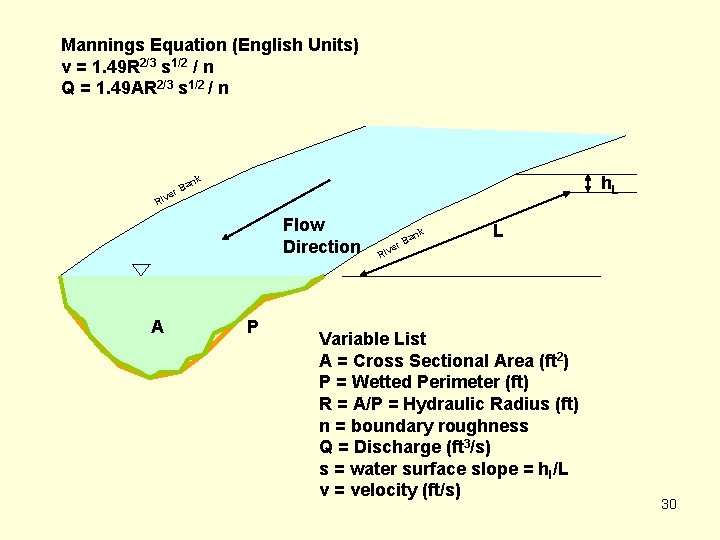
Mannings Equation (English Units) v = 1. 49 R 2/3 s 1/2 / n Q = 1. 49 AR 2/3 s 1/2 / n h. L k an Riv B er Flow Direction A P nk a r. B ive L R Variable List A = Cross Sectional Area (ft 2) P = Wetted Perimeter (ft) R = A/P = Hydraulic Radius (ft) n = boundary roughness Q = Discharge (ft 3/s) s = water surface slope = hl/L v = velocity (ft/s) 30
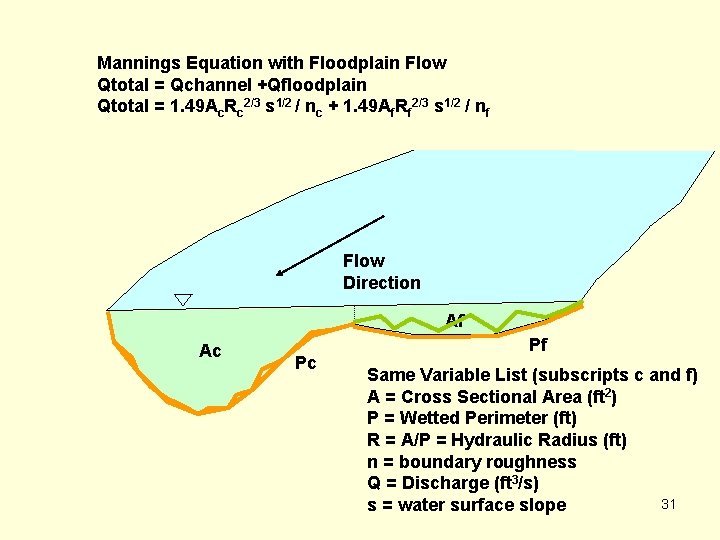
Mannings Equation with Floodplain Flow Qtotal = Qchannel +Qfloodplain Qtotal = 1. 49 Ac. Rc 2/3 s 1/2 / nc + 1. 49 Af. Rf 2/3 s 1/2 / nf Flow Direction Af Ac Pc Pf Same Variable List (subscripts c and f) A = Cross Sectional Area (ft 2) P = Wetted Perimeter (ft) R = A/P = Hydraulic Radius (ft) n = boundary roughness Q = Discharge (ft 3/s) 31 s = water surface slope
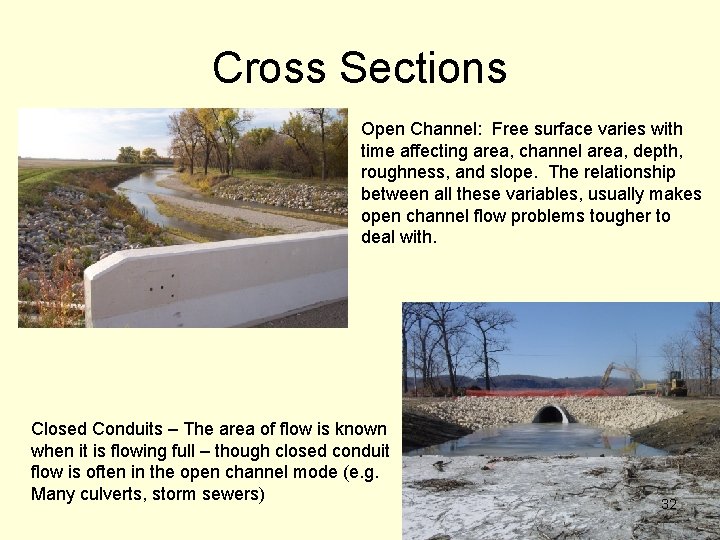
Cross Sections Open Channel: Free surface varies with time affecting area, channel area, depth, roughness, and slope. The relationship between all these variables, usually makes open channel flow problems tougher to deal with. Closed Conduits – The area of flow is known when it is flowing full – though closed conduit flow is often in the open channel mode (e. g. Many culverts, storm sewers) 32
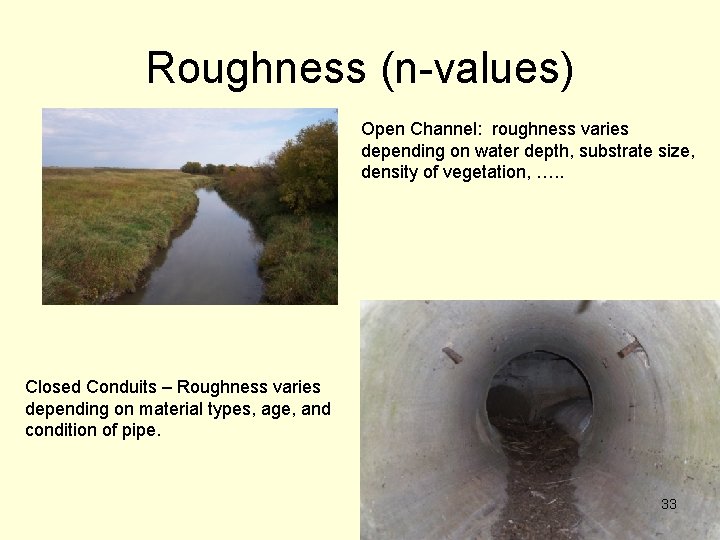
Roughness (n-values) Open Channel: roughness varies depending on water depth, substrate size, density of vegetation, …. . Closed Conduits – Roughness varies depending on material types, age, and condition of pipe. 33
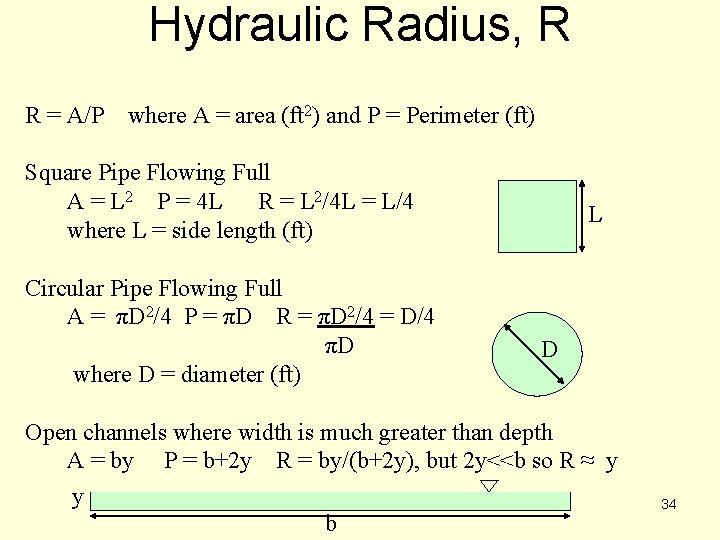
Hydraulic Radius, R R = A/P where A = area (ft 2) and P = Perimeter (ft) Square Pipe Flowing Full A = L 2 P = 4 L R = L 2/4 L = L/4 where L = side length (ft) Circular Pipe Flowing Full A = πD 2/4 P = πD R = πD 2/4 = D/4 πD where D = diameter (ft) L D Open channels where width is much greater than depth A = by P = b+2 y R = by/(b+2 y), but 2 y<<b so R ≈ y y b 34
Slope, s • this is the friction slope, i. e. the rate at which head (energy) is expended through friction per unit horizontal length of flow, ft/ft • the physical slope of a pipe or the bed of an open channel may, or may not, happen to match the friction slope 35
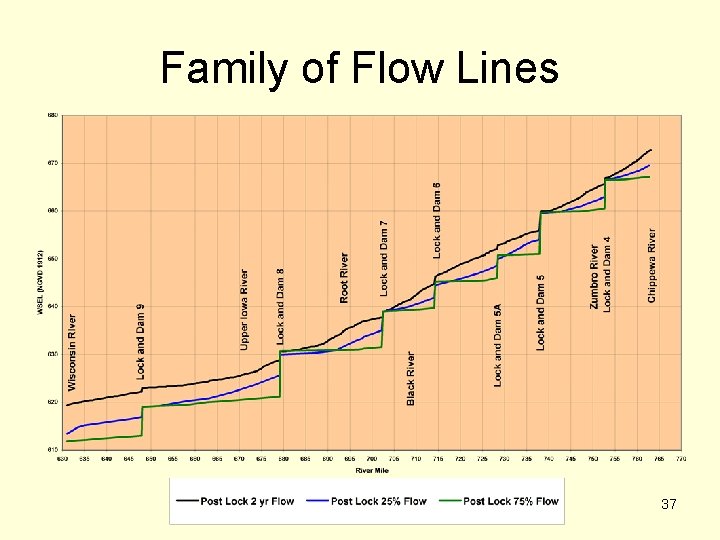
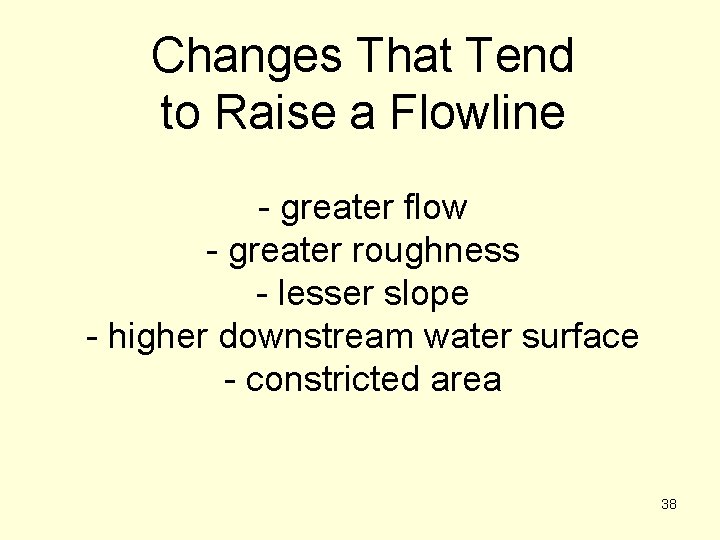
Open Channel Flowlines - a plot of water surface elevation over distance - calculated by numerical models or by using existing gage data -multiple flows: a family of flowlines 36
Family of Flow Lines 37
Changes That Tend to Raise a Flowline - greater flow - greater roughness - lesser slope - higher downstream water surface - constricted area 38
Tributary-Main Stem Interaction Mainstem high flow = M 1 on Trib. Channel Botto m Mainstem low flow = M 2 on Trib. 39
Bridge 6477 TH 75 over Wild Rice River Flood 4/18/1997 Backwater of Red River 40
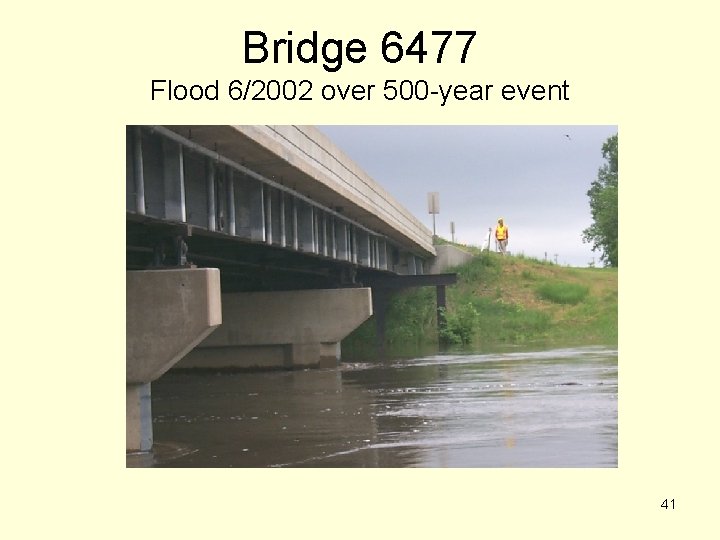
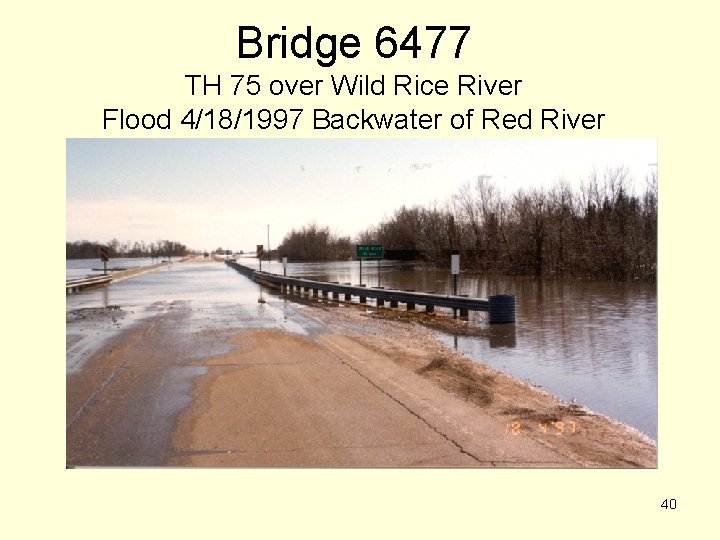
Bridge 6477 Flood 6/2002 over 500 -year event 41
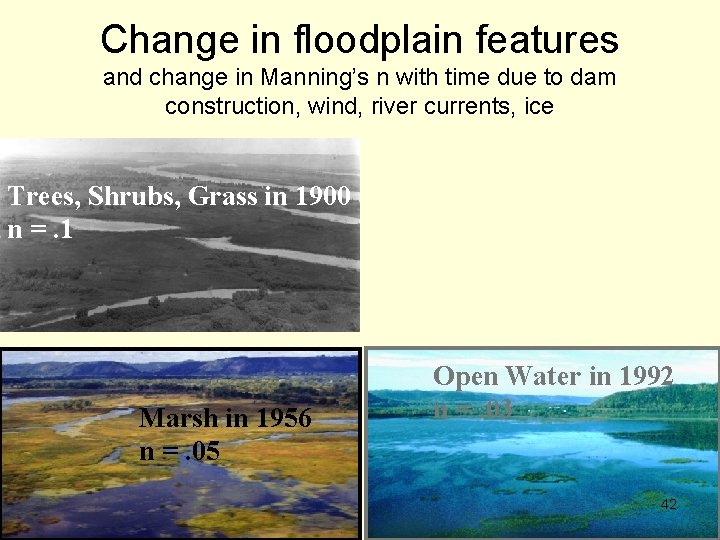
Change in floodplain features and change in Manning’s n with time due to dam construction, wind, river currents, ice Trees, Shrubs, Grass in 1900 n =. 1 Marsh in 1956 n =. 05 Open Water in 1992 n =. 03 42
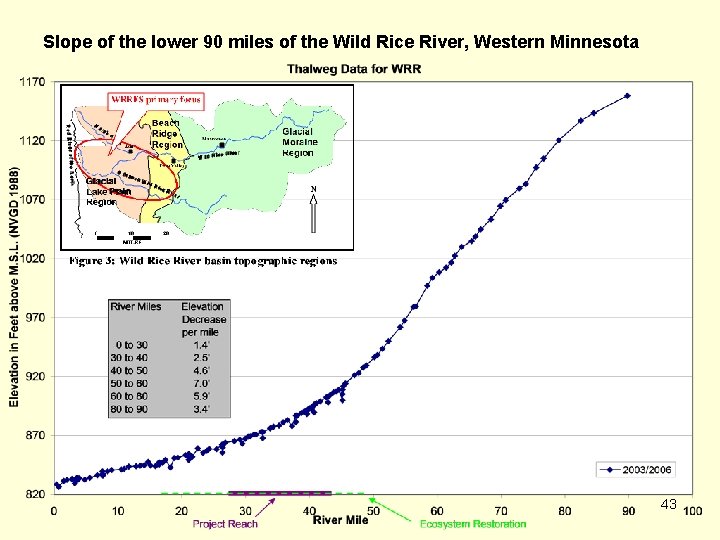
Slope of the lower 90 miles of the Wild Rice River, Western Minnesota 43
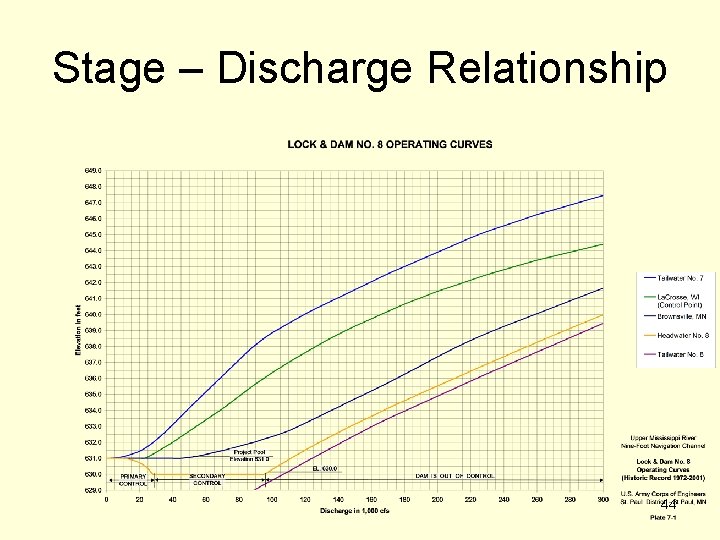
Stage – Discharge Relationship 44
Closed Conduits or Pipes 45
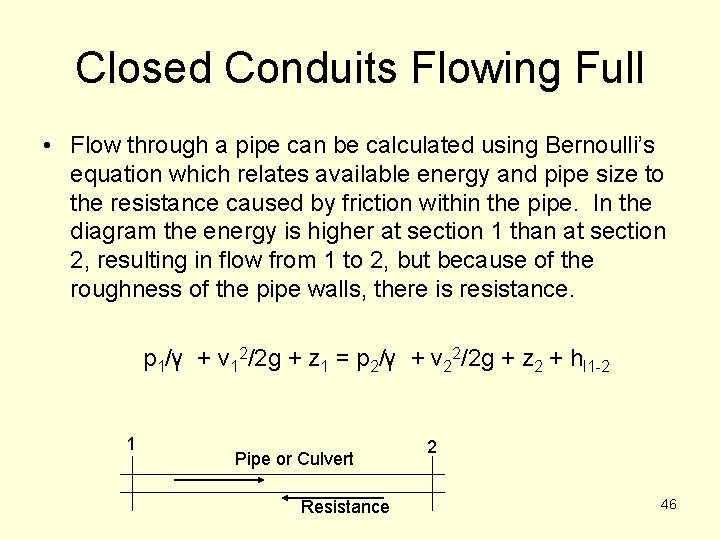
Closed Conduits Flowing Full • Flow through a pipe can be calculated using Bernoulli’s equation which relates available energy and pipe size to the resistance caused by friction within the pipe. In the diagram the energy is higher at section 1 than at section 2, resulting in flow from 1 to 2, but because of the roughness of the pipe walls, there is resistance. p 1/γ + v 12/2 g + z 1 = p 2/γ + v 22/2 g + z 2 + hl 1 -2 1 Pipe or Culvert Resistance 2 46
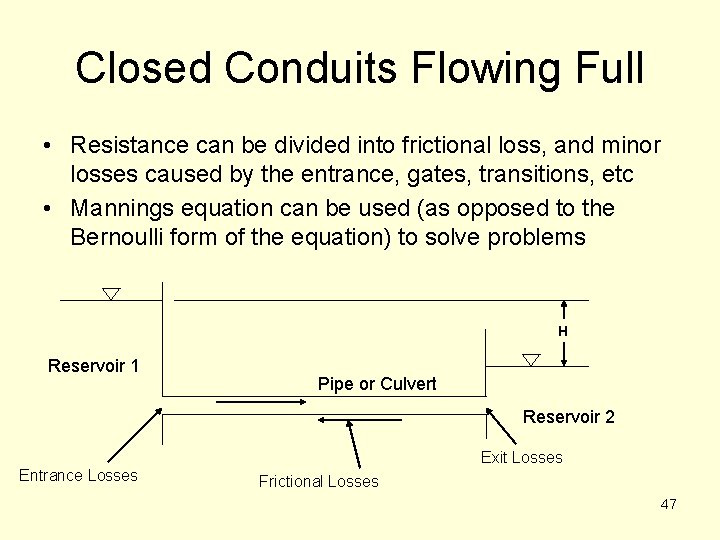
Closed Conduits Flowing Full • Resistance can be divided into frictional loss, and minor losses caused by the entrance, gates, transitions, etc • Mannings equation can be used (as opposed to the Bernoulli form of the equation) to solve problems H Reservoir 1 Pipe or Culvert Reservoir 2 Exit Losses Entrance Losses Frictional Losses 47

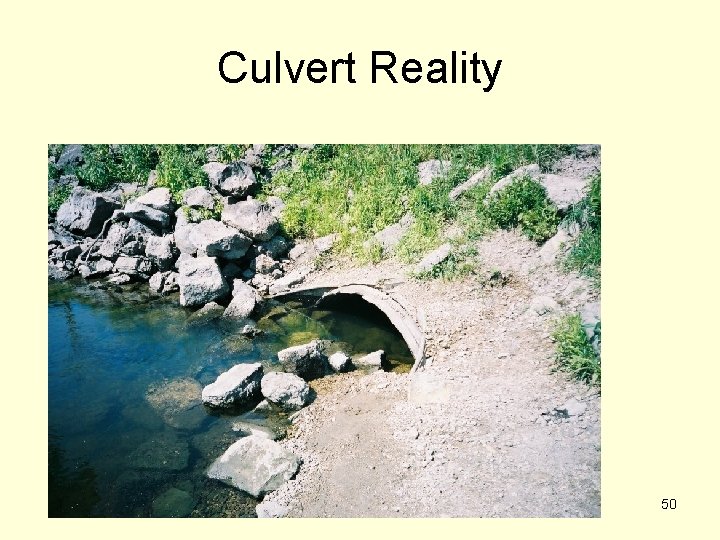
Closed Conduits Flowing Full 1. 2. 3. Culvert area (A) is known If flow is known, then velocity (v) is known, since Q = v. A With velocity known, the Manning equation can be used to calculate the hydraulic slope (s) to overcome friction in the pipe. v, R, and n are known, so solve for s. v = 1. 49 R 2/3 s 1/2/n 4. Since s is equal to H/L, and L is known, then solve for H, or the difference in water surface from one side of the road to the other. Top of Road H Upstream Side Culvert L Downstream Side 48
Culvert Reality 49
Culvert Reality 50
Additional Hydraulic Topics 51
Open Channel --The Weir - doubling head more than doubles the flow. Look at the equation Q = CBH 3/2 52
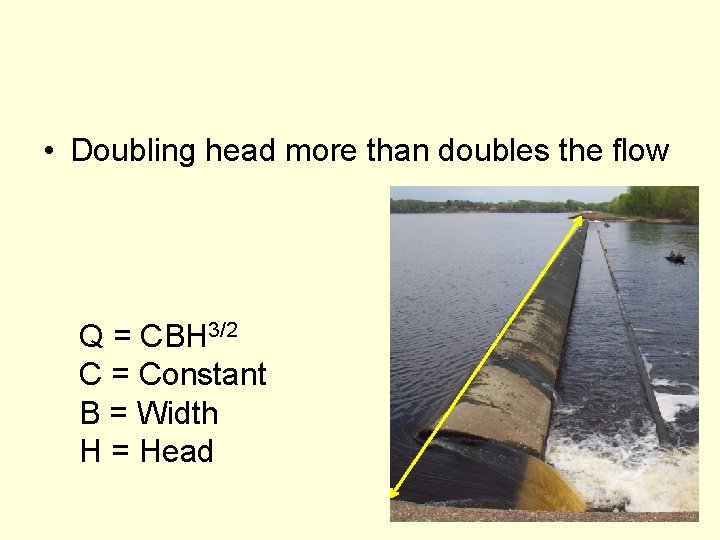
• Doubling head more than doubles the flow Q = CBH 3/2 C = Constant B = Width H = Head 53
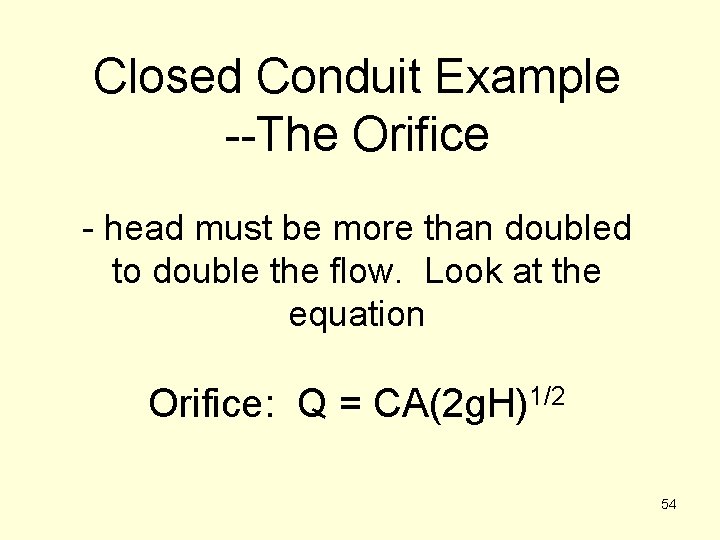
Closed Conduit Example --The Orifice - head must be more than doubled to double the flow. Look at the equation Orifice: Q = CA(2 g. H)1/2 54
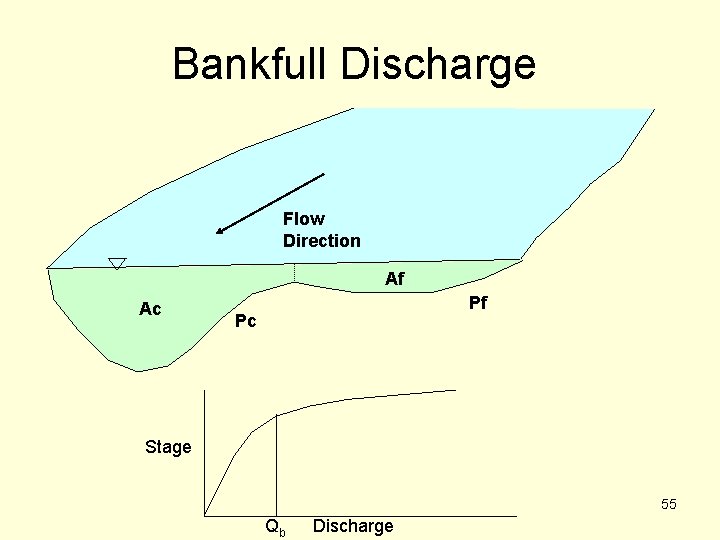
Bankfull Discharge Flow Direction Af Ac Pf Pc Stage 55 Qb Discharge
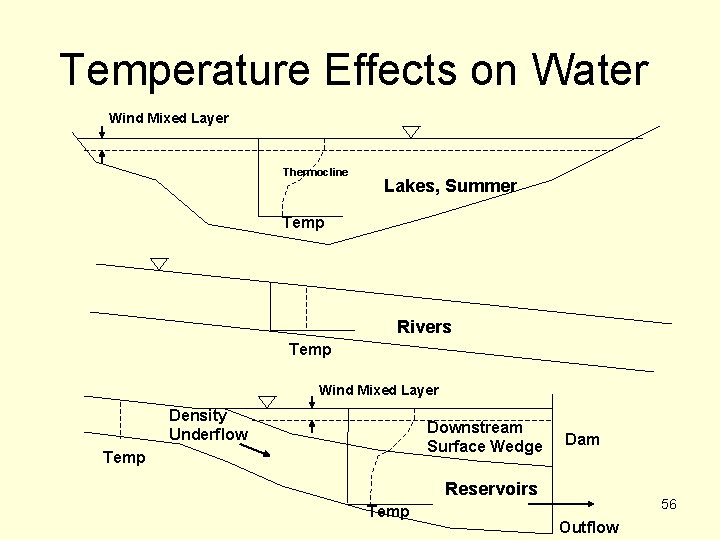
Temperature Effects on Water Wind Mixed Layer Thermocline Lakes, Summer Temp Rivers Temp Wind Mixed Layer Density Underflow Downstream Surface Wedge Temp Dam Reservoirs Temp 56 Outflow
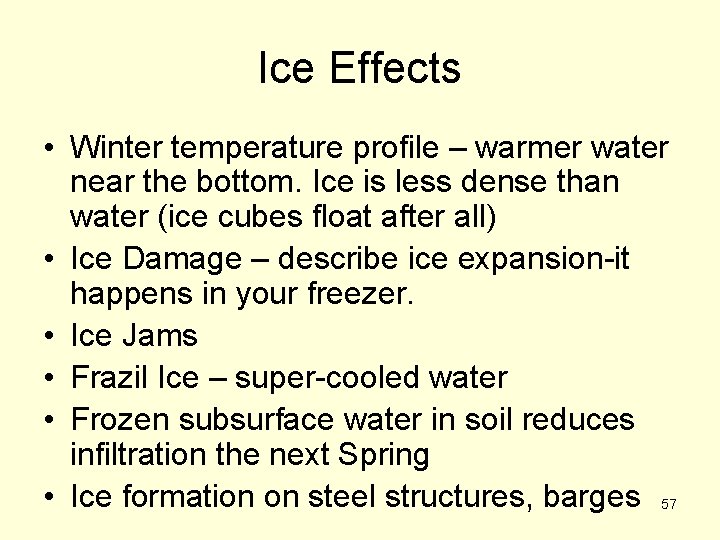
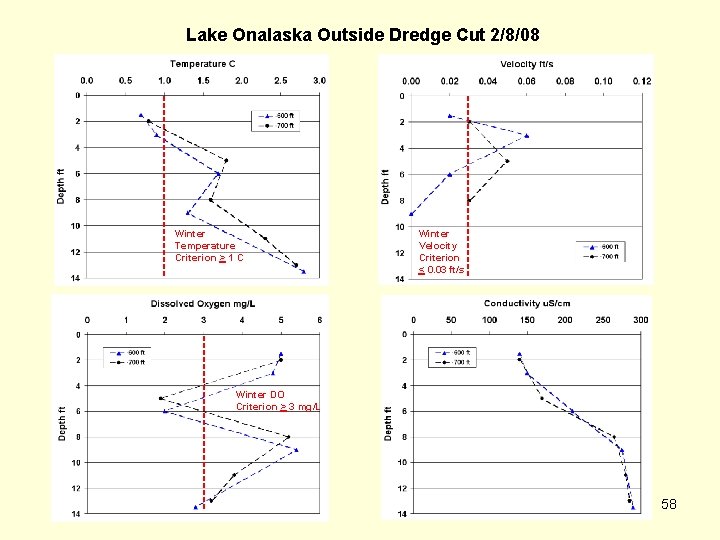
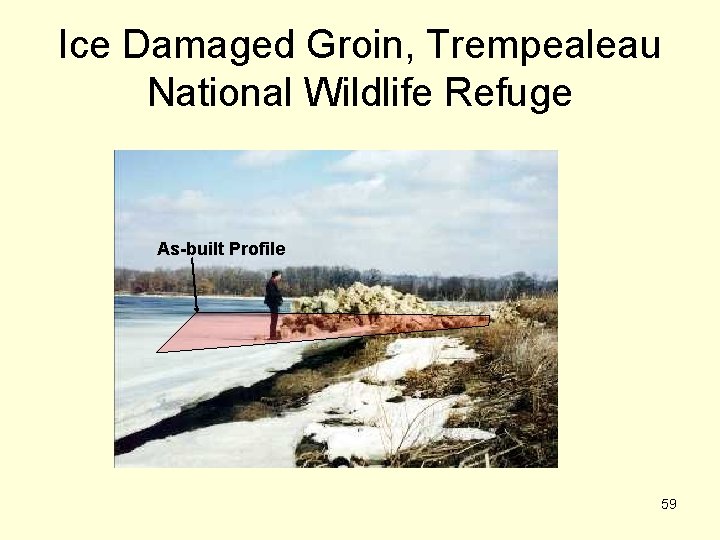
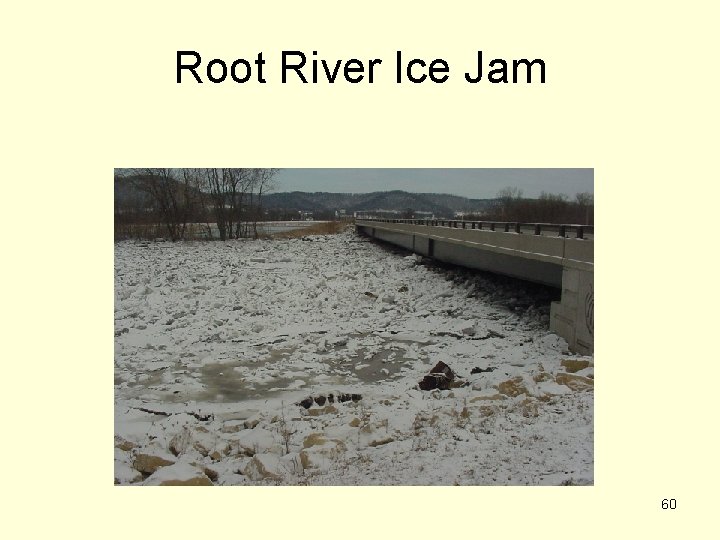
Ice Effects • Winter temperature profile – warmer water near the bottom. Ice is less dense than water (ice cubes float after all) • Ice Damage – describe ice expansion-it happens in your freezer. • Ice Jams • Frazil Ice – super-cooled water • Frozen subsurface water in soil reduces infiltration the next Spring • Ice formation on steel structures, barges 57
Lake Onalaska Outside Dredge Cut 2/8/08 Winter Temperature Criterion > 1 C Winter Velocity Criterion < 0. 03 ft/s Winter DO Criterion > 3 mg/L 58
Ice Damaged Groin, Trempealeau National Wildlife Refuge As-built Profile 59
Root River Ice Jam 60
61
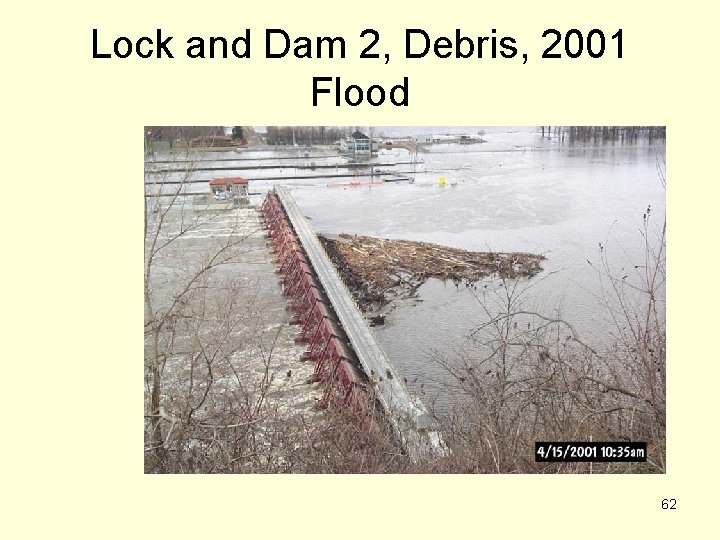
Lock and Dam 2, Debris, 2001 Flood 62
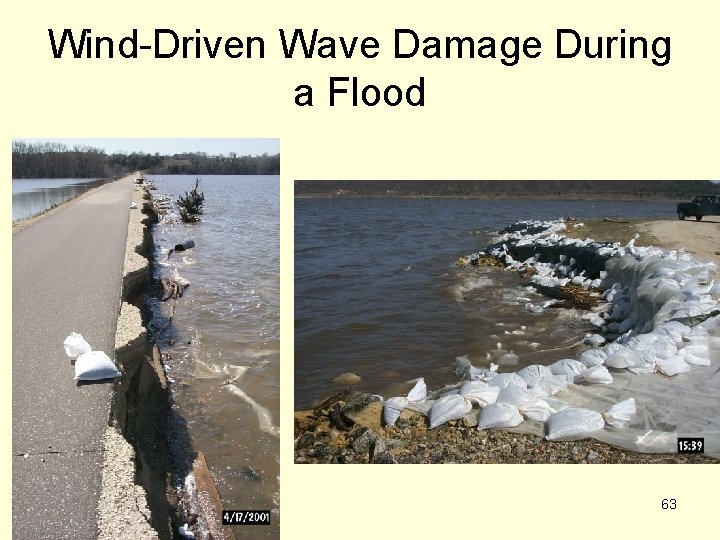
Wind-Driven Wave Damage During a Flood 63
Groundwater/Surface Water Interaction • Rivers re-charge groundwater table when river is high • Groundwater recharges rivers when river is low • Balance can be upset by dams, sediment deposition, groundwater pumping, … • At reach scale (ie. study area is a small reach of a much larger river or stream), groundwater’s contribution to open channel flow is ignored. • At a watershed scale, groundwater’s influence to open channel flow can be significant 64
Measuring Flow • • • Velocity – Price, ADCP Discharge Stage Wind – waves Flow characteristics through a structure 65
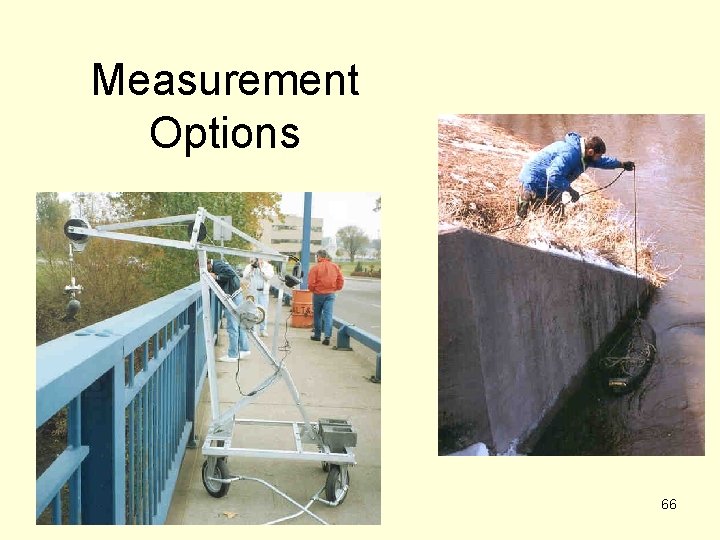
Measurement Options 66
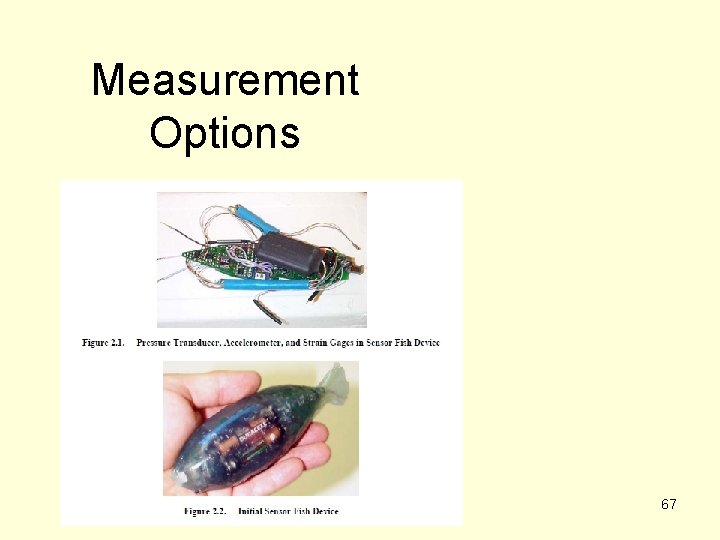
Measurement Options 67
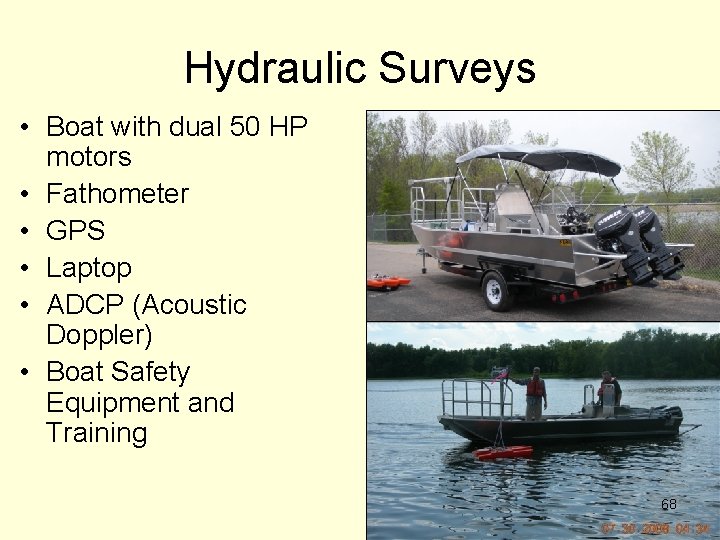
Hydraulic Surveys • Boat with dual 50 HP motors • Fathometer • GPS • Laptop • ADCP (Acoustic Doppler) • Boat Safety Equipment and Training 68

~ The End ~ 69
- Slides: 69