
Fluid Power Hydraulics Versus Pneumatics Exercise Answers By

Fluid Power Hydraulics Versus Pneumatics Exercise Answers By Clifford Mayhew
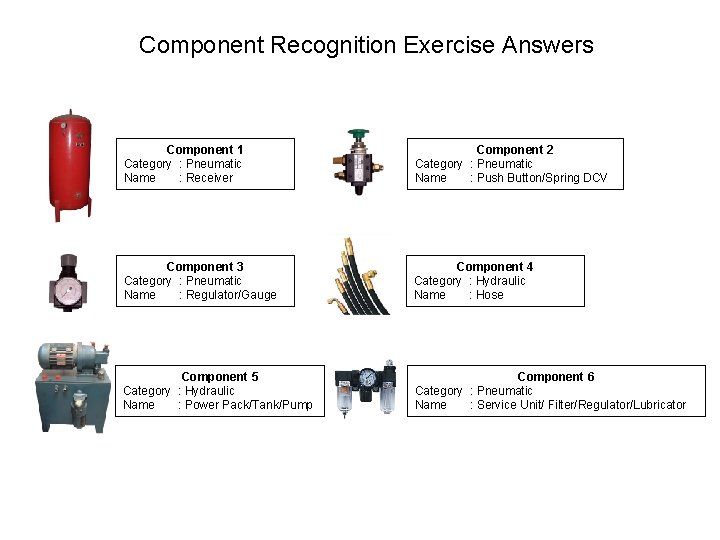
Component Recognition Exercise Answers Component 1 Category : Pneumatic Name : Receiver Component 2 Category : Pneumatic Name : Push Button/Spring DCV Component 3 Category : Pneumatic Name : Regulator/Gauge Component 4 Category : Hydraulic Name : Hose Component 5 Category : Hydraulic Name : Power Pack/Tank/Pump Component 6 Category : Pneumatic Name : Service Unit/ Filter/Regulator/Lubricator
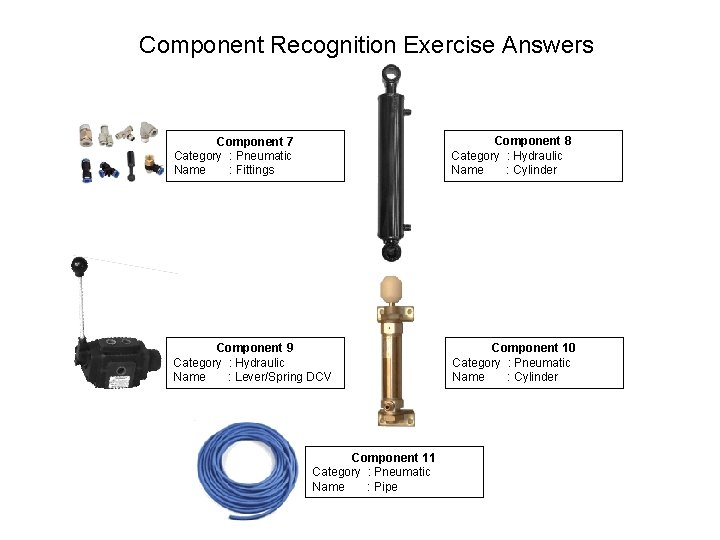
Component Recognition Exercise Answers Component 7 Category : Pneumatic Name : Fittings Component 8 Category : Hydraulic Name : Cylinder Component 9 Category : Hydraulic Name : Lever/Spring DCV Component 10 Category : Pneumatic Name : Cylinder Component 11 Category : Pneumatic Name : Pipe
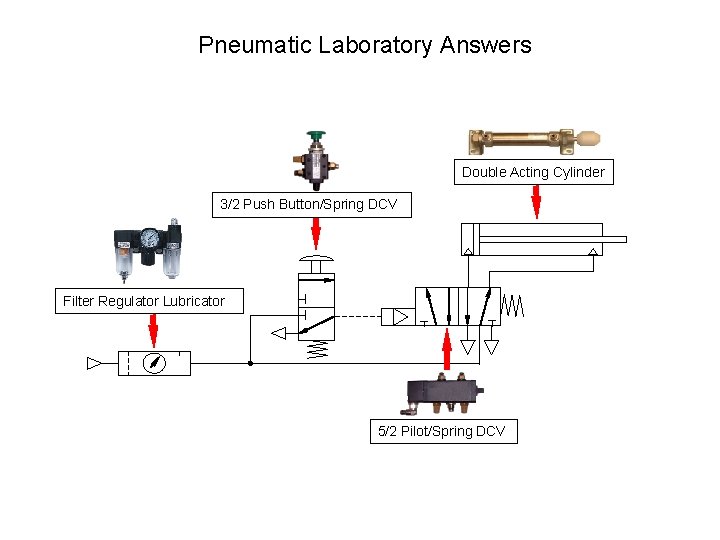
Pneumatic Laboratory Answers Double Acting Cylinder 3/2 Push Button/Spring DCV Filter Regulator Lubricator 5/2 Pilot/Spring DCV
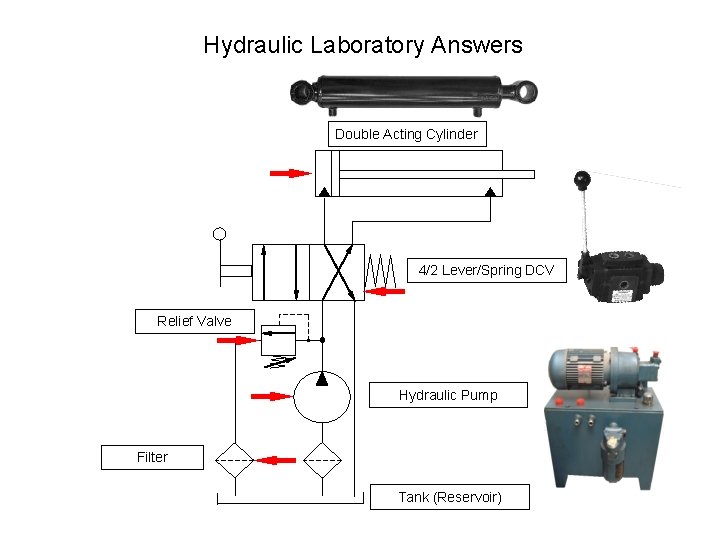
Hydraulic Laboratory Answers Double Acting Cylinder 4/2 Lever/Spring DCV Relief Valve Hydraulic Pump Filter Tank (Reservoir)
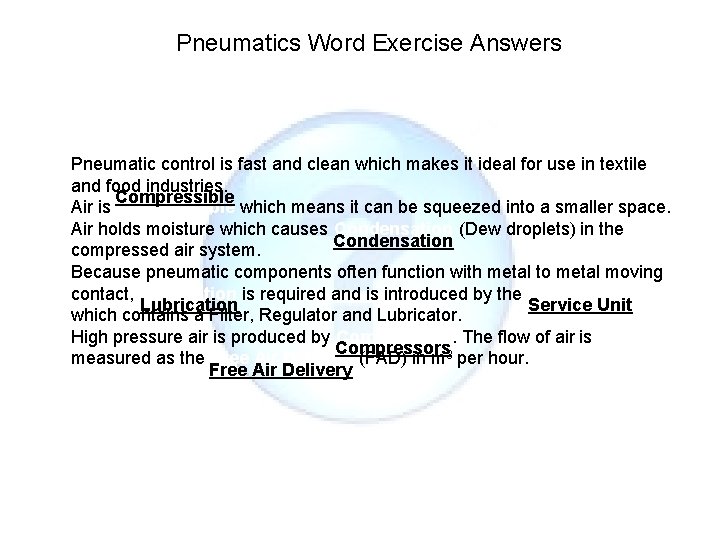
Pneumatics Word Exercise Answers Pneumatic control is fast and clean which makes it ideal for use in textile and food industries. Compressible Air is Compressible which means it can be squeezed into a smaller space. Air holds moisture which causes Condensation (Dew droplets) in the Condensation compressed air system. Because pneumatic components often function with metal to metal moving contact, Lubrication is required and is introduced by the Service Unit Lubrication Service Unit which contains a Filter, Regulator and Lubricator. High pressure air is produced by Compressors. The flow of air is Compressors measured as the Free Air Delivery (FAD) in m 3 per hour. Free Air Delivery
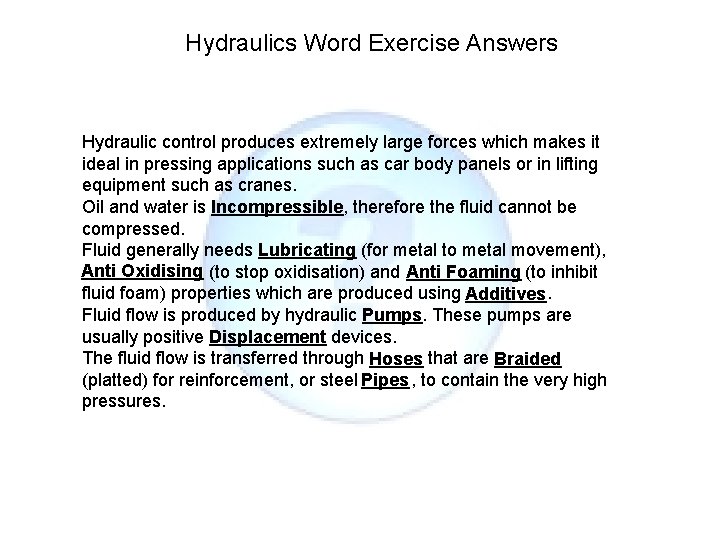
Hydraulics Word Exercise Answers Hydraulic control produces extremely large forces which makes it ideal in pressing applications such as car body panels or in lifting equipment such as cranes. Oil and water is Incompressible, therefore the fluid cannot be compressed. Fluid generally needs Lubricating (for metal to metal movement), Anti Oxidising (to stop oxidisation) and Anti Foaming (to inhibit fluid foam) properties which are produced using Additives. Fluid flow is produced by hydraulic Pumps. These pumps are usually positive Displacement devices. The fluid flow is transferred through Hoses that are Braided (platted) for reinforcement, or steel Pipes, to contain the very high pressures.

Crossword Answers
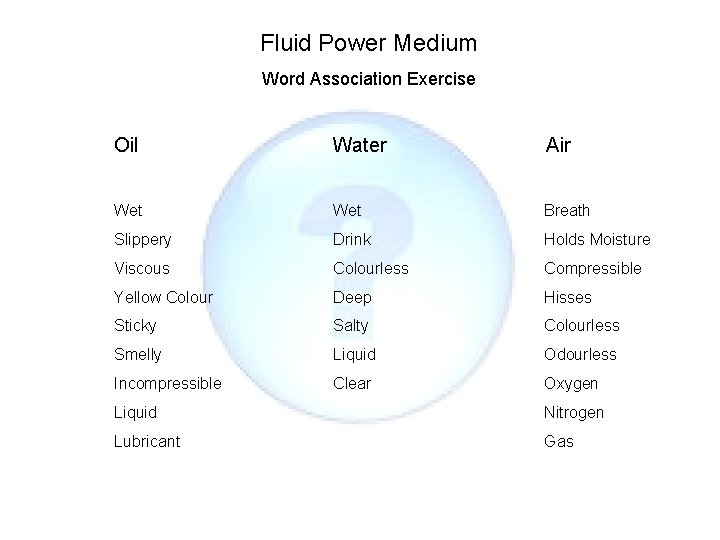
Fluid Power Medium Word Association Exercise Oil Water Air Wet Breath Slippery Drink Holds Moisture Viscous Colourless Compressible Yellow Colour Deep Hisses Sticky Salty Colourless Smelly Liquid Odourless Incompressible Clear Oxygen Liquid Nitrogen Lubricant Gas
- Slides: 9