Human Rights in Practice Sharon Soper and Tish
- Slides: 39
Human Rights in Practice Sharon Soper and Tish Elliott 25 th April 2017 SCW 452
“To deny people their human rights is to challenge their very humanity” Nelson Mandela https: //youtu. be/F 69 PBQ 4 Zy. Nw
Political context • The government has confirmed that reform of the Human Rights Act will not be attempted during the period of exiting from the EU. • Leaving the EU in 2019 does not automatically mean the UK will withdraw from the European Convention on Human Rights. • Discussions regarding a ‘British Bill of Human Rights’ to date have featured many of the rights enshrined in the HRA, and any future reform is likely to face substantial opposition.
Learning outcomes You will be able to: • Consider human rights practice in relation to the FREDA Standards • Explain the development of human rights principles historically • Evidence how human rights relate to yourself and the people you work with • Identify strategies for the promotion of people’s human rights
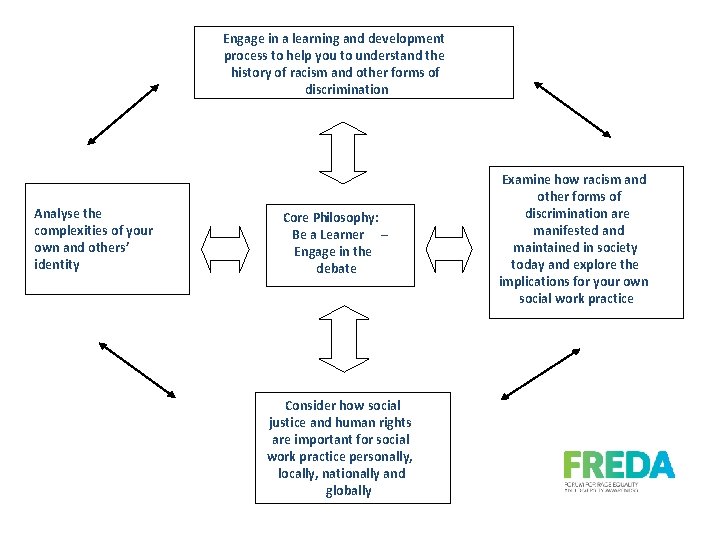
Engage in a learning and development process to help you to understand the history of racism and other forms of discrimination Analyse the complexities of your own and others’ identity Core Philosophy: Be a Learner – Engage in the debate Consider how social justice and human rights are important for social work practice personally, locally, nationally and globally Examine how racism and other forms of discrimination are manifested and maintained in society today and explore the implications for your own social work practice
What are our human rights under the HRA? Re-cap the main rights in Articles and Protocols
British Institute for Human Rights A short film about rights for the public • https: //www. bihr. org. uk/my-human-rights Human rights are a common parlance which practitioners can use in everyday conversations and negotiations with service users, their families and advocates.
Understand the development of human rights principles historically Exercise in small groups - research the history of human rights • Group 1 Global perspective - United Nations • Group 2 European perspective - European Court • Group 2 National perspective - UK pre & post ‘ 98 • Group 3 Local perspective - Devon & Cornwall - Plymouth as an entry point for slave trade and people being trafficked Feedback one thing you found
A human rights approach to practice … works with the entitlements we all have and that we share as members of society, ensuring these are protected for all. In this way it avoids ‘othering’. The HRA sits alongside other core legislation yet it is unique in that it focuses on humanity, the basic freedoms and protections that every person has simply because they are human, as opposed to focussing on behaviour, needs or identity. Human rights are described as ‘universal, inherent and inalienable (cannot be forfeited)’.
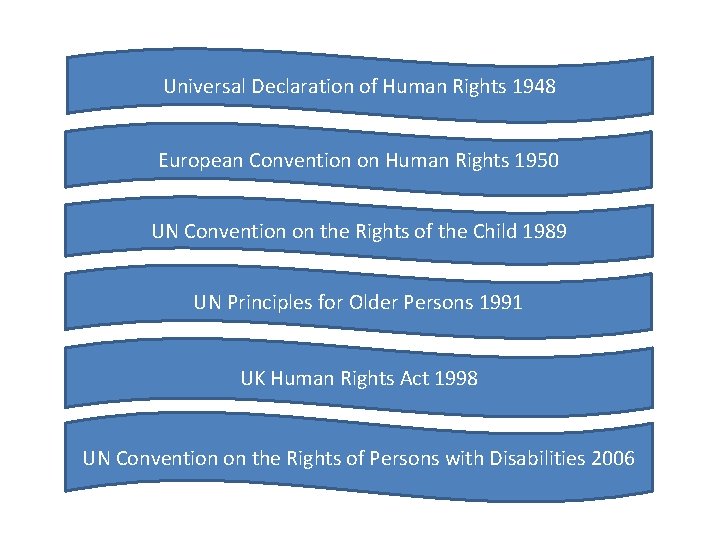
Universal Declaration of Human Rights 1948 European Convention on Human Rights 1950 UN Convention on the Rights of the Child 1989 UN Principles for Older Persons 1991 UK Human Rights Act 1998 UN Convention on the Rights of Persons with Disabilities 2006
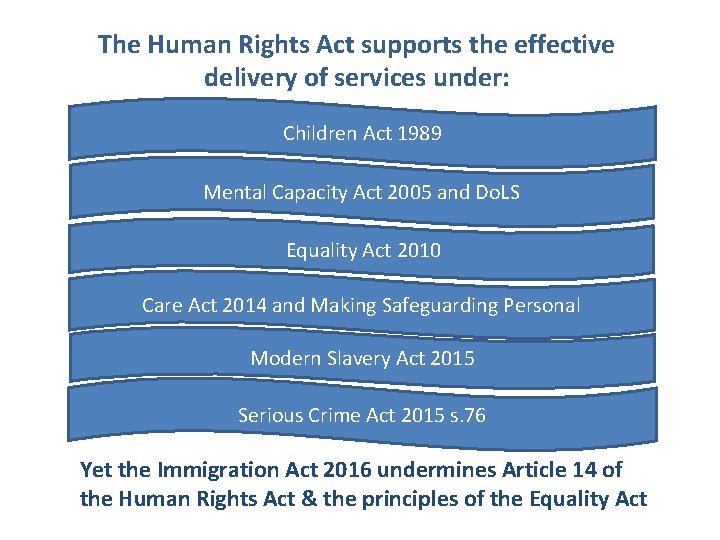
The Human Rights Act supports the effective delivery of services under: Children Act 1989 Mental Capacity Act 2005 and Do. LS Equality Act 2010 Care Act 2014 and Making Safeguarding Personal Modern Slavery Act 2015 Serious Crime Act 2015 s. 76 Yet the Immigration Act 2016 undermines Article 14 of the Human Rights Act & the principles of the Equality Act
The benefits of a human rights approach A human rights approach counters any national or global tendency towards the creation of a ‘hierarchy of humanity’ which treats some as less than human. James O’Brien cautions against this as echoing the creation of an Untermenschen - those persecuted as racially or socially inferior people not deserving of the same rights under law nor the same protections according to the fundamental principles of universal human rights. (Elliott, 2017)
Protected characteristics and diversity • People with a ‘protected characteristic’ may be described as belonging to a particular ‘equality group’, however it is important not to assume that all members of an equality group have the same needs (brap, 2010). • For people with care and support needs there is often an intersection of several factors, and the experience of multiple oppression (Crenshaw, 2012) - for example Older LGBT people with dementia (National Care Forum, 2016). *brap is a partnership that promotes evidence-based thinking on equalities issues http: //www. brap. org. uk
Embedding human rights in practice • In tackling such complexities ‘brap’ describe the benefits of an approach to equality that draws on human rights and the basic entitlements we all have, that we share as members of society. • Human rights provide the benchmark or minimum standard against which provision of services to a range of people can be judged. • In this way the focus moves from “a plethora of different approaches” to enabling all to have equal benefit by creating benchmarks of quality (brap 2010: 12) with measurable outcomes in terms of human rights.
Rogers story ` http: //www. scie. org. uk/socialcaretv/videoplayer. asp? guid=cacaae 12 -7375 -429 a-9 d 9 a 1 d 28 e 29 e 65 bd Listen for any specific rights that are potentially being breached or protected in Roger’s story
Be aware of how human rights relate to yourself and the people you work with Take a few minutes reflection time individually: • Choose a right that speaks to you personally • Do you see any personal connection to this right as being an enabler to your practice, or a barrier? • Are there any ways that the enabler may also be a barrier (or vice versa)? • Are there any specific actions you might take as a result of this reflection?
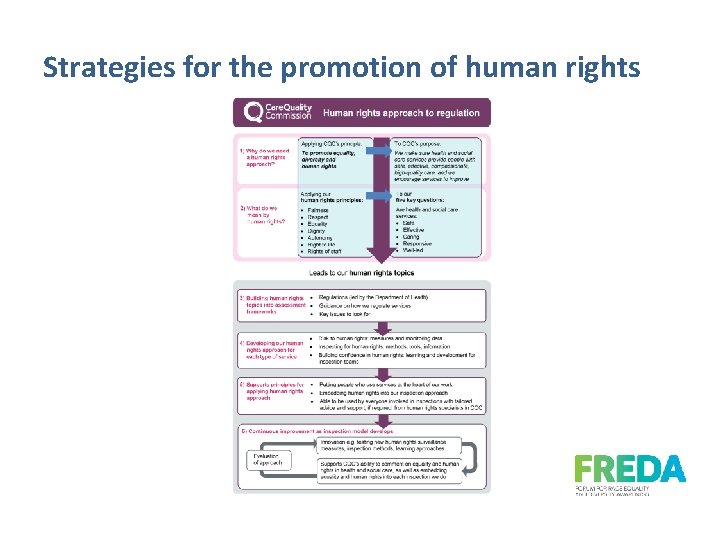
Strategies for the promotion of human rights
Mersey Care ‘Keeping Me Safe and Well’ Manual • Co-produced with, and for, people with learning disability. • They use a human rights approach to risk assessment focussed on rights maximisation, in a user-friendly and accessible way. • The tool uses stories and pictures to identify risks and any restrictions on a person’s rights as a result of these risks. • A simple traffic light system is used to ensure that any risks are discussed with service users along with any restrictions on their rights, ensuring any such restrictions are lawful, legitimate and proportional. http: //www. humanrightsinhealthcare. nhs. uk/Library/a-z/learning_disability_keeping_me_safe_and_well. pdf
Calderdale Council As part of a Named Social Worker pilot project (SCIE, 2017) the local authority are working alongside young people with learning disabilities to develop a named social worker-client relationship in which power and control meaningfully shift to the young person, and which is based on full respect for individuals’ human rights. [Source: SCIE & Innovation Unit http: //www. scie. org. uk/files/social-work/namedsocial-worker/nsw-learning-report. pdf]
Five practical benefits from adopting a human rights approach • More person-centred • Reduced risk of complaints and litigation in the longer term • Improved decision making • More meaningful engagement • Broader range of marginalised groups involved and considered (BIHR 2013: 8)
Using the PANEL principles to embed a human rights approach to practice in organisations • P - enabling meaningful participation of all key people and stakeholders • A - ensuring clear accountability, identifying who has legal duties and practical responsibility for a human rights approach • N – promoting non-discrimination, where discrimination is avoided & attention is paid to groups made vulnerable • E - empowerment of staff and service users with knowledge, skills and commitment to realising human rights • L - expressly applied human rights laws, particularly the HRA [Source: BIHR, 2013]
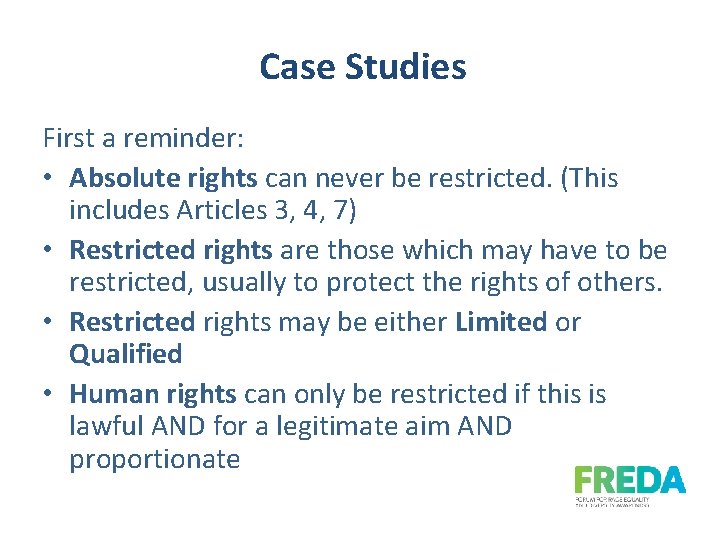
Case Studies First a reminder: • Absolute rights can never be restricted. (This includes Articles 3, 4, 7) • Restricted rights are those which may have to be restricted, usually to protect the rights of others. • Restricted rights may be either Limited or Qualified • Human rights can only be restricted if this is lawful AND for a legitimate aim AND proportionate
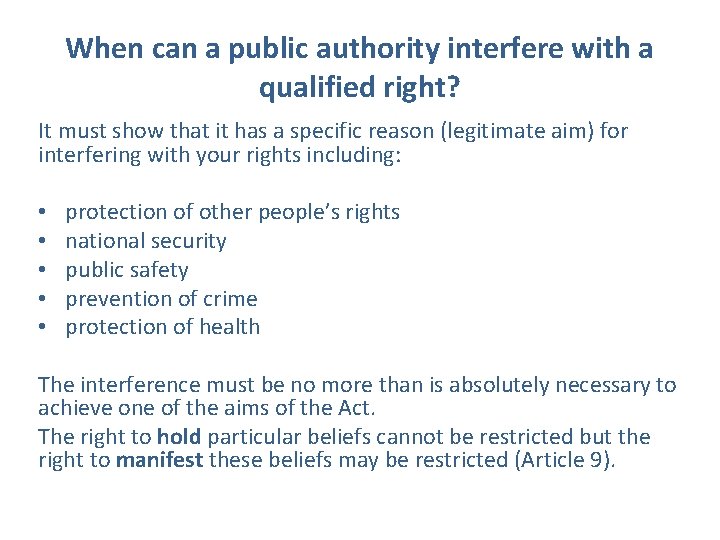
When can a public authority interfere with a qualified right? It must show that it has a specific reason (legitimate aim) for interfering with your rights including: • • • protection of other people’s rights national security public safety prevention of crime protection of health The interference must be no more than is absolutely necessary to achieve one of the aims of the Act. The right to hold particular beliefs cannot be restricted but the right to manifest these beliefs may be restricted (Article 9).
Case study exercise Which human rights do you think are involved and whose? What might you do as a social work student in this situation?
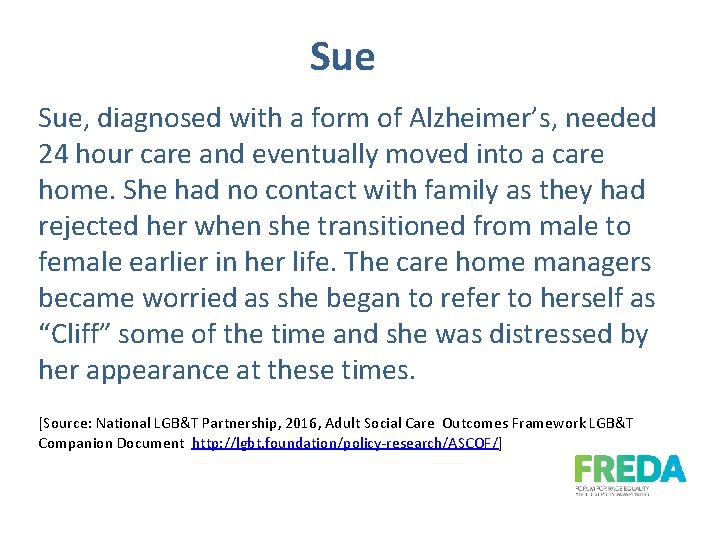
Sue Sue, diagnosed with a form of Alzheimer’s, needed 24 hour care and eventually moved into a care home. She had no contact with family as they had rejected her when she transitioned from male to female earlier in her life. The care home managers became worried as she began to refer to herself as “Cliff” some of the time and she was distressed by her appearance at these times. [Source: National LGB&T Partnership, 2016, Adult Social Care Outcomes Framework LGB&T Companion Document http: //lgbt. foundation/policy-research/ASCOF/]
Outcomes for Sue The social worker contacted Gay Advice Darlington/Durham who formed a partnership with Sue, Sue’s GP, social services and the care home. Care home staff also received training on trans identities which included the impact of stigma and misgendering, especially during periods of regression. This enabled more appropriate, empathic care and a significant improvement in Sue’s wellbeing and quality of life.
Steven is a young man with autism and severe learning disability. He went into a respite unit for a few weeks whilst his father was unwell. This has now extended from weeks into months, though Steven consistently asks to go home and his father has said he wishes for this to happen as he feels well now. The local authority however have not discharged Steven as they wish to undertake a full assessment of any risk prior to any return home. Source: Essex Chambers, Hillingdon v Neary 2011 http: //www. 39 essex. com/cop_ cases/london-borough-of-hillingdon-v-neary-2/
Outcomes for Steven Case precedent. It took over a year for Steven to be returned home, finally, after a court ruling that the LA was contravening his right to liberty and to family life (Article 5 and 8, ECHR). The evidence before the court was that the local authority did not sufficiently discuss its concerns nor plans with Steven himself, who had consistently expressed a desire to go home, nor with his father. The judge’s ruling states “Nowhere in their very full records of Steven’s year in care is there any mention of the supposition that he should be at home, other things being equal, or the disadvantages to him of living away from his family, still less an attempt to weigh those disadvantages against the supposed advantages of care elsewhere. No acknowledgement ever appears of the unique bond between Steven and his father, or of the priceless importance to a dependent person of the personal element in care by a parent rather than a stranger, however committed. No attempt was made at the outset to carry out a genuinely balanced best interests assessment, nor was one attempted subsequently. ”
Balbir suffered a major stroke which left her with severe physical disabilities, so she has had to place her bed and commode in the downstairs living room. The local authority have refused to build her a downstairs bathroom and toilet. Balbir has IBS and has to wait for her carers to come to empty the commode. As a Muslim she prays five times a day and has to rely on her carers to bring her a bowl of water to perform ablution. She has been living like this for a year. [Source BIHR, 2013]
Outcomes for Balbir’s advocate wrote a letter to the local authority explaining that this was humiliating and degrading to Balbir, referring to her right to be free from inhuman and degrading treatment (Article 3 HRA). As a result the local authority carried out an assessment and adaptations were made to her home, including an accessible downstairs bathroom with walk-in shower.
Child G ‘G’ is a child with severe physical and mental disability. He was admitted to hospital where doctors have given him a course of medical treatment (morphine) which his mother objected to. A Do Not Resuscitate order has now been placed on his notes, without consulting the family. [Glass v UK, 2004]
Outcomes for Child ‘G’ Case precedent. The court ruled that this was a breach of the right to respect for private and family life; the hospital should have asked a court to authorise the treatment, and its failure to do so was a breach of the child’s right to physical integrity under Article 8. [Glass v UK, 2004]
Joshua, 7 years old, has recently started bedwetting. He eventually told his parents Femi and Ahmet, that other children in the playground have been teasing him ‘for having two dads’. They phoned Joshua’s teacher and have also met with the head of pastoral care, but have been told Joshua will have to take this kind of thing in his stride, it’s just “kids being kids”. Joshua now says a boy has been challenging him to a fight so he can prove he “isn’t weird like his parents”. [Source: BIHR Human Rights Tour 2015]
Outcomes for Joshua This is a training example from the British Institute of Human Rights Tour celebrating fifteen years of the Human Rights Act. What human rights if any are being breached and what would you do? BIHR provide a wealth of case examples in their resources which you can access via their website.
“A human rights approach means putting the human being and their legally protected rights at the centre of policymaking and day-to-day practice. ” (BIHR, 2013: 4)
International Federation of Social Work The President of the International Federation of Social Workers emphasises that, as a global profession, ‘social work is a human rights discipline… It’s not just an element of it - it is the core principle. ’ (Ruth Stark, 2014). https: //www. liberty-humanrights. org. uk/human-rights/what-are-humanrights/history-human-rights
And Still I Rise https: //www. youtube. com/watch? v=E 3 jul. Kfe 1 cc Age UK Older People’s Human Rights https: //m. youtube. com/watch? v=Jq. Oqo 50 LSZ 0
References and further reading brap (2010) Why bother with human rights? Birmingham: brap. http: //www. brap. org. uk/resources-publications-342/human-rights-publications-565 British Institute of Human Rights (2013) The Difference It Makes: Putting Human Rights at the Heart of Health and Social Care. London: BIHR. British Institute of Human Rights (2016) Mental Health, Mental Capacity and Human Rights: A practitioner’s guide. London: BIHR. Care Quality Commission (2014) Human rights approach for our regulation of health and social care services Newcastle upon Tyne: CQC https: //www. cqc. org. uk/sites/default/files/20150416_our_human_rights_approach. pdf Carr, H. and Goosey, D. (2017) ‘Human rights law’, Chapter 3 in Law for Social Workers, (14 th Edition) Oxford: Oxford University Press. Crenshaw, K. (2012) On Intersectionality: The Essential Writings of Kimberlé Crenshaw. Perseus. Elliott, T. (forthcoming May/June, 2017) Leader’s Briefing: Human Rights in Adult Social Care. Dartington. Research in Practice for Adults. Equality and Human Rights Commission (2014) Human Rights: Human Lives. A Guide to the Human Rights Act for Public Authorities London: EHRC. Fifty Human Rights cases https: //rightsinfo. org/infographics/fifty-human-rights-cases/
Ife, J. (2012) Human rights and social work: Towards rights-based practice (3 rd Edition) Cambridge: Cambridge University Press Liberty website – History of human rights https: //www. liberty-human- rights. org. uk/human-rights/what-are-human-rights/history-human-rights National Care Forum (2016) Dementia care and LGBT communities: A good practice paper April 2016. Coventry. NCF & Voluntary Organisations Disability Group. O’Brien J. (2017) LBC 30 th January 2017 10: 49 http: //www. lbc. co. uk/radio/presenters/james-obrien-rubbishes-reasons -trumps-travel-ban/ Stark, R. (2014) ‘Social work is a human rights discipline’ President of International Federation of Social Workers and former head of the Scottish Association of Social Workers, Community Care 23 July 2014. United Nations (1948) Universal Declaration of Human Rights http: //www. un. org/en/universal-declaration-hu man-rights/. United Nations Convention on the Rights of Disabled Persons https: //www. equalityhumanrights. com/en/our-human-rights-work/monitoring-andpromoting-un-treaties/un-convention-rights-persons-disabilities United Nations Principles for Older Persons http: //www. ohchr. org/EN/Professional. Interest/Pages/Older. Persons. aspx United Nations Refugee Agency http: //www. unhcr. org/uk/