Human Motivation Chapter 14 MANAGEMENT Meeting and Exceeding
- Slides: 52
Human Motivation Chapter 14 MANAGEMENT Meeting and Exceeding Customer Expectations EIGHTH EDITION Prepared by Deborah Baker Texas Christian University Copyright © 2005 by South-Western, a division of Thomson Learning. All rights reserved 1
learning objectives 1. Discuss the factors that stimulate and influence motivation 2. Differentiate between content and process theories of motivation 3. List the five levels of needs according to Maslow and give an example of each 4. Discuss the impact of hygiene and motivation factors in the work environment 5. Explain the characteristics of a person with high-achievement needs Chapter 14 6. Identify the needs associated with ERG theory Copyright © 2005 by South-Western, a division of Thomson Learning. All rights reserved 2
learning objectives (continued) 7. Discuss the relationship between expectations and motivation 8. Explain the relationship between reinforcement and motivation 9. Explain how equity influences motivation 10. Explain how goals influence motivation 11. Discuss the importance of a manager’s philosophy of management in creating a positive work environment 12. Describe how managers can structure the Chapter 14 environment to provide motivation Copyright © 2005 by South-Western, a division of Thomson Learning. All rights reserved 3
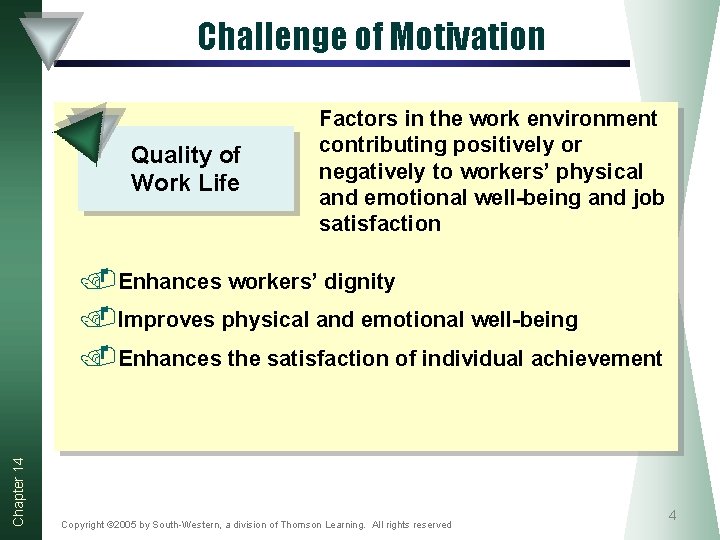
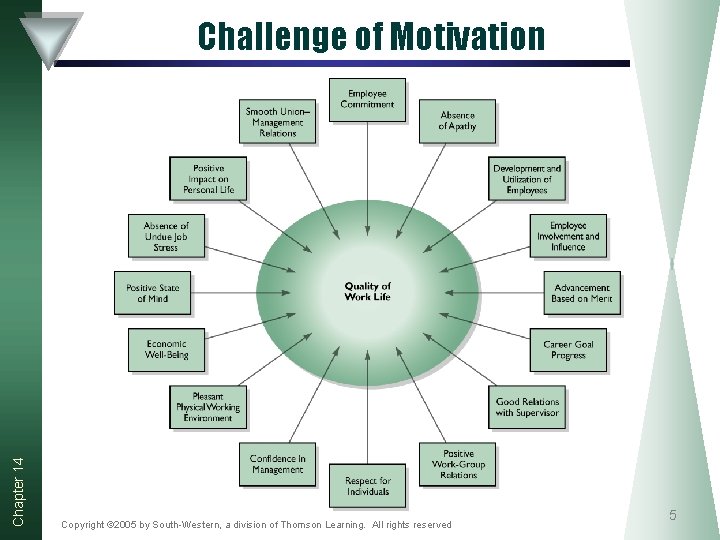
Challenge of Motivation Quality of Work Life Factors in the work environment contributing positively or negatively to workers’ physical and emotional well-being and job satisfaction Chapter 14 . Enhances workers’ dignity. Improves physical and emotional well-being. Enhances the satisfaction of individual achievement Copyright © 2005 by South-Western, a division of Thomson Learning. All rights reserved 4
Chapter 14 Challenge of Motivation Copyright © 2005 by South-Western, a division of Thomson Learning. All rights reserved 5
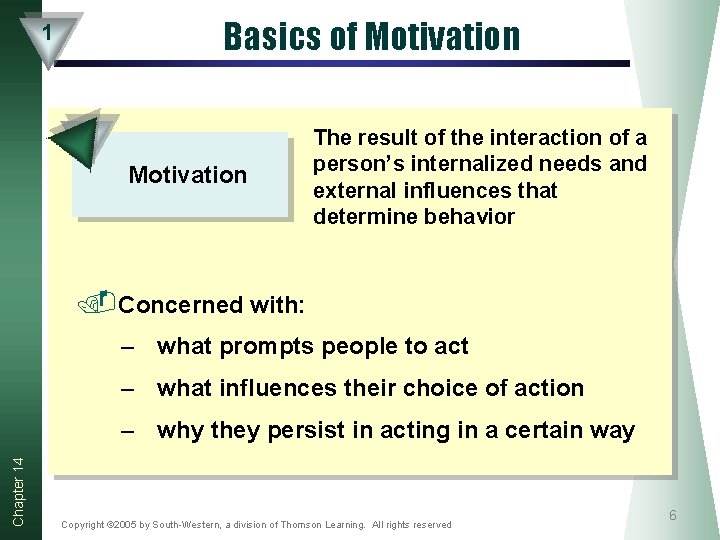
1 Basics of Motivation The result of the interaction of a person’s internalized needs and external influences that determine behavior . Concerned with: – what prompts people to act – what influences their choice of action Chapter 14 – why they persist in acting in a certain way Copyright © 2005 by South-Western, a division of Thomson Learning. All rights reserved 6
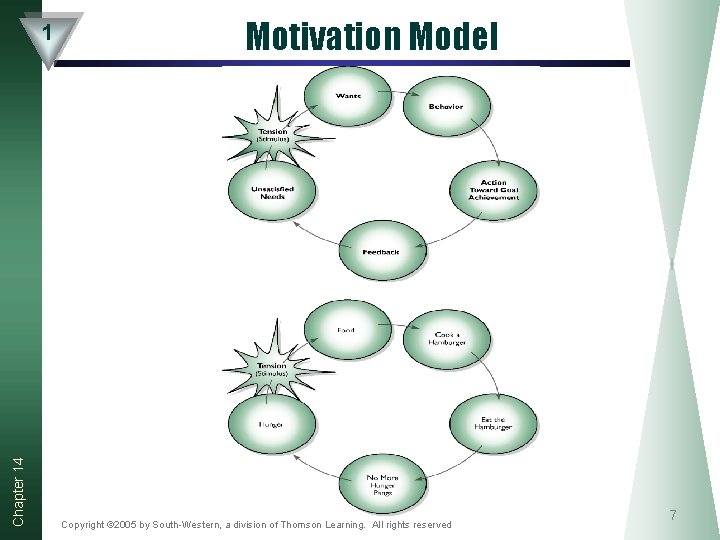
Chapter 14 1 Motivation Model Copyright © 2005 by South-Western, a division of Thomson Learning. All rights reserved 7
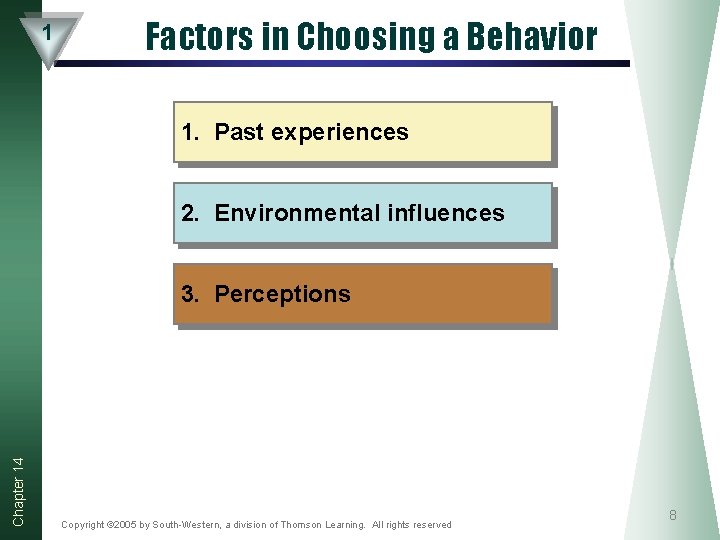
1 Factors in Choosing a Behavior 1. Past experiences 2. Environmental influences Chapter 14 3. Perceptions Copyright © 2005 by South-Western, a division of Thomson Learning. All rights reserved 8
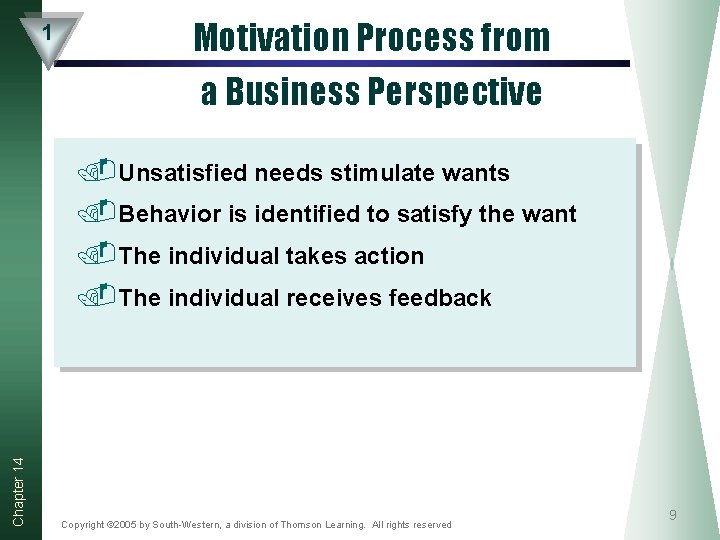
1 Motivation Process from a Business Perspective Chapter 14 . Unsatisfied needs stimulate wants. Behavior is identified to satisfy the want. The individual takes action. The individual receives feedback Copyright © 2005 by South-Western, a division of Thomson Learning. All rights reserved 9
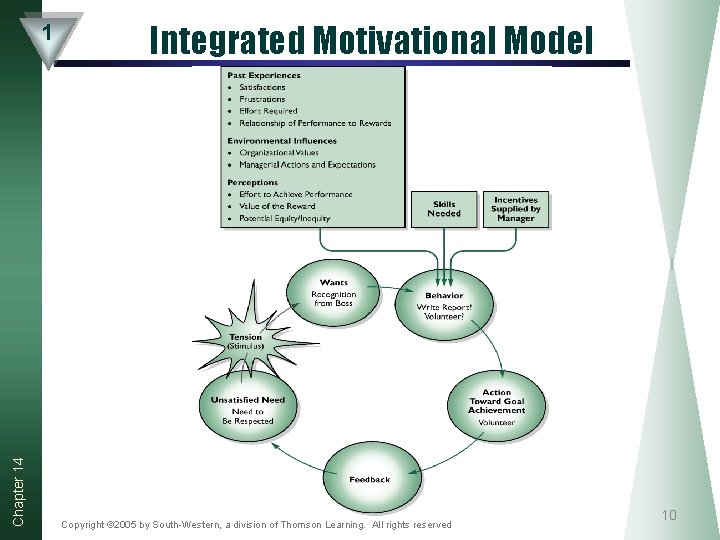
Chapter 14 1 Integrated Motivational Model Copyright © 2005 by South-Western, a division of Thomson Learning. All rights reserved 10
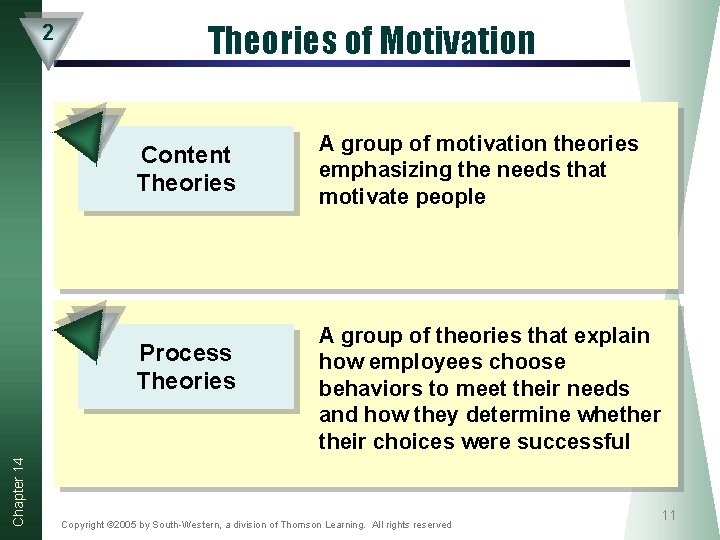
2 Theories of Motivation Content Theories Chapter 14 Process Theories A group of motivation theories emphasizing the needs that motivate people A group of theories that explain how employees choose behaviors to meet their needs and how they determine whether their choices were successful Copyright © 2005 by South-Western, a division of Thomson Learning. All rights reserved 11
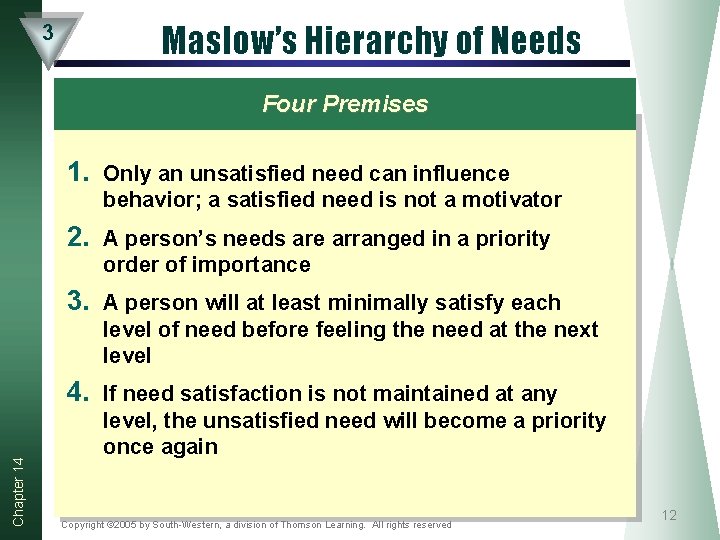
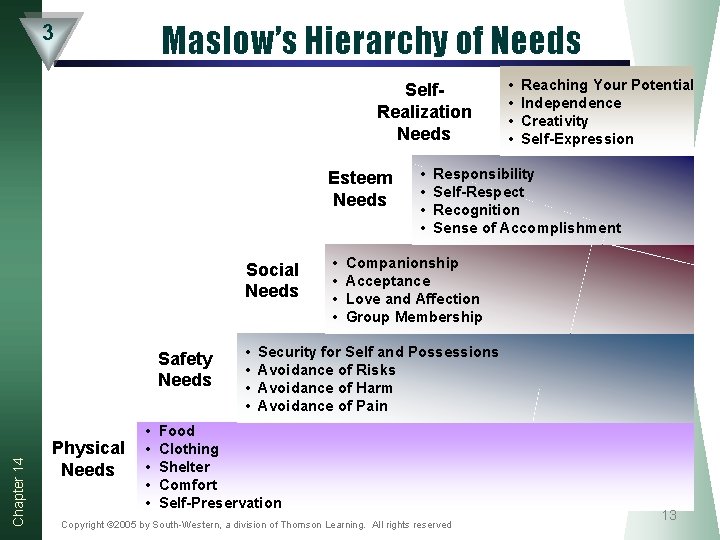
3 Maslow’s Hierarchy of Needs Four Premises 1. Only an unsatisfied need can influence behavior; a satisfied need is not a motivator 2. A person’s needs are arranged in a priority order of importance 3. A person will at least minimally satisfy each level of need before feeling the need at the next level Chapter 14 4. If need satisfaction is not maintained at any level, the unsatisfied need will become a priority once again Copyright © 2005 by South-Western, a division of Thomson Learning. All rights reserved 12
Maslow’s Hierarchy of Needs 3 Self. Realization Needs Esteem Needs Social Needs Chapter 14 Safety Needs Physical Needs • • • • • • Reaching Your Potential Independence Creativity Self-Expression Responsibility Self-Respect Recognition Sense of Accomplishment Companionship Acceptance Love and Affection Group Membership Security for Self and Possessions Avoidance of Risks Avoidance of Harm Avoidance of Pain Food Clothing Shelter Comfort Self-Preservation Copyright © 2005 by South-Western, a division of Thomson Learning. All rights reserved 13
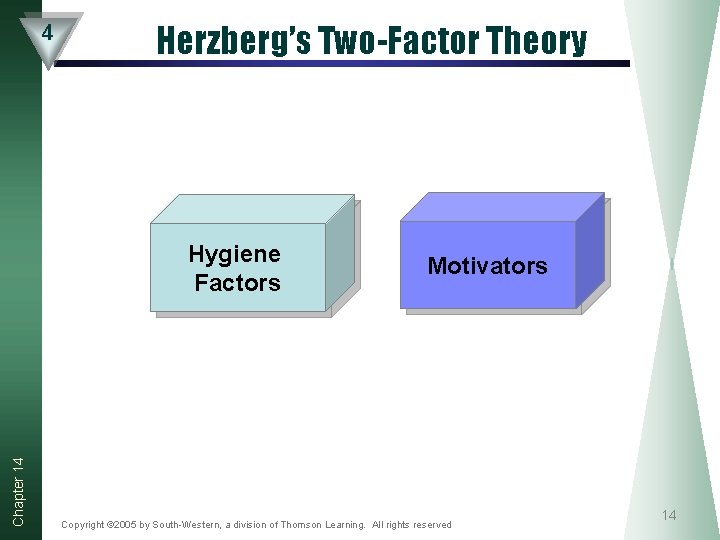
4 Herzberg’s Two-Factor Theory Chapter 14 Hygiene Factors Motivators Copyright © 2005 by South-Western, a division of Thomson Learning. All rights reserved 14
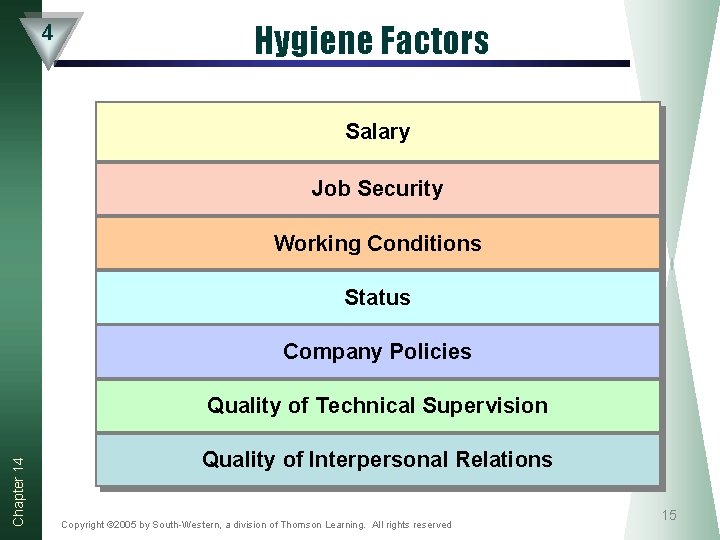
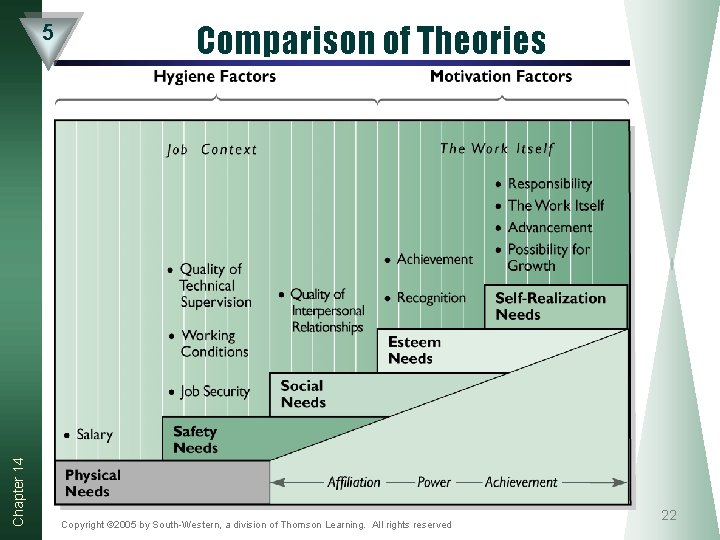
4 Hygiene Factors Salary Job Security Working Conditions Status Company Policies Chapter 14 Quality of Technical Supervision Quality of Interpersonal Relations Copyright © 2005 by South-Western, a division of Thomson Learning. All rights reserved 15
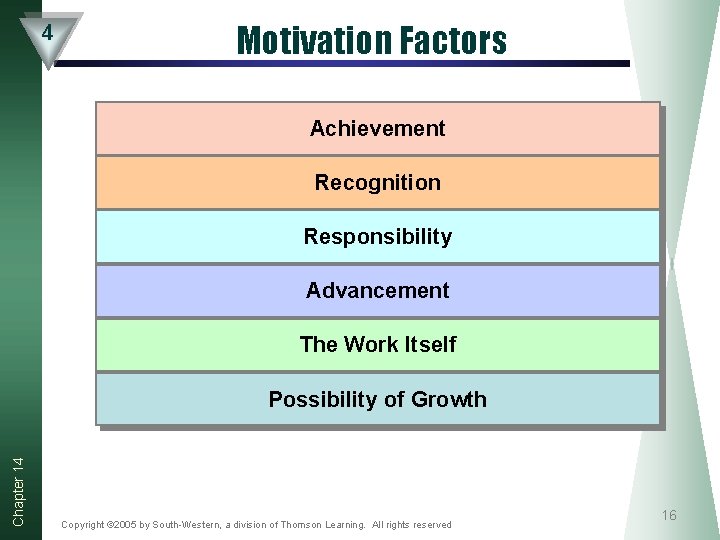
4 Motivation Factors Achievement Recognition Responsibility Advancement The Work Itself Chapter 14 Possibility of Growth Copyright © 2005 by South-Western, a division of Thomson Learning. All rights reserved 16
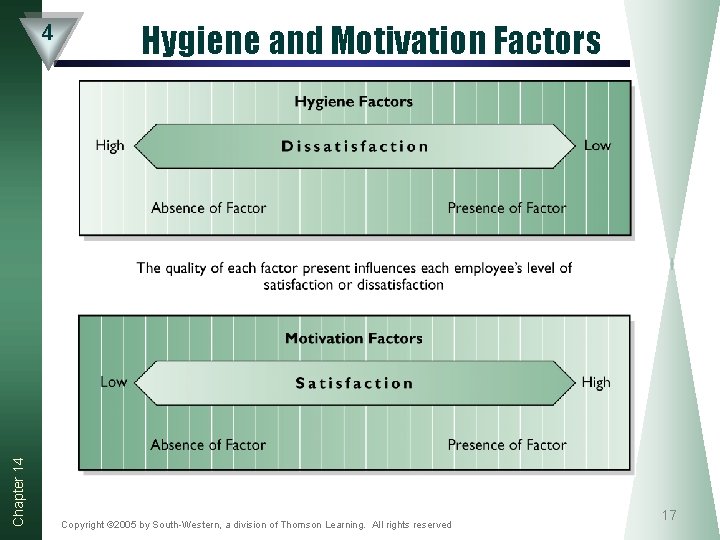
Chapter 14 4 Hygiene and Motivation Factors Copyright © 2005 by South-Western, a division of Thomson Learning. All rights reserved 17
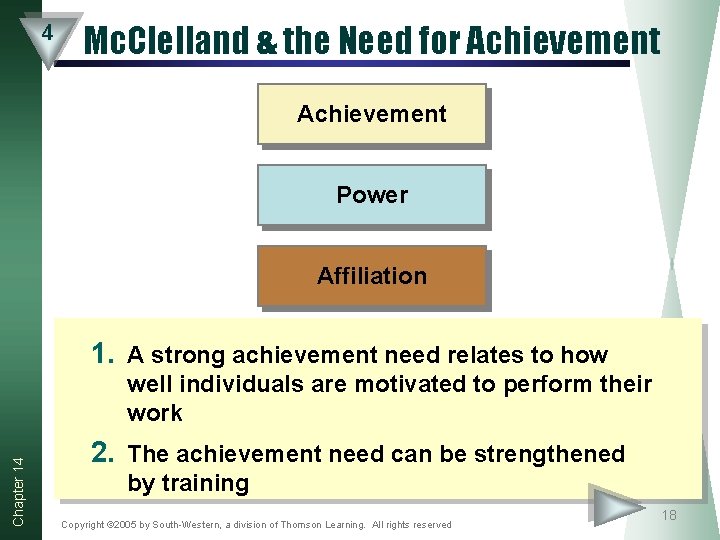
4 Mc. Clelland & the Need for Achievement Power Affiliation 1. A strong achievement need relates to how Chapter 14 well individuals are motivated to perform their work 2. The achievement need can be strengthened by training Copyright © 2005 by South-Western, a division of Thomson Learning. All rights reserved 18
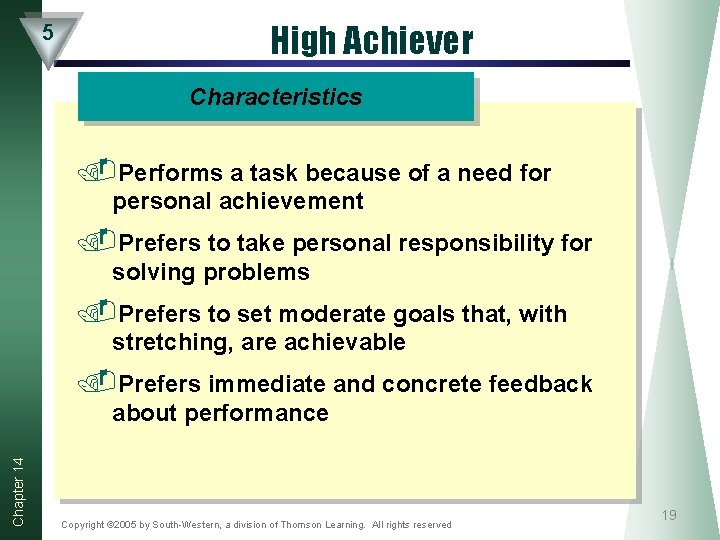
5 High Achiever Characteristics . Performs a task because of a need for personal achievement . Prefers to take personal responsibility for solving problems . Prefers to set moderate goals that, with stretching, are achievable . Prefers immediate and concrete feedback Chapter 14 about performance Copyright © 2005 by South-Western, a division of Thomson Learning. All rights reserved 19
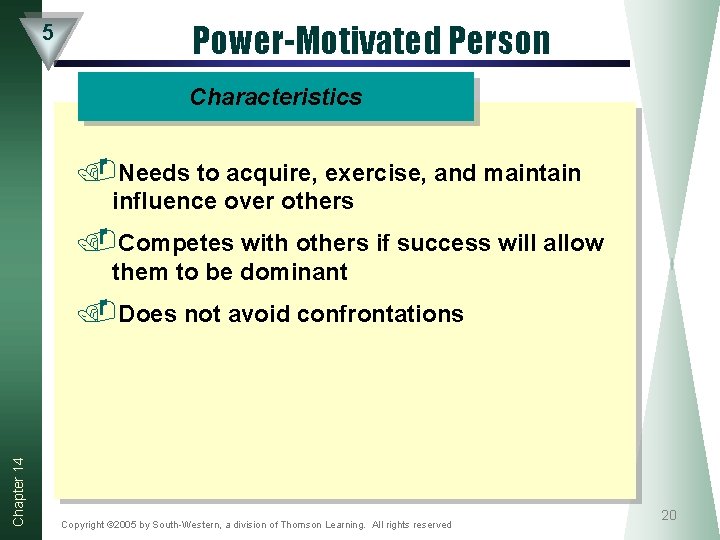
5 Power-Motivated Person Characteristics . Needs to acquire, exercise, and maintain influence over others . Competes with others if success will allow them to be dominant Chapter 14 . Does not avoid confrontations Copyright © 2005 by South-Western, a division of Thomson Learning. All rights reserved 20
5 Affiliator Characteristics Chapter 14 . Wants to be liked by other people. Attempts to establish friendships. Seeks to avoid conflict. Prefers conciliation Copyright © 2005 by South-Western, a division of Thomson Learning. All rights reserved 21
Chapter 14 5 Comparison of Theories Copyright © 2005 by South-Western, a division of Thomson Learning. All rights reserved 22
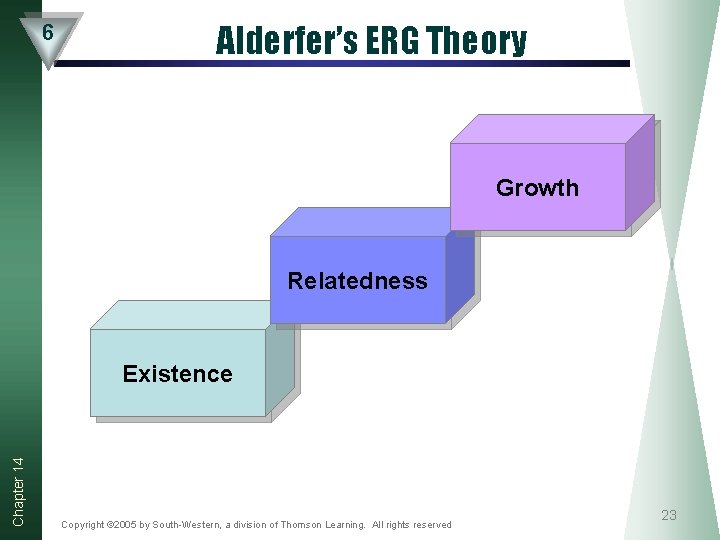
6 Alderfer’s ERG Theory Growth Relatedness Chapter 14 Existence Copyright © 2005 by South-Western, a division of Thomson Learning. All rights reserved 23
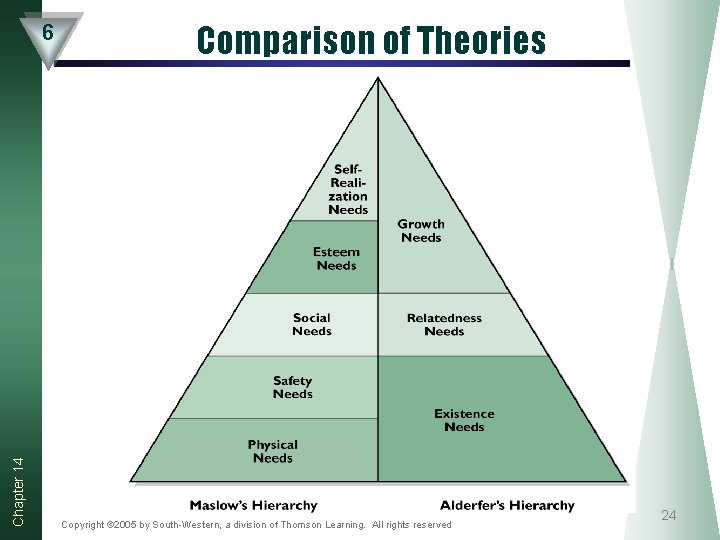
Chapter 14 6 Comparison of Theories Copyright © 2005 by South-Western, a division of Thomson Learning. All rights reserved 24
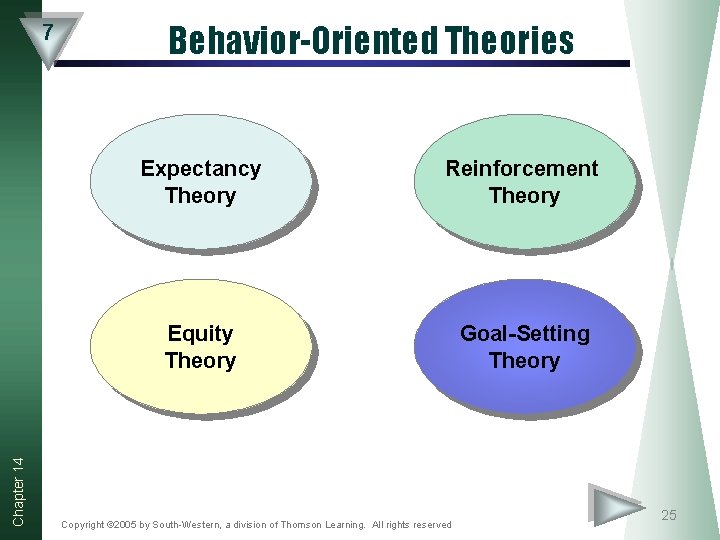
Chapter 14 7 Behavior-Oriented Theories Expectancy Theory Reinforcement Theory Equity Theory Goal-Setting Theory Copyright © 2005 by South-Western, a division of Thomson Learning. All rights reserved 25
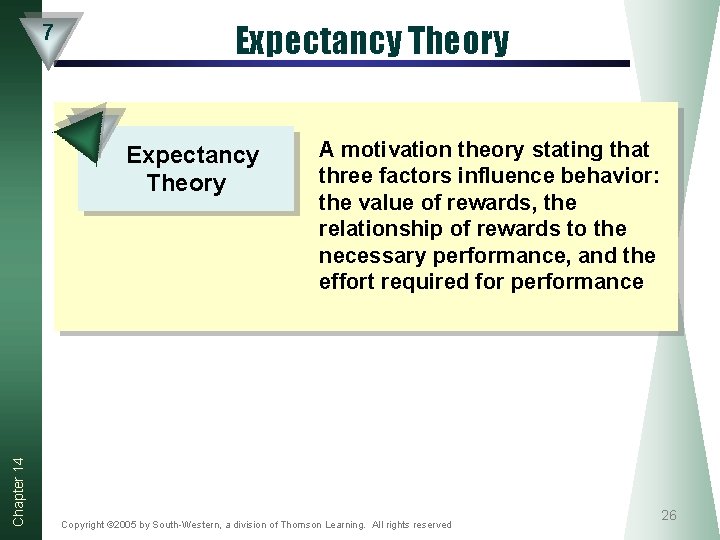
7 Expectancy Theory Chapter 14 Expectancy Theory A motivation theory stating that three factors influence behavior: the value of rewards, the relationship of rewards to the necessary performance, and the effort required for performance Copyright © 2005 by South-Western, a division of Thomson Learning. All rights reserved 26
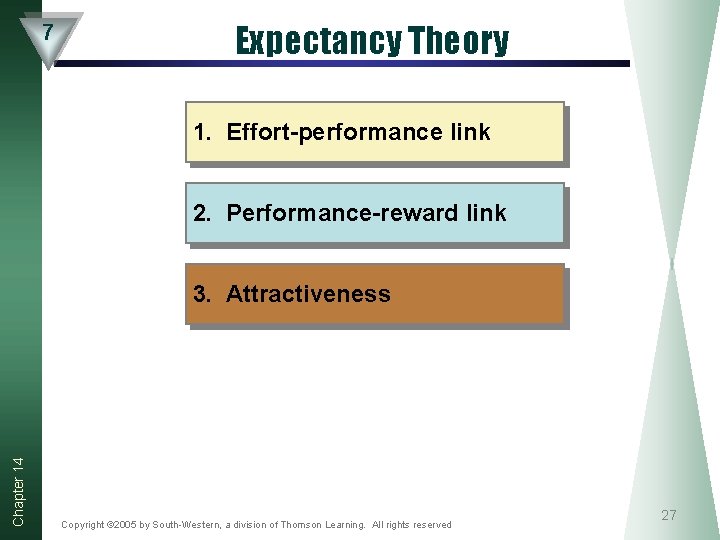
7 Expectancy Theory 1. Effort-performance link 2. Performance-reward link Chapter 14 3. Attractiveness Copyright © 2005 by South-Western, a division of Thomson Learning. All rights reserved 27
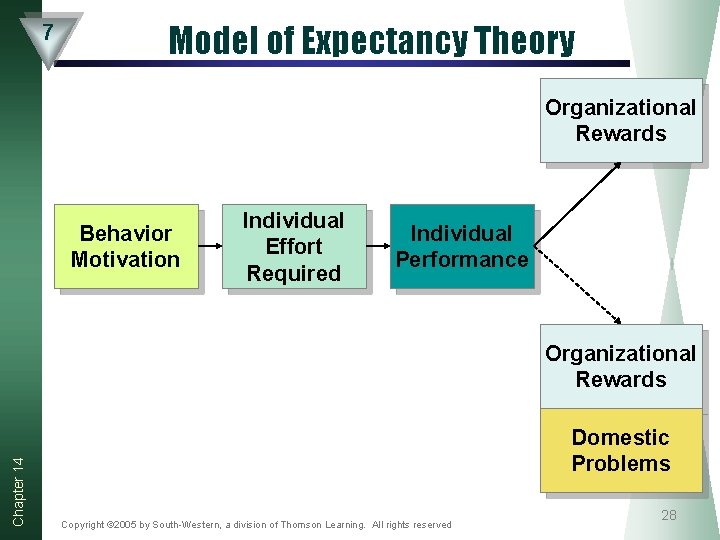
7 Model of Expectancy Theory Organizational Rewards Behavior Motivation Individual Effort Required Individual Performance Chapter 14 Organizational Rewards Domestic Problems Copyright © 2005 by South-Western, a division of Thomson Learning. All rights reserved 28
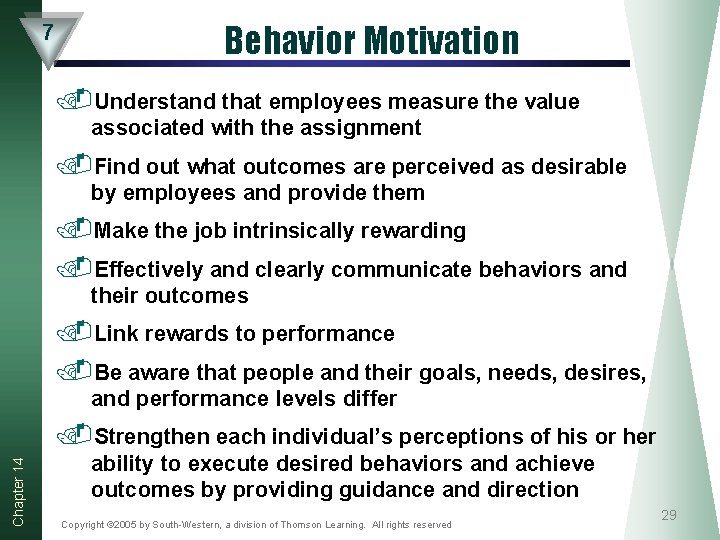
7 Behavior Motivation. Understand that employees measure the value associated with the assignment . Find out what outcomes are perceived as desirable by employees and provide them . Make the job intrinsically rewarding. Effectively and clearly communicate behaviors and their outcomes . Link rewards to performance. Be aware that people and their goals, needs, desires, and performance levels differ Chapter 14 . Strengthen each individual’s perceptions of his or her ability to execute desired behaviors and achieve outcomes by providing guidance and direction Copyright © 2005 by South-Western, a division of Thomson Learning. All rights reserved 29
8 Reinforcement Theory Chapter 14 Reinforcement Theory A motivation theory that states a supervisor’s reactions and past rewards and penalties affect employees’ behavior Copyright © 2005 by South-Western, a division of Thomson Learning. All rights reserved 30
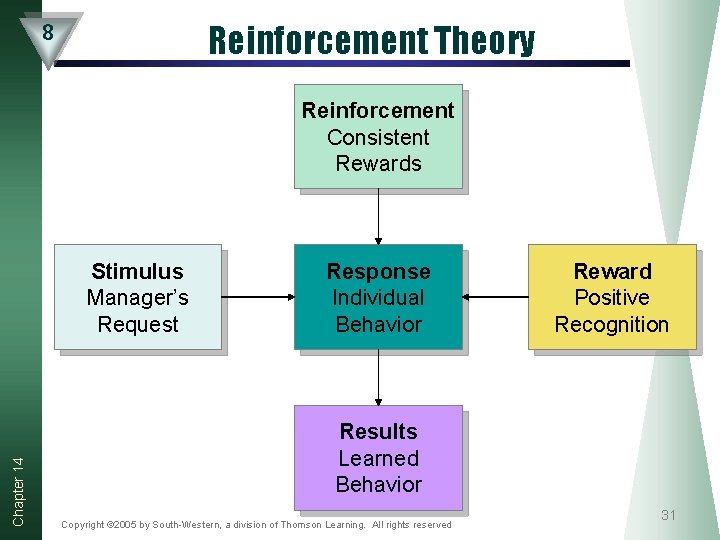
Reinforcement Theory 8 Reinforcement Consistent Rewards Chapter 14 Stimulus Manager’s Request Response Individual Behavior Reward Positive Recognition Results Learned Behavior Copyright © 2005 by South-Western, a division of Thomson Learning. All rights reserved 31
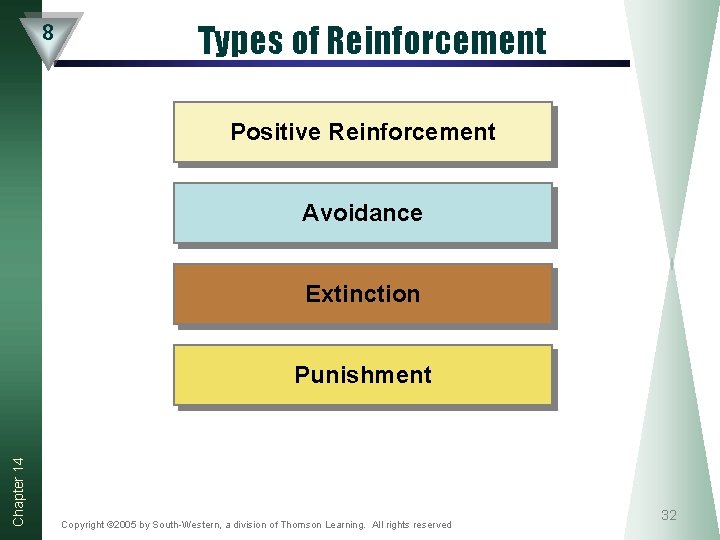
8 Types of Reinforcement Positive Reinforcement Avoidance Extinction Chapter 14 Punishment Copyright © 2005 by South-Western, a division of Thomson Learning. All rights reserved 32
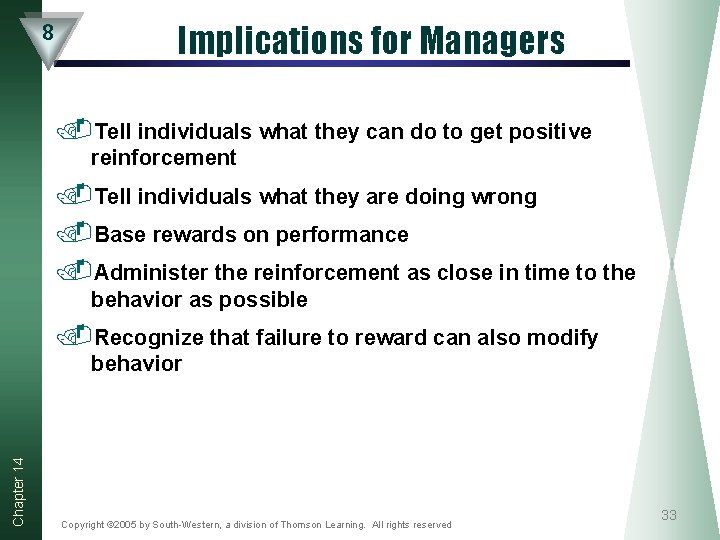
8 Implications for Managers. Tell individuals what they can do to get positive reinforcement . Tell individuals what they are doing wrong. Base rewards on performance. Administer the reinforcement as close in time to the behavior as possible . Recognize that failure to reward can also modify Chapter 14 behavior Copyright © 2005 by South-Western, a division of Thomson Learning. All rights reserved 33
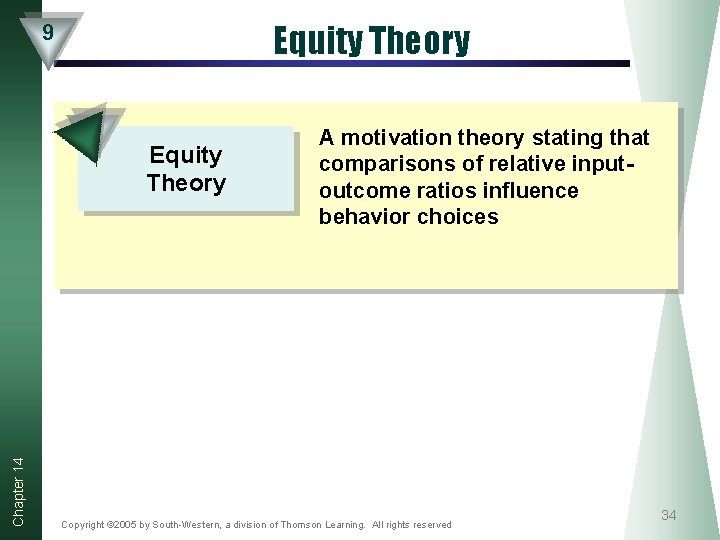
Equity Theory 9 Chapter 14 Equity Theory A motivation theory stating that comparisons of relative inputoutcome ratios influence behavior choices Copyright © 2005 by South-Western, a division of Thomson Learning. All rights reserved 34
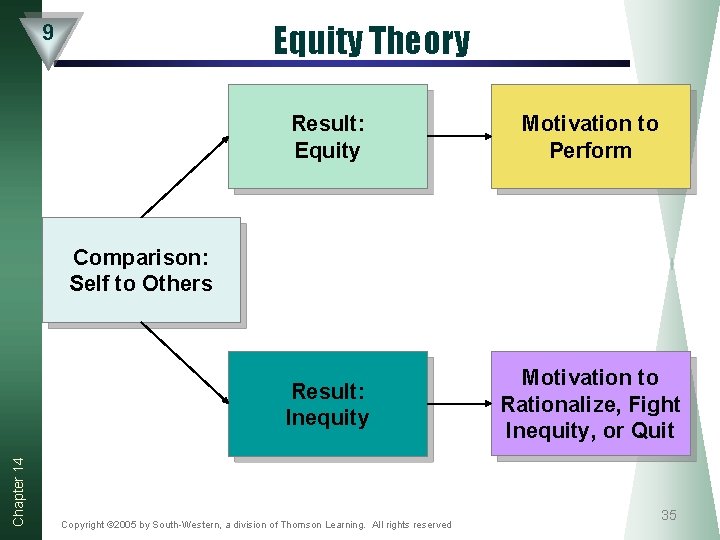
Equity Theory 9 Result: Equity Motivation to Perform Result: Inequity Motivation to Rationalize, Fight Inequity, or Quit Chapter 14 Comparison: Self to Others Copyright © 2005 by South-Western, a division of Thomson Learning. All rights reserved 35
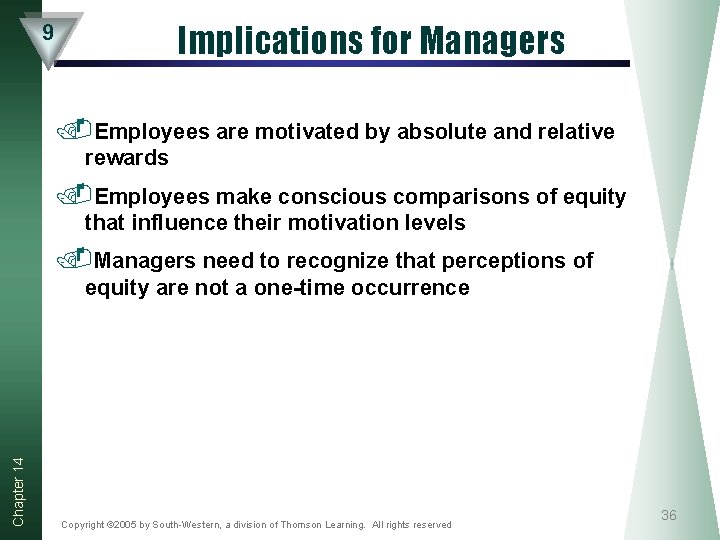
Implications for Managers 9 . Employees are motivated by absolute and relative rewards . Employees make conscious comparisons of equity that influence their motivation levels . Managers need to recognize that perceptions of Chapter 14 equity are not a one-time occurrence Copyright © 2005 by South-Western, a division of Thomson Learning. All rights reserved 36
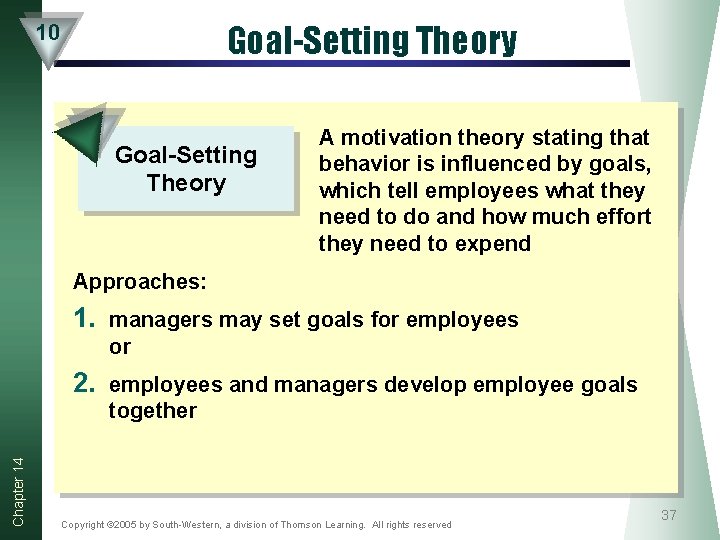
Goal-Setting Theory 10 Goal-Setting Theory A motivation theory stating that behavior is influenced by goals, which tell employees what they need to do and how much effort they need to expend Approaches: 1. managers may set goals for employees or 2. employees and managers develop employee goals Chapter 14 together Copyright © 2005 by South-Western, a division of Thomson Learning. All rights reserved 37
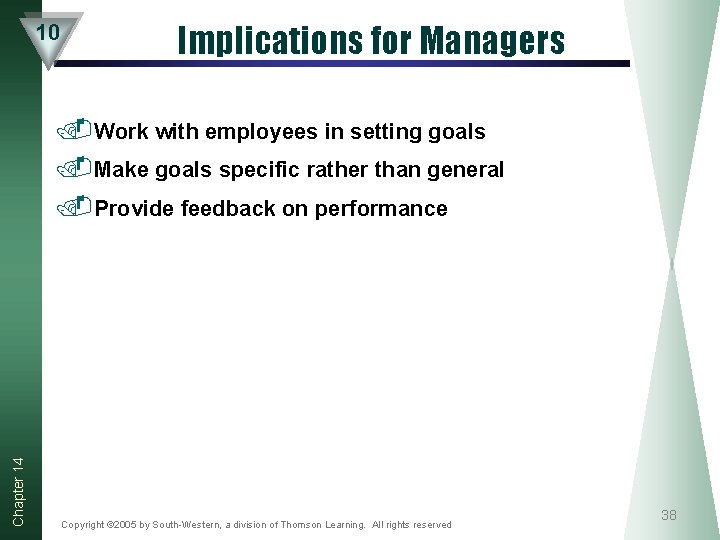
10 Implications for Managers Chapter 14 . Work with employees in setting goals. Make goals specific rather than general. Provide feedback on performance Copyright © 2005 by South-Western, a division of Thomson Learning. All rights reserved 38
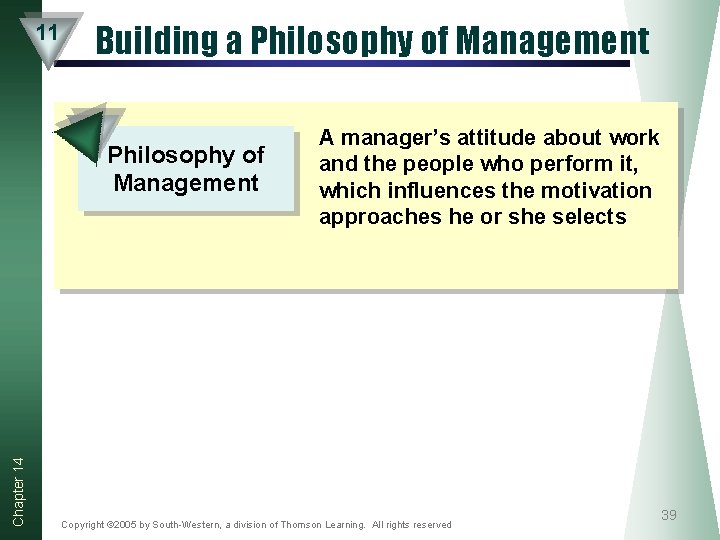
11 Building a Philosophy of Management Chapter 14 Philosophy of Management A manager’s attitude about work and the people who perform it, which influences the motivation approaches he or she selects Copyright © 2005 by South-Western, a division of Thomson Learning. All rights reserved 39
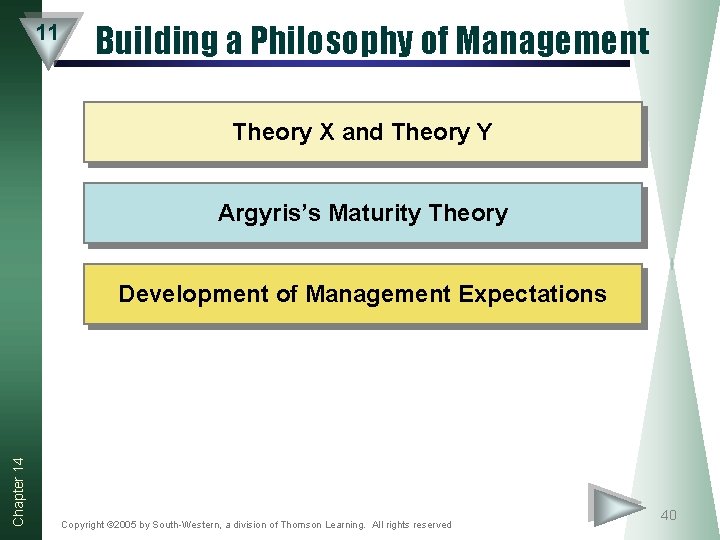
11 Building a Philosophy of Management Theory X and Theory Y Argyris’s Maturity Theory Chapter 14 Development of Management Expectations Copyright © 2005 by South-Western, a division of Thomson Learning. All rights reserved 40
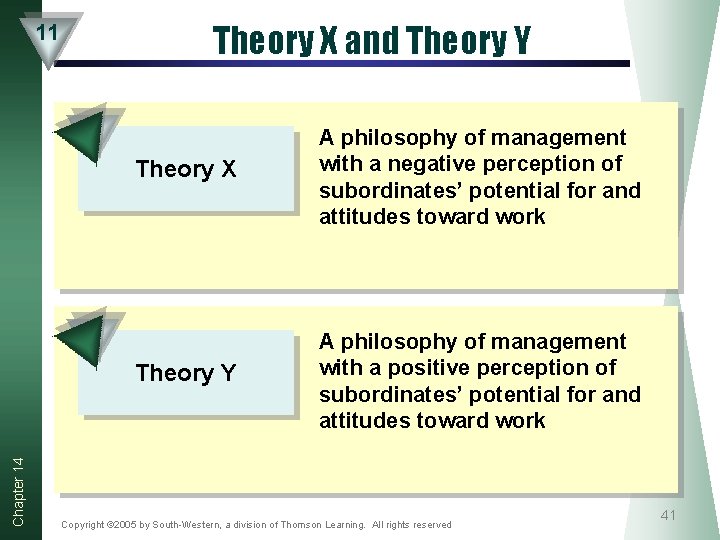
Chapter 14 11 Theory X and Theory Y Theory X A philosophy of management with a negative perception of subordinates’ potential for and attitudes toward work Theory Y A philosophy of management with a positive perception of subordinates’ potential for and attitudes toward work Copyright © 2005 by South-Western, a division of Thomson Learning. All rights reserved 41
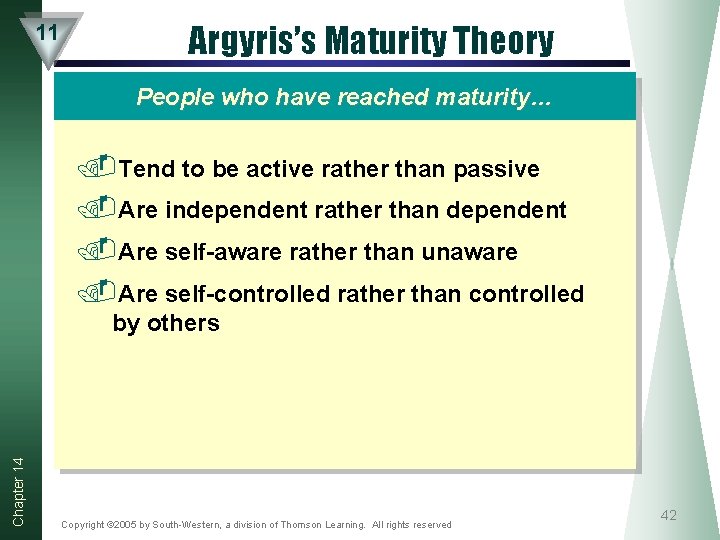
11 Argyris’s Maturity Theory People who have reached maturity… . Tend to be active rather than passive. Are independent rather than dependent. Are self-aware rather than unaware. Are self-controlled rather than controlled Chapter 14 by others Copyright © 2005 by South-Western, a division of Thomson Learning. All rights reserved 42
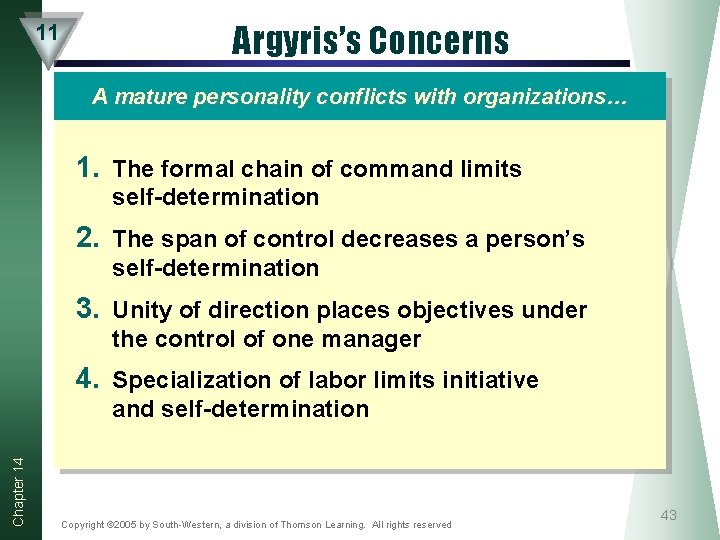
11 Argyris’s Concerns A mature personality conflicts with organizations… 1. The formal chain of command limits self-determination 2. The span of control decreases a person’s self-determination 3. Unity of direction places objectives under the control of one manager 4. Specialization of labor limits initiative Chapter 14 and self-determination Copyright © 2005 by South-Western, a division of Thomson Learning. All rights reserved 43
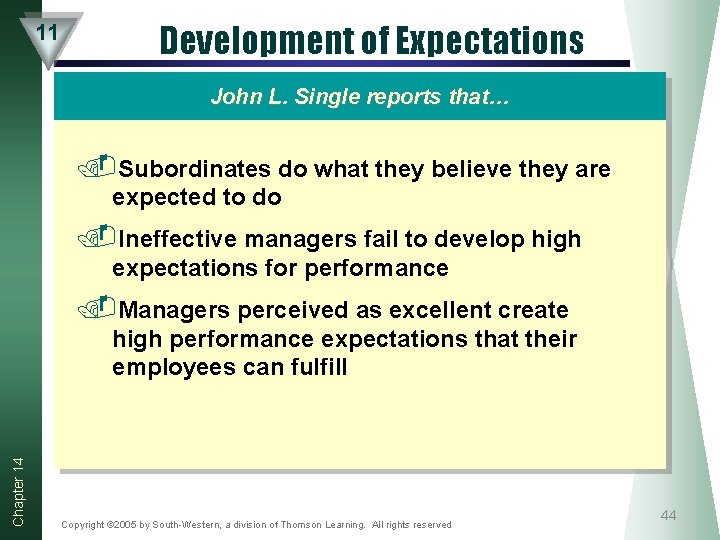
11 Development of Expectations John L. Single reports that… . Subordinates do what they believe they are expected to do . Ineffective managers fail to develop high expectations for performance . Managers perceived as excellent create Chapter 14 high performance expectations that their employees can fulfill Copyright © 2005 by South-Western, a division of Thomson Learning. All rights reserved 44
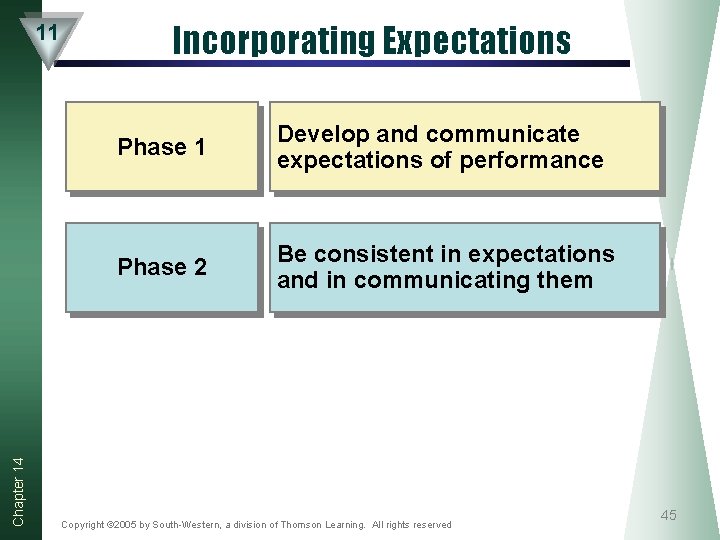
Chapter 14 11 Incorporating Expectations Phase 1 Develop and communicate expectations of performance Phase 2 Be consistent in expectations and in communicating them Copyright © 2005 by South-Western, a division of Thomson Learning. All rights reserved 45
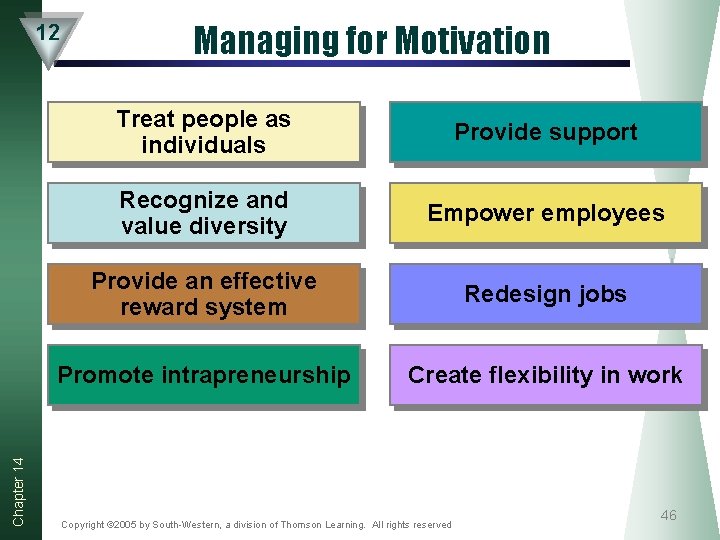
Chapter 14 12 Managing for Motivation Treat people as individuals Provide support Recognize and value diversity Empower employees Provide an effective reward system Redesign jobs Promote intrapreneurship Create flexibility in work Copyright © 2005 by South-Western, a division of Thomson Learning. All rights reserved 46
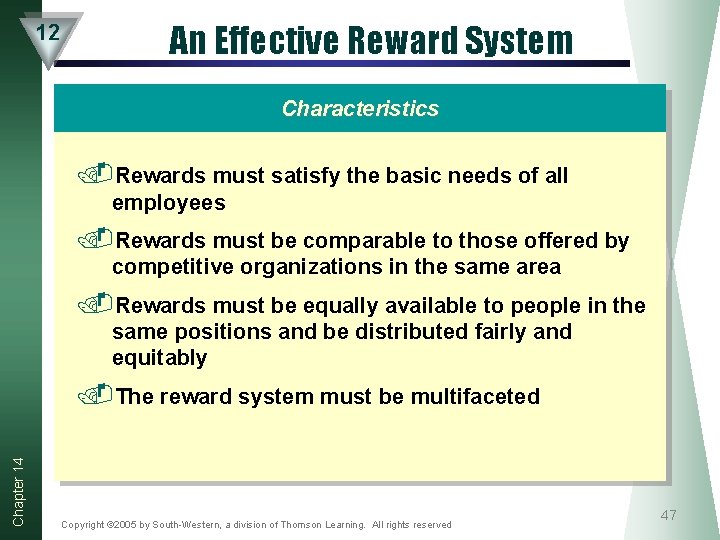
12 An Effective Reward System Characteristics . Rewards must satisfy the basic needs of all employees . Rewards must be comparable to those offered by competitive organizations in the same area . Rewards must be equally available to people in the same positions and be distributed fairly and equitably Chapter 14 . The reward system must be multifaceted Copyright © 2005 by South-Western, a division of Thomson Learning. All rights reserved 47
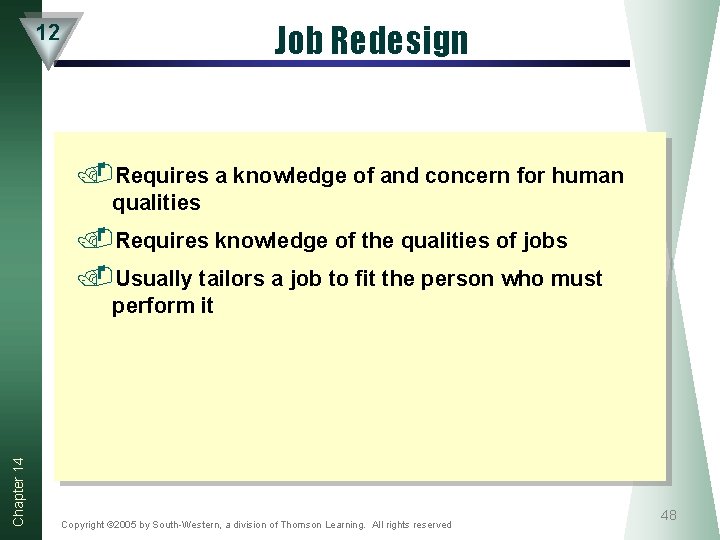
Job Redesign 12 . Requires a knowledge of and concern for human qualities . Requires knowledge of the qualities of jobs. Usually tailors a job to fit the person who must Chapter 14 perform it Copyright © 2005 by South-Western, a division of Thomson Learning. All rights reserved 48
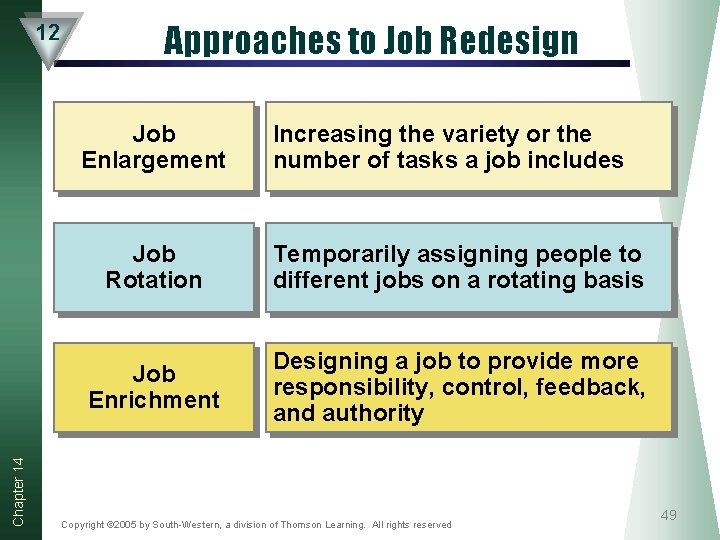
12 Approaches to Job Redesign Chapter 14 Job Enlargement Increasing the variety or the number of tasks a job includes Job Rotation Temporarily assigning people to different jobs on a rotating basis Job Enrichment Designing a job to provide more responsibility, control, feedback, and authority Copyright © 2005 by South-Western, a division of Thomson Learning. All rights reserved 49
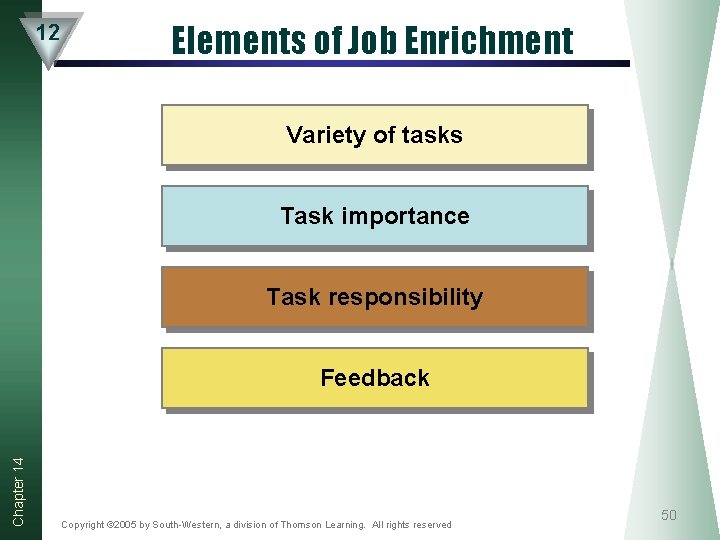
12 Elements of Job Enrichment Variety of tasks Task importance Task responsibility Chapter 14 Feedback Copyright © 2005 by South-Western, a division of Thomson Learning. All rights reserved 50
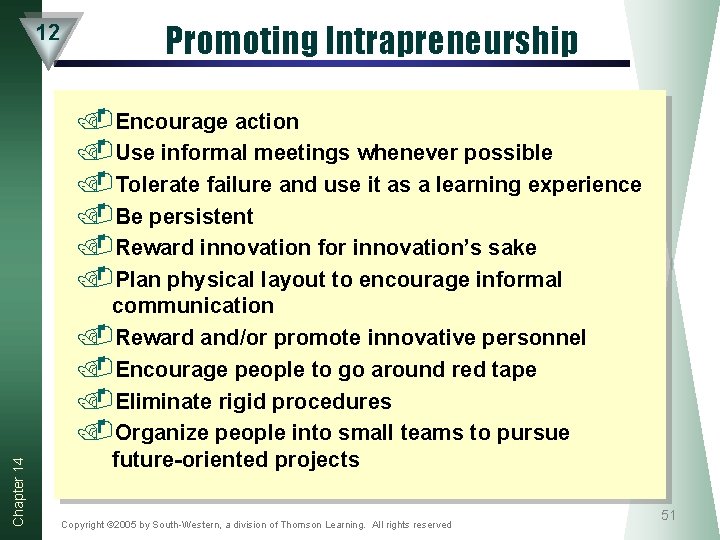
12 Promoting Intrapreneurship Chapter 14 . Encourage action. Use informal meetings whenever possible. Tolerate failure and use it as a learning experience. Be persistent. Reward innovation for innovation’s sake. Plan physical layout to encourage informal communication. Reward and/or promote innovative personnel. Encourage people to go around red tape. Eliminate rigid procedures. Organize people into small teams to pursue future-oriented projects Copyright © 2005 by South-Western, a division of Thomson Learning. All rights reserved 51
12 Creating Flexibility Flextime Compressed Workweek Chapter 14 Job Sharing Copyright © 2005 by South-Western, a division of Thomson Learning. All rights reserved 52