HSM Use and Training Karen K Dixon Ph




- Slides: 44
HSM Use and Training Karen K. Dixon, Ph. D. , P. E. Oregon State University
Presentation Summary 1 What is the HSM? 2 Why is the HSM needed? 3 How can the HSM be used? 4 When will the 1 st Edition be available? 5 Where can one find more information about the HSM?
Overview of the new HSM I. WHAT IS THE HSM?
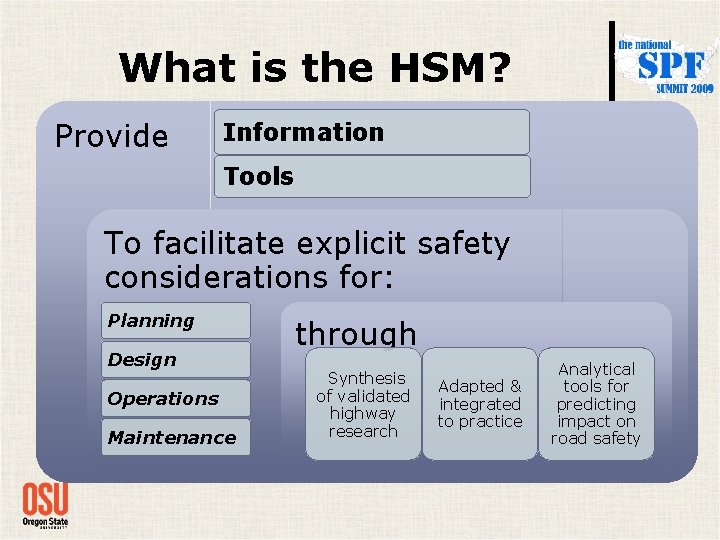
What is the HSM? Provide Information Tools To facilitate explicit safety considerations for: Planning Design Operations Maintenance through Synthesis of validated highway research Adapted & integrated to practice Analytical tools for predicting impact on road safety
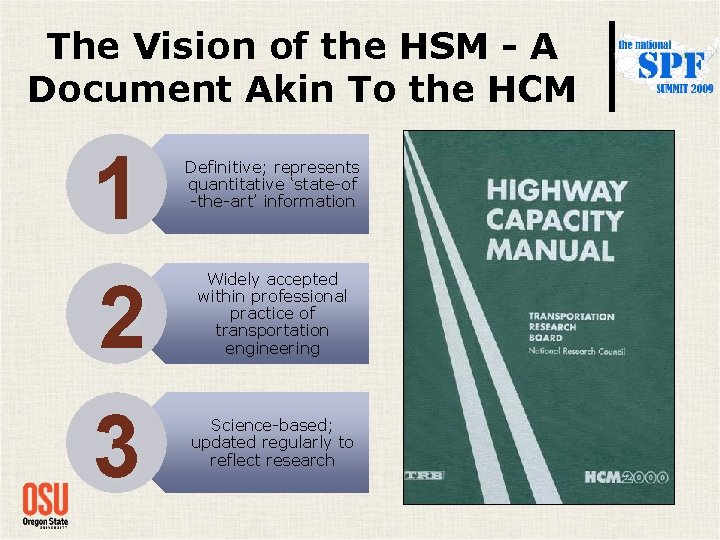
The Vision of the HSM - A Document Akin To the HCM 1 2 3 Definitive; represents quantitative ‘state-of -the-art’ information Widely accepted within professional practice of transportation engineering Science-based; updated regularly to reflect research
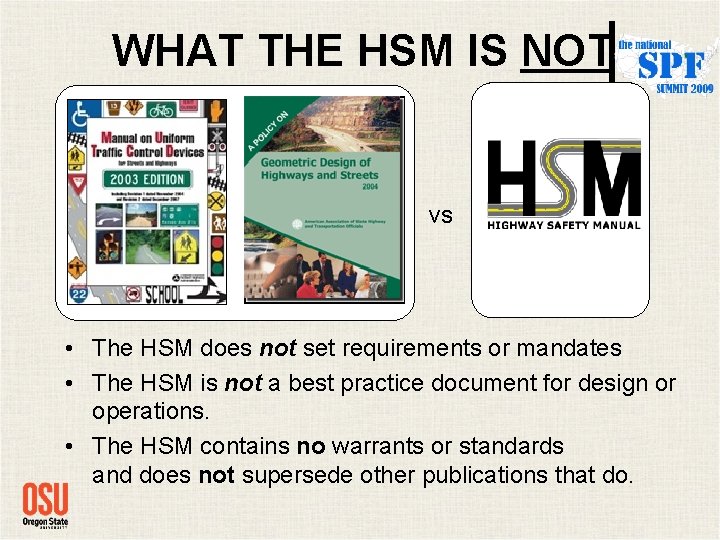
WHAT THE HSM IS NOT vs • The HSM does not set requirements or mandates • The HSM is not a best practice document for design or operations. • The HSM contains no warrants or standards and does not supersede other publications that do.
The HSM does not establish a legal standard of care nor does it create a duty to the public.
Overview of the new HSM II. WHY DO WE NEED THE HSM?
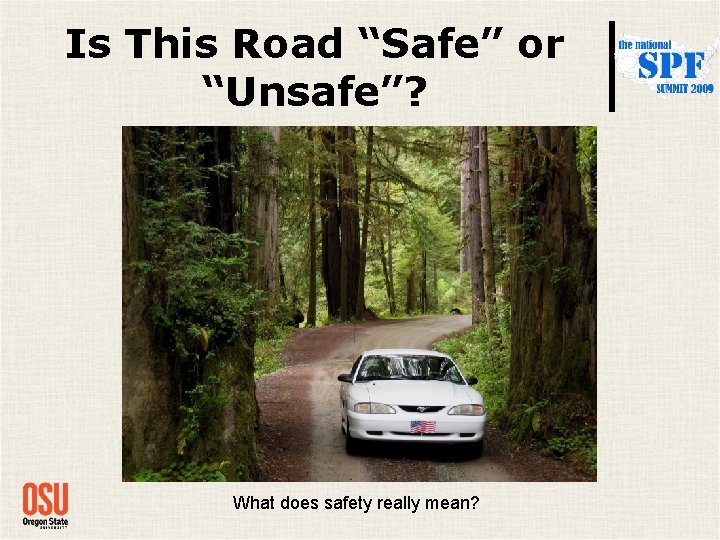
Is This Road “Safe” or “Unsafe”? What does safety really mean?
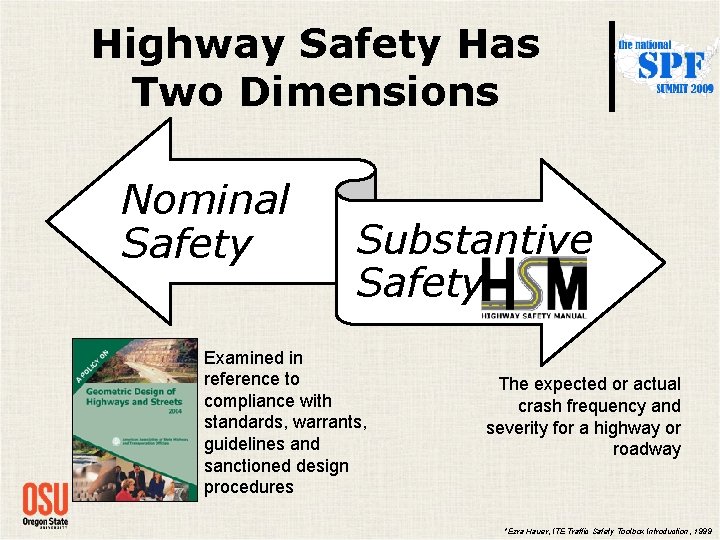
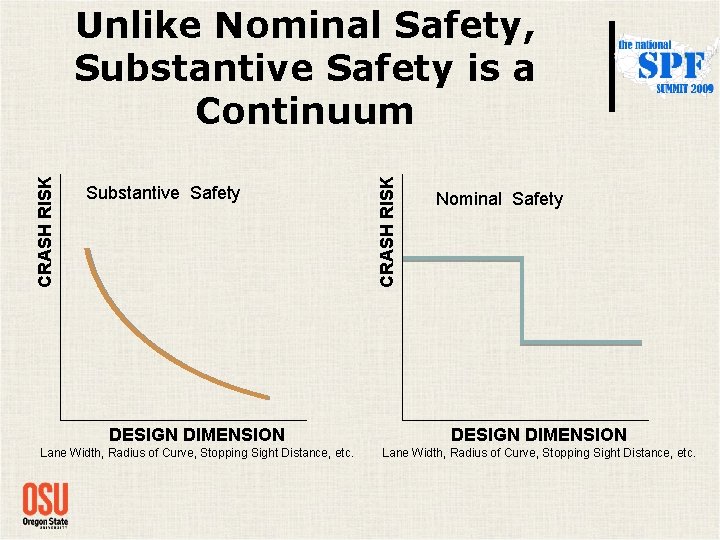
Highway Safety Has Two Dimensions Nominal Safety Substantive Safety Examined in reference to compliance with standards, warrants, guidelines and sanctioned design procedures The expected or actual crash frequency and severity for a highway or roadway *Ezra Hauer, ITE Traffic Safety Toolbox Introduction, 1999
Substantive Safety CRASH RISK Unlike Nominal Safety, Substantive Safety is a Continuum Nominal Safety DESIGN DIMENSION Lane Width, Radius of Curve, Stopping Sight Distance, etc.
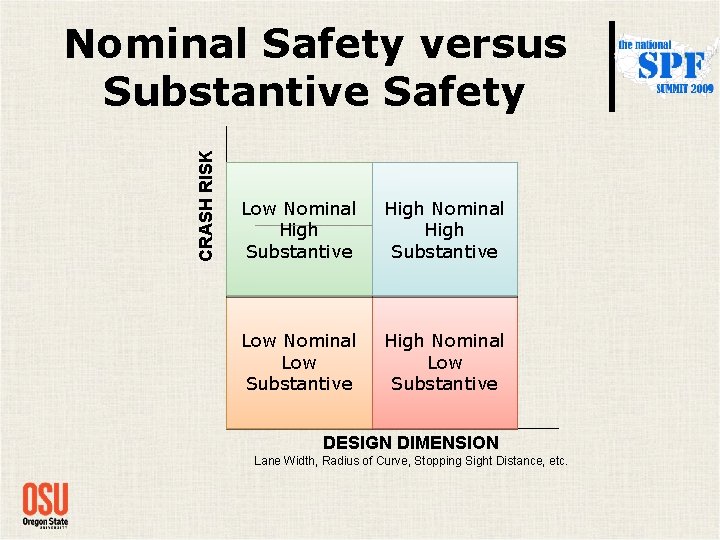
CRASH RISK Nominal Safety versus Substantive Safety Low Nominal High Substantive High Nominal High Substantive Low Nominal Low Substantive High Nominal Low Substantive DESIGN DIMENSION Lane Width, Radius of Curve, Stopping Sight Distance, etc.
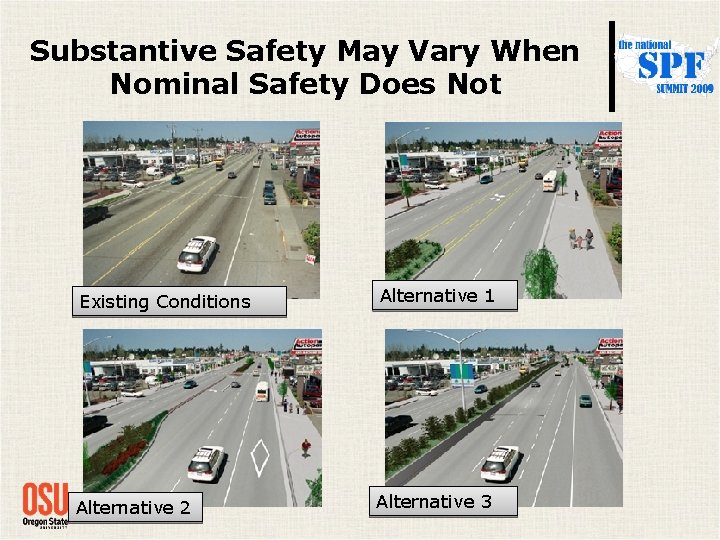
Substantive Safety May Vary When Nominal Safety Does Not Existing Conditions Alternative 1 Alternative 2 Alternative 3
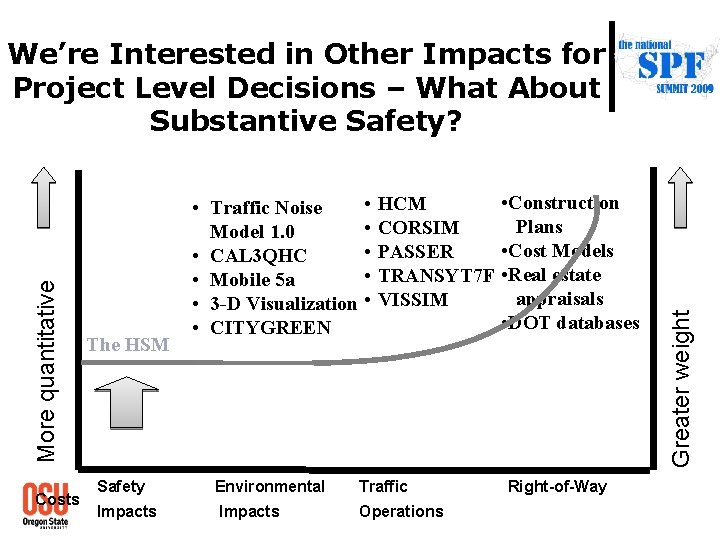
Costs Design Criteria (nominal safety) The HSM • • Traffic Noise • Model 1. 0 • • CAL 3 QHC • • Mobile 5 a • 3 -D Visualization • • CITYGREEN • Construction HCM Plans CORSIM • Cost Models PASSER TRANSYT 7 F • Real estate appraisals VISSIM • DOT databases Safety Environmental Traffic Impacts Operations Right-of-Way Greater weight More quantitative We’re Interested in Other Impacts for Project Level Decisions – What About Substantive Safety?
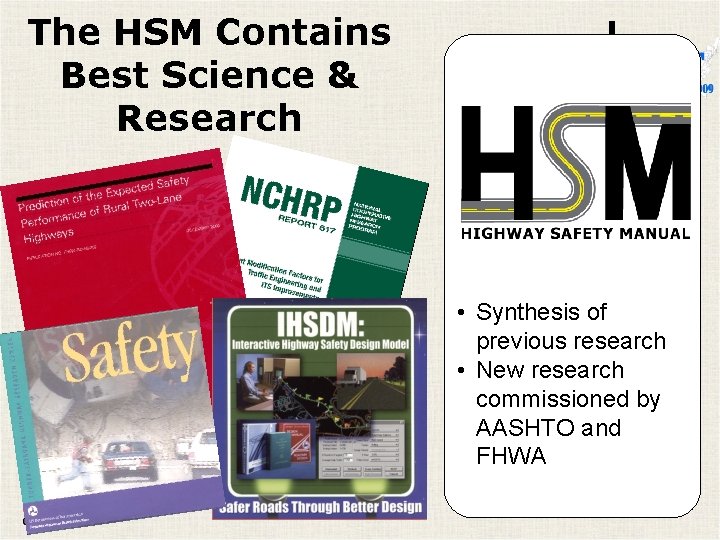
The HSM Contains Best Science & Research • Synthesis of previous research • New research commissioned by AASHTO and FHWA
Overview of the new HSM III. HOW WAS THE HSM DEVELOPED?
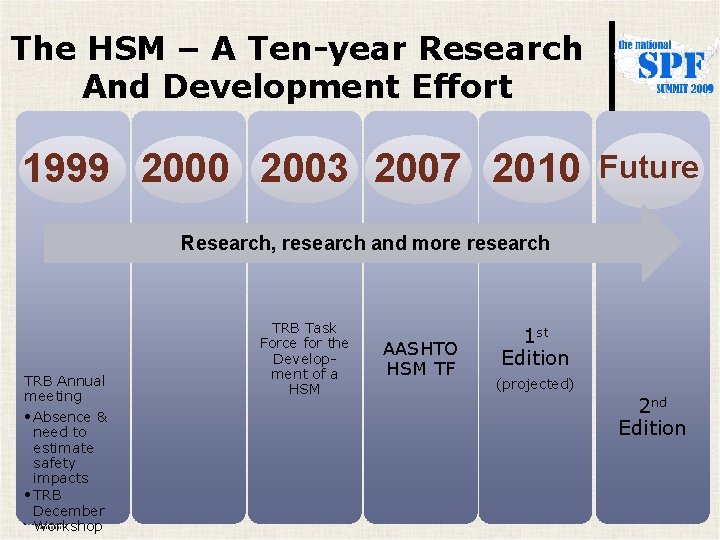
The HSM – A Ten-year Research And Development Effort 1999 2000 2003 2007 2010 Future Research, research and more research TRB Annual meeting • Absence & need to estimate safety impacts • TRB December Workshop TRB Task Force for the Development of a HSM AASHTO HSM TF 1 st Edition (projected) 2 nd Edition
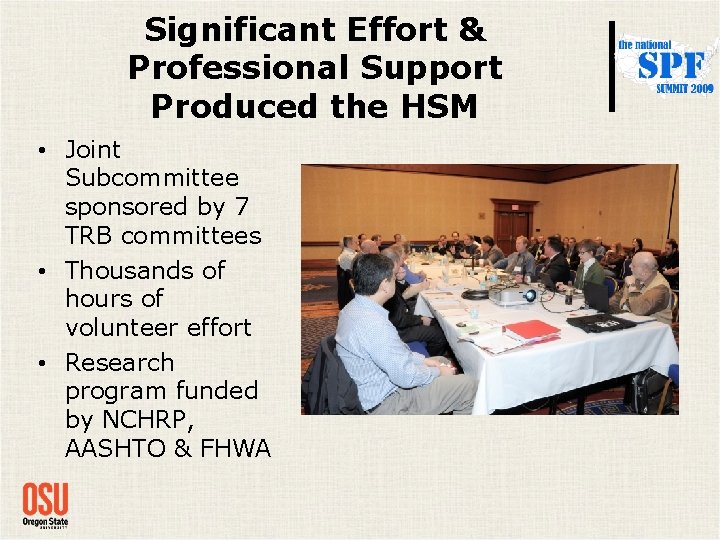
Significant Effort & Professional Support Produced the HSM • Joint Subcommittee sponsored by 7 TRB committees • Thousands of hours of volunteer effort • Research program funded by NCHRP, AASHTO & FHWA
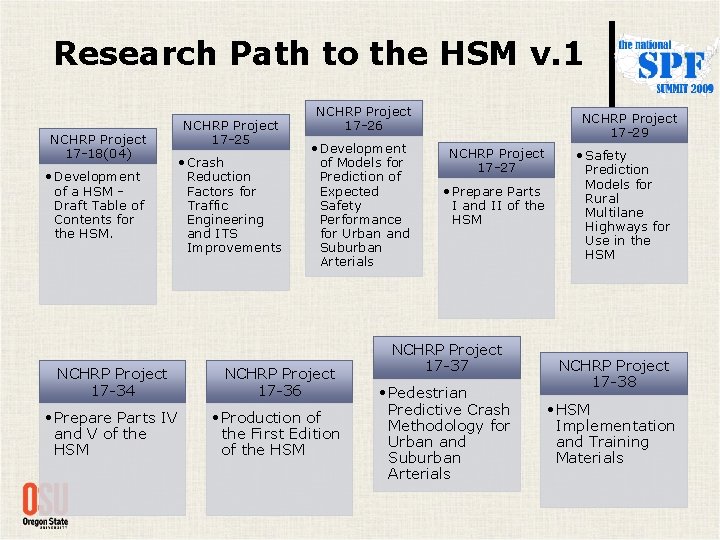
Research Path to the HSM v. 1 NCHRP Project 17 -18(04) • Development of a HSM Draft Table of Contents for the HSM. NCHRP Project 17 -25 • Crash Reduction Factors for Traffic Engineering and ITS Improvements NCHRP Project 17 -26 • Development of Models for Prediction of Expected Safety Performance for Urban and Suburban Arterials NCHRP Project 17 -34 NCHRP Project 17 -36 • Prepare Parts IV and V of the HSM • Production of the First Edition of the HSM NCHRP Project 17 -29 NCHRP Project 17 -27 • Prepare Parts I and II of the HSM NCHRP Project 17 -37 • Pedestrian Predictive Crash Methodology for Urban and Suburban Arterials • Safety Prediction Models for Rural Multilane Highways for Use in the HSM NCHRP Project 17 -38 • HSM Implementation and Training Materials
Overview of the new HSM IV. WHAT IS COVERED BY THE HSM?
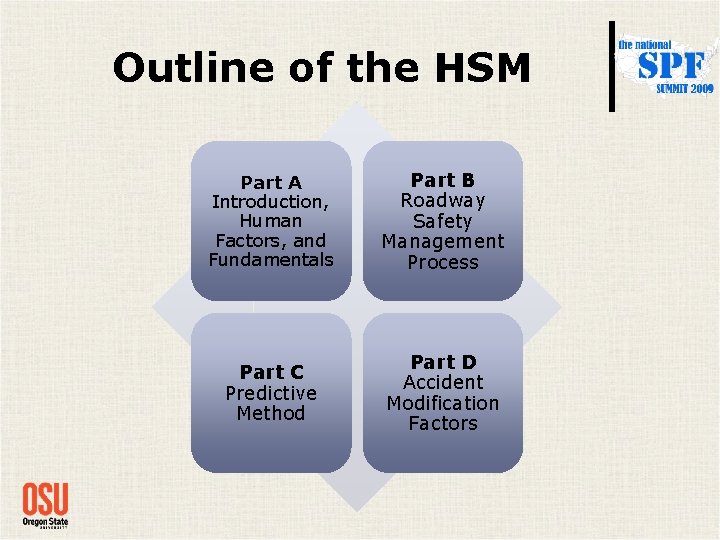
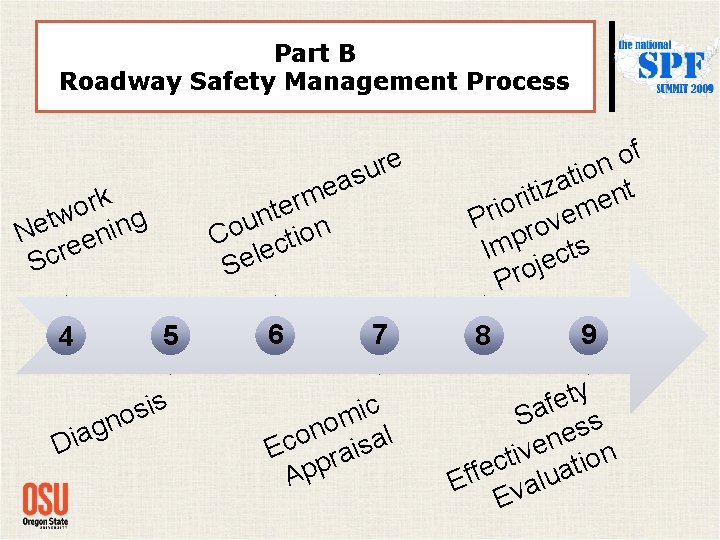
Outline of the HSM Part A Introduction, Human Factors, and Fundamentals Part B Roadway Safety Management Process Part C Predictive Method Part D Accident Modification Factors
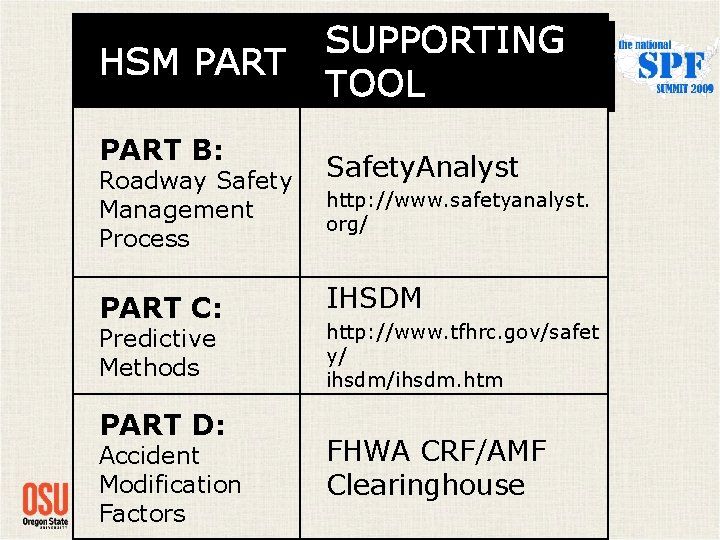
HSM PART B: Roadway Safety Management Process PART C: Predictive Methods PART D: Accident Modification Factors SUPPORTING TOOL Safety. Analyst http: //www. safetyanalyst. org/ IHSDM http: //www. tfhrc. gov/safet y/ ihsdm/ihsdm. htm FHWA CRF/AMF Clearinghouse
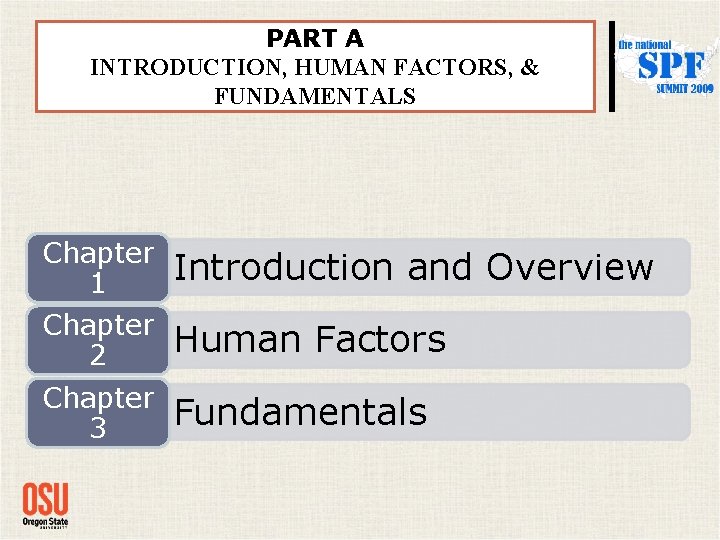
PART A INTRODUCTION, HUMAN FACTORS, & FUNDAMENTALS Chapter • Introduction 1 Chapter • Human 2 and Overview Factors Chapter • Fundamentals 3
Part B Roadway Safety Management Process ure as e rm e t n u n o o C i t c e l Se k r o w ing t e N n e e Scr 4 6 5 4 5 g a i D is s o n 6 f o n o i t a nt z i t i r e o i m r P rove Imp jects Pro 8 7 7 ic m o n l o Ec raisa App 8 9 9 ty e f Sa ss e n e iv tion t c Effe valua E
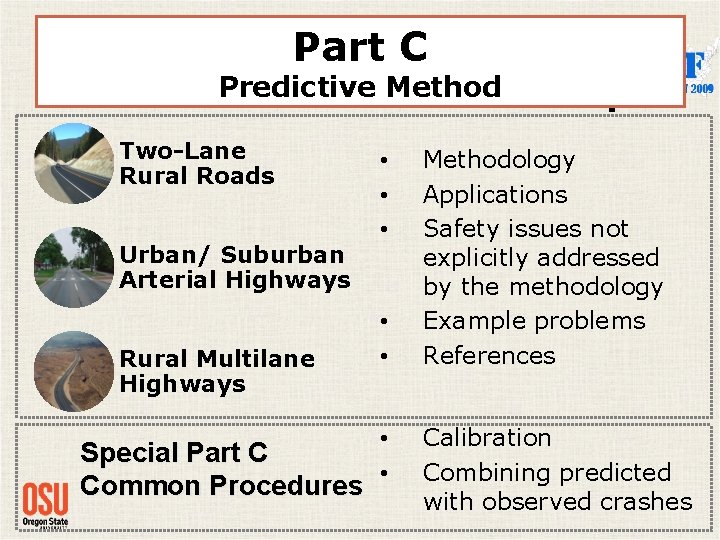
Part C Predictive Method Two-Lane Rural Roads Urban/ Suburban Arterial Highways Rural Multilane Highways Special Part C Common Procedures • • Methodology Applications Safety issues not explicitly addressed by the methodology Example problems References Calibration Combining predicted with observed crashes
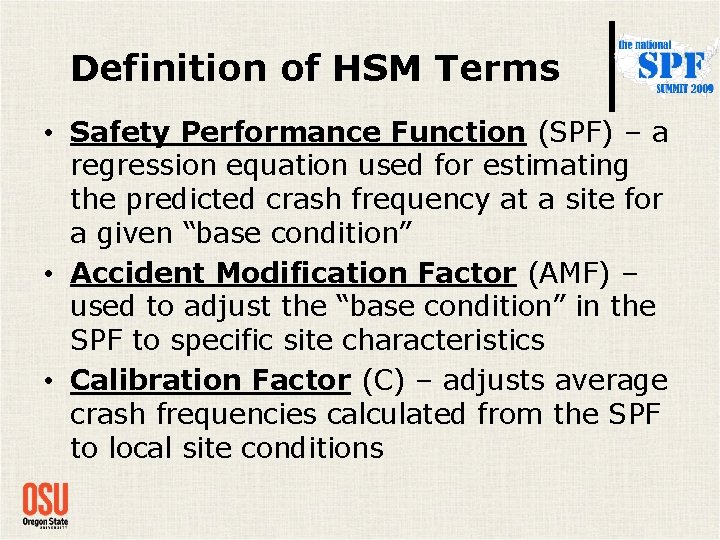
Definition of HSM Terms • Safety Performance Function (SPF) – a regression equation used for estimating the predicted crash frequency at a site for a given “base condition” • Accident Modification Factor (AMF) – used to adjust the “base condition” in the SPF to specific site characteristics • Calibration Factor (C) – adjusts average crash frequencies calculated from the SPF to local site conditions
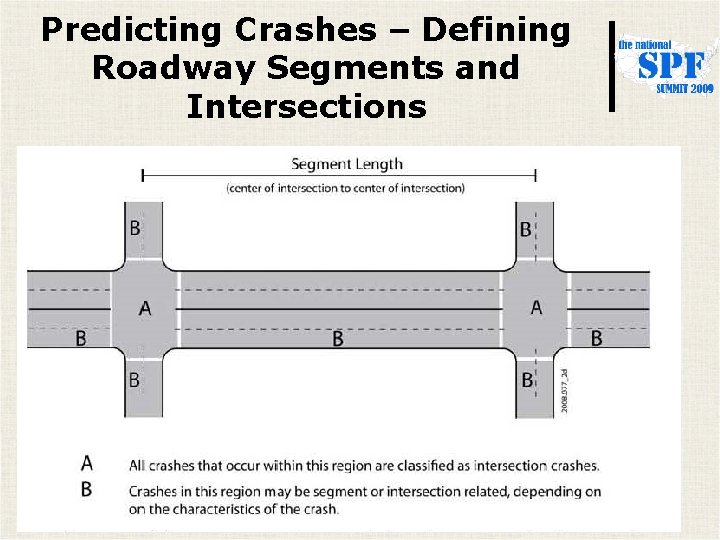
Predicting Crashes – Defining Roadway Segments and Intersections
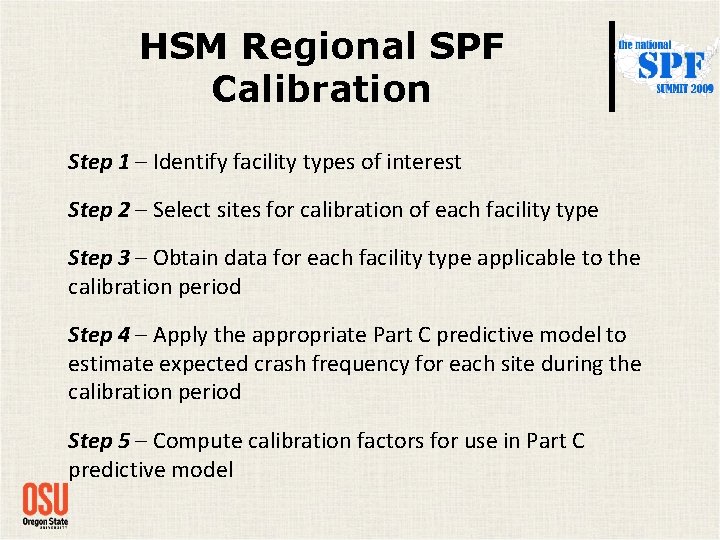
HSM Regional SPF Calibration Step 1 – Identify facility types of interest Step 2 – Select sites for calibration of each facility type Step 3 – Obtain data for each facility type applicable to the calibration period Step 4 – Apply the appropriate Part C predictive model to estimate expected crash frequency for each site during the calibration period Step 5 – Compute calibration factors for use in Part C predictive model
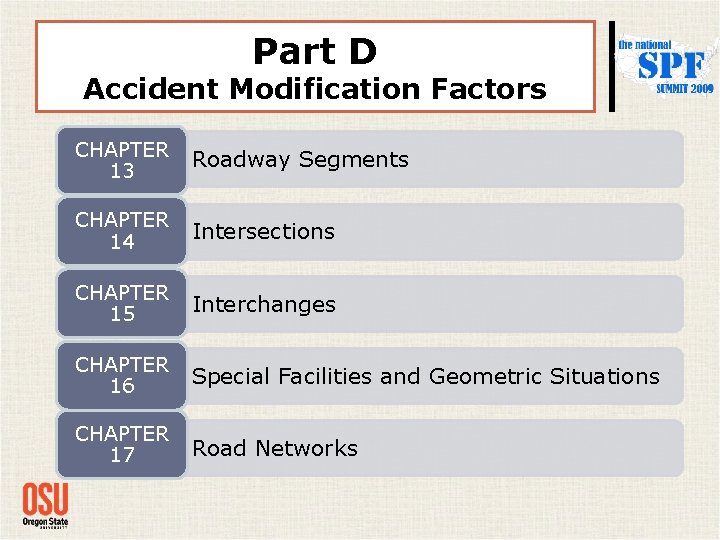
Part D Accident Modification Factors CHAPTER • Roadway Segments 13 CHAPTER • Intersections 14 CHAPTER • Interchanges 15 CHAPTER • Special Facilities and Geometric Situations 16 CHAPTER • Road Networks 17
Overview of the new HSM V. WHO SHOULD USE THE HSM?
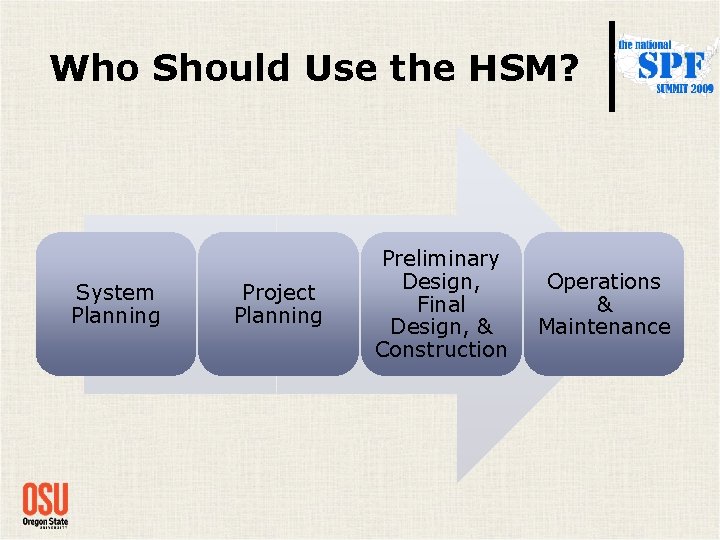
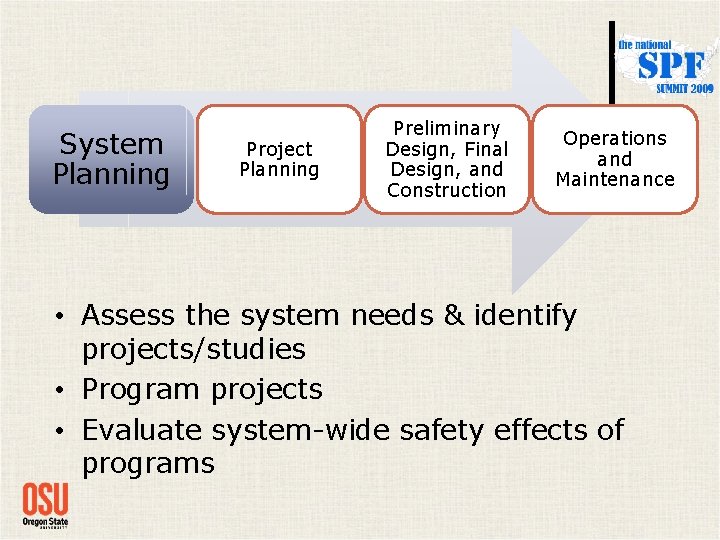
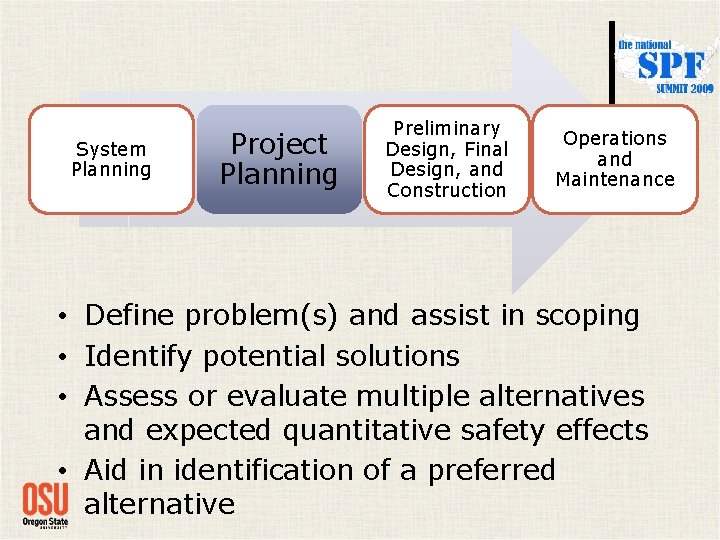
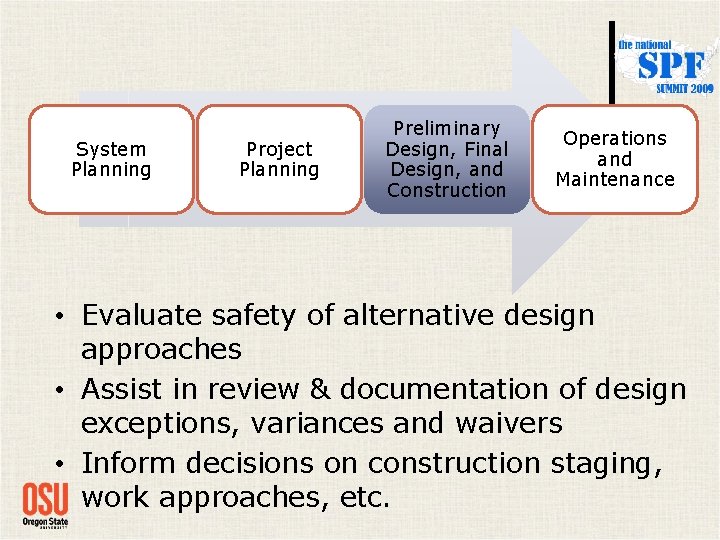
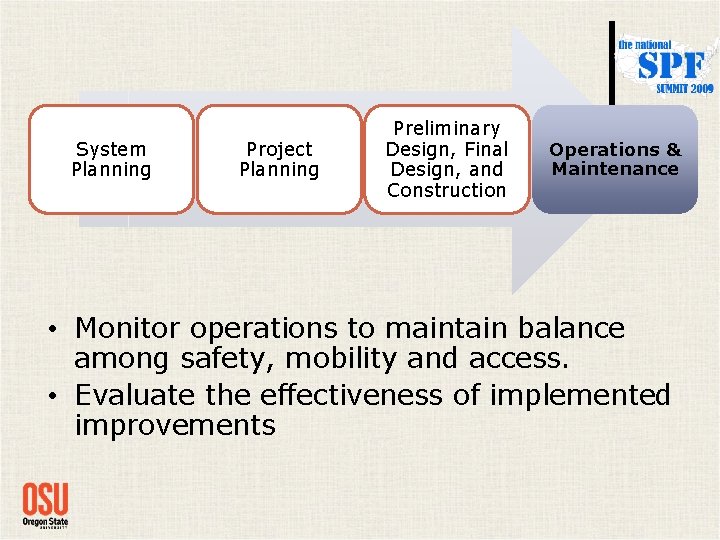
Who Should Use the HSM? System Planning Project Planning Preliminary Design, Final Design, & Construction Operations & Maintenance
System Planning Project Planning Preliminary Design, Final Design, and Construction Operations and Maintenance • Assess the system needs & identify projects/studies • Program projects • Evaluate system-wide safety effects of programs
System Planning Project Planning Preliminary Design, Final Design, and Construction Operations and Maintenance • Define problem(s) and assist in scoping • Identify potential solutions • Assess or evaluate multiple alternatives and expected quantitative safety effects • Aid in identification of a preferred alternative
System Planning Project Planning Preliminary Design, Final Design, and Construction Operations and Maintenance • Evaluate safety of alternative design approaches • Assist in review & documentation of design exceptions, variances and waivers • Inform decisions on construction staging, work approaches, etc.
System Planning Project Planning Preliminary Design, Final Design, and Construction Operations & Maintenance • Monitor operations to maintain balance among safety, mobility and access. • Evaluate the effectiveness of implemented improvements
Overview of the new HSM VI. WHEN WILL THE HSM BE AVAILABLE?
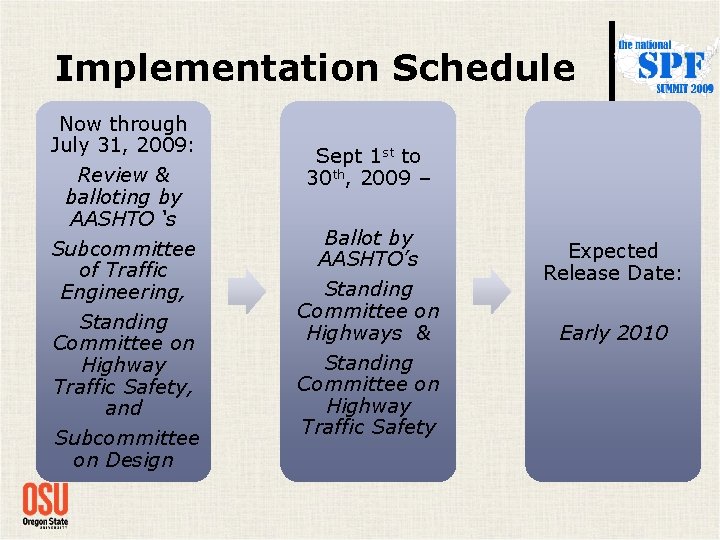
Implementation Schedule Now through July 31, 2009: Review & balloting by AASHTO ‘s Subcommittee of Traffic Engineering, Standing Committee on Highway Traffic Safety, and Subcommittee on Design Sept 1 st to 30 th, 2009 – Ballot by AASHTO’s Standing Committee on Highways & Standing Committee on Highway Traffic Safety Expected Release Date: Early 2010
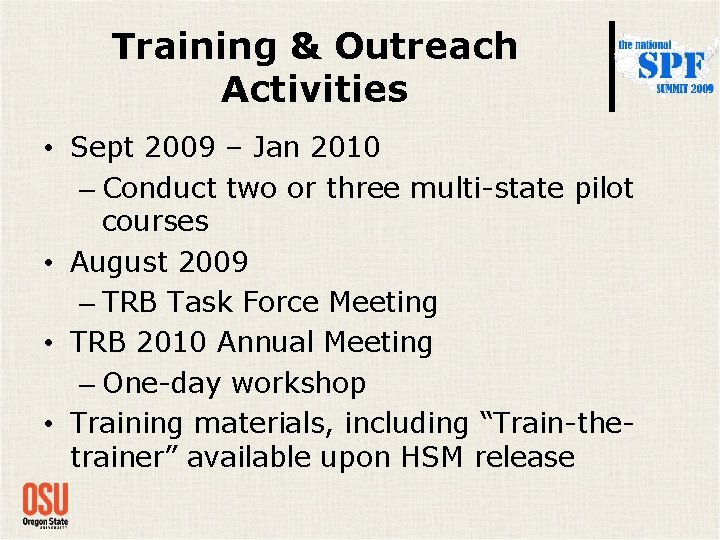
Training & Outreach Activities • Sept 2009 – Jan 2010 – Conduct two or three multi-state pilot courses • August 2009 – TRB Task Force Meeting • TRB 2010 Annual Meeting – One-day workshop • Training materials, including “Train-thetrainer” available upon HSM release
Overview of the new HSM VII. WHERE CAN ONE FIND MORE INFORMATION ABOUT THE HSM?
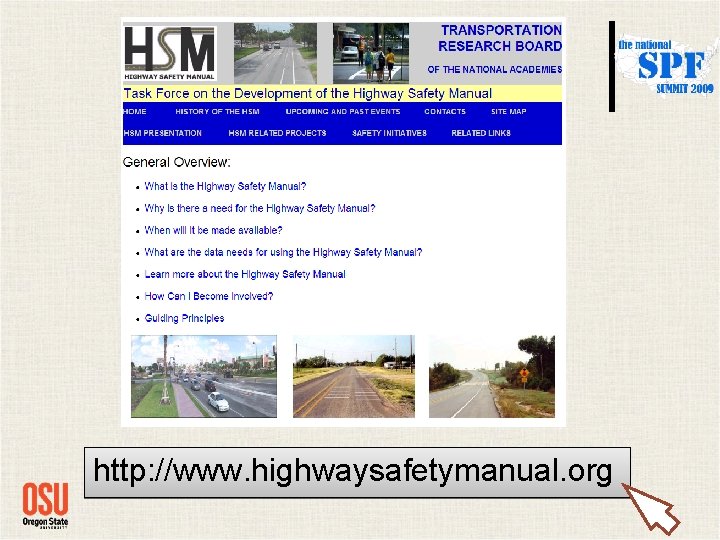
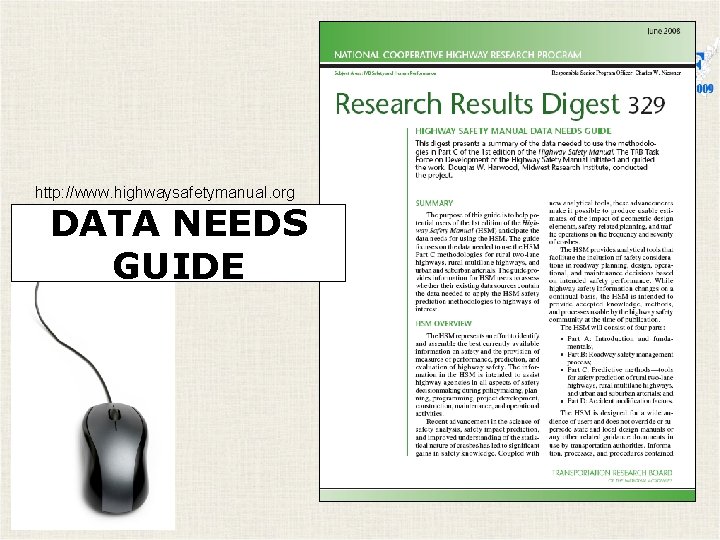
http: //www. highwaysafetymanual. org
http: //www. highwaysafetymanual. org DATA NEEDS GUIDE
Key Contacts • AASHTO – Ken Kobetsky: kenk@aashto. org, (202) 624 -5254 – Jim Mc. Donnell: jimm@aashto. org, (202) 624 -5448 – Joel Mc. Carroll: jmccarroll@aashto. org, (202) 624 -3632 • AASHTO JOINT TASK COMMITTEE FOR THE HSM – Don Vaughn, ALDOT, vaughnd@dot. state. al. us, (334) 242 -6319
Key Contacts • TRB/ NCHRP – Rick Pain: rpain@nas. edu, (202)334 -2964 – Chuck Niessner: cniessne@nas. edu, (202) 334 -1431 • TRB HSM TF: Development of a Highway Safety Manual – John Milton, miltonj@wsdot. wa. gov, (360)704 -6363 • TRB HSM TF: User Liaison – Geni Bahar (User Liaison Subcommittee of the TRB HSM Task Force): genibahar@rogers. com, (416) 932 -9272 • TRAINING – Karen Dixon (PI of NCHRP Project 17 -38): karen. dixon@oregonstate. edu, (541) 737 -6337
The End Questions?