HP model for protein folding K Dill Theory











- Slides: 23
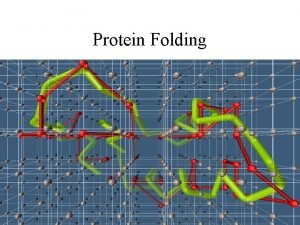
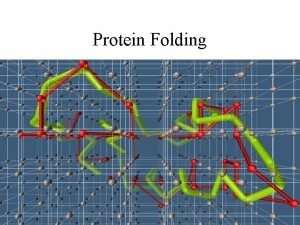
HP model for protein folding K. Dill, Theory for the folding and stability of globular proteins. Biochemistry, 24: 1501 -1509, 1985 red - Hydrophobic ; blue - Polar (hydrophylic) molecules
Reasons why HP model can explain some key features of protein folding
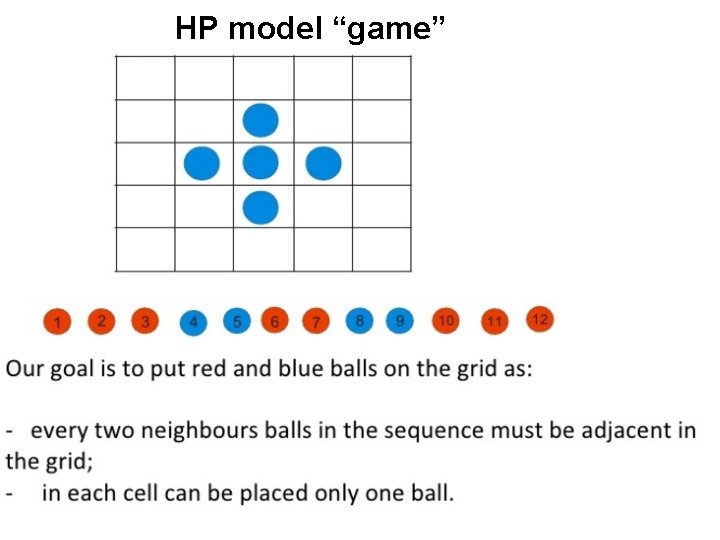
HP model “game”
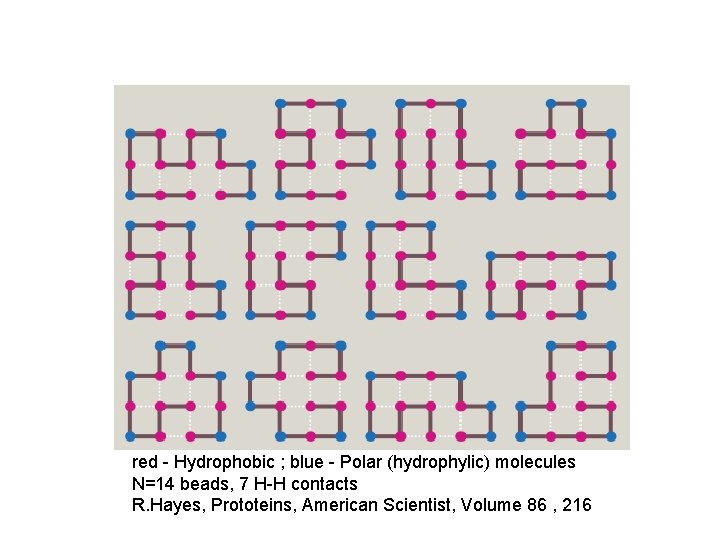
red - Hydrophobic ; blue - Polar (hydrophylic) molecules N=14 beads, 7 H-H contacts R. Hayes, Prototeins, American Scientist, Volume 86 , 216
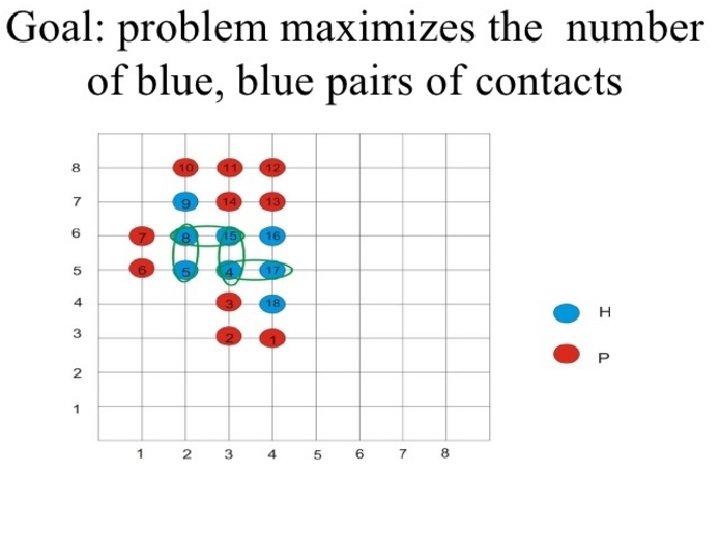
21 beads - “folded” proteins (11 H-H contacts – maximum number) vs “unfolded” proteins (0 or 1 H-H contacts – minimum number)
The aminoacid sequence for the protein P H H P a=[0 1 1 0] n 2 configurations at length n The folding sequence for the protein 1 (east), i (north), -1 (west), and -i (south). f = [1 1 1] (n-1 bonds) f = [1 1 i 1 1] or f(x+iy)= [0 1 2 2+1 i 3+1 i 4+1 i] n 43/32 -1 (2. 3683) * n configurations at length n for large n Lattice walks can be represented as a list of x, y coordinates, as compass directions or as left, right and forward commands. The last representation can also be encoded in a ternary (base 3) number
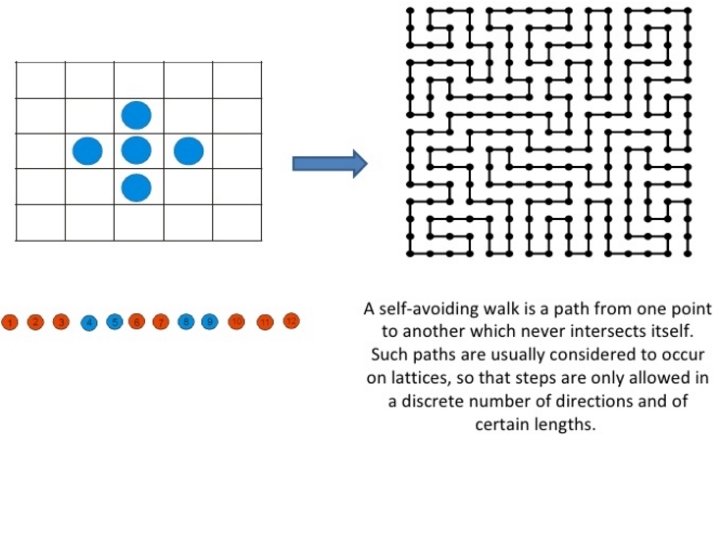
Self-avoiding walks Brian Hayes, “How to Avoid Yourself, ” American Scientist, July-August 1998, Volume 86, p. 314
Berger B and Leighton T (1998) Protein folding in the hydrophobic-hydrophilic (HP) model is NP-complete. J Comput Biol 5: 27 -40 Combinatorial explosion Number of HP model configurations at length n+1 n 43/32 2 * (2. 3683) * n
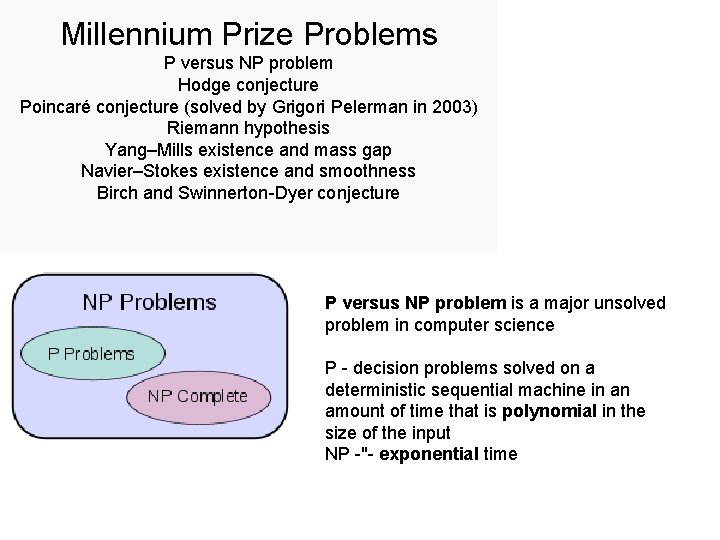
Millennium Prize Problems P versus NP problem Hodge conjecture Poincaré conjecture (solved by Grigori Pelerman in 2003) Riemann hypothesis Yang–Mills existence and mass gap Navier–Stokes existence and smoothness Birch and Swinnerton-Dyer conjecture P versus NP problem is a major unsolved problem in computer science P - decision problems solved on a deterministic sequential machine in an amount of time that is polynomial in the size of the input NP -"- exponential time
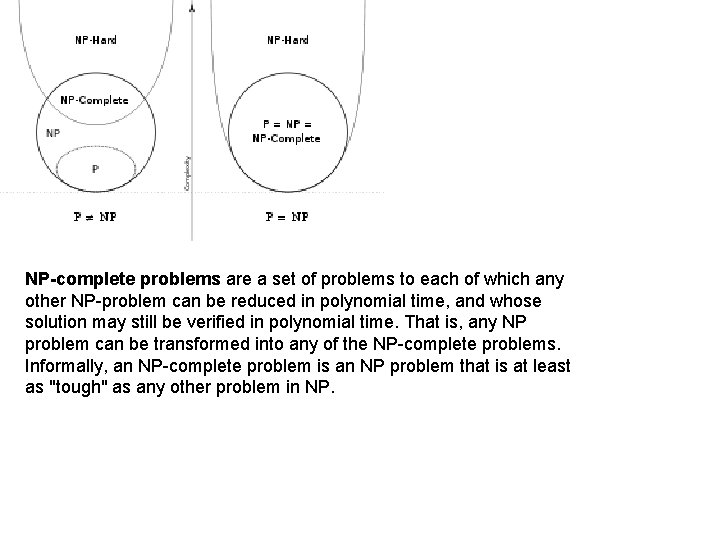
NP-complete problems are a set of problems to each of which any other NP-problem can be reduced in polynomial time, and whose solution may still be verified in polynomial time. That is, any NP problem can be transformed into any of the NP-complete problems. Informally, an NP-complete problem is an NP problem that is at least as "tough" as any other problem in NP.
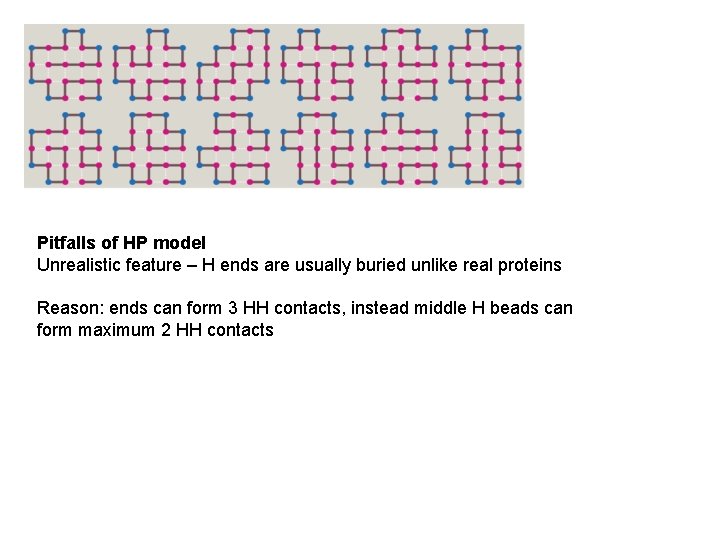
Pitfalls of HP model Unrealistic feature – H ends are usually buried unlike real proteins Reason: ends can form 3 HH contacts, instead middle H beads can form maximum 2 HH contacts
Unrealistic feature – unnatural extended polar loops Original HP model does not take in account compactness
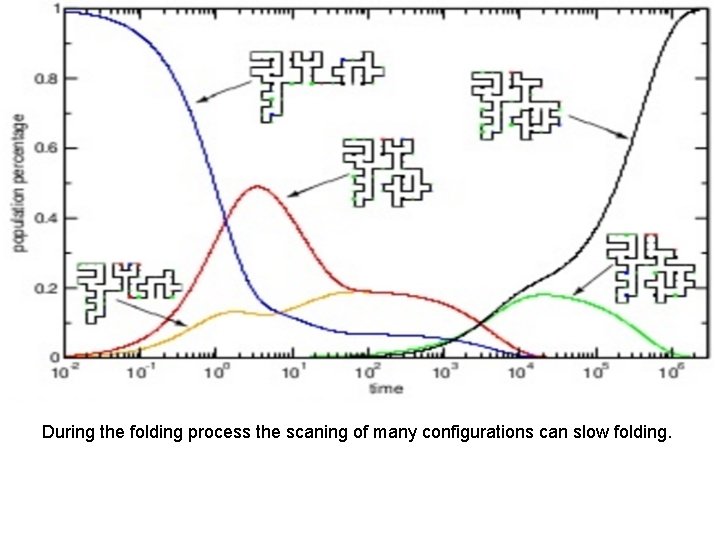
Folding process
During the folding process the scaning of many configurations can slow folding.
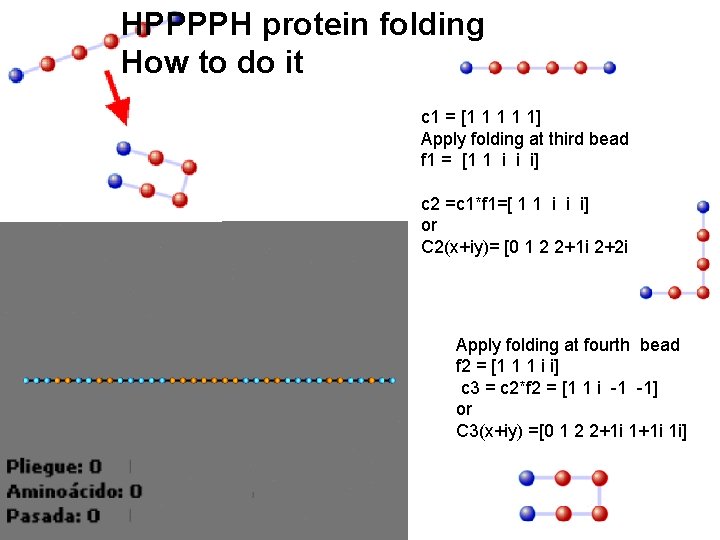
HPPPPH protein folding How to do it c 1 = [1 1 1] Apply folding at third bead f 1 = [1 1 i i i] c 2 =c 1*f 1=[ 1 1 i i i] or C 2(x+iy)= [0 1 2 2+1 i 2+2 i 2+3 i] Apply folding at fourth bead f 2 = [1 1 1 i i] c 3 = c 2*f 2 = [1 1 i -1 -1] or C 3(x+iy) =[0 1 2 2+1 i 1 i]
Basic operations: Bending c 1 = [1 1 1] Apply bending at third bead f 1 = [1 1 i i i] c 2 =c 1*f 1=[ 1 1 i i i] or C 2(x+iy)= [0 1 2 2+1 i 2+2 i 2+3 i] Flipping c 2 = [1 1 i i i] Apply flipping at second and third bond f 2 = [1 i i] c 3 =c 1*f 2=[ 1 i i] or C 3(x+iy)= [0 1 1+i 2+2 i 2+3 i]
Suboptimal folded configuration with E = - 3 Native configuration with E = - 4