
Role of heat shock proteins in aging AS

- Slides: 25
Role of heat shock proteins in aging A&S 300 -002 Jim Lund
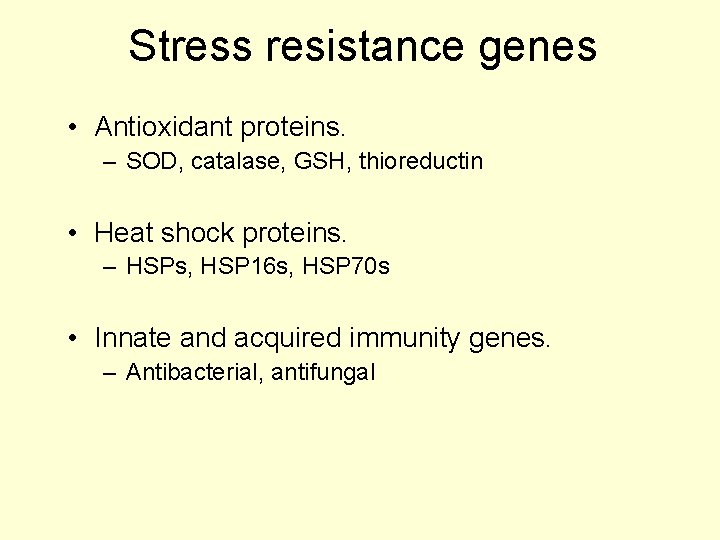
Stress resistance genes • Antioxidant proteins. – SOD, catalase, GSH, thioreductin • Heat shock proteins. – HSPs, HSP 16 s, HSP 70 s • Innate and acquired immunity genes. – Antibacterial, antifungal
Heat shock proteins • Initially discovered in Drosophila as proteins induced in response to culturing flies at high temperatures. (Ashburner and Bonner, 1978) • Now known to be ubiquitous. • Bacteria, vertebrates, plants.
Heat shock proteins • Induced in response to many stressors. • Heat shock • Heavy metals • Oxidative stress • Also called HSPs, cellular stress proteins and molecular chaperones.
Heat shock protein function • Chaperones: help newly synthesized proteins fold. • Protect proteins from cellular stresses that can cause unfolding and aggregation. • Target proteins to degradation, prevent and clean up protein aggregates.
Cellular roles of HSPs Macario el al. , 2005
HSP complexes Macario el al. , 2005
Heat shock protein function • Present normally in cells. • Stress increases levels of unfolded proteins, makes aggregates more likely to form. • Stress increases levels of HSPs. • Both transcriptional and post-transcriptional mechanisms. • Total levels of protein synthesis in the cell inhibited by stress.
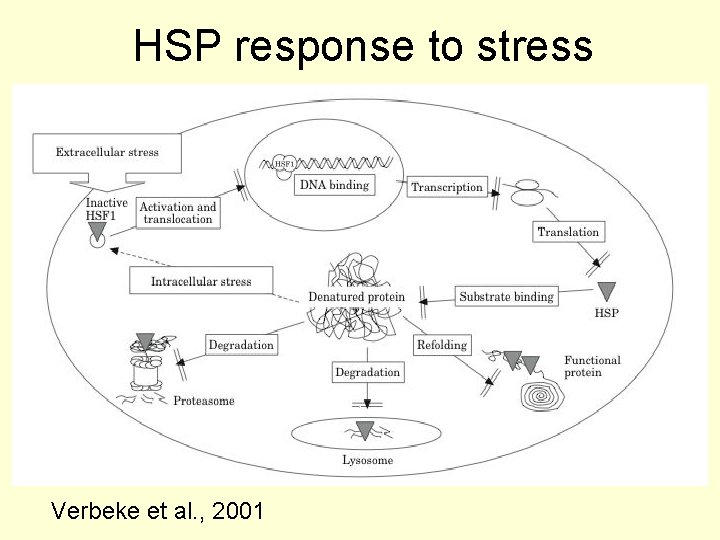
HSP response to stress Verbeke et al. , 2001
Heat shock induction declines with age • Cells in young animals rapidly alter levels of HSPs. • Older animals lose the ability to induce HSPs and other stress response proteins. • Observed in yeast, worms, flies, and mouse and human cell lines.
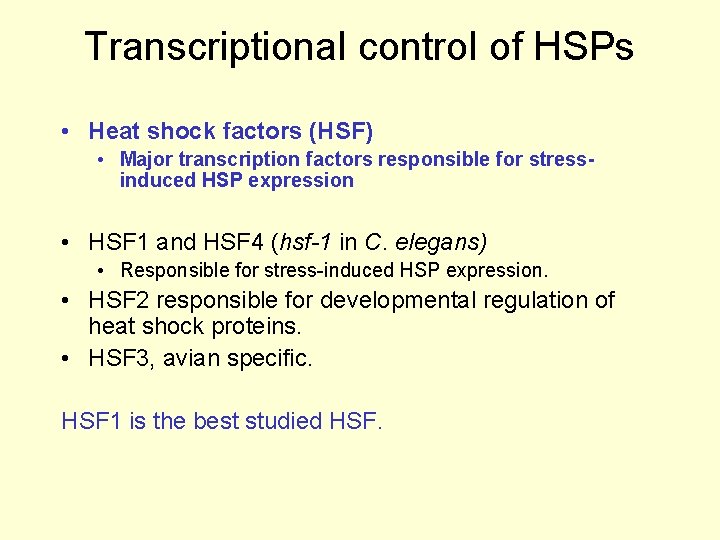
Transcriptional control of HSPs • Heat shock factors (HSF) • Major transcription factors responsible for stressinduced HSP expression • HSF 1 and HSF 4 (hsf-1 in C. elegans) • Responsible for stress-induced HSP expression. • HSF 2 responsible for developmental regulation of heat shock proteins. • HSF 3, avian specific. HSF 1 is the best studied HSF.
HSF functions Pirkkala et al. , 2001
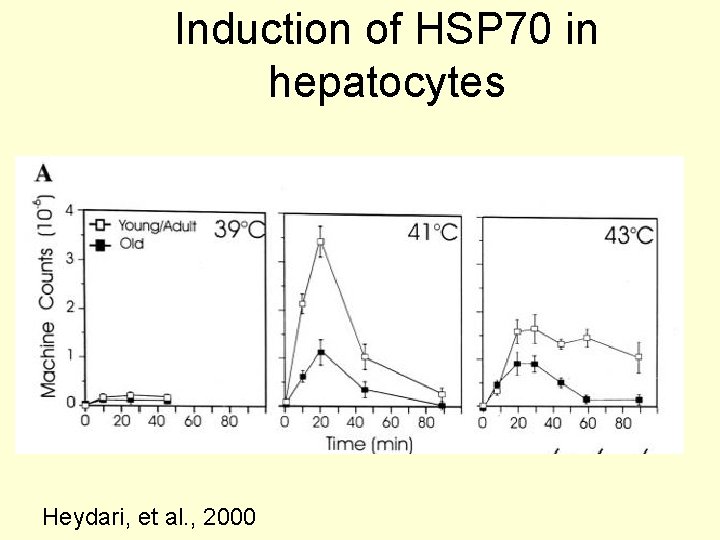
Induction of HSP 70 in hepatocytes Heydari, et al. , 2000
Age-related changes in HSF 1 • In rat hepatocytes, the regulation of HSF 70 by HSF 1 was studied. • HSF 1 induces HSP 70 in cells from young rats, but HSP 70 is only weakly induced in cells from old rats. • HSF 1 loses ability to bind the HSP 70 promoter in old cells. • HSF 1 undergoes post-transcription modification that alters promoter binding.
HSP overexpression can extend lifespan • Hsp 22 (a mitochondrial HSP) overexpression can extend lifespan in Drosophila. – Ubiquitous or targeted expression in motorneurons: 30% lifespan extension. (Kurapati et al. , 2000) • Drosophila lines selected for longevity. – Hsp 22 2 X - 10 X higher expression relative to control outbred lines. – Hsp 23 also significantly overexpressed. (Kurapati et al. , 2004)
Mitochondrial HSPs Overexpression of HSPs in mitochondria. • Decreases production of free radicals. • Increases mitochondrial efficiency. May be a mechanism by which HSP overexpression leads to longevity.
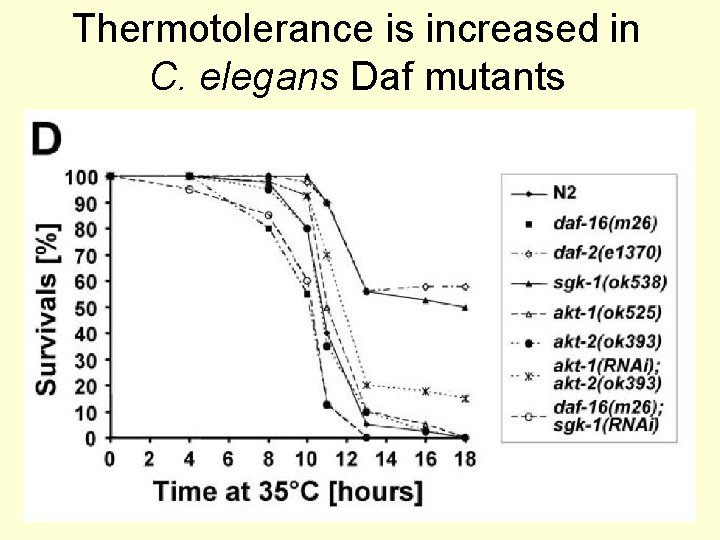
HSP overexpression can extend lifespan • HSP 16 in the worm is not expressed in young worms, but expressed in old (16+ days old) worms. • Overexpression of HSP 16 extends lifespan. • Depends on DAF-16. • Thermotolerance also increased. Walker and Lithgow 2003
Thermotolerance is increased in C. elegans Daf mutants
DAF-16 and HSPs • HSP 70 and HSP 90 expression is also dependent on DAF-16 (Forkhead family transcription factor) expression. Munox et al. , 2003
HSP 16 transgenics: +15% lifespan
HSF-1 expression affects lifespan • C. elegans hsf-1 knockout has reduced lifespan. • hsp-1 overexpression extends lifespan. • Recall daf-2 has a long lifespan. hsf-1 is required for daf-2 long lifespan. Hsu et al. , 2003
HSP and protein aggregation • Protein aggregate formation is involved in the development of neurogenerative disease. – -amyloid, tau, and polyglutamine protein aggregate formation is slowed by HSPs – Overexpression of HSPs delayed aggregate formation. • hsf-1 overexpression in C. elegans delays formation of polyglutamine protein aggregates (Hsu et al. , 2003).
HSF transcription response • Chromatin immunoprecipitation (Ch. IP) combined with DNA microarrays was used to identify direct trascriptional targets of HSF in yeast. • 3% of yeast genes identified as targets: – Protein folding and degradation – Energy generation – Protein trafficking – Maintenance of cell integrity – Small molecule transport – Cell signaling – Transcription
HSF activated genes Hahn et al. , 2004
HSF activated genes are stress induced Hahn et al. , 2004