HOW TO INCREASE NEAR MISS REPORTING IEC Regulatory







- Slides: 43
HOW TO INCREASE NEAR MISS REPORTING IEC Regulatory Compliance Program April 25, 2016
TODAY’S GOAL Give safety leaders ideas on how to increase near miss reporting in order to help keep employees safe. 2
PRESENTATION OVERVIEW How to Increase Near Miss Reporting • Definition: Near Miss • Reluctance to Report Near Misses • Benefits of Reporting Near Misses • How to Improve Near Miss Reporting • Actions Needed to Address Near Miss Reporting • Keeping the Process Flowing 3
If you were asked to define a near miss, what would you say? 4
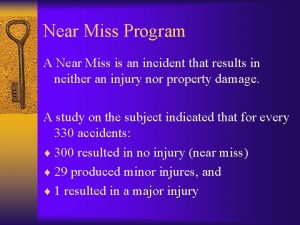
WHAT IS A NEAR MISS? • Simply put…a close call! • Individual(s) involved were not injured • May have resulted in damage to T&E • If not attended to and corrected, more than likely will result in one or more of your employees being injured or acquiring an illness from its cause Definition: Near Miss 5
• Forklift tipped over while carrying load that shifted on an uneven work surface. Driver escaped without a scratch by staying buckled inside the cage. • Mechanic working under railcar had just stepped away when the car was struck by another railcar being positioned on an active work track. • Forklift ran over welder’s foot (which was protected by his steel toed boots) when the driver backed up and did not see him walking behind his lift. Definition: Near Miss
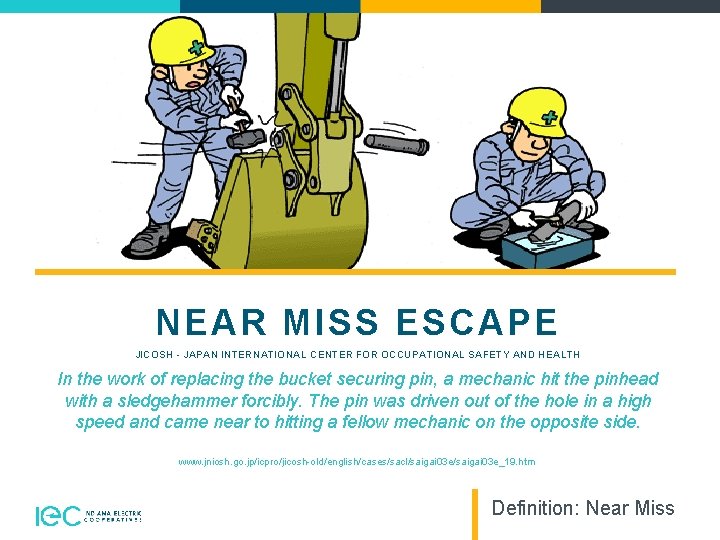
NEAR MISS ESCAPE JICOSH - JAPAN INTERNATIONAL CENTER FOR OCCUPATIONAL SAFETY AND HEALTH In the work of replacing the bucket securing pin, a mechanic hit the pinhead with a sledgehammer forcibly. The pin was driven out of the hole in a high speed and came near to hitting a fellow mechanic on the opposite side. www. jniosh. go. jp/icpro/jicosh-old/english/cases/sacl/saigai 03 e_19. htm Definition: Near Miss
OSHA: FATAL FACTS A near miss is often only an Inch or two away from a tragedy. • A carpenter apprentice was killed when he was struck in the head by a nail that was fired from a power actuated tool. • The tool operator, while attempting to anchor a plywood form in preparation for pouring a concrete wall, fired the gun causing the nail to pass through the hollow wall. • The nail traveled some twenty-seven feet before striking the victim. • The tool operator had never received training in the proper use of the tool, and none of the employees in the area were wearing personal protective equipment. http: //www. osha. gov/Osh. Doc/data_Fatal. Facts/f-facts 02. html Definition: Near Miss
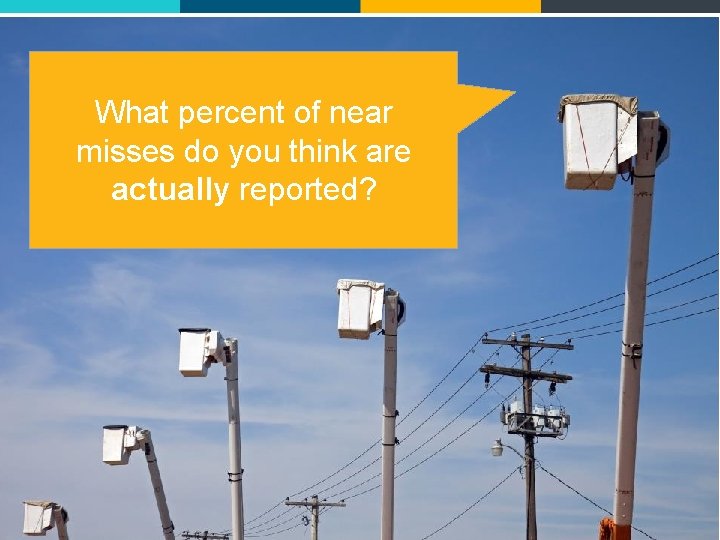
What percent of near misses do you think are actually reported?
Near miss incidents in any organization outnumber actual injuries between 2: 1 and 4: 1 Personal Opinions Less than 20% of near miss incidents are actually reported to the proper authority. Reluctance to Report Near Misses
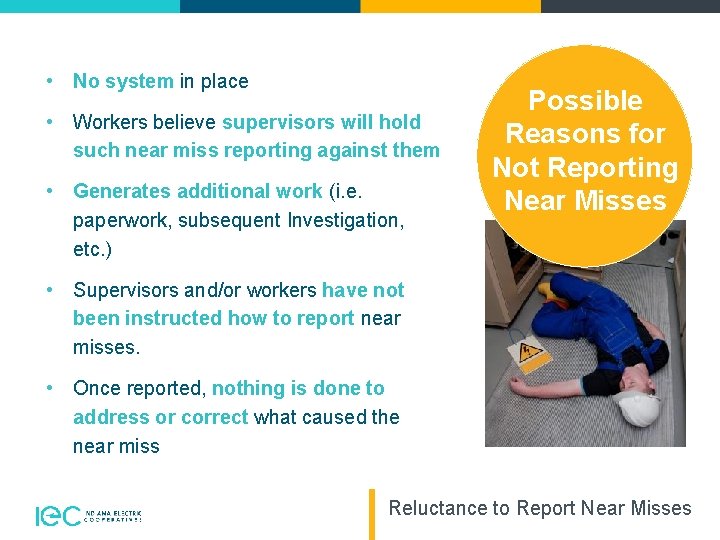
• No system in place • Workers believe supervisors will hold such near miss reporting against them • Generates additional work (i. e. paperwork, subsequent Investigation, etc. ) Possible Reasons for Not Reporting Near Misses • Supervisors and/or workers have not been instructed how to report near misses. • Once reported, nothing is done to address or correct what caused the near miss Reluctance to Report Near Misses
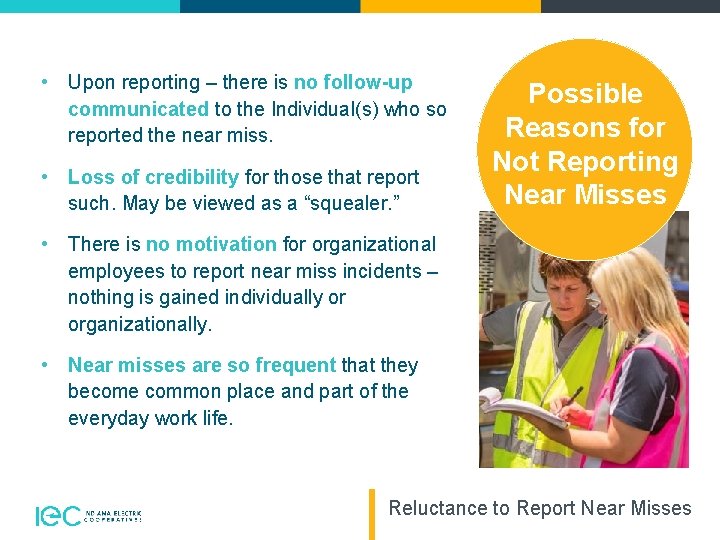
• Upon reporting – there is no follow-up communicated to the Individual(s) who so reported the near miss. • Loss of credibility for those that report such. May be viewed as a “squealer. ” Possible Reasons for Not Reporting Near Misses • There is no motivation for organizational employees to report near miss incidents – nothing is gained individually or organizationally. • Near misses are so frequent that they become common place and part of the everyday work life. Reluctance to Report Near Misses
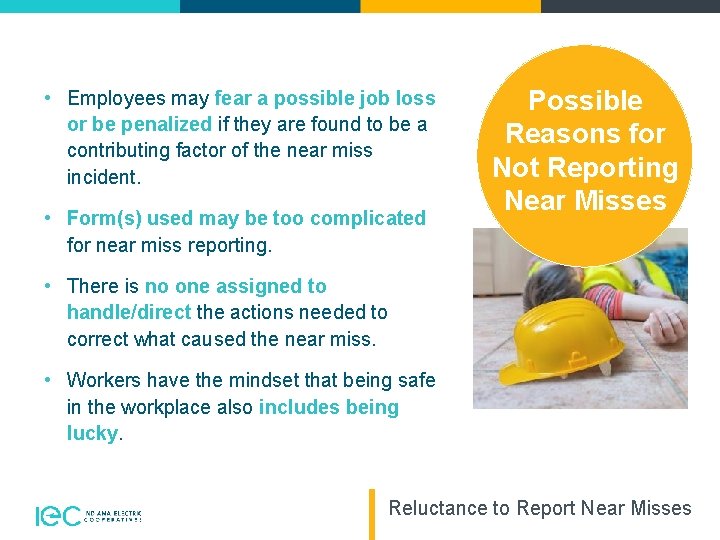
• Employees may fear a possible job loss or be penalized if they are found to be a contributing factor of the near miss incident. • Form(s) used may be too complicated for near miss reporting. Possible Reasons for Not Reporting Near Misses • There is no one assigned to handle/direct the actions needed to correct what caused the near miss. • Workers have the mindset that being safe in the workplace also includes being lucky. Reluctance to Report Near Misses
We must find ways to hear and learn from our near misses.
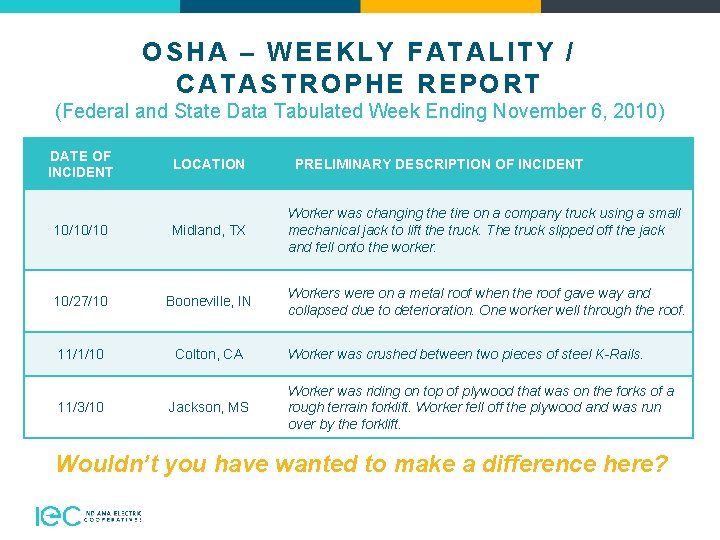
OSHA – WEEKLY FATALITY / CATASTROPHE REPORT (Federal and State Data Tabulated Week Ending November 6, 2010) DATE OF INCIDENT LOCATION PRELIMINARY DESCRIPTION OF INCIDENT 10/10/10 Midland, TX Worker was changing the tire on a company truck using a small mechanical jack to lift the truck. The truck slipped off the jack and fell onto the worker. 10/27/10 Booneville, IN Workers were on a metal roof when the roof gave way and collapsed due to deterioration. One worker well through the roof. 11/1/10 Colton, CA 11/3/10 Jackson, MS Worker was crushed between two pieces of steel K-Rails. Worker was riding on top of plywood that was on the forks of a rough terrain forklift. Worker fell off the plywood and was run over by the forklift. Wouldn’t you have wanted to make a difference here?
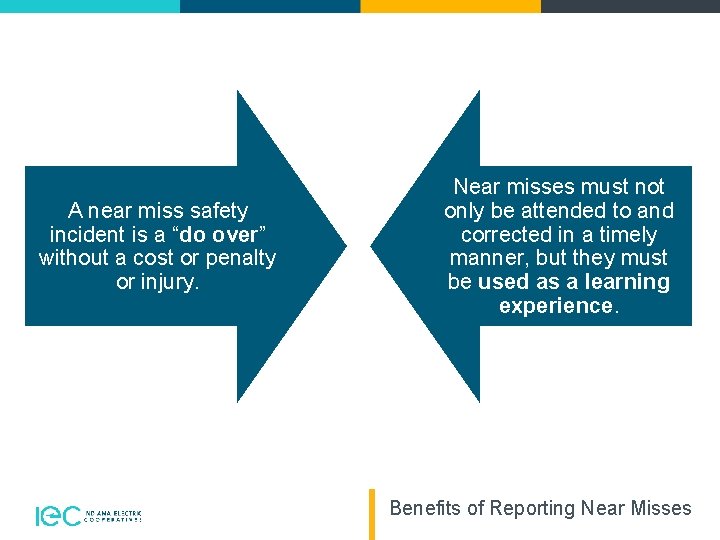
A near miss safety incident is a “do over” without a cost or penalty or injury. Near misses must not only be attended to and corrected in a timely manner, but they must be used as a learning experience. Benefits of Reporting Near Misses
Real Life Example Benefits of Reporting Near Misses
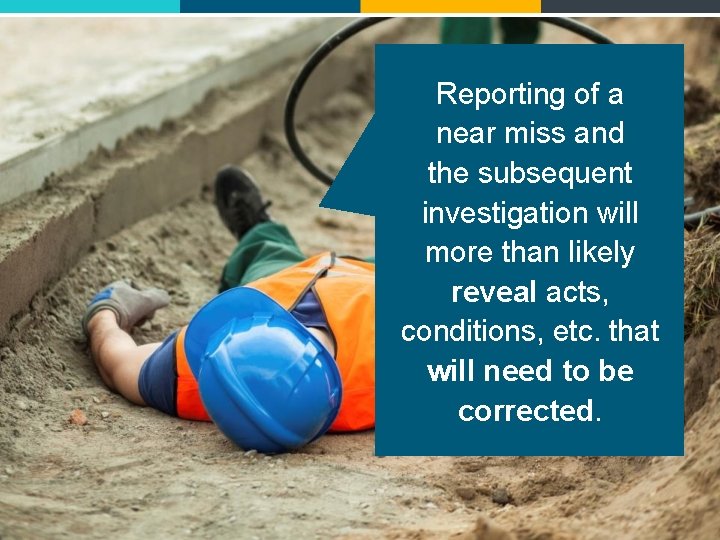
Reporting of a near miss and the subsequent investigation will more than likely reveal acts, conditions, etc. that will need to be corrected.
Existing Conditions Do not be surprised when investigating near misses if you find unsafe conditions that have been present for some time. No Standard Work Practice Near miss incidents are often caused by having no such standard practice or procedure in place, which results in having various and most likely unsafe ways to accomplish a task or responsibility. Lack of Training Another condition that leads to safety incidents is the lack of training of the workers involved – i. e. how to safely use a comealong. Benefits of Reporting Near Misses
Using Improper or Unsafe Tools Can a near miss incident ever be caused by management? A tool is given to an employee that is either improper or unsafe to use for the job that they are asked to perform. Cutting Corners Employees not following the steps that need to be performed in a specific order. Such may be due to complacency and the belief that they will not get hurt or it may include simply trying to speed up their work process. Benefits of Reporting Near Misses
Lack of Safety Awareness There is a lack of safety awareness by people involved in near misses and accidents. • Not seeing co-workers in immediate work area. • Placing body parts between pinch points. • Not checking work area prior to setting up or beginning work. Outdated Procedures Organizations must ensure that when their processes change they must update their procedures to reflect such changes. Benefits of Reporting Near Misses
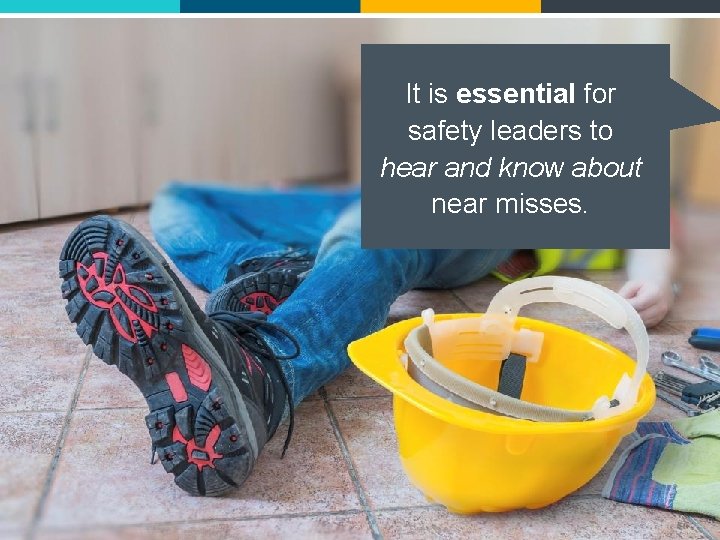
It is essential for safety leaders to hear and know about near misses.
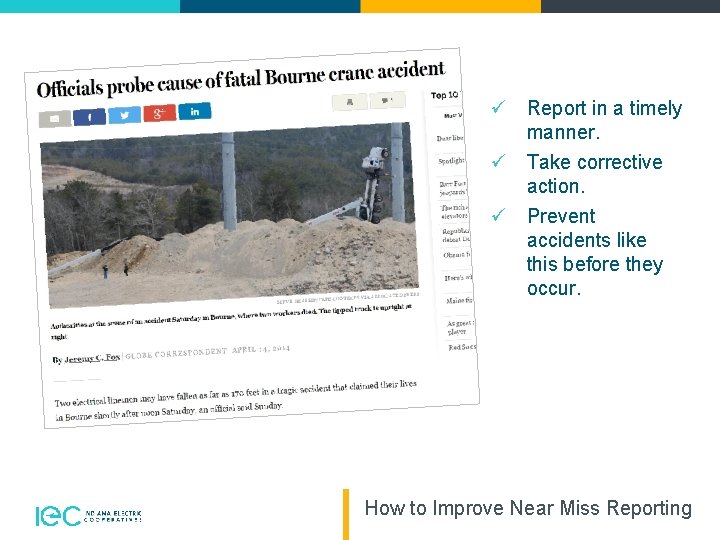
ü Report in a timely manner. ü Take corrective action. ü Prevent accidents like this before they occur. How to Improve Near Miss Reporting
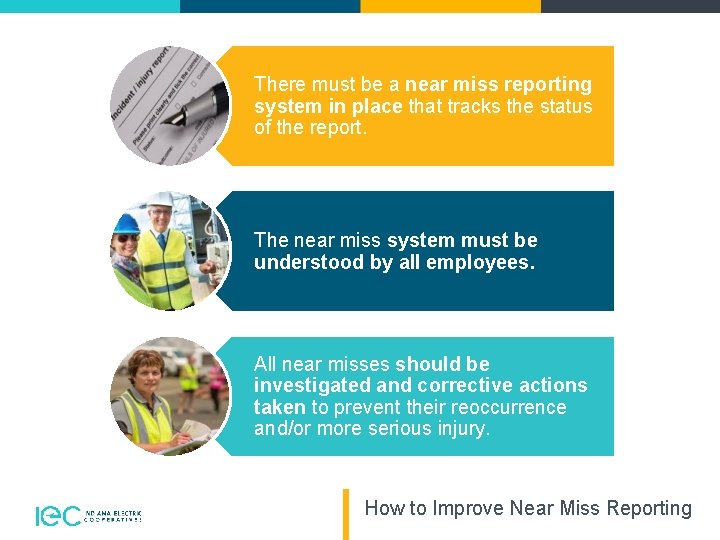
There must be a near miss reporting system in place that tracks the status of the report. The near miss system must be understood by all employees. All near misses should be investigated and corrective actions taken to prevent their reoccurrence and/or more serious injury. How to Improve Near Miss Reporting
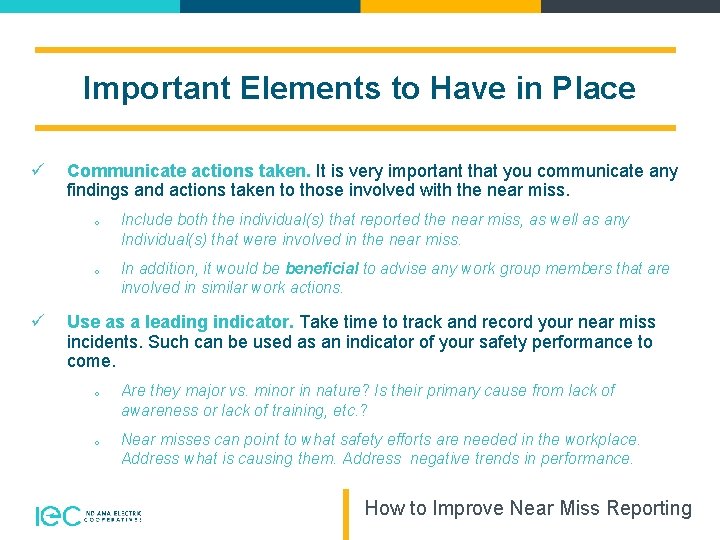
Important Elements to Have in Place ü No penalty. There should be no penalty to any employee that reports a near miss. o As soon as such is experienced, all near misses will go underground. ü Driver of the system. At each of your locations, you need to have someone assigned to be the “handler” of all near misses. o Such duties will include recording, leading the near miss investigation and helping to determine and complete corrective actions to prevent any reoccurrence. How to Improve Near Miss Reporting
Important Elements to Have in Place ü Publicize your efforts. In order to make near miss reporting successful, you must publicize your efforts. o o Find a way to report how corrective actions taken as a result of near misses have helped your cooperative and employees by making their workplace safer. You will have employees reluctant to report near misses until they see that they have something to gain from reporting. ü Share with others. Near misses can and should be a learning tool for all applicable employees. o Make sure that you take time to not only share the near miss incident but also how it occurred and what actions were taken to prevent its reoccurrence. How to Improve Near Miss Reporting
Important Elements to Have in Place ü Communicate actions taken. It is very important that you communicate any findings and actions taken to those involved with the near miss. o o ü Include both the individual(s) that reported the near miss, as well as any Individual(s) that were involved in the near miss. In addition, it would be beneficial to advise any work group members that are involved in similar work actions. Use as a leading indicator. Take time to track and record your near miss incidents. Such can be used as an indicator of your safety performance to come. o o Are they major vs. minor in nature? Is their primary cause from lack of awareness or lack of training, etc. ? Near misses can point to what safety efforts are needed in the workplace. Address what is causing them. Address negative trends in performance. How to Improve Near Miss Reporting
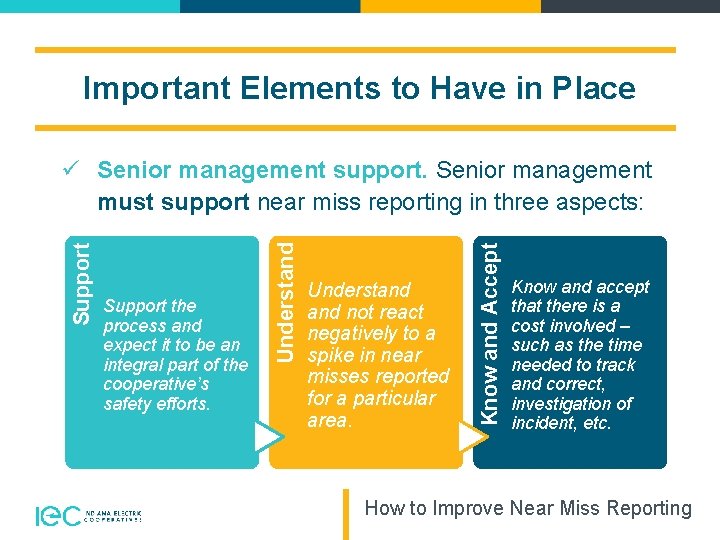
Important Elements to Have in Place Understand not react negatively to a spike in near misses reported for a particular area. Know and Accept Support the process and expect it to be an integral part of the cooperative’s safety efforts. Understand Support ü Senior management support. Senior management must support near miss reporting in three aspects: Know and accept that there is a cost involved – such as the time needed to track and correct, investigation of incident, etc. How to Improve Near Miss Reporting
The actions we take in response to near miss reporting will determine the success of the process.
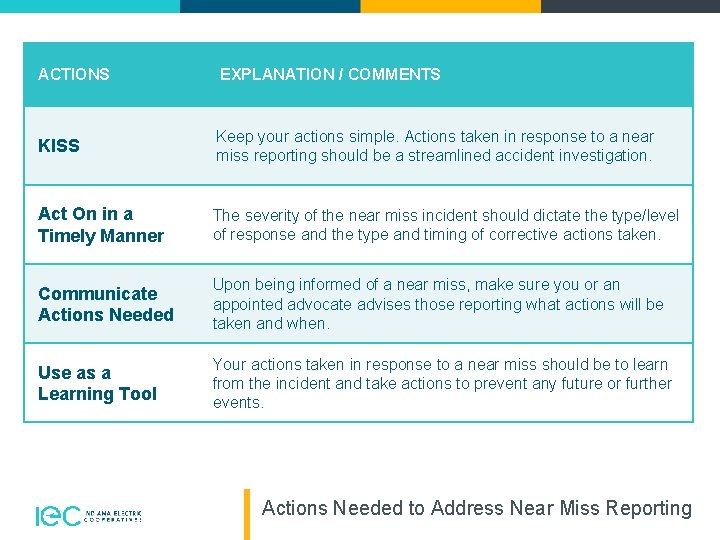
ACTIONS EXPLANATION / COMMENTS KISS Keep your actions simple. Actions taken in response to a near miss reporting should be a streamlined accident investigation. Act On in a Timely Manner The severity of the near miss incident should dictate the type/level of response and the type and timing of corrective actions taken. Communicate Actions Needed Upon being informed of a near miss, make sure you or an appointed advocate advises those reporting what actions will be taken and when. Use as a Learning Tool Your actions taken in response to a near miss should be to learn from the incident and take actions to prevent any future or further events. Actions Needed to Address Near Miss Reporting
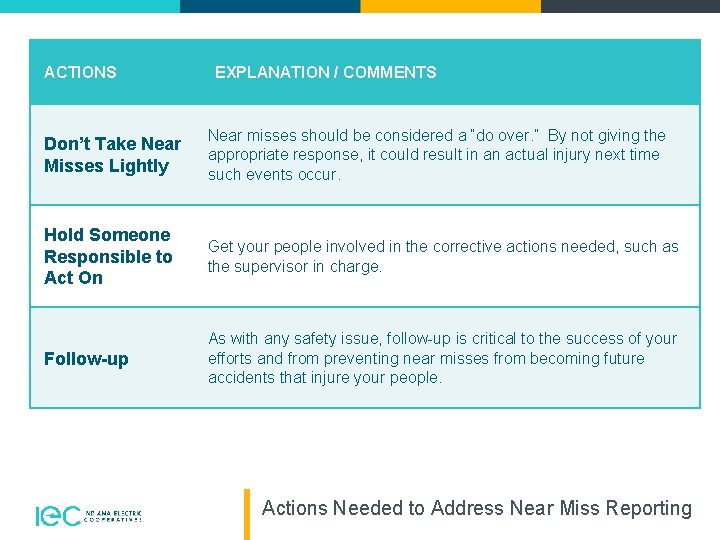
ACTIONS EXPLANATION / COMMENTS Don’t Take Near Misses Lightly Near misses should be considered a “do over. ” By not giving the appropriate response, it could result in an actual injury next time such events occur. Hold Someone Responsible to Act On Get your people involved in the corrective actions needed, such as the supervisor in charge. Follow-up As with any safety issue, follow-up is critical to the success of your efforts and from preventing near misses from becoming future accidents that injure your people. Actions Needed to Address Near Miss Reporting
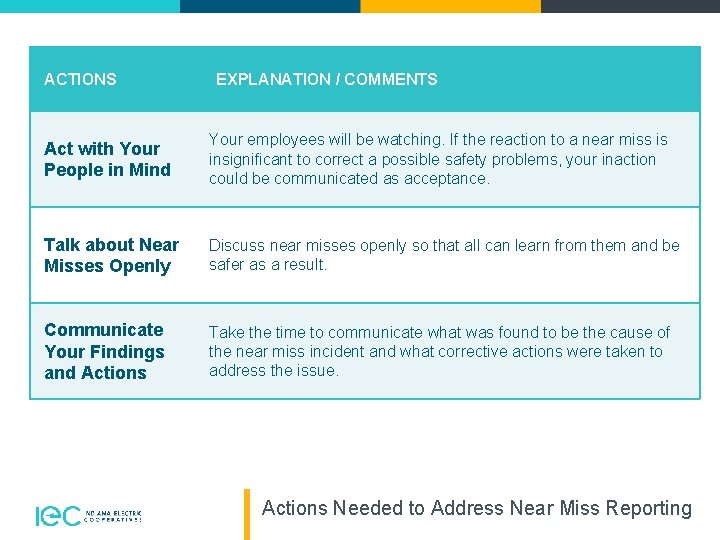
ACTIONS EXPLANATION / COMMENTS Act with Your People in Mind Your employees will be watching. If the reaction to a near miss is insignificant to correct a possible safety problems, your inaction could be communicated as acceptance. Talk about Near Misses Openly Discuss near misses openly so that all can learn from them and be safer as a result. Communicate Your Findings and Actions Take the time to communicate what was found to be the cause of the near miss incident and what corrective actions were taken to address the issue. Actions Needed to Address Near Miss Reporting
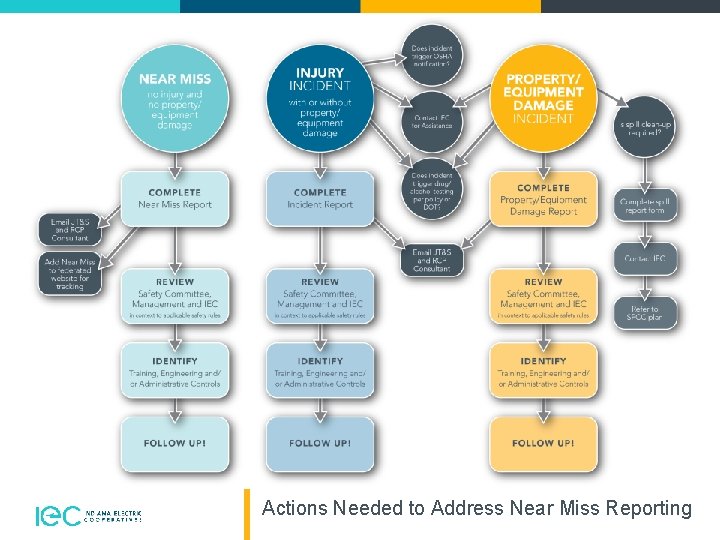
Actions Needed to Address Near Miss Reporting
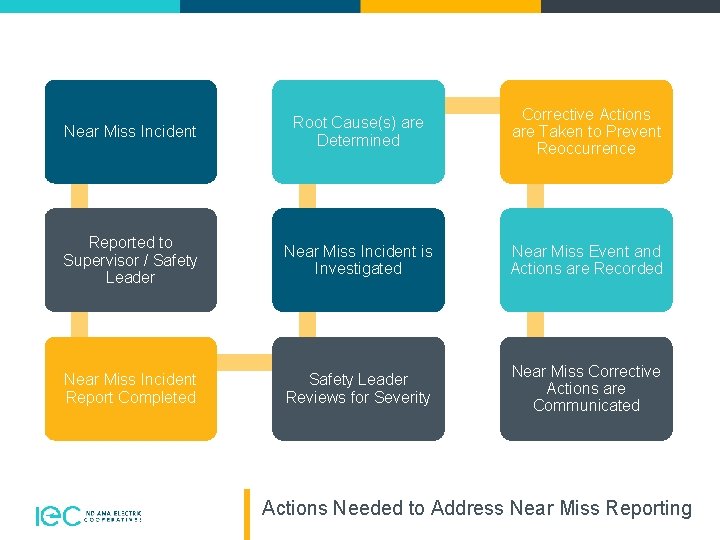
Near Miss Incident Root Cause(s) are Determined Corrective Actions are Taken to Prevent Reoccurrence Reported to Supervisor / Safety Leader Near Miss Incident is Investigated Near Miss Event and Actions are Recorded Near Miss Incident Report Completed Safety Leader Reviews for Severity Near Miss Corrective Actions are Communicated Actions Needed to Address Near Miss Reporting
How do we keep the process flowing and ensure success?
Make it an integral part of your cooperative ’s safety program. Near miss incidents that are severe in nature should receive as much attention and corrective action as an actual accident/injury. Be consistent with your response to and actions taken. Keep the Process Flowing
Reporting of near misses never be incentivized. Let the program prove its merit. Let your employees know near miss non-reporting is unacceptable. Communication of both near miss events and the corrective actions taken will be the key to its success. Employees should never be penalized for reporting near miss incidents. Keep the Process Flowing
Learn from your near miss incidents and be safer because of them. As with any safety effort, revitalize from time to ensure reporting matches current processes. Any and all near miss incidents should be shared with others. Let them learn! Engage your entire organization. Keep management in the loop. Keep the Process Flowing
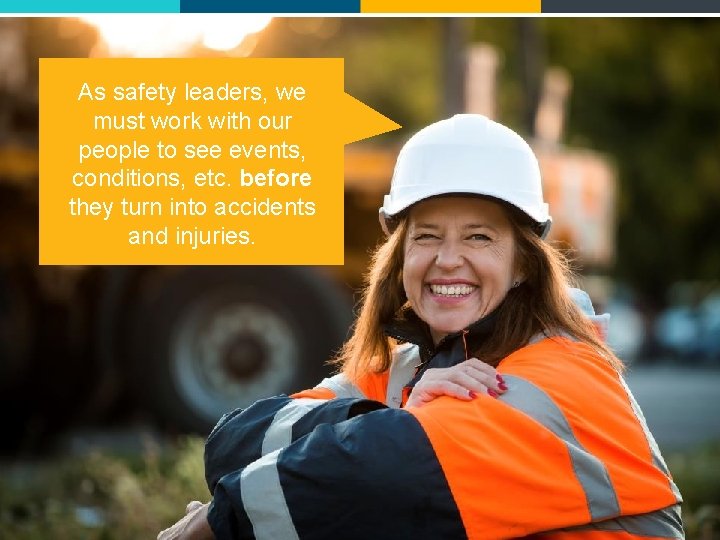
As safety leaders, we must work with our people to see events, conditions, etc. before they turn into accidents and injuries.
Safety leaders must be there for our people – including those that DO and DON’T know better.
QUESTIONS? Kodi Swafford kswafford@indianaec. org 42
HOW TO INCREASE NEAR MISS REPORTING REFERENCES – THOSE NOTED • Forck, Matthew (2010). The S. T. O. R. M Model for Near-Miss Reporting. TDWorld. com. Retrieved December 26, 2010 from http: //tdworld. com/overhead_distribution/storm-model-near-miss-reporting-20100201/ • Professional Safety (Nov 2010). Safety Management – Webinar Encourages Near-Miss Reporting. American Society of Safety Engineers. Retrieved December 10, 2010 from http: //findarticles. com/p/articles/mi_hb 5618/is_200911/ai_n 42857768/ • Forck, Matt (Oct 2009). Near Miss Reporting – The Sounds of Silence. ISHN. Retrieved December 29, 2010 from http: //www. ishn. com/Articles/Feature_Article/BNP_GUID_9 -52006_A_10000000678682