Homeowner Association Law and Small Claims Court A







- Slides: 35
Homeowner Association Law and Small Claims Court: A Mixed Bag California Conference on Self-Represented Litigants San Francisco, June 2011 Center for California Homeowner Association Law Oakland, California: http: //www. calhomelaw. org Copyright 2011, All Rights Reserved June 9, 2011 1
CID: WHAT DOES IT LOOK LIKE? v v v v Planned unit development of single-family detached/attached homes Condominium Mobile home park Stock cooperative Community apartment project Key feature of the CID: “Separate interest coupled with undivided interest” [Civil Code § 1351] 2
WHAT DOES IT DO? v v v Provides many services formerly provided only by local government Levies “taxes, ” i. e. assessments, adopts budgets, spends the money*** Can foreclose, like a bank, in order to force payment of assessments Is run by an elected board with legislative, executive, judicial powers i. e. behaves like government but with limited statutory restraints on its powers.
CALIFORNIA LAWS GOVERNING CIDS v v Davis-Stirling Act [Civil Code §§ 1350 -1375. 05] Nonprofit Corporation Law [Corp. Code §§ 7110 et seq. ] Subdivided Lands Act [Sections 11000 -11202 of the Business and Professions Code] Local Codes: Cities and Counties 4
Facts to Keep in Mind v v v About 9 million Californians live in HOAs 49, 000 HOAs in California in 2010 HOAs are home to all income groups, including low-income California HOAs now control $10 B – in cash Terms: HOA v CID Local governments tend to build affordable ownership housing in CIDs, because of the high cost of land and/or high cost of labor; but state laws make affordability difficult to maintain
Three Most Common Disputes v v Getting access to association records, especially financial records Challenging election procedures and election results Disputing assessments or other charges Convergence of all three issues: records, elections, and assessments/charges 6
Association Industry Infrastructure v v Players: HOA board with corporate powers and attorney on retainer Interlocking industry of property managers, debt collectors, trustees and their attorneys Law firms or subdivisions of law firms specializing in assessment collection and foreclosure; role of the debt collector Typical homeowner has no attorney and is unaware of his/her consumer rights
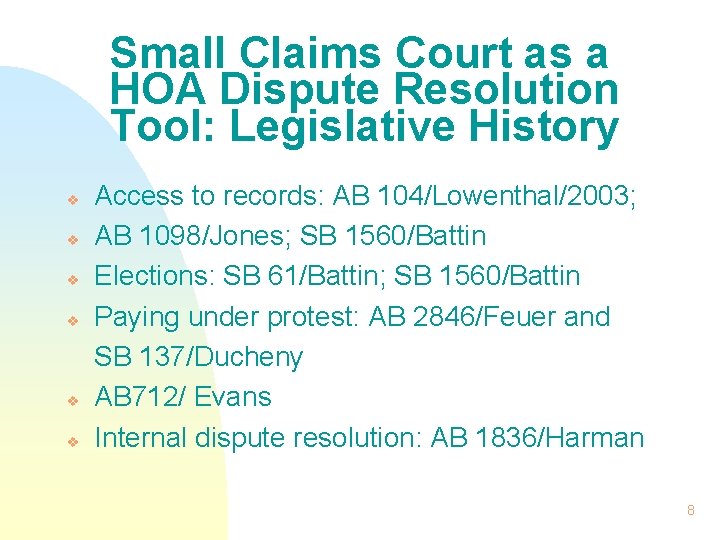
Small Claims Court as a HOA Dispute Resolution Tool: Legislative History v v v Access to records: AB 104/Lowenthal/2003; AB 1098/Jones; SB 1560/Battin Elections: SB 61/Battin; SB 1560/Battin Paying under protest: AB 2846/Feuer and SB 137/Ducheny AB 712/ Evans Internal dispute resolution: AB 1836/Harman 8
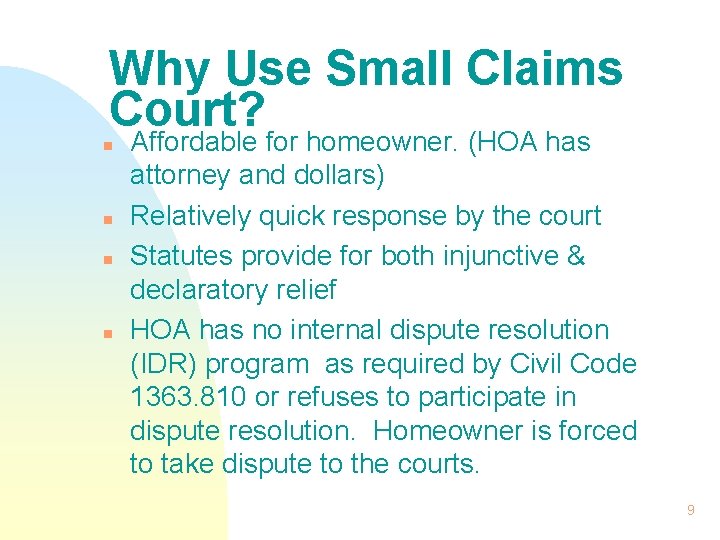
Why Use Small Claims Court? n n Affordable for homeowner. (HOA has attorney and dollars) Relatively quick response by the court Statutes provide for both injunctive & declaratory relief HOA has no internal dispute resolution (IDR) program as required by Civil Code 1363. 810 or refuses to participate in dispute resolution. Homeowner is forced to take dispute to the courts. 9
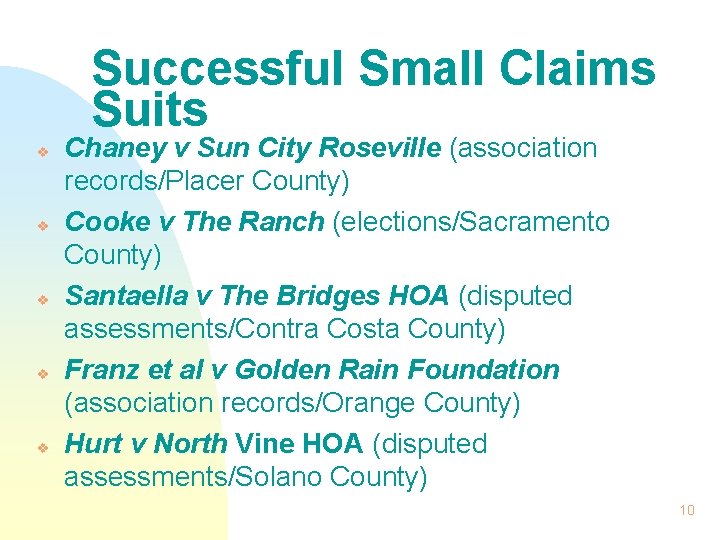
Successful Small Claims Suits v v v Chaney v Sun City Roseville (association records/Placer County) Cooke v The Ranch (elections/Sacramento County) Santaella v The Bridges HOA (disputed assessments/Contra Costa County) Franz et al v Golden Rain Foundation (association records/Orange County) Hurt v North Vine HOA (disputed assessments/Solano County) 10
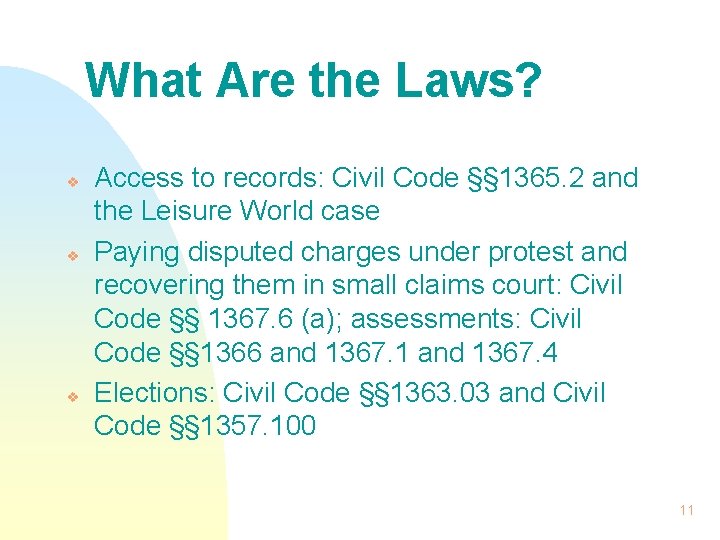
What Are the Laws? v v v Access to records: Civil Code §§ 1365. 2 and the Leisure World case Paying disputed charges under protest and recovering them in small claims court: Civil Code §§ 1367. 6 (a); assessments: Civil Code §§ 1366 and 1367. 1 and 1367. 4 Elections: Civil Code §§ 1363. 03 and Civil Code §§ 1357. 100 11
Association Records 12
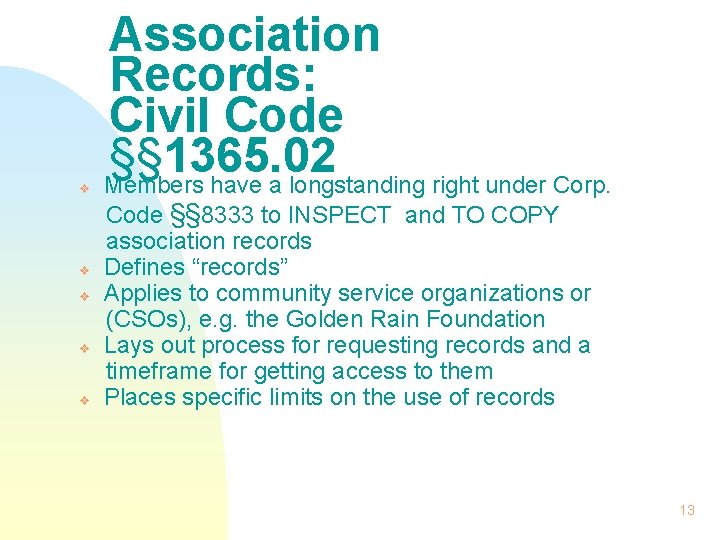
v v v Association Records: Civil Code §§ 1365. 02 Members have a longstanding right under Corp. Code §§ 8333 to INSPECT and TO COPY association records Defines “records” Applies to community service organizations or (CSOs), e. g. the Golden Rain Foundation Lays out process for requesting records and a timeframe for getting access to them Places specific limits on the use of records 13
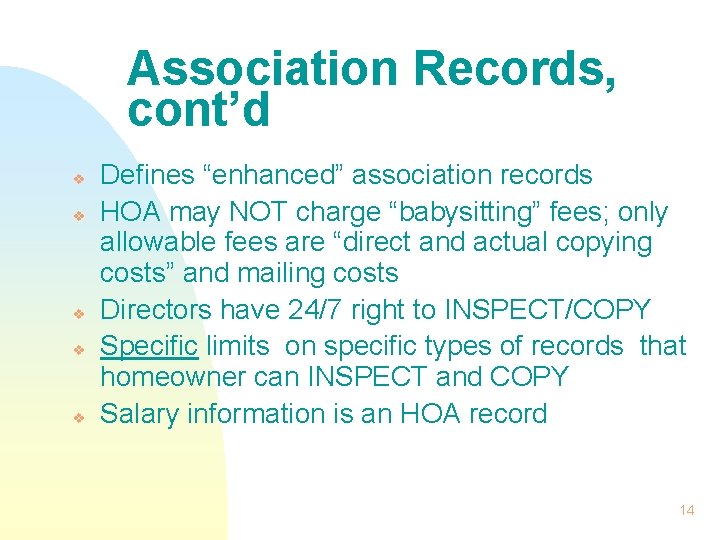
Association Records, cont’d v v v Defines “enhanced” association records HOA may NOT charge “babysitting” fees; only allowable fees are “direct and actual copying costs” and mailing costs Directors have 24/7 right to INSPECT/COPY Specific limits on specific types of records that homeowner can INSPECT and COPY Salary information is an HOA record 14
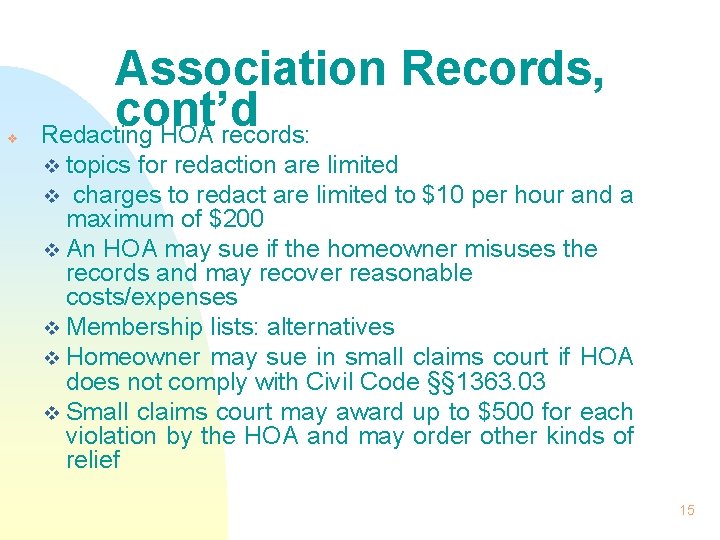
v Association Records, cont’d Redacting HOA records: v topics for redaction are limited v charges to redact are limited to $10 per hour and a maximum of $200 v An HOA may sue if the homeowner misuses the records and may recover reasonable costs/expenses v Membership lists: alternatives v Homeowner may sue in small claims court if HOA does not comply with Civil Code §§ 1363. 03 v Small claims court may award up to $500 for each violation by the HOA and may order other kinds of relief 15
Paying Disputed Charges Under Protest 16
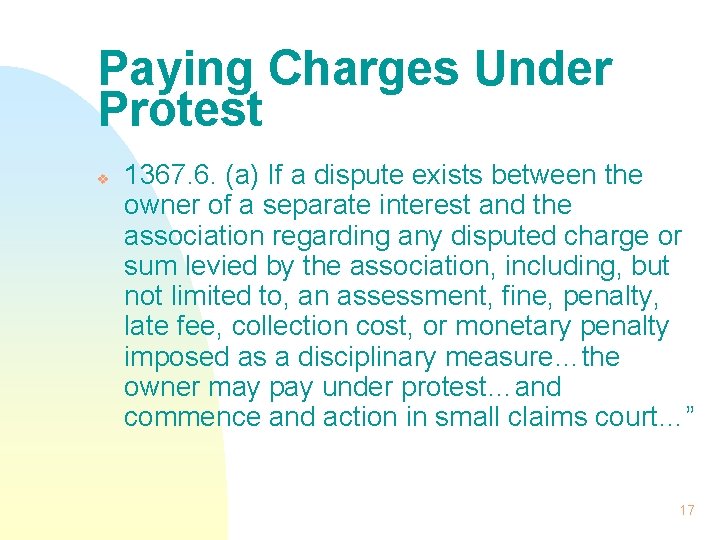
Paying Charges Under Protest v 1367. 6. (a) If a dispute exists between the owner of a separate interest and the association regarding any disputed charge or sum levied by the association, including, but not limited to, an assessment, fine, penalty, late fee, collection cost, or monetary penalty imposed as a disciplinary measure…the owner may pay under protest…and commence and action in small claims court…” 17
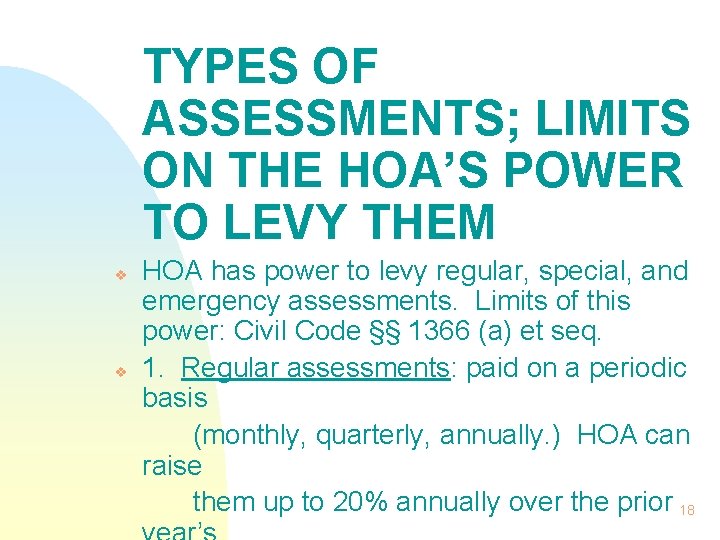
TYPES OF ASSESSMENTS; LIMITS ON THE HOA’S POWER TO LEVY THEM v v HOA has power to levy regular, special, and emergency assessments. Limits of this power: Civil Code §§ 1366 (a) et seq. 1. Regular assessments: paid on a periodic basis (monthly, quarterly, annually. ) HOA can raise them up to 20% annually over the prior 18
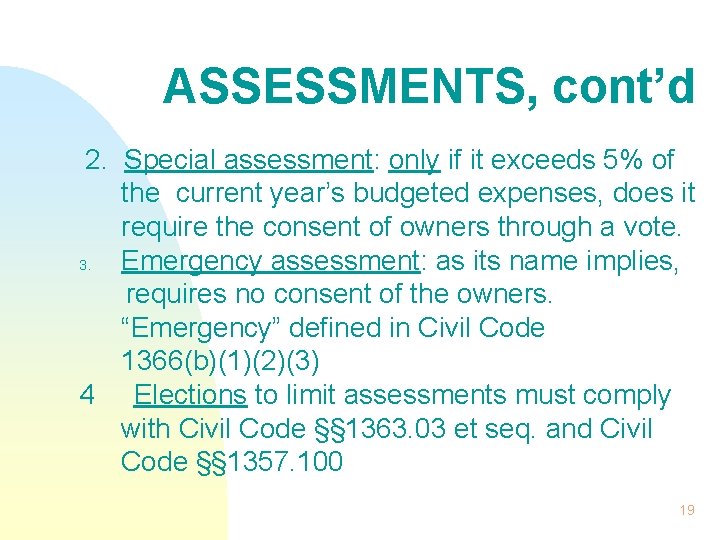
ASSESSMENTS, cont’d 2. Special assessment: only if it exceeds 5% of the current year’s budgeted expenses, does it require the consent of owners through a vote. 3. Emergency assessment: as its name implies, requires no consent of the owners. “Emergency” defined in Civil Code 1366(b)(1)(2)(3) 4 Elections to limit assessments must comply with Civil Code §§ 1363. 03 et seq. and Civil Code §§ 1357. 100 19
FORECLOSURE IN THE CID ENVIRONMENT v v v HOA has the power to foreclose to force payment of assessments (of any type) and ALL collection costs: Civil Code §§ 1367, et seq. HOA typically uses nonjudicial foreclosure Foreclosure can be used ONLY to collect assessments and NOT fines or penalties. Assessments owed must be a minimum of $1800 excluding collection costs for HOA to foreclose v Assessment figure can be less if owed for 12+ months [see foreclosure handout for more details] v 20
Foreclosure, cont’d v v v Players: HOA board, property manager, debt collector, trustee and their attorneys; and homeowner, who typically has no attorney Foreclosure is not an absolute right: it must be preceded by multiple disclosure and noticing requirements executed by HOA board Decision to foreclose must be made by the HOA board; it can’t be delegated to a HOA agent, e. g. property manager or debt collector 21
Consumer Rights During Assessment Collection v v Assessments as consumer debt. Thies v Wyman , 969 F. Supp. 604 (S. D. Calif. 1997 and Newman v Boehm, Pearlstein, and Bright, Ltd. , 119 F. 3 d 477, 481 (7 th Cir. 1997). Rosenthal Fair Debt Collection Practices Act (Civil Code §§ 1788 et seq. and Federal Fair Debt Collection Practices Act (15 USC 1692). 22
Elections 23
Elections: Civil Code §§ 1363. 03 v v v Board and owners together to devise and adopt certain specified election rules using Civil Code §§ 1357. 100 Rules to specify how Inspector – neutral third party -is to be chosen Rules to specify other procedures consistent with the law and with HOA governing documents HOA cannot use HOA money to promote a candidate or ballot proposition Ballots shall be secret; procedures for maintaining secrecy are specified Inspector shall retain custody of ballots prior to tabulation 24
Rules for Writing Election Rules v v v Definition of election operating rule Rules must be in writing Board must deliver draft rules to every homeowner Homeowners have 30 days to comment Rules to include a rule for choosing the Inspector of Elections Board shall adopt the elections rules at a properly -noticed board meeting 25
Rules for Writing Election Rules v v Rules cannot prohibit self-nomination Board shall notify owners of election rules 15 days after board adopts them Owners with 5% of the voting power in the HOA may call a special meeting to reverse the election rules Election rules reversed by owners cannot be re-adopted for 1 year 26
Elections, cont’d v v Proxies are “permission slips” and not ballots. [See Corp Code § 7613 (a)] Inspector to tabulate the ballots publicly at a properly-noticed meeting: board or annual or special meeting Any HOA member may witness the Inspector’s tabulation of ballots Board to notify HOA members in 15 days of election results 27
Elections, cont’d v v v Elections Inspector may appoint additional neutral persons for certain specified tasks Allows member to revoke a proxy vote only if Inspector has not yet received it Inspector may verify signatures prior to public tabulation of votes 28
Elections, cont’d v v v HOA to preserve ballots for 1 -year; custody and location of ballots to be determined under operating rules Any re-count shall preserve confidentiality of the vote HOA funds shall not be used to promote a candidate or issue 29
What Can the Court Do? v v v Order a re-count of the ballots Order a new election or order that owner’s name be put on the ballot Void the election Levy fines or penalties; award court costs and attorney fees to homeowner Take custody of the ballots 30
Liability Risks for HOA v v Homeowner may sue for violations of Civil Code 1363. 03 including HOA failure to comply with rulemaking procedures. If owner wins, s/he may recover fees/costs. If HOA prevails, it may not recover any costs or attorney fees unless it can prove the suit was frivolous. 31
Preparing & Presenting Your Case 32
Deciding Whether to Sue v Factors: v Have all other remedies been tried? v Are you ready to be your own lawyer? Do you understand the laws under which you are thinking of suing? v Do you have the resources (time, money, political/emotional support, records/evidence; legal support)? v Long-term impacts of lawsuits on the HOA community/members – and you 33
Resources, cont’d v v August 8, “Protecting Homeowners from Association Debt Collectors and Foreclosure, ” San Diego County Law Library, 10 -12: 30. To register, go to https: //www. calhomelaw. org/workshopreg. asp Future CCHAL workshops to be announced on the CCHAL website 34
Resources v v n v Center for California Homeowner Association Law: www. calhomelaw. org http: //www. lsnc. net/? page_id=76 [for a comprehensive list of Fair Housing resources on the website of Legal Services of North California. ] June 8, Practising Law Institute (PLI): “Using Limited Scope Representation to Protect the Rights of Homeowners. ” Live webcast; 3 CLE credits. http: //www. pli. edu/product/clenow_detail. asp? id=56670 June 13, CCHAL workshop, “Discrimination and Fair Housing Issues in California HOAs, ” UC Davis. Visit www. calhomelaw. org to register. 35