History of Education ETP Unit 2 Lesson 1

- Slides: 41
History of Education ETP Unit 2 Lesson 1 CIE Unit This PPT is used for both ETP and CIE units on the History of Education. With ETP, I use the PPT to create a Gallery Walk lesson for students as an introduction. In CIE, the PPT is presented to students in a lecture series and leads to classroom discussions of the issues.
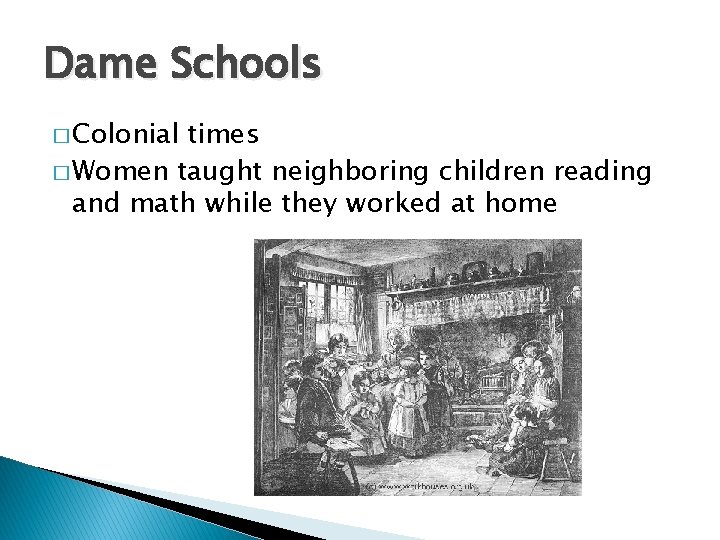
Dame Schools � Colonial times � Women taught neighboring children reading and math while they worked at home
Gallery Walk materials-print Read about a dame school Another dame school
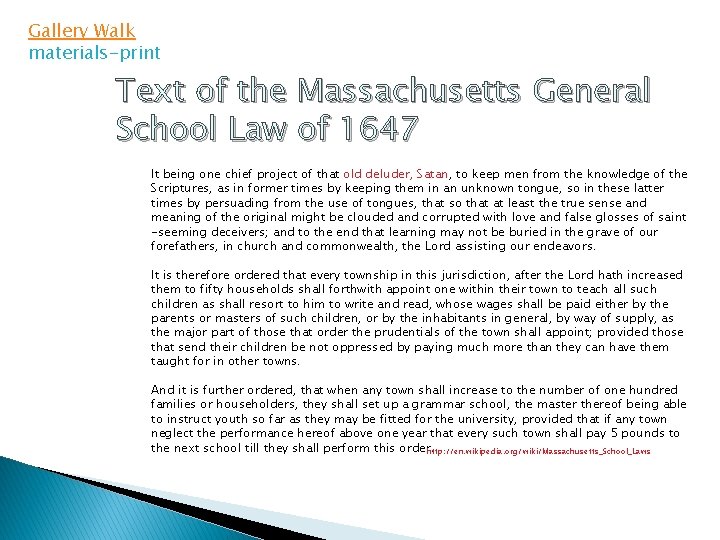
1647 Old Deluder Satan Law � Weird name, simple concept � The main purpose of school ◦ Learn to read ◦ So you can read the Bible ◦ So you can thwart Satan � Massachusetts passed this law ◦ Every town over 50 households �Must hire and pay a teacher �To teach reading and writing ◦ Every town of 100 households �Must provide a Latin grammar school �To provide youths for college
Gallery Walk materials-print Text of the Massachusetts General School Law of 1647 It being one chief project of that old deluder, Satan, to keep men from the knowledge of the Scriptures, as in former times by keeping them in an unknown tongue, so in these latter times by persuading from the use of tongues, that so that at least the true sense and meaning of the original might be clouded and corrupted with love and false glosses of saint -seeming deceivers; and to the end that learning may not be buried in the grave of our forefathers, in church and commonwealth, the Lord assisting our endeavors. It is therefore ordered that every township in this jurisdiction, after the Lord hath increased them to fifty households shall forthwith appoint one within their town to teach all such children as shall resort to him to write and read, whose wages shall be paid either by the parents or masters of such children, or by the inhabitants in general, by way of supply, as the major part of those that order the prudentials of the town shall appoint; provided those that send their children be not oppressed by paying much more than they can have them taught for in other towns. And it is further ordered, that when any town shall increase to the number of one hundred families or householders, they shall set up a grammar school, the master thereof being able to instruct youth so far as they may be fitted for the university, provided that if any town neglect the performance hereof above one year that every such town shall pay 5 pounds to the next school till they shall perform this order. http: //en. wikipedia. org/wiki/Massachusetts_School_Laws
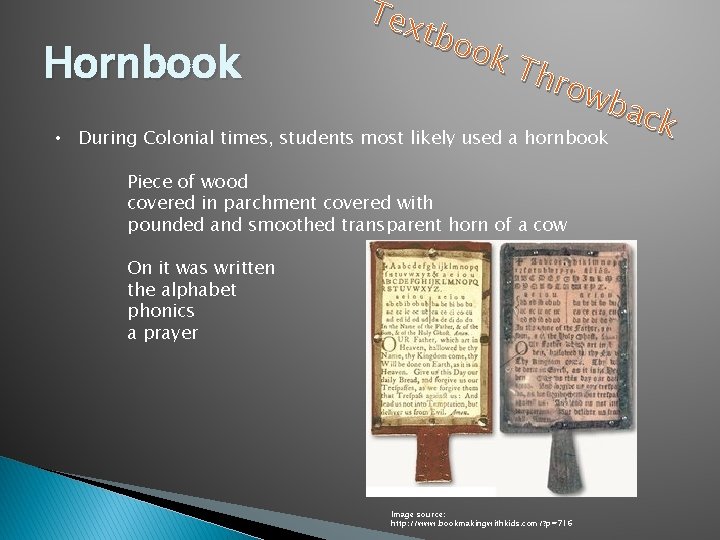
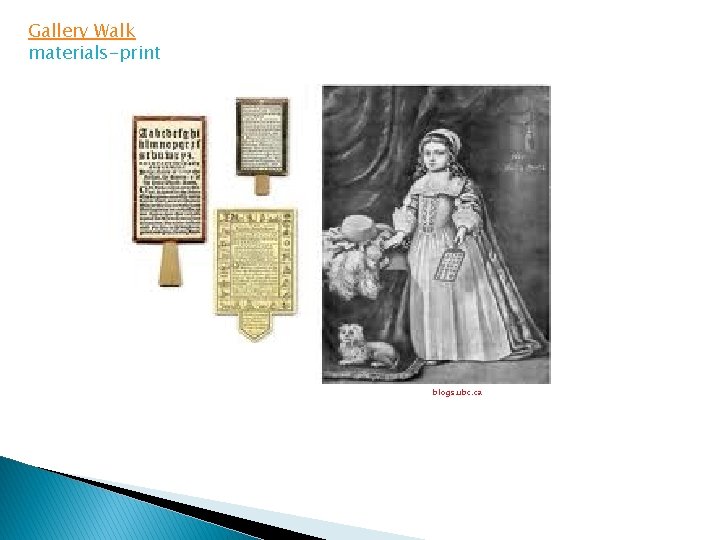
Tex tbo ok Thr Hornbook owb ack • During Colonial times, students most likely used a hornbook Piece of wood covered in parchment covered with pounded and smoothed transparent horn of a cow On it was written the alphabet phonics a prayer Image source: http: //www. bookmakingwithkids. com/? p=716
Gallery Walk materials-print blogs. ubc. ca
1635 Latin Grammar School ◦ White boys ◦ With money ◦ 7 -14 years old ◦ Basically, a private school that provided a college-prep type curriculum in classical studies ◦ How it relates to you: first step in creating the American high school ◦ A year later, Harvard University was founded �To prepare ministers �First college in America
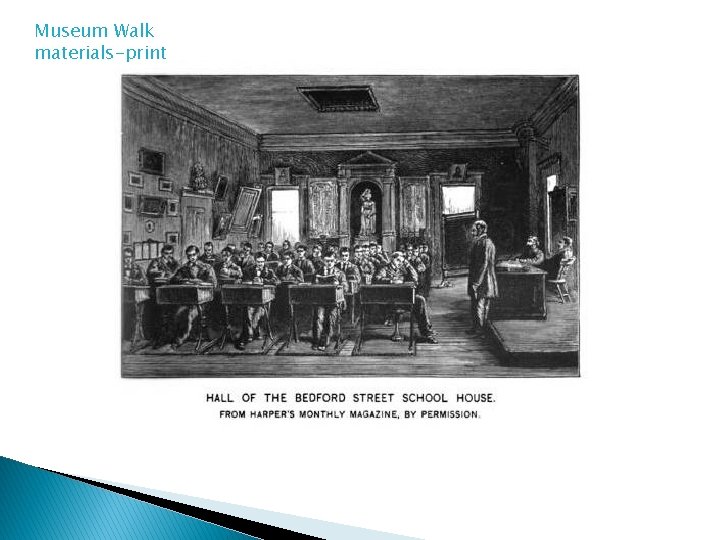
Museum Walk materials-print
From the Colonial system � Today’s ◦ ◦ educational norms were established: Local control of schools Compulsory education Tax-supported schools State standards for teaching and schools ◦ However, there were no formal teacher evaluations
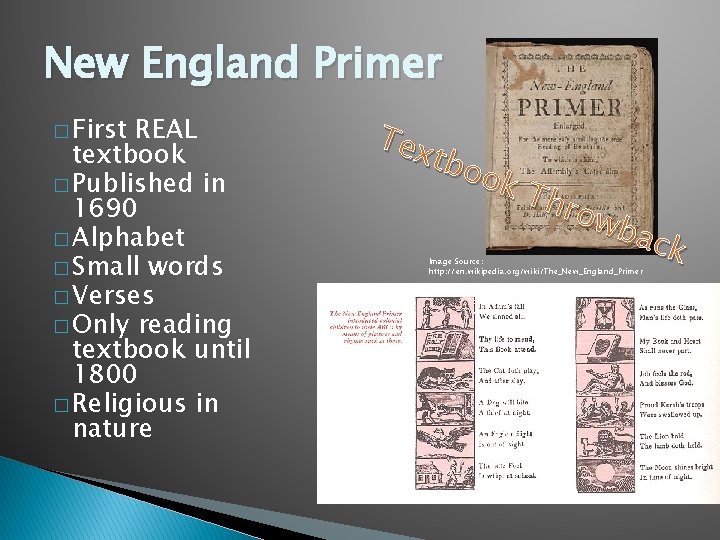
New England Primer � First REAL textbook � Published in 1690 � Alphabet � Small words � Verses � Only reading textbook until 1800 � Religious in nature Tex tbo ok Thr owb ack Image Source: http: //en. wikipedia. org/wiki/The_New_England_Primer
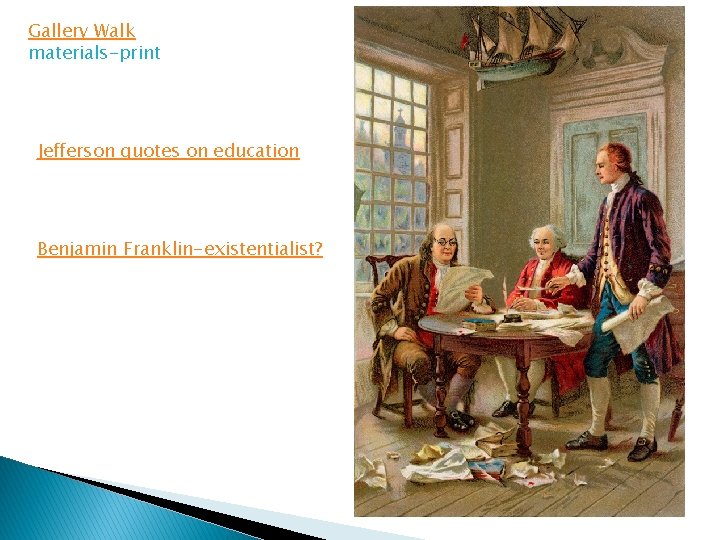
1700 s Academies � Thomas Jefferson ◦ Believed education should not be just for elite class ◦ and based on religious views (still only whites) ◦ Government expense � Benjamin ◦ ◦ ◦ Franklin Created the academy to replace Latin Grammar School Free of religious influences Provided practical subjects Students able to choose some courses (electives) Accepted both girls and boys (but charged tuition)
Gallery Walk materials-print Jefferson quotes on education Benjamin Franklin-existentialist?
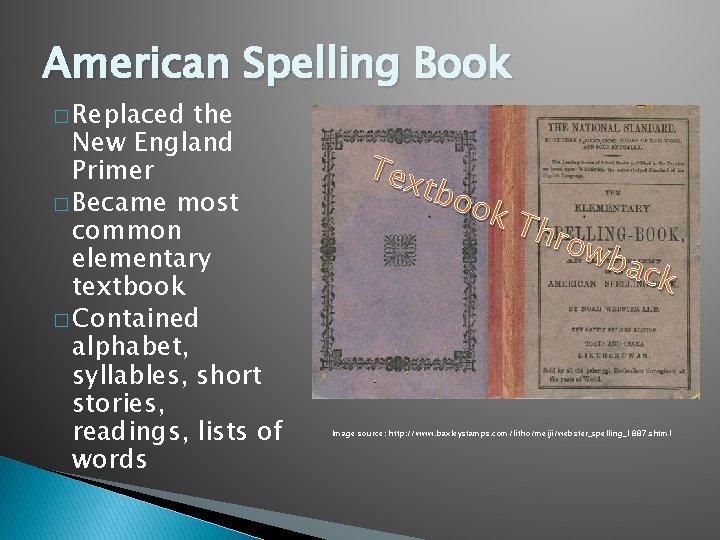
American Spelling Book � Replaced the New England Primer � Became most common elementary textbook � Contained alphabet, syllables, short stories, readings, lists of words Tex tbo ok Thr owb ack Image source: http: //www. baxleystamps. com/litho/meiji/webster_spelling_1887. shtml
Education became a state responsibility through the Tenth Amendment. The powers not delegated to the United States by the Constitution nor prohibited by states, are reserved to the states respectively or to the people. The Tenth Amendment, or Amendment X of the United States Constitution is the section of the Bill of Rights that basically says that any power that is not given to the federal government is given to the people or the states. The Tenth Amendment of the Bill of Rights put into the United States Constitution on September 5, 1789 and was voted for by 9 out of 12 states on December 15, 1791. - See more at: http: //kids. laws. com/tenth -amendment#sthash. 7 l. Ih. Ge. UF. dpuf
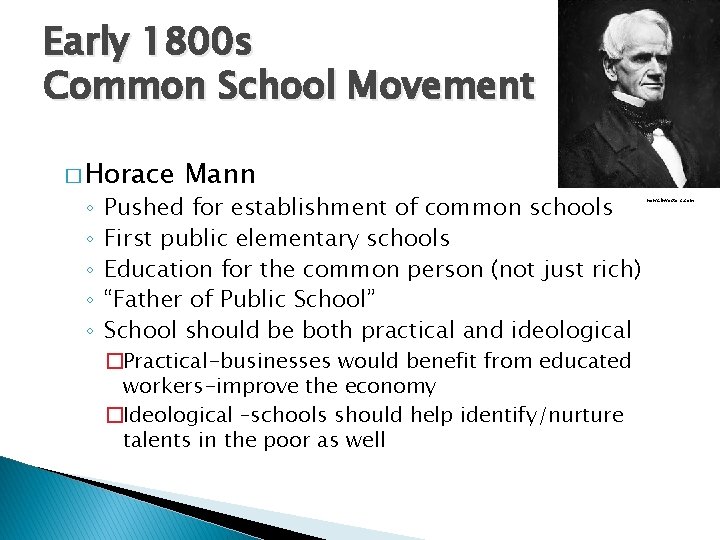
Early 1800 s Common School Movement � Horace ◦ ◦ ◦ Mann Pushed for establishment of common schools First public elementary schools Education for the common person (not just rich) “Father of Public School” School should be both practical and ideological �Practical-businesses would benefit from educated workers-improve the economy �Ideological –schools should help identify/nurture talents in the poor as well news. investors. com
Early 1800 s Common School Movement � Mann all had to battle for his idea of school for ◦ Businesses didn’t want to lose cheap child labor ◦ Citizens didn’t want to pay taxes to fund schools ◦ Private schools didn’t want the competition Mann also battled for high-quality schools made districts improve their school buildings started “normal” schools for teacher preparation promoted new teaching methods opposed corporal punishment believed in positive motivation
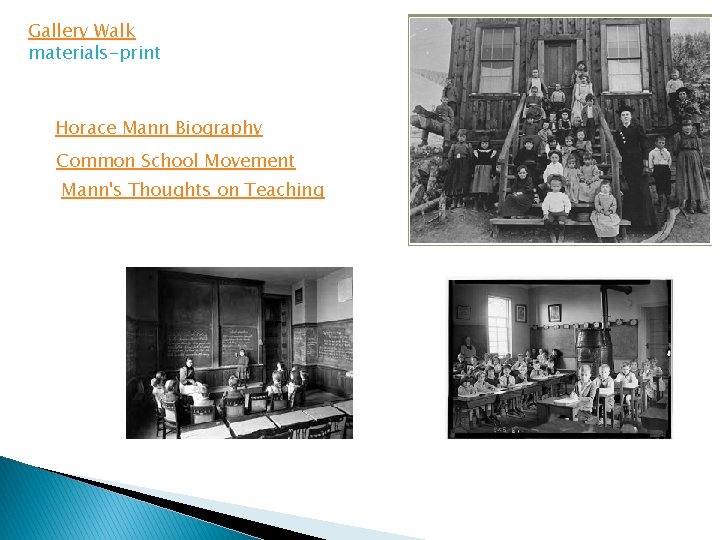
Gallery Walk materials-print Horace Mann Biography Common School Movement Mann's Thoughts on Teaching
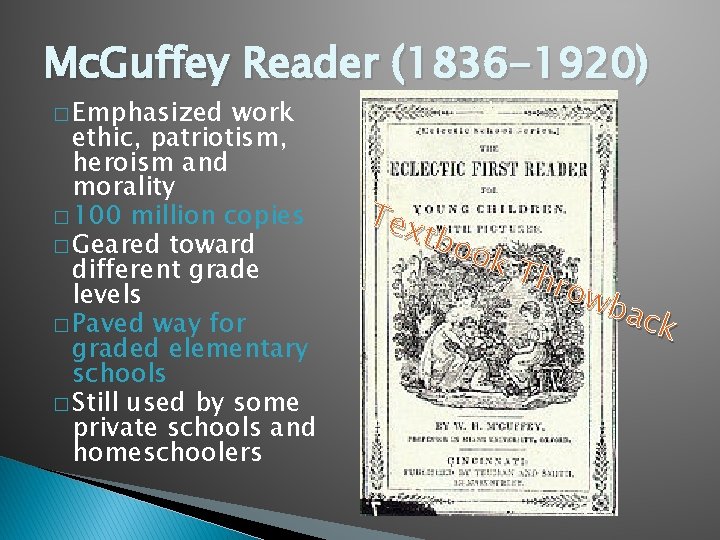
Mc. Guffey Reader (1836 -1920) � Emphasized work ethic, patriotism, heroism and morality � 100 million copies � Geared toward different grade levels � Paved way for graded elementary schools � Still used by some private schools and homeschoolers Tex tbo ok Thr owb ack
1821 Boston English Classical School � First free secondary school ◦ Only boys ◦ 1852 -created one for girls ◦ Changed to Boys’ High School � Many charged some tuition � Major problem-public resistance to paying additional school taxes ◦ 1874 Kalamazoo, MI Case-SC voted taxes could be used for public high schools
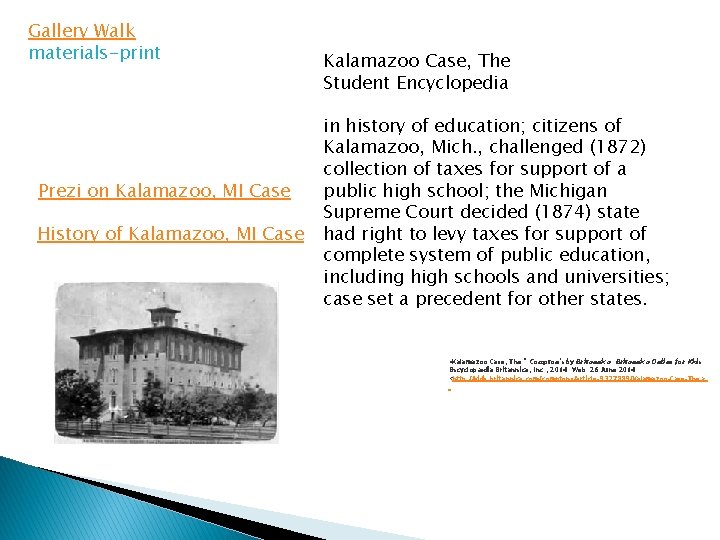
Gallery Walk materials-print Prezi on Kalamazoo, MI Case History of Kalamazoo, MI Case Kalamazoo Case, The Student Encyclopedia in history of education; citizens of Kalamazoo, Mich. , challenged (1872) collection of taxes for support of a public high school; the Michigan Supreme Court decided (1874) state had right to levy taxes for support of complete system of public education, including high schools and universities; case set a precedent for other states. • Kalamazoo Case, The. " Compton's by Britannica Online for Kids. Encyclopædia Britannica, Inc. , 2014. Web. 26 June 2014. <http: //kids. britannica. com/comptons/article-9 327889/Kalamazoo-Case-The>.
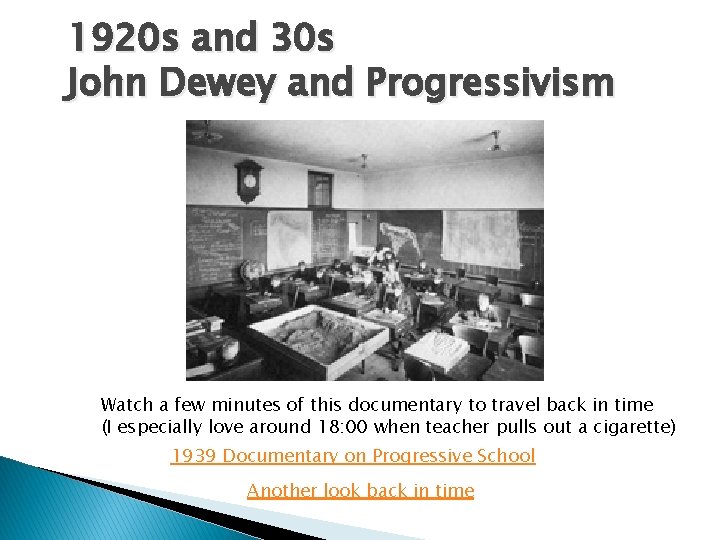
1920 s and 30 s John Dewey and Progressivism Watch a few minutes of this documentary to travel back in time (I especially love around 18: 00 when teacher pulls out a cigarette) 1939 Documentary on Progressive School Another look back in time
John Dewey-Progressivism Watch this brief bio on Dewey ◦ ◦ ◦ 1892 established Chicago Laboratory School Not until 1920 s was progressivism popular Education should focus around student interests Learning is not memorization but experience Similar to problem-based and authentic learning ◦ Attacked because it encouraged students to think and explore, traditional values not being taught ◦ Curriculum not academically sound-some wanted more rigorous studies Sputnik ended the debate
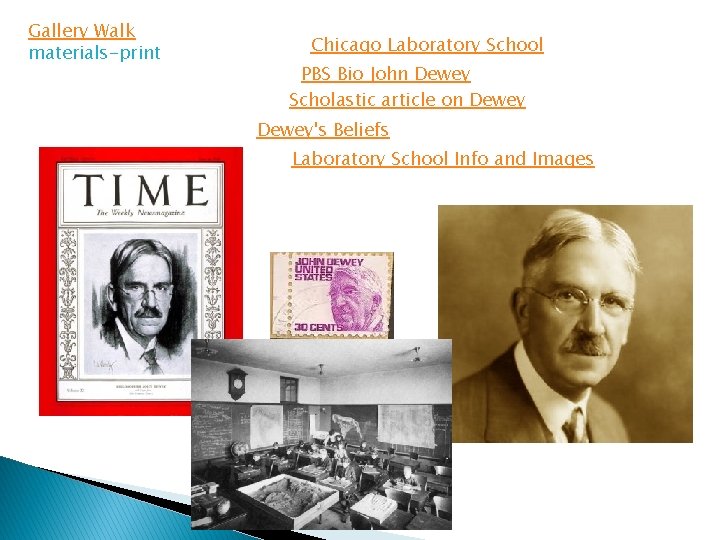
Gallery Walk materials-print Chicago Laboratory School PBS Bio John Dewey Scholastic article on Dewey's Beliefs Laboratory School Info and Images
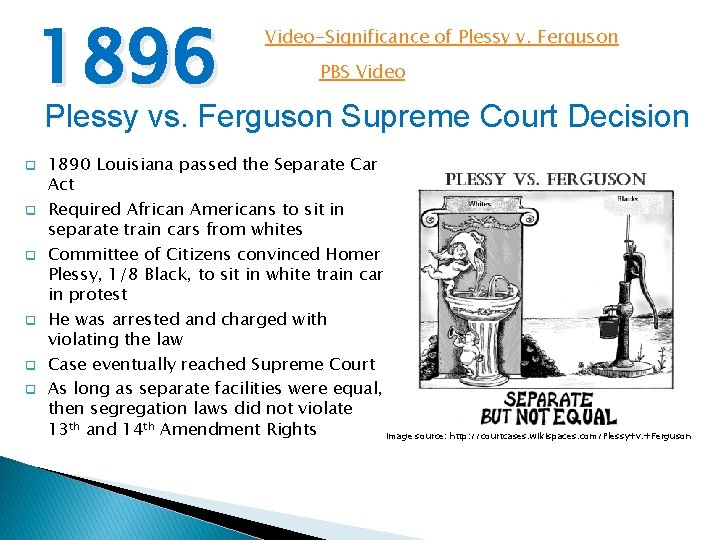
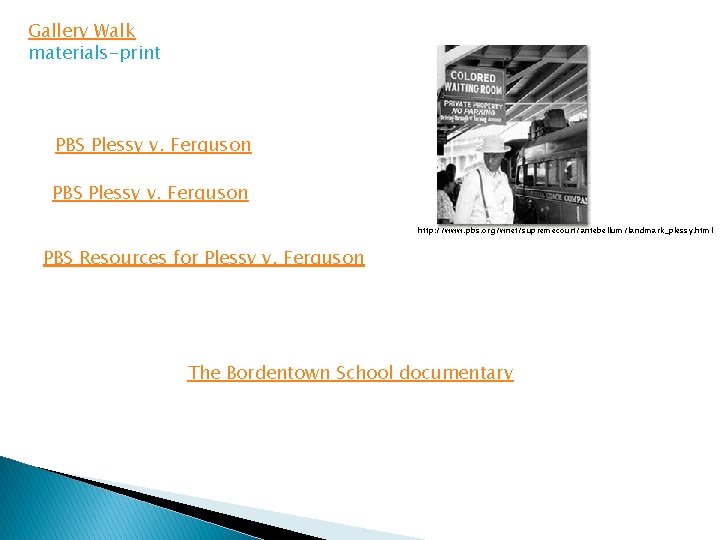
1896 Video-Significance of Plessy v. Ferguson PBS Video Plessy vs. Ferguson Supreme Court Decision q q q 1890 Louisiana passed the Separate Car Act Required African Americans to sit in separate train cars from whites Committee of Citizens convinced Homer Plessy, 1/8 Black, to sit in white train car in protest He was arrested and charged with violating the law Case eventually reached Supreme Court As long as separate facilities were equal, then segregation laws did not violate 13 th and 14 th Amendment Rights Image source: http: //courtcases. wikispaces. com/Plessy+v. +Ferguson
Just FYI � The 13 th Amendment to the Constitution declared that "Neither slavery nor involuntary servitude, except as a punishment for crime whereof the party shall have been duly convicted, shall exist within the United States, or any place subject to their jurisdiction. " Formally abolishing slavery in the United States, the 13 th Amendment was passed by the Congress on January 31, 1865, and ratified by the states on December 6, 1865. Source: http: //www. loc. gov/rr/program/bib/ourdocs/13 thamendment. html
Just FYI � The 14 th Amendment to the Constitution was ratified on July 9, 1868, and granted citizenship to “all persons born or naturalized in the United States, ” which included former slaves recently freed. In addition, it forbids states from denying any person "life, liberty or property, without due process of law" or to "deny to any person within its jurisdiction the equal protection of the laws. ” By directly mentioning the role of the states, the 14 th Amendment greatly expanded the protection of civil rights to all Americans and is cited in more litigation than any other amendment. Source: http: //www. loc. gov/rr/program/bib/ourdocs/14 thamendment. html
Gallery Walk materials-print PBS Plessy v. Ferguson http: //www. pbs. org/wnet/supremecourt/antebellum/landmark_plessy. html PBS Resources for Plessy v. Ferguson The Bordentown School documentary
1917 Smith-Hughes National Vocational Education Act of 1917 q q Established vocational (agricultural) education Separate curriculum Separate funding Federal government control Source: http: //en. wikipedia. org/wiki/Smith%E 2%80%93 Hughes_Act Image source: www. oregonffaalumni. net
Encyclopedia Entry Smith-Hughes Act GA CTAE
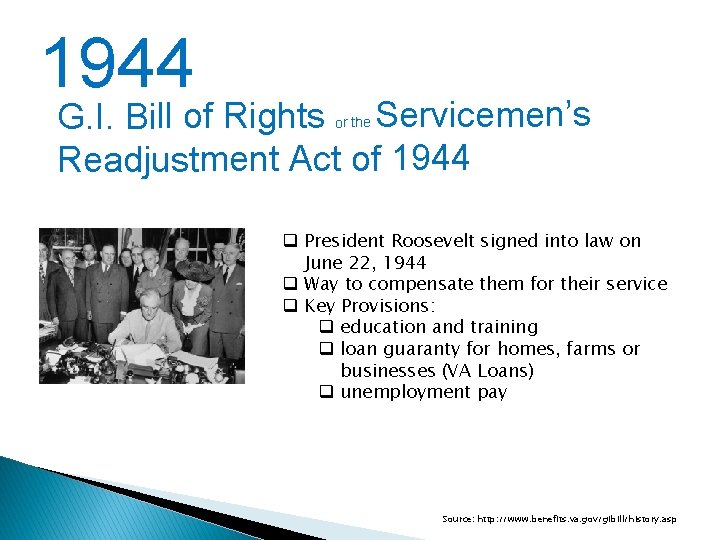
1944 G. I. Bill of Rights Servicemen’s Readjustment Act of 1944 or the q President Roosevelt signed into law on June 22, 1944 q Way to compensate them for their service q Key Provisions: q education and training q loan guaranty for homes, farms or businesses (VA Loans) q unemployment pay Source: http: //www. benefits. va. gov/gibill/history. asp
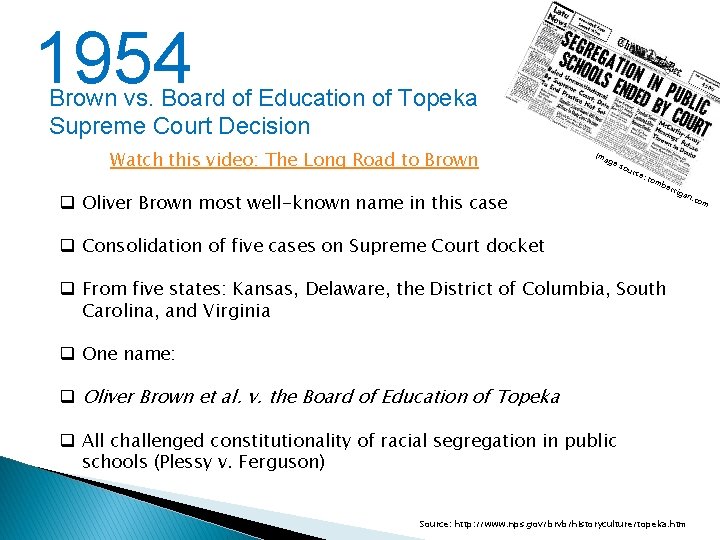
1954 Brown vs. Board of Education of Topeka Supreme Court Decision Watch this video: The Long Road to Brown Ima ge q Oliver Brown most well-known name in this case sou rce : to mb err iga n q Consolidation of five cases on Supreme Court docket q From five states: Kansas, Delaware, the District of Columbia, South Carolina, and Virginia q One name: q Oliver Brown et al. v. the Board of Education of Topeka q All challenged constitutionality of racial segregation in public schools (Plessy v. Ferguson) Source: http: //www. nps. gov/brvb/historyculture/topeka. htm . co m
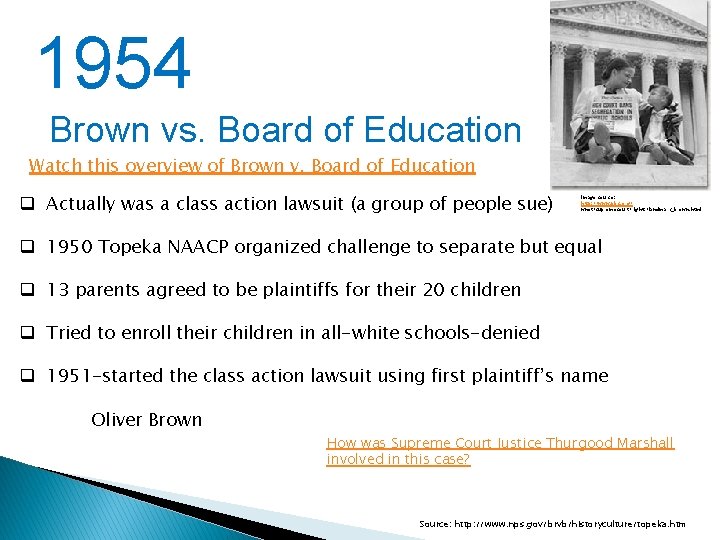
1954 Brown vs. Board of Education Watch this overview of Brown v. Board of Education q Actually was a class action lawsuit (a group of people sue) Image source: http: //www. pbs. org/ wnet/supremecourt/rights/landmark_brown. html q 1950 Topeka NAACP organized challenge to separate but equal q 13 parents agreed to be plaintiffs for their 20 children q Tried to enroll their children in all-white schools-denied q 1951 -started the class action lawsuit using first plaintiff’s name Oliver Brown How was Supreme Court Justice Thurgood Marshall involved in this case? Source: http: //www. nps. gov/brvb/historyculture/topeka. htm
1954 Brown v. Board of Education � “In this milestone decision, the Supreme Court ruled that separating children in public schools on the basis of race was unconstitutional. It signaled the end of legalized racial segregation in the schools of the United States, overruling the "separate but equal" principle set forth in the 1896 Plessy v. Ferguson case. ” � Violated 14 th Amendment rights (Equal Protection Clause) Source: http: //www. ourdocuments. gov/doc. php? flash=true&doc=87
Gallery Walk materials-print PBS Resources Brown v. Board Kenneth Clark Doll Studies and Brown v. Board
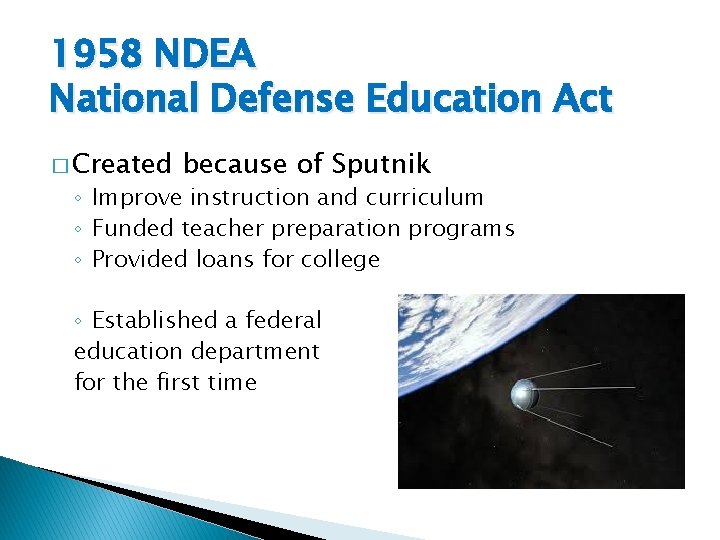
1958 NDEA National Defense Education Act � Created because of Sputnik ◦ Improve instruction and curriculum ◦ Funded teacher preparation programs ◦ Provided loans for college ◦ Established a federal education department for the first time
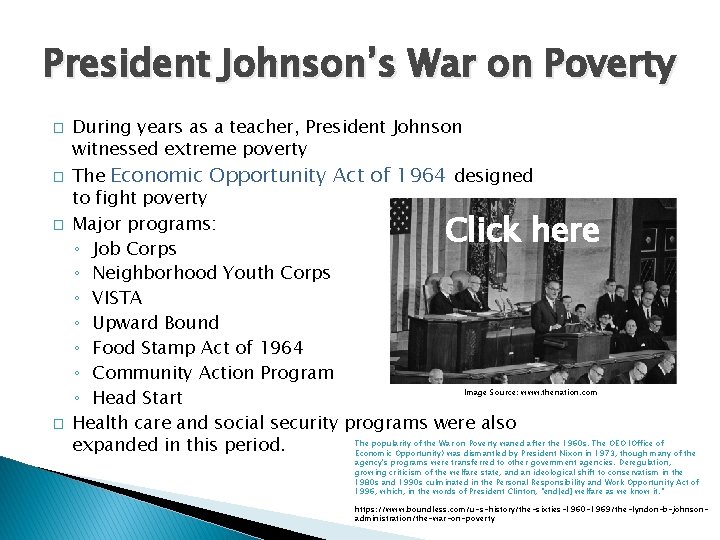
President Johnson’s War on Poverty � � During years as a teacher, President Johnson witnessed extreme poverty The Economic Opportunity Act of 1964 designed to fight poverty Major programs: ◦ Job Corps ◦ Neighborhood Youth Corps ◦ VISTA ◦ Upward Bound ◦ Food Stamp Act of 1964 ◦ Community Action Program Image Source: www. thenation. com ◦ Head Start Health care and social security programs were also The popularity of the War on Poverty waned after the 1960 s. The OEO (Office of expanded in this period. Economic Opportunity) was dismantled by President Nixon in 1973, though many of the Click here agency's programs were transferred to other government agencies. Deregulation, growing criticism of the welfare state, and an ideological shift to conservatism in the 1980 s and 1990 s culminated in the Personal Responsibility and Work Opportunity Act of 1996, which, in the words of President Clinton, "end[ed] welfare as we know it. " https: //www. boundless. com/u-s-history/the-sixties-1960 -1969/the-lyndon-b-johnsonadministration/the-war-on-poverty
1965 Elementary and Secondary Education Act (ESEA) (Another component of Johnson’s War on Poverty) Title 1 Head Start Watch video of history of Head Start Bilingual Education Act
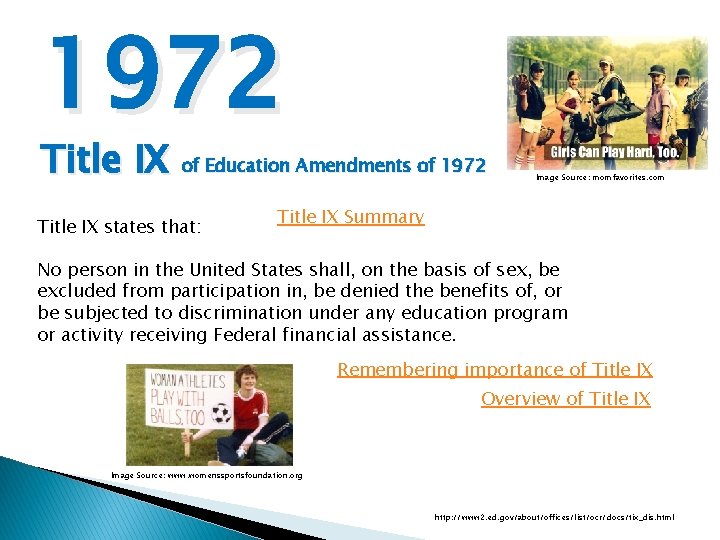
1972 Title IX of Education Amendments of 1972 Title IX states that: Image Source: momfavorites. com Title IX Summary No person in the United States shall, on the basis of sex, be excluded from participation in, be denied the benefits of, or be subjected to discrimination under any education program or activity receiving Federal financial assistance. Remembering importance of Title IX Overview of Title IX Image Source: www. womenssportsfoundation. org http: //www 2. ed. gov/about/offices/list/ocr/docs/tix_dis. html
It’s not just about girls playing sports. . . Title IX • protects male students against gender discrimination. • protects teachers against gender discrimination. • ensures that health benefits are not gender biased.
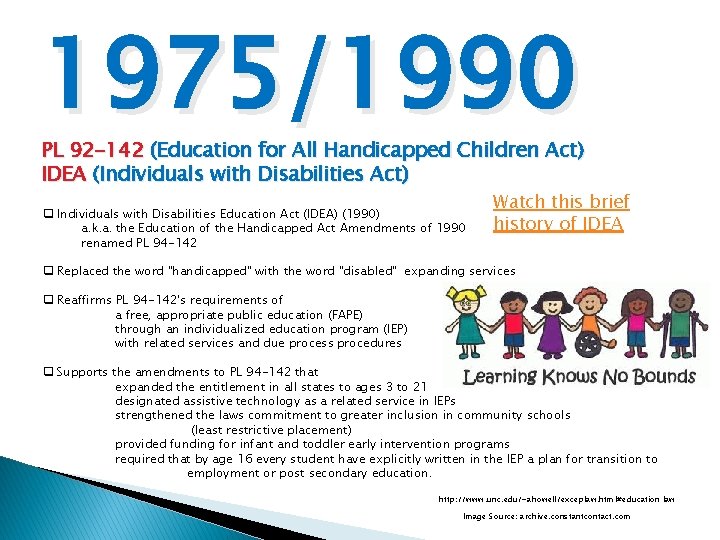
1975/1990 PL 92 -142 (Education for All Handicapped Children Act) IDEA (Individuals with Disabilities Act) q Individuals with Disabilities Education Act (IDEA) (1990) a. k. a. the Education of the Handicapped Act Amendments of 1990 renamed PL 94 -142 Watch this brief history of IDEA q Replaced the word "handicapped" with the word "disabled" expanding services q Reaffirms PL 94 -142's requirements of a free, appropriate public education (FAPE) through an individualized education program (IEP) with related services and due process procedures q Supports the amendments to PL 94 -142 that expanded the entitlement in all states to ages 3 to 21 designated assistive technology as a related service in IEPs strengthened the laws commitment to greater inclusion in community schools (least restrictive placement) provided funding for infant and toddler early intervention programs required that by age 16 every student have explicitly written in the IEP a plan for transition to employment or post secondary education. http: //www. unc. edu/~ahowell/exceplaw. html#education law Image Source: archive. constantcontact. com