Unit 4 Lesson 3 History of Space Exploration




- Slides: 17
Unit 4 Lesson 3 History of Space Exploration Copyright © Houghton Mifflin Harcourt Publishing Company
Unit 4 Lesson 3 History of Space Exploration Space: The Final Frontier How did space exploration begin? • In October of 1957, the Soviet Union launched the first satellite, Sputnik I, into low Earth orbit. It was the start of the “Space Age. ” • In response, the United States launched its first satellite, Explorer I, on January 31, 1958. This started the Space Race. • In the same year, the National Aeronautics and Space Administration, or NASA, was formed. Copyright © Houghton Mifflin Harcourt Publishing Company
Unit 4 Lesson 3 History of Space Exploration From Earth to the Moon How have people explored space? • Suborbital crewed spacecraft do not orbit Earth because they do not reach the required speed and altitude. They spend only a short time in space. • The first crewed suborbital spaceflight missions were NASA’s Mercury project in 1961. • These missions included the suborbital flights of Alan B. Shepard, Jr. , on May 5, 1961, and Virgil I. Grissom on July 21, 1961. Copyright © Houghton Mifflin Harcourt Publishing Company
Unit 4 Lesson 3 History of Space Exploration How have people explored space? • Orbital crewed spacecraft completely orbit Earth. On April 12, 1961, Soviet air force pilot Yuri A. Gagarin became the first person to orbit Earth. • On July 21, 1961, John H. Glenn, Jr. , became the first American to orbit Earth. • On June 16, 1963, Soviet cosmonaut Valentina V. Tereshkova became the first woman to fly in space and orbit Earth. Copyright © Houghton Mifflin Harcourt Publishing Company
Unit 4 Lesson 3 History of Space Exploration How have people explored space? • The United States developed the Gemini program with two-person crews, partly to see if astronauts could spend longer periods of time in space. • The Soviet Union extended their existing Vostok program to include multiperson spaceflights. • On March 18, 1965, Soviet cosmonaut Alexei A. Leonov performed the first walk in space. On June 3, 1965, Edward H. White II became the first American to do so. Copyright © Houghton Mifflin Harcourt Publishing Company
Unit 4 Lesson 3 History of Space Exploration How have people explored space? • On September 12, 1962, President John F. Kennedy committed the United States to land a man on the moon before the decade ended. • In 1969, the Apollo 11 spacecraft took astronauts Neil Armstrong, Edwin “Buzz” Aldrin, and Michael Collins to the moon. • While Collins orbited the moon in the spacecraft, Armstrong and Aldrin landed on the moon’s surface in a lunar module on July 20, 1969. Copyright © Houghton Mifflin Harcourt Publishing Company
Unit 4 Lesson 3 History of Space Exploration How have people explored space? • The United States is the only nation that has sent astronauts to the moon. • Six moon landings took place during the Apollo program of the late 1960 s and early 1970 s. • In total, 12 astronauts have walked on the moon. Copyright © Houghton Mifflin Harcourt Publishing Company
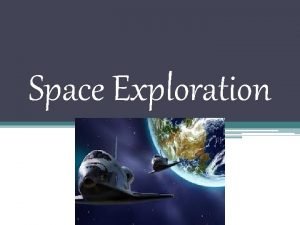
Unit 4 Lesson 3 History of Space Exploration Where have people lived and worked in space? • Space shuttles are crewed space vehicles that lift off with the aid of rocket boosters and like airplanes. • Space shuttles orbit Earth while in space. The shuttle and its rocket boosters are reusable. • Shuttle missions have included gathering data, launching satellites, transporting materials, and docking with the International Space Station. Copyright © Houghton Mifflin Harcourt Publishing Company
Unit 4 Lesson 3 History of Space Exploration Where have people lived and worked in space? • Space shuttle missions began with the launch of the shuttle Columbia in 1981. • Six shuttles—Enterprise, Columbia, Challenger, Discovery, Atlantis, and Endeavour—have together completed more than 100 missions. • Tragic accidents led to the loss of Challenger and its crew in 1986 and Columbia and its crew in 2003. Copyright © Houghton Mifflin Harcourt Publishing Company
Unit 4 Lesson 3 History of Space Exploration Where have people lived and worked in space? • A space station is a long-term, crewed spacecraft that orbits Earth. • It can be used to launch other vehicles and carry out scientific research. • Astronauts live aboard a space station for a period of several weeks or months and conduct research and experiments. Copyright © Houghton Mifflin Harcourt Publishing Company
Unit 4 Lesson 3 History of Space Exploration Where have people lived and worked in space? • The first space station, Salyut-1, was placed in orbit by the Soviet Union in April 1971. In 1973, the U. S. launched its first space station, Skylab. • The Soviet/Russian space station Mir was built between 1986 and 1996 and operated in low Earth orbit until 2001. • The International Space Station, as long as a football field, was built in low Earth orbit over a period of 13 years, starting in 1998. Copyright © Houghton Mifflin Harcourt Publishing Company
Unit 4 Lesson 3 History of Space Exploration Just Passing By How have people used uncrewed vehicles to explore space? • Uncrewed vehicles, such as space probes and orbiters, are a safe way to explore distant bodies that could take years or decades to reach. • Space probes carry scientific instruments and transmit data back to Earth. • Scientists have used space probes to fly by the moon, Mercury, and Venus, to land on Mars, and to explore the far reaches of the solar system. Copyright © Houghton Mifflin Harcourt Publishing Company
Unit 4 Lesson 3 History of Space Exploration How have people used uncrewed vehicles to explore space? • How did Voyager 2 help with space exploration? Copyright © Houghton Mifflin Harcourt Publishing Company
Unit 4 Lesson 3 History of Space Exploration How have people used uncrewed vehicles to explore space? • An orbiter is a spacecraft that travels to a planet and goes into orbit around it. • Several orbiters have been exploring the features of Mars by mapping the Martian surface and collecting data about its chemical makeup. • NASA’s Mars Reconnaissance Orbiter has a powerful camera that could guide future spacecraft to make precise landings on Mars. Copyright © Houghton Mifflin Harcourt Publishing Company
Unit 4 Lesson 3 History of Space Exploration How have people used uncrewed vehicles to explore space? • A lander is designed to land on the surface of a planet or other body and send data back to Earth. • A rover physically explores the body’s surface by moving about. • Landers and rovers can conduct experiments on soil and rocks, and they can record surface conditions such as temperature and wind flow. Copyright © Houghton Mifflin Harcourt Publishing Company
Unit 4 Lesson 3 History of Space Exploration How have people used uncrewed vehicles to explore space? • An artificial satellite is any human-made object placed in orbit around a body in space. Hundreds of active satellites currently orbit Earth. • A satellite may collect weather data, relay TV and radio signals, assist in navigation, or study Earth’s surface. • A system of orbiting global navigation satellites has been operated by the U. S. since 1978. They are used to determine precise locations on Earth. Copyright © Houghton Mifflin Harcourt Publishing Company
Unit 4 Lesson 3 History of Space Exploration How have people used uncrewed vehicles to explore space? • What is the function of the satellite shown here? Copyright © Houghton Mifflin Harcourt Publishing Company