High Performance Data Center Operating Systems Tom Anderson
- Slides: 66
High Performance Data Center Operating Systems Tom Anderson Antoine Kaufmann, Youngjin Kwon, Naveen Kr. Sharma, Arvind Krishnamurthy, Simon Peter, Mothy Roscoe, and Emmett Witchel
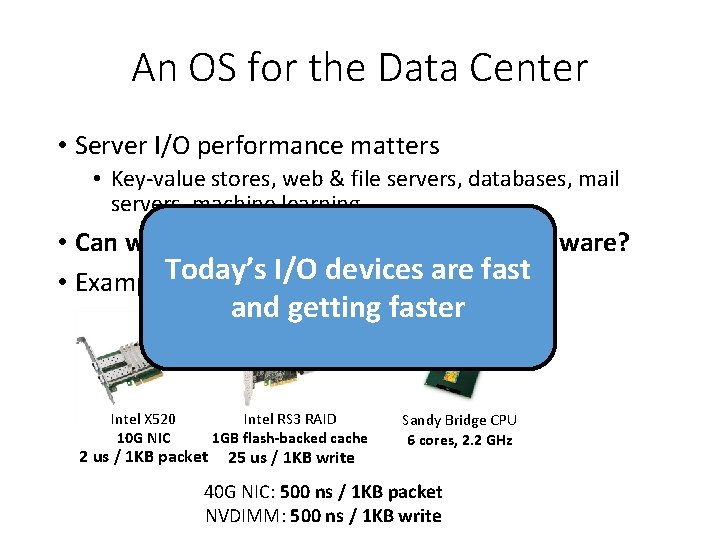
An OS for the Data Center • Server I/O performance matters • Key-value stores, web & file servers, databases, mail servers, machine learning, … • Can we deliver performance close to hardware? I/O Power. Edge devices are fast • Example. Today’s system: Dell R 520 and getting faster + Intel X 520 10 G NIC 2 us / 1 KB packet + Intel RS 3 RAID 1 GB flash-backed cache 25 us / 1 KB write Sandy Bridge CPU 6 cores, 2. 2 GHz 40 G NIC: 500 ns / 1 KB packet NVDIMM: 500 ns / 1 KB write
Can’t we just use Linux?
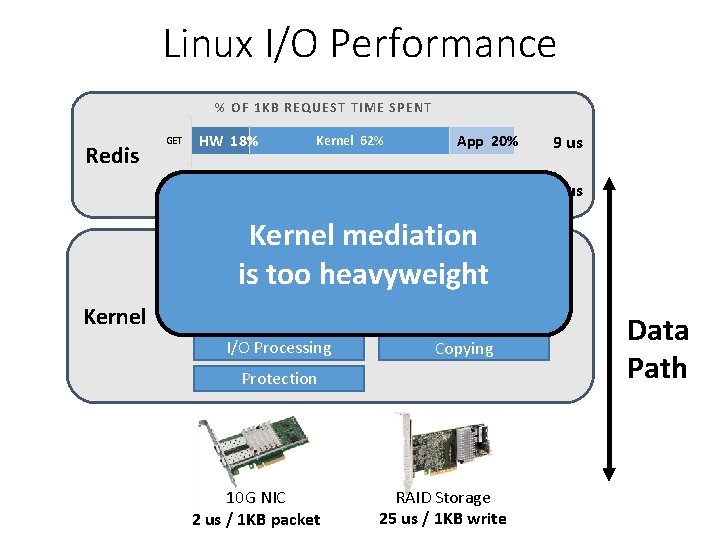
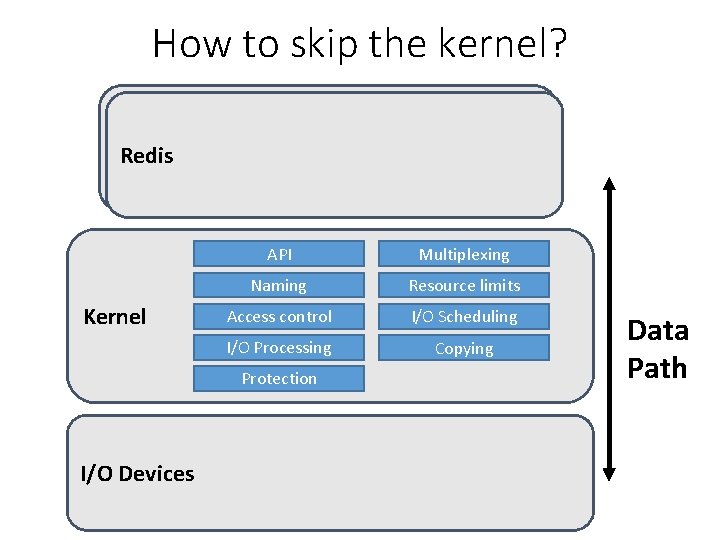
Linux I/O Performance % OF 1 KB REQUEST TIME SPENT Redis GET SET HW 18% Kernel 62% HW 13% App 20% 9 us App 163 us 3% Kernel 84% Kernel mediation API Multiplexing is. Naming too heavyweight Resource limits Kernel Access control I/O Scheduling I/O Processing Copying Protection 10 G NIC 2 us / 1 KB packet RAID Storage 25 us / 1 KB write Data Path
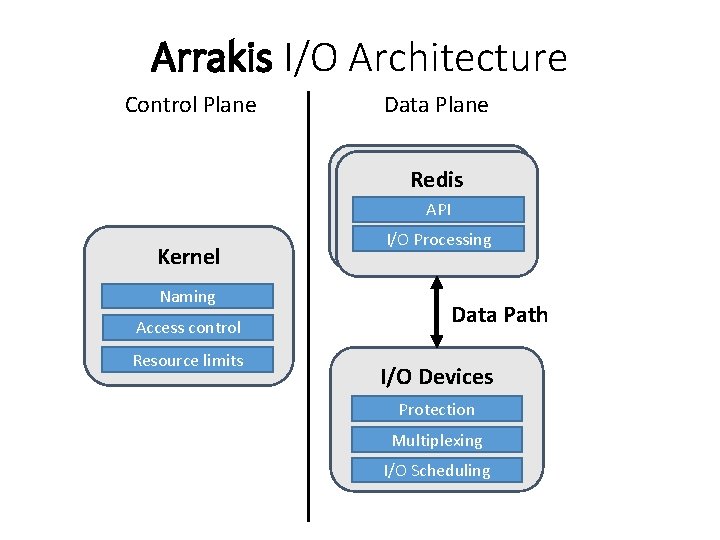
Arrakis: Separate the OS control and data plane
How to skip the kernel? Redis Kernel API Multiplexing Naming Resource limits Access control I/O Scheduling I/O Processing Copying Protection I/O Devices Data Path
Arrakis I/O Architecture Control Plane Data Plane Redis Kernel Naming Access control Resource limits Redis API I/O Processing Data Path I/O Devices Protection Multiplexing I/O Scheduling
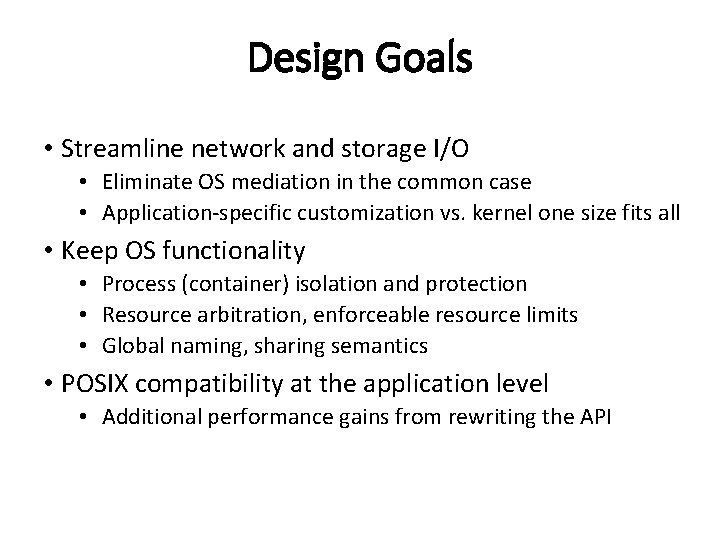
Design Goals • Streamline network and storage I/O • Eliminate OS mediation in the common case • Application-specific customization vs. kernel one size fits all • Keep OS functionality • Process (container) isolation and protection • Resource arbitration, enforceable resource limits • Global naming, sharing semantics • POSIX compatibility at the application level • Additional performance gains from rewriting the API
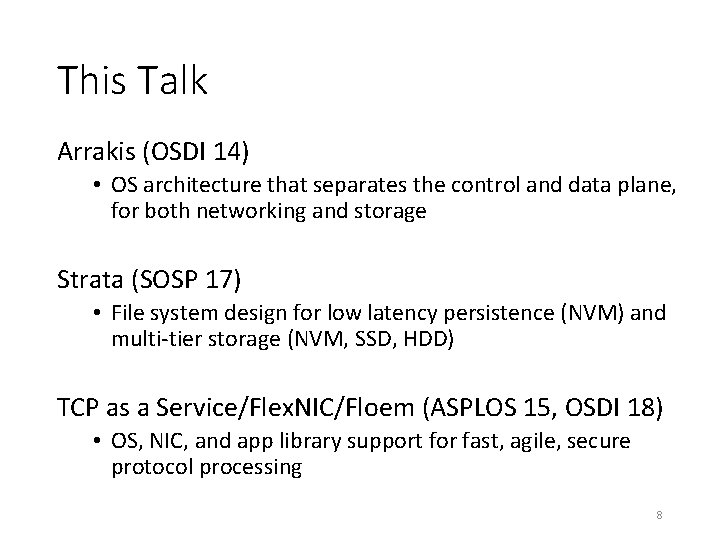
This Talk Arrakis (OSDI 14) • OS architecture that separates the control and data plane, for both networking and storage Strata (SOSP 17) • File system design for low latency persistence (NVM) and multi-tier storage (NVM, SSD, HDD) TCP as a Service/Flex. NIC/Floem (ASPLOS 15, OSDI 18) • OS, NIC, and app library support for fast, agile, secure protocol processing 8
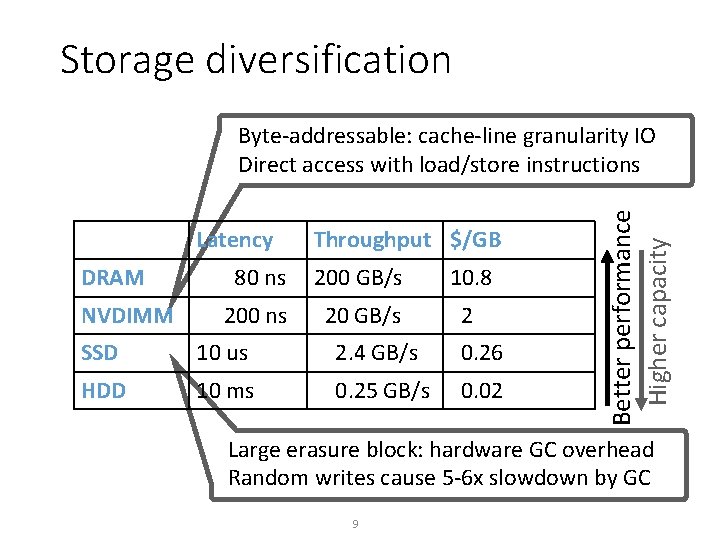
Storage diversification Latency DRAM NVDIMM Throughput $/GB 80 ns 200 GB/s 10. 8 200 ns 20 GB/s 2 SSD 10 us 2. 4 GB/s 0. 26 HDD 10 ms 0. 25 GB/s 0. 02 Better performance Higher capacity Byte-addressable: cache-line granularity IO Direct access with load/store instructions Large erasure block: hardware GC overhead Random writes cause 5 -6 x slowdown by GC 9
Let’s Build a Fast Server Key value store, database, file server, mail server, … Requirements: • Small updates dominate • Dataset scales up to many terabytes • Updates must be crash consistent 10
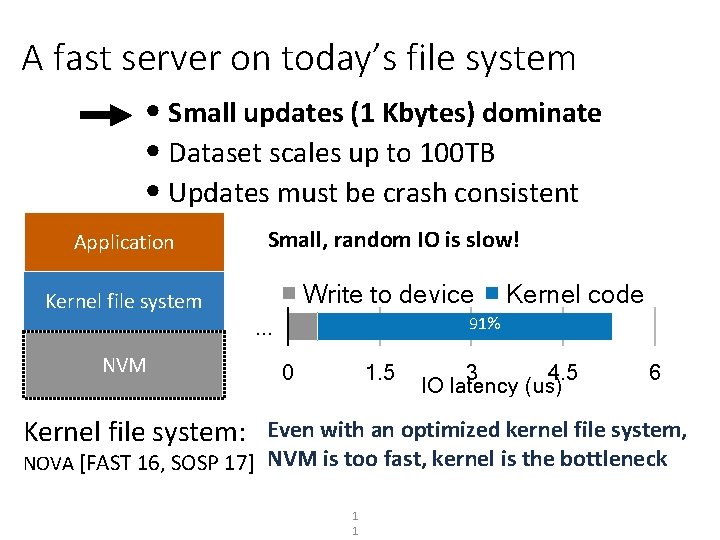
A fast server on today’s file system • Small updates (1 Kbytes) dominate • Dataset scales up to 100 TB • Updates must be crash consistent Application Small, random IO is slow! Kernel file system Write to device 91% . . . NVM Kernel code 0 1. 5 Kernel file system: 3 4. 5 IO latency (us) 91% 6 Even with an optimized kernel file system, NOVA [FAST 16, SOSP 17] NVM is too fast, kernel is the bottleneck 1 1
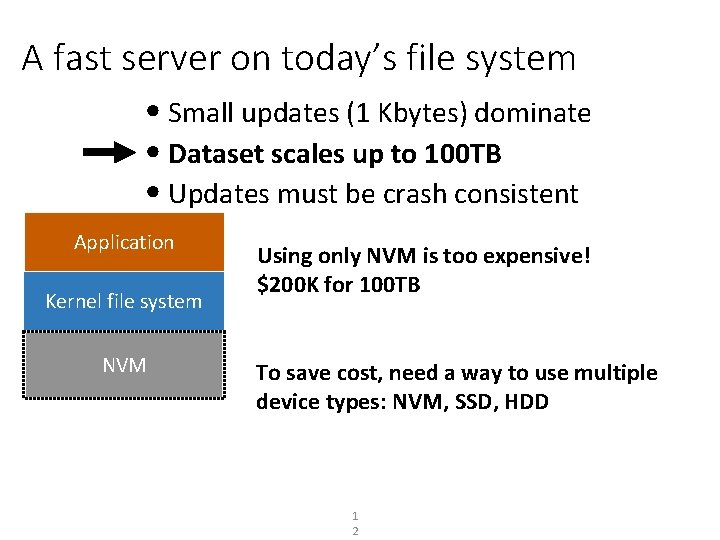
A fast server on today’s file system • Small updates (1 Kbytes) dominate • Dataset scales up to 100 TB • Updates must be crash consistent Application Kernel file system NVM Using only NVM is too expensive! $200 K for 100 TB To save cost, need a way to use multiple device types: NVM, SSD, HDD 1 2
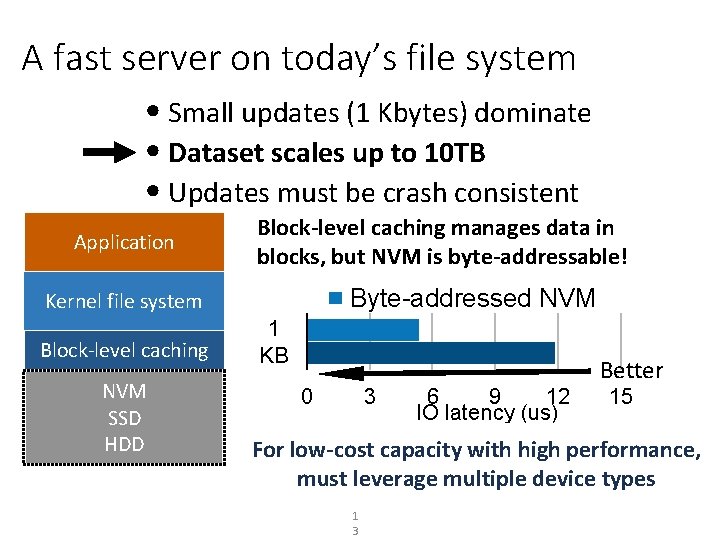
A fast server on today’s file system • Small updates (1 Kbytes) dominate • Dataset scales up to 10 TB • Updates must be crash consistent Application Block-level caching manages data in blocks, but NVM is byte-addressable! Byte-addressed NVM Kernel file system Block-level caching NVM SSD HDD 1 KB 0 3 6 9 12 IO latency (us) Better 15 For low-cost capacity with high performance, must leverage multiple device types 1 3
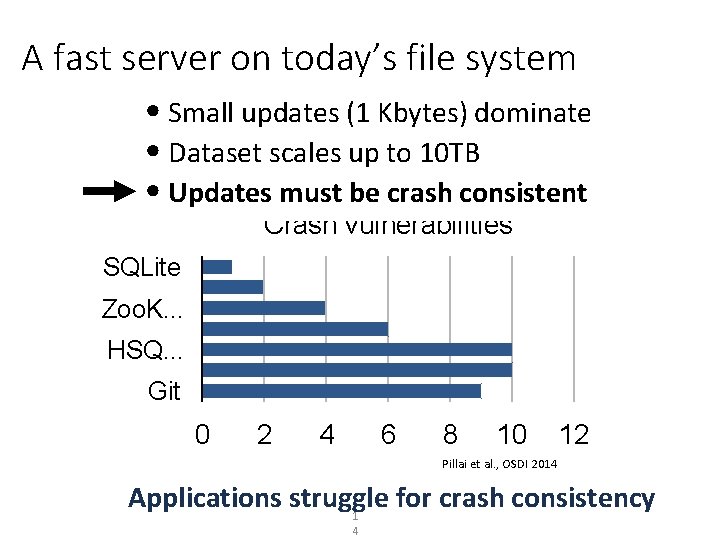
A fast server on today’s file system • Small updates (1 Kbytes) dominate • Dataset scales up to 10 TB • Updates must be crash consistent Crash vulnerabilities SQLite Zoo. K. . . HSQ. . . Git 0 2 4 6 8 10 12 Pillai et al. , OSDI 2014 Applications struggle for crash consistency 1 4
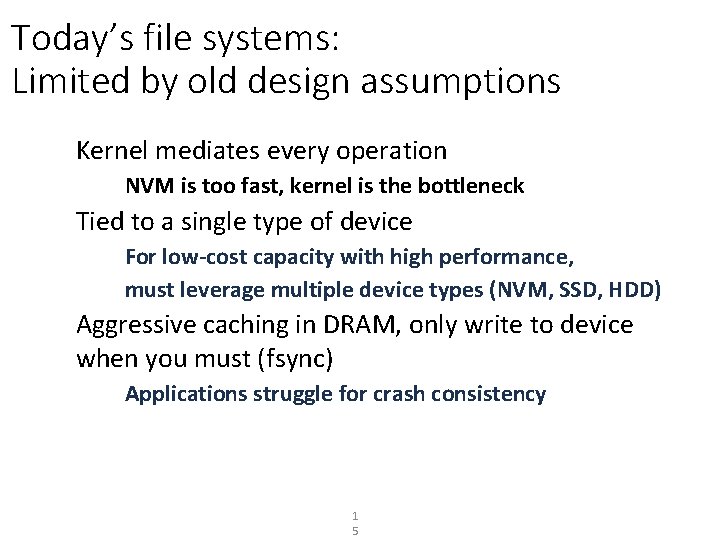
Today’s file systems: Limited by old design assumptions Kernel mediates every operation NVM is too fast, kernel is the bottleneck Tied to a single type of device For low-cost capacity with high performance, must leverage multiple device types (NVM, SSD, HDD) Aggressive caching in DRAM, only write to device when you must (fsync) Applications struggle for crash consistency 1 5
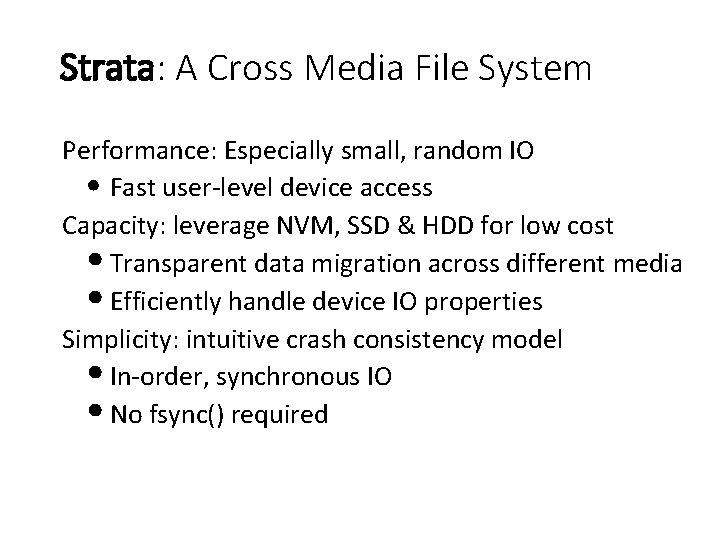
Strata: A Cross Media File System Performance: Especially small, random IO • Fast user-level device access Capacity: leverage NVM, SSD & HDD for low cost • Transparent data migration across different media • Efficiently handle device IO properties Simplicity: intuitive crash consistency model • In-order, synchronous IO • No fsync() required 1 6
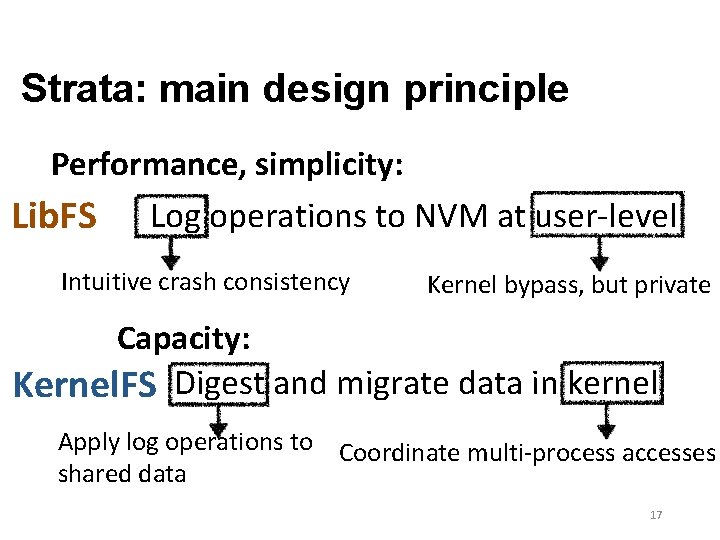
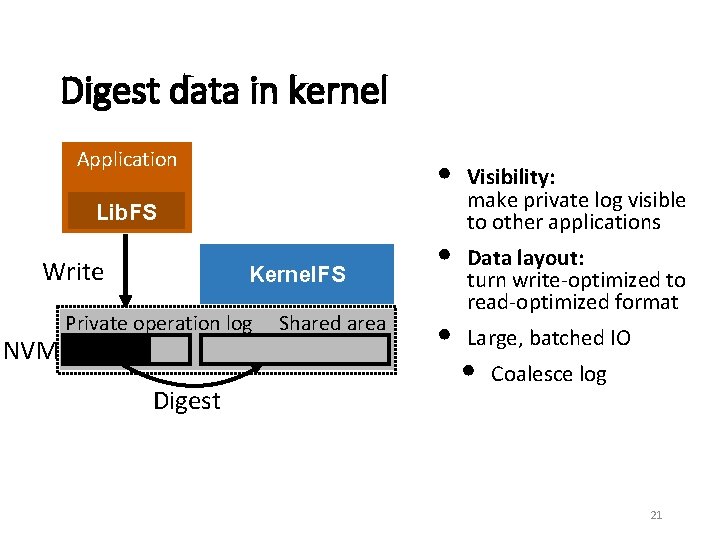
Strata: main design principle Performance, simplicity: Lib. FS Log operations to NVM at user-level Intuitive crash consistency Kernel bypass, but private Capacity: Kernel. FS Digest and migrate data in kernel Apply log operations to Coordinate multi-process accesses shared data 17
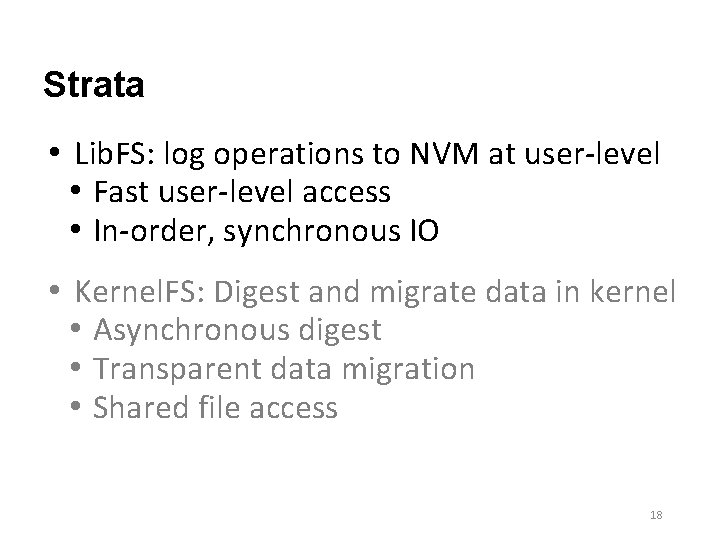
Strata • Lib. FS: log operations to NVM at user-level • Fast user-level access • In-order, synchronous IO • Kernel. FS: Digest and migrate data in kernel • Asynchronous digest • Transparent data migration • Shared file access 18
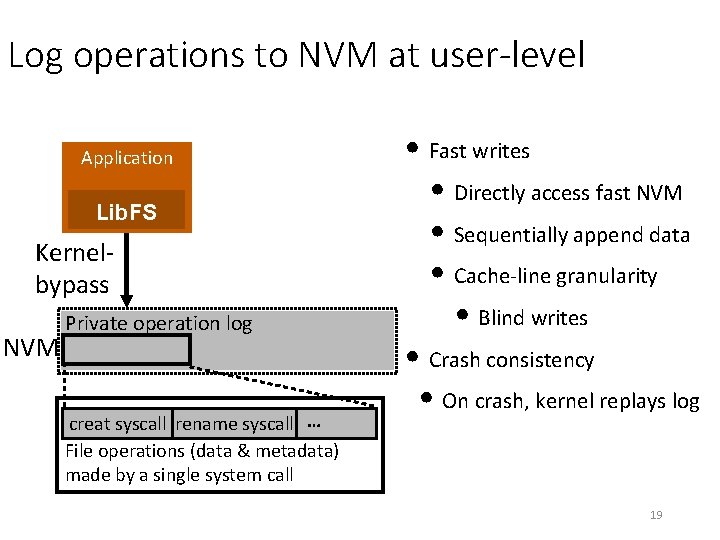
Log operations to NVM at user-level Application Lib. FS Kernelbypass NVM Private operation log creat syscall rename syscall … File operations (data & metadata) made by a single system call • Fast writes • Directly access fast NVM • Sequentially append data • Cache-line granularity • Blind writes • Crash consistency • On crash, kernel replays log 19
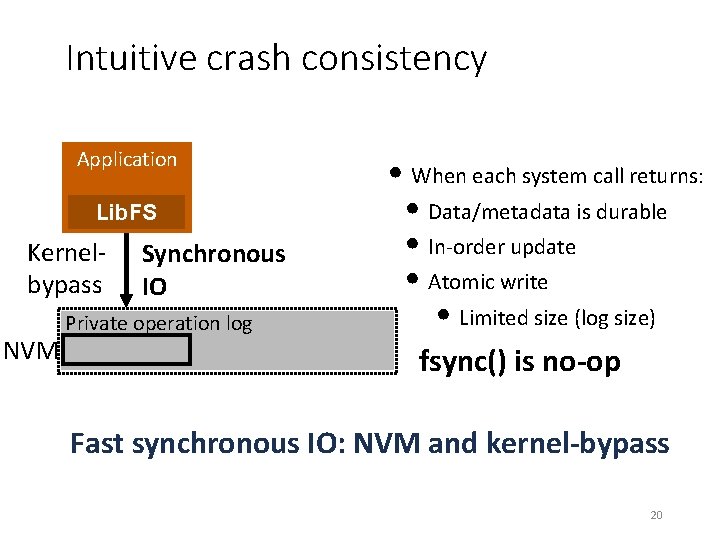
Intuitive crash consistency Application Lib. FS Kernelbypass NVM Synchronous IO Private operation log • When each system call returns: • Data/metadata is durable • In-order update • Atomic write • Limited size (log size) fsync() is no-op Fast synchronous IO: NVM and kernel-bypass 20
Digest data in kernel Application • Lib. FS Write NVM Kernel. FS Private operation log Digest Shared area • • Visibility: make private log visible to other applications Data layout: turn write-optimized to read-optimized format Large, batched IO • Coalesce log 21
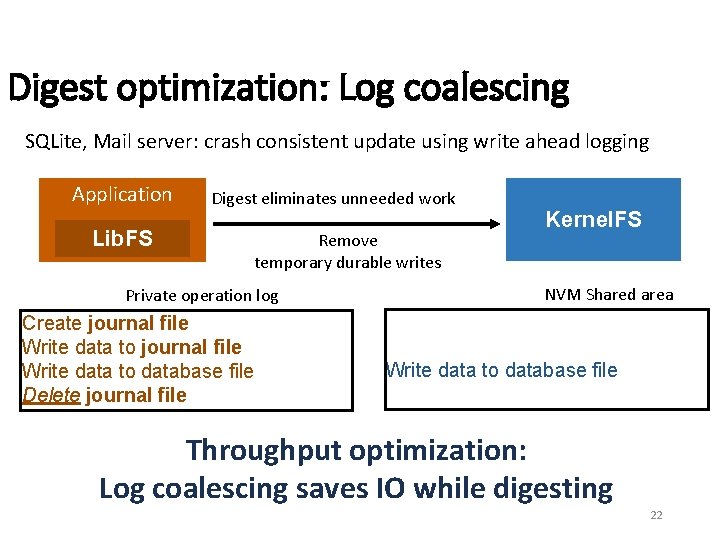
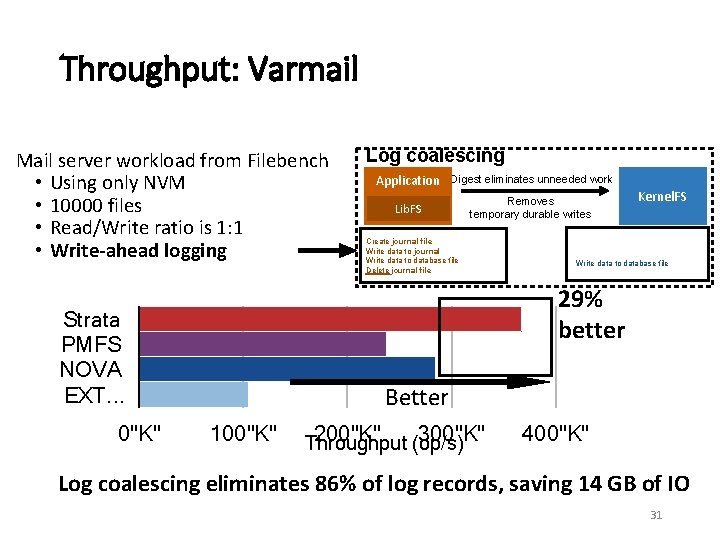
Digest optimization: Log coalescing SQLite, Mail server: crash consistent update using write ahead logging Application Lib. FS Digest eliminates unneeded work Remove temporary durable writes Private operation log Create journal file Write data to database file Delete journal file Kernel. FS NVM Shared area Write data to database file Throughput optimization: Log coalescing saves IO while digesting 22
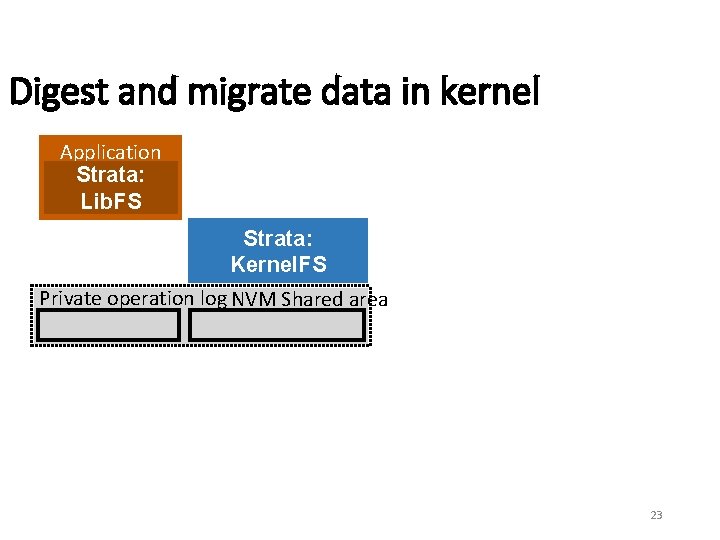
Digest and migrate data in kernel Application Strata: Lib. FS Strata: Kernel. FS Private operation log NVM Shared area 23
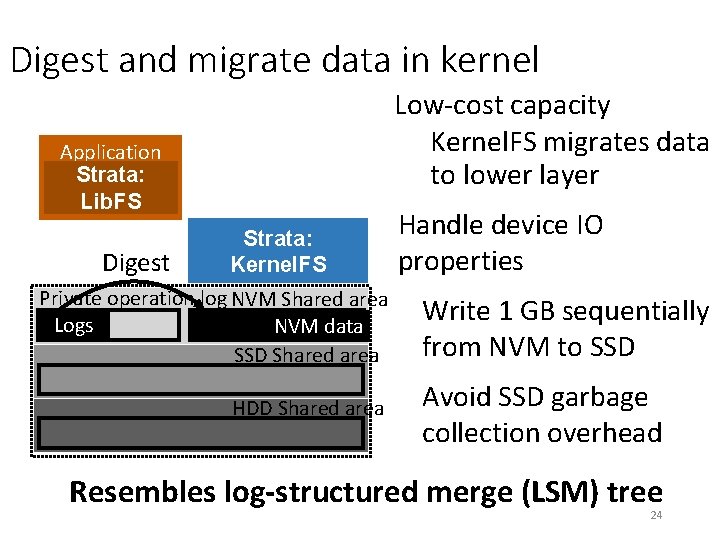
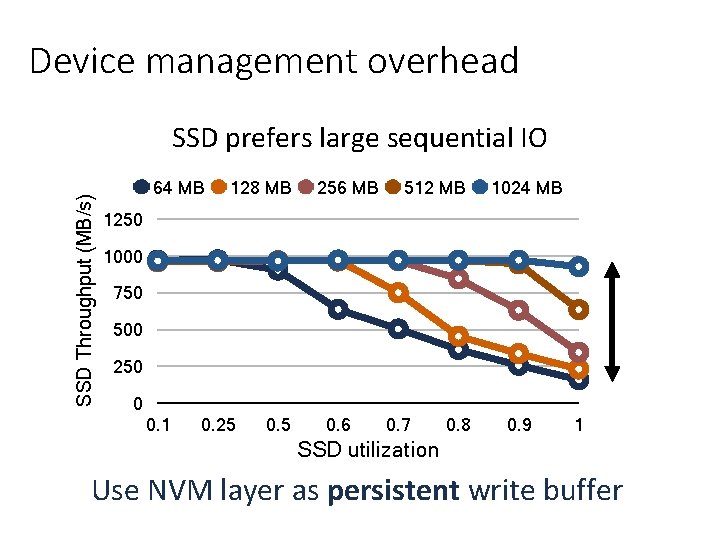
Digest and migrate data in kernel Low-cost capacity Kernel. FS migrates data to lower layer Application Strata: Lib. FS Digest Strata: Kernel. FS Private operation log NVM Shared area Logs NVM data SSD Shared area HDD Shared area Handle device IO properties Write 1 GB sequentially from NVM to SSD Avoid SSD garbage collection overhead Resembles log-structured merge (LSM) tree 24
Device management overhead SSD Throughput (MB/s) SSD prefers large sequential IO 64 MB 128 MB 256 MB 512 MB 1024 MB 1250 1000 750 500 250 0 0. 1 0. 25 0. 6 0. 7 0. 8 0. 9 1 SSD utilization Use NVM layer as persistent write buffer
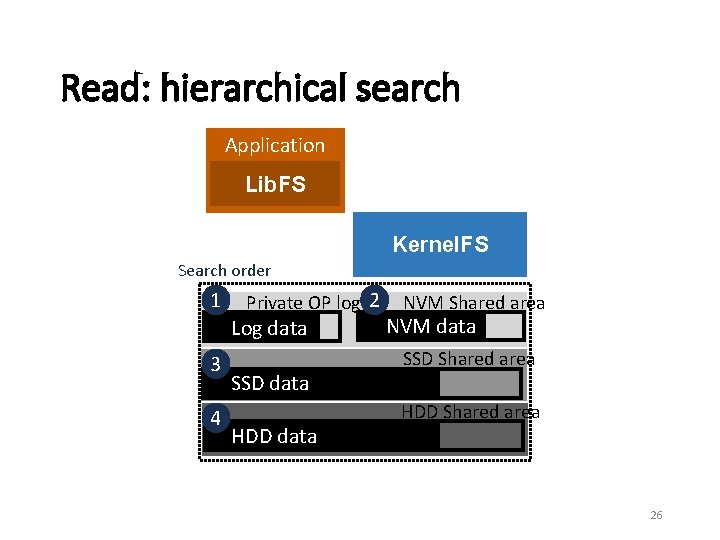
Read: hierarchical search Application Lib. FS Kernel. FS Search order 1 Private OP log 2 Log data 3 4 SSD data HDD data NVM Shared area NVM data SSD Shared area HDD Shared area 26
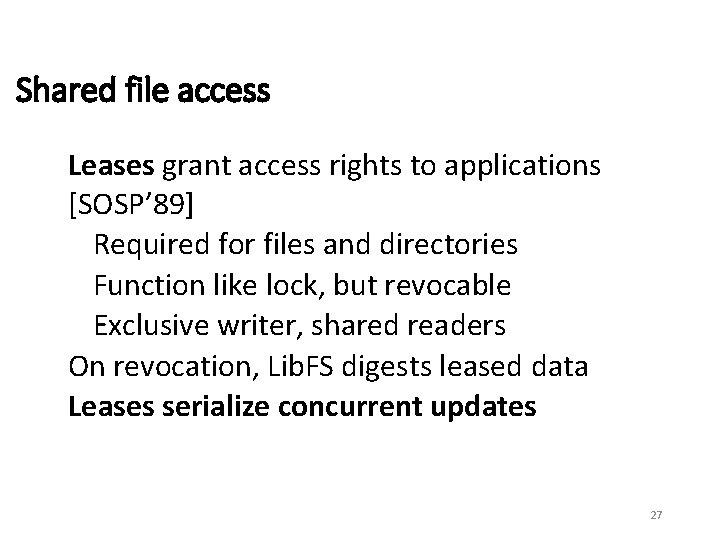
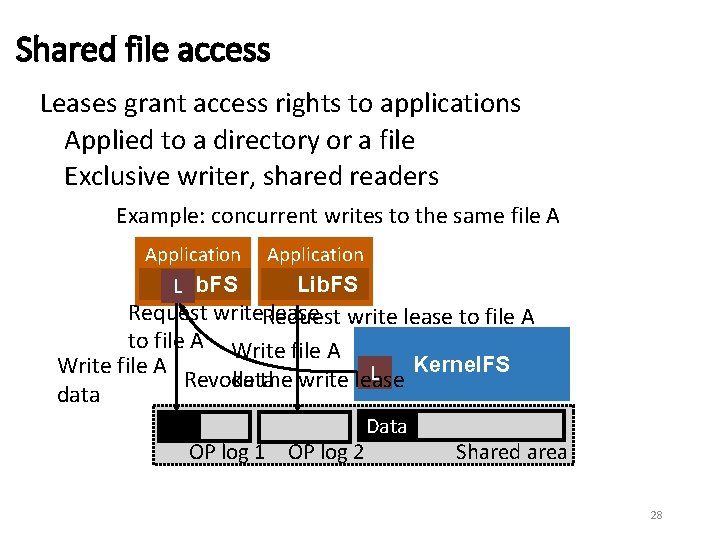
Shared file access Leases grant access rights to applications [SOSP’ 89] Required for files and directories Function like lock, but revocable Exclusive writer, shared readers On revocation, Lib. FS digests leased data Leases serialize concurrent updates 27
Shared file access Leases grant access rights to applications Applied to a directory or a file Exclusive writer, shared readers Example: concurrent writes to the same file A Application 1 LLib. FS Application 2 Lib. FS Request write. Request lease write lease to file A Write file A Kernel. FS Write file A L data Revoke the write lease data OP log 1 OP log 2 Data Shared area 28
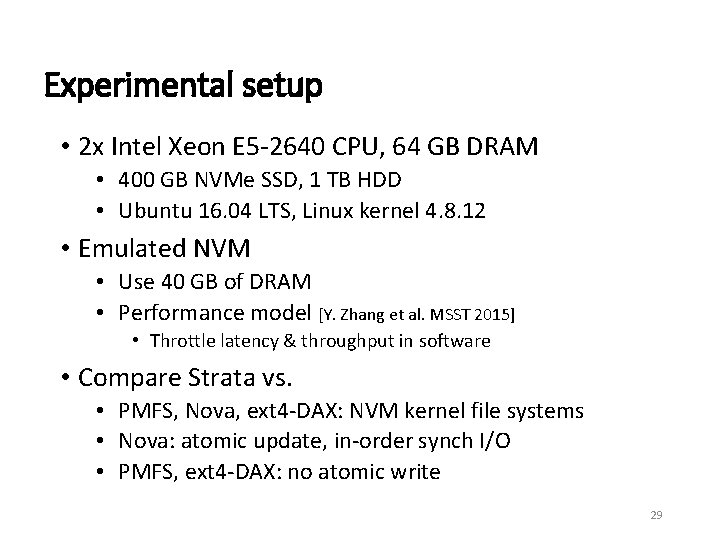
Experimental setup • 2 x Intel Xeon E 5 -2640 CPU, 64 GB DRAM • 400 GB NVMe SSD, 1 TB HDD • Ubuntu 16. 04 LTS, Linux kernel 4. 8. 12 • Emulated NVM • Use 40 GB of DRAM • Performance model [Y. Zhang et al. MSST 2015] • Throttle latency & throughput in software • Compare Strata vs. • PMFS, Nova, ext 4 -DAX: NVM kernel file systems • Nova: atomic update, in-order synch I/O • PMFS, ext 4 -DAX: no atomic write 29
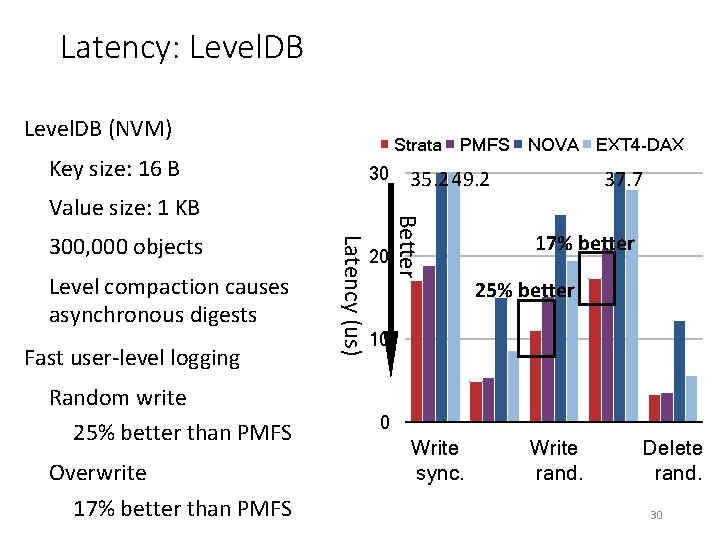
Latency: Level. DB (NVM) Key size: 16 B Strata PMFS NOVA EXT 4 -DAX 30 Level compaction causes asynchronous digests Fast user-level logging Random write 25% better than PMFS Overwrite 17% better than PMFS Latency (us) 300, 000 objects 20 Better Value size: 1 KB 35. 2 49. 2 37. 7 17% better 25% better 10 0 Write sync. Write rand. Delete rand. 30
Throughput: Varmail Mail server workload from Filebench • Using only NVM • 10000 files • Read/Write ratio is 1: 1 • Write-ahead logging Application Digest eliminates unneeded work Lib. FS Removes temporary durable writes Create journal file Write data to journal Write data to database file Delete journal file Kernel. FS Write data to database file 29% better Strata PMFS NOVA EXT. . . 0"K" Log coalescing Better 100"K" 200"K" (op/s) 300"K" Throughput 400"K" Log coalescing eliminates 86% of log records, saving 14 GB of IO 31
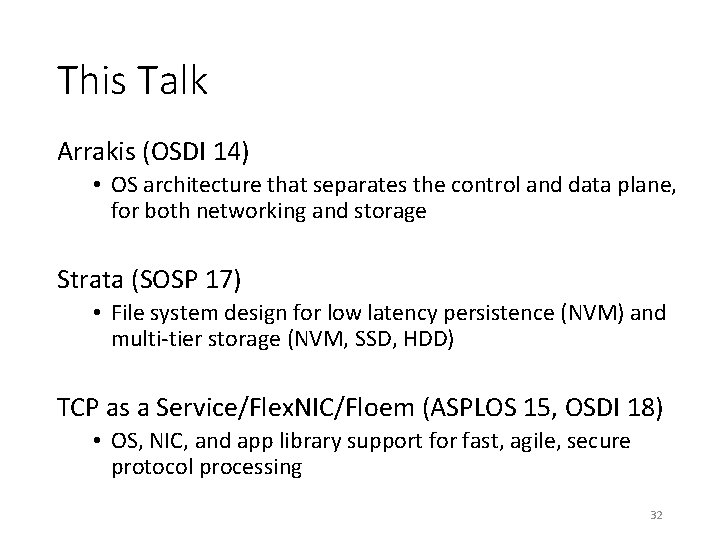
This Talk Arrakis (OSDI 14) • OS architecture that separates the control and data plane, for both networking and storage Strata (SOSP 17) • File system design for low latency persistence (NVM) and multi-tier storage (NVM, SSD, HDD) TCP as a Service/Flex. NIC/Floem (ASPLOS 15, OSDI 18) • OS, NIC, and app library support for fast, agile, secure protocol processing 32
Let’s Build a Fast Server Key value store, database, mail server, ML, … Requirements: • Mostly small RPCs over TCP • 40 Gbps network links (100+ Gbps soon) • Enforceable resource sharing (multi-tenant) • Agile protocol development: kernel and app • Tail latency, cost efficient hardware 33
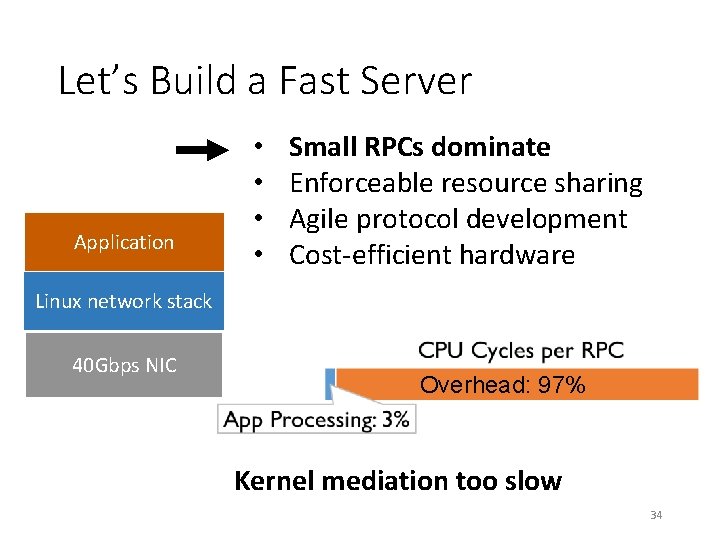
Let’s Build a Fast Server Application • • Small RPCs dominate Enforceable resource sharing Agile protocol development Cost-efficient hardware Linux network stack 40 Gbps NIC Overhead: 97% Kernel mediation too slow 34
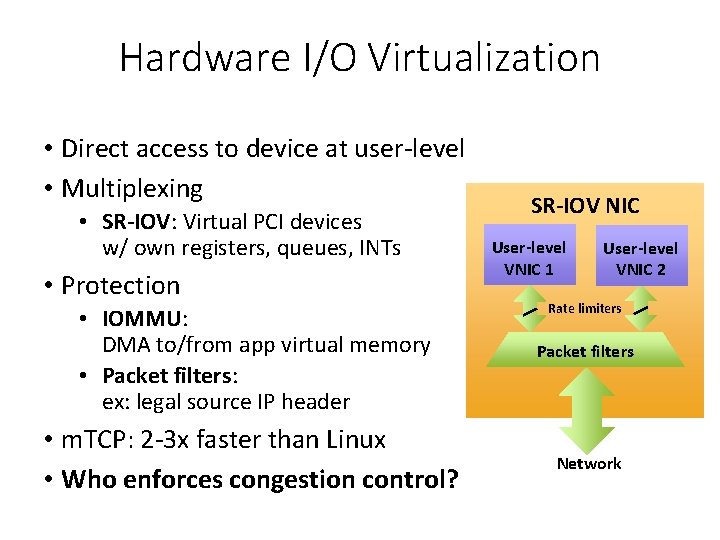
Hardware I/O Virtualization • Direct access to device at user-level • Multiplexing • SR-IOV: Virtual PCI devices w/ own registers, queues, INTs • Protection SR-IOV NIC User-level VNIC 1 User-level VNIC 2 Rate limiters • IOMMU: DMA to/from app virtual memory • Packet filters: ex: legal source IP header Packet filters • m. TCP: 2 -3 x faster than Linux • Who enforces congestion control? Network
Remote DMA (RDMA) Programming model: read/write to (limited) region of remote server memory • • Model dates to the 80’s (Alfred Spector) HPC community revived for communication within a rack Extended to data center over Ethernet (Ro. CE) Commercially available 100 G NICs No CPU involvement on the remote node • Fast if app can use programming model Limitations: • What if you need remote application computation (RPC)? • Lossless model is performance-fragile 36
Smart NICs (Cavium, …) NIC with array of low-end CPU cores (Cavium, …) If compute on the NIC, maybe don’t need to go CPU? • Applications in high speed trading We’ve been here before: “wheel of reinvention” • Hardware relatively expensive • Apps often slower on NIC vs. CPU (cf. Floem) 37
Step 1 Build a faster kernel TCP in software No change in isolation, resource allocation, API Q: Why is RPC over Linux TCP is so slow? 38
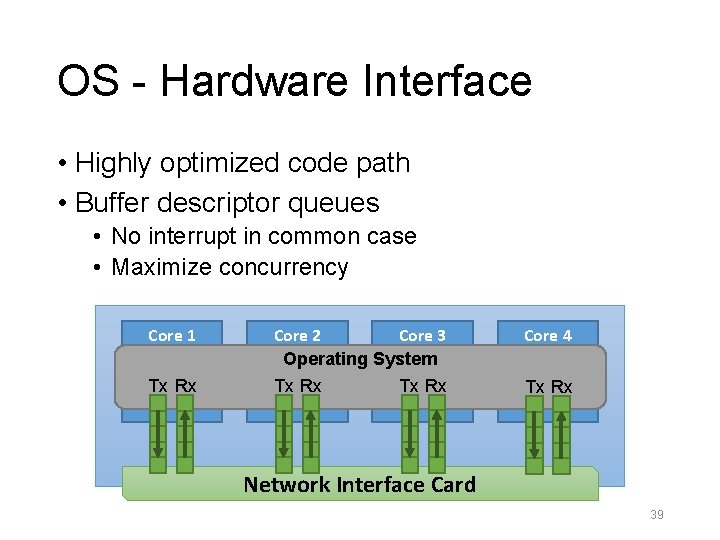
OS - Hardware Interface • Highly optimized code path • Buffer descriptor queues • No interrupt in common case • Maximize concurrency Core 1 Tx Rx Core 2 Core 3 Operating System Tx Rx Core 4 Tx Rx Network Interface Card 39
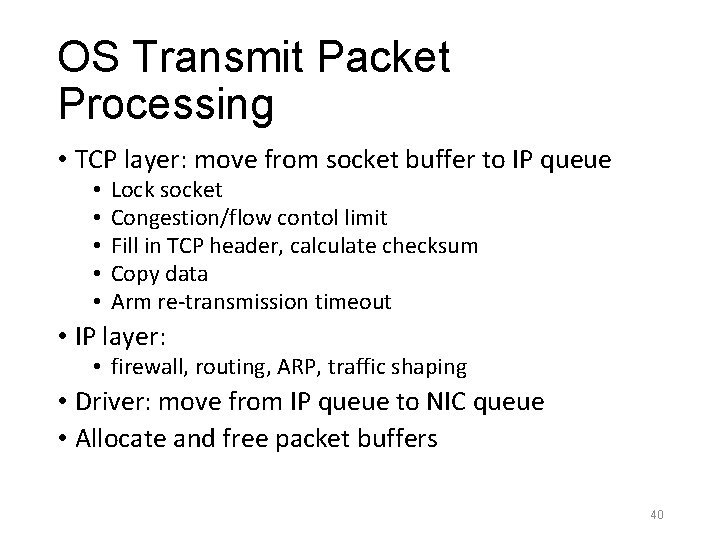
OS Transmit Packet Processing • TCP layer: move from socket buffer to IP queue • • • Lock socket Congestion/flow contol limit Fill in TCP header, calculate checksum Copy data Arm re-transmission timeout • IP layer: • firewall, routing, ARP, traffic shaping • Driver: move from IP queue to NIC queue • Allocate and free packet buffers 40
Sidebar: Tail Latency On Linux with a 40 Gbps link, 400 outbound TPC flows sending RPCs, no congestion, what is the minimum rate across all flows? 41
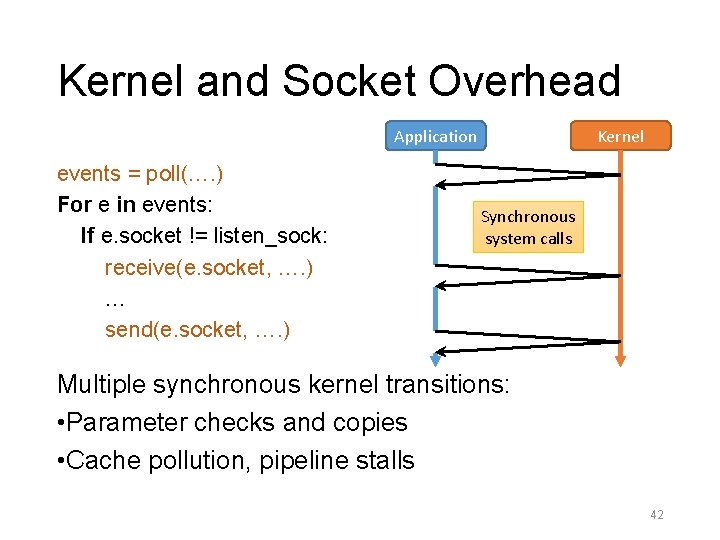
Kernel and Socket Overhead Application events = poll(…. ) For e in events: If e. socket != listen_sock: receive(e. socket, …. ) … send(e. socket, …. ) Kernel Synchronous system calls Multiple synchronous kernel transitions: • Parameter checks and copies • Cache pollution, pipeline stalls 42
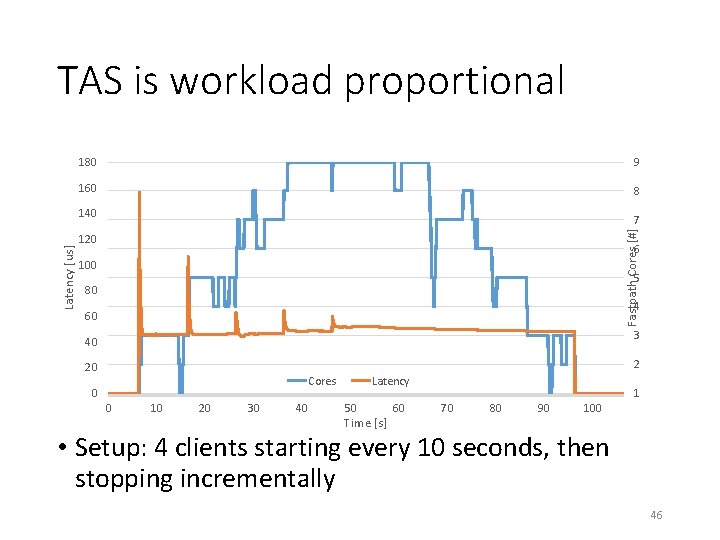
TCP Acceleration as a Service (Ta. S) • TCP as a user-level OS service • SRIO-V to dedicated cores • Scale number of cores up/down to match demand • Optimized data plane for common case operations • Application uses its own dedicated cores • Avoid polluting application level cache • Fewer cores => better performance scaling • To the application, per-socket tx/rx queues with doorbells • Analogous to hardware device tx/rx queues 43
Streamline common-case data path • Remove unneeded computation from data path • Congestion control, timeouts per RTT (not per packet) • Minimize per-flow TCP state • prefetch 2 cache lines on packet arrival • Linearized code • Better branch prediction • Super-scalar execution • Enforce IP level access control on control plane at connection setup
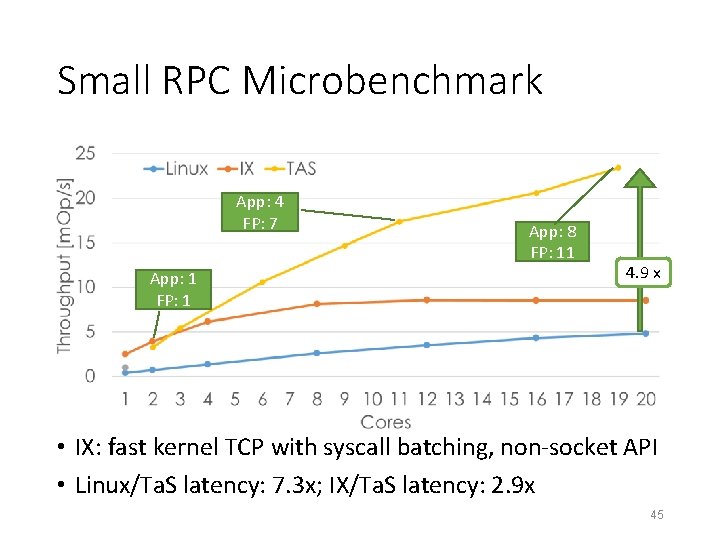
Small RPC Microbenchmark App: 4 FP: 7 App: 1 FP: 1 App: 8 FP: 11 4. 9 x • IX: fast kernel TCP with syscall batching, non-socket API • Linux/Ta. S latency: 7. 3 x; IX/Ta. S latency: 2. 9 x 45
TAS is workload proportional 180 9 160 8 7 Fastpath Cores [#] Latency [us] 140 120 6 100 5 80 4 60 3 40 2 20 Cores 0 0 10 20 30 40 Latency 50 Time [s] 60 1 70 80 90 100 • Setup: 4 clients starting every 10 seconds, then stopping incrementally 46
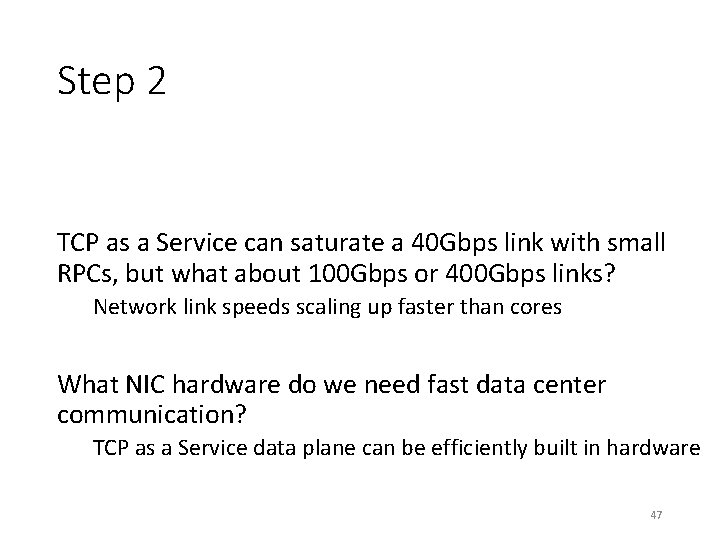
Step 2 TCP as a Service can saturate a 40 Gbps link with small RPCs, but what about 100 Gbps or 400 Gbps links? Network link speeds scaling up faster than cores What NIC hardware do we need fast data center communication? TCP as a Service data plane can be efficiently built in hardware 47
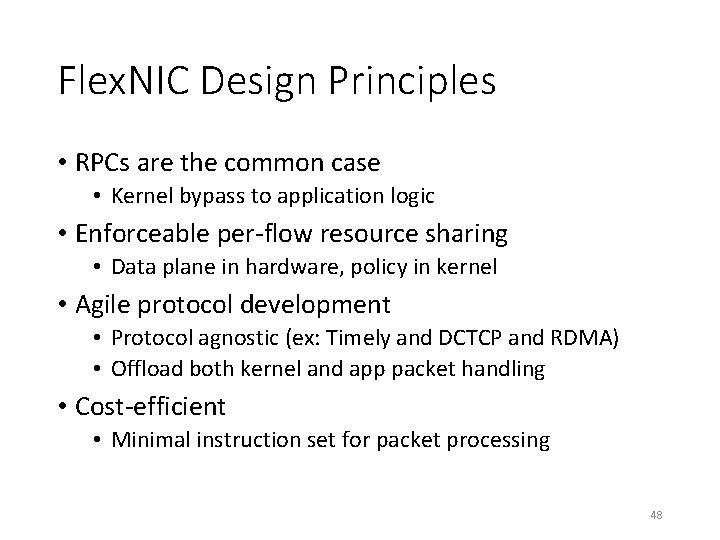
Flex. NIC Design Principles • RPCs are the common case • Kernel bypass to application logic • Enforceable per-flow resource sharing • Data plane in hardware, policy in kernel • Agile protocol development • Protocol agnostic (ex: Timely and DCTCP and RDMA) • Offload both kernel and app packet handling • Cost-efficient • Minimal instruction set for packet processing 48
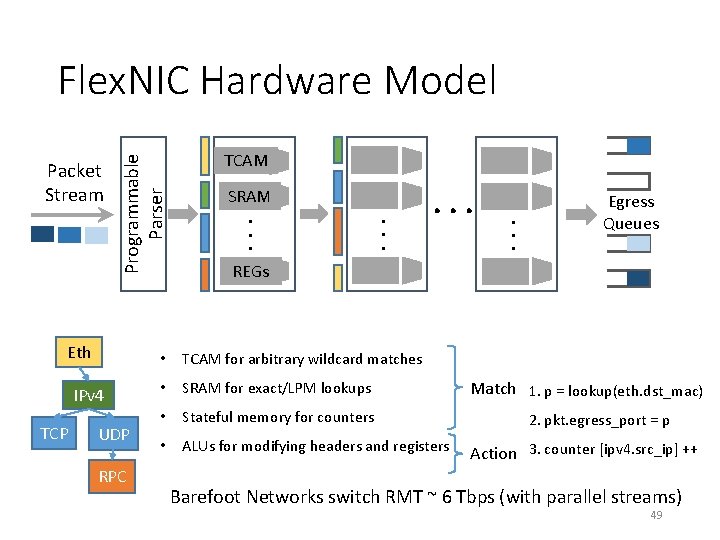
Eth IPv 4 TCP UDP RPC . . . SRAM . . . TCAM . . . Packet Stream Programmable Parser Flex. NIC Hardware Model Egress Queues REGs • TCAM for arbitrary wildcard matches • SRAM for exact/LPM lookups • Stateful memory for counters • ALUs for modifying headers and registers Match 1. p = lookup(eth. dst_mac) 2. pkt. egress_port = p Action 3. counter [ipv 4. src_ip] ++ Barefoot Networks switch RMT ~ 6 Tbps (with parallel streams) 49
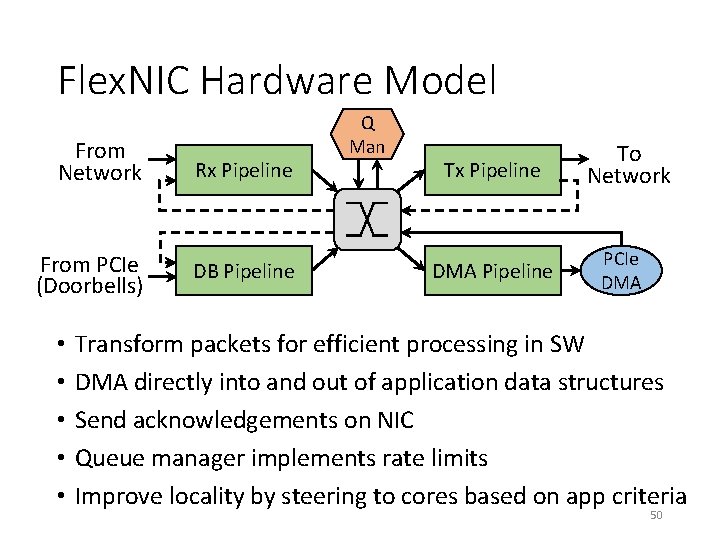
Flex. NIC Hardware Model From Network Rx Pipeline From PCIe (Doorbells) DB Pipeline • • • Q Man Tx Pipeline DMA Pipeline To Network PCIe DMA Transform packets for efficient processing in SW DMA directly into and out of application data structures Send acknowledgements on NIC Queue manager implements rate limits Improve locality by steering to cores based on app criteria 50
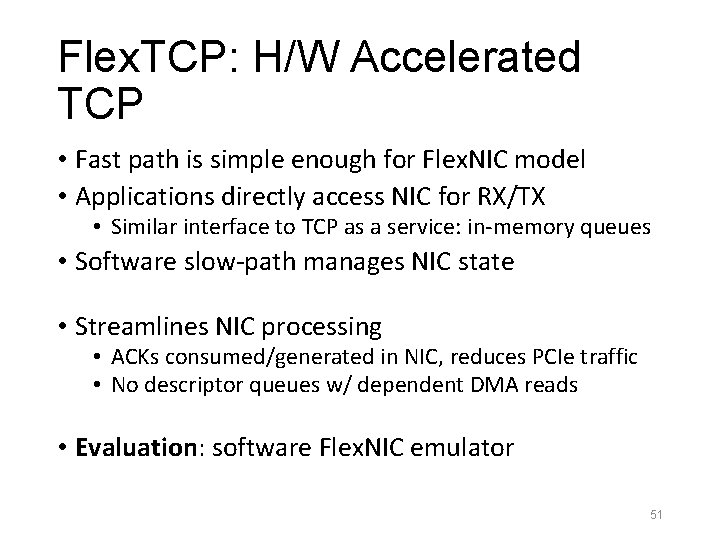
Flex. TCP: H/W Accelerated TCP • Fast path is simple enough for Flex. NIC model • Applications directly access NIC for RX/TX • Similar interface to TCP as a service: in-memory queues • Software slow-path manages NIC state • Streamlines NIC processing • ACKs consumed/generated in NIC, reduces PCIe traffic • No descriptor queues w/ dependent DMA reads • Evaluation: software Flex. NIC emulator 51
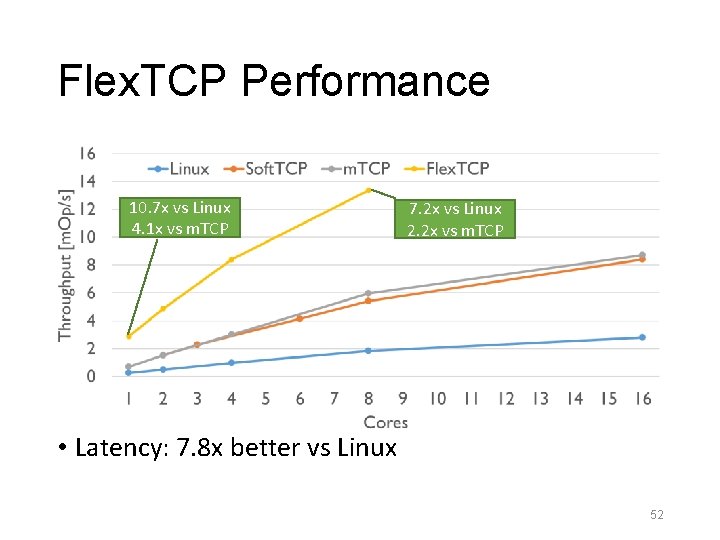
Flex. TCP Performance 10. 7 x vs Linux 4. 1 x vs m. TCP 7. 2 x vs Linux 2. 2 x vs m. TCP • Latency: 7. 8 x better vs Linux 52
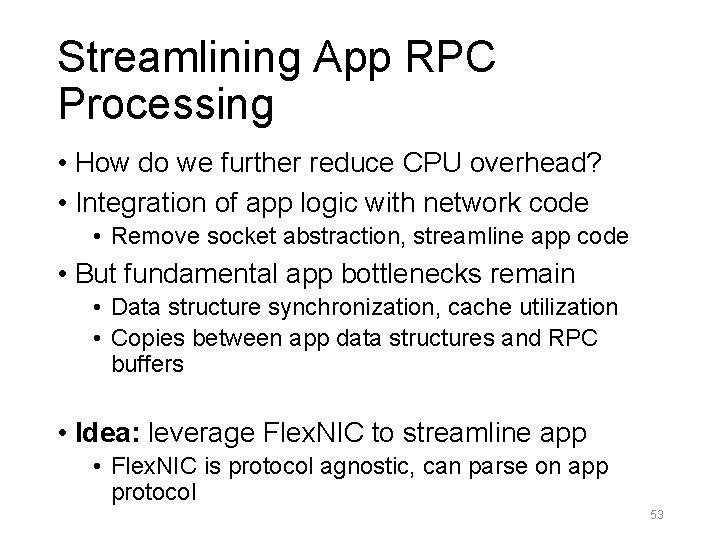
Streamlining App RPC Processing • How do we further reduce CPU overhead? • Integration of app logic with network code • Remove socket abstraction, streamline app code • But fundamental app bottlenecks remain • Data structure synchronization, cache utilization • Copies between app data structures and RPC buffers • Idea: leverage Flex. NIC to streamline app • Flex. NIC is protocol agnostic, can parse on app protocol 53
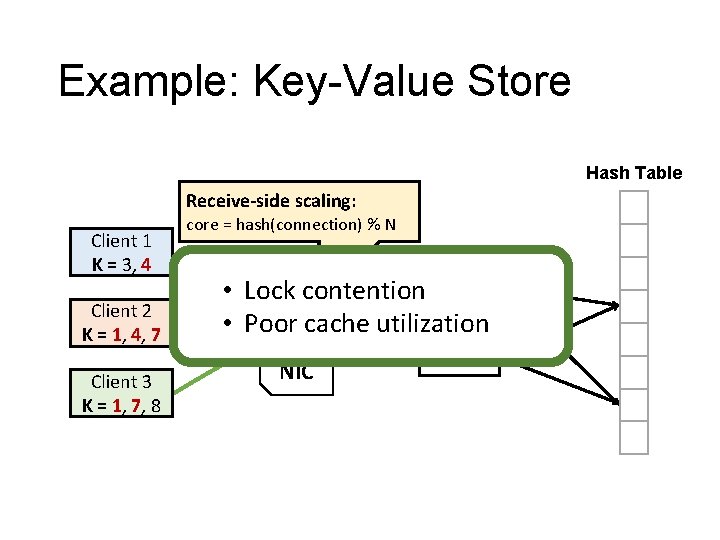
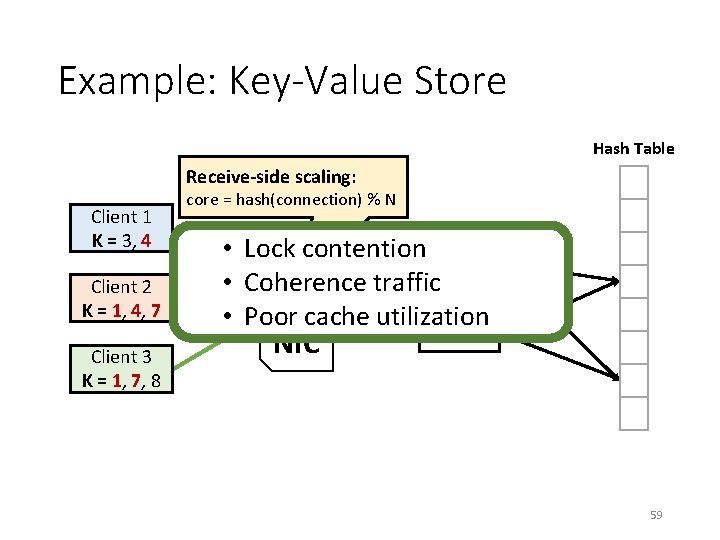
Example: Key-Value Store Hash Table Receive-side scaling: Client 1 K = 3, 4 Client 2 K = 1, 4, 7 Client 3 K = 1, 7, 8 core = hash(connection) % N • Lock contention Core 1 • Poor cache utilization NIC 4 Core 2 7
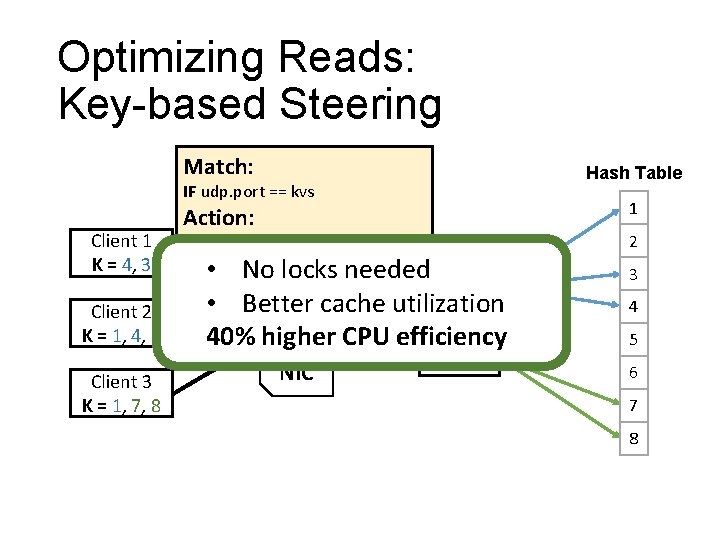
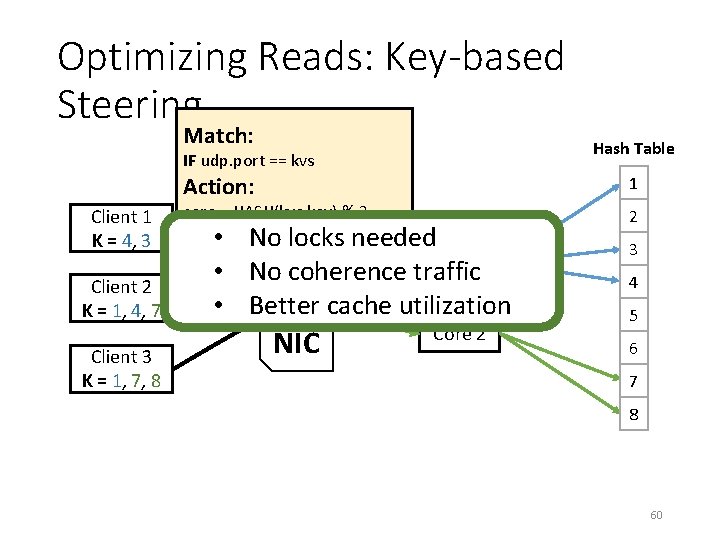
Optimizing Reads: Key-based Steering Match: Hash Table Action: 1 IF udp. port == kvs Client 1 K = 4, 3 Client 2 K = 1, 4, 7 Client 3 K = 1, 7, 8 core = HASH(kvs. key) % 2 DMA TO Cores[core] • hash, Nokvslocks needed 2 Core 1 • Better cache utilization 40% higher CPU efficiency NIC Core 2 3 4 5 6 7 8
Summary Arrakis (OSDI 14) • OS architecture that separates the control and data plane, for both networking and storage Strata (SOSP 17) • File system design for low latency persistence (NVM) and multi-tier storage (NVM, SSD, HDD) TCP as a Service/Flex. NIC/Floem (ASPLOS 15, OSDI 18) • OS, NIC, and app library support for fast, agile, secure protocol processing 56
Biography • College: physics -> psychology -> philosophy • Took three CS classes as a senior • After college: developed an OS for a z 80 • After project shipped, project got cancelled • Applied to grad school: seven out of eight turned me down • Grad school • Learned a lot • Dissertation had zero commercial impact for decades • As faculty • I learn a lot from the people I work with • Try to pick topics that matter, and where I get to learn
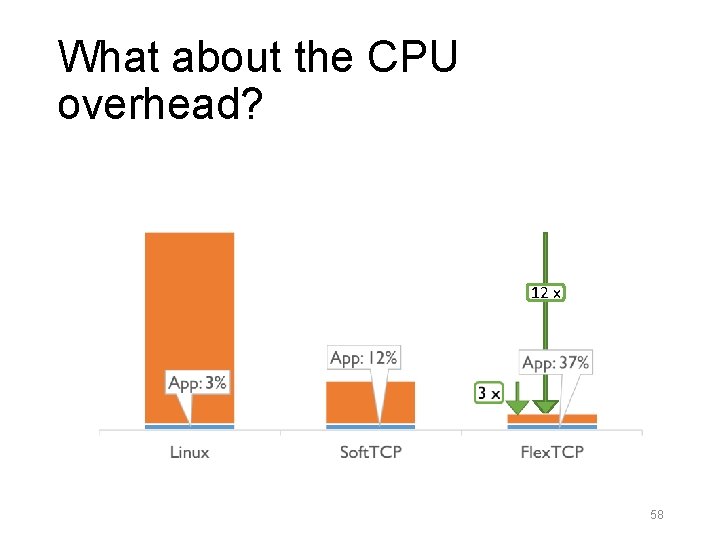
What about the CPU overhead? 12 x 58
Example: Key-Value Store Hash Table Receive-side scaling: Client 1 K = 3, 4 Client 2 K = 1, 4, 7 Client 3 K = 1, 7, 8 core = hash(connection) % N • Lock contention Core 1 • Coherence traffic • Poor cache utilization NIC 4 Core 2 7 59
Optimizing Reads: Key-based Steering Match: Hash Table Action: 1 IF udp. port == kvs Client 1 K = 4, 3 Client 2 K = 1, 4, 7 Client 3 K = 1, 7, 8 core = HASH(kvs. key) % 2 DMA • hash, TO Cores[core] Nokvslocks needed Core 1 • No coherence traffic • Better cache utilization NIC Core 2 2 3 4 5 6 7 8 60
Where is hardware going?
The Example of Bitcoin is a protocol for maintaining a byzantine fault tolerant public ledger • Cryptographically signed ledger of of a sequence of transfers of digital currency, but could be anything Provides an incentive to participate in the fault tolerant protocol • Proof of work: Solve a cryptographic puzzle, get a reward • Hard to monopolize Extremely low bandwidth: a few transactions/second • Energy cost roughly the same as Ireland
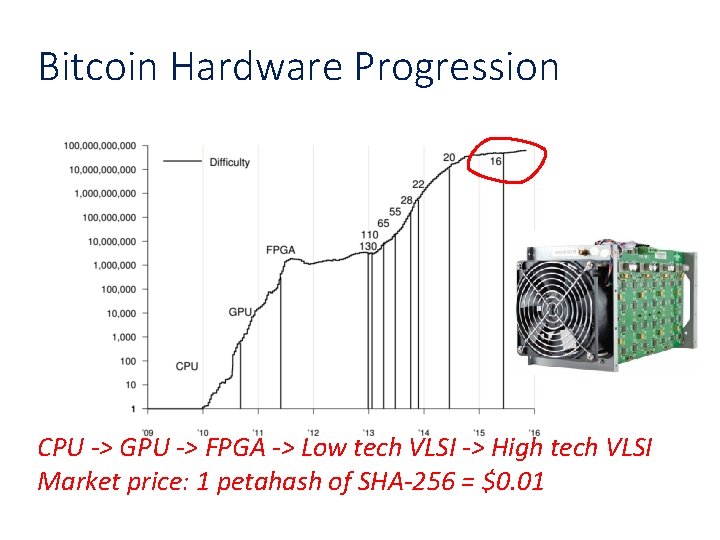
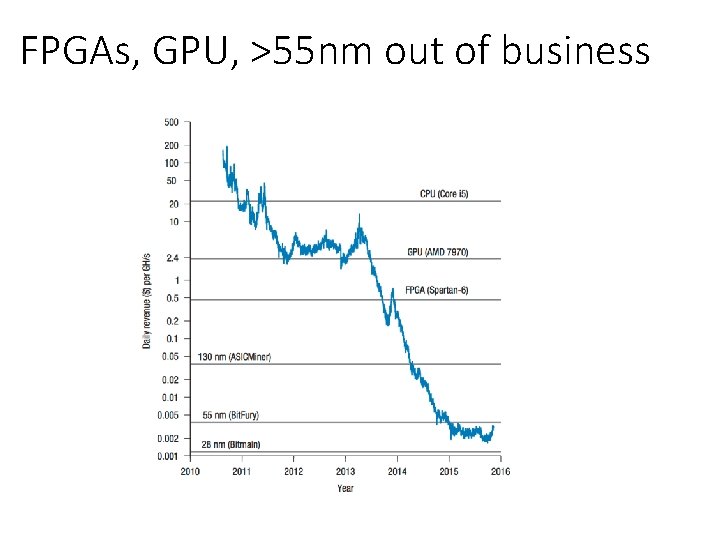
Bitcoin Hardware Progression CPU -> GPU -> FPGA -> Low tech VLSI -> High tech VLSI Market price: 1 petahash of SHA-256 = $0. 01
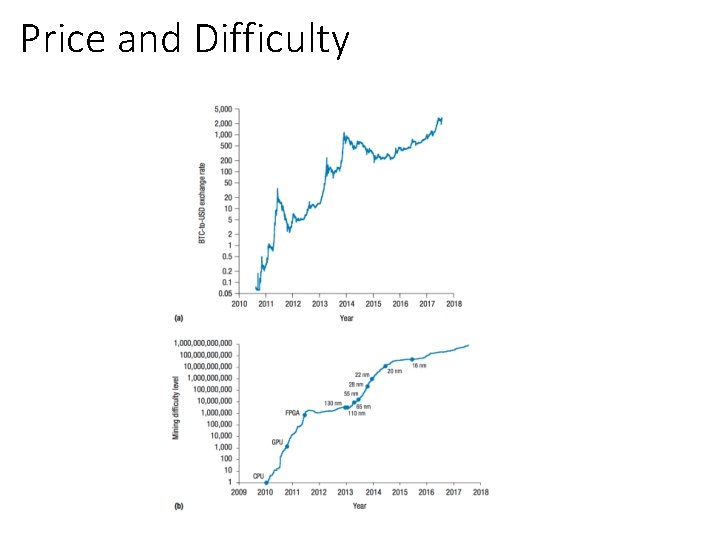
Price and Difficulty
FPGAs, GPU, >55 nm out of business