
High Performance Data Mining with Services on Multicore

- Slides: 29
High Performance Data Mining with Services on Multi-core systems Shanghai Many-Core Workshop March 27 -28 2008 Judy Qiu xqiu@indiana. edu, http: //www. infomall. org/salsa Research Computing UITS, Indiana University Bloomington IN Geoffrey Fox, Huapeng Yuan, Seung-Hee Bae Community Grids Laboratory, Indiana University Bloomington IN George Chrysanthakopoulos, Henrik Frystyk Nielsen Microsoft Research, Redmond WA
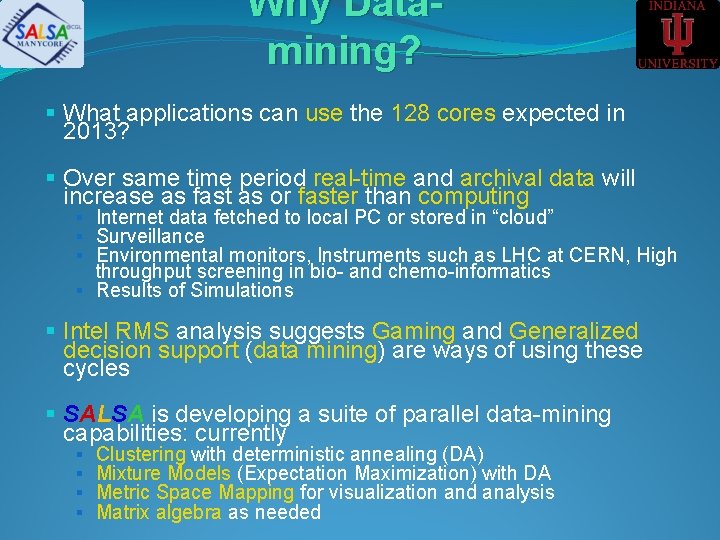
Why Datamining? § What applications can use the 128 cores expected in 2013? § Over same time period real-time and archival data will increase as fast as or faster than computing § Internet data fetched to local PC or stored in “cloud” § Surveillance § Environmental monitors, Instruments such as LHC at CERN, High throughput screening in bio- and chemo-informatics § Results of Simulations § Intel RMS analysis suggests Gaming and Generalized decision support (data mining) are ways of using these cycles § SALSA is developing a suite of parallel data-mining capabilities: currently § § Clustering with deterministic annealing (DA) Mixture Models (Expectation Maximization) with DA Metric Space Mapping for visualization and analysis Matrix algebra as needed
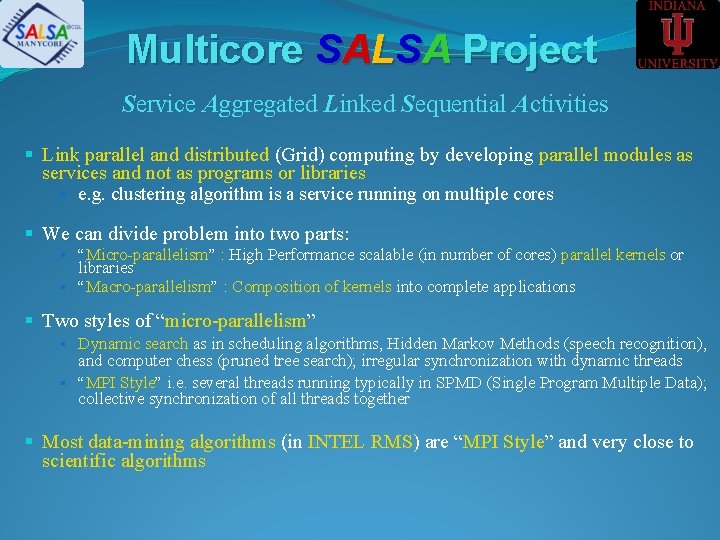
Multicore SALSA Project Service Aggregated Linked Sequential Activities § Link parallel and distributed (Grid) computing by developing parallel modules as services and not as programs or libraries § e. g. clustering algorithm is a service running on multiple cores § We can divide problem into two parts: § “Micro-parallelism” : High Performance scalable (in number of cores) parallel kernels or libraries § “Macro-parallelism” : Composition of kernels into complete applications § Two styles of “micro-parallelism” § Dynamic search as in scheduling algorithms, Hidden Markov Methods (speech recognition), and computer chess (pruned tree search); irregular synchronization with dynamic threads § “MPI Style” i. e. several threads running typically in SPMD (Single Program Multiple Data); collective synchronization of all threads together § Most data-mining algorithms (in INTEL RMS) are “MPI Style” and very close to scientific algorithms
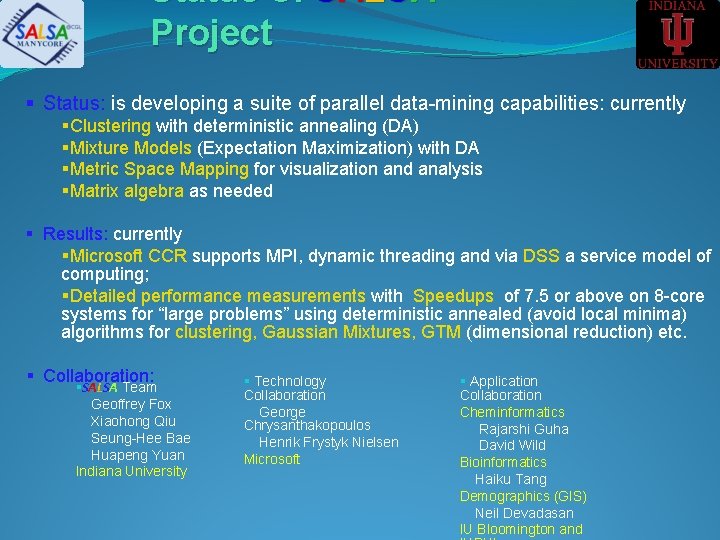
Status of SALSA Project § Status: is developing a suite of parallel data-mining capabilities: currently §Clustering with deterministic annealing (DA) §Mixture Models (Expectation Maximization) with DA §Metric Space Mapping for visualization and analysis §Matrix algebra as needed § Results: currently §Microsoft CCR supports MPI, dynamic threading and via DSS a service model of computing; §Detailed performance measurements with Speedups of 7. 5 or above on 8 -core systems for “large problems” using deterministic annealed (avoid local minima) algorithms for clustering, Gaussian Mixtures, GTM (dimensional reduction) etc. § Collaboration: §SALSA Team Geoffrey Fox Xiaohong Qiu Seung-Hee Bae Huapeng Yuan Indiana University § Technology Collaboration George Chrysanthakopoulos Henrik Frystyk Nielsen Microsoft § Application Collaboration Cheminformatics Rajarshi Guha David Wild Bioinformatics Haiku Tang Demographics (GIS) Neil Devadasan IU Bloomington and
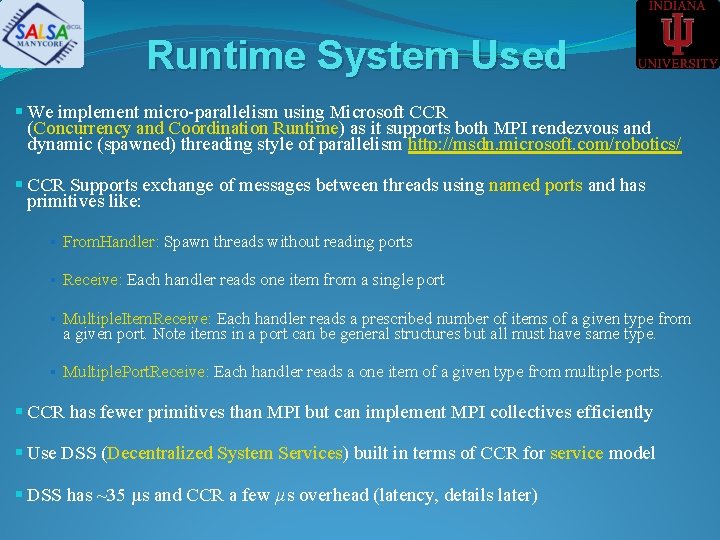
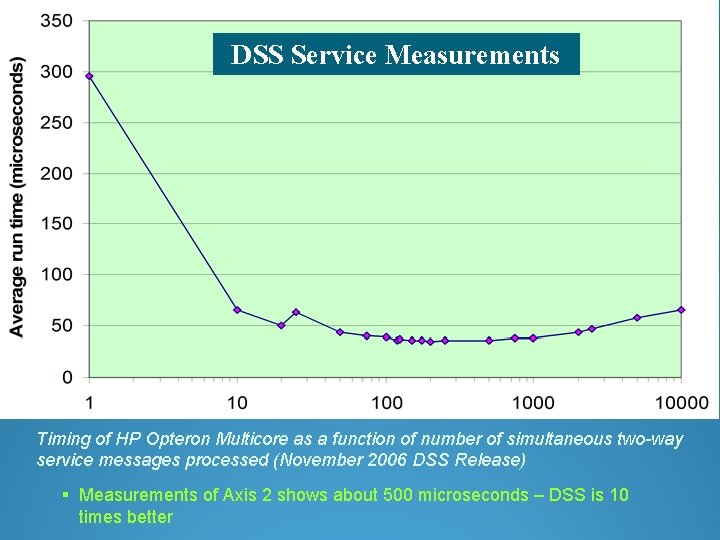
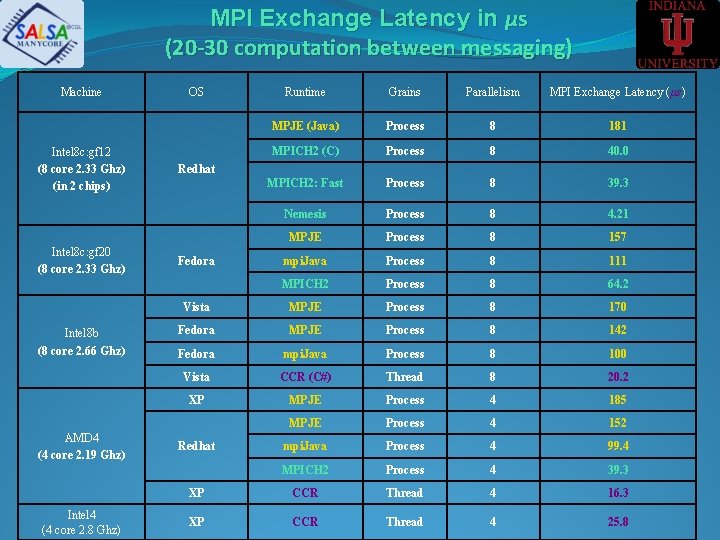
Runtime System Used § We implement micro-parallelism using Microsoft CCR (Concurrency and Coordination Runtime) as it supports both MPI rendezvous and dynamic (spawned) threading style of parallelism http: //msdn. microsoft. com/robotics/ § CCR Supports exchange of messages between threads using named ports and has primitives like: § From. Handler: Spawn threads without reading ports § Receive: Each handler reads one item from a single port § Multiple. Item. Receive: Each handler reads a prescribed number of items of a given type from a given port. Note items in a port can be general structures but all must have same type. § Multiple. Port. Receive: Each handler reads a one item of a given type from multiple ports. § CCR has fewer primitives than MPI but can implement MPI collectives efficiently § Use DSS (Decentralized System Services) built in terms of CCR for service model § DSS has ~35 µs and CCR a few µs overhead (latency, details later)
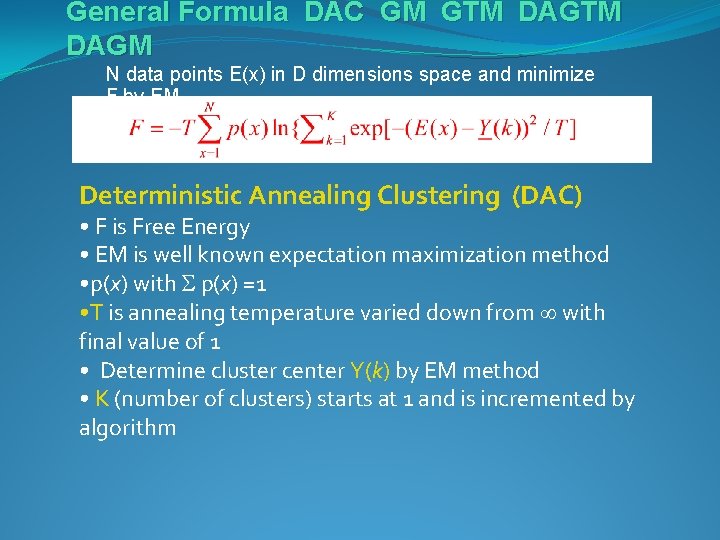
General Formula DAC GM GTM DAGM N data points E(x) in D dimensions space and minimize F by EM Deterministic Annealing Clustering (DAC) • F is Free Energy • EM is well known expectation maximization method • p(x) with p(x) =1 • T is annealing temperature varied down from with final value of 1 • Determine cluster center Y(k) by EM method • K (number of clusters) starts at 1 and is incremented by algorithm
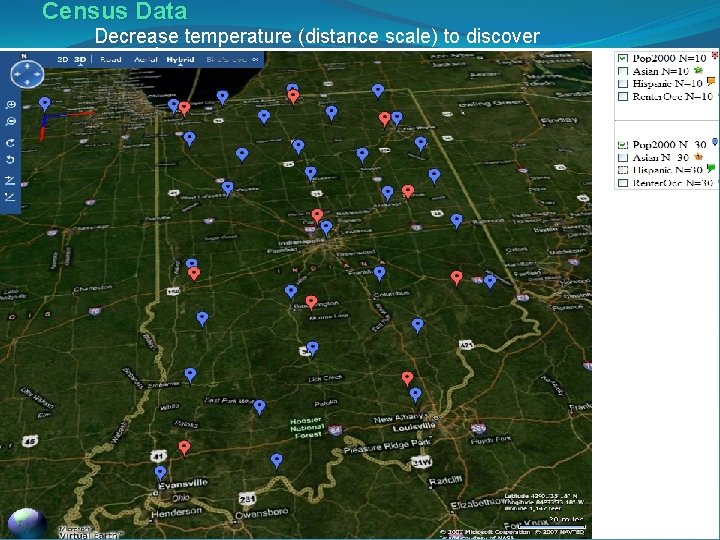
Census Data Decrease temperature (distance scale) to discover more clusters
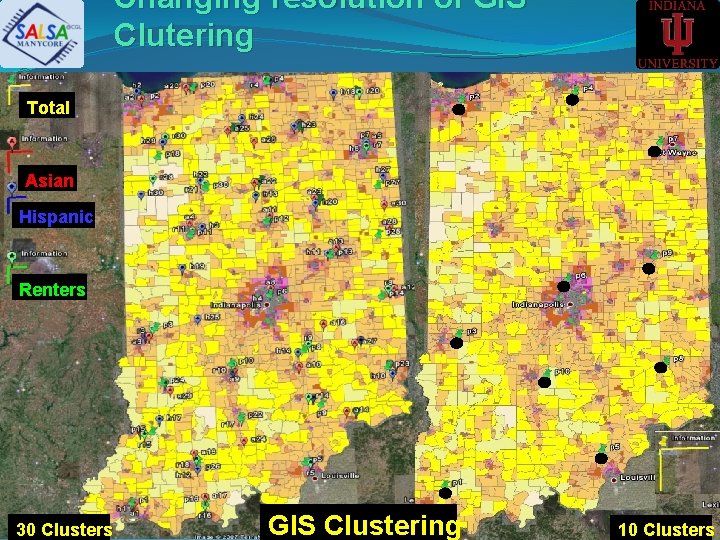
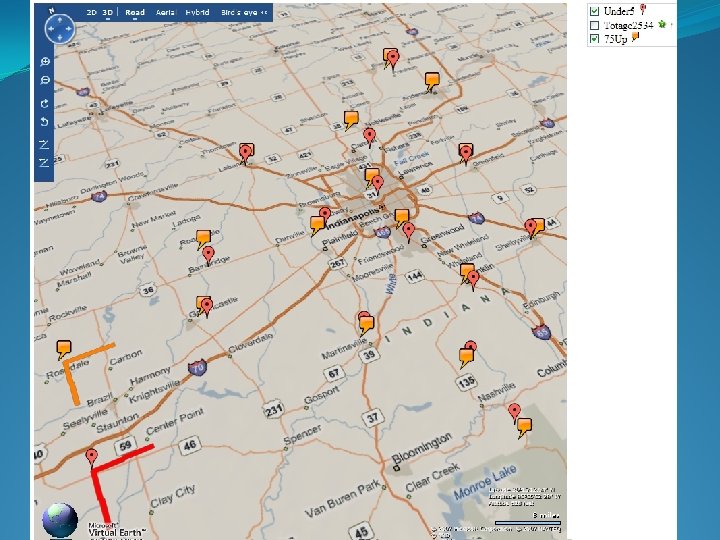
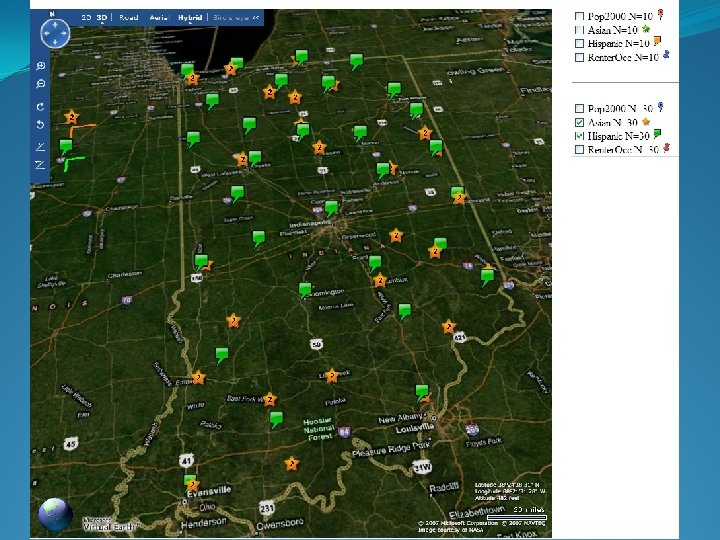
Changing resolution of GIS Clutering Total Asian Hispanic Renters 30 Clusters GIS 30 Clustering Clusters 10 Clusters
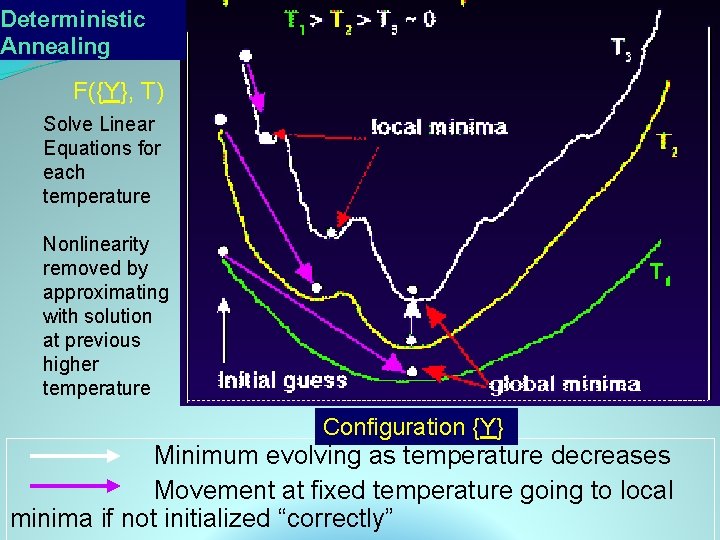
Deterministic Annealing F({Y}, T) Solve Linear Equations for each temperature Nonlinearity removed by approximating with solution at previous higher temperature Configuration {Y} Minimum evolving as temperature decreases Movement at fixed temperature going to local minima if not initialized “correctly”
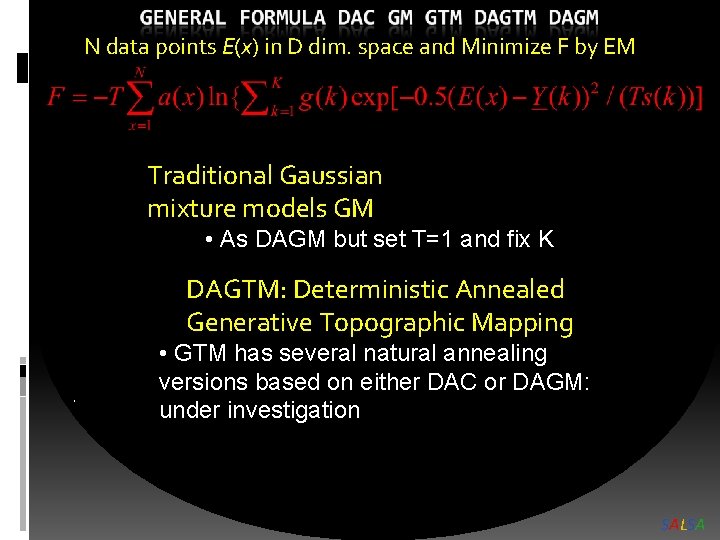
N data points E(x) in D dim. space and Minimize F by EM Traditional Gaussian Deterministic Generative Topographic Annealing Clustering Mapping (GTM) (DAC) Deterministic Annealing Gaussian Mixture models GM (DAGM) • a(x) = 1/N or generally p(x) D/2 with p(x) =1 • a(x) = 1 and g(k) = (1/K)( /2 ) • and As s(k)=0. 5 DAGM but set T=1 and fix K • g(k)=1 • a(x) = 1 • s(k) = 1/ and T = 1 2)D/2}1/T temperature varied down from M W/(2 (k) • Y(k) • • =Tg(k)={P ism=1 annealing (X(k)) km m DAGTM: Deterministic Annealed 2 with final value of 1 2/ 2 Gaussian) • s(k)= (k) (taking case of(X- spherical • Choose fixed (X) = exp( 0. 5 ) ) m m Generative Topographic Mapping Vary cluster center Y(k)of but can calculate weight T misand annealing temperature varied down from • Vary • • W but fix values M and K a priori 2 • GTM has several natural annealing P and correlation matrix s(k) = (k) (even for space k with final value of 1 • Y(k) E(x)versions Wm are 2 vectors in original high D dimension based on either DAC or DAGM: matrix (k) ) using IDENTICAL formulae for space • Vary Y(k) P and (k) • X(k) andunder m areinvestigation vectors in 2 dimensional mapped k Gaussian • K startsmixtures at 1 and is incremented by algorithm • K starts at 1 and is incremented by algorithm SALSA
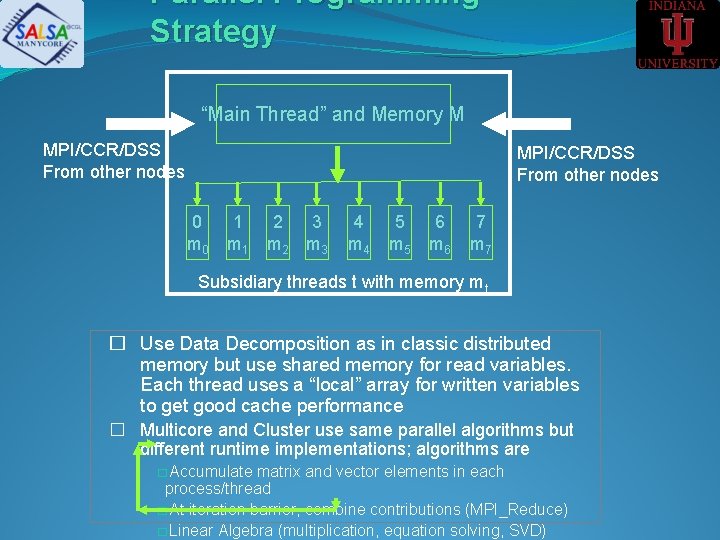
Parallel Programming Strategy “Main Thread” and Memory M MPI/CCR/DSS From other nodes 0 m 0 1 m 1 2 3 m 2 m 3 4 m 4 5 m 5 6 m 6 7 m 7 Subsidiary threads t with memory mt � Use Data Decomposition as in classic distributed memory but use shared memory for read variables. Each thread uses a “local” array for written variables to get good cache performance � Multicore and Cluster use same parallel algorithms but different runtime implementations; algorithms are � Accumulate matrix and vector elements in each process/thread � At iteration barrier, combine contributions (MPI_Reduce) � Linear Algebra (multiplication, equation solving, SVD)
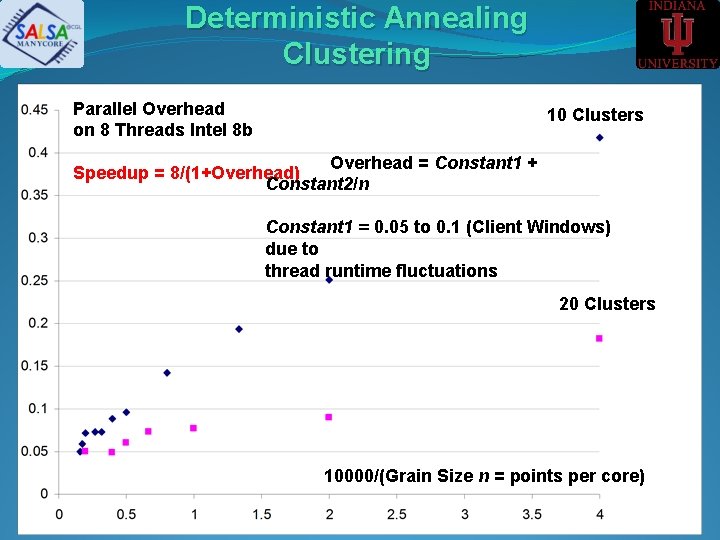
Deterministic Annealing Clustering Parallel Overhead on 8 Threads Intel 8 b 10 Clusters Overhead = Constant 1 + Speedup = 8/(1+Overhead) Constant 2/n Constant 1 = 0. 05 to 0. 1 (Client Windows) due to thread runtime fluctuations 20 Clusters 10000/(Grain Size n = points per core)
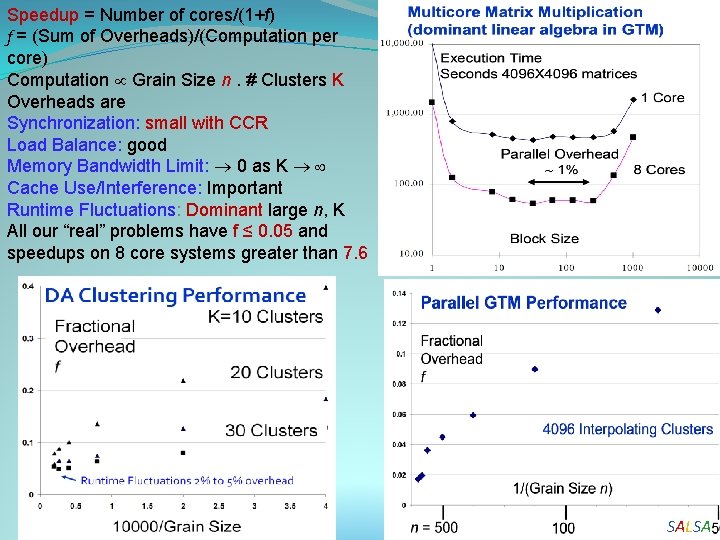
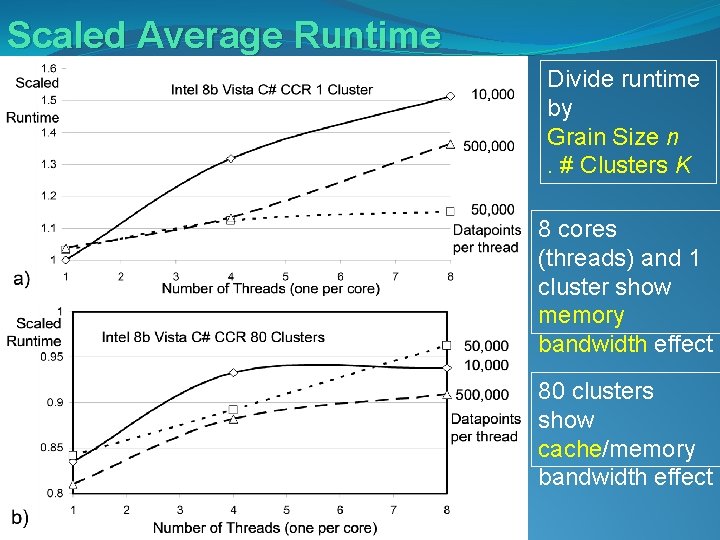
Speedup = Number of cores/(1+f) f = (Sum of Overheads)/(Computation per core) Computation Grain Size n. # Clusters K Overheads are Synchronization: small with CCR Load Balance: good Memory Bandwidth Limit: 0 as K Cache Use/Interference: Important Runtime Fluctuations: Dominant large n, K All our “real” problems have f ≤ 0. 05 and speedups on 8 core systems greater than 7. 6 SALSA
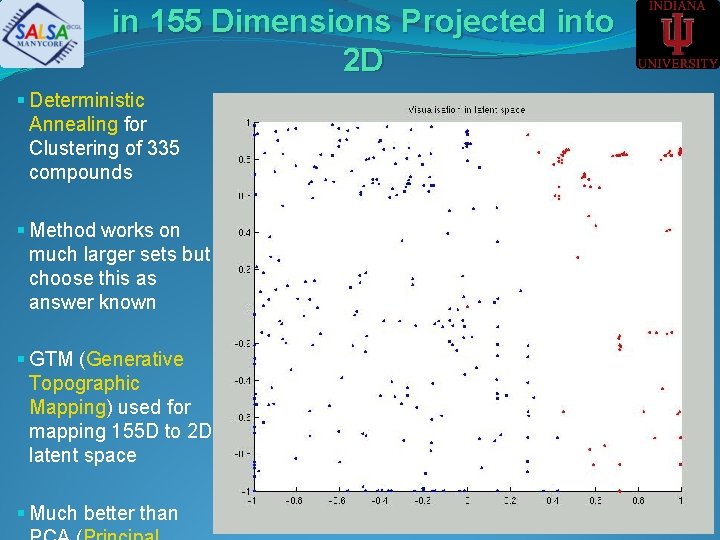
in 155 Dimensions Projected into 2 D § Deterministic Annealing for Clustering of 335 compounds § Method works on much larger sets but choose this as answer known § GTM (Generative Topographic Mapping) used for mapping 155 D to 2 D latent space § Much better than
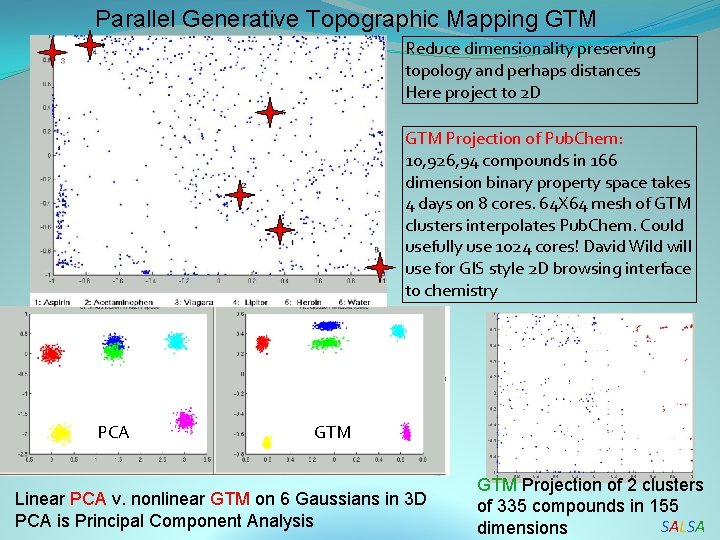
Parallel Generative Topographic Mapping GTM Reduce dimensionality preserving topology and perhaps distances Here project to 2 D GTM Projection of Pub. Chem: 10, 926, 94 compounds in 166 dimension binary property space takes 4 days on 8 cores. 64 X 64 mesh of GTM clusters interpolates Pub. Chem. Could usefully use 1024 cores! David Wild will use for GIS style 2 D browsing interface to chemistry PCA GTM Linear PCA v. nonlinear GTM on 6 Gaussians in 3 D PCA is Principal Component Analysis GTM Projection of 2 clusters of 335 compounds in 155 SALSA dimensions
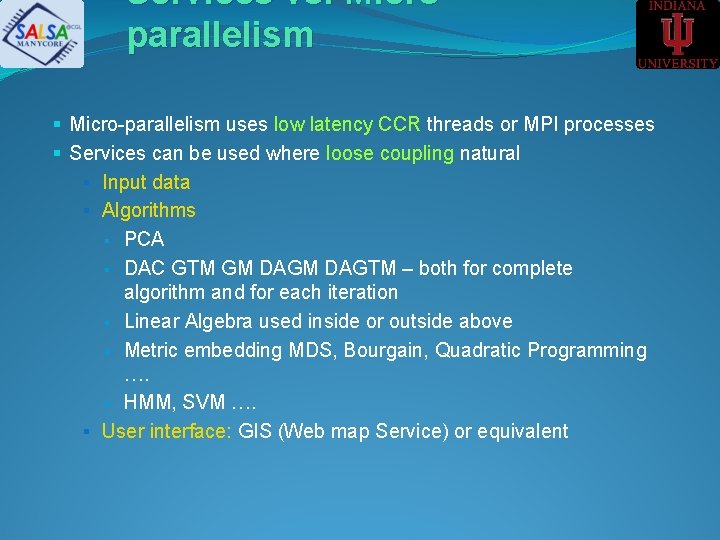
Services vs. Microparallelism § Micro-parallelism uses low latency CCR threads or MPI processes § Services can be used where loose coupling natural § Input data § Algorithms § PCA § DAC GTM GM DAGTM – both for complete algorithm and for each iteration § Linear Algebra used inside or outside above § Metric embedding MDS, Bourgain, Quadratic Programming …. § HMM, SVM …. § User interface: GIS (Web map Service) or equivalent
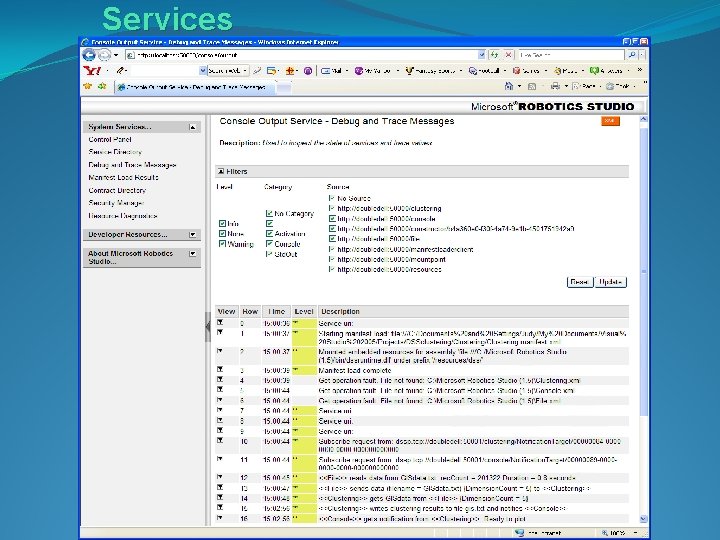
Services
DSS Service Measurements Timing of HP Opteron Multicore as a function of number of simultaneous two-way service messages processed (November 2006 DSS Release) § Measurements of Axis 2 shows about 500 microseconds – DSS is 10 times better
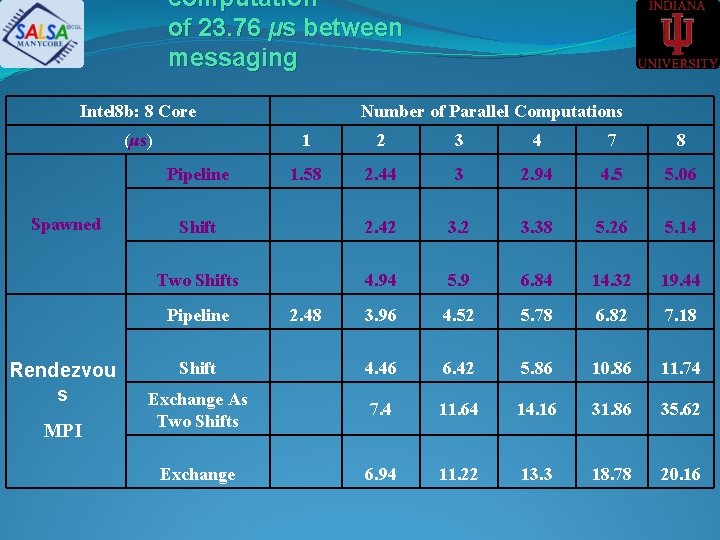
MPI Exchange Latency in μs (20 -30 computation between messaging) Machine Intel 8 c: gf 12 (8 core 2. 33 Ghz) (in 2 chips) Intel 8 c: gf 20 (8 core 2. 33 Ghz) Intel 8 b (8 core 2. 66 Ghz) AMD 4 (4 core 2. 19 Ghz) Intel 4 (4 core 2. 8 Ghz) OS Runtime Grains Parallelism MPI Exchange Latency (µs) MPJE (Java) Process 8 181 MPICH 2 (C) Process 8 40. 0 MPICH 2: Fast Process 8 39. 3 Nemesis Process 8 4. 21 MPJE Process 8 157 mpi. Java Process 8 111 MPICH 2 Process 8 64. 2 Vista MPJE Process 8 170 Fedora MPJE Process 8 142 Fedora mpi. Java Process 8 100 Vista CCR (C#) Thread 8 20. 2 XP MPJE Process 4 185 MPJE Process 4 152 mpi. Java Process 4 99. 4 MPICH 2 Process 4 39. 3 XP CCR Thread 4 16. 3 XP CCR Thread 4 25. 8 Redhat Fedora Redhat
computation of 23. 76 µs between messaging Intel 8 b: 8 Core (μs) 1 2 3 4 7 8 1. 58 2. 44 3 2. 94 4. 5 5. 06 Shift 2. 42 3. 38 5. 26 5. 14 Two Shifts 4. 94 5. 9 6. 84 14. 32 19. 44 3. 96 4. 52 5. 78 6. 82 7. 18 Shift 4. 46 6. 42 5. 86 10. 86 11. 74 Exchange As Two Shifts 7. 4 11. 64 14. 16 31. 86 35. 62 Exchange 6. 94 11. 22 13. 3 18. 78 20. 16 Pipeline Spawned Pipeline Rendezvou s MPI Number of Parallel Computations 2. 48
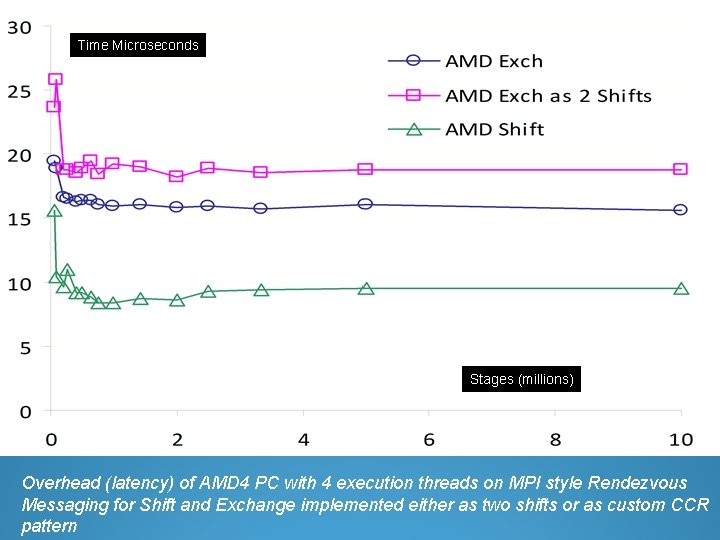
Time Microseconds Stages (millions) Overhead (latency) of AMD 4 PC with 4 execution threads on MPI style Rendezvous Messaging for Shift and Exchange implemented either as two shifts or as custom CCR pattern
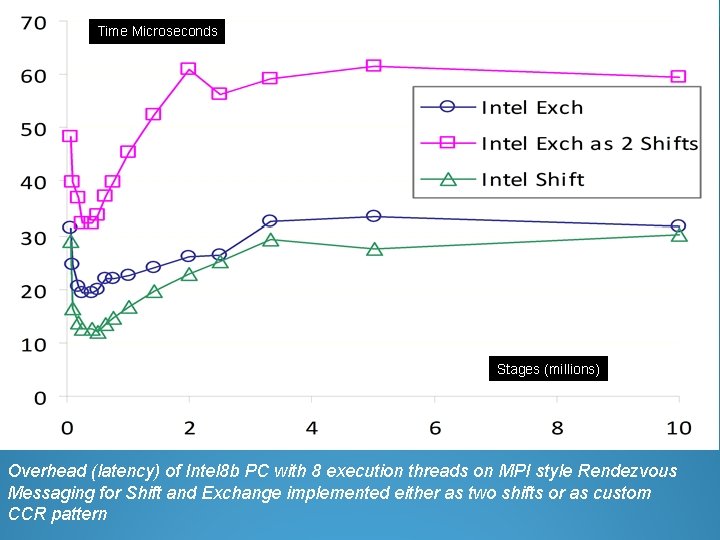
Time Microseconds Stages (millions) Overhead (latency) of Intel 8 b PC with 8 execution threads on MPI style Rendezvous Messaging for Shift and Exchange implemented either as two shifts or as custom CCR pattern
Scaled Average Runtime Divide runtime by Grain Size n. # Clusters K 8 cores (threads) and 1 cluster show memory bandwidth effect 80 clusters show cache/memory bandwidth effect
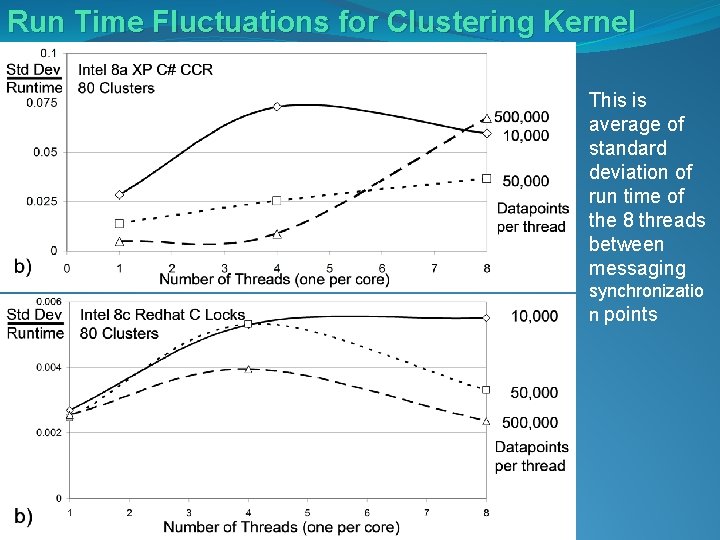
Run Time Fluctuations for Clustering Kernel This is average of standard deviation of run time of the 8 threads between messaging synchronizatio n points
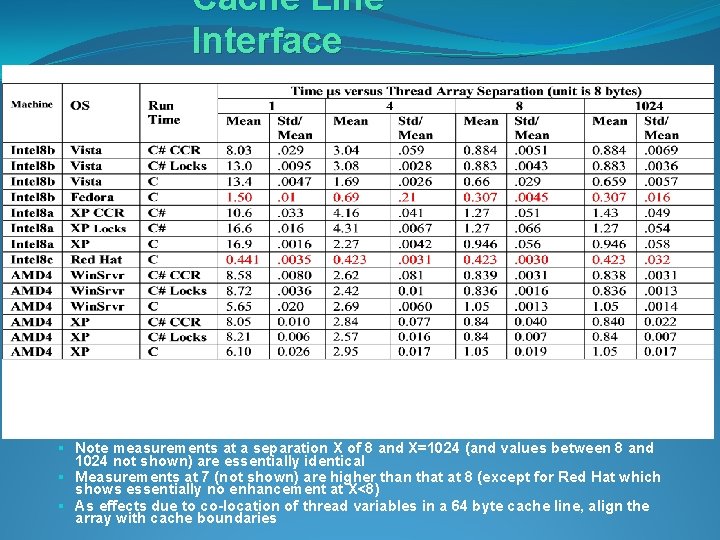
Cache Line Interference § Early implementations of our clustering algorithm showed large fluctuations due to the cache line interference effect (false sharing) § We have one thread on each core each calculating a sum of same complexity storing result in a common array A with different cores using different array locations § Thread i stores sum in A(i) is separation 1 – no memory access interference but cache line interference § Thread i stores sum in A(X*i) is separation X § Serious degradation if X < 8 (64 bytes) with Windows § Note A is a double (8 bytes) § Less interference effect with Linux – especially Red Hat
Cache Line Interface § Note measurements at a separation X of 8 and X=1024 (and values between 8 and 1024 not shown) are essentially identical § Measurements at 7 (not shown) are higher than that at 8 (except for Red Hat which shows essentially no enhancement at X<8) § As effects due to co-location of thread variables in a 64 byte cache line, align the array with cache boundaries
Futures §This class of data mining does/will parallelize well on current/future multicore nodes §Several engineering issues for use in large applications § How to take CCR in multicore node to cluster (MPI or cross-cluster CCR? ) § Need high performance linear algebra for C# (PLASMA from UTenn) § Access linear algebra services in a different language? § Need equivalent of Intel C Math Libraries for C# (vector arithmetic – level 1 BLAS) § Service model to integrate modules § Need access to a ~ 128 node Windows cluster §Future work is more applications; refine current algorithms such as DAGTM §New parallel algorithms § Clustering with pairwise distances but no vector spaces § Bourgain Random Projection for metric embedding § MDS Dimensional Scaling with EM-like SMACOF and deterministic annealing § Support use of Newton’s Method (Marquardt’s method) as EM alternative