Heat of Fusion Investigation 6 Key Idea Quiz




- Slides: 36
Heat of Fusion Investigation #6
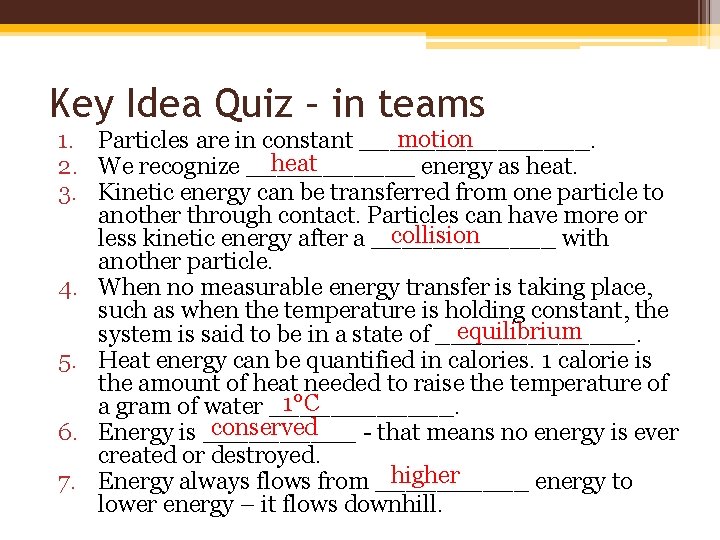
Key Idea Quiz – in teams motion 1. Particles are in constant ________. heat 2. We recognize ______ energy as heat. 3. Kinetic energy can be transferred from one particle to another through contact. Particles can have more or collision less kinetic energy after a ______ with another particle. 4. When no measurable energy transfer is taking place, such as when the temperature is holding constant, the equilibrium system is said to be in a state of _______. 5. Heat energy can be quantified in calories. 1 calorie is the amount of heat needed to raise the temperature of 1°C a gram of water ______. conserved 6. Energy is _____ - that means no energy is ever created or destroyed. higher 7. Energy always flows from _____ energy to lower energy – it flows downhill.
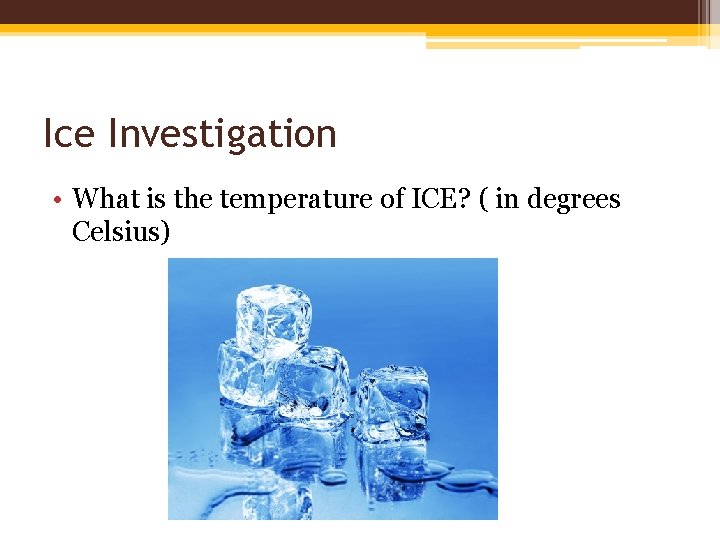
Ice Investigation • What is the temperature of ICE? ( in degrees Celsius)
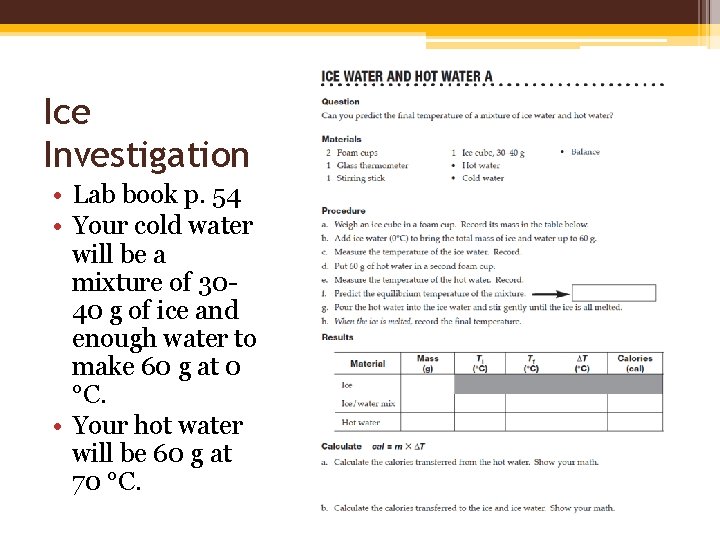
Ice Investigation • Lab book p. 54 • Your cold water will be a mixture of 3040 g of ice and enough water to make 60 g at 0 °C. • Your hot water will be 60 g at 70 °C.
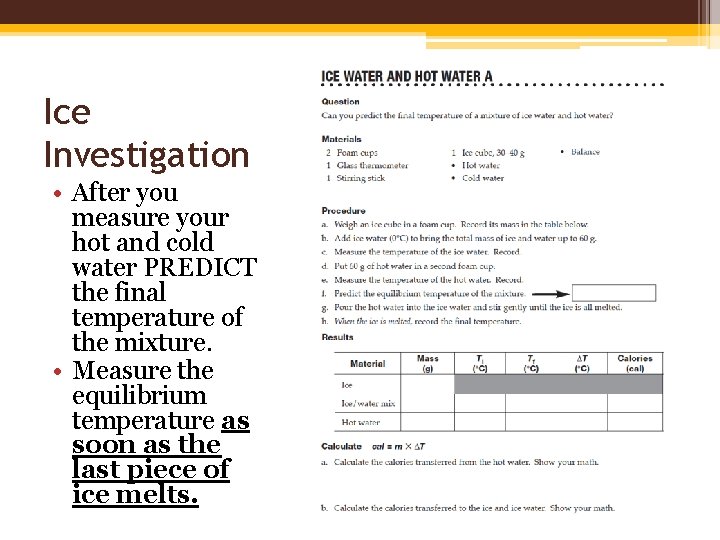
Ice Investigation • After you measure your hot and cold water PREDICT the final temperature of the mixture. • Measure the equilibrium temperature as soon as the last piece of ice melts.
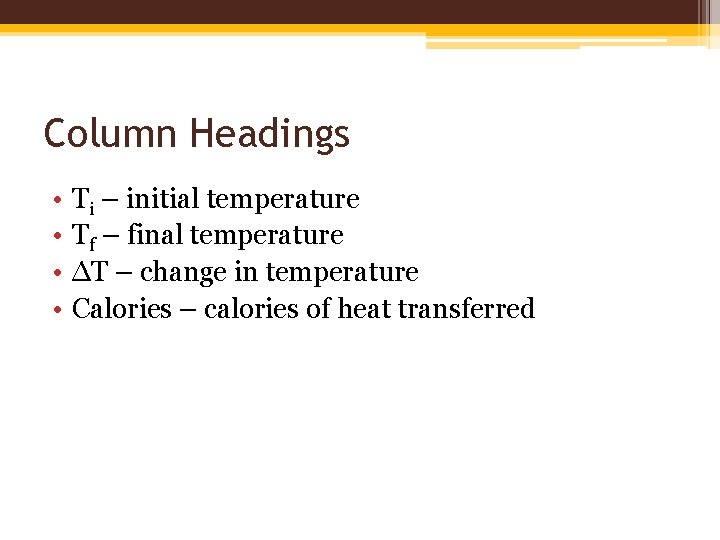
Column Headings • • Ti – initial temperature Tf – final temperature ∆T – change in temperature Calories – calories of heat transferred
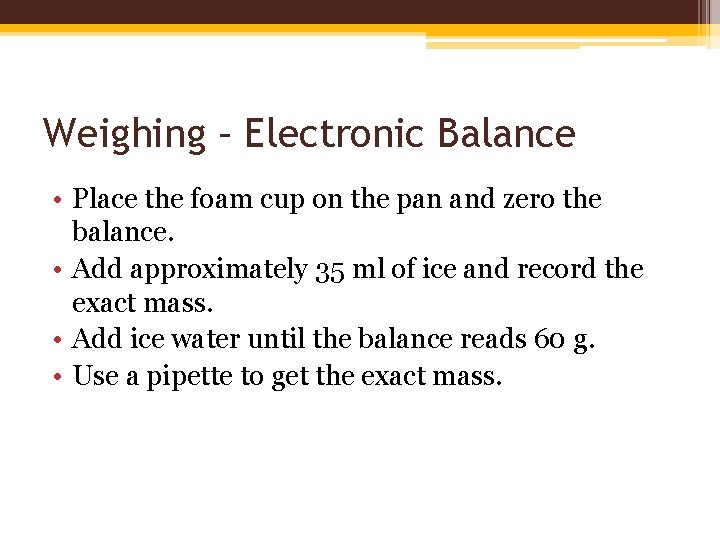
Weighing – Electronic Balance • Place the foam cup on the pan and zero the balance. • Add approximately 35 ml of ice and record the exact mass. • Add ice water until the balance reads 60 g. • Use a pipette to get the exact mass.
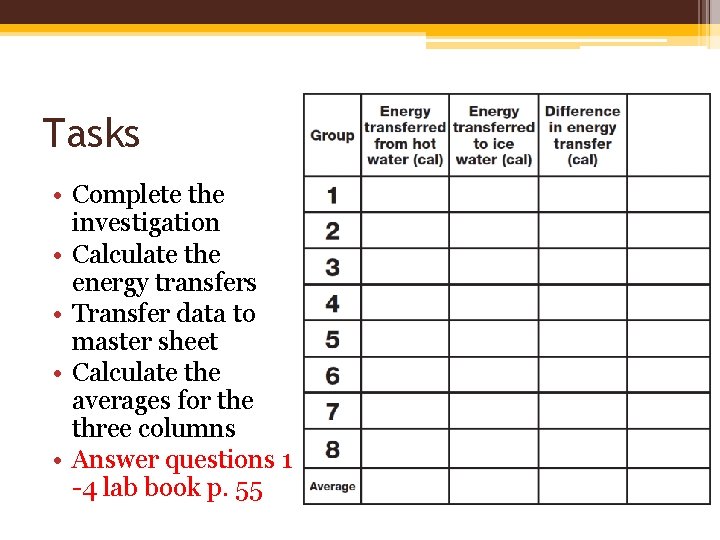
Tasks • Complete the investigation • Calculate the energy transfers • Transfer data to master sheet • Calculate the averages for the three columns • Answer questions 1 -4 lab book p. 55
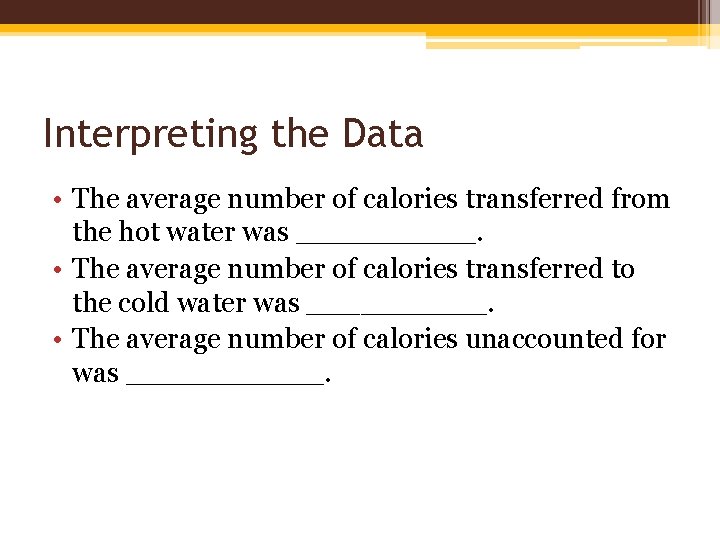
Interpreting the Data • The average number of calories transferred from the hot water was _____. • The average number of calories transferred to the cold water was _____. • The average number of calories unaccounted for was ______.
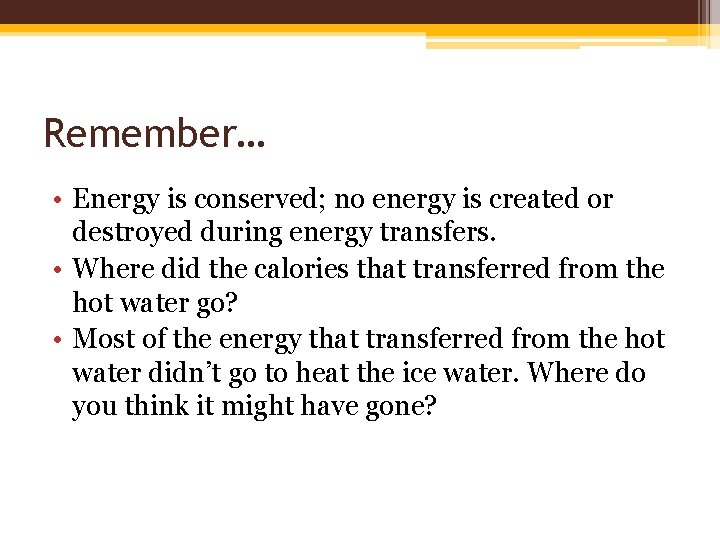
Remember… • Energy is conserved; no energy is created or destroyed during energy transfers. • Where did the calories that transferred from the hot water go? • Most of the energy that transferred from the hot water didn’t go to heat the ice water. Where do you think it might have gone?
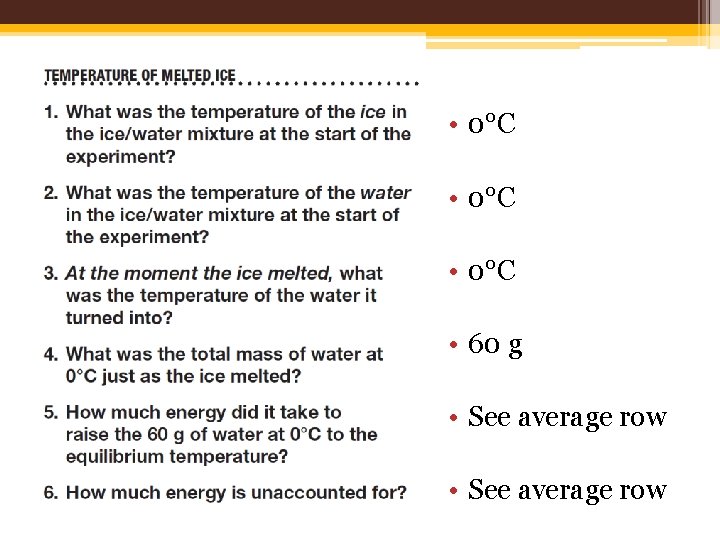
• 0°C • 60 g • See average row
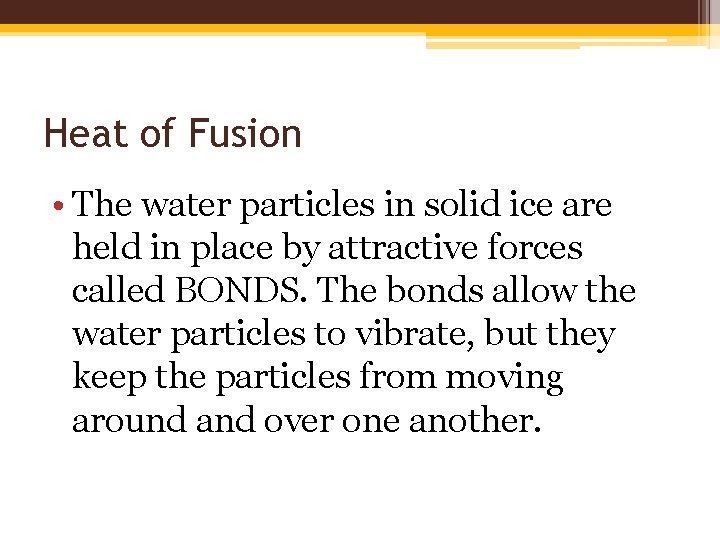
Heat of Fusion • The water particles in solid ice are held in place by attractive forces called BONDS. The bonds allow the water particles to vibrate, but they keep the particles from moving around and over one another.
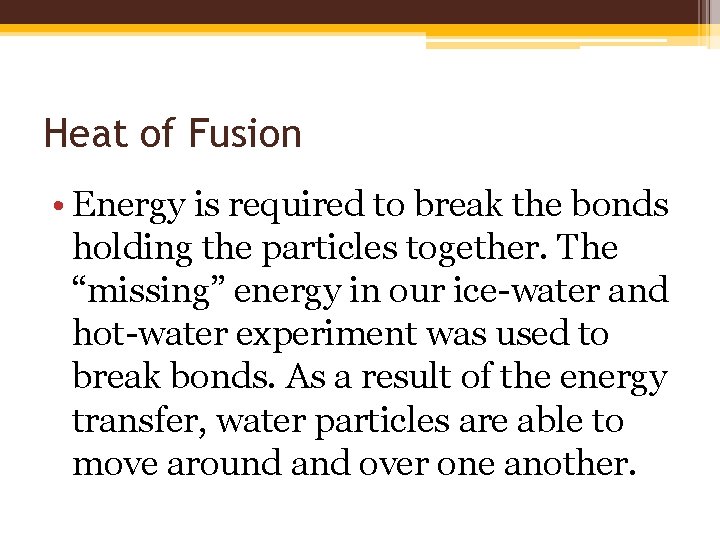
Heat of Fusion • Energy is required to break the bonds holding the particles together. The “missing” energy in our ice-water and hot-water experiment was used to break bonds. As a result of the energy transfer, water particles are able to move around and over one another.
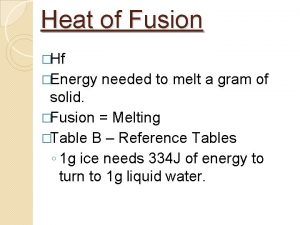
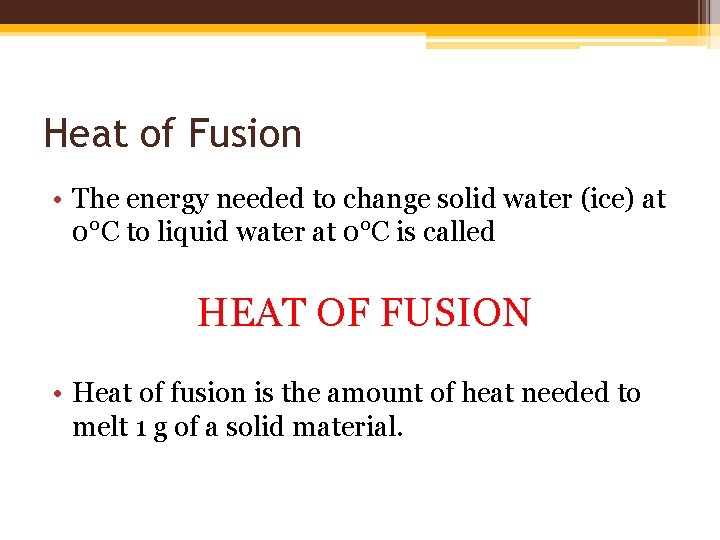
Heat of Fusion • The energy needed to change solid water (ice) at 0°C to liquid water at 0°C is called HEAT OF FUSION • Heat of fusion is the amount of heat needed to melt 1 g of a solid material.
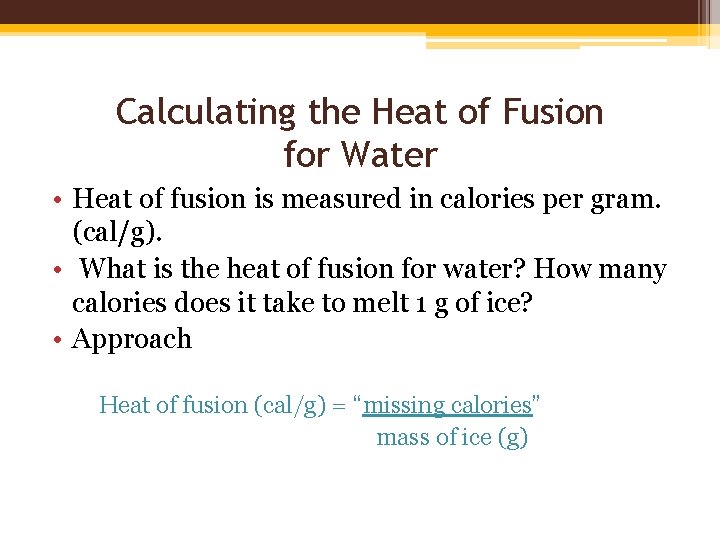
Calculating the Heat of Fusion for Water • Heat of fusion is measured in calories per gram. (cal/g). • What is the heat of fusion for water? How many calories does it take to melt 1 g of ice? • Approach Heat of fusion (cal/g) = “missing calories” mass of ice (g)
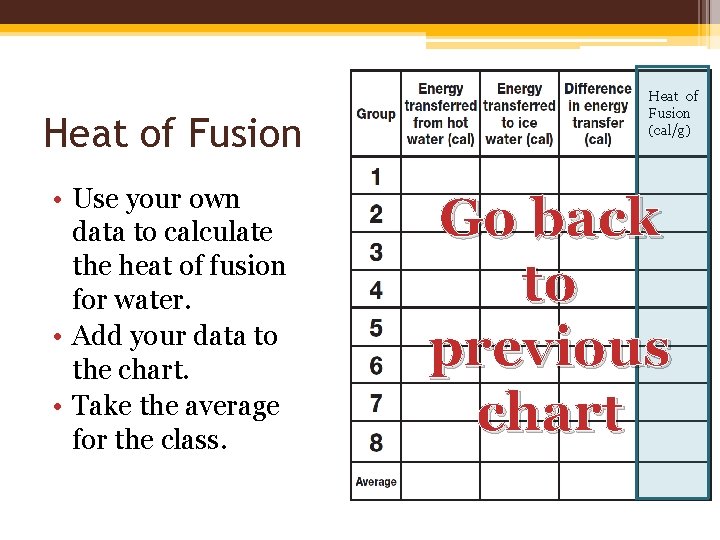
Heat of Fusion • Use your own data to calculate the heat of fusion for water. • Add your data to the chart. • Take the average for the class. Heat of Fusion (cal/g) Go back to previous chart
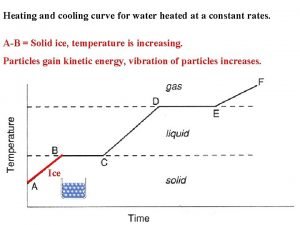
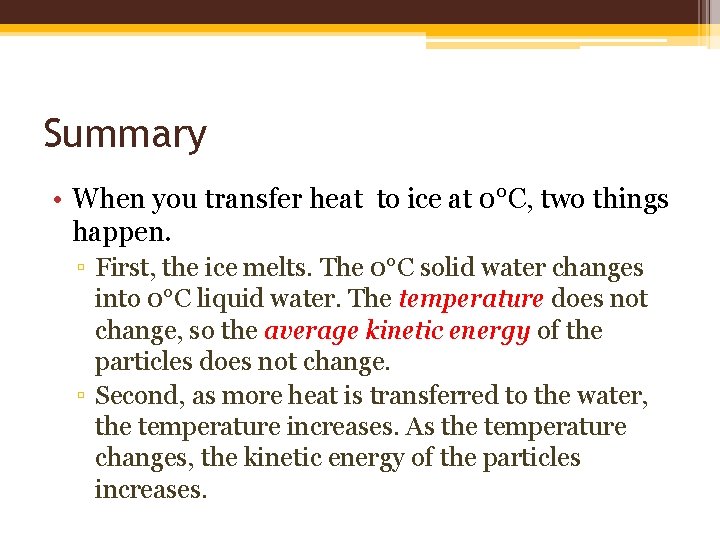
Summary • When you transfer heat to ice at 0°C, two things happen. ▫ First, the ice melts. The 0°C solid water changes into 0°C liquid water. The temperature does not change, so the average kinetic energy of the particles does not change. ▫ Second, as more heat is transferred to the water, the temperature increases. As the temperature changes, the kinetic energy of the particles increases.
Notice • During the melting process, the temperature does not change. Only the state changes from solid to liquid. The heat transferred to ice breaks the bonds, but does not increase temperature. This heat is called the _______. • The heat of fusion for water is 80 cal/g.
Heat of Fusion • Other materials can melt – wax, sugar, copper, gold mercury. They all have a heat of fusion, although it is different that the heat of fusion for water.
Heat of Fusion – the amount of heat needed to change 1 g of a solid material at its melting temperature to 1 g of liquid at the same temperature. (add to glossary page)
BREAK POINT
Review • Why was the equilibrium temperature so much lower than what we predicted? • A lot of energy was used to melt the ice. Energy used to melt ice does not raise the temperature; it breaks bonds.
Review • When we mix 60 g of hot water with 60 g of ice and water, what energy transfer took place? • Energy transferred from the hot water to the cold water and ice.
Review • What is the name for energy used to melt a substance? • Heat of Fusion.
Review • What is the heat of fusion for water and what does it mean? • 80 cal/g. It takes 80 cal to melt 1 g of solid water at 0°C into 1 g of liquid water at 0°C.
Review • Is the heat of fusion for all materials the same? • No, every material has its own heat of fusion.
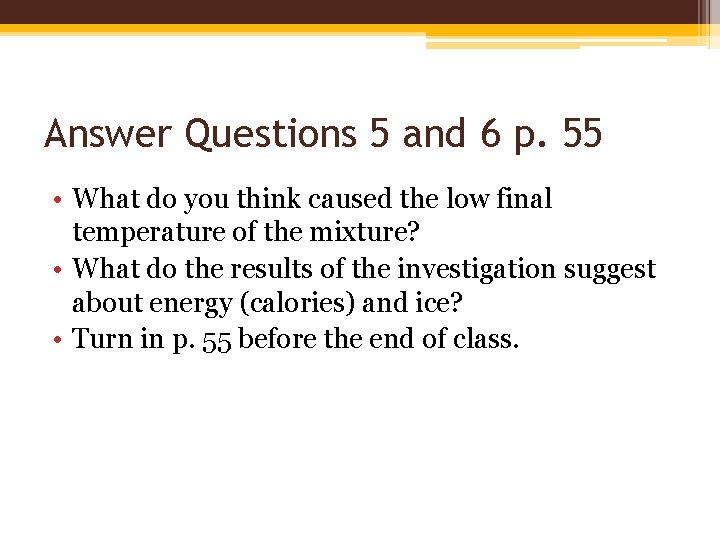
Answer Questions 5 and 6 p. 55 • What do you think caused the low final temperature of the mixture? • What do the results of the investigation suggest about energy (calories) and ice? • Turn in p. 55 before the end of class.
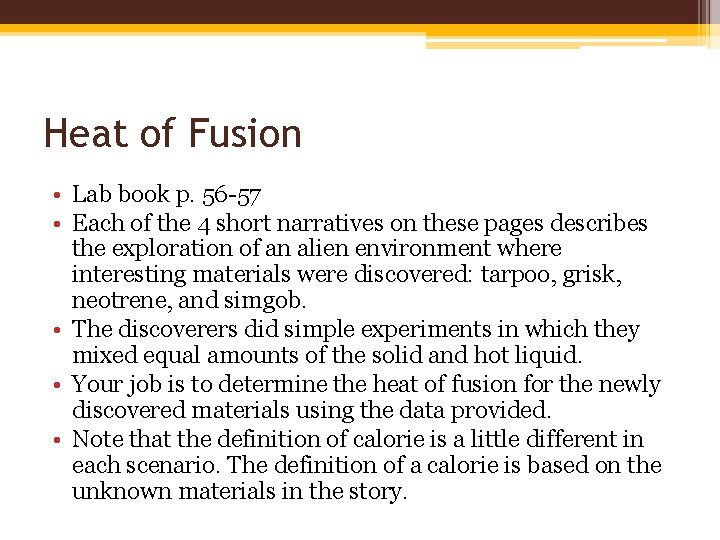
Heat of Fusion • Lab book p. 56 -57 • Each of the 4 short narratives on these pages describes the exploration of an alien environment where interesting materials were discovered: tarpoo, grisk, neotrene, and simgob. • The discoverers did simple experiments in which they mixed equal amounts of the solid and hot liquid. • Your job is to determine the heat of fusion for the newly discovered materials using the data provided. • Note that the definition of calorie is a little different in each scenario. The definition of a calorie is based on the unknown materials in the story.
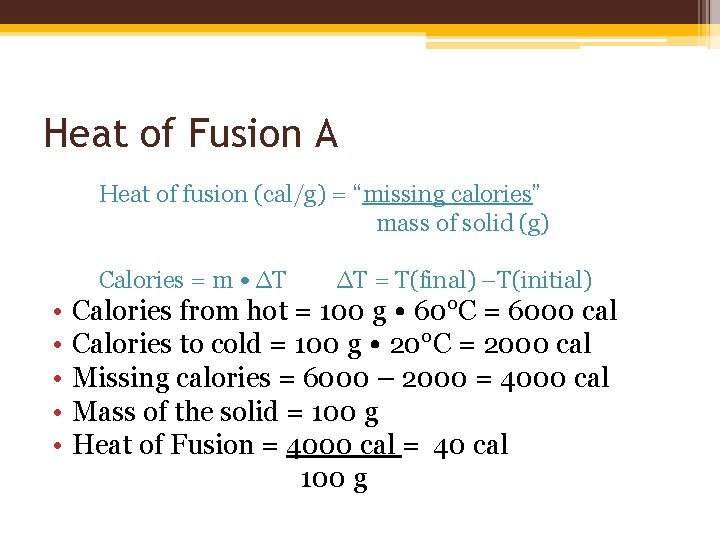
Heat of Fusion A Heat of fusion (cal/g) = “missing calories” mass of solid (g) • • • Calories = m • ∆T ∆T = T(final) –T(initial) Calories from hot = 100 g • 60°C = 6000 cal Calories to cold = 100 g • 20°C = 2000 cal Missing calories = 6000 – 2000 = 4000 cal Mass of the solid = 100 g Heat of Fusion = 4000 cal = 40 cal 100 g
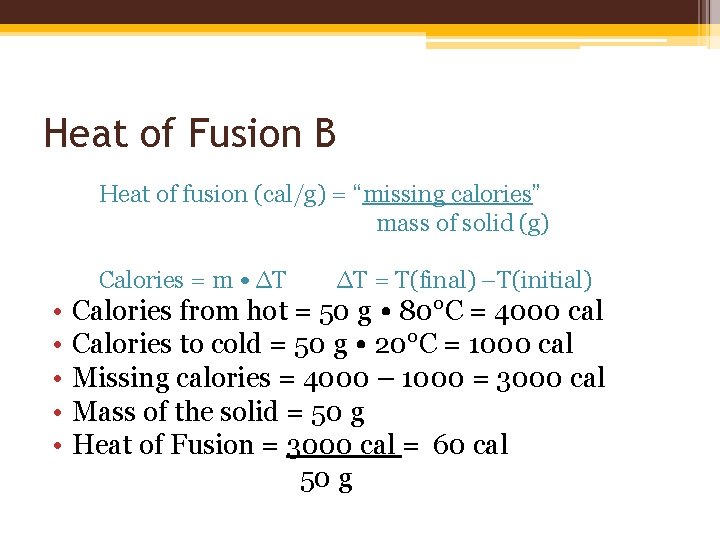
Heat of Fusion B Heat of fusion (cal/g) = “missing calories” mass of solid (g) • • • Calories = m • ∆T ∆T = T(final) –T(initial) Calories from hot = 50 g • 80°C = 4000 cal Calories to cold = 50 g • 20°C = 1000 cal Missing calories = 4000 – 1000 = 3000 cal Mass of the solid = 50 g Heat of Fusion = 3000 cal = 60 cal 50 g
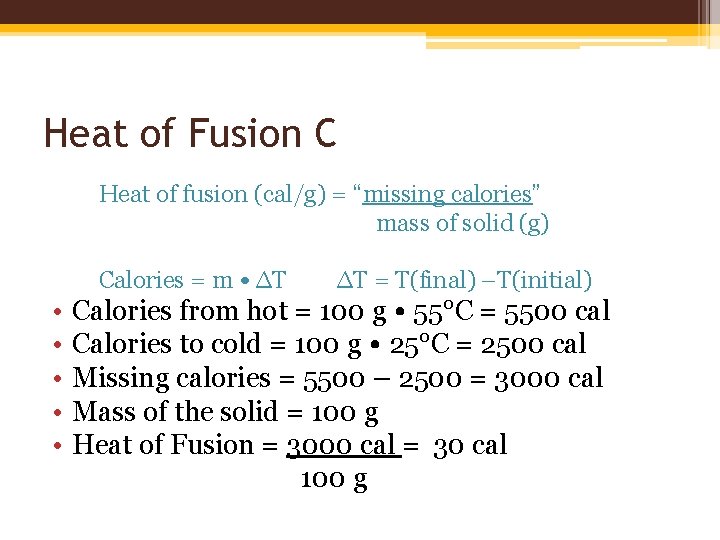
Heat of Fusion C Heat of fusion (cal/g) = “missing calories” mass of solid (g) • • • Calories = m • ∆T ∆T = T(final) –T(initial) Calories from hot = 100 g • 55°C = 5500 cal Calories to cold = 100 g • 25°C = 2500 cal Missing calories = 5500 – 2500 = 3000 cal Mass of the solid = 100 g Heat of Fusion = 3000 cal = 30 cal 100 g
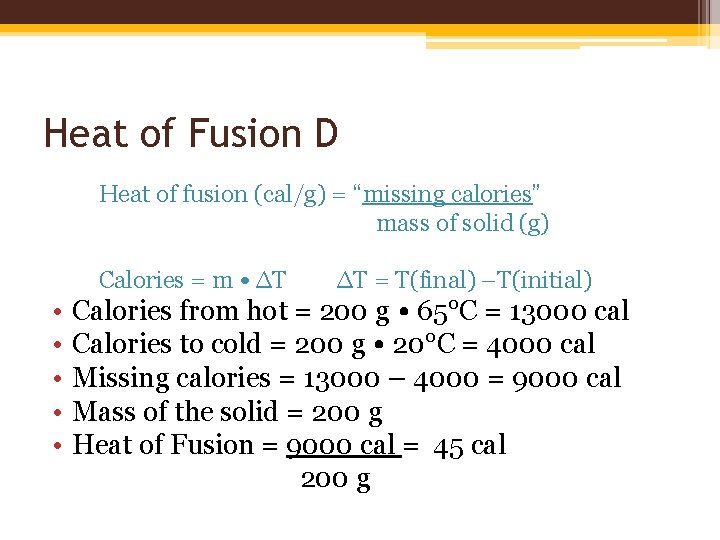
Heat of Fusion D Heat of fusion (cal/g) = “missing calories” mass of solid (g) • • • Calories = m • ∆T ∆T = T(final) –T(initial) Calories from hot = 200 g • 65°C = 13000 cal Calories to cold = 200 g • 20°C = 4000 cal Missing calories = 13000 – 4000 = 9000 cal Mass of the solid = 200 g Heat of Fusion = 9000 cal = 45 cal 200 g
Assignment • Read Heat of Fusion in Resource Book. • Answer questions in your lab book p. 59. (15 minutes)
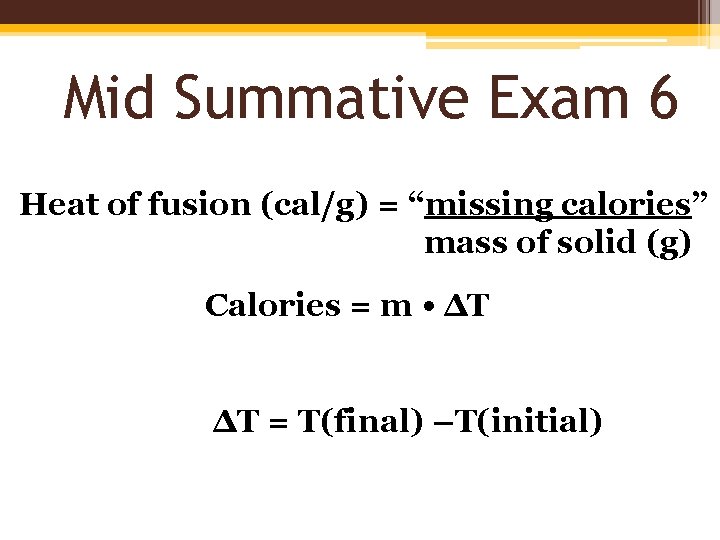
Mid Summative Exam 6 Heat of fusion (cal/g) = “missing calories” mass of solid (g) Calories = m • ∆T ∆T = T(final) –T(initial)