Gravity as Entropic Force XiaoGang He NTU Talk
- Slides: 37
Gravity as Entropic Force Xiao-Gang He NTU Talk at USTC on April 16 th ? In collaboration with Bo-Qiang Ma X. -G. He & B. -Q. Ma, Black Holes and Photons with Entropic Force, ar. Xiv: 1003: 1625 X. -G. He & B. -Q. Ma, Quantization of Black Holes, ar. Xiv: 1003: 2510
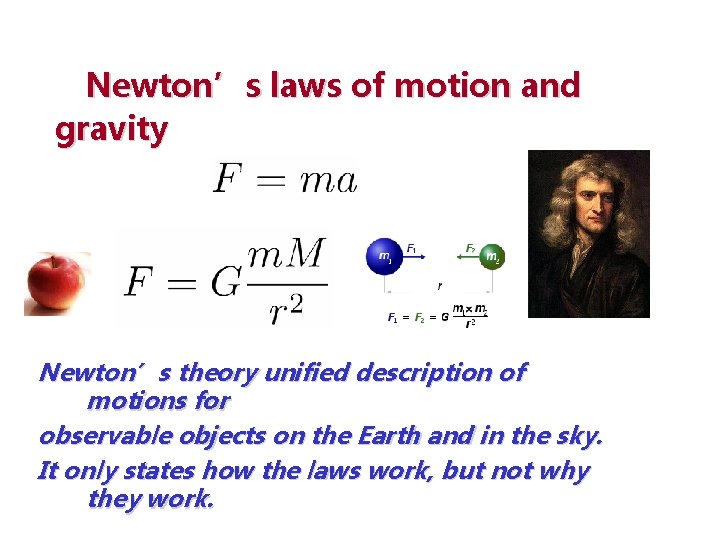
Newton’s laws of motion and gravity Newton’s theory unified description of motions for observable objects on the Earth and in the sky. It only states how the laws work, but not why they work.
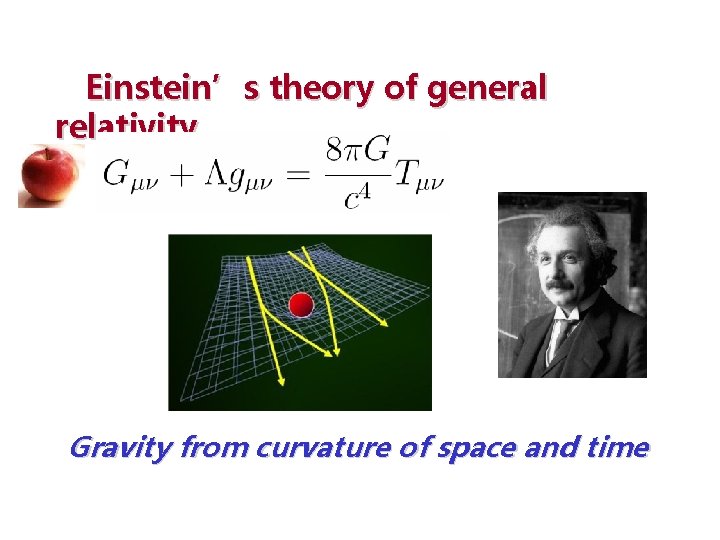
Einstein’s theory of general relativity Gravity from curvature of space and time
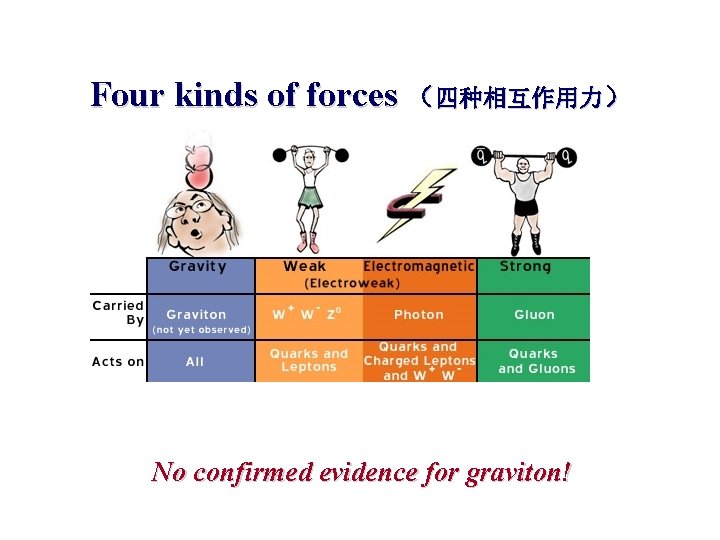
Four kinds of forces (四种相互作用力) No confirmed evidence for graviton!
Unification of gravity with other interactions Unification of gravity with quantum theory Dream of physicists for decades Many attempts: extra-dimension, supersymmetry, string and etc
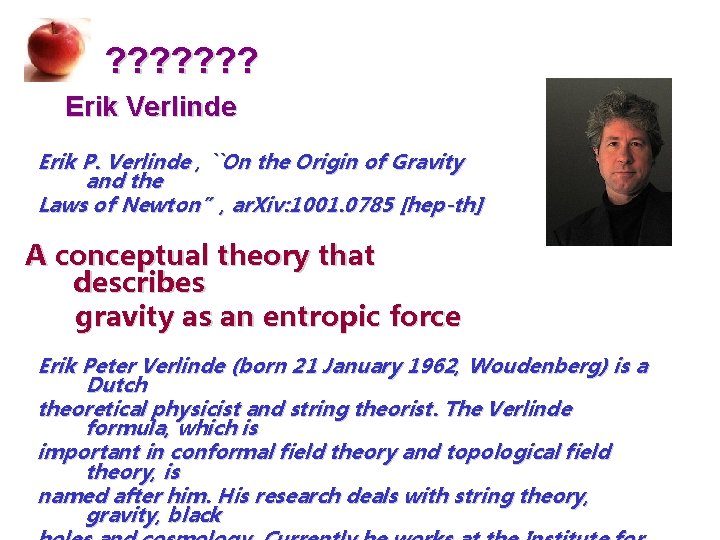
? ? ? ? Erik Verlinde Erik P. Verlinde , ``On the Origin of Gravity and the Laws of Newton”, ar. Xiv: 1001. 0785 [hep-th] A conceptual theory that describes gravity as an entropic force Erik Peter Verlinde (born 21 January 1962, Woudenberg) is a Dutch theoretical physicist and string theorist. The Verlinde formula, which is important in conformal field theory and topological field theory, is named after him. His research deals with string theory, gravity, black
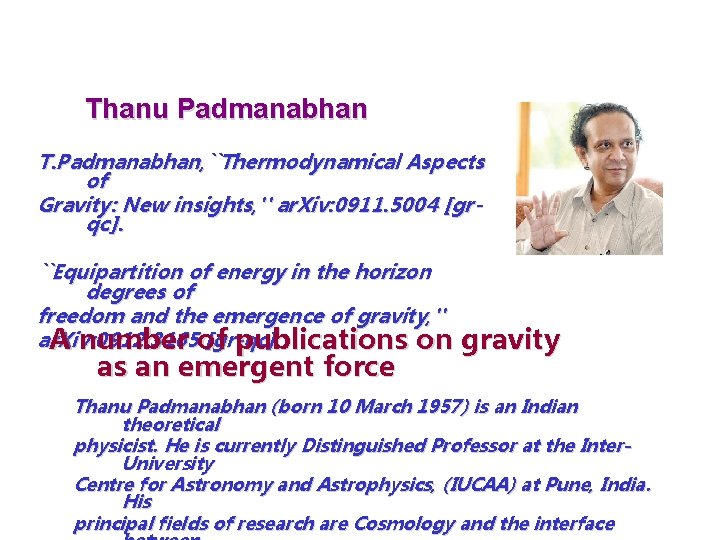
Thanu Padmanabhan T. Padmanabhan, ``Thermodynamical Aspects of Gravity: New insights, '' ar. Xiv: 0911. 5004 [grqc]. ``Equipartition of energy in the horizon degrees of freedom and the emergence of gravity, '' ar. Xiv: 0912. 3165 [gr-qc]. A number of publications on as an emergent force gravity Thanu Padmanabhan (born 10 March 1957) is an Indian theoretical physicist. He is currently Distinguished Professor at the Inter. University Centre for Astronomy and Astrophysics, (IUCAA) at Pune, India. His principal fields of research are Cosmology and the interface
Reaction from physics society Gerard 't Hooft: Erik is stressing real physical concepts like mass and force, not just fancy abstract mathematics. That's encouraging from my perspective as a physicist. " Citations of Verlinde’s paper: 58 by April 16, 2010 Discussions Application to Expansion, Inflation, Acceleration in Cosmology. Acceleration without dark energy
Doubts & Criticisms circular reasoning? consistency? Needs to be checked Any new predictions?
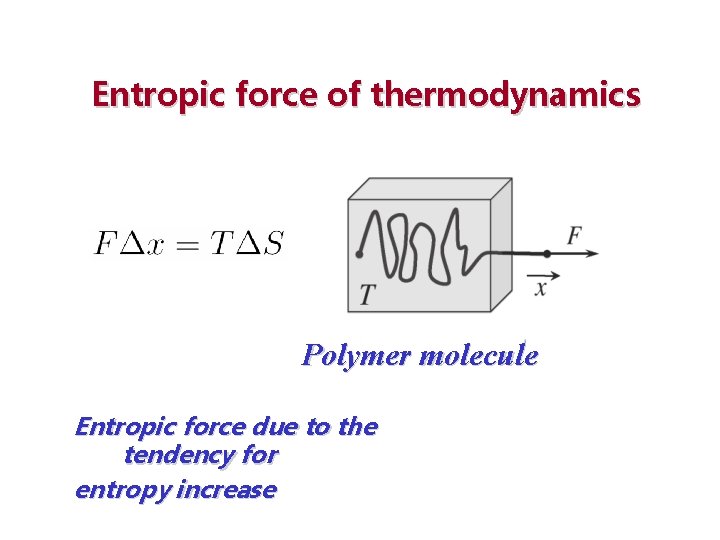
Entropic force of thermodynamics Polymer molecule Entropic force due to the tendency for entropy increase
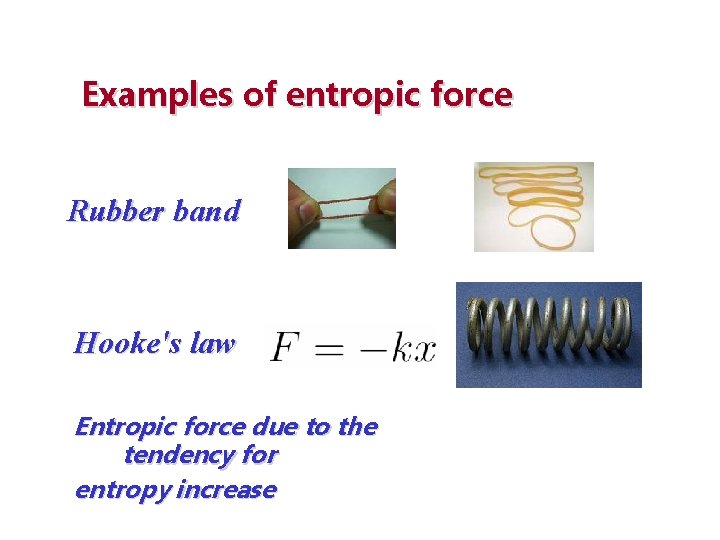
Examples of entropic force Rubber band Hooke's law Entropic force due to the tendency for entropy increase
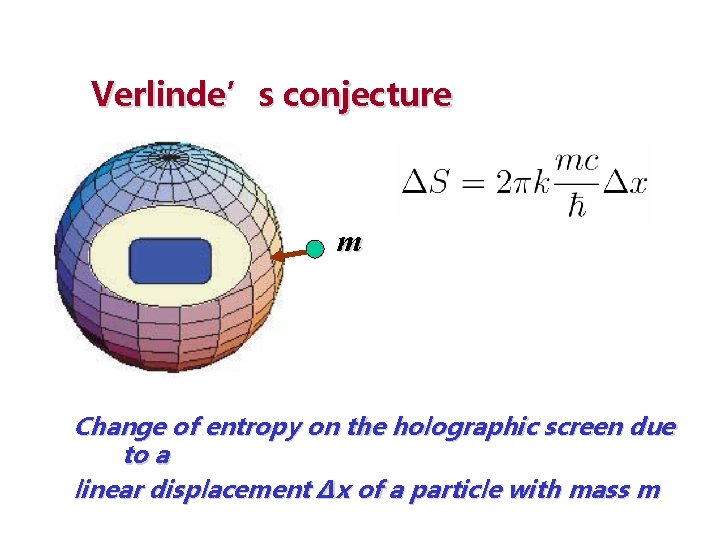
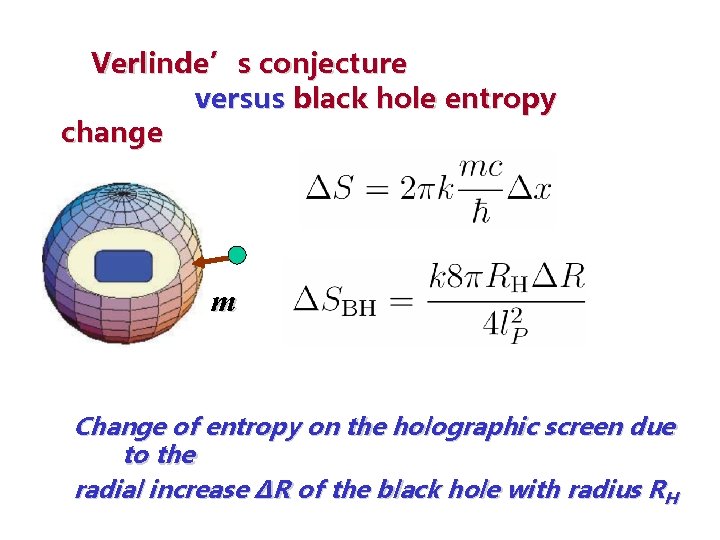
Verlinde’s conjecture m Change of entropy on the holographic screen due to a linear displacement Δx of a particle with mass m
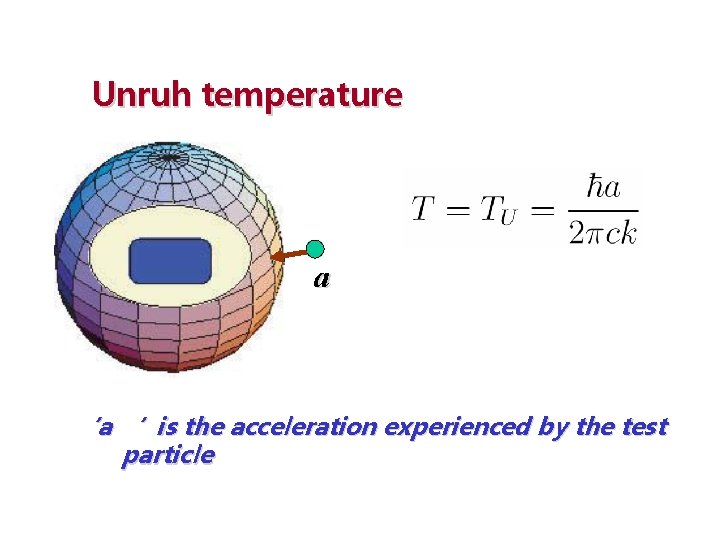
Unruh temperature a ‘a ‘ is the acceleration experienced by the test particle
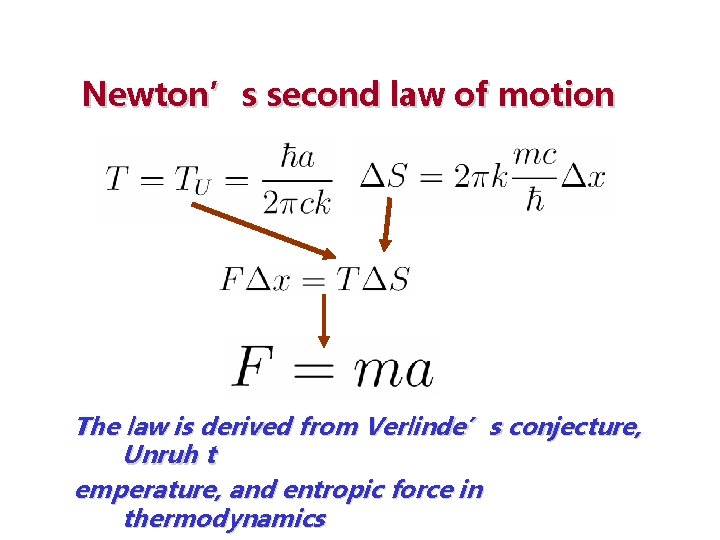
Newton’s second law of motion The law is derived from Verlinde’s conjecture, Unruh t emperature, and entropic force in thermodynamics
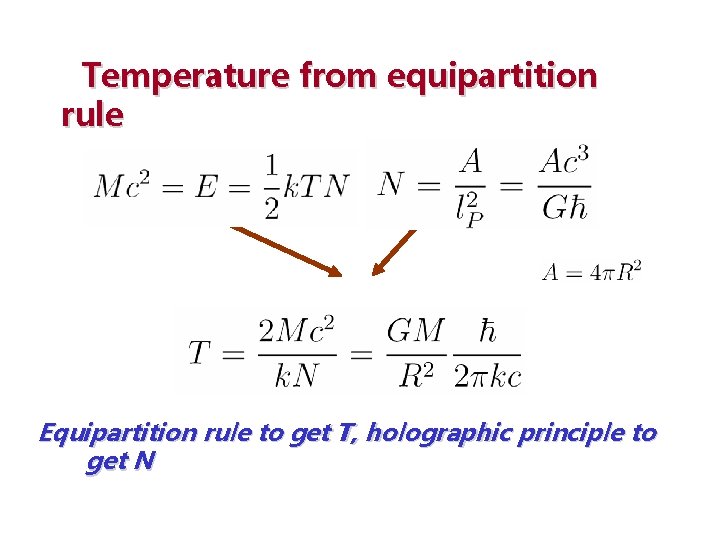
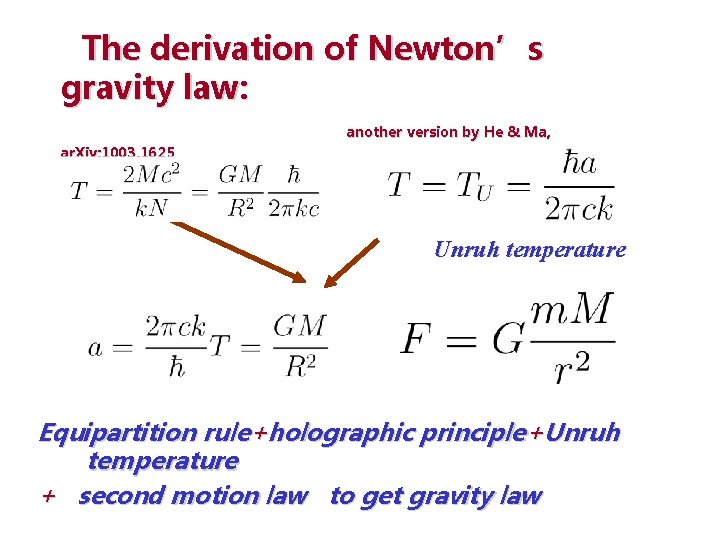
Temperature from equipartition rule Equipartition rule to get T, holographic principle to get N
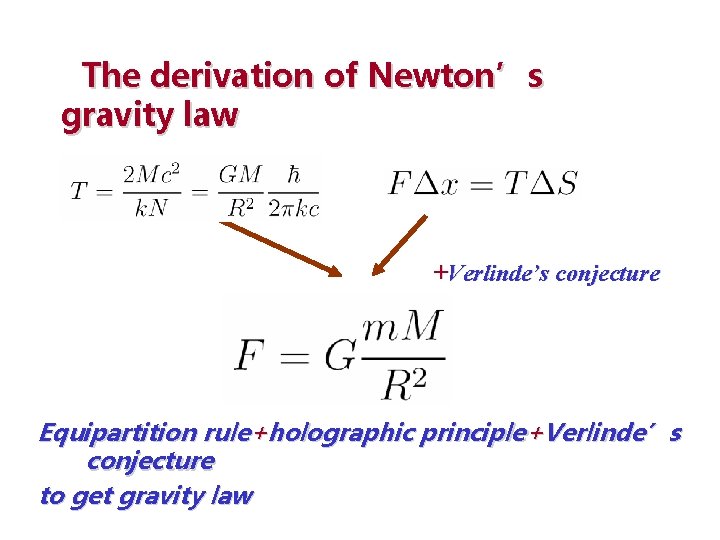
The derivation of Newton’s gravity law +Verlinde’s conjecture Equipartition rule+holographic principle+Verlinde’s conjecture to get gravity law
The derivation of Newton’s gravity law: another version by He & Ma, ar. Xiv: 1003. 1625 Unruh temperature Equipartition rule+holographic principle+Unruh temperature + second motion law to get gravity law
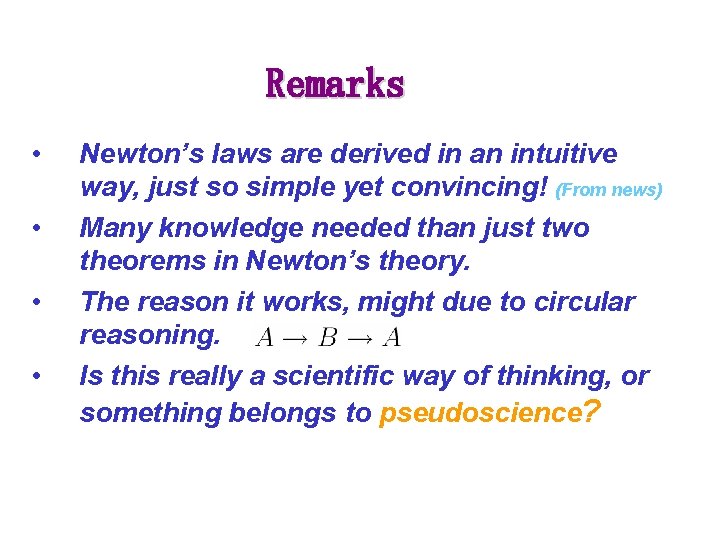
Remarks • • Newton’s laws are derived in an intuitive way, just so simple yet convincing! (From news) Many knowledge needed than just two theorems in Newton’s theory. The reason it works, might due to circular reasoning. Is this really a scientific way of thinking, or something belongs to pseudoscience?
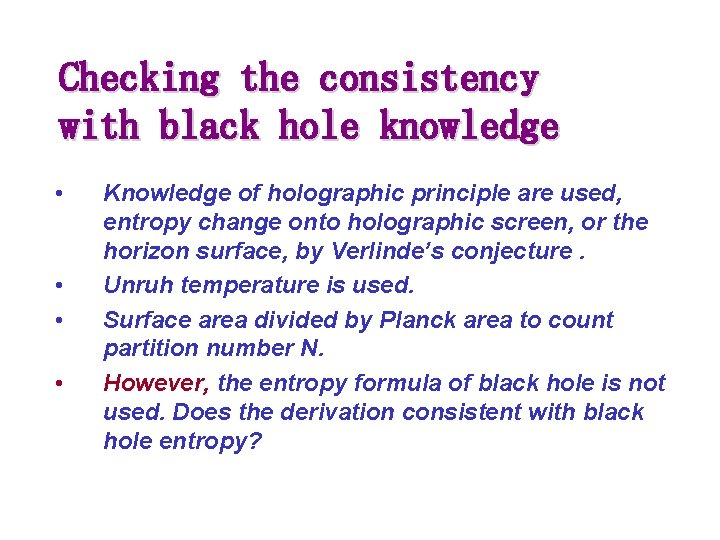
Checking the consistency with black hole knowledge • • Knowledge of holographic principle are used, entropy change onto holographic screen, or the horizon surface, by Verlinde’s conjecture. Unruh temperature is used. Surface area divided by Planck area to count partition number N. However, the entropy formula of black hole is not used. Does the derivation consistent with black hole entropy?
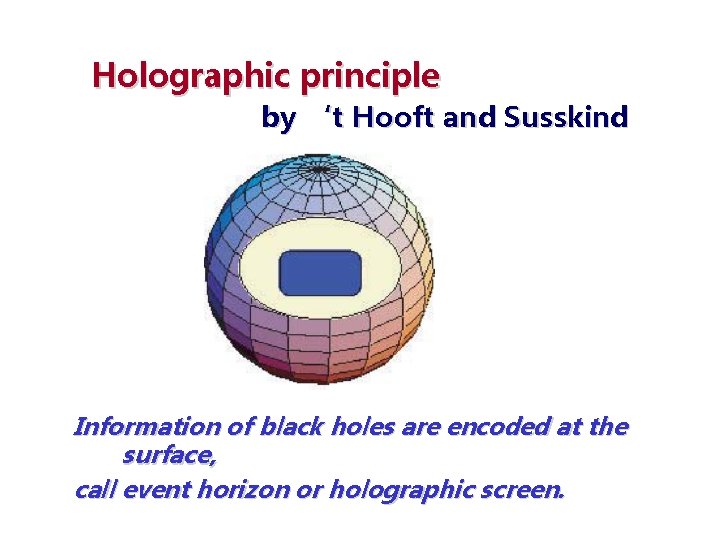
Holographic principle by ‘t Hooft and Susskind Information of black holes are encoded at the surface, call event horizon or holographic screen.
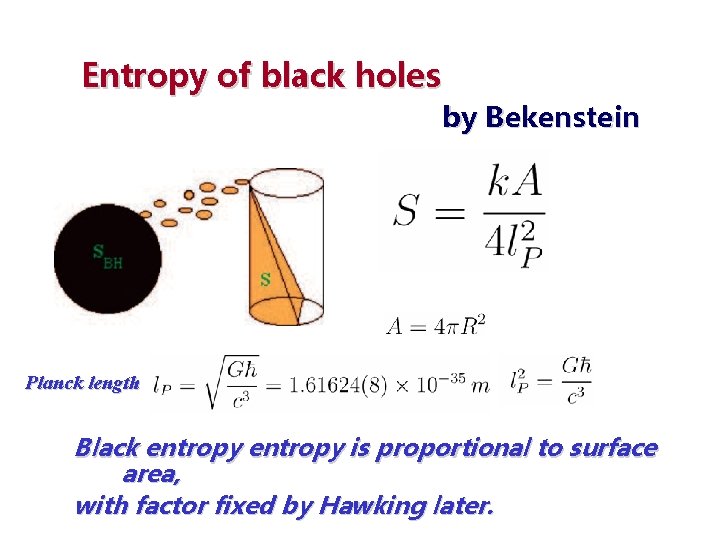
Entropy of black holes by Bekenstein Planck length Black entropy is proportional to surface area, with factor fixed by Hawking later.
Verlinde’s conjecture versus black hole entropy change m Change of entropy on the holographic screen due to the radial increase ΔR of the black hole with radius RH
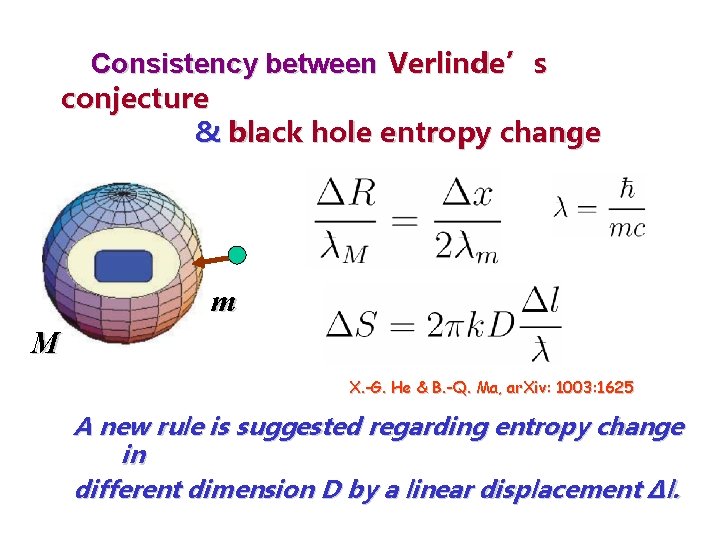
Consistency between Verlinde’s conjecture & black hole entropy change m M X. -G. He & B. -Q. Ma, ar. Xiv: 1003: 1625 A new rule is suggested regarding entropy change in different dimension D by a linear displacement Δl.
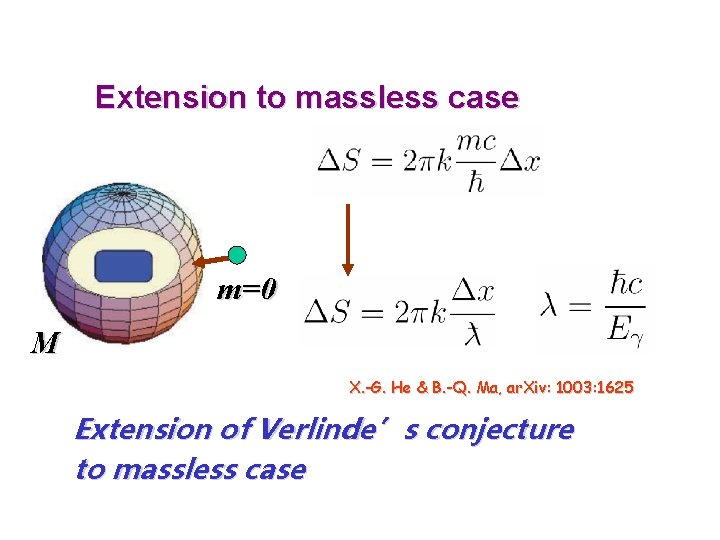
Extension to massless case m=0 M X. -G. He & B. -Q. Ma, ar. Xiv: 1003: 1625 Extension of Verlinde’s conjecture to massless case
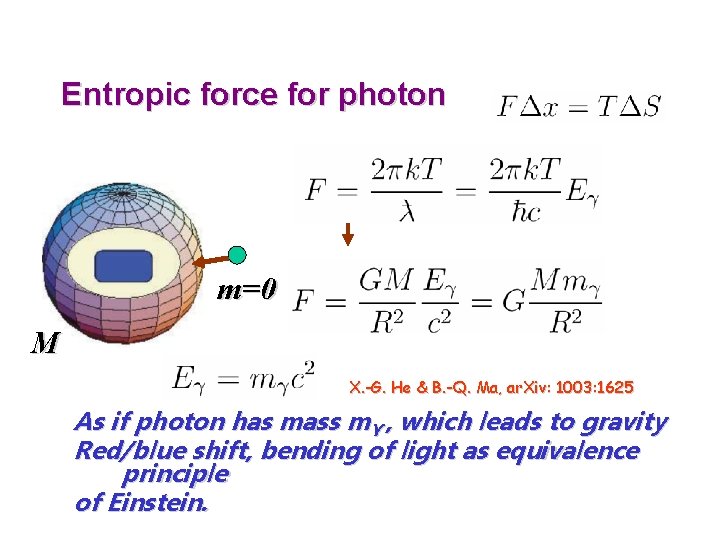
Entropic force for photon m=0 M X. -G. He & B. -Q. Ma, ar. Xiv: 1003: 1625 As if photon has mass mϒ , which leads to gravity Red/blue shift, bending of light as equivalence principle of Einstein.
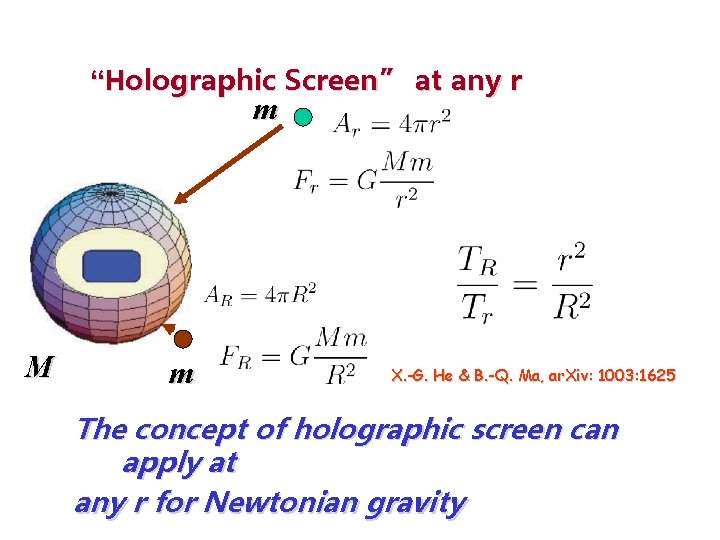
“Holographic Screen” at any r m M m X. -G. He & B. -Q. Ma, ar. Xiv: 1003: 1625 The concept of holographic screen can apply at any r for Newtonian gravity
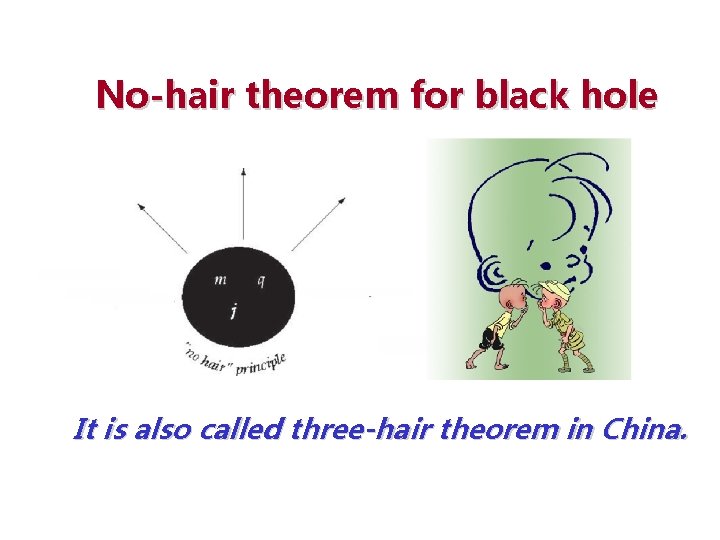
No-hair theorem for black hole It is also called three-hair theorem in China.
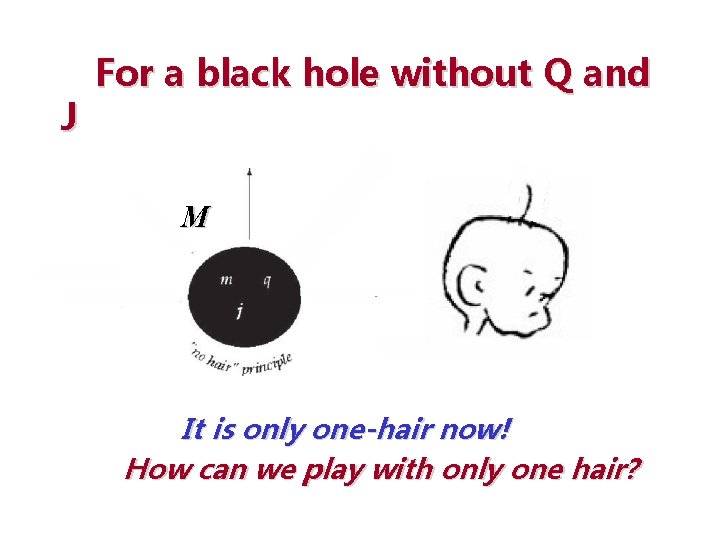
J For a black hole without Q and M It is only one-hair now! How can we play with only one hair?
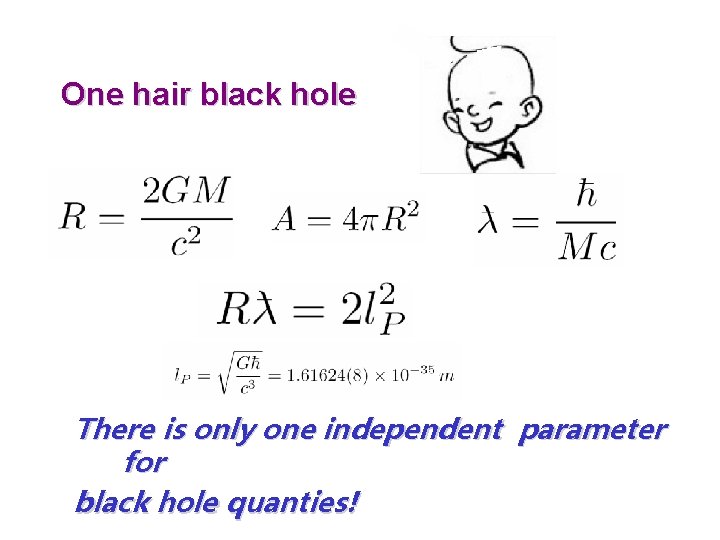
One hair black hole There is only one independent parameter for black hole quanties!
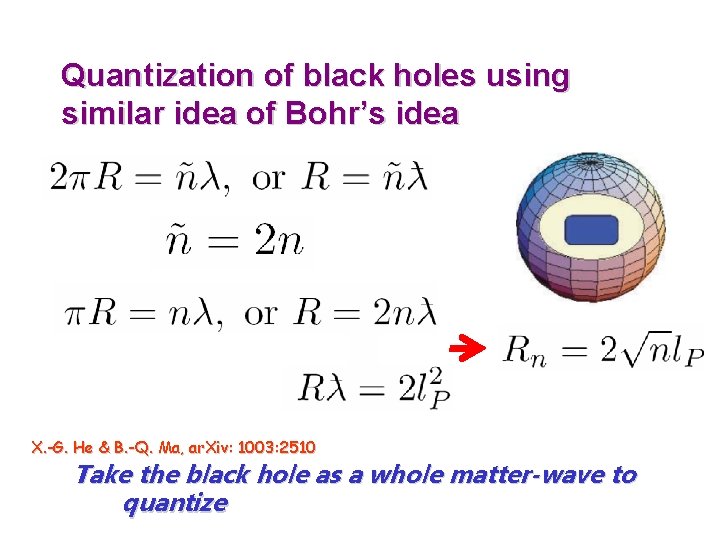
Quantization of black holes using similar idea of Bohr’s idea X. -G. He & B. -Q. Ma, ar. Xiv: 1003: 2510 Take the black hole as a whole matter-wave to quantize
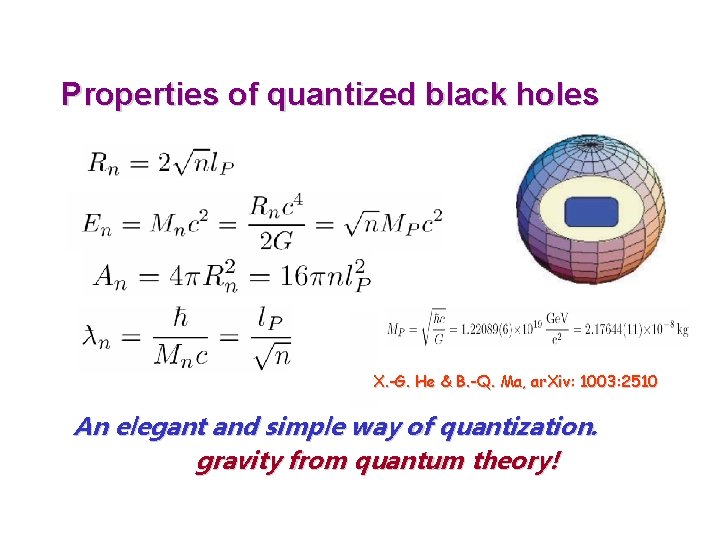
Properties of quantized black holes X. -G. He & B. -Q. Ma, ar. Xiv: 1003: 2510 An elegant and simple way of quantization. gravity from quantum theory!
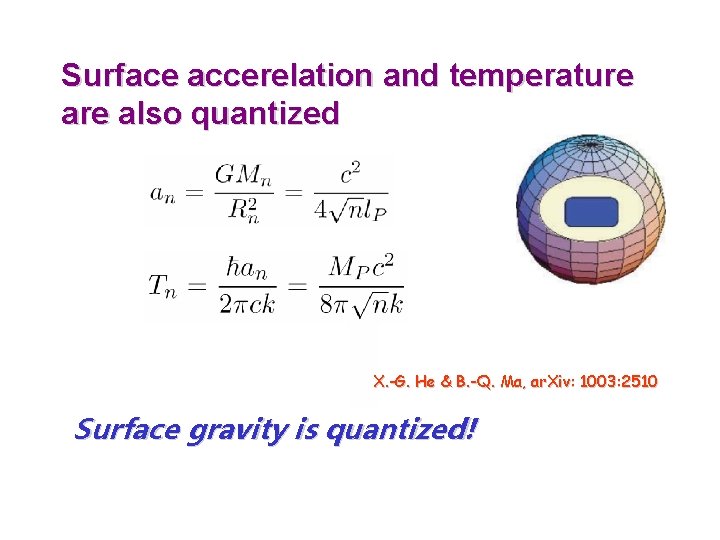
Surface accerelation and temperature also quantized X. -G. He & B. -Q. Ma, ar. Xiv: 1003: 2510 Surface gravity is quantized!
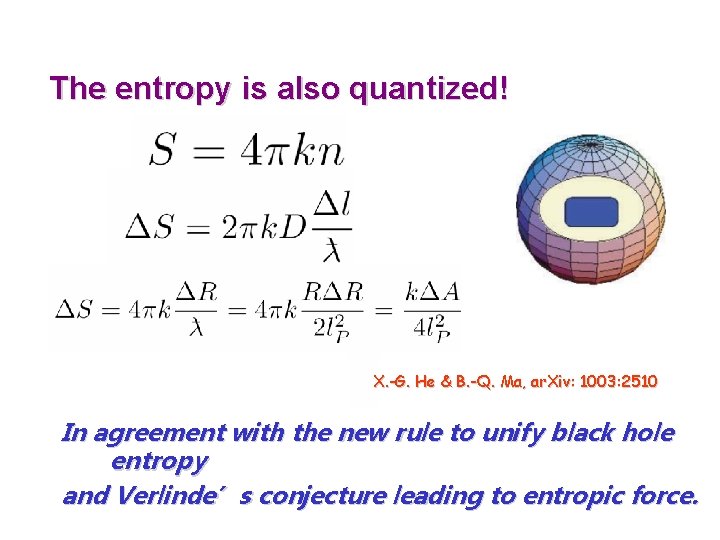
The entropy is also quantized! X. -G. He & B. -Q. Ma, ar. Xiv: 1003: 2510 In agreement with the new rule to unify black hole entropy and Verlinde’s conjecture leading to entropic force.
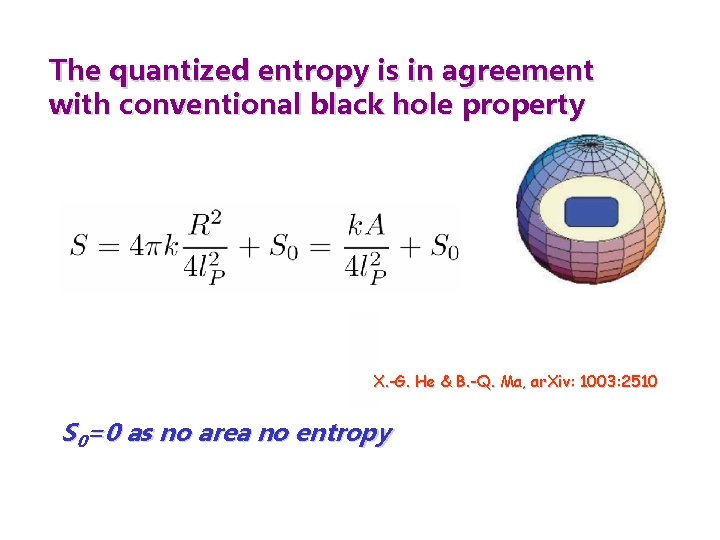
The quantized entropy is in agreement with conventional black hole property X. -G. He & B. -Q. Ma, ar. Xiv: 1003: 2510 S 0=0 as no area no entropy
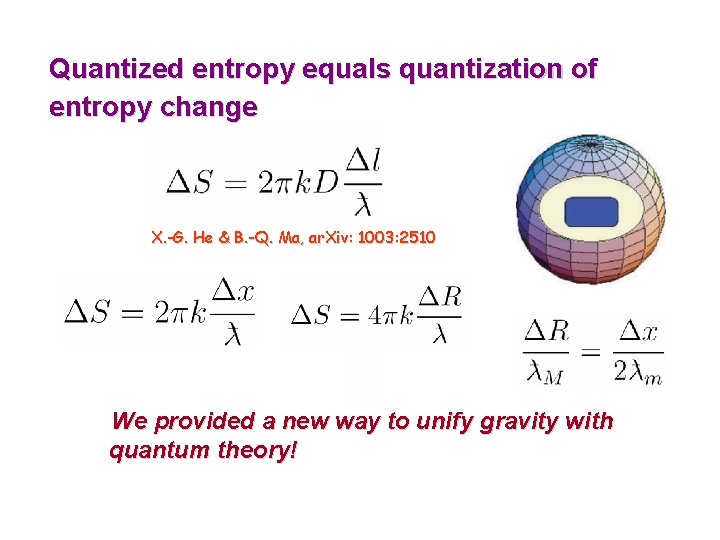
Quantized entropy equals quantization of entropy change X. -G. He & B. -Q. Ma, ar. Xiv: 1003: 2510 We provided a new way to unify gravity with quantum theory!
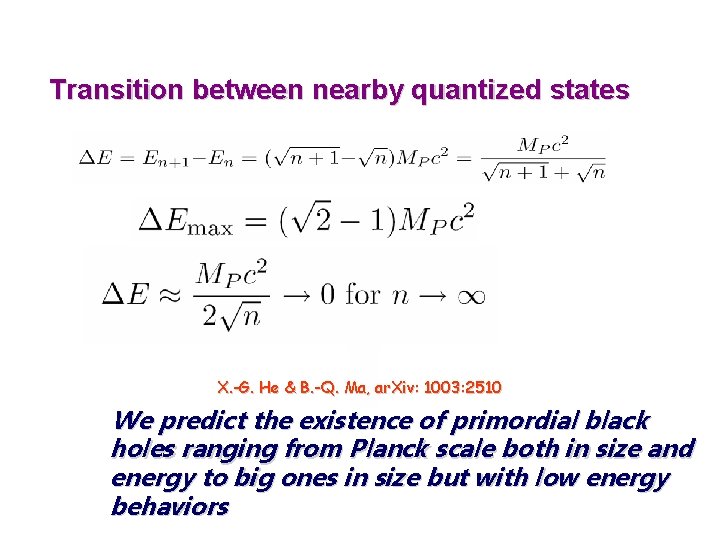
Transition between nearby quantized states X. -G. He & B. -Q. Ma, ar. Xiv: 1003: 2510 We predict the existence of primordial black holes ranging from Planck scale both in size and energy to big ones in size but with low energy behaviors
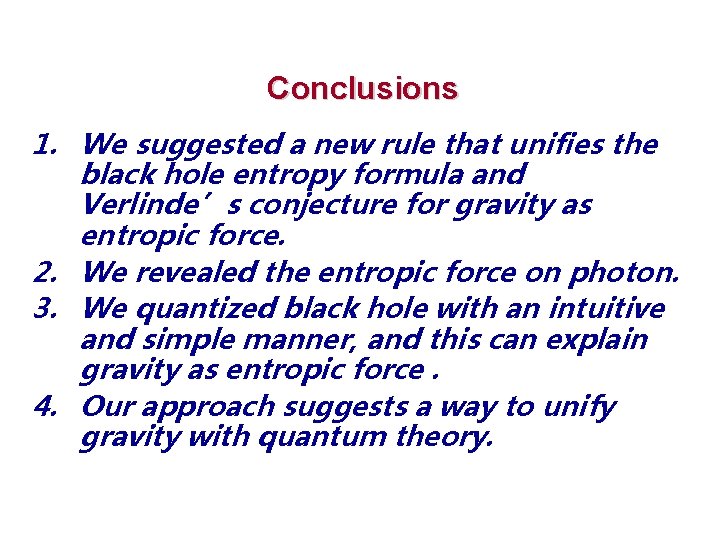
Conclusions 1. We suggested a new rule that unifies the black hole entropy formula and Verlinde’s conjecture for gravity as entropic force. 2. We revealed the entropic force on photon. 3. We quantized black hole with an intuitive and simple manner, and this can explain gravity as entropic force. 4. Our approach suggests a way to unify gravity with quantum theory.