
Gravity Force at Impact A falling ball on
Gravity
![Force at Impact ] A falling ball on a paper surface can break through.](http://slidetodoc.com/presentation_image/20337f31c0497a96d023b9bf0b568af7/image-2.jpg "Force at Impact ] A falling ball on a paper surface can break through.")
Force at Impact ] A falling ball on a paper surface can break through. • The ball is exerting a force ] A falling ball on a hard surface rebounds. • The surface is exerting a force of the ball on the surface force of the surface on the ball ] There are forces both ways at contact.
![Force is Not Motion ] The ball breaking paper doesn’t stop. • The force](http://slidetodoc.com/presentation_image/20337f31c0497a96d023b9bf0b568af7/image-3.jpg "Force is Not Motion ] The ball breaking paper doesn’t stop. • The force")
Force is Not Motion ] The ball breaking paper doesn’t stop. • The force needed to break through is small. • But that small force is also exerted on the ball. ] force of the ball on the surface force of the surface on the ball On a rebound the ground doesn’t move. • The force needed to break through is large • A force acted in both ways
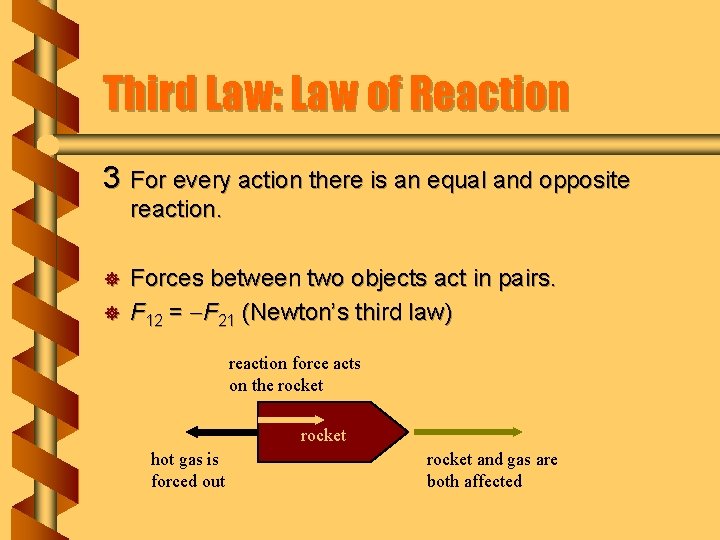
Third Law: Law of Reaction 3 For every action there is an equal and opposite reaction. ] ] Forces between two objects act in pairs. F 12 = -F 21 (Newton’s third law) reaction force acts on the rocket hot gas is forced out rocket and gas are both affected
![Equal and Opposite ] Newton’s law of reaction also applies to the force of](http://slidetodoc.com/presentation_image/20337f31c0497a96d023b9bf0b568af7/image-5.jpg "Equal and Opposite ] Newton’s law of reaction also applies to the force of")
Equal and Opposite ] Newton’s law of reaction also applies to the force of gravity. • The Earth pulls the Moon • The Moon pulls the Earth ] Newton used this to describe a Law of Gravity. FME Earth FEM Moon
![Universal Gravity ] Newton realized that all objects obey that Law. ] • Other](http://slidetodoc.com/presentation_image/20337f31c0497a96d023b9bf0b568af7/image-6.jpg "Universal Gravity ] Newton realized that all objects obey that Law. ] • Other")
Universal Gravity ] Newton realized that all objects obey that Law. ] • Other planets • Apples • People ] What is the gravitational force between two students sitting in adjacent seats? • Assume the students have a mass of 70 kg each. • Assume that they are separated by 1 m. The gravitational force is universal. • The gravitational constant is G = 6. 67 x 10 -11 Nm 2/kg 2. ] ] F = (6. 67 x 10 -11 Nm 2/kg 2) x (70 kg)2 / (1 m)2 F = 3. 3 x 10 -7 N.
![Surface Gravity ] ] The force of gravity on a mass is its weight.](http://slidetodoc.com/presentation_image/20337f31c0497a96d023b9bf0b568af7/image-7.jpg "Surface Gravity ] ] The force of gravity on a mass is its weight.")
Surface Gravity ] ] The force of gravity on a mass is its weight. ] • • The force of gravity compared to the mass is the field strength. • Consider the force on an unknown mass m. • Use Earth’s mass M and Earth’s radius R Calculate the field strength. g = F/m = GM/R 2 M = 5. 97 x 1024 kg R = 6. 37 x 106 m g = 9. 81 N/kg = 9. 81 m/s 2 ] This field strength g only applies at Earth’s surface. ] Approximately, g is equal to 9. 8 N/kg or 9. 8 m/s 2.
![Variations ] Gravity varies over the surface of the Earth. • • ] The](http://slidetodoc.com/presentation_image/20337f31c0497a96d023b9bf0b568af7/image-8.jpg "Variations ] Gravity varies over the surface of the Earth. • • ] The")
Variations ] Gravity varies over the surface of the Earth. • • ] The height of the surface varies – so the radius does, too The material under the surface is not uniform The earth isn’t exactly round The tides affect the earth as well as the oceans One unit of gravitational acceleration used on the Earth is the Galileo. • 1 Gal = 1 cm/s 2 = 0. 01 N/kg. • g = 981 Gal
![Effect of Height ] High areas have a greater distance from the center of](http://slidetodoc.com/presentation_image/20337f31c0497a96d023b9bf0b568af7/image-9.jpg "Effect of Height ] High areas have a greater distance from the center of")
Effect of Height ] High areas have a greater distance from the center of the Earth. • An increase of 1 km should decrease g by 300 m. Gal. • Type of rock affects g. USGS
![Latitude Changes ] As the Earth spins the equator slightly bulges. ] The radius](http://slidetodoc.com/presentation_image/20337f31c0497a96d023b9bf0b568af7/image-10.jpg "Latitude Changes ] As the Earth spins the equator slightly bulges. ] The radius")
Latitude Changes ] As the Earth spins the equator slightly bulges. ] The radius is about 22 km bigger compared to the pole. ] Expect a few Gal difference from equator to pole. • Equator: 9. 780 m/s 2 • North Pole: 9. 832 m/s 2 Colorado School of Mines
![Earth’s Rotation ] The earth is made of layers of different types of rock.](http://slidetodoc.com/presentation_image/20337f31c0497a96d023b9bf0b568af7/image-11.jpg "Earth’s Rotation ] The earth is made of layers of different types of rock.")
Earth’s Rotation ] The earth is made of layers of different types of rock. ] These rocks can move due to daily tides. • Much less than ocean tides • Period is 12 hours like the ocean ] The force of gravity from the Moon is countering some of the force of the Earth. Colorado School of Mines next
- Slides: 11