
SVVRL IM NTU Cryptographic Hash Functions YihKuen Tsay
![Birthday Attacks (cont. ) n SVVRL @ IM. NTU [Yuval 1979] proposed the following](https://slidetodoc.com/presentation_image_h2/6b68ec69f9d76d6d000f8f8a6261bc02/image-26.jpg "Birthday Attacks (cont. ) n SVVRL @ IM. NTU [Yuval 1979] proposed the following")
![IOTA step function i: a a RC[ir] L[0, 0] RC[ir] 0<ir<24 Yih-Kuen Tsay (IM.](https://slidetodoc.com/presentation_image_h2/6b68ec69f9d76d6d000f8f8a6261bc02/image-56.jpg "IOTA step function i: a a RC[ir] L[0, 0] RC[ir] 0<ir<24 Yih-Kuen Tsay (IM.")
- Slides: 56
SVVRL @ IM. NTU Cryptographic Hash Functions Yih-Kuen Tsay Dept. of Information Management National Taiwan University (Based on [Lee 2013, Stallings 2014]) 1 / 56
SVVRL @ IM. NTU Outline n Applications of cryptographic hash functions q q n n n Message Authentication Digital Signatures Simple hash functions Requirements and security Hash functions based on cipher block chaining Secure Hash Algorithm (SHA) SHA-3 Yih-Kuen Tsay (IM. NTU) IS 2015: Cryptographic Hash Functions 2 / 56
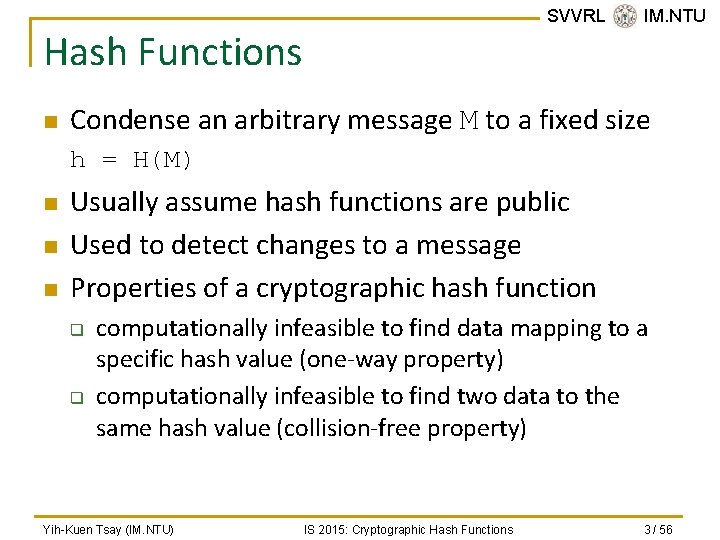
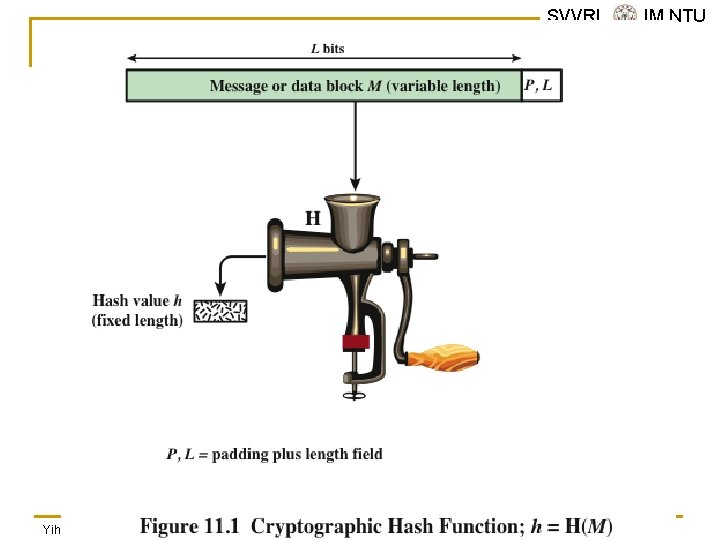
SVVRL @ IM. NTU Hash Functions n Condense an arbitrary message M to a fixed size h = H(M) n n n Usually assume hash functions are public Used to detect changes to a message Properties of a cryptographic hash function q q computationally infeasible to find data mapping to a specific hash value (one-way property) computationally infeasible to find two data to the same hash value (collision-free property) Yih-Kuen Tsay (IM. NTU) IS 2015: Cryptographic Hash Functions 3 / 56
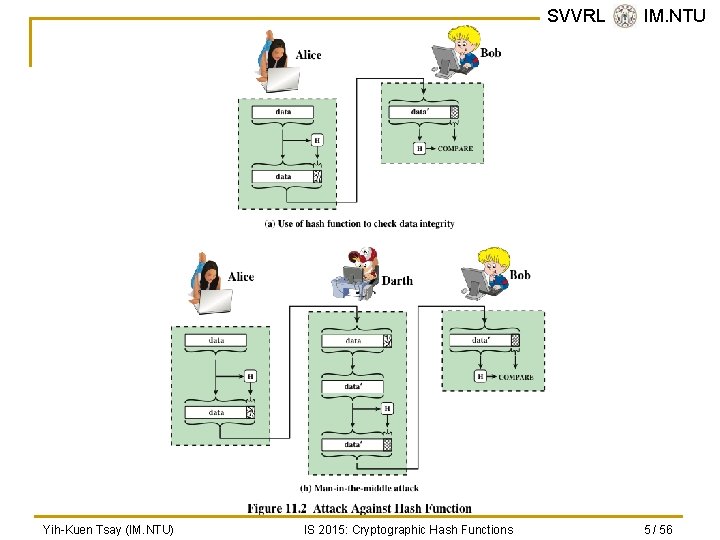
SVVRL @ IM. NTU Yih-Kuen Tsay (IM. NTU) IS 2015: Cryptographic Hash Functions 4 / 56
SVVRL @ IM. NTU Yih-Kuen Tsay (IM. NTU) IS 2015: Cryptographic Hash Functions 5 / 56
Message Authentication n n SVVRL @ IM. NTU A mechanism or service used to verify the integrity of a message. Message authentication assures that data received are exactly as sent. Yih-Kuen Tsay (IM. NTU) IS 2015: Cryptographic Hash Functions 6 / 56
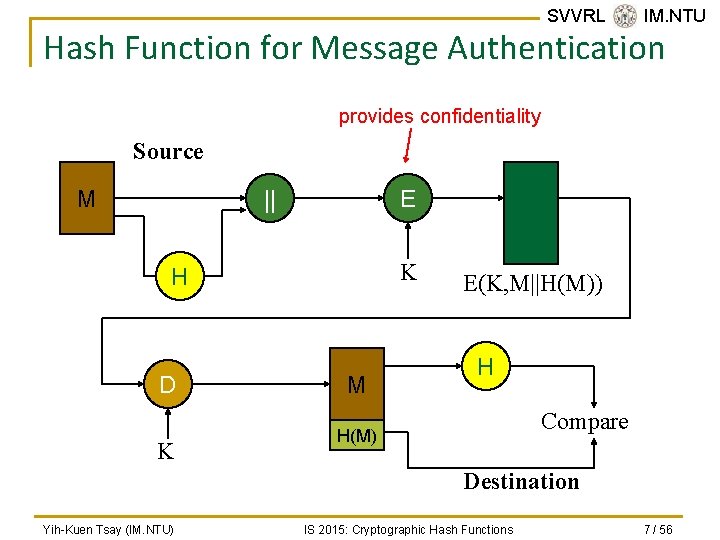
SVVRL @ IM. NTU Hash Function for Message Authentication provides confidentiality Source || M E K H D K M E(K, M||H(M)) H Compare H(M) Destination Yih-Kuen Tsay (IM. NTU) IS 2015: Cryptographic Hash Functions 7 / 56
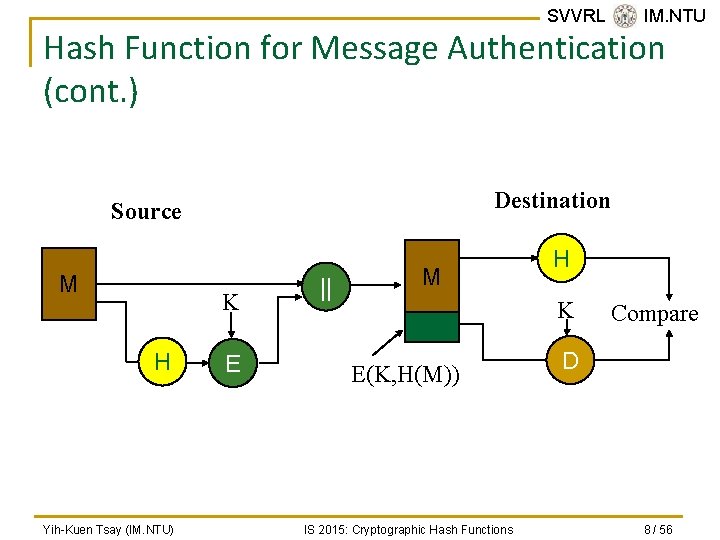
SVVRL @ IM. NTU Hash Function for Message Authentication (cont. ) Destination Source M K H Yih-Kuen Tsay (IM. NTU) E || M H K E(K, H(M)) IS 2015: Cryptographic Hash Functions Compare D 8 / 56
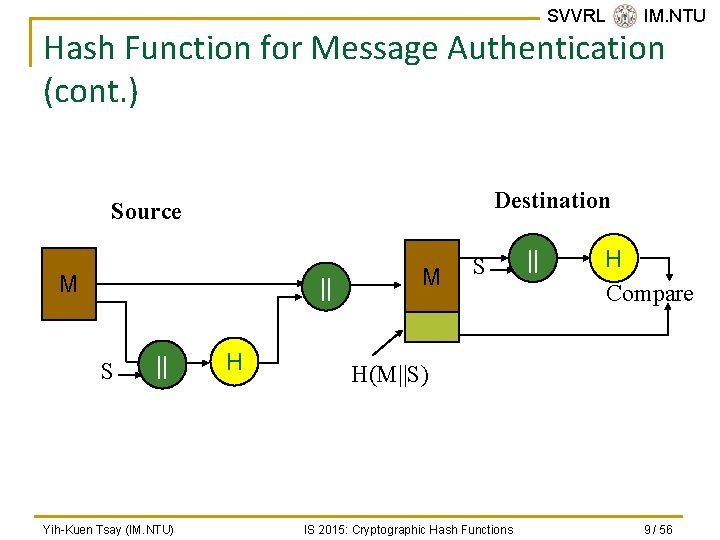
SVVRL @ IM. NTU Hash Function for Message Authentication (cont. ) Destination Source M || S || Yih-Kuen Tsay (IM. NTU) H M S || H Compare H(M||S) IS 2015: Cryptographic Hash Functions 9 / 56
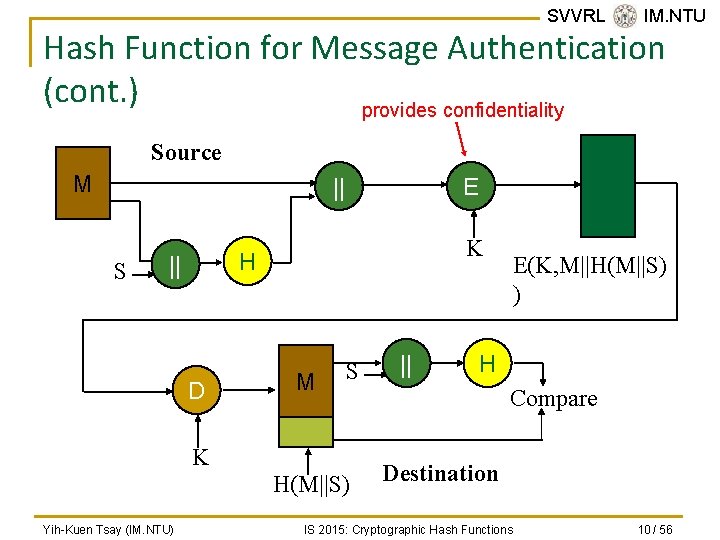
SVVRL @ IM. NTU Hash Function for Message Authentication (cont. ) provides confidentiality Source M || S E K H || D M S K H(M||S) Yih-Kuen Tsay (IM. NTU) || E(K, M||H(M||S) ) H Compare Destination IS 2015: Cryptographic Hash Functions 10 / 56
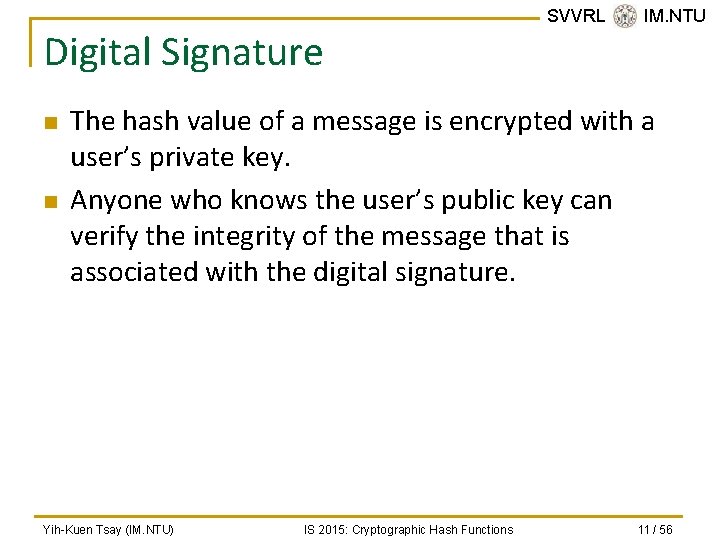
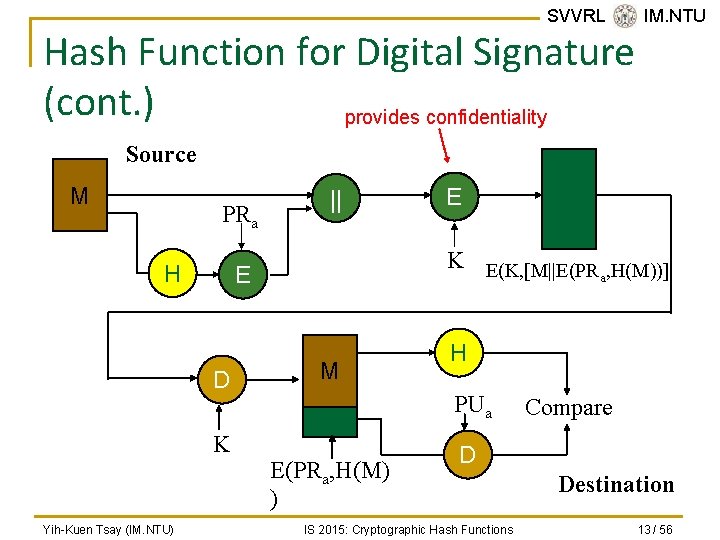
Digital Signature n n SVVRL @ IM. NTU The hash value of a message is encrypted with a user’s private key. Anyone who knows the user’s public key can verify the integrity of the message that is associated with the digital signature. Yih-Kuen Tsay (IM. NTU) IS 2015: Cryptographic Hash Functions 11 / 56
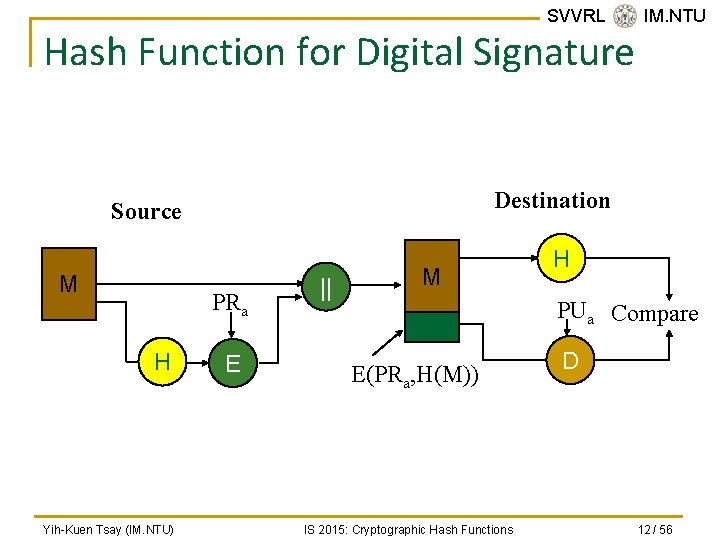
SVVRL @ IM. NTU Hash Function for Digital Signature Destination Source M PRa H Yih-Kuen Tsay (IM. NTU) E || M H PUa Compare E(PRa, H(M)) IS 2015: Cryptographic Hash Functions D 12 / 56
SVVRL @ IM. NTU Hash Function for Digital Signature (cont. ) provides confidentiality Source M PRa H K E(K, [M||E(PR , H(M))] a E D Yih-Kuen Tsay (IM. NTU) || M H PUa E(PRa, H(M) ) Compare D IS 2015: Cryptographic Hash Functions Destination 13 / 56
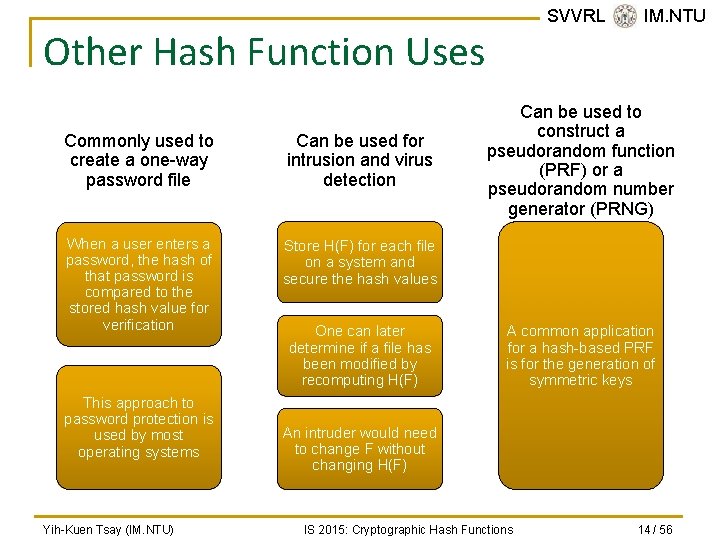
SVVRL @ IM. NTU Other Hash Function Uses Commonly used to create a one-way password file Can be used for intrusion and virus detection When a user enters a password, the hash of that password is compared to the stored hash value for verification Store H(F) for each file on a system and secure the hash values This approach to password protection is used by most operating systems Yih-Kuen Tsay (IM. NTU) One can later determine if a file has been modified by recomputing H(F) Can be used to construct a pseudorandom function (PRF) or a pseudorandom number generator (PRNG) A common application for a hash-based PRF is for the generation of symmetric keys An intruder would need to change F without changing H(F) IS 2015: Cryptographic Hash Functions 14 / 56
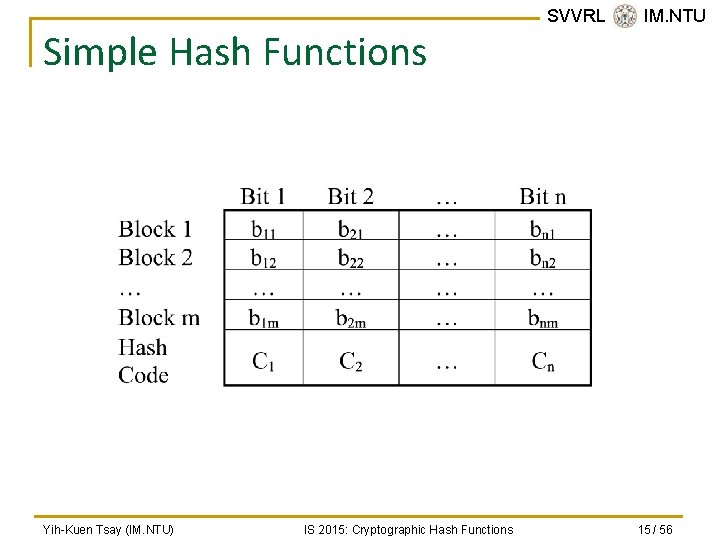
Simple Hash Functions Yih-Kuen Tsay (IM. NTU) IS 2015: Cryptographic Hash Functions SVVRL @ IM. NTU 15 / 56
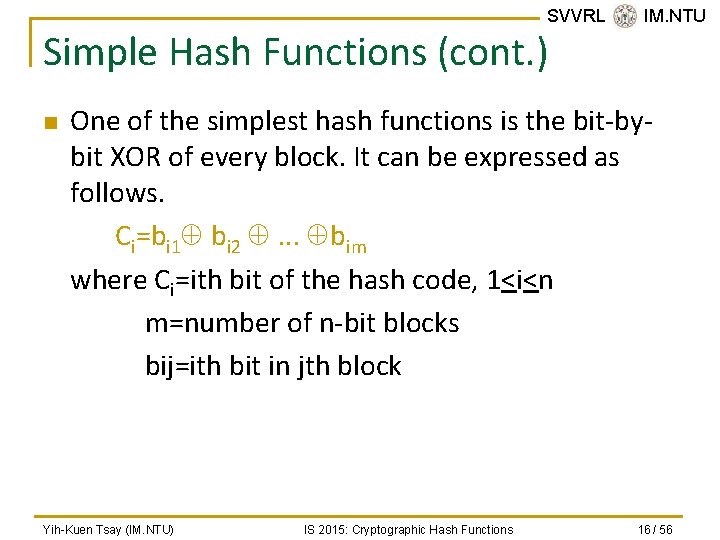
SVVRL @ IM. NTU Simple Hash Functions (cont. ) n One of the simplest hash functions is the bit-bybit XOR of every block. It can be expressed as follows. Ci=bi 1 bi 2 . . . bim where Ci=ith bit of the hash code, 1<i<n m=number of n-bit blocks bij=ith bit in jth block Yih-Kuen Tsay (IM. NTU) IS 2015: Cryptographic Hash Functions 16 / 56
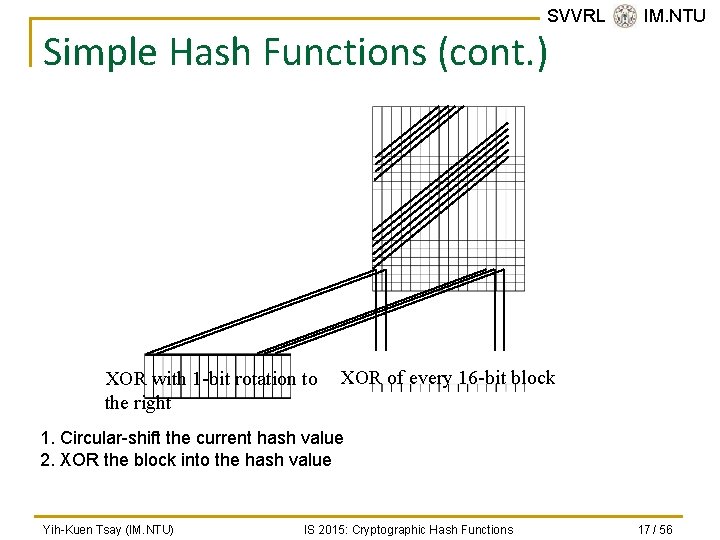
SVVRL @ IM. NTU Simple Hash Functions (cont. ) XOR with 1 -bit rotation to the right XOR of every 16 -bit block 1. Circular-shift the current hash value 2. XOR the block into the hash value Yih-Kuen Tsay (IM. NTU) IS 2015: Cryptographic Hash Functions 17 / 56
Simple But Not Secure n n n SVVRL @ IM. NTU A simple XOR or rotated XOR (RXOR) is insufficient if only the hash code is encrypted. You may still feel that such a simple function could be useful when the message as well as the hash code are encrypted. However, you must be really careful. Consider the cipher block chaining (CBC). Given a message consisting of a sequence of 64 -bit blocks of X 1, X 2, …, XN, define the hash code C as the block-byblock XOR of all blocks and append the hash code as the final block. C=XN+1=X 1 X 2 … XN Yih-Kuen Tsay (IM. NTU) IS 2015: Cryptographic Hash Functions 18 / 56
Simple But Not Secure (cont. ) n n SVVRL @ IM. NTU XN+1 = X 1 X 2 X 3 … XN = [IV D(K, Y 1)] [Y 1 D(K, Y 2)] [Y 2 D(K, Y 3)] [Y 3 D(K, Y 4)] … [YN-1 D(K, YN)] {suppose Y 1 and Y 2 are exchanged} = [IV D(K, Y 2)] [Y 2 D(K, Y 1)] [Y 1 D(K, Y 3)] [Y 3 D(K, Y 4)] … [YN-1 D(K, YN)] So, even if two ciphertext blocks are permuted, the hash code remains the same. Yih-Kuen Tsay (IM. NTU) IS 2015: Cryptographic Hash Functions 19 / 56
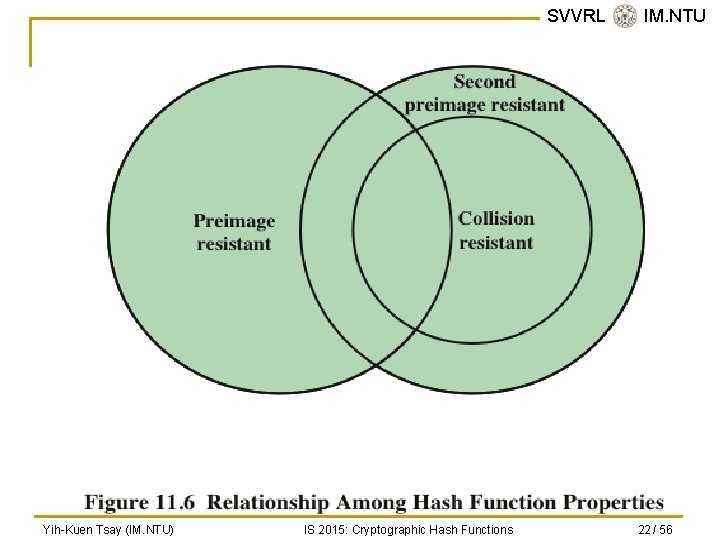
Requirements and Security Collision Preimage n n n x is the preimage of h for a hash value h = H(x) Is a data block whose hash function, using the function H, is h Because H is a many-toone mapping, for any given hash value h, there will in general be multiple preimages Yih-Kuen Tsay (IM. NTU) SVVRL @ IM. NTU n n Occurs if we have x ≠ y and H(x) = H(y) Because we are using hash functions for data integrity, collisions are clearly undesirable IS 2015: Cryptographic Hash Functions 20 / 56
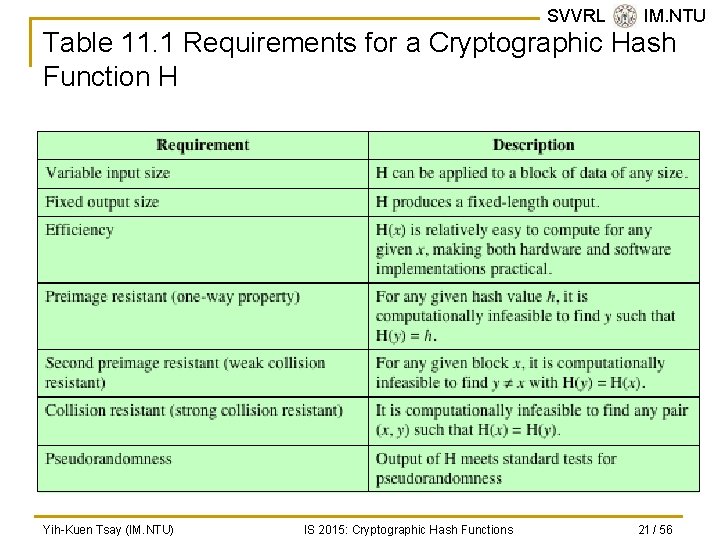
SVVRL @ IM. NTU Table 11. 1 Requirements for a Cryptographic Hash Function H Yih-Kuen Tsay (IM. NTU) IS 2015: Cryptographic Hash Functions 21 / 56
SVVRL @ IM. NTU Yih-Kuen Tsay (IM. NTU) IS 2015: Cryptographic Hash Functions 22 / 56
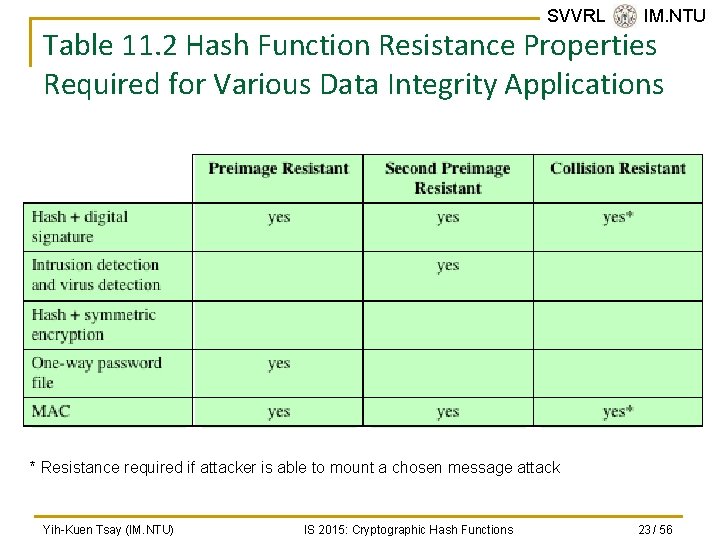
SVVRL @ IM. NTU Table 11. 2 Hash Function Resistance Properties Required for Various Data Integrity Applications * Resistance required if attacker is able to mount a chosen message attack Yih-Kuen Tsay (IM. NTU) IS 2015: Cryptographic Hash Functions 23 / 56
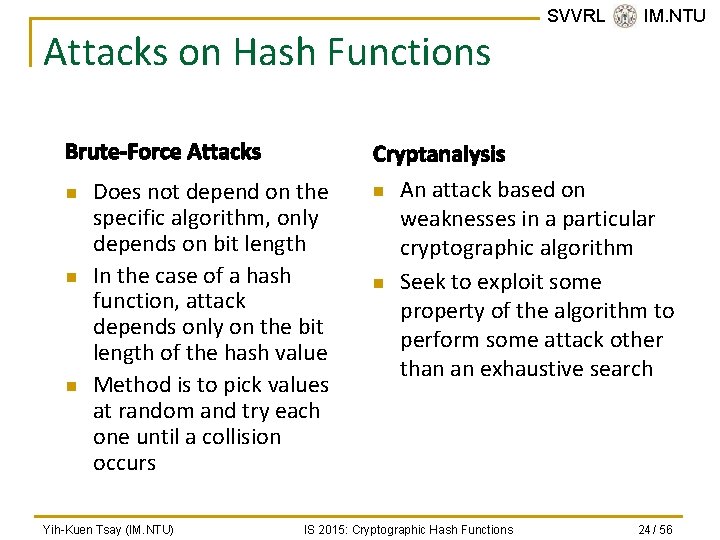
Attacks on Hash Functions Brute-Force Attacks n n n Cryptanalysis Does not depend on the specific algorithm, only depends on bit length In the case of a hash function, attack depends only on the bit length of the hash value Method is to pick values at random and try each one until a collision occurs Yih-Kuen Tsay (IM. NTU) SVVRL @ IM. NTU n n An attack based on weaknesses in a particular cryptographic algorithm Seek to exploit some property of the algorithm to perform some attack other than an exhaustive search IS 2015: Cryptographic Hash Functions 24 / 56
Birthday Attacks n n n SVVRL @ IM. NTU Suppose that a 64 -bit hash code is used. One might think this is quite secure. For example, if an encrypted hash code C is transmitted with the corresponding unencrypted message M, then an opponent would need to find an M’ such that H(M’)=H(M) to substitute another message and fool the receiver. On average, the opponent would have to try 263 (=264 /2) messages to find one. Yih-Kuen Tsay (IM. NTU) IS 2015: Cryptographic Hash Functions 25 / 56
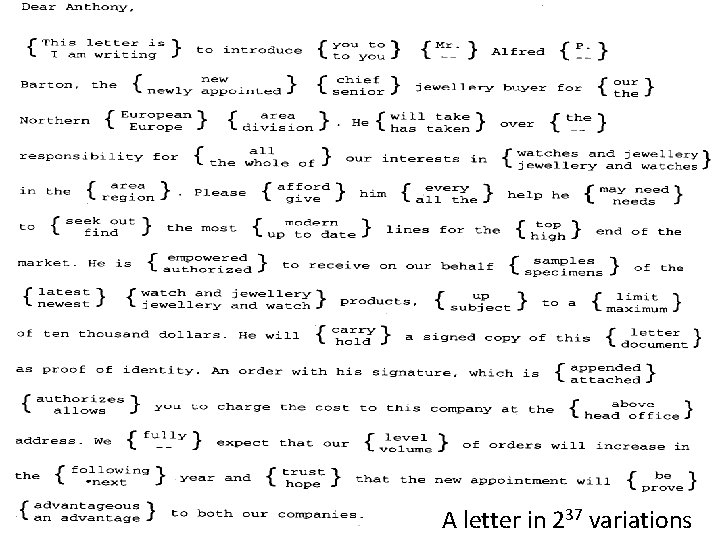
Birthday Attacks (cont. ) n SVVRL @ IM. NTU [Yuval 1979] proposed the following attack strategy: q q q The source A is prepared to “sign” a message by appending the appropriate m-bit MAC and encrypting that MAC with A’s private key. The opponent generates 2 m/2 variations on the message, all of which convey essentially the same meaning. The opponent prepares for an equal number of messages, all of which are variations on the fraudulent message to be substituted for the real one. Yih-Kuen Tsay (IM. NTU) IS 2015: Cryptographic Hash Functions 26 / 56
Birthday Attacks (cont. ) q q SVVRL @ IM. NTU The two sets of messages are compared to find a pair of messages that produces the same hash code. If no match is found, additional valid and fraudulent messages are generated until a match is made. The opponent offers the valid variation to A for signature. This signature can then be attached to the fraudulent variation for transmission to the intended recipient. Yih-Kuen Tsay (IM. NTU) IS 2015: Cryptographic Hash Functions 27 / 56
Birthday Attacks (cont. ) n n SVVRL @ IM. NTU Thus, if a 64 -bit hash code is used, the level of effort required is only on the order of 232. The conclusion to be drawn from this is that the length of the hash code should be substantial. Yih-Kuen Tsay (IM. NTU) IS 2015: Cryptographic Hash Functions 28 / 56
SVVRL @ IM. NTU Yih-Kuen Tsay (IM. NTU) A letter in 237 variations 29 / 56 IS 2015: Cryptographic Hash Functions
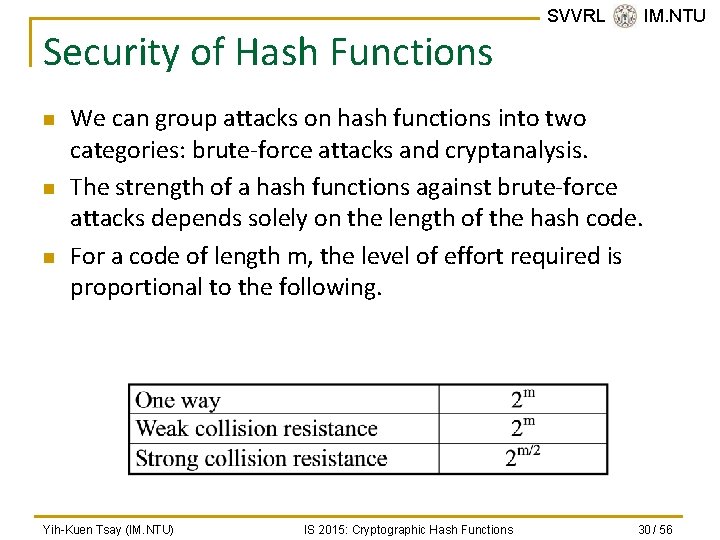
Security of Hash Functions n n n SVVRL @ IM. NTU We can group attacks on hash functions into two categories: brute-force attacks and cryptanalysis. The strength of a hash functions against brute-force attacks depends solely on the length of the hash code. For a code of length m, the level of effort required is proportional to the following. Yih-Kuen Tsay (IM. NTU) IS 2015: Cryptographic Hash Functions 30 / 56
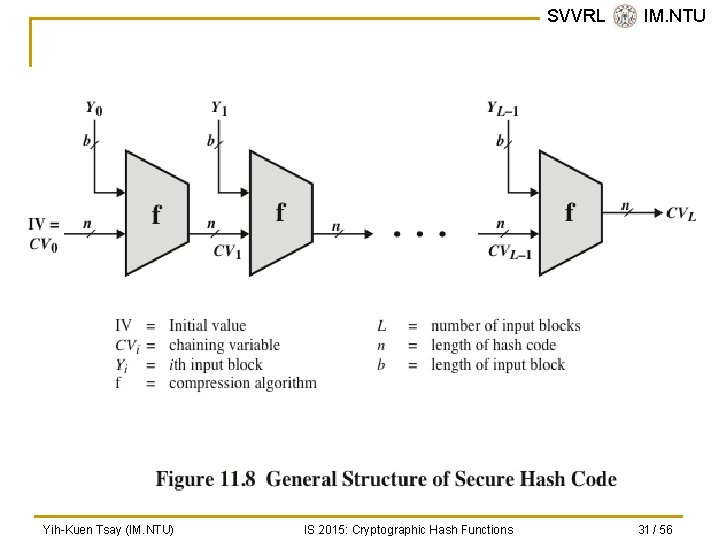
SVVRL @ IM. NTU Yih-Kuen Tsay (IM. NTU) IS 2015: Cryptographic Hash Functions 31 / 56
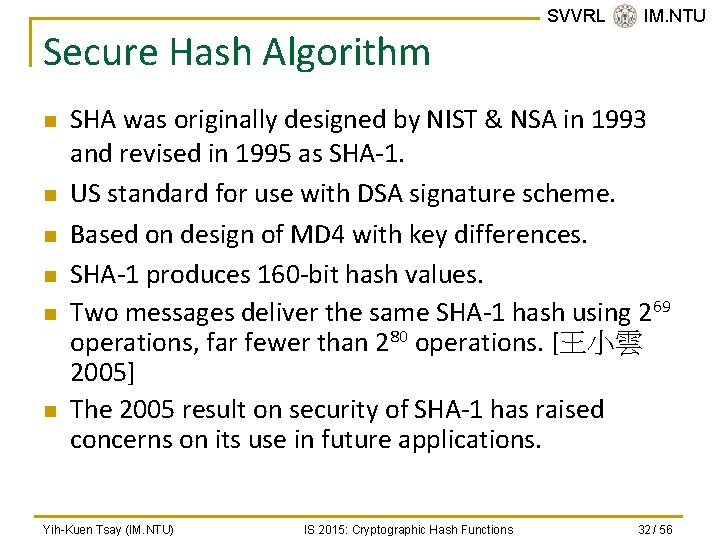
Secure Hash Algorithm n n n SVVRL @ IM. NTU SHA was originally designed by NIST & NSA in 1993 and revised in 1995 as SHA-1. US standard for use with DSA signature scheme. Based on design of MD 4 with key differences. SHA-1 produces 160 -bit hash values. Two messages deliver the same SHA-1 hash using 269 operations, far fewer than 280 operations. [王小雲 2005] The 2005 result on security of SHA-1 has raised concerns on its use in future applications. Yih-Kuen Tsay (IM. NTU) IS 2015: Cryptographic Hash Functions 32 / 56
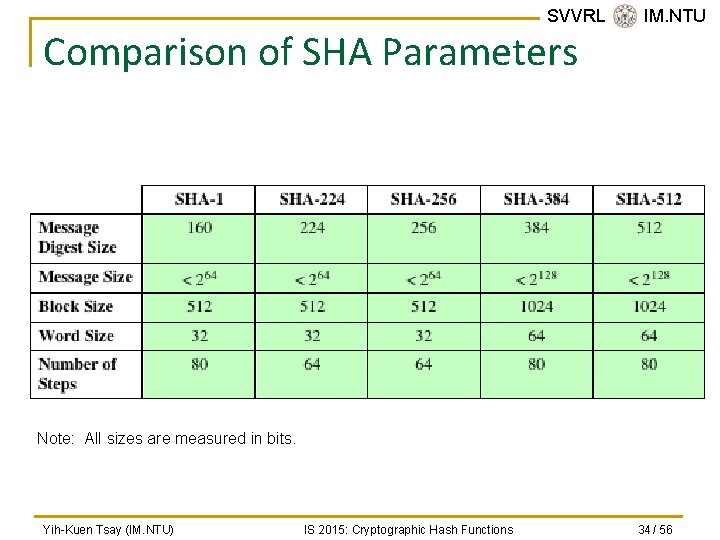
SVVRL @ IM. NTU Revised Secure Hash Standard n n NIST issued revision FIPS 180 -2 in 2002. Adds 3 additional versions (SHA-2) q q n n SHA-256, SHA-384, SHA-512 SHA-224 added in 2008 (FIPS 180 -3) Designed for compatibility with increased security provided by the AES cipher. Structure & detail is similar to SHA-1, hence analysis should be similar, but security levels are rather higher. Yih-Kuen Tsay (IM. NTU) IS 2015: Cryptographic Hash Functions 33 / 56
SVVRL @ IM. NTU Comparison of SHA Parameters Note: All sizes are measured in bits. Yih-Kuen Tsay (IM. NTU) IS 2015: Cryptographic Hash Functions 34 / 56
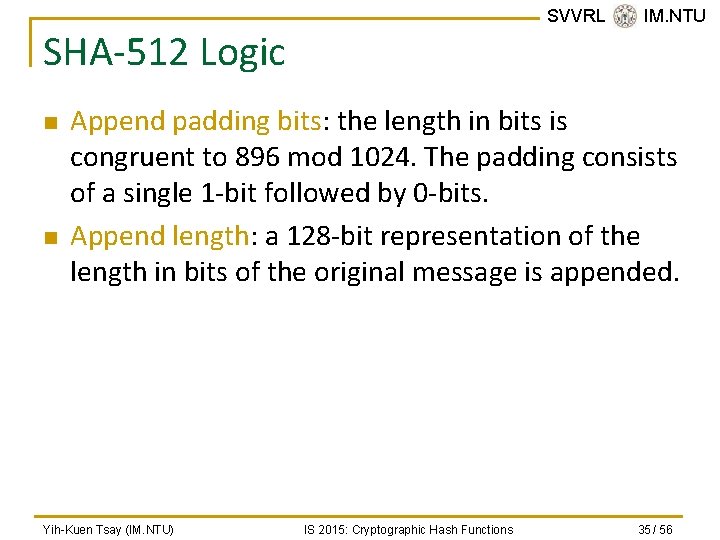
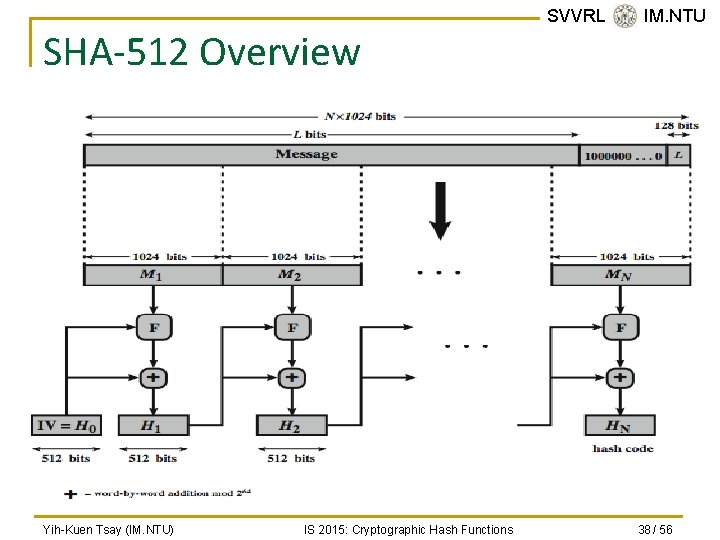
SVVRL @ IM. NTU SHA-512 Logic n n Append padding bits: the length in bits is congruent to 896 mod 1024. The padding consists of a single 1 -bit followed by 0 -bits. Append length: a 128 -bit representation of the length in bits of the original message is appended. Yih-Kuen Tsay (IM. NTU) IS 2015: Cryptographic Hash Functions 35 / 56
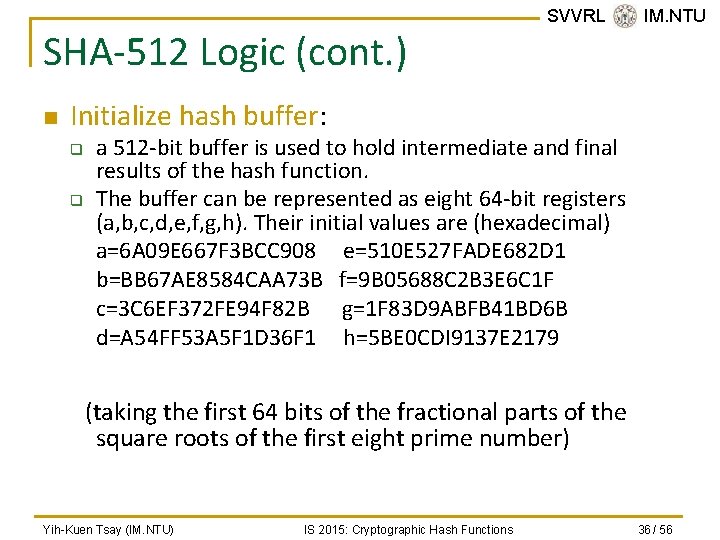
SHA-512 Logic (cont. ) n SVVRL @ IM. NTU Initialize hash buffer: q q a 512 -bit buffer is used to hold intermediate and final results of the hash function. The buffer can be represented as eight 64 -bit registers (a, b, c, d, e, f, g, h). Their initial values are (hexadecimal) a=6 A 09 E 667 F 3 BCC 908 e=510 E 527 FADE 682 D 1 b=BB 67 AE 8584 CAA 73 B f=9 B 05688 C 2 B 3 E 6 C 1 F c=3 C 6 EF 372 FE 94 F 82 B g=1 F 83 D 9 ABFB 41 BD 6 B d=A 54 FF 53 A 5 F 1 D 36 F 1 h=5 BE 0 CDI 9137 E 2179 (taking the first 64 bits of the fractional parts of the square roots of the first eight prime number) Yih-Kuen Tsay (IM. NTU) IS 2015: Cryptographic Hash Functions 36 / 56
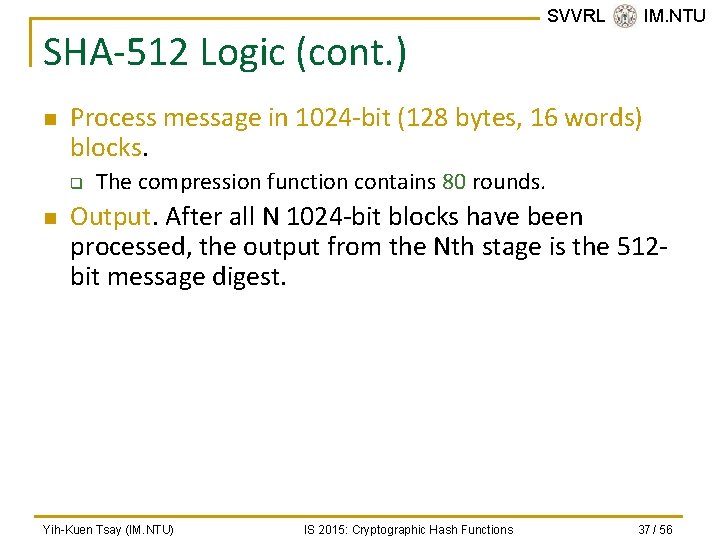
SHA-512 Logic (cont. ) n Process message in 1024 -bit (128 bytes, 16 words) blocks. q n SVVRL @ IM. NTU The compression function contains 80 rounds. Output. After all N 1024 -bit blocks have been processed, the output from the Nth stage is the 512 bit message digest. Yih-Kuen Tsay (IM. NTU) IS 2015: Cryptographic Hash Functions 37 / 56
SHA-512 Overview Yih-Kuen Tsay (IM. NTU) IS 2015: Cryptographic Hash Functions SVVRL @ IM. NTU 38 / 56
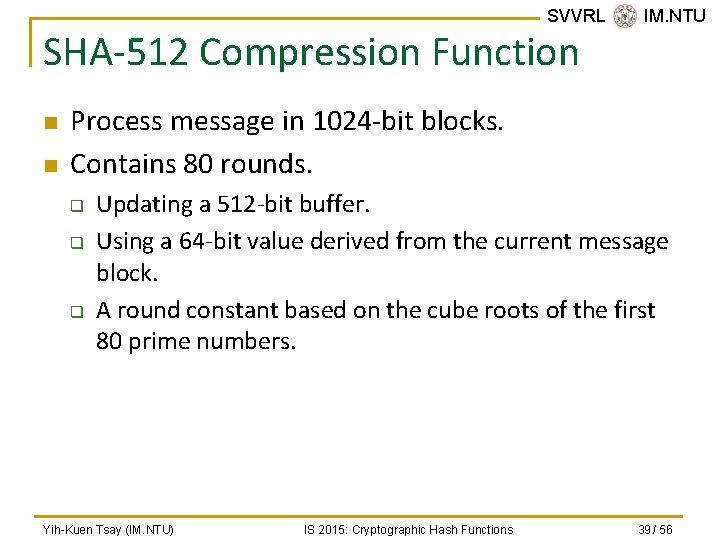
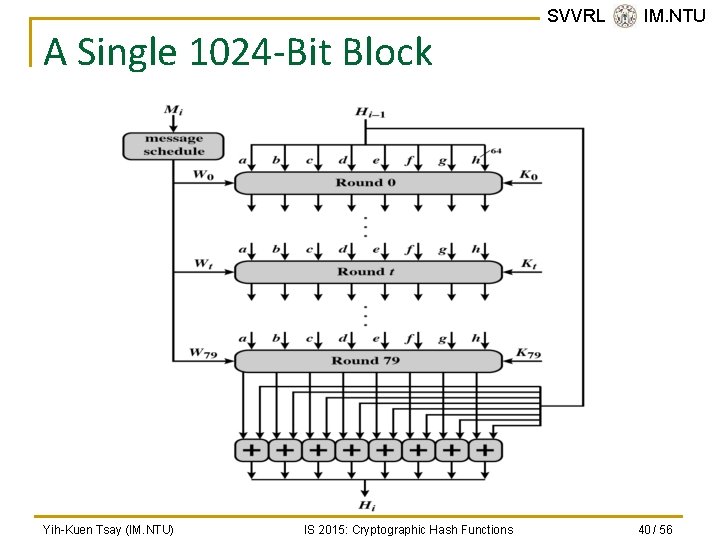
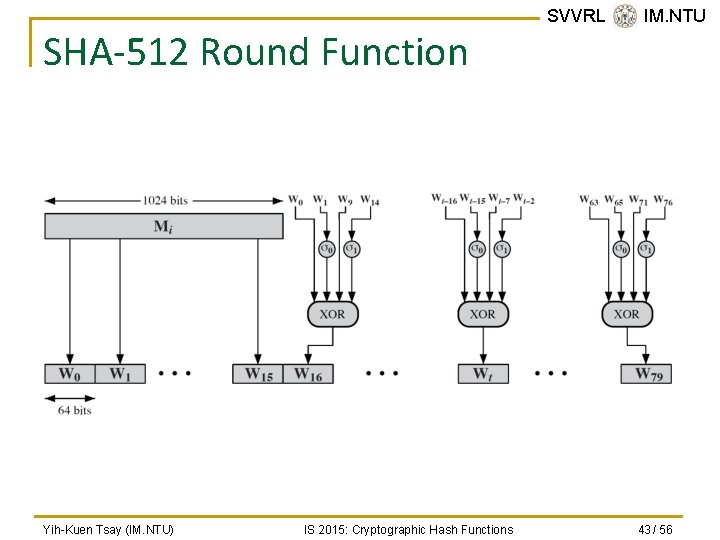
SVVRL @ IM. NTU SHA-512 Compression Function n n Process message in 1024 -bit blocks. Contains 80 rounds. q q q Updating a 512 -bit buffer. Using a 64 -bit value derived from the current message block. A round constant based on the cube roots of the first 80 prime numbers. Yih-Kuen Tsay (IM. NTU) IS 2015: Cryptographic Hash Functions 39 / 56
A Single 1024 -Bit Block Yih-Kuen Tsay (IM. NTU) IS 2015: Cryptographic Hash Functions SVVRL @ IM. NTU 40 / 56
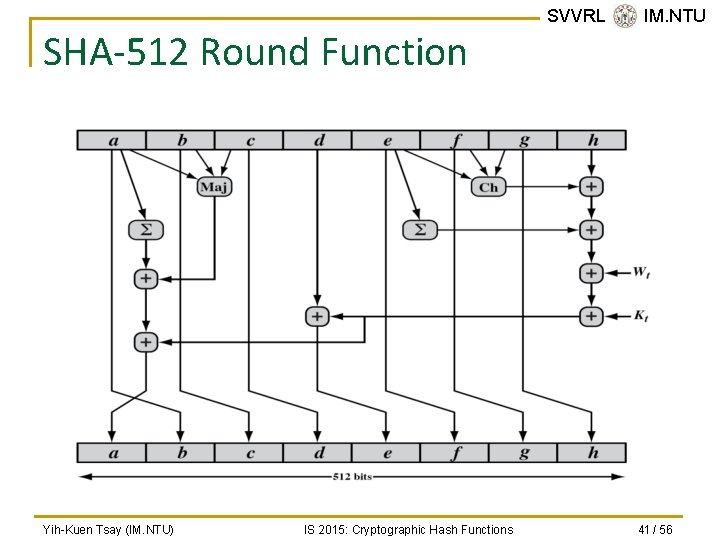
SHA-512 Round Function Yih-Kuen Tsay (IM. NTU) IS 2015: Cryptographic Hash Functions SVVRL @ IM. NTU 41 / 56
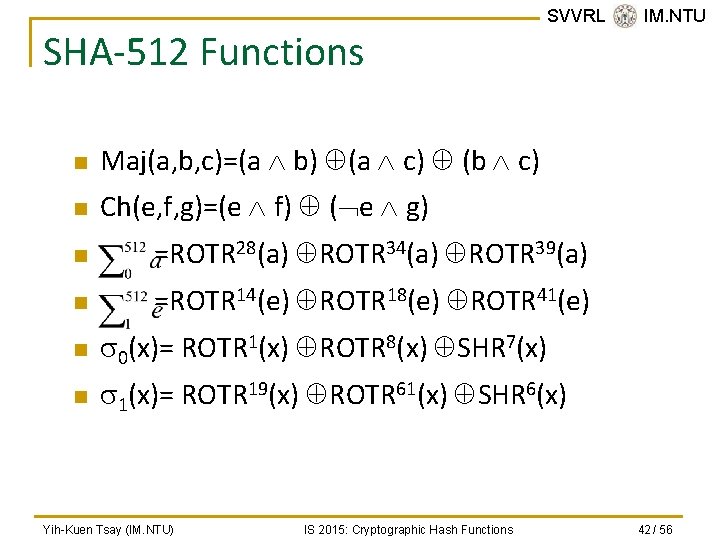
SHA-512 Functions n Maj(a, b, c)=(a b) (a c) (b c) n Ch(e, f, g)=(e f) ( e g) SVVRL @ IM. NTU n =ROTR 28(a) ROTR 34(a) ROTR 39(a) n =ROTR 14(e) ROTR 18(e) ROTR 41(e) n s 0(x)= ROTR 1(x) ROTR 8(x) SHR 7(x) n s 1(x)= ROTR 19(x) ROTR 61(x) SHR 6(x) Yih-Kuen Tsay (IM. NTU) IS 2015: Cryptographic Hash Functions 42 / 56
SHA-512 Round Function Yih-Kuen Tsay (IM. NTU) IS 2015: Cryptographic Hash Functions SVVRL @ IM. NTU 43 / 56
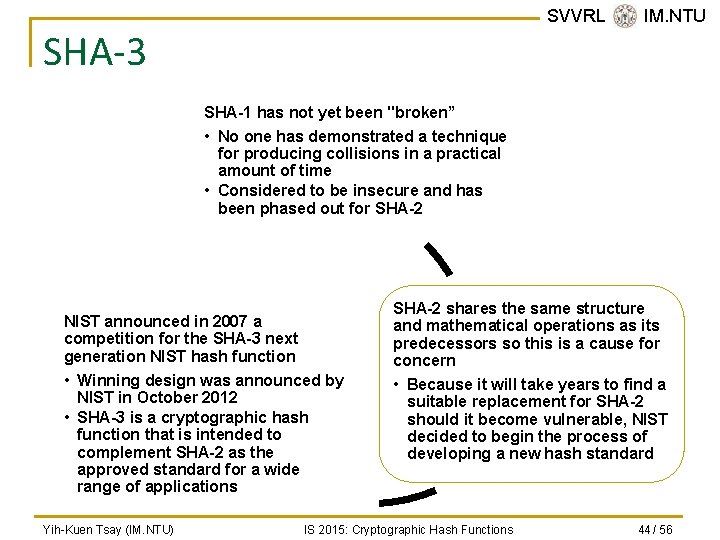
SVVRL @ IM. NTU SHA-3 SHA-1 has not yet been "broken” • No one has demonstrated a technique for producing collisions in a practical amount of time • Considered to be insecure and has been phased out for SHA-2 NIST announced in 2007 a competition for the SHA-3 next generation NIST hash function • Winning design was announced by NIST in October 2012 • SHA-3 is a cryptographic hash function that is intended to complement SHA-2 as the approved standard for a wide range of applications Yih-Kuen Tsay (IM. NTU) SHA-2 shares the same structure and mathematical operations as its predecessors so this is a cause for concern • Because it will take years to find a suitable replacement for SHA-2 should it become vulnerable, NIST decided to begin the process of developing a new hash standard IS 2015: Cryptographic Hash Functions 44 / 56
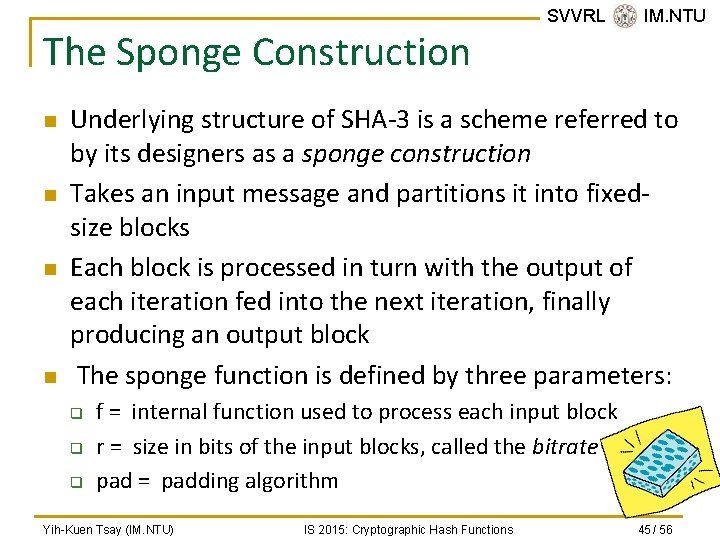
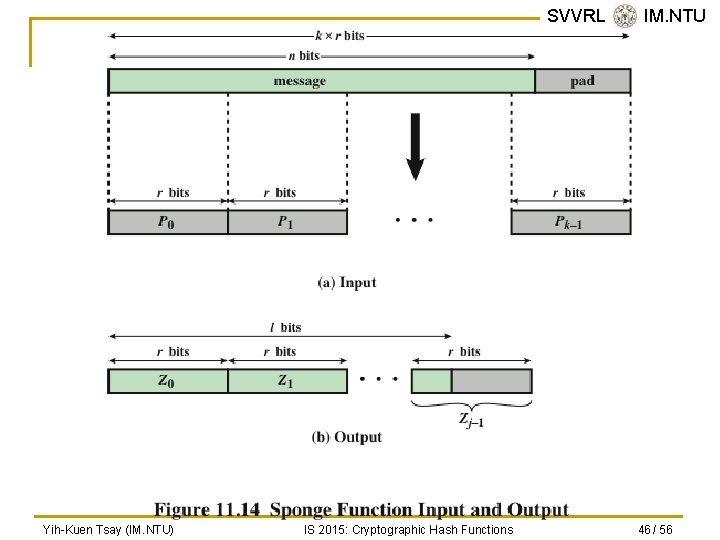
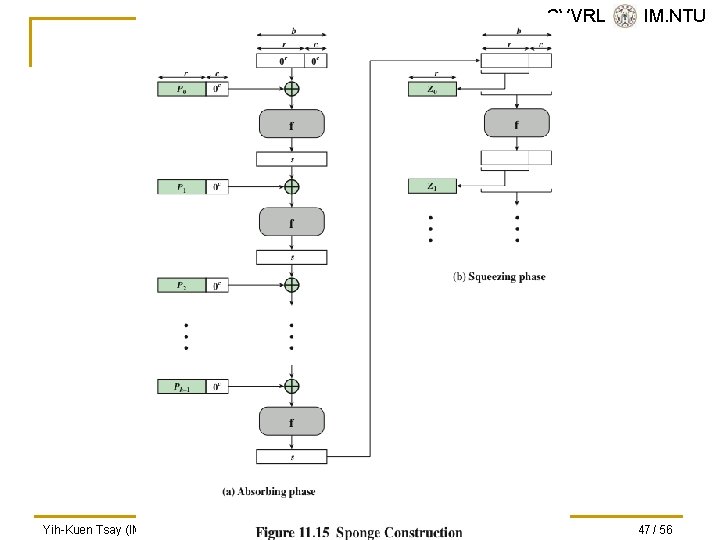
The Sponge Construction n n SVVRL @ IM. NTU Underlying structure of SHA-3 is a scheme referred to by its designers as a sponge construction Takes an input message and partitions it into fixedsize blocks Each block is processed in turn with the output of each iteration fed into the next iteration, finally producing an output block The sponge function is defined by three parameters: q q q f = internal function used to process each input block r = size in bits of the input blocks, called the bitrate pad = padding algorithm Yih-Kuen Tsay (IM. NTU) IS 2015: Cryptographic Hash Functions 45 / 56
SVVRL @ IM. NTU Yih-Kuen Tsay (IM. NTU) IS 2015: Cryptographic Hash Functions 46 / 56
SVVRL @ IM. NTU Yih-Kuen Tsay (IM. NTU) IS 2015: Cryptographic Hash Functions 47 / 56
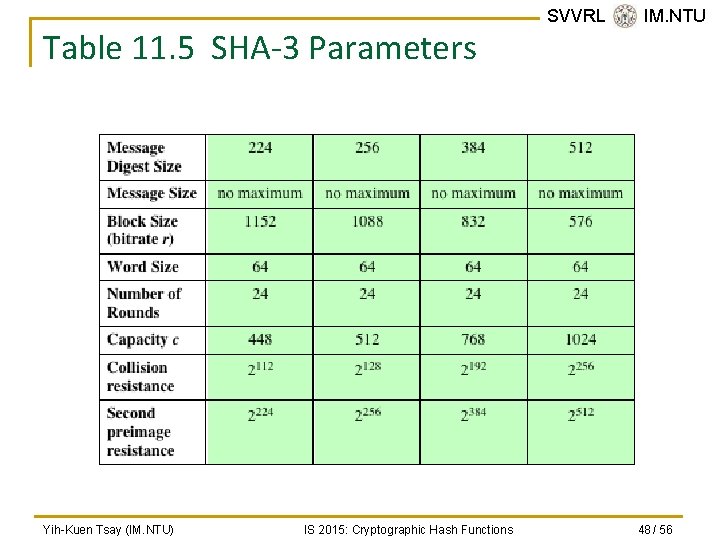
Table 11. 5 SHA-3 Parameters Yih-Kuen Tsay (IM. NTU) IS 2015: Cryptographic Hash Functions SVVRL @ IM. NTU 48 / 56
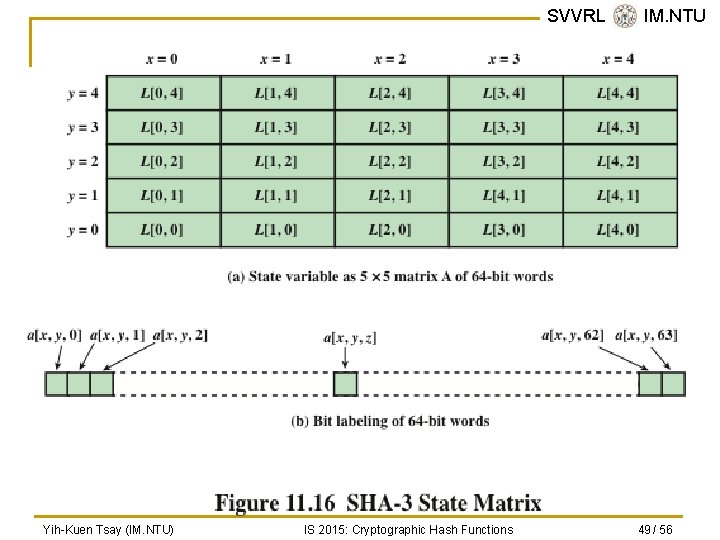
SVVRL @ IM. NTU Yih-Kuen Tsay (IM. NTU) IS 2015: Cryptographic Hash Functions 49 / 56
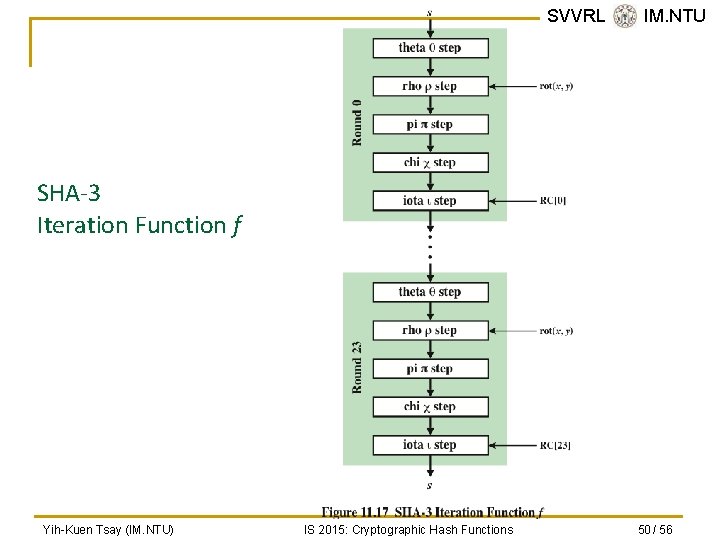
SVVRL @ IM. NTU SHA-3 Iteration Function f Yih-Kuen Tsay (IM. NTU) IS 2015: Cryptographic Hash Functions 50 / 56
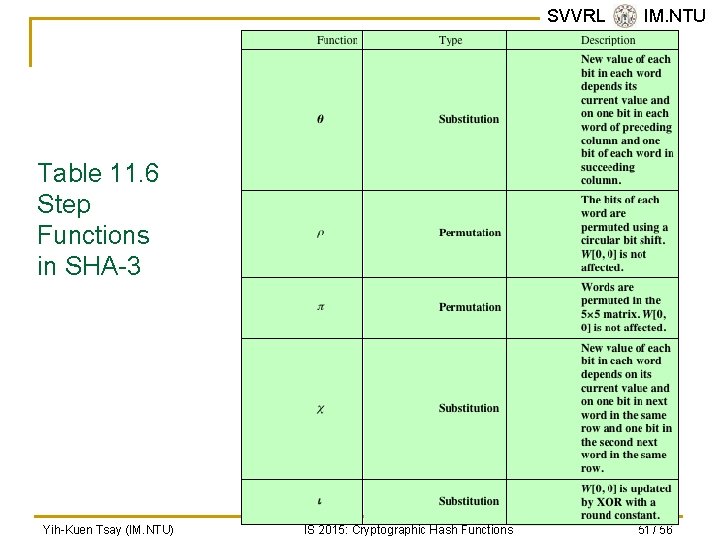
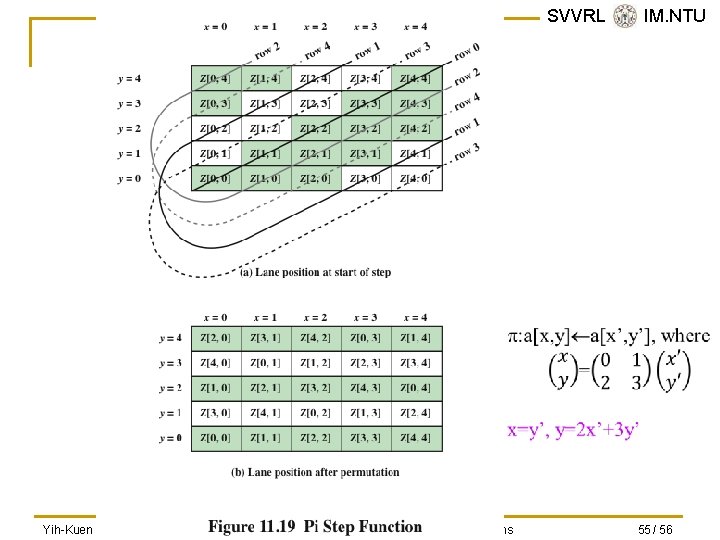
SVVRL @ IM. NTU Table 11. 6 Step Functions in SHA-3 Yih-Kuen Tsay (IM. NTU) IS 2015: Cryptographic Hash Functions 51 / 56
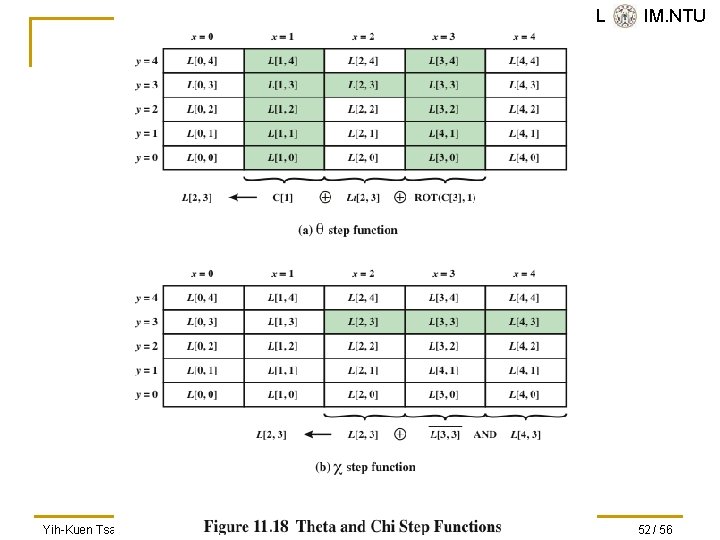
SVVRL @ IM. NTU Yih-Kuen Tsay (IM. NTU) IS 2015: Cryptographic Hash Functions 52 / 56
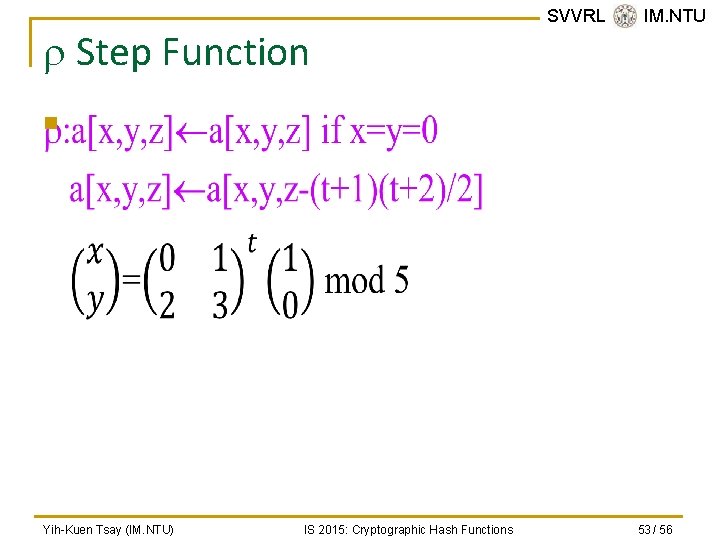
r Step Function SVVRL @ IM. NTU n Yih-Kuen Tsay (IM. NTU) IS 2015: Cryptographic Hash Functions 53 / 56
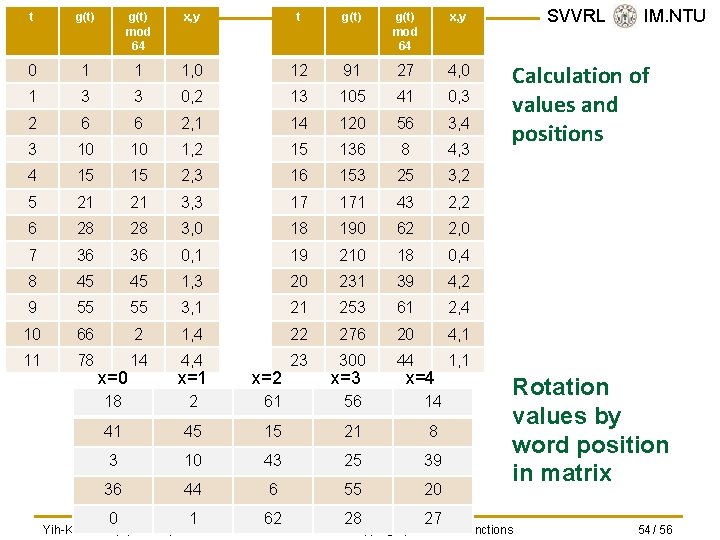
t g(t) mod 64 x, y 0 1 1 1, 0 12 91 27 4, 0 1 3 3 0, 2 13 105 41 0, 3 2 6 6 2, 1 14 120 56 3, 4 3 10 10 1, 2 15 136 8 4, 3 4 15 15 2, 3 16 153 25 3, 2 5 21 21 3, 3 17 171 43 2, 2 6 28 28 3, 0 18 190 62 2, 0 7 36 36 0, 1 19 210 18 0, 4 8 45 45 1, 3 20 231 39 4, 2 9 55 55 3, 1 21 253 61 2, 4 10 66 2 1, 4 22 276 20 4, 1 11 78 14 4, 4 23 300 44 1, 1 x=0 x=1 x=2 x=3 x=4 18 2 61 56 14 41 45 15 21 8 3 10 43 25 39 36 44 6 55 20 0 1 62 28 27 Yih-Kuen Tsay (IM. NTU) SVVRL @ IM. NTU Calculation of values and positions Rotation values by word position in matrix IS 2015: Cryptographic Hash Functions 54 / 56
SVVRL @ IM. NTU Yih-Kuen Tsay (IM. NTU) IS 2015: Cryptographic Hash Functions 55 / 56
IOTA step function i: a a RC[ir] L[0, 0] RC[ir] 0<ir<24 Yih-Kuen Tsay (IM. NTU) Round Constant # of 1’s Round SVVRL Constant @ IM. NTU # of 1’s 0 00000000 1 1 12 00008000808 B 6 1 000000808 2 3 13 800000008 B 5 2 8000000808 A 5 14 8000000808 9 5 3 80000000800 0 3 15 8000000800 3 4 4 000000808 B 5 16 8000000800 2 3 5 00008000000 1 2 17 800000008 0 2 6 80000000808 1 5 18 000000800 A 3 7 8000000800 9 4 19 800000008000000 A 4 8 00000008 A 3 20 80000000808 1 5 9 00000008 8 2 21 8000000808 0 3 10 00008000800 9 4 22 00008000000 1 2 11 00008000000 3 23 A IS 2015: Cryptographic Hash Functions 80000000800 4 8 56 / 56