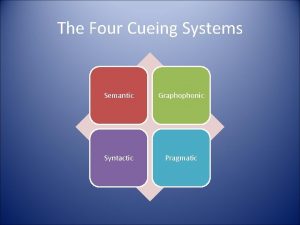
Graphophonemic Knowledge Spelling and Dispelling 2013 Texas Education



- Slides: 65
Graphophonemic Knowledge: Spelling and Dispelling © 2013 Texas Education Agency / The University of Texas System 1
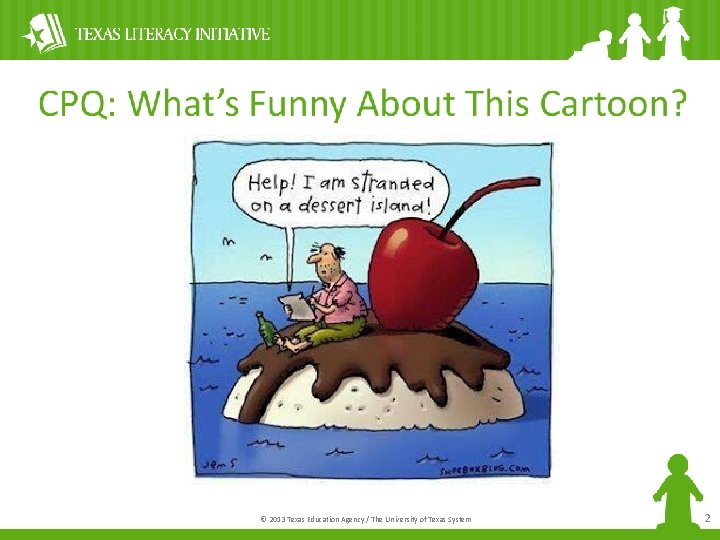
© 2013 Texas Education Agency / The University of Texas System 2
Share Successes HO 1 • If you have attempted to implement the spelling routine introduced at the last training: – – what has worked for you and your students? what is the easiest part of the routine? what is the most difficult part of the routine? what questions do you have about the routine? Please record your questions and be ready to share. THINK TURN TALK © 2013 Texas Education Agency / The University of Texas System 3
Questions? Answers to these questions will be discussed, either in this training or through a subsequent training. © 2013 Texas Education Agency / The University of Texas System 4
© 2013 Texas Education Agency / The University of Texas System 5
Let’s take a closer look at the steps in the GK routine! © 2013 Texas Education Agency / The University of Texas System 6
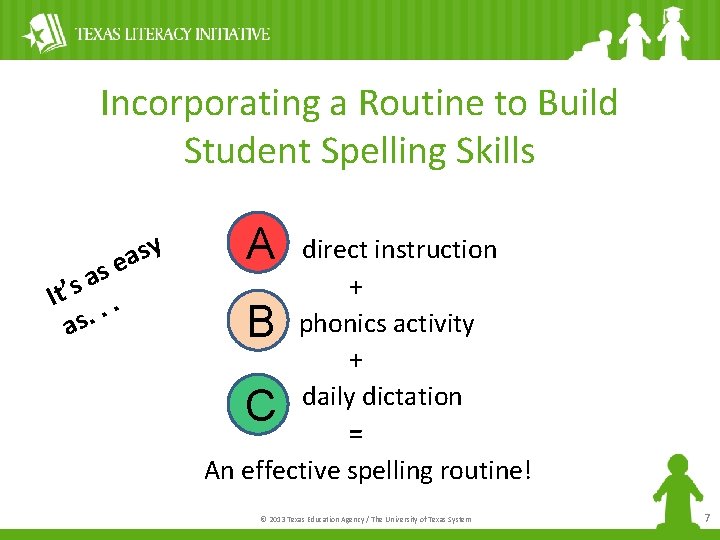
Incorporating a Routine to Build Student Spelling Skills y s a se a It’s. . as. A direct instruction + B phonics activity + daily dictation C = An effective spelling routine! © 2013 Texas Education Agency / The University of Texas System 7
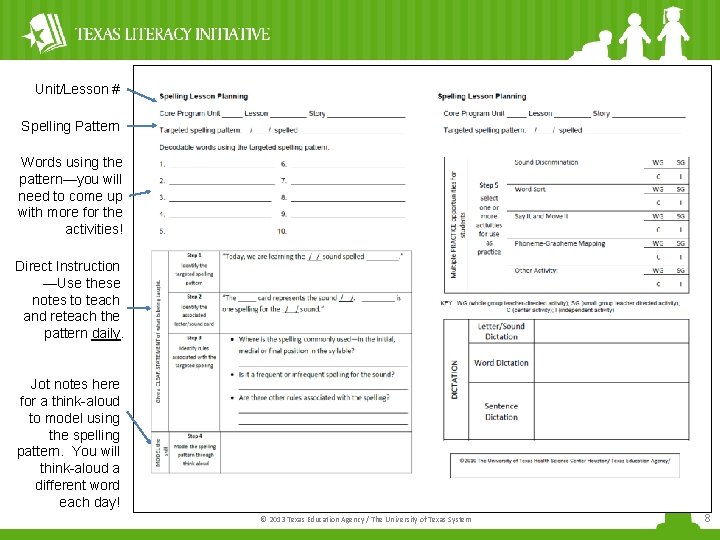
Unit/Lesson # Spelling Pattern Words using the pattern—you will need to come up with more for the activities! Direct Instruction —Use these notes to teach and reteach the pattern daily. Jot notes here for a think-aloud to model using the spelling pattern. You will think-aloud a different word each day! © 2013 Texas Education Agency / The University of Texas System 8
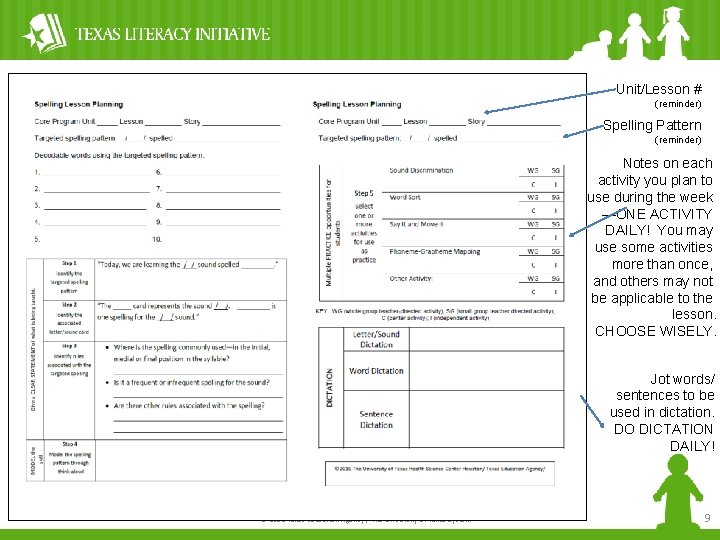
Unit/Lesson # (reminder) Spelling Pattern (reminder) Notes on each activity you plan to use during the week —ONE ACTIVITY DAILY! You may use some activities more than once, and others may not be applicable to the lesson. CHOOSE WISELY. Jot words/ sentences to be used in dictation. DO DICTATION DAILY! © 2013 Texas Education Agency / The University of Texas System 9
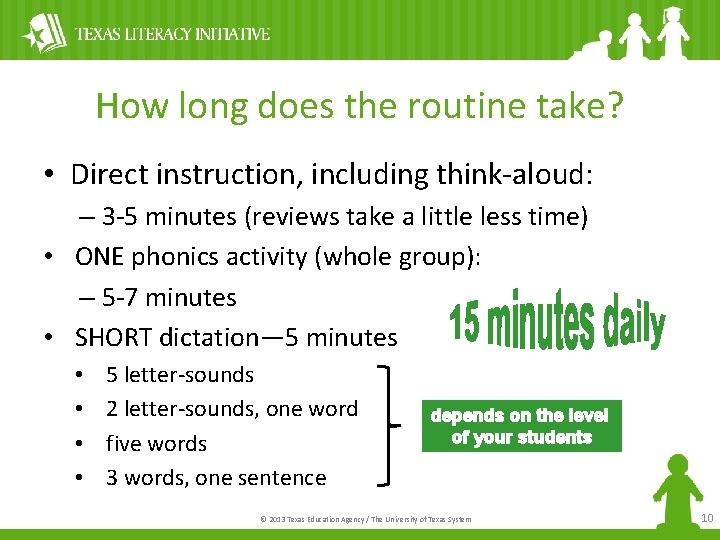
How long does the routine take? • Direct instruction, including think-aloud: – 3 -5 minutes (reviews take a little less time) • ONE phonics activity (whole group): – 5 -7 minutes • SHORT dictation— 5 minutes • • 5 letter-sounds 2 letter-sounds, one word five words 3 words, one sentence depends on the level of your students © 2013 Texas Education Agency / The University of Texas System 10
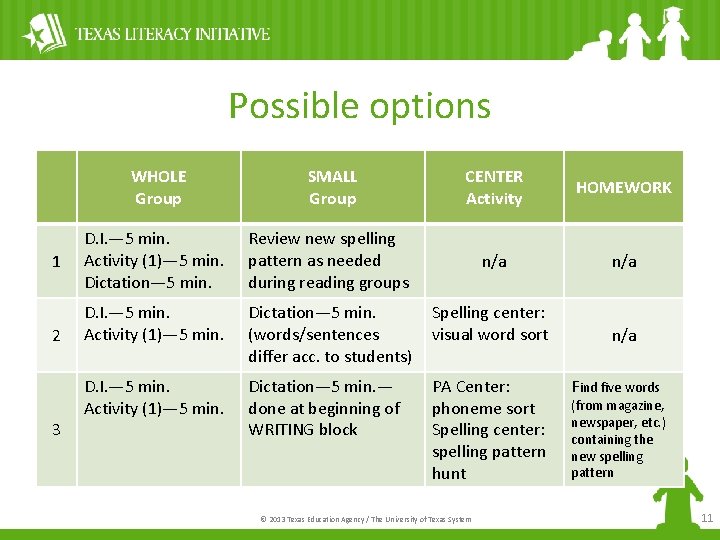
Possible options 1 2 3 WHOLE Group SMALL Group CENTER Activity HOMEWORK D. I. — 5 min. Activity (1)— 5 min. Dictation— 5 min. Review new spelling pattern as needed during reading groups n/a D. I. — 5 min. Activity (1)— 5 min. Dictation— 5 min. (words/sentences differ acc. to students) Spelling center: visual word sort n/a D. I. — 5 min. Activity (1)— 5 min. Dictation— 5 min. — done at beginning of WRITING block PA Center: phoneme sort Spelling center: spelling pattern hunt © 2013 Texas Education Agency / The University of Texas System Find five words (from magazine, newspaper, etc. ) containing the new spelling pattern 11
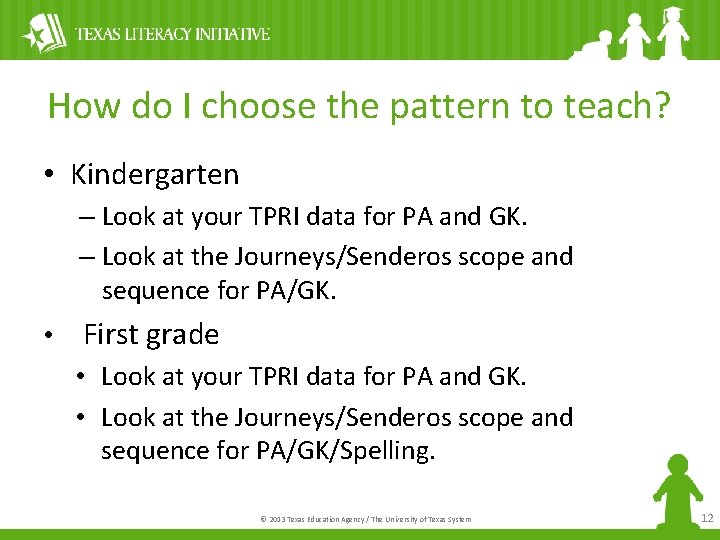
How do I choose the pattern to teach? • Kindergarten – Look at your TPRI data for PA and GK. – Look at the Journeys/Senderos scope and sequence for PA/GK. • First grade • Look at your TPRI data for PA and GK. • Look at the Journeys/Senderos scope and sequence for PA/GK/Spelling. © 2013 Texas Education Agency / The University of Texas System 12
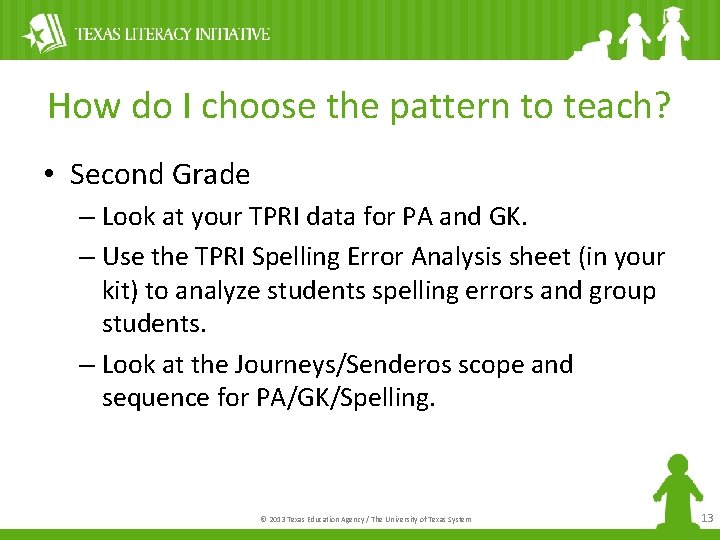
How do I choose the pattern to teach? • Second Grade – Look at your TPRI data for PA and GK. – Use the TPRI Spelling Error Analysis sheet (in your kit) to analyze students spelling errors and group students. – Look at the Journeys/Senderos scope and sequence for PA/GK/Spelling. © 2013 Texas Education Agency / The University of Texas System 13
How do I choose the pattern to teach? • Examine the scope and sequence from Journeys. • Let’s work together for a few minutes to figure out where you’ve been, where you are, and where you need to go. © 2013 Texas Education Agency / The University of Texas System 14
Incorporating spelling into workstations • Use the same spelling philosophy! – Once students can independently play FCRR and TPRI games and activities done in whole and small group, move these to centers. – Word sorts make great centers! Compare/contrast words that use spelling patterns students have learned. • closed sorts • open sorts © 2013 Texas Education Agency / The University of Texas System 15
Incorporating spelling into workstations • Keep it simple! – Change out the spelling pattern, NOT the activity! • Students look through newspapers and magazines to find and copy or cut out words containing the current (or a past) spelling pattern. • Students take turns reading/spelling words. One student reads a word using the current spelling pattern. The other student sounds out and spells the word (using pencil/paper OR magnetic letters). © 2013 Texas Education Agency / The University of Texas System 16
Incorporating spelling into workstations • Use spelling words at the reading/fluency center. – Write sentences using words with the new spelling pattern. At a fluency center, students read the sentences, circle the words with the new spelling pattern, then cover the word and try to sound it out and spell it correctly. They check their own spelling by looking back at the circled word. © 2013 Texas Education Agency / The University of Texas System 17
Incorporating spelling into workstations • For High Frequency Words/Sight Words, use activities to help students memorize the words. – Write each word three times. – Use each word in a sentence. – Create a word jumble or crossword puzzle with the HFWs. © 2013 Texas Education Agency / The University of Texas System 18
Your turn! HO 2 • Work with your assigned team. • Use the supplies on your table. • Come up with two new workstation activities: Øone which helps students learn to use a new spelling pattern, and Ø one which helps them learn HFWs. • Be careful—the new spelling pattern activity should NOT encourage the students to memorize words! © 2013 Texas Education Agency / The University of Texas System 19
Your turn! • Come up with two new workstation activities: Øone which helps students learn to use a new spelling pattern, and Ø one which helps them learn HFWs. HO 2 You have 15 minutes to complete the activity. Be prepared to share your ideas with the group. © 2013 Texas Education Agency / The University of Texas System 20
Phonemic Awareness Spelling • The relationship between phonemic awareness and spelling skills is bidirectional: Ø spelling influences growth in phonemic awareness, and Ø phonemic awareness contributes to growth in spelling skills. Hecht and Close, 2002 © 2013 Texas Education Agency / The University of Texas System 21
According to Louisa Moats… “About 15 -20 minutes of class time per day over a period of 15 -20 weeks during the last half of kindergarten are sufficient to develop phoneme awareness and to connect phonemes with their most common spellings. ” Speech to Print, 2 nd Edition, Brookes Publishing 2010, p. 201 © 2013 Texas Education Agency / The University of Texas System 22
Characteristics of a Powerful Phonemic Awareness Program 1. A gradual, systematic progression through a developmentally and linguistically appropriate sequence of activities 2. Brief, fun, active manipulation of oral language 3. Minimal or carefully chosen use of print in beginning lessons © 2013 Texas Education Agency / The University of Texas System 23
Characteristics of a Powerful PA Program 4. Gradual introduction of print as children become aware of sounds 5. Instruction in how to blend sounds together as well as how to take them apart or substitute them for one another 6. Use of modeling, demonstration, and application rather than lengthy explanations © 2013 Texas Education Agency / The University of Texas System 24
Characteristics of a Powerful PA Program 7. Use of active responses from children, such as moving counters into boxes, showing syllables or sounds with blocks, matching objects, moving cards in a pocket chart, clapping, speaking, and singing (worksheets are seldom effective during lessons) Speech to Print, 2 nd Edition, Brookes Publishing 2010, pp. 202 -203 © 2013 Texas Education Agency / The University of Texas System 25
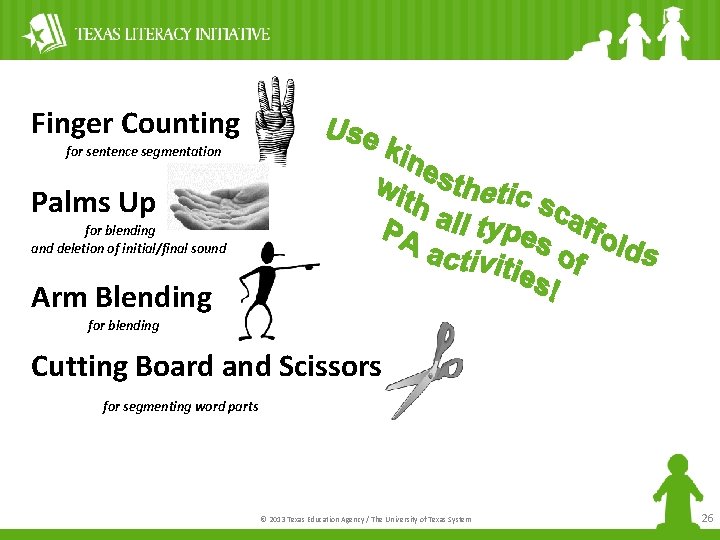
Finger Counting for sentence segmentation Palms Up for blending and deletion of initial/final sound Arm Blending for blending Cutting Board and Scissors for segmenting word parts © 2013 Texas Education Agency / The University of Texas System 26
What PA skills does a good speller really need, anyway? • A good speller can segment a sentence into individual words. • A good speller can segment a word into its syllables. • A good speller can segment the onset and rime of a word. • A good speller can segment a word into its individual phonemes (sounds). © 2013 Texas Education Agency / The University of Texas System 27
What PA skills does a good speller really need, anyway? • A good speller can manipulate the sounds in a word, including – isolating and/or deleting the initial sound – isolating and/or deleting the final sound – substituting initial, medial, and final sounds in words © 2013 Texas Education Agency / The University of Texas System 28
Give it a try! HO 3 • Work with a partner. • Complete the first three sections of Louisa Moats’ “Brief Survey of Language Knowledge”, including – Phoneme Counting – Syllable Counting – Phoneme Matching © 2013 Texas Education Agency / The University of Texas System 29
PA Skills a Good Speller Needs 1. Sentence segmentation – When writing a sentence, a good speller can hear and recognize the individual words in the sentence. The teacher enabled the second-grade students to develop incredible skills in spelling. © 2013 Texas Education Agency / The University of Texas System 30
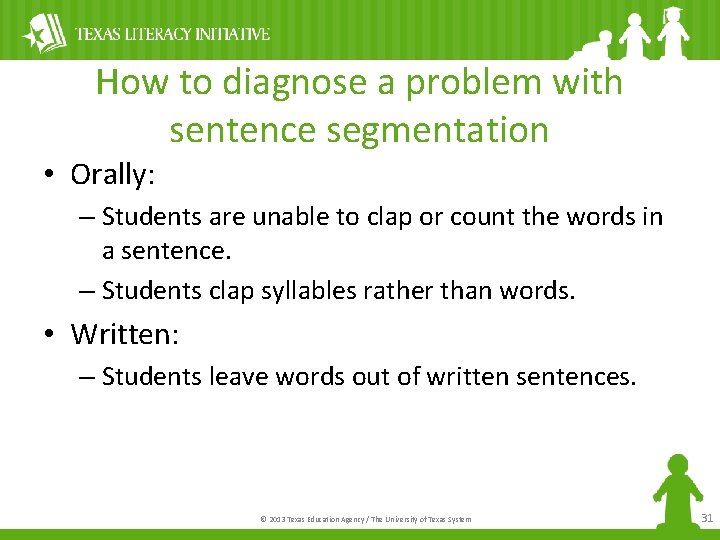
How to diagnose a problem with sentence segmentation • Orally: – Students are unable to clap or count the words in a sentence. – Students clap syllables rather than words. • Written: – Students leave words out of written sentences. © 2013 Texas Education Agency / The University of Texas System 31
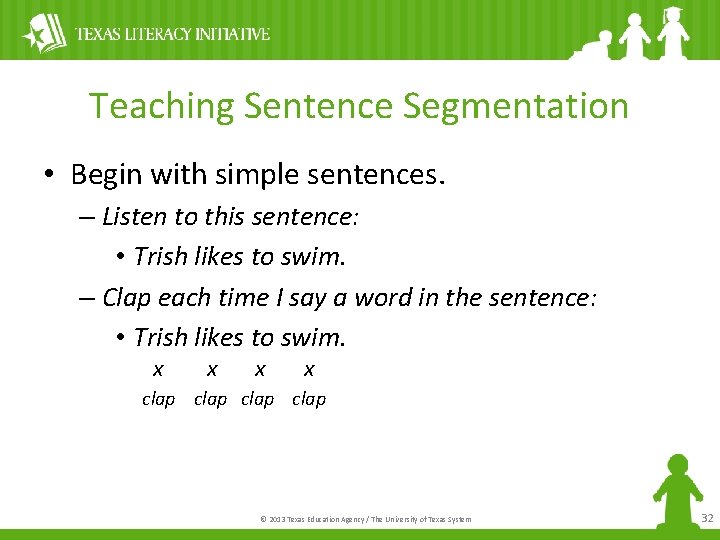
Teaching Sentence Segmentation • Begin with simple sentences. – Listen to this sentence: • Trish likes to swim. – Clap each time I say a word in the sentence: • Trish likes to swim. x x clap © 2013 Texas Education Agency / The University of Texas System 32
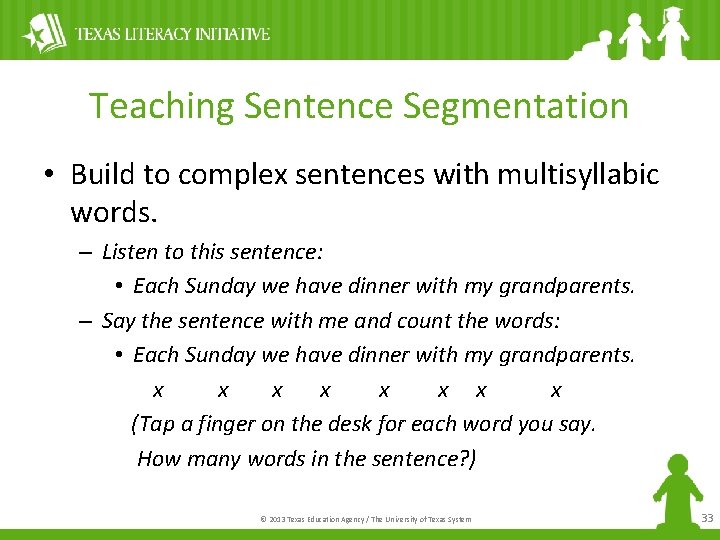
Teaching Sentence Segmentation • Build to complex sentences with multisyllabic words. – Listen to this sentence: • Each Sunday we have dinner with my grandparents. – Say the sentence with me and count the words: • Each Sunday we have dinner with my grandparents. x x x x (Tap a finger on the desk for each word you say. How many words in the sentence? ) © 2013 Texas Education Agency / The University of Texas System 33
FCRR Resources for Sentence Segmentation From Grades K-1 Student Center Activities: • PA. 013 Nursery Rhymes (picture cards and linking cubes) • PA. 014 Sentence Game (board game) • PA. 015 Sentence Graph—can be easily adapted for use as a 2 nd grade activity © 2013 Texas Education Agency / The University of Texas System 34
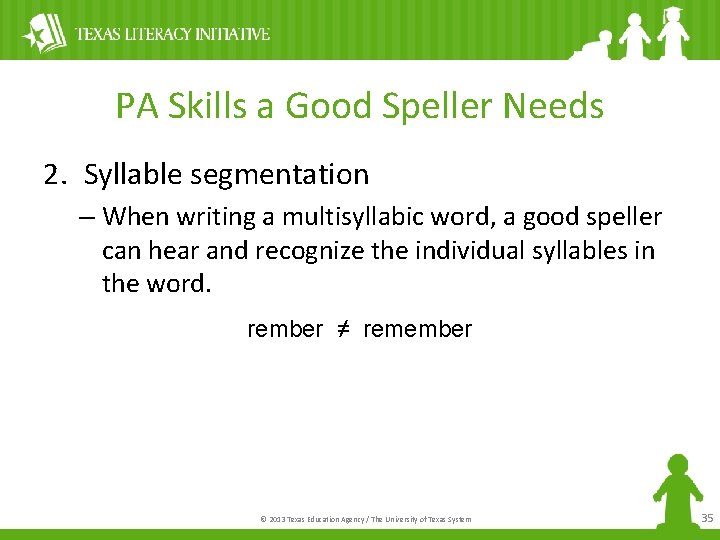
PA Skills a Good Speller Needs 2. Syllable segmentation – When writing a multisyllabic word, a good speller can hear and recognize the individual syllables in the word. rember ≠ remember © 2013 Texas Education Agency / The University of Texas System 35
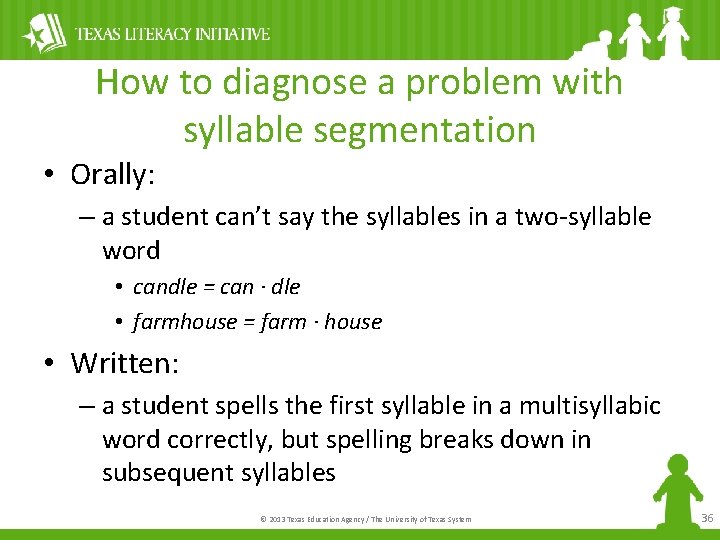
How to diagnose a problem with syllable segmentation • Orally: – a student can’t say the syllables in a two-syllable word • candle = can · dle • farmhouse = farm · house • Written: – a student spells the first syllable in a multisyllabic word correctly, but spelling breaks down in subsequent syllables © 2013 Texas Education Agency / The University of Texas System 36
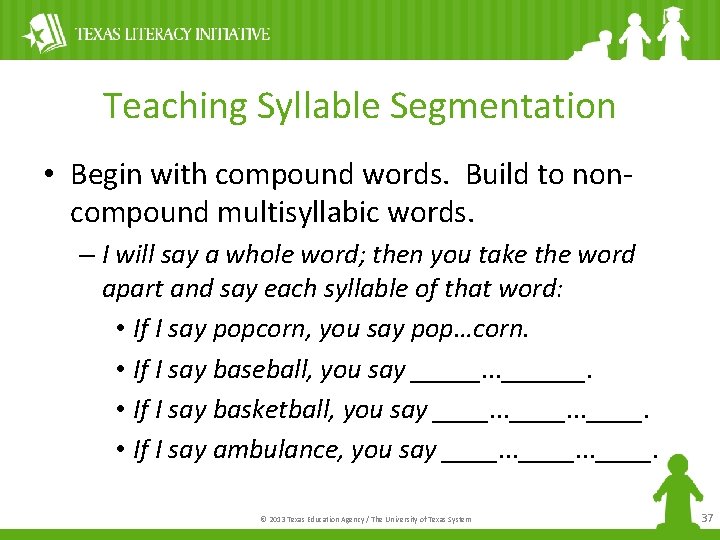
Teaching Syllable Segmentation • Begin with compound words. Build to noncompound multisyllabic words. – I will say a whole word; then you take the word apart and say each syllable of that word: • If I say popcorn, you say pop…corn. • If I say baseball, you say _____. . . ______. • If I say basketball, you say ____. . . ____. • If I say ambulance, you say ____. . . ____. © 2013 Texas Education Agency / The University of Texas System 37
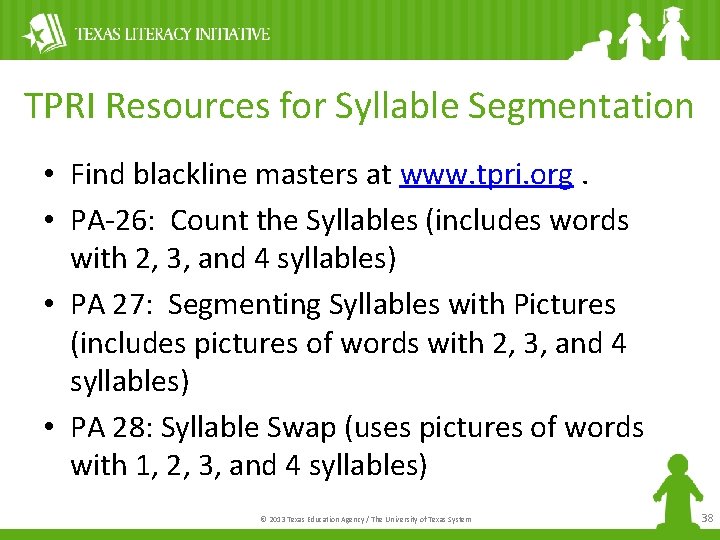
TPRI Resources for Syllable Segmentation • Find blackline masters at www. tpri. org. • PA-26: Count the Syllables (includes words with 2, 3, and 4 syllables) • PA 27: Segmenting Syllables with Pictures (includes pictures of words with 2, 3, and 4 syllables) • PA 28: Syllable Swap (uses pictures of words with 1, 2, 3, and 4 syllables) © 2013 Texas Education Agency / The University of Texas System 38
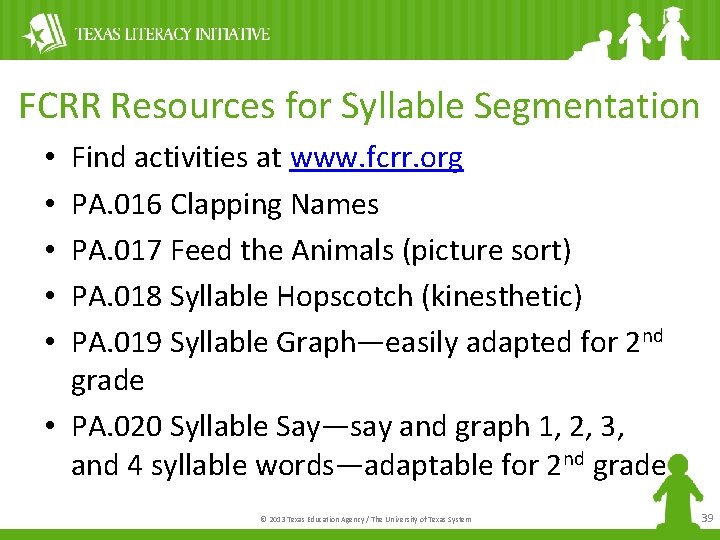
FCRR Resources for Syllable Segmentation Find activities at www. fcrr. org PA. 016 Clapping Names PA. 017 Feed the Animals (picture sort) PA. 018 Syllable Hopscotch (kinesthetic) PA. 019 Syllable Graph—easily adapted for 2 nd grade • PA. 020 Syllable Say—say and graph 1, 2, 3, and 4 syllable words—adaptable for 2 nd grade • • • © 2013 Texas Education Agency / The University of Texas System 39
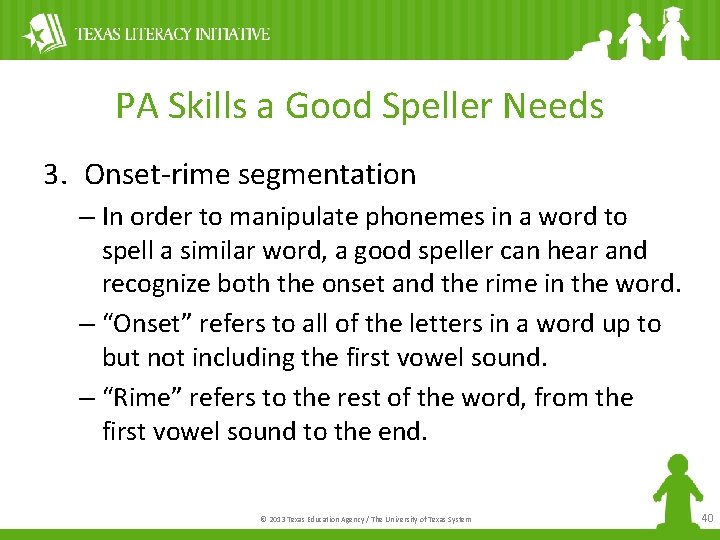
PA Skills a Good Speller Needs 3. Onset-rime segmentation – In order to manipulate phonemes in a word to spell a similar word, a good speller can hear and recognize both the onset and the rime in the word. – “Onset” refers to all of the letters in a word up to but not including the first vowel sound. – “Rime” refers to the rest of the word, from the first vowel sound to the end. © 2013 Texas Education Agency / The University of Texas System 40
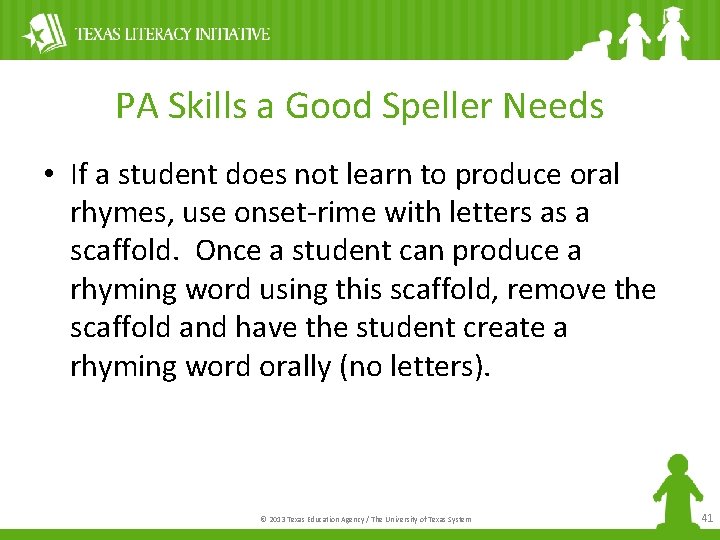
PA Skills a Good Speller Needs • If a student does not learn to produce oral rhymes, use onset-rime with letters as a scaffold. Once a student can produce a rhyming word using this scaffold, remove the scaffold and have the student create a rhyming word orally (no letters). © 2013 Texas Education Agency / The University of Texas System 41
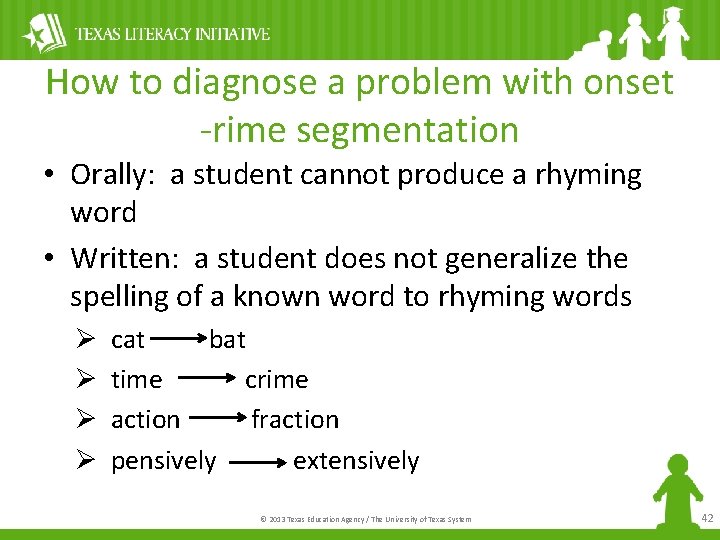
How to diagnose a problem with onset -rime segmentation • Orally: a student cannot produce a rhyming word • Written: a student does not generalize the spelling of a known word to rhyming words Ø Ø cat bat time crime action fraction pensively extensively © 2013 Texas Education Agency / The University of Texas System 42
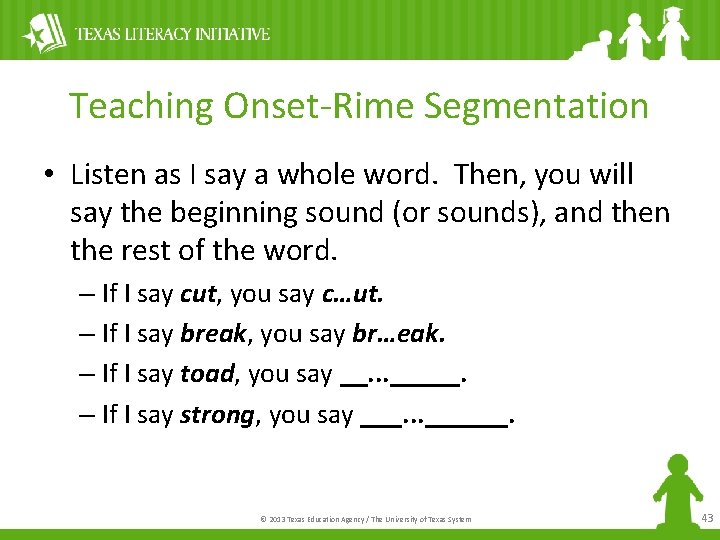
Teaching Onset-Rime Segmentation • Listen as I say a whole word. Then, you will say the beginning sound (or sounds), and then the rest of the word. – If I say cut, you say c…ut. – If I say break, you say br…eak. – If I say toad, you say __. . . _____. – If I say strong, you say ___. . . ______. © 2013 Texas Education Agency / The University of Texas System 43
TPRI Resources for Onset-Rime Segmentation • Find blackline masters at www. tpri. org. • PA-61: Onset-Rime Segmenting with Pictures If a student in any grade is having difficulty segmenting onset-rime, check to see whether that student has mastered blending onsets and rimes. If not, go back and work on blending first. © 2013 Texas Education Agency / The University of Texas System 44
FCRR Resources for Onset-Rime Segmentation • Find activities at www. fcrr. org • PA. 024: Guessing Game – It begins with /r/ and rhymes with bug. – It begins like “ran” and ends like “tug”. – It end with /ug/ and begins like robot. © 2013 Texas Education Agency / The University of Texas System 45
PA Skills a Good Speller Needs 5. Phoneme segmentation – f · ake – fl · ake – sh · ake – earth · qu · ake Why is this an important skill? © 2013 Texas Education Agency / The University of Texas System 46
© 2013 Texas Education Agency / The University of Texas System 47
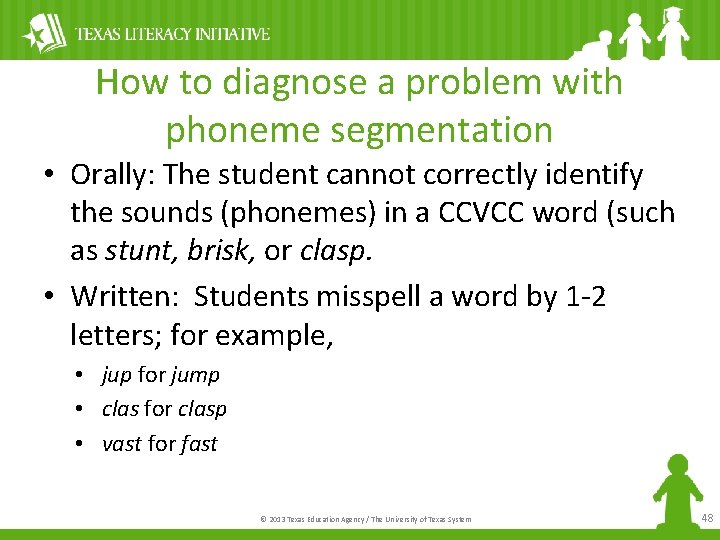
How to diagnose a problem with phoneme segmentation • Orally: The student cannot correctly identify the sounds (phonemes) in a CCVCC word (such as stunt, brisk, or clasp. • Written: Students misspell a word by 1 -2 letters; for example, • jup for jump • clas for clasp • vast for fast © 2013 Texas Education Agency / The University of Texas System 48
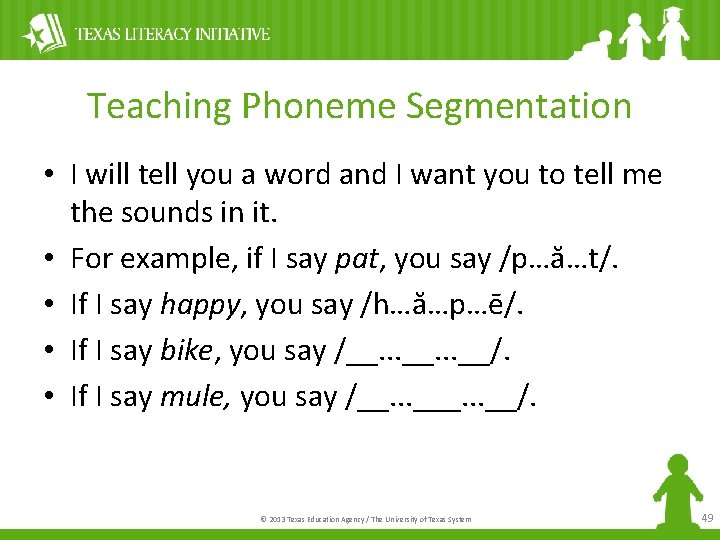
Teaching Phoneme Segmentation • I will tell you a word and I want you to tell me the sounds in it. • For example, if I say pat, you say /p…ă…t/. • If I say happy, you say /h…ă…p…ē/. • If I say bike, you say /__. . . __/. • If I say mule, you say /__. . . __/. © 2013 Texas Education Agency / The University of Texas System 49
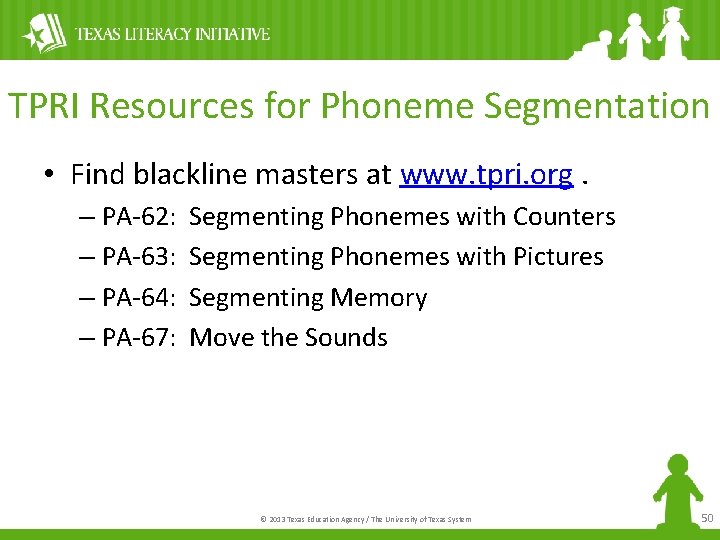
TPRI Resources for Phoneme Segmentation • Find blackline masters at www. tpri. org. – PA-62: – PA-63: – PA-64: – PA-67: Segmenting Phonemes with Counters Segmenting Phonemes with Pictures Segmenting Memory Move the Sounds © 2013 Texas Education Agency / The University of Texas System 50
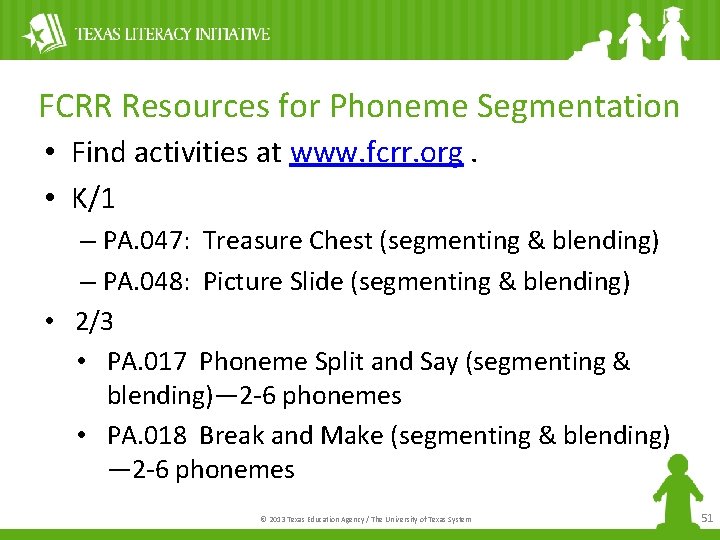
FCRR Resources for Phoneme Segmentation • Find activities at www. fcrr. org. • K/1 – PA. 047: Treasure Chest (segmenting & blending) – PA. 048: Picture Slide (segmenting & blending) • 2/3 • PA. 017 Phoneme Split and Say (segmenting & blending)— 2 -6 phonemes • PA. 018 Break and Make (segmenting & blending) — 2 -6 phonemes © 2013 Texas Education Agency / The University of Texas System 51
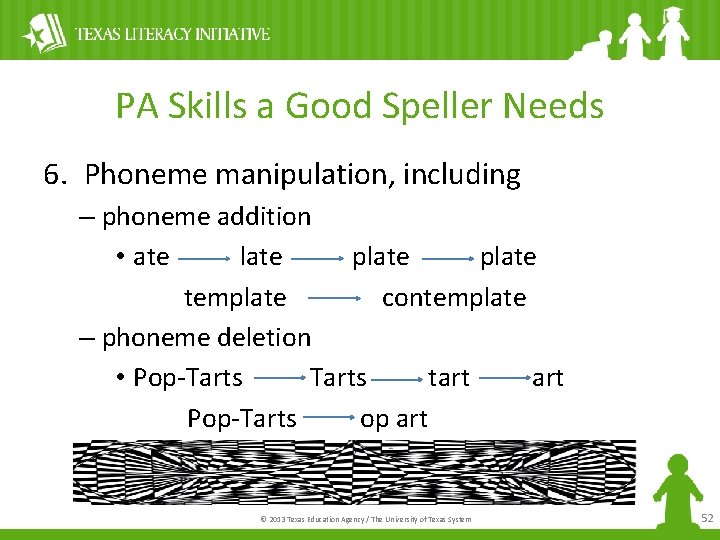
PA Skills a Good Speller Needs 6. Phoneme manipulation, including – phoneme addition • ate late plate template contemplate – phoneme deletion • Pop-Tarts tart Pop-Tarts op art © 2013 Texas Education Agency / The University of Texas System 52
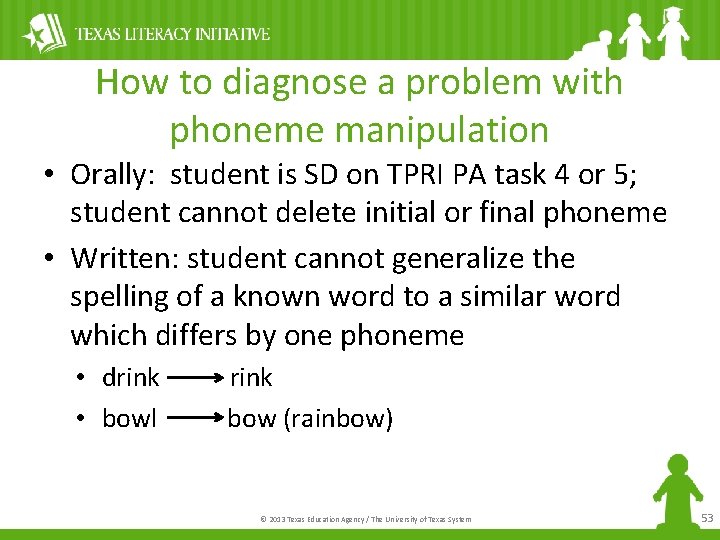
How to diagnose a problem with phoneme manipulation • Orally: student is SD on TPRI PA task 4 or 5; student cannot delete initial or final phoneme • Written: student cannot generalize the spelling of a known word to a similar word which differs by one phoneme • drink • bowl rink bow (rainbow) © 2013 Texas Education Agency / The University of Texas System 53
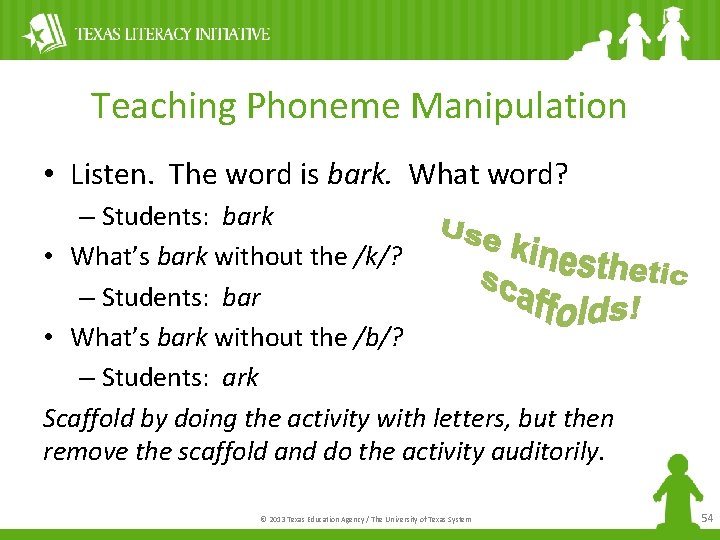
Teaching Phoneme Manipulation • Listen. The word is bark. What word? – Students: bark • What’s bark without the /k/? – Students: bar • What’s bark without the /b/? – Students: ark Scaffold by doing the activity with letters, but then remove the scaffold and do the activity auditorily. © 2013 Texas Education Agency / The University of Texas System 54
TPRI Resources for Phoneme Manipulation • Find blackline masters at www. tpri. org. – PA-56: Initial Sound Elision with Pictures – PA-58: Final Sound Elision with Pictures © 2013 Texas Education Agency / The University of Texas System 55
FCRR Resources for Phoneme Manipulation • Find activities at www. fcrr. org. • K/1 – PA. 049: Drop and Say – PA. 050: Name Changes (may be done on CD rather than cassette tape) • 2/3 – PA. 019: What’s Left? © 2013 Texas Education Agency / The University of Texas System 56
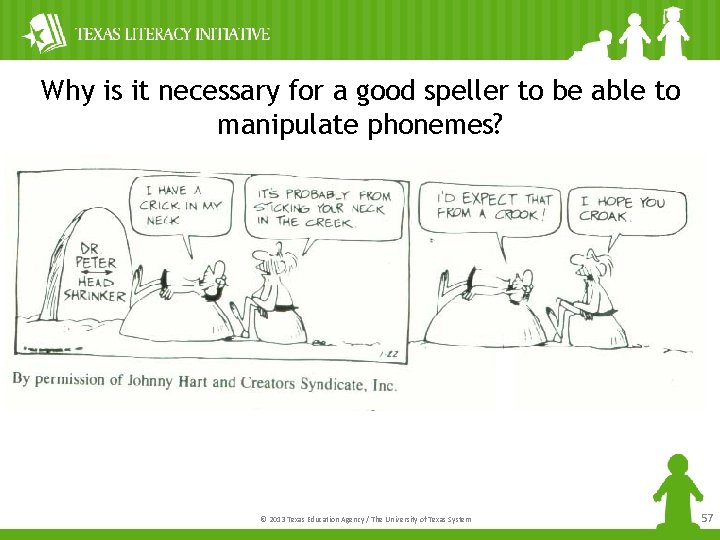
Why is it necessary for a good speller to be able to manipulate phonemes? s l k h s © 2013 Texas Education Agency / The University of Texas System 57
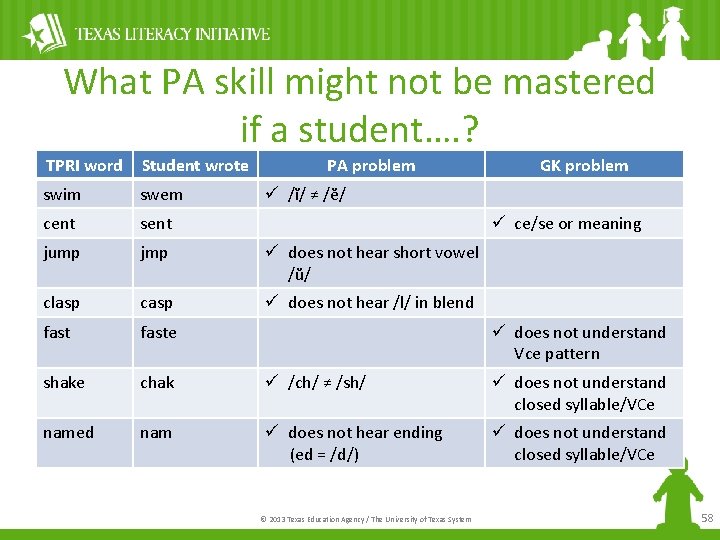
What PA skill might not be mastered if a student…. ? TPRI word Student wrote PA problem GK problem swim swem cent sent jump jmp ü does not hear short vowel /ŭ/ clasp casp ü does not hear /l/ in blend faste shake chak ü /ch/ ≠ /sh/ ü does not understand closed syllable/VCe named nam ü does not hear ending (ed = /d/) ü does not understand closed syllable/VCe ü /ĭ/ ≠ /ĕ/ ü ce/se or meaning ü does not understand Vce pattern © 2013 Texas Education Agency / The University of Texas System 58
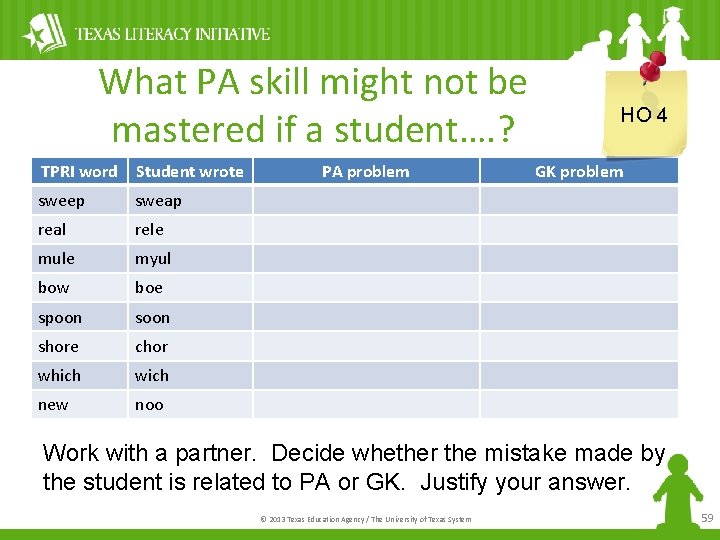
What PA skill might not be mastered if a student…. ? TPRI word Student wrote sweep sweap real rele mule myul bow boe spoon shore chor which wich new noo PA problem HO 4 GK problem Work with a partner. Decide whether the mistake made by the student is related to PA or GK. Justify your answer. © 2013 Texas Education Agency / The University of Texas System 59
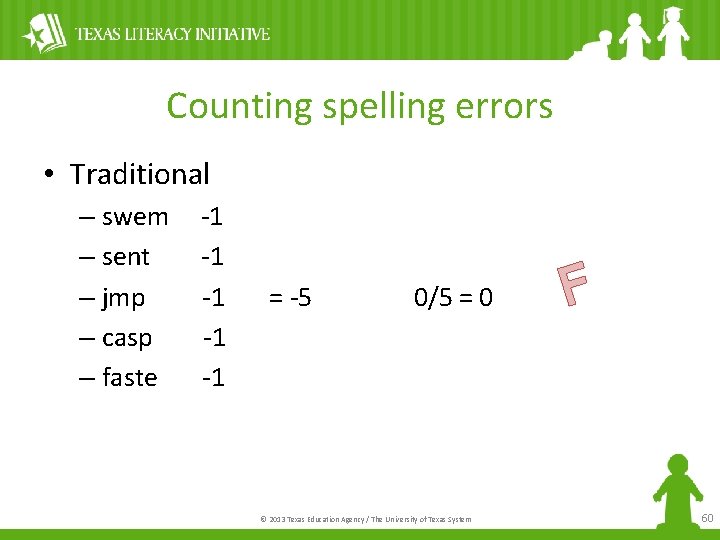
Counting spelling errors • Traditional – swem – sent – jmp – casp – faste -1 -1 -1 = -5 0/5 = 0 © 2013 Texas Education Agency / The University of Texas System F 60
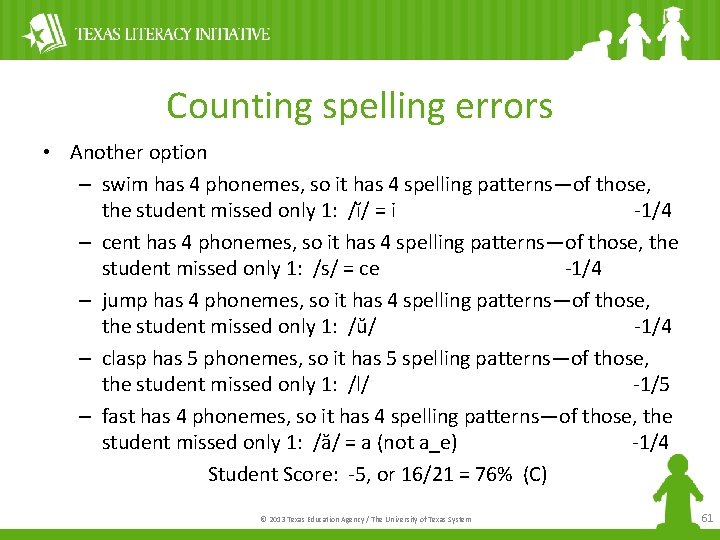
Counting spelling errors • Another option – swim has 4 phonemes, so it has 4 spelling patterns—of those, the student missed only 1: /ĭ/ = i -1/4 – cent has 4 phonemes, so it has 4 spelling patterns—of those, the student missed only 1: /s/ = ce -1/4 – jump has 4 phonemes, so it has 4 spelling patterns—of those, the student missed only 1: /ŭ/ -1/4 – clasp has 5 phonemes, so it has 5 spelling patterns—of those, the student missed only 1: /l/ -1/5 – fast has 4 phonemes, so it has 4 spelling patterns—of those, the student missed only 1: /ă/ = a (not a_e) -1/4 Student Score: -5, or 16/21 = 76% (C) © 2013 Texas Education Agency / The University of Texas System 61
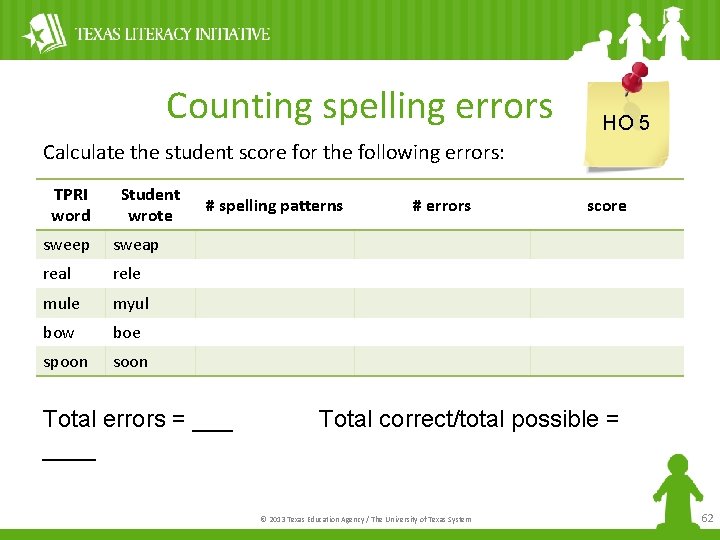
Counting spelling errors HO 5 Calculate the student score for the following errors: TPRI word Student wrote sweep sweap real rele mule myul bow boe spoon soon # spelling patterns Total errors = ____ # errors score Total correct/total possible = © 2013 Texas Education Agency / The University of Texas System 62
Discuss as a school/grade-level team HO 6 • Of the ideas discussed today, which do we want to apply to spelling instruction on our campus? • Using ONE of the ideas, plan for how this will be rolled out on your campus. Will additional training be needed? What is the proposed timetable for implementation? © 2013 Texas Education Agency / The University of Texas System 63
References Moats, Louisa Cook (2010). Speech to Print: Language Essentials for Teachers. Baltimore: Brookes Publishing Co. Graphophonemic Knowledge: Routines and Teaching Tools. Children’s Learning Institute, UT Houston (2008). PA…All Day! Children’s Learning Institute, UT Houston (2009). © 2013 Texas Education Agency / The University of Texas System 64
© 2013 Texas Education Agency / The University of Texas System 65