Genetics The Science of Heredity Pages 295 337


- Slides: 30
Genetics: The Science of Heredity Pages 295 -337
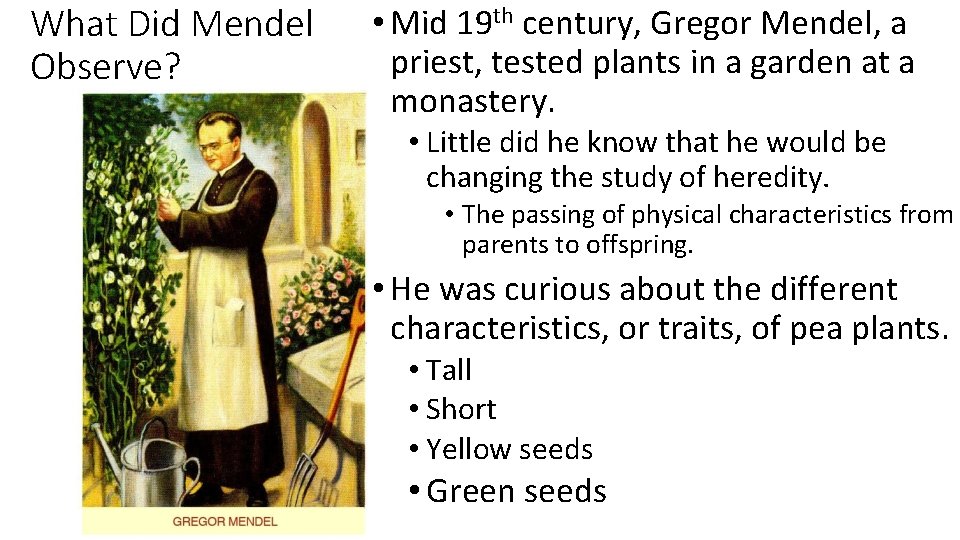
What Did Mendel Observe? • Mid 19 th century, Gregor Mendel, a priest, tested plants in a garden at a monastery. • Little did he know that he would be changing the study of heredity. • The passing of physical characteristics from parents to offspring. • He was curious about the different characteristics, or traits, of pea plants. • Tall • Short • Yellow seeds • Green seeds
• He observed that plants were similar to their parents. • He is considered the FATHER of GENETICS! • Remember, the process by which the egg and the sperm cell join is called fertilization. • Before this can occur the pollen must reach the pistil of the pea plant: pollination. • Pea plants self-pollinate (pollen lands on he pistil of the same plant). • Mendel cross-pollinated these plants by taking pollen from one plant and placing it on another. • He crossed plants with different characteristics.
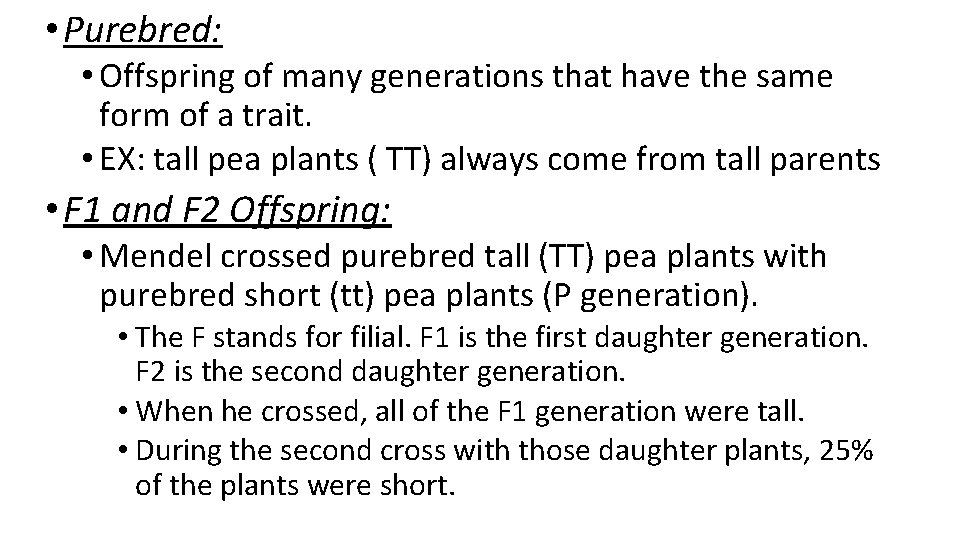
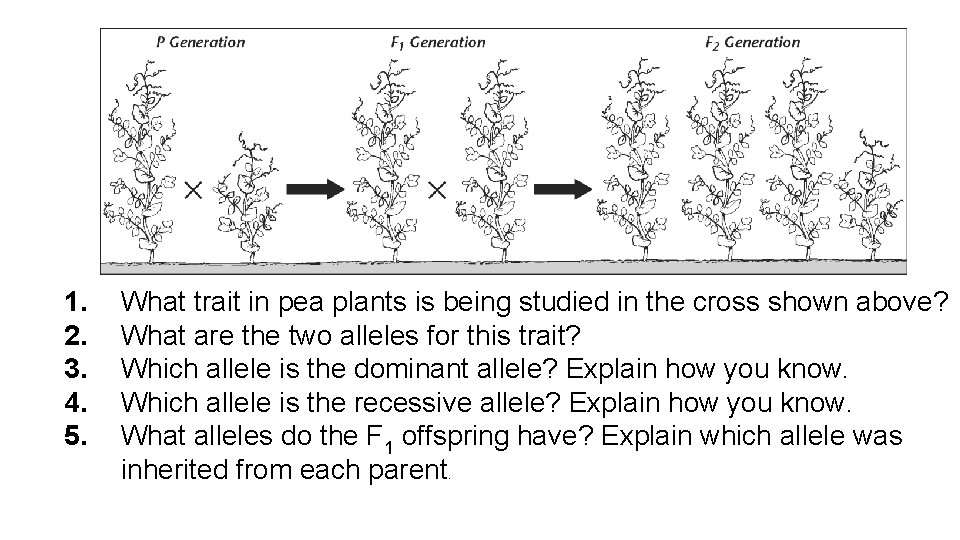
• Purebred: • Offspring of many generations that have the same form of a trait. • EX: tall pea plants ( TT) always come from tall parents • F 1 and F 2 Offspring: • Mendel crossed purebred tall (TT) pea plants with purebred short (tt) pea plants (P generation). • The F stands for filial. F 1 is the first daughter generation. F 2 is the second daughter generation. • When he crossed, all of the F 1 generation were tall. • During the second cross with those daughter plants, 25% of the plants were short.
• Experiments with Other Traits: • In all of his crosses, Mendel found that only one form of the trait appeared in the F 1 generation. • However, in the F 2 generation, the “lost” form of the trait always reappeared in about ¼ of the plants.
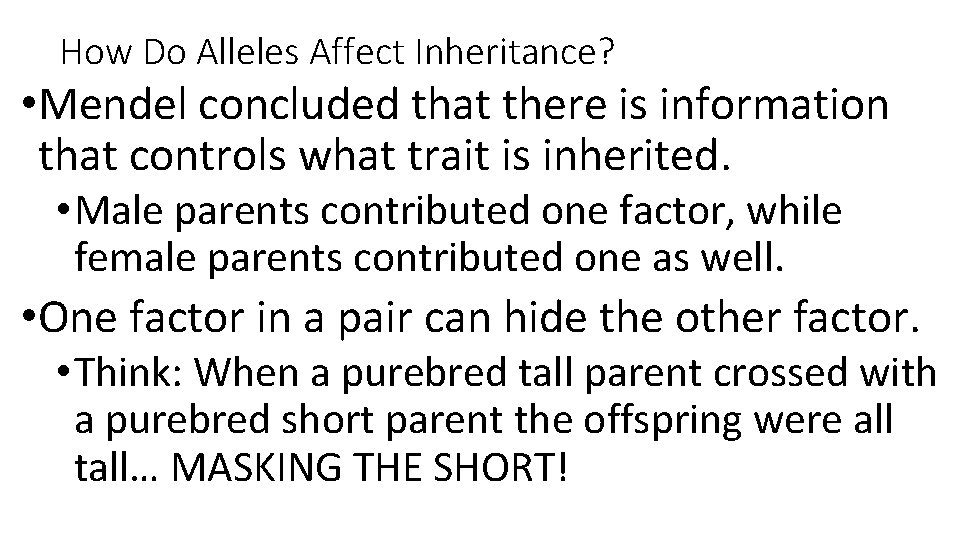
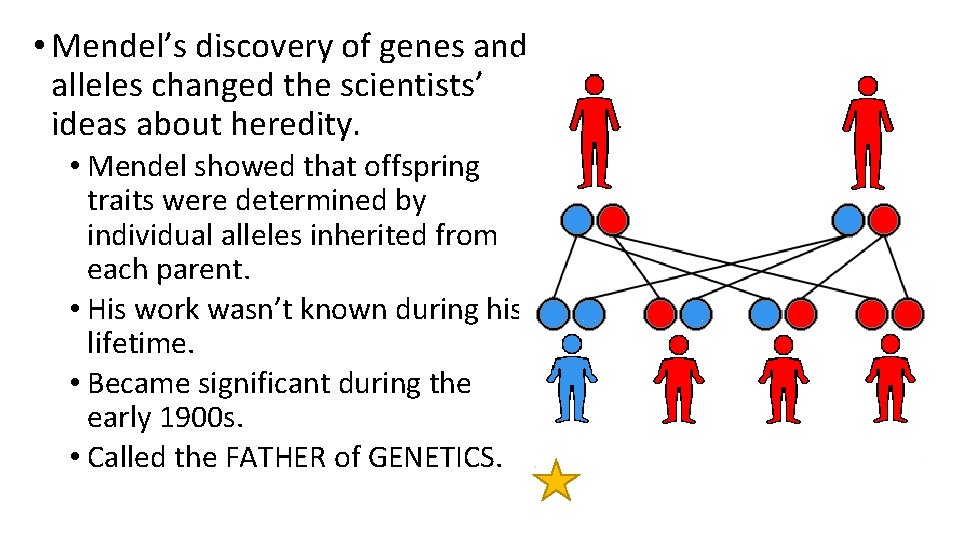
How Do Alleles Affect Inheritance? • Mendel concluded that there is information that controls what trait is inherited. • Male parents contributed one factor, while female parents contributed one as well. • One factor in a pair can hide the other factor. • Think: When a purebred tall parent crossed with a purebred short parent the offspring were all tall… MASKING THE SHORT!
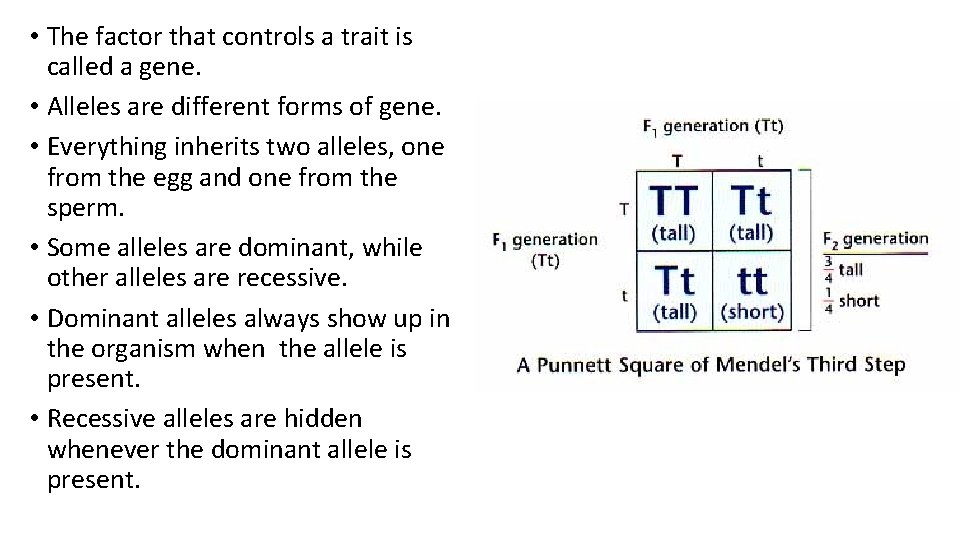
• The factor that controls a trait is called a gene. • Alleles are different forms of gene. • Everything inherits two alleles, one from the egg and one from the sperm. • Some alleles are dominant, while other alleles are recessive. • Dominant alleles always show up in the organism when the allele is present. • Recessive alleles are hidden whenever the dominant allele is present.
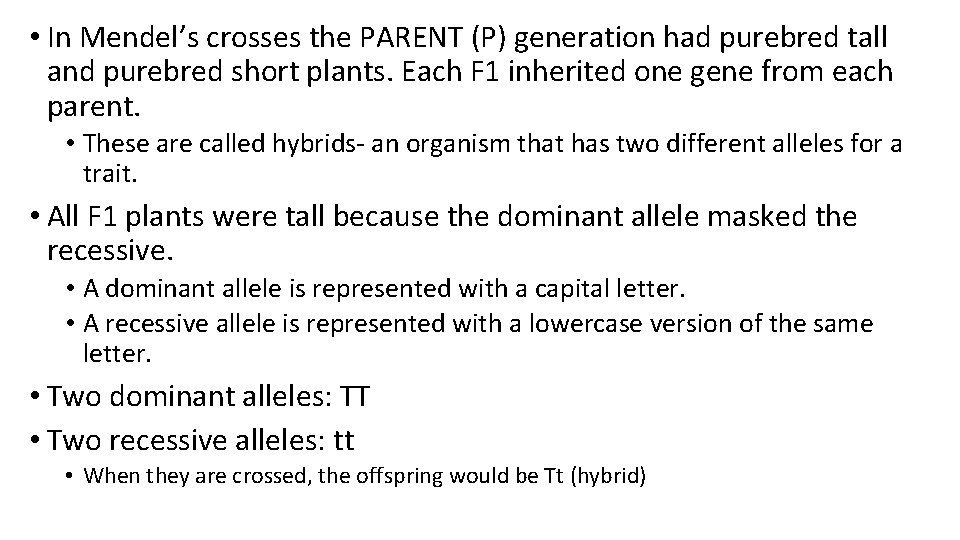
• In Mendel’s crosses the PARENT (P) generation had purebred tall and purebred short plants. Each F 1 inherited one gene from each parent. • These are called hybrids- an organism that has two different alleles for a trait. • All F 1 plants were tall because the dominant allele masked the recessive. • A dominant allele is represented with a capital letter. • A recessive allele is represented with a lowercase version of the same letter. • Two dominant alleles: TT • Two recessive alleles: tt • When they are crossed, the offspring would be Tt (hybrid)
• Mendel’s discovery of genes and alleles changed the scientists’ ideas about heredity. • Mendel showed that offspring traits were determined by individual alleles inherited from each parent. • His work wasn’t known during his lifetime. • Became significant during the early 1900 s. • Called the FATHER of GENETICS.
1. 2. 3. 4. 5. What trait in pea plants is being studied in the cross shown above? What are the two alleles for this trait? Which allele is the dominant allele? Explain how you know. Which allele is the recessive allele? Explain how you know. What alleles do the F 1 offspring have? Explain which allele was inherited from each parent.
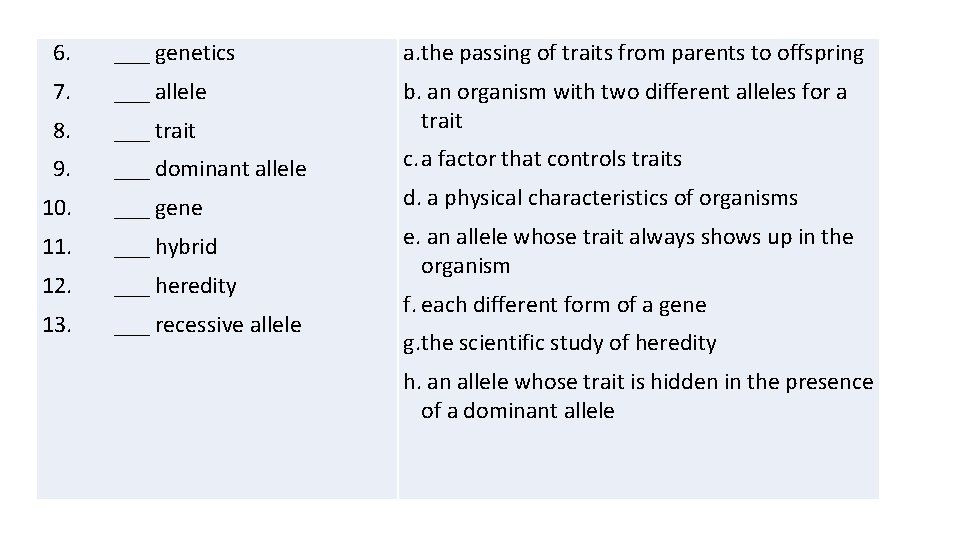
6. ___ genetics a. the passing of traits from parents to offspring 7. ___ allele 8. ___ trait b. an organism with two different alleles for a trait 9. ___ dominant allele 10. ___ gene 11. ___ hybrid 12. ___ heredity 13. ___ recessive allele c. a factor that controls traits d. a physical characteristics of organisms e. an allele whose trait always shows up in the organism f. each different form of a gene g. the scientific study of heredity h. an allele whose trait is hidden in the presence of a dominant allele
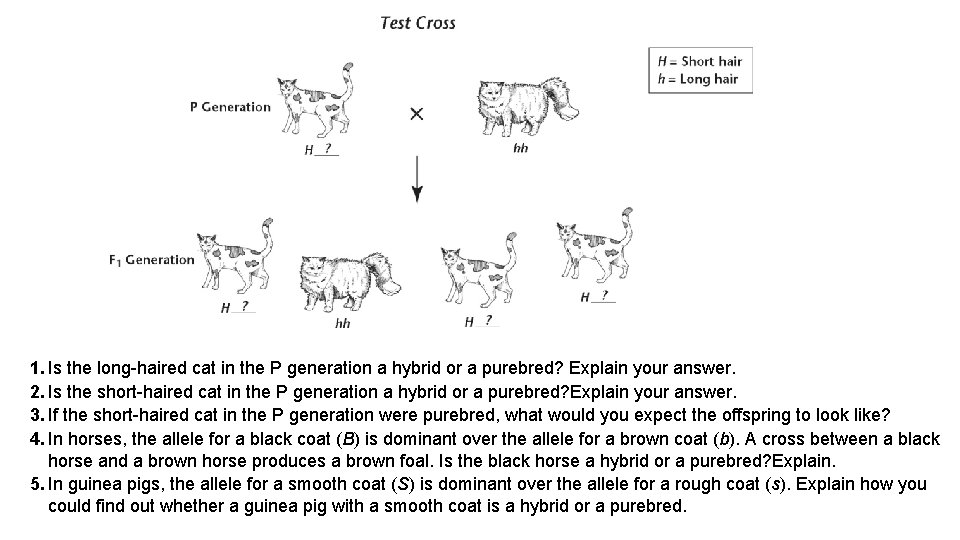
1. Is the long-haired cat in the P generation a hybrid or a purebred? Explain your answer. 2. Is the short-haired cat in the P generation a hybrid or a purebred? Explain your answer. 3. If the short-haired cat in the P generation were purebred, what would you expect the offspring to look like? 4. In horses, the allele for a black coat (B) is dominant over the allele for a brown coat (b). A cross between a black horse and a brown horse produces a brown foal. Is the black horse a hybrid or a purebred? Explain. 5. In guinea pigs, the allele for a smooth coat (S) is dominant over the allele for a rough coat (s). Explain how you could find out whether a guinea pig with a smooth coat is a hybrid or a purebred.
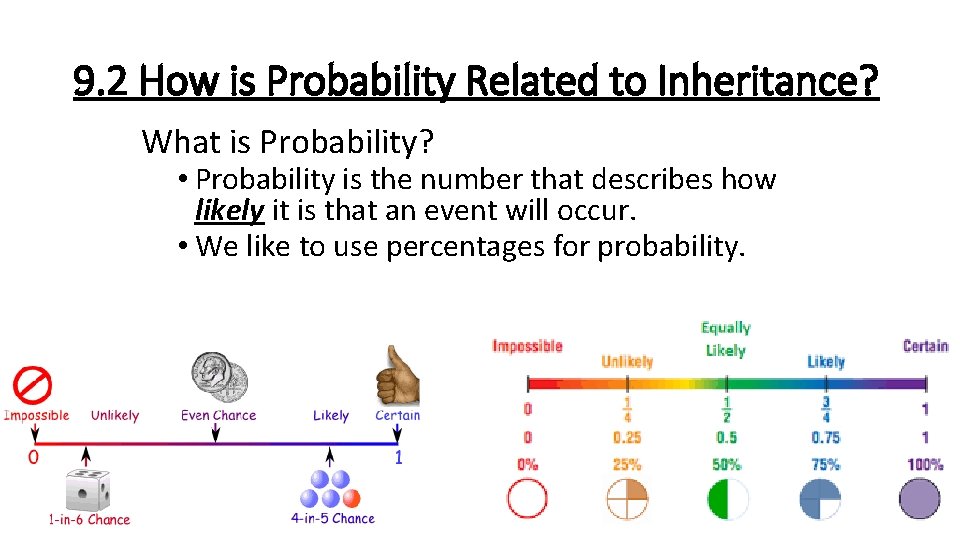
9. 2 How is Probability Related to Inheritance? What is Probability? • Probability is the number that describes how likely it is that an event will occur. • We like to use percentages for probability.
Probability and Genetics? • Mendel counted every offspring for every cross. • Each time he repeated the cross, he observed similar results. • He was the first scientists to recognize that probability can predict the results of genetic crosses. • A Punnett Square ( P. Square) is a chart that shows all the possible ways alleles can combine in a genetic cross • In a genetic cross the combination of alleles that parents can pass to an offspring is based on probability.
Relating Punnett Squares to Mendel • Mendel didn’t know about P. Squares • But the P. Squares show us data for what he saw.
What are Phenotype and Genotype? • An organism’s phenotype is its physical appearance, or visible traits. • An organism’s genotype is its genetic makeup, or alleles. • Plants with at least one dominant allele will have the same phenotype (example: DD and Dd)
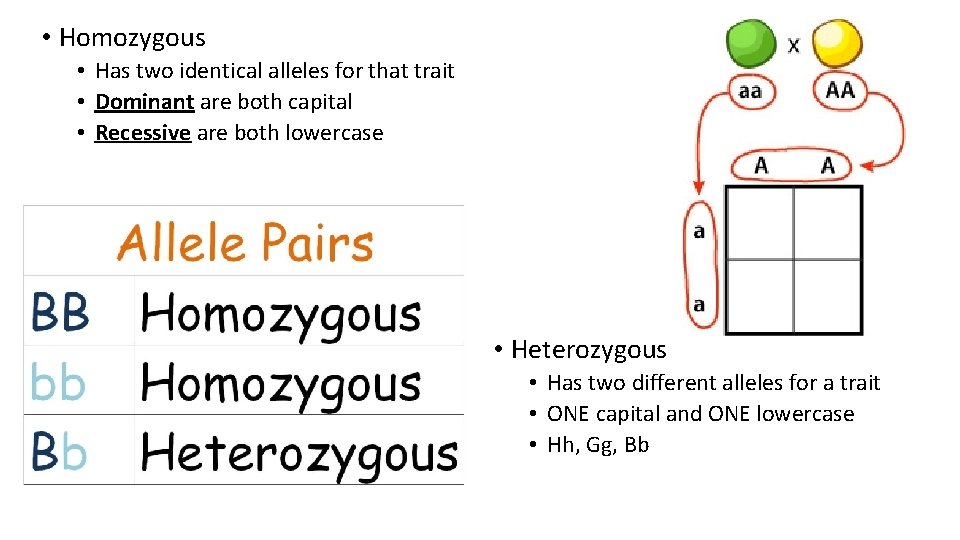
• Homozygous • Has two identical alleles for that trait • Dominant are both capital • Recessive are both lowercase • Heterozygous • Has two different alleles for a trait • ONE capital and ONE lowercase • Hh, Gg, Bb
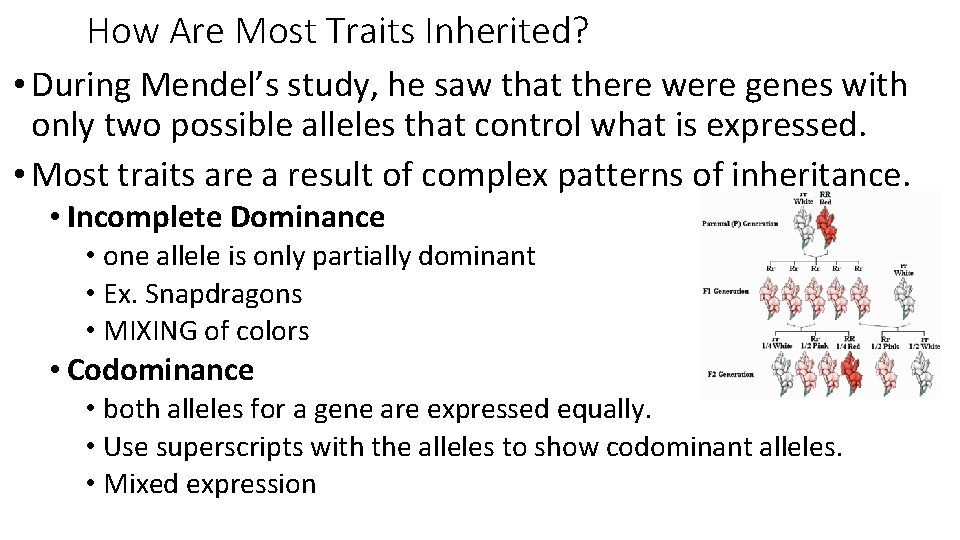
How Are Most Traits Inherited? • During Mendel’s study, he saw that there were genes with only two possible alleles that control what is expressed. • Most traits are a result of complex patterns of inheritance. • Incomplete Dominance • one allele is only partially dominant • Ex. Snapdragons • MIXING of colors • Codominance • both alleles for a gene are expressed equally. • Use superscripts with the alleles to show codominant alleles. • Mixed expression
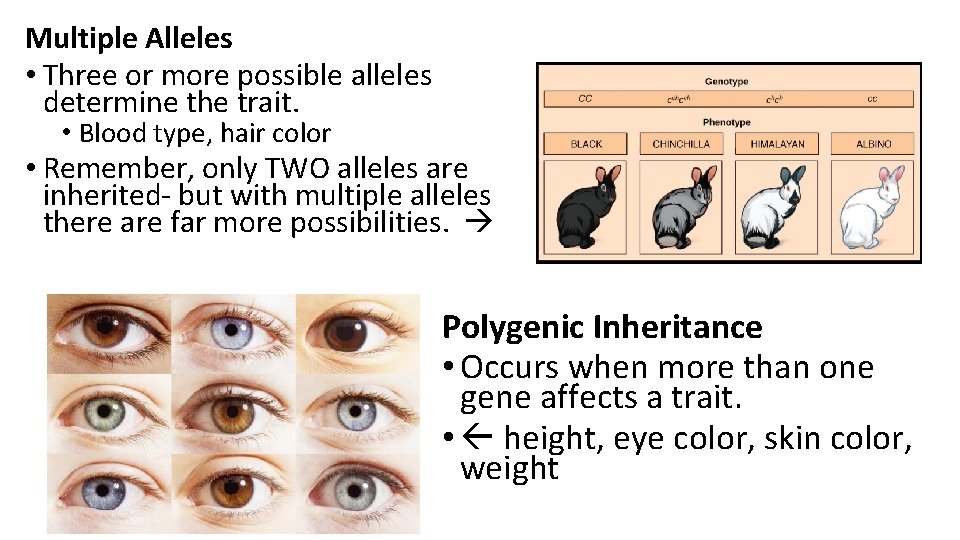
Multiple Alleles • Three or more possible alleles determine the trait. • Blood type, hair color • Remember, only TWO alleles are inherited- but with multiple alleles there are far more possibilities. Polygenic Inheritance • Occurs when more than one gene affects a trait. • height, eye color, skin color, weight
How Do Genes and the Environment Interact? Inherited 1. Traits passed on to offspring. a. Height b. Body/skin color c. Freckles d. Eye color Acquired 1. Traits that are not passed on to offspring; LEARNED/ CHANGED a. Dyed hair color b. Musical talent c. Language d. Hedge shape e. REMEMBER: second generation professional athletes learn their skills from their TALENTED parents
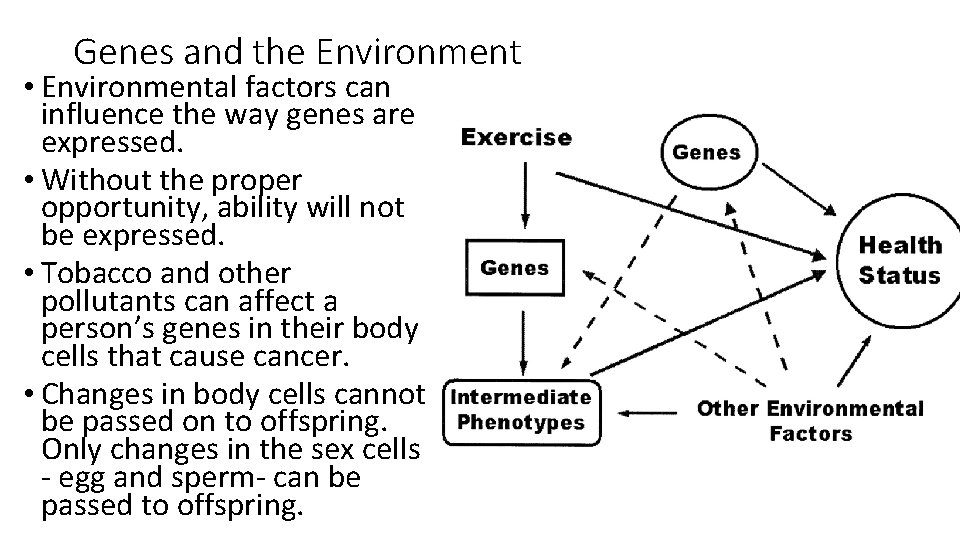
Genes and the Environment • Environmental factors can influence the way genes are expressed. • Without the proper opportunity, ability will not be expressed. • Tobacco and other pollutants can affect a person’s genes in their body cells that cause cancer. • Changes in body cells cannot be passed on to offspring. Only changes in the sex cells - egg and sperm- can be passed to offspring.
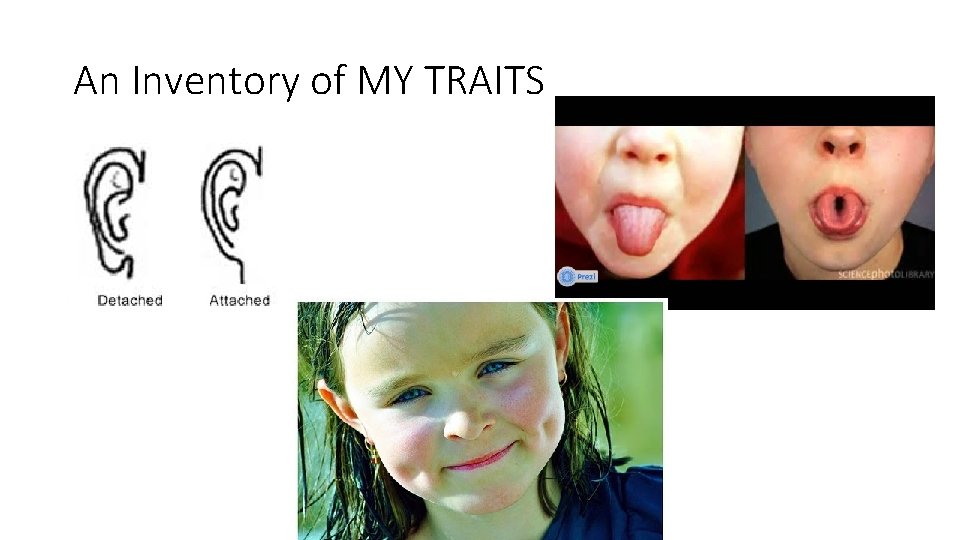
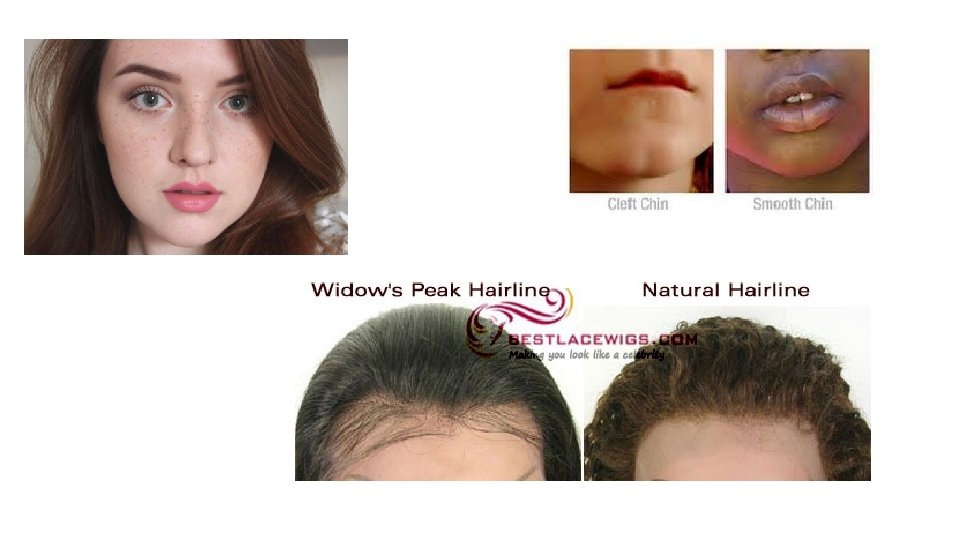
An Inventory of MY TRAITS
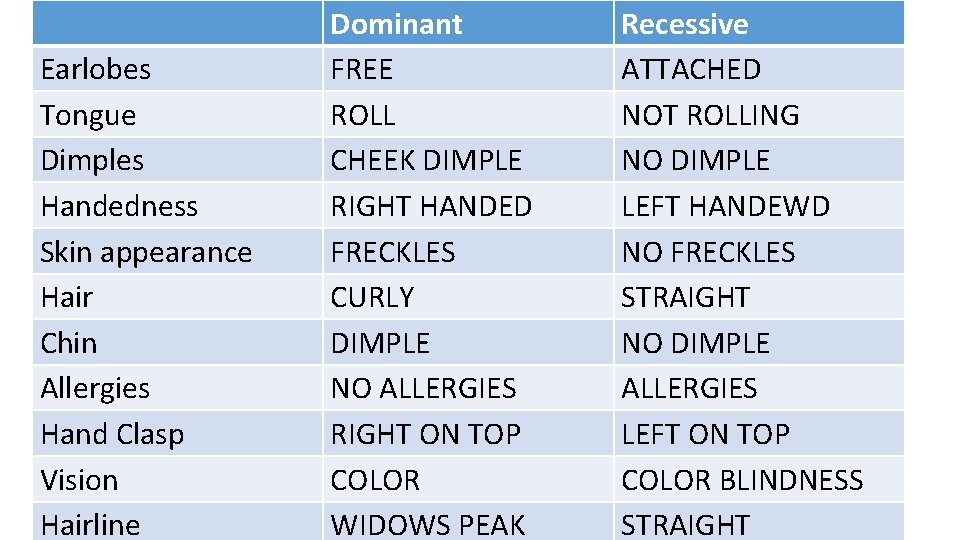
Earlobes Tongue Dimples Handedness Skin appearance Hair Chin Allergies Hand Clasp Vision Hairline Dominant FREE ROLL CHEEK DIMPLE RIGHT HANDED FRECKLES CURLY DIMPLE NO ALLERGIES RIGHT ON TOP COLOR WIDOWS PEAK Recessive ATTACHED NOT ROLLING NO DIMPLE LEFT HANDEWD NO FRECKLES STRAIGHT NO DIMPLE ALLERGIES LEFT ON TOP COLOR BLINDNESS STRAIGHT
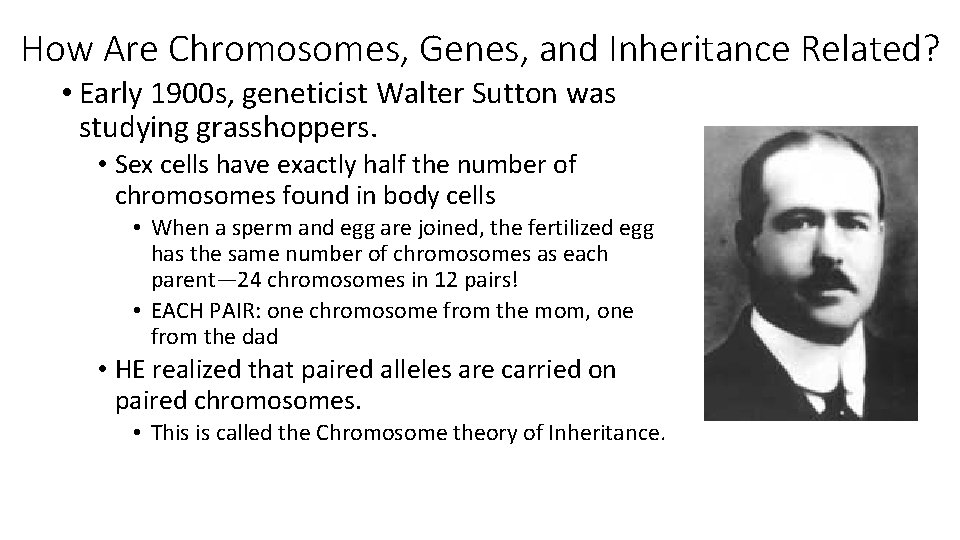
How Are Chromosomes, Genes, and Inheritance Related? • Early 1900 s, geneticist Walter Sutton was studying grasshoppers. • Sex cells have exactly half the number of chromosomes found in body cells • When a sperm and egg are joined, the fertilized egg has the same number of chromosomes as each parent— 24 chromosomes in 12 pairs! • EACH PAIR: one chromosome from the mom, one from the dad • HE realized that paired alleles are carried on paired chromosomes. • This is called the Chromosome theory of Inheritance.
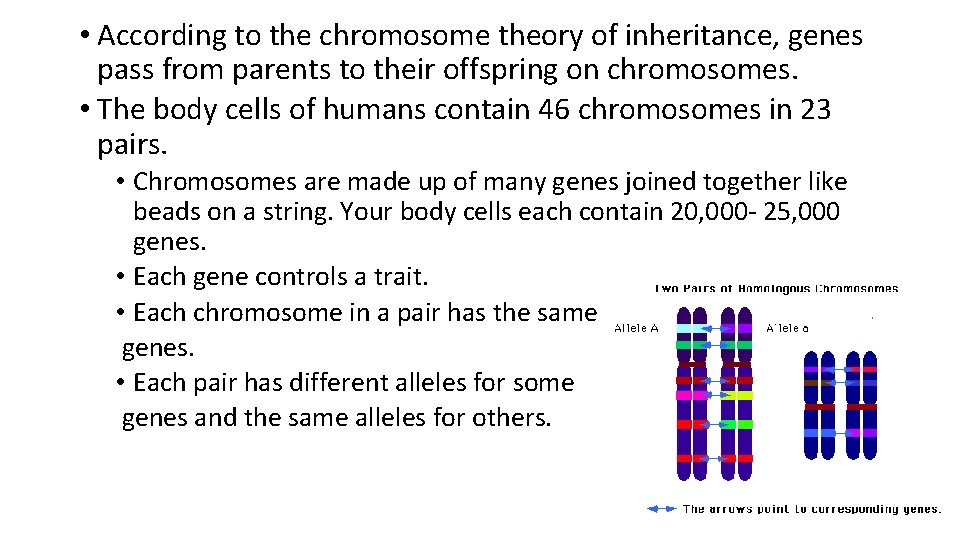
• According to the chromosome theory of inheritance, genes pass from parents to their offspring on chromosomes. • The body cells of humans contain 46 chromosomes in 23 pairs. • Chromosomes are made up of many genes joined together like beads on a string. Your body cells each contain 20, 000 - 25, 000 genes. • Each gene controls a trait. • Each chromosome in a pair has the same genes. • Each pair has different alleles for some genes and the same alleles for others.
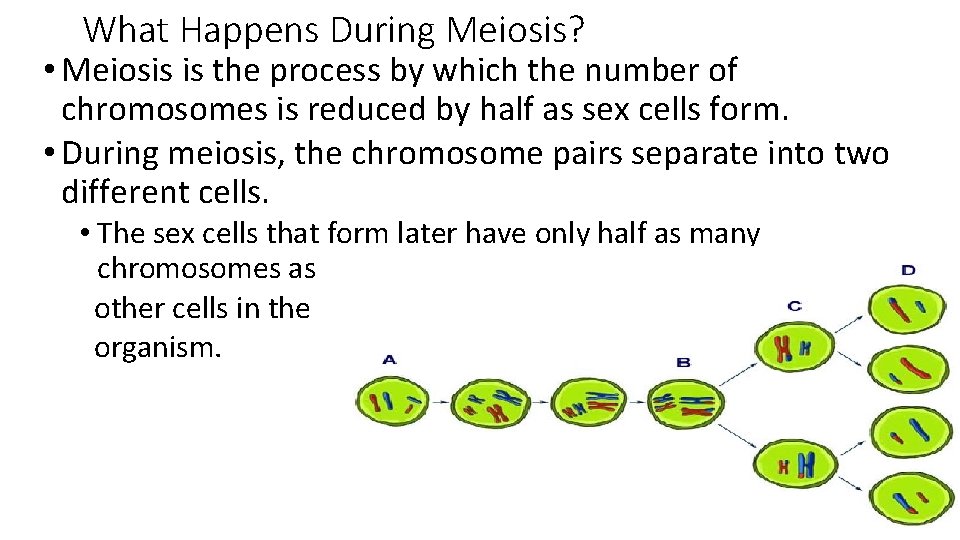
What Happens During Meiosis? • Meiosis is the process by which the number of chromosomes is reduced by half as sex cells form. • During meiosis, the chromosome pairs separate into two different cells. • The sex cells that form later have only half as many chromosomes as other cells in the organism.
• Before meiosis, every chromosome in the parent cell is copied. Centromeres hold the two chromatids together. 1. The chromosome pairs line up in the center of the cell. 2. The pairs separate and move to opposite ends of the cell. 3. Two cells form, each with half the original number of chromosomes. Each chromosome is still made up of two chromatids. 4. Then in each cell, the chromosomes move to the center, the centromeres split, and the chromatids separate. 5. They become single chromosomes and move to opposite ends of the cell. 6. After meiosis, four sex cells are produced. Each cell has half the number of chromosomes of the parent cell—only one chromosome form an original pair. • When two sex cells join at fertilization, the new cell that forms has the full number of chromosomes.
How Do Sexual and Asexual Reproduction Compare? • DNA transfer through sexual reproduction requiring meiosis and asexual reproduction requiring mitosis equip organisms in different ways for survival • Both processes of reproduction offer survival advantages and disadvantages. • In asexual reproduction, one parent can quickly produce many identicaloffspring. • Sexual reproduction has the advantage of producing offspring with new combinations of DNA (genes). • These offspring may have characteristics that help them survive under unfavorable conditions.