General Chemistry Principles and Modern Applications Petrucci Harwood
- Slides: 23
General Chemistry Principles and Modern Applications Petrucci • Harwood • Herring 8 th Edition Chapter 12: Chemical Bonding II: Additional Aspects Philip Dutton University of Windsor, Canada N 9 B 3 P 4 Prentice-Hall © 2002 (modified 2003 by Dr. Paul Root and 2005 by Dr. David Tramontozzi) Prentice-Hall © 2002 General Chemistry: Chapter 12
Contents 12 -1 12 -2 12 -3 12 -4 12 -5 12 -6 12 -7 Prentice-Hall © 2002 What a Bonding Theory Should Do Introduction to the Valence-Bond Method Hybridization of Atomic Orbitals Multiple Covalent Bonds Molecular Orbital Theory Delocalized Electrons: Bonding in the Benzene Molecule Bonding in Metals Focus on Photoelectron Spectroscopy General Chemistry: Chapter 12 2
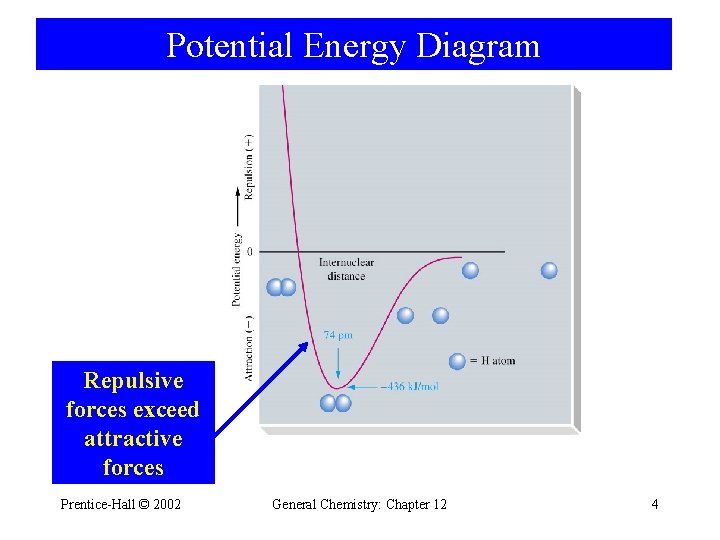
12 -1 What a Bonding Theory Should Do • Bring atoms together from a distance. – e- are attracted to both nuclei. – e- are repelled by each other. – Nuclei are repelled by each other. • Plot the total potential energy verses distance. – -ve energies correspond to net attractive forces. – +ve energies correspond to net repulsive forces. • A bonding theory should help us understand why. – Lewis theory: ease of application. – VSEPR theory: propose molecular shapes. – Quantitative limitations (bond energies, bond lengths) Prentice-Hall © 2002 General Chemistry: Chapter 12 3
Potential Energy Diagram Repulsive forces exceed attractive forces Prentice-Hall © 2002 General Chemistry: Chapter 12 4
12 -2 Introduction to the Valence-Bond Method • Atomic orbital overlap describes covalent bonding. • Area of overlap of orbitals is in phase. • A localized model of bonding. – Core electrons and lone-pair electrons retain orbital location. – Charge density of the bonding electrons is concentrated in the region of orbital overlap. Prentice-Hall © 2002 General Chemistry: Chapter 12 5
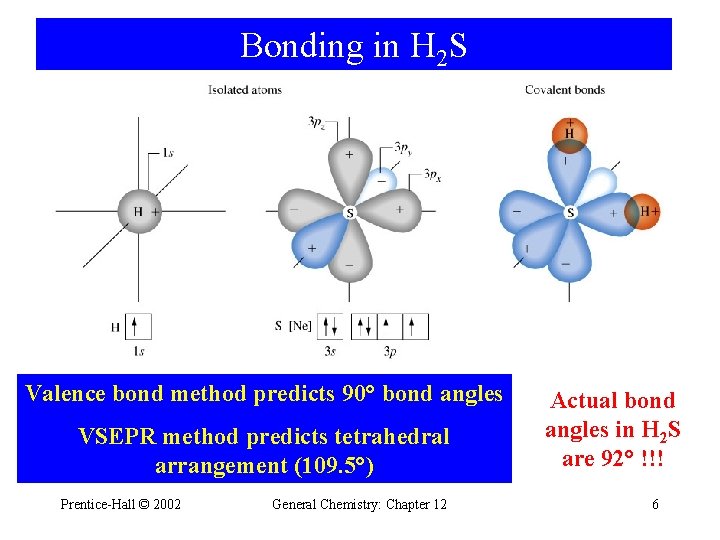
Bonding in H 2 S Valence bond method predicts 90° bond angles VSEPR method predicts tetrahedral arrangement (109. 5°) Prentice-Hall © 2002 General Chemistry: Chapter 12 Actual bond angles in H 2 S are 92° !!! 6
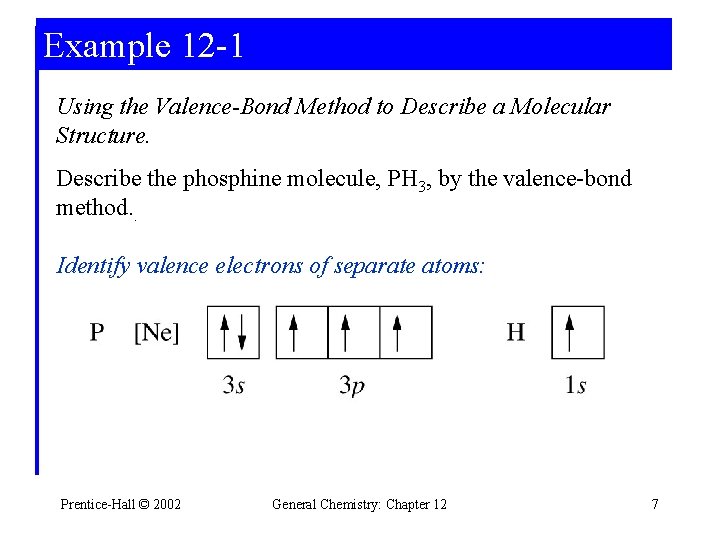
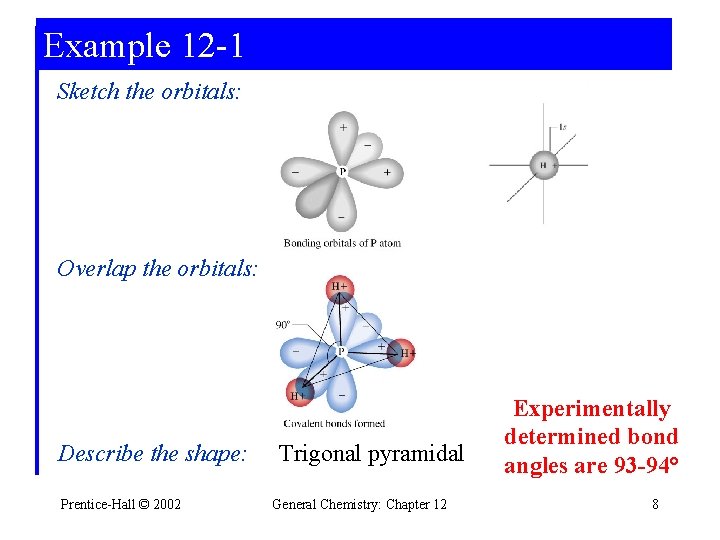
Example 12 -1 Using the Valence-Bond Method to Describe a Molecular Structure. Describe the phosphine molecule, PH 3, by the valence-bond method. . Identify valence electrons of separate atoms: Prentice-Hall © 2002 General Chemistry: Chapter 12 7
Example 12 -1 Sketch the orbitals: Overlap the orbitals: Describe the shape: Prentice-Hall © 2002 Trigonal pyramidal General Chemistry: Chapter 12 Experimentally determined bond angles are 93 -94° 8
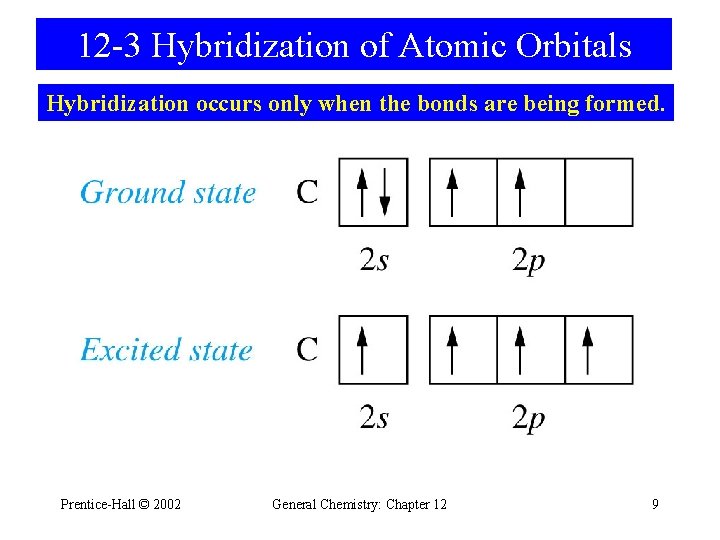
12 -3 Hybridization of Atomic Orbitals Hybridization occurs only when the bonds are being formed. Prentice-Hall © 2002 General Chemistry: Chapter 12 9
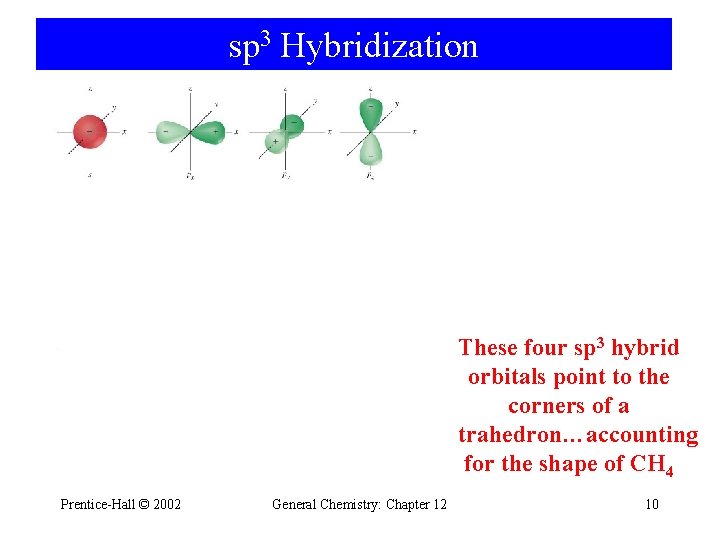
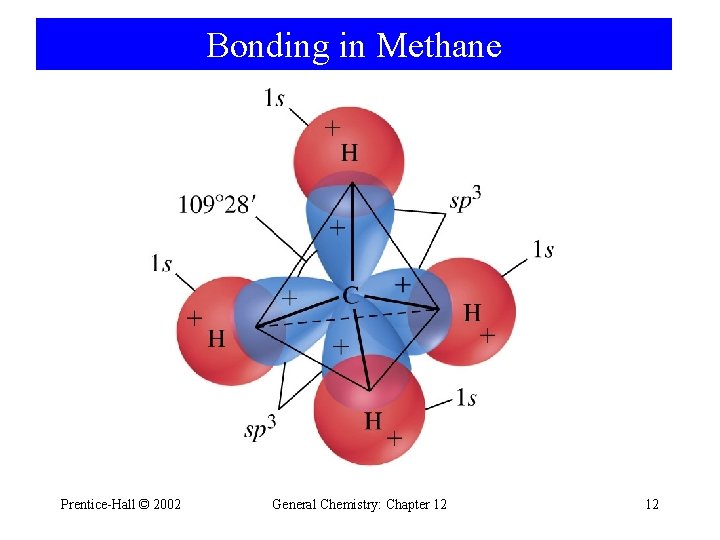
sp 3 Hybridization Combine to generate four equivalent sp 3 orbitals Which are represented as the set Prentice-Hall © 2002 These four sp 3 hybrid orbitals point to the corners of a tetrahedron…accounting for the shape of CH 4 General Chemistry: Chapter 12 10
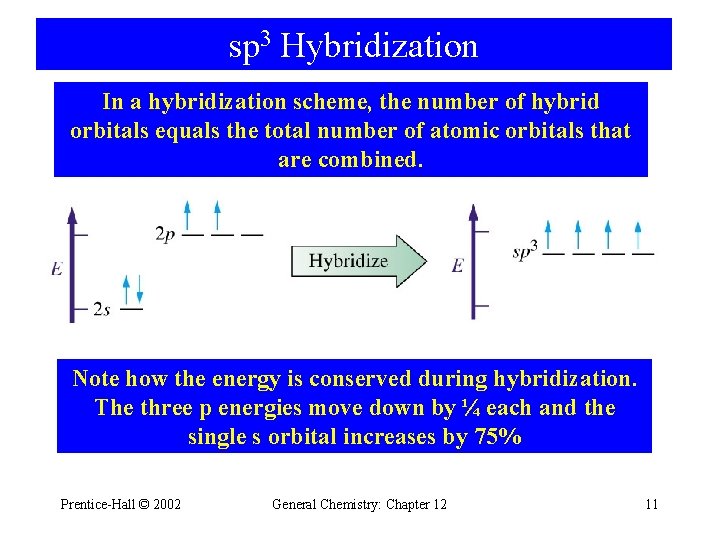
sp 3 Hybridization In a hybridization scheme, the number of hybrid orbitals equals the total number of atomic orbitals that are combined. Note how the energy is conserved during hybridization. The three p energies move down by ¼ each and the single s orbital increases by 75% Prentice-Hall © 2002 General Chemistry: Chapter 12 11
Bonding in Methane Prentice-Hall © 2002 General Chemistry: Chapter 12 12
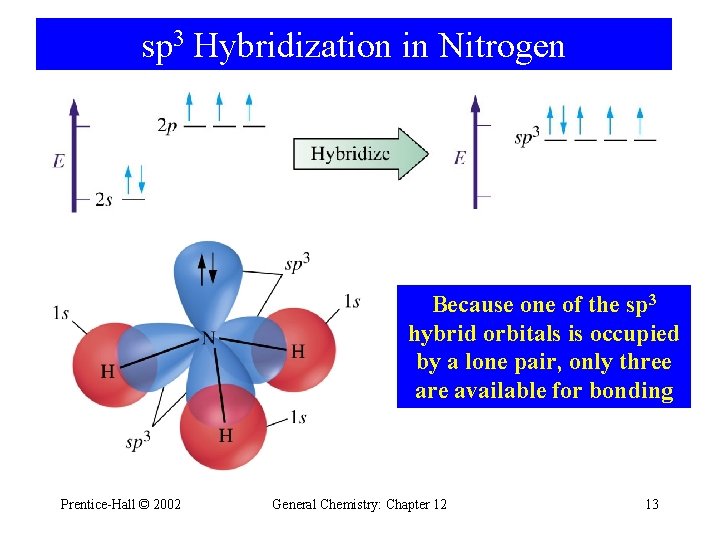
sp 3 Hybridization in Nitrogen Because one of the sp 3 hybrid orbitals is occupied by a lone pair, only three are available for bonding Prentice-Hall © 2002 General Chemistry: Chapter 12 13
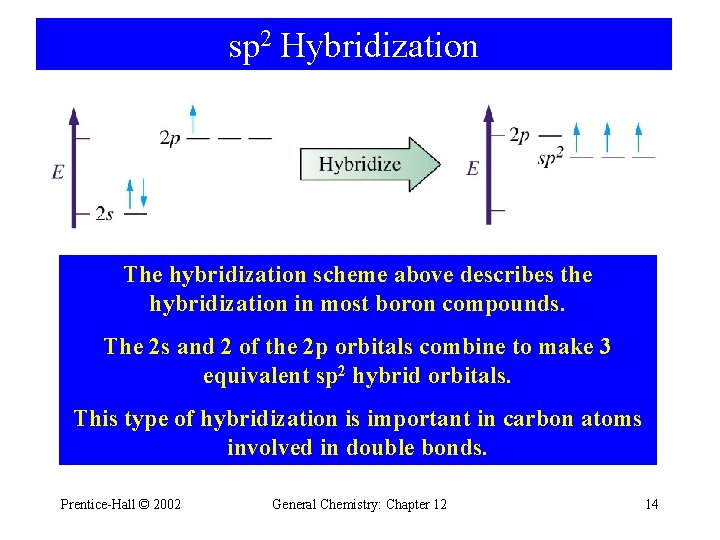
sp 2 Hybridization The hybridization scheme above describes the hybridization in most boron compounds. The 2 s and 2 of the 2 p orbitals combine to make 3 equivalent sp 2 hybrid orbitals. This type of hybridization is important in carbon atoms involved in double bonds. Prentice-Hall © 2002 General Chemistry: Chapter 12 14
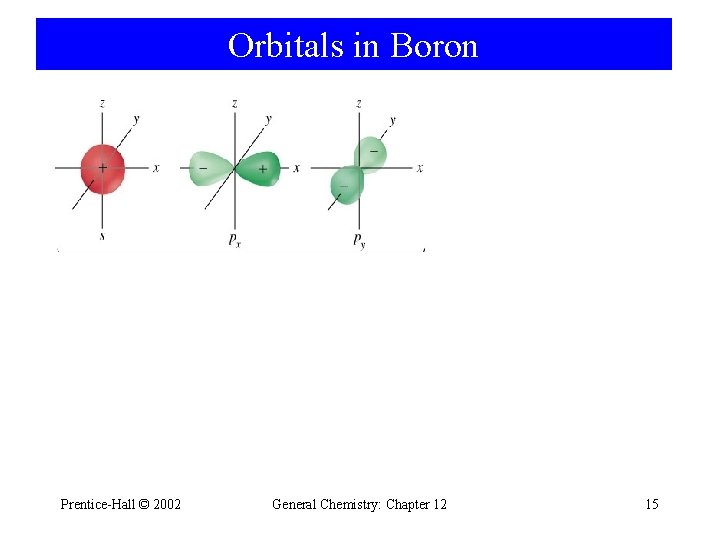
Orbitals in Boron Combine to generate 3 sp 2 orbitals Prentice-Hall © 2002 General Chemistry: Chapter 12 15
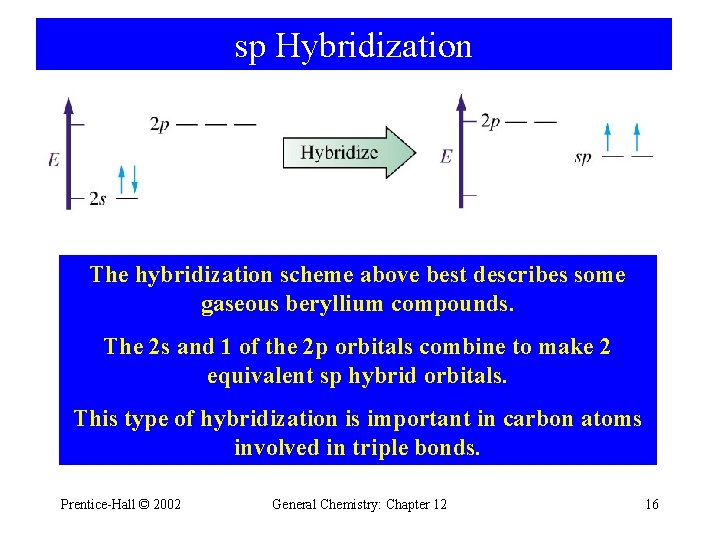
sp Hybridization The hybridization scheme above best describes some gaseous beryllium compounds. The 2 s and 1 of the 2 p orbitals combine to make 2 equivalent sp hybrid orbitals. This type of hybridization is important in carbon atoms involved in triple bonds. Prentice-Hall © 2002 General Chemistry: Chapter 12 16
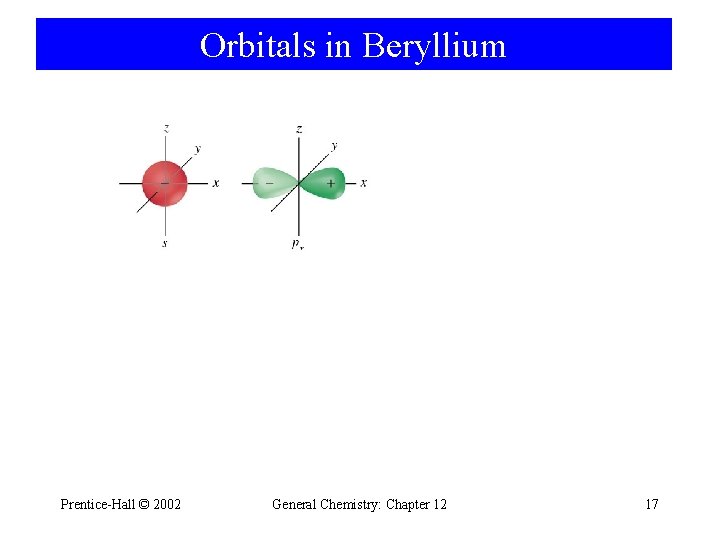
Orbitals in Beryllium Combine to generate 2 sp orbitals Prentice-Hall © 2002 General Chemistry: Chapter 12 17
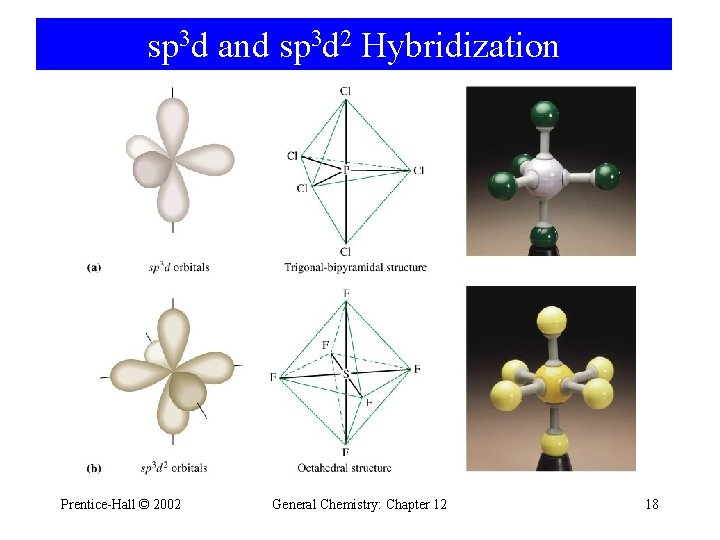
sp 3 d and sp 3 d 2 Hybridization Prentice-Hall © 2002 General Chemistry: Chapter 12 18
Hybrid Orbitals and VSEPR • Write a plausible Lewis structure. • Use VSEPR to predict electron geometry. • Select the appropriate hybridization. Prentice-Hall © 2002 General Chemistry: Chapter 12 19
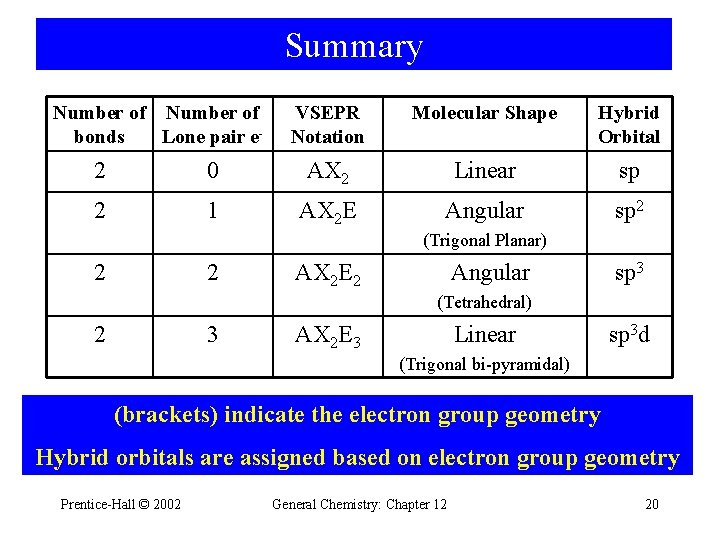
Summary Number of bonds Lone pair e- VSEPR Notation Molecular Shape Hybrid Orbital 2 0 AX 2 Linear sp 2 1 AX 2 E Angular sp 2 (Trigonal Planar) 2 2 AX 2 E 2 Angular sp 3 (Tetrahedral) 2 3 AX 2 E 3 Linear sp 3 d (Trigonal bi-pyramidal) (brackets) indicate the electron group geometry Hybrid orbitals are assigned based on electron group geometry Prentice-Hall © 2002 General Chemistry: Chapter 12 20
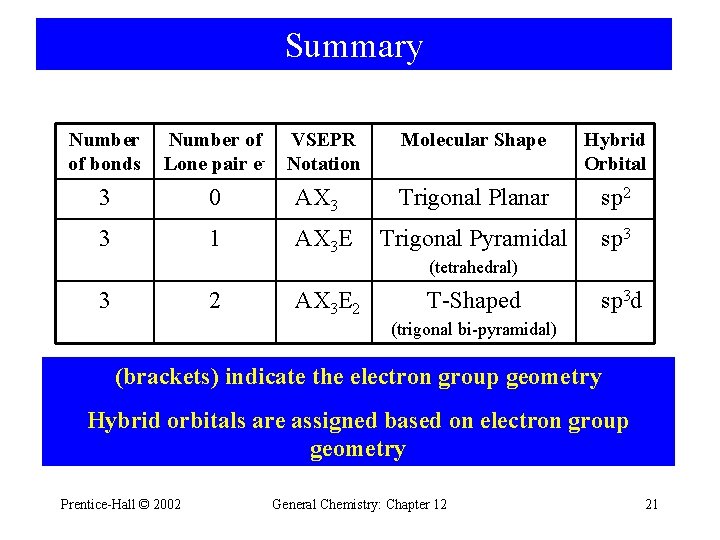
Summary Number of bonds Number of Lone pair e- VSEPR Notation 3 0 AX 3 3 1 AX 3 E Molecular Shape Hybrid Orbital Trigonal Planar sp 2 Trigonal Pyramidal sp 3 (tetrahedral) 3 2 AX 3 E 2 T-Shaped sp 3 d (trigonal bi-pyramidal) (brackets) indicate the electron group geometry Hybrid orbitals are assigned based on electron group geometry Prentice-Hall © 2002 General Chemistry: Chapter 12 21
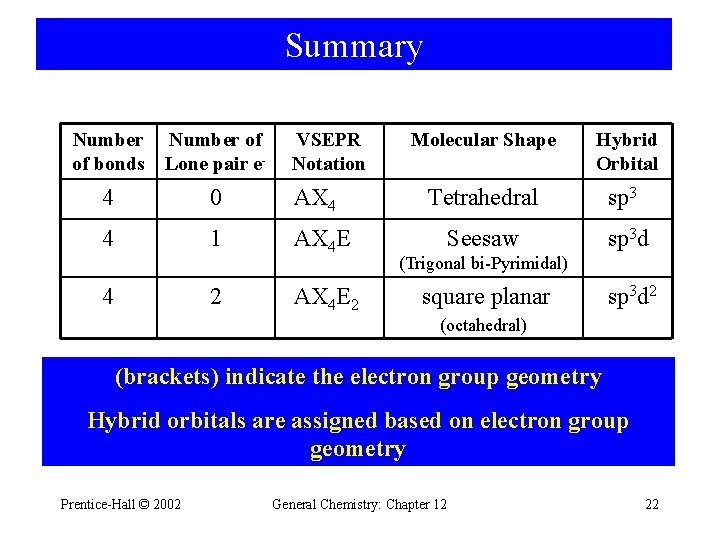
Summary Number of of bonds Lone pair e- VSEPR Notation 4 0 AX 4 4 1 AX 4 E 4 2 AX 4 E 2 Molecular Shape Hybrid Orbital Tetrahedral sp 3 Seesaw sp 3 d (Trigonal bi-Pyrimidal) square planar sp 3 d 2 (octahedral) (brackets) indicate the electron group geometry Hybrid orbitals are assigned based on electron group geometry Prentice-Hall © 2002 General Chemistry: Chapter 12 22
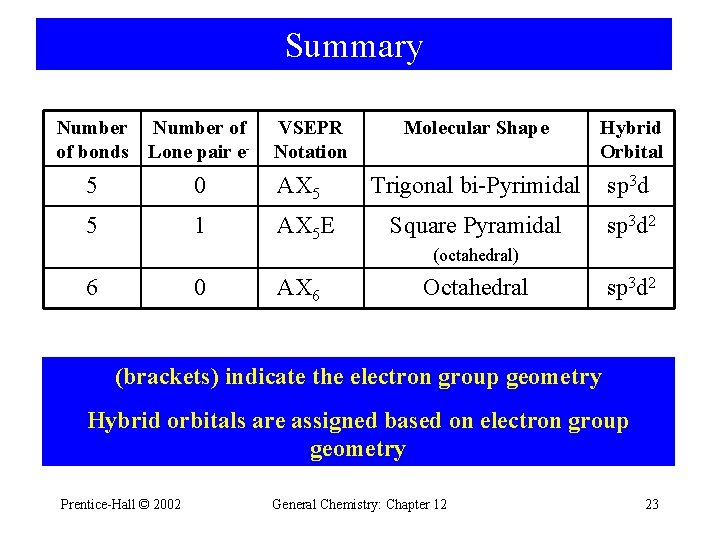
Summary Number of of bonds Lone pair e- VSEPR Notation 5 0 AX 5 5 1 AX 5 E Molecular Shape Hybrid Orbital Trigonal bi-Pyrimidal sp 3 d Square Pyramidal sp 3 d 2 (octahedral) 6 0 AX 6 Octahedral sp 3 d 2 (brackets) indicate the electron group geometry Hybrid orbitals are assigned based on electron group geometry Prentice-Hall © 2002 General Chemistry: Chapter 12 23