Game Theory Meets Compressed Sensing Sina Jafarpour Princeton


- Slides: 22
Game Theory Meets Compressed Sensing Sina Jafarpour Princeton University Based on joint work with: Robert Calderbank Volkan Cevher Rob Schapire
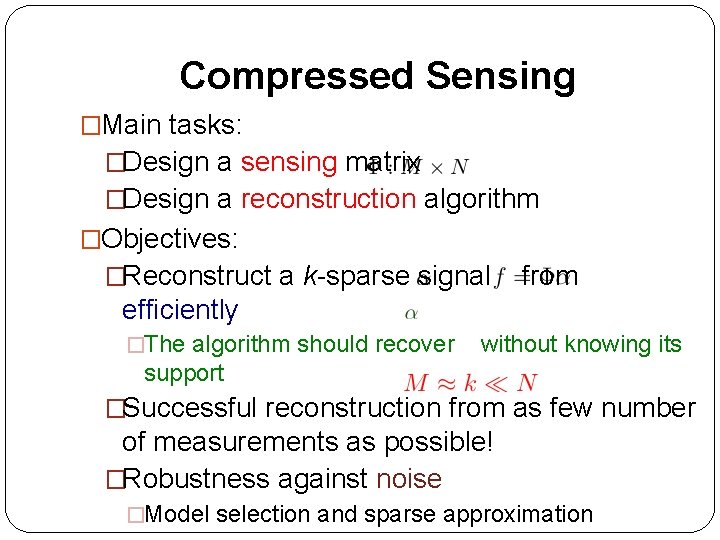
Compressed Sensing �Main tasks: �Design a sensing matrix �Design a reconstruction algorithm �Objectives: �Reconstruct a k-sparse signal from efficiently �The algorithm should recover without knowing its support �Successful reconstruction from as few number of measurements as possible! �Robustness against noise �Model selection and sparse approximation
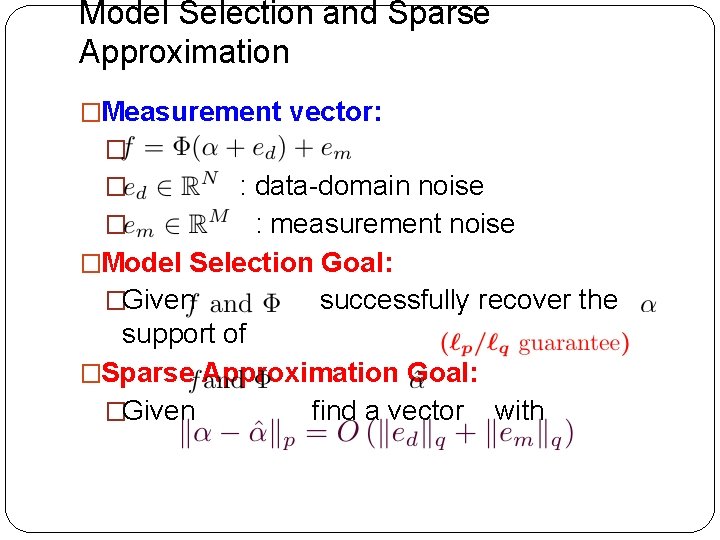
Model Selection and Sparse Approximation �Measurement vector: � : data-domain noise � : measurement noise �Model Selection Goal: �Given successfully recover the support of �Sparse Approximation Goal: �Given find a vector with �
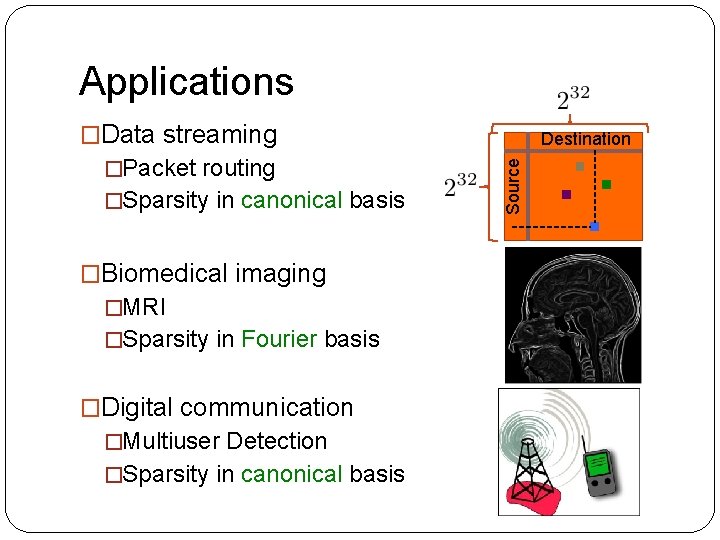
Applications �Data streaming �Sparsity in canonical basis �Biomedical imaging �MRI �Sparsity in Fourier basis �Digital communication �Multiuser Detection �Sparsity in canonical basis Source �Packet routing Destination
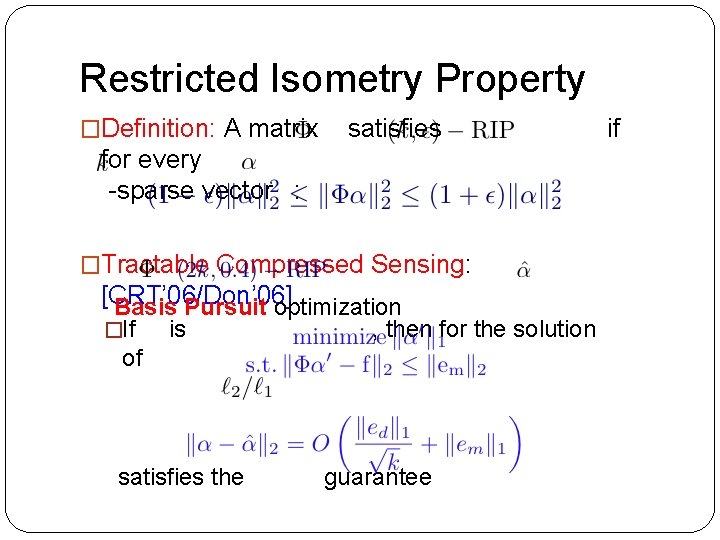
Restricted Isometry Property �Definition: A matrix satisfies for every -sparse vector : �Tractable Compressed Sensing: [CRT’ 06/Don’ 06] Basis Pursuit optimization �If is , then for the solution of satisfies the guarantee if
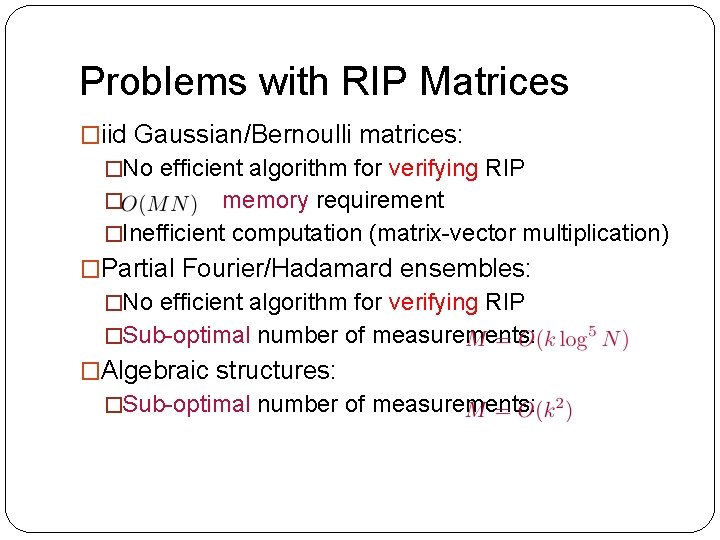
Problems with RIP Matrices �iid Gaussian/Bernoulli matrices: �No efficient algorithm for verifying RIP memory requirement �Inefficient computation (matrix-vector multiplication) � �Partial Fourier/Hadamard ensembles: �No efficient algorithm for verifying RIP �Sub-optimal number of measurements: �Algebraic structures: �Sub-optimal number of measurements:
Deterministic Compressed Sensing via Expander Graphs
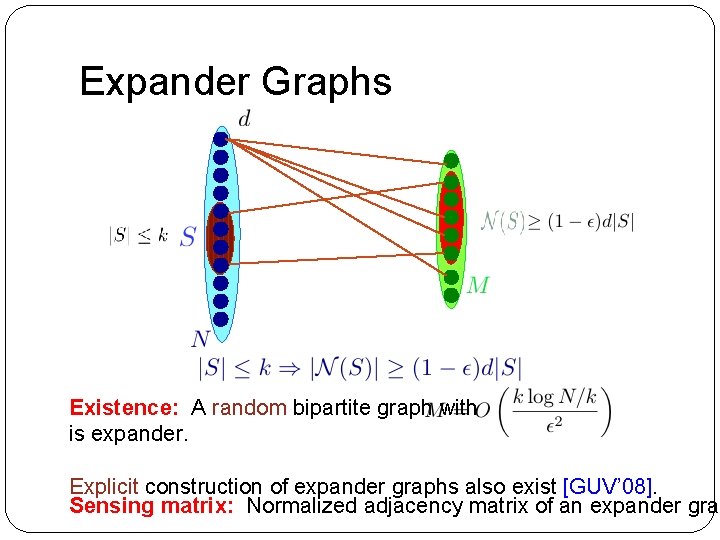
Expander Graphs Existence: A random bipartite graph with is expander. Explicit construction of expander graphs also exist [GUV’ 08]. Sensing matrix: Normalized adjacency matrix of an expander grap
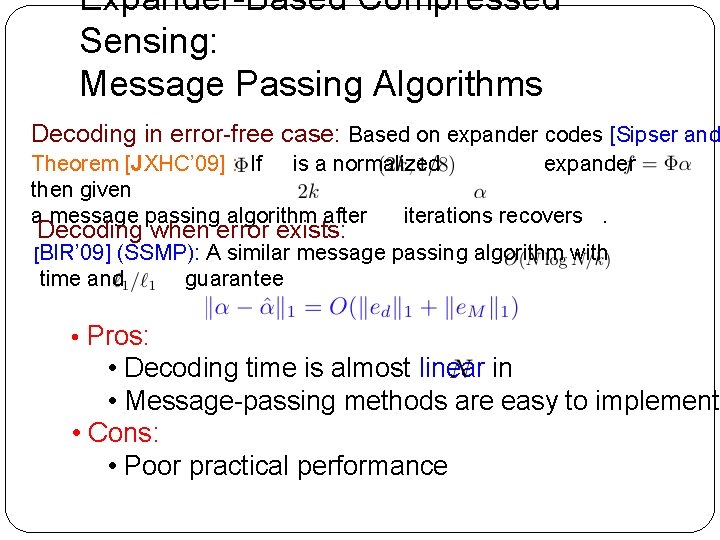
Expander-Based Compressed Sensing: Message Passing Algorithms Decoding in error-free case: Based on expander codes [Sipser and Theorem [JXHC’ 09] : If is a normalized expander then given a message passing algorithm after iterations recovers. Decoding when error exists: [BIR’ 09] (SSMP): A similar message passing algorithm with time and guarantee • Pros: • Decoding time is almost linear in • Message-passing methods are easy to implement • Cons: • Poor practical performance
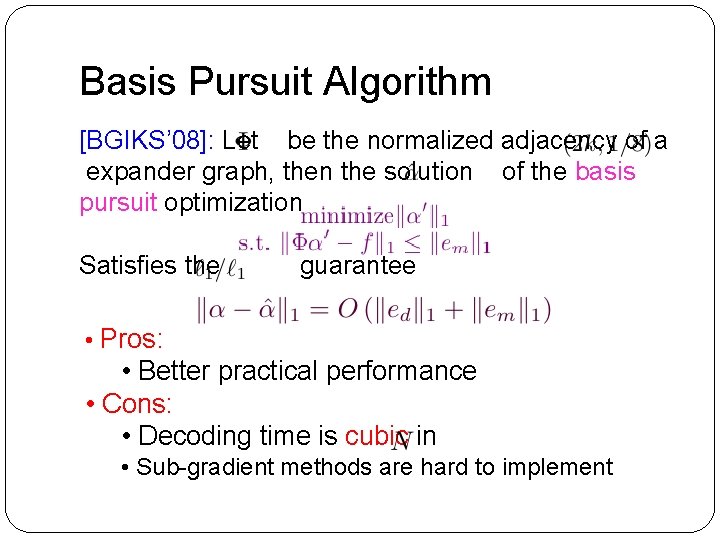
Basis Pursuit Algorithm [BGIKS’ 08]: Let be the normalized adjacency of a expander graph, then the solution of the basis pursuit optimization Satisfies the guarantee • Pros: • Better practical performance • Cons: • Decoding time is cubic in • Sub-gradient methods are hard to implement
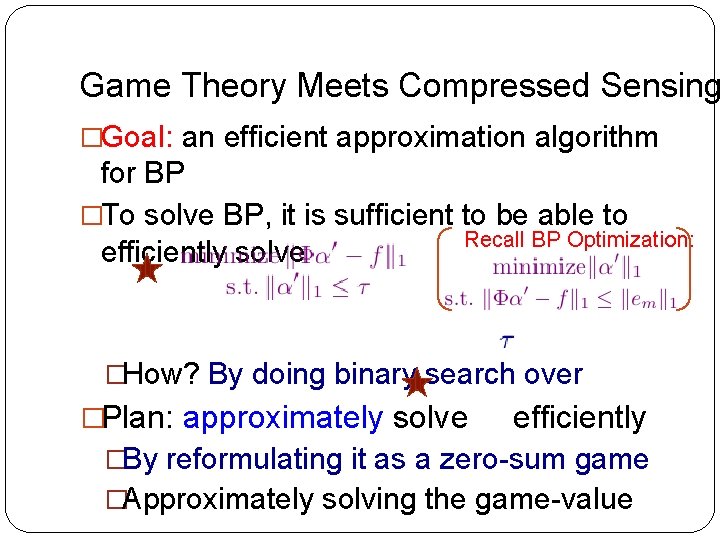
Game Theory Meets Compressed Sensing �Goal: an efficient approximation algorithm for BP �To solve BP, it is sufficient to be able to Recall BP Optimization: efficiently solve �How? By doing binary search over �Plan: approximately solve efficiently �By reformulating it as a zero-sum game �Approximately solving the game-value
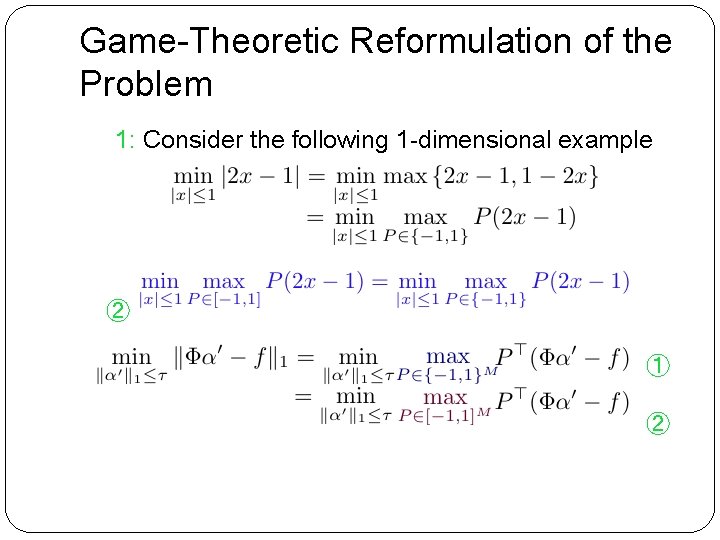
Game-Theoretic Reformulation of the Problem 1: Consider the following 1 -dimensional example ① 2: Fix (say ) and observe that Maximum ② Interval Discrete set (2 elements) ① ②
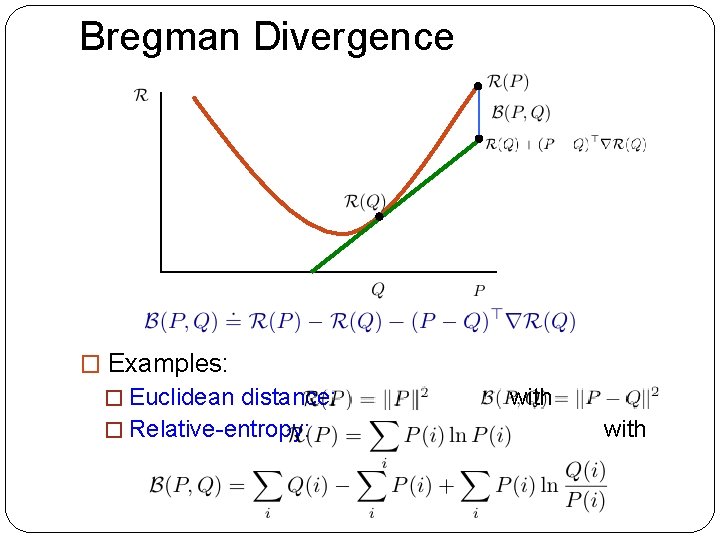
Bregman Divergence � Examples: � Euclidean distance: � Relative-entropy: with
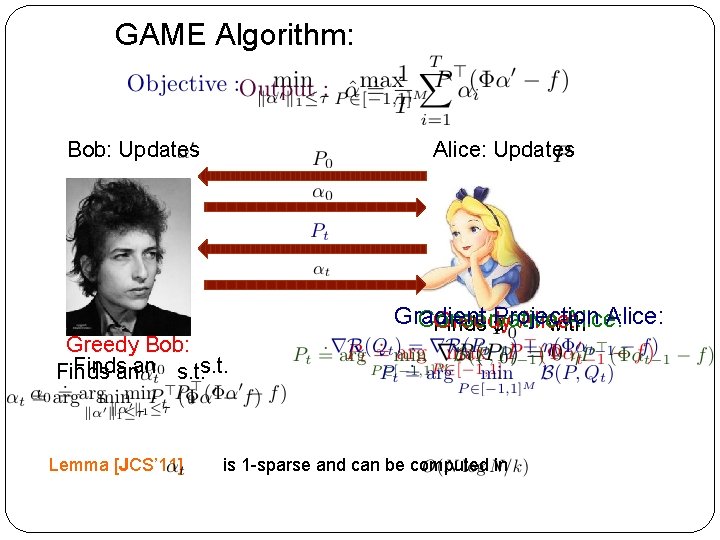
GAME Algorithm: Bob: Updates Alice: Updates Greedy Bob: Finds anan s. t. Lemma [JCS’ 11] Gradient Projection Alice: Conservative Alice: Greedy Finds a Alice: with is 1 -sparse and can be computed in
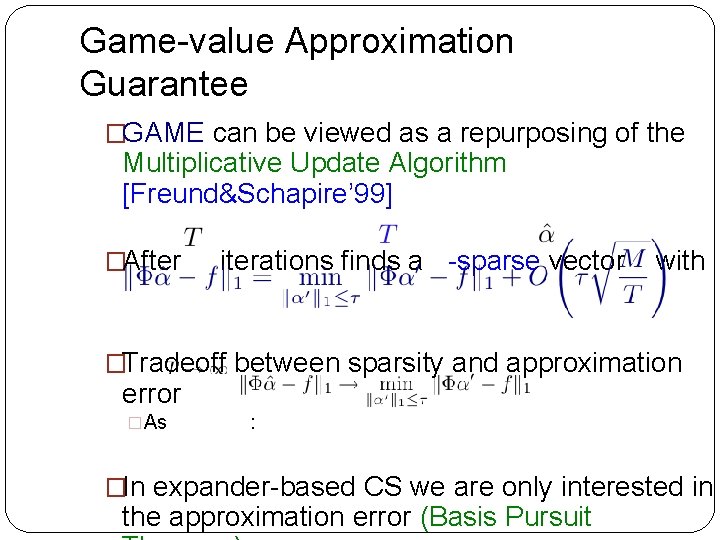
Game-value Approximation Guarantee �GAME can be viewed as a repurposing of the Multiplicative Update Algorithm [Freund&Schapire’ 99] �After iterations finds a -sparse vector with �Tradeoff between sparsity and approximation error �As : �In expander-based CS we are only interested in the approximation error (Basis Pursuit
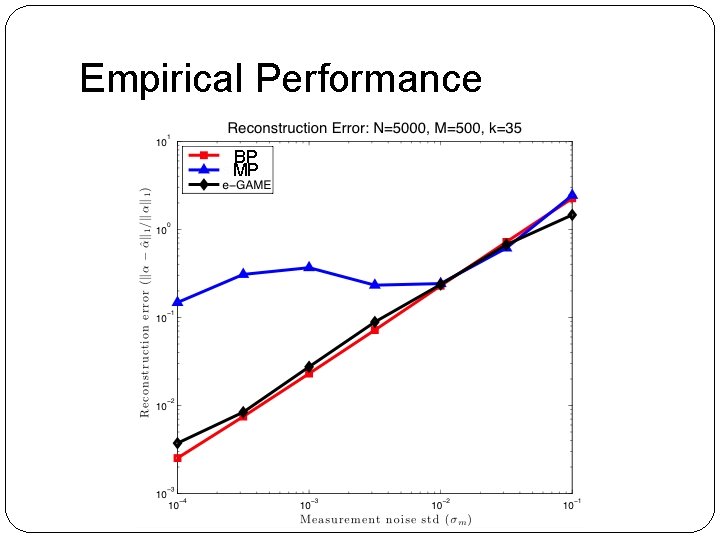
Empirical Performance BP MP
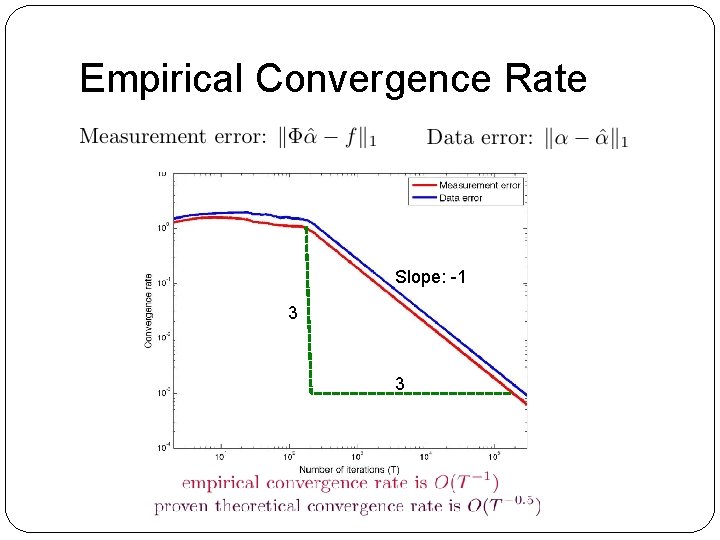
Empirical Convergence Rate Slope: -1 3 3
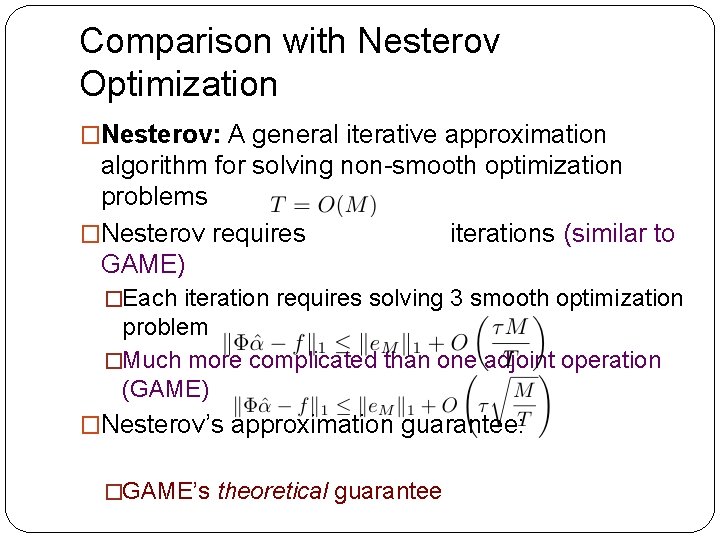
Comparison with Nesterov Optimization �Nesterov: A general iterative approximation algorithm for solving non-smooth optimization problems �Nesterov requires iterations (similar to GAME) �Each iteration requires solving 3 smooth optimization problem �Much more complicated than one adjoint operation (GAME) �Nesterov’s approximation guarantee: �GAME’s theoretical guarantee
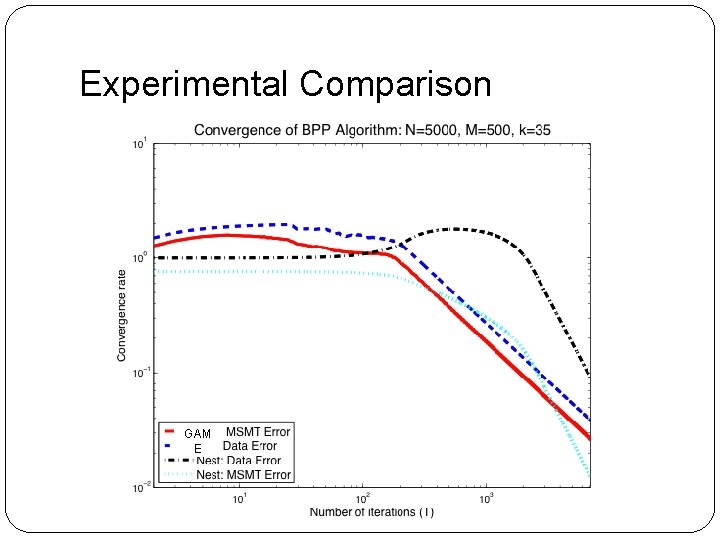
Experimental Comparison GAM E
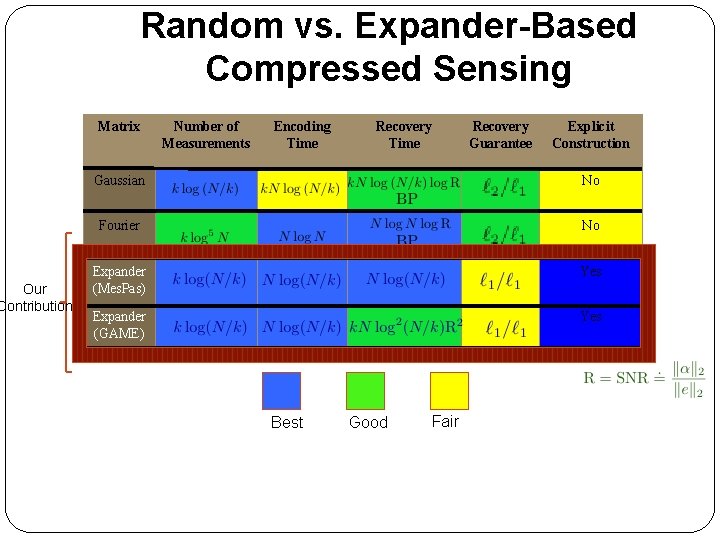
Our Contribution Random vs. Expander-Based Compressed Sensing Matrix Number of Measurements Encoding Time Recovery Guarantee Explicit Construction Gaussian No Fourier No Expander (Mes. Pas) Yes Expander (GAME) Yes Best Good Fair
Take-Home Message: Random vs. Deterministic Gerhard Richter The value of a random matrix: US $ 3, 703, 500 Piet Mondrian The value of a deterministic matrix: US $ 27, 191, 525
Thank You!