
New Proposed Foam Developments M Gilchriese LBNL W
New Proposed Foam Developments M. Gilchriese, LBNL W. Miller, W. Shih, Allcomp
Carbon Foam Topics • Allcomp Carbon Foam Current Technology 0. 2 g/cc density – Focused on “core” application in long stave-like sandwich structures • Both strength and cooling design issues • Low radiation length penalty – Allcomp’s answer was open carbon cell structure processed for optimum K • Foam blocks produced 12 in by 1 in thickness • Highly thermally conductive, ligament K~1700 W/m. K • Thermal evaluation by laser diffusivity for bulk thermal conductivity – Strongly dependent on final density • Predictive methods for correlating results have been proposed and studied • Future Development Opportunities – Applications: • Short structures, vertical and horizontal orientation, long suspension spans not primary focus • Ultra-low density >50% reduction in mass? • Detectors bonded directly to foam? – Re-think foam processing methods 2 Allcomp
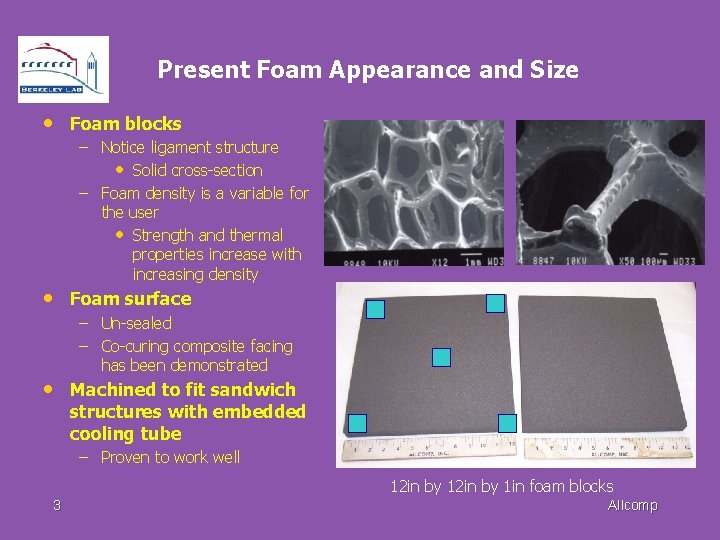
Present Foam Appearance and Size • Foam blocks – Notice ligament structure • Solid cross-section – Foam density is a variable for the user • Strength and thermal properties increase with increasing density • Foam surface – Un-sealed – Co-curing composite facing has been demonstrated • Machined to fit sandwich structures with embedded cooling tube – Proven to work well 12 in by 1 in foam blocks 3 Allcomp
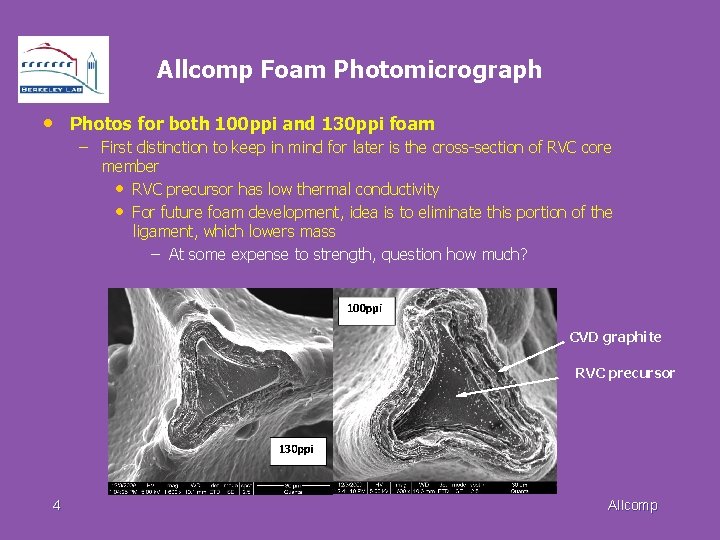
Allcomp Foam Photomicrograph • Photos for both 100 ppi and 130 ppi foam – First distinction to keep in mind for later is the cross-section of RVC core member • RVC precursor has low thermal conductivity • For future foam development, idea is to eliminate this portion of the ligament, which lowers mass – At some expense to strength, question how much? CVD graphite RVC precursor 4 Allcomp
Approach to Eliminate RVC Precursor • Objective is to lower density and have solely highly conductive graphite • Approach to eliminating RVC precursor – Precursor initially needed for skeleton – CVD carbon over sacrificial precursor – Remove precursor, leaving hollow ligaments – Heat treat CVD carbon to obtain highly conductive graphite • Present precursor of choice – Nickel foam, commercially available v Need to try different ppi foam to settle on approach – Nickel is removed via acid digestion v Alternate is high temperature exposure to chlorine gas • Result is hollow ligaments, all graphite • Sounds easy, but? 5 Allcomp
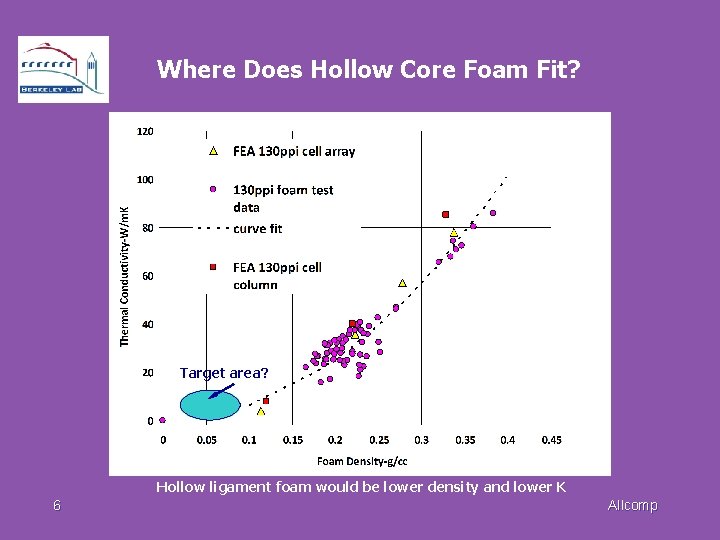
Where Does Hollow Core Foam Fit? Target area? Hollow ligament foam would be lower density and lower K 6 Allcomp
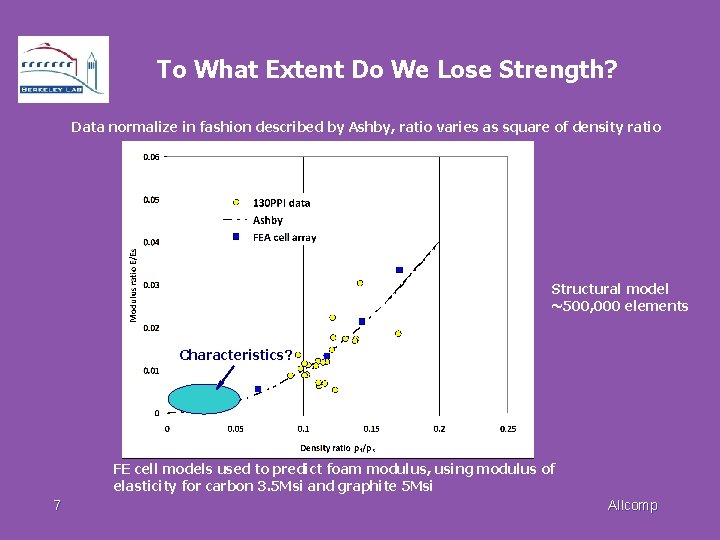
To What Extent Do We Lose Strength? Data normalize in fashion described by Ashby, ratio varies as square of density ratio Structural model ~500, 000 elements Characteristics? FE cell models used to predict foam modulus, using modulus of elasticity for carbon 3. 5 Msi and graphite 5 Msi 7 Allcomp
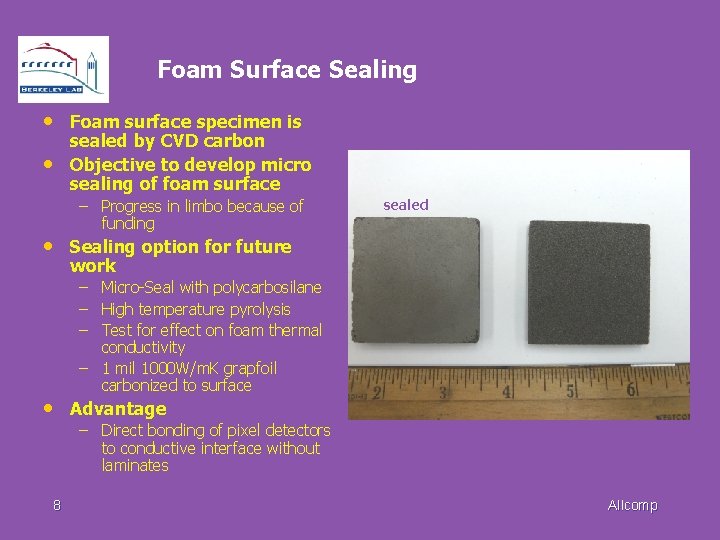
Foam Surface Sealing • Foam surface specimen is • sealed by CVD carbon Objective to develop micro sealing of foam surface – Progress in limbo because of funding sealed • Sealing option for future work – Micro-Seal with polycarbosilane – High temperature pyrolysis – Test for effect on foam thermal conductivity – 1 mil 1000 W/m. K grapfoil carbonized to surface • Advantage – Direct bonding of pixel detectors to conductive interface without laminates 8 Allcomp
Where We Are Now • Allcomp high conductivity comes from: – Special thermal processing of CVD material, converting material conductivity to graphite, 4 times that of copper • Conductivity variations appear connected to final CVD material structure – Strongly proportional to increased foam density • Foam conductivity is weak function of cell size, as presently processed – More dependent on density • Noticed in our data and in foam literature – In density range of interest 130 ppi has a conductivity improvement over 100 ppi • At very low densities 100 ppi should be higher, since the CVD coating over the 130 ppi foam is thinner – But that was not the general case – 130 ppi foam processing at 0. 2 g/cc and above produces higher conductivity than 100 ppi foam 9 Allcomp
What Would Our Approach Be in The Future? • Develop foam processing for hollow ligament graphite structure foam – Start with 100 and 130 ppi foam cell size • Good machinability • Does it make sense to try 30 ppi to 45 ppi foam? – Column strength of ligament possibly greater, since ligament shell cross -section would have a greater perimeter • Ultra-lightweight foam – Micro-seal foam surface with Si • CVD silicon onto overcoat, micro polish? • Appropriate for hollow ligament foam? • First order evaluations for new foam – Measurement • Compression and tensile testing, extend analytical model to cover ultra-low density foam – Fabricate sample sandwich structure • Simple bend tests 10 Allcomp
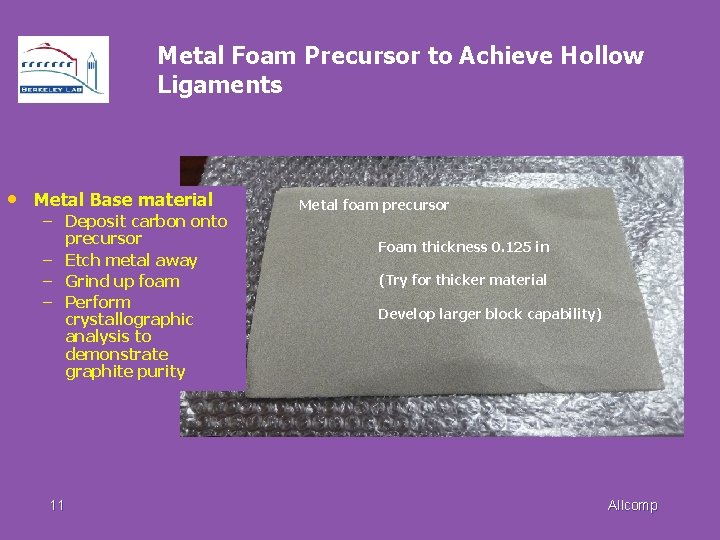
Metal Foam Precursor to Achieve Hollow Ligaments • Metal Base material – Deposit carbon onto precursor – Etch metal away – Grind up foam – Perform crystallographic analysis to demonstrate graphite purity 11 Metal foam precursor Foam thickness 0. 125 in (Try for thicker material Develop larger block capability) Allcomp
Hollow Foam Ligaments • Foam Structure Presents New Challenges – Processing of course is an issue • Removal of precursor, that poses less of a problem, but carbon purity could be an issue – However to what extent are the primary parameters, thermal conductivity and strength affected? • More testing, with and without surface sealing • Surface sealing may prove useful to stabilizing the hollow ligaments – With foil and with polycarbosilane – What is the best approach to modeling? • Combination of empirical solutions and FEA? – FEA of CAD generated cell geometry? v Some success – FEA of scanned foam specimens? v Before ligaments were represented as solids, now need shell elements v Model requires gazillion elements! 12 Allcomp
Summary on Allcomp Foam Material • Allcomp will focus on 130 ppi foam for applications using 0. 2 g/cc – We have answered our satisfaction what caused several blocks to have low thermal conductivity • This was not a trivial aspect to chase down—had to do with samples taken from edges • Progress to date – Achieving high conductivity low density carbon foam is a success in large batch processing • Low density, solely carbon based material equates to very long radiation length – Solid density of the ligaments is ~1. 98 g/cc – Makes the solid radiation length 212 mm or for the foam 1909 mm at 0. 22 g/cc – Pixel stave <5 mm thickness or 0. 26% of a radiation length • Goal for radiation length for foam is 8500 mm or ~0. 05% versus current 1909 mm 13 Allcomp
- Slides: 13