Galactic Archeology Search for the formation history of

- Slides: 26
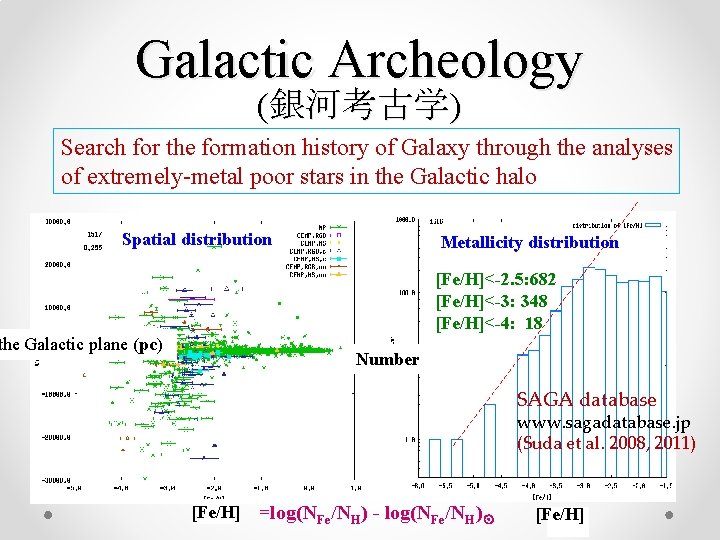
Galactic Archeology (銀河考古学) Search for the formation history of Galaxy through the analyses of extremely-metal poor stars in the Galactic halo Spatial distribution the Galactic plane (pc) Metallicity distribution [Fe/H]<-2. 5: 682 [Fe/H]<-3: 348 [Fe/H]<-4: 18 Number SAGA database www. sagadatabase. jp (Suda et al. 2008, 2011) [Fe/H] =log(NFe/NH) - log(NFe/NH)☉ [Fe/H]
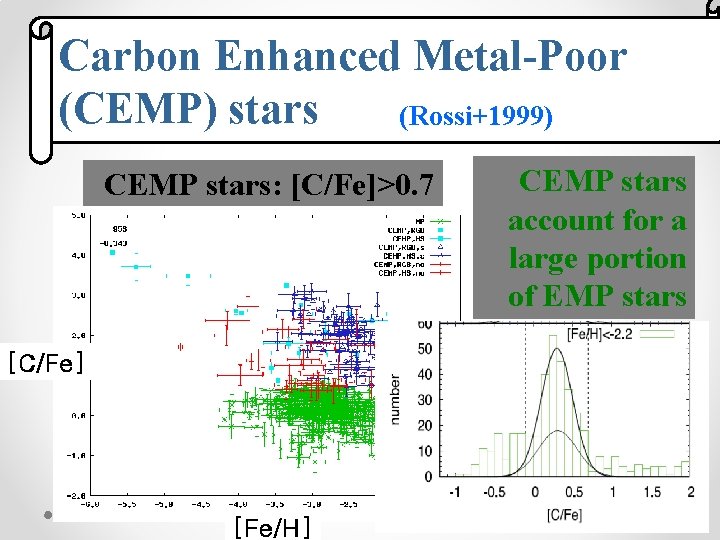
Carbon Enhanced Metal-Poor (CEMP) stars (Rossi+1999) CEMP stars: [C/Fe]>0. 7 CEMP stars account for a large portion of EMP stars Fraction of CEMP stars [C/Fe] 163/544 = 30% : Fe/H]<-2 57/211 = 27% : Fe/H]<-3 9/15 = 60%: Fe/H]<-4 SAGA database (Suda et al. 2008) [Fe/H]
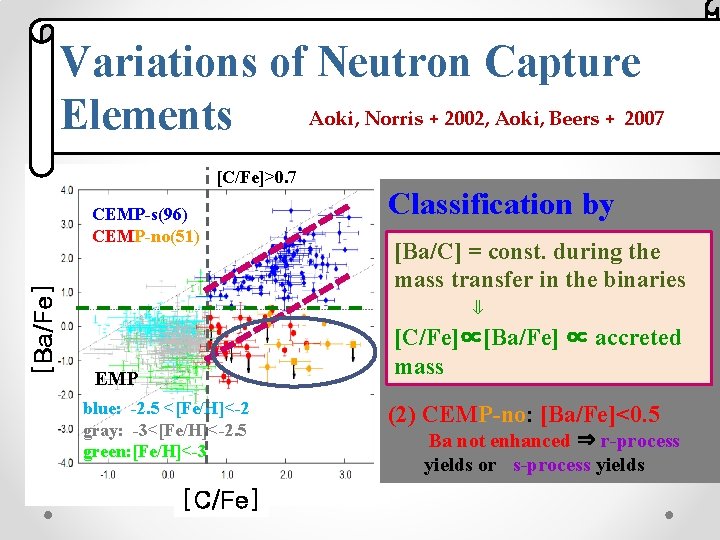
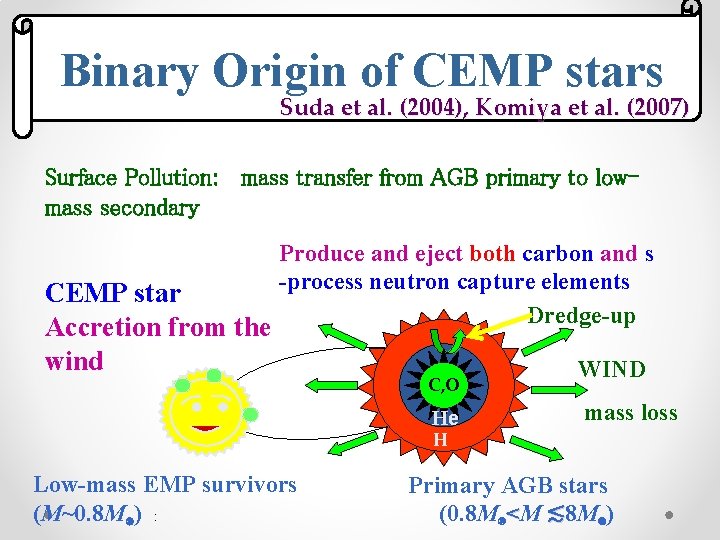
Variations of Neutron Capture Aoki, Norris + 2002, Aoki, Beers + 2007 Elements [C/Fe]>0. 7 [Ba/Fe] CEMP-s(96) CEMP-no(51) Classification by Ba enrichment [Ba/C] = const. during the mass transfer in the binaries (1) CEMP-s: [Ba/Fe] > 0. 5 ⇓ Ba enhancement∝ ⇒accreted accretion of [C/Fe]∝[Ba/Fe] s-process yields from AGB stars mass EMP blue: -2. 5 <[Fe/H]<-2 gray: -3<[Fe/H]<-2. 5 green: [Fe/H]<-3 [C/Fe] (2) CEMP-no: [Ba/Fe]<0. 5 Ba not enhanced ⇒ r-process yields or s-process yields
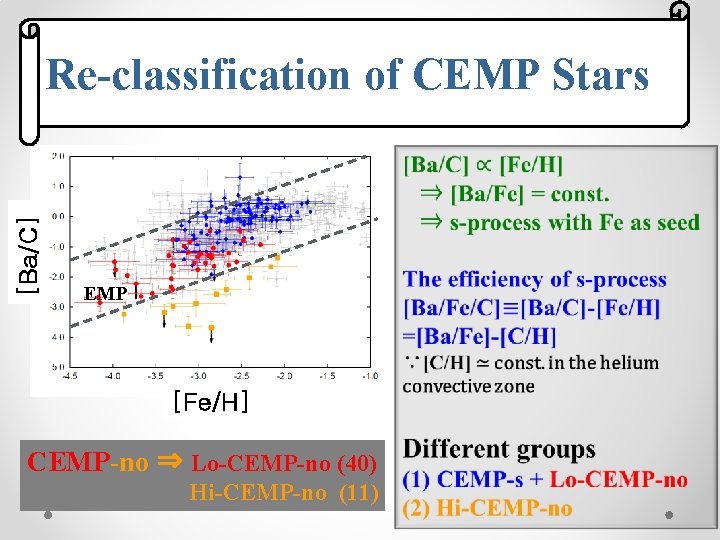
[Ba/C] Re-classification of CEMP Stars EMP [Fe/H] CEMP-no ⇒ Lo-CEMP-no (40) Hi-CEMP-no (11)
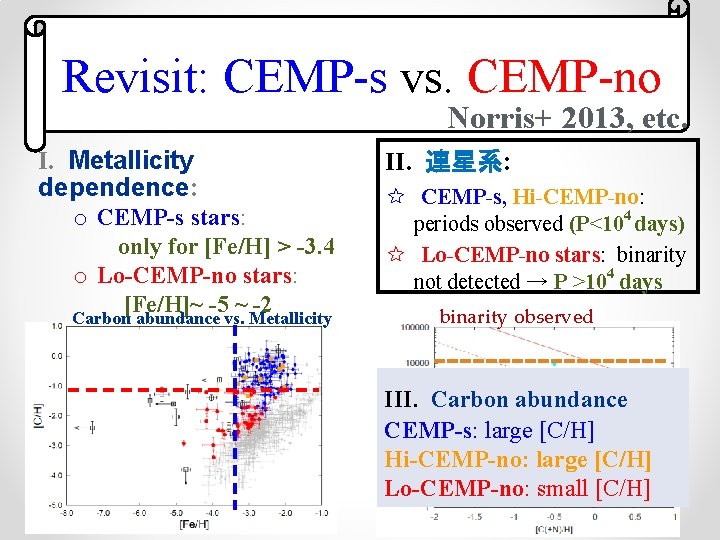
Revisit: CEMP-s vs. CEMP-no Norris+ 2013, etc. I. Metallicity dependence: o CEMP-s stars: only for [Fe/H] > -3. 4 o Lo-CEMP-no stars: [Fe/H]~ -5 ~ -2 Carbon abundance vs. Metallicity II. 連星系: ✩ CEMP-s, Hi-CEMP-no: periods observed (P<104 days) ✩ Lo-CEMP-no stars: binarity not detected → P >104 days binarity observed III. Carbon abundance CEMP-s: large [C/H] Hi-CEMP-no: large [C/H] Lo-CEMP-no: small [C/H]
Binary Origin of CEMP stars Suda et al. (2004), Komiya et al. (2007) Surface Pollution: mass transfer from AGB primary to lowmass secondary CEMP star Accretion from the wind Produce and eject both carbon and s -process neutron capture elements Dredge-up C, O H He WIND mass loss H Low-mass EMP survivors (M~0. 8 M◉) : Primary AGB stars (0. 8 M◉<M ≲ 8 M◉)
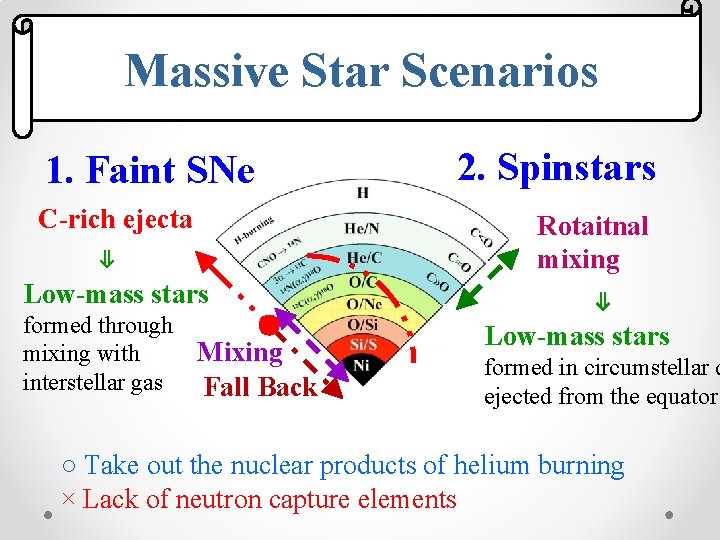
Massive Star Scenarios 1. Faint SNe C-rich ejecta ⇓ Low-mass stars formed through mixing with interstellar gas Mixing Fall Back 2. Spinstars Rotaitnal mixing ⇓ Low-mass stars formed in circumstellar d ejected from the equator ○ Take out the nuclear products of helium burning × Lack of neutron capture elements
1. Synthesis of Neutron Capture Elements
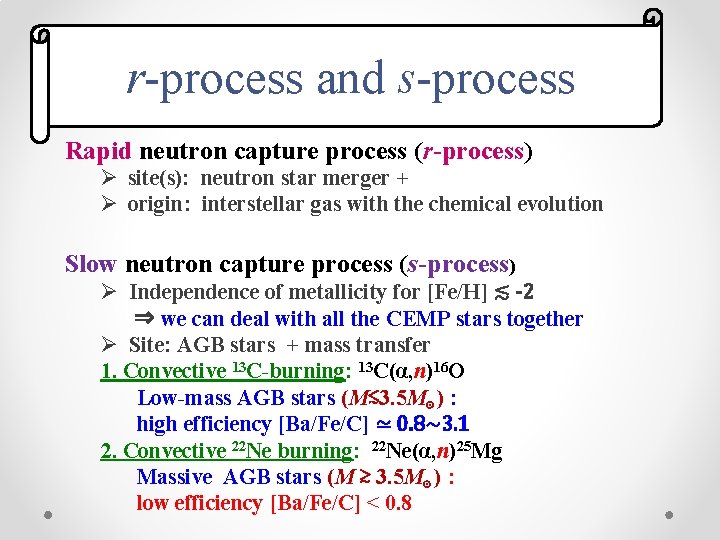
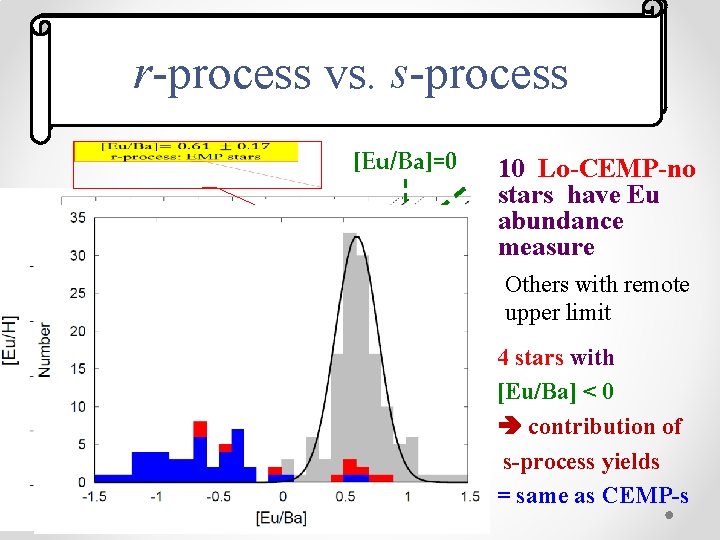
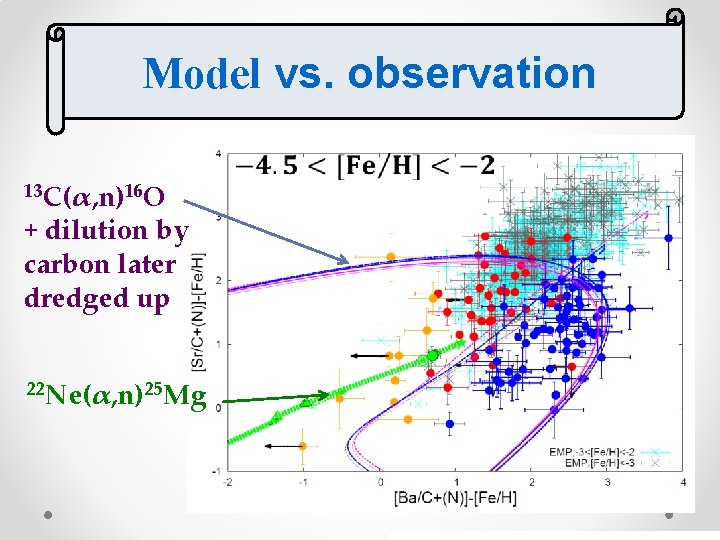
r-process and s-process H Rapid neutron capture process (r-process) Ø site(s): neutron star merger + Ø origin: interstellar gas with the chemical evolution Slow neutron capture process (s-process) Ø Independence of metallicity for [Fe/H] ≲ -2 ⇒ we can deal with all the CEMP stars together Ø Site: AGB stars + mass transfer 1. Convective 13 C-burning: 13 C(α, n)16 O Low-mass AGB stars (M≲ 3. 5 M⊙ ) : high efficiency [Ba/Fe/C] ≃ 0. 8~3. 1 2. Convective 22 Ne burning: 22 Ne(α, n)25 Mg Massive AGB stars (M ≳ 3. 5 M⊙ ) : low efficiency [Ba/Fe/C] < 0. 8
s -process vs. r -process s-process vs. r-process s-process [Eu/Ba]=0 10 Lo-CEMP-no stars have Eu abundance measure Others with remote upper limit • • • 4 stars with [Eu/Ba] < 0 contribution of s-process yields = same as CEMP-s
2. Origin of CEMP-no Stars
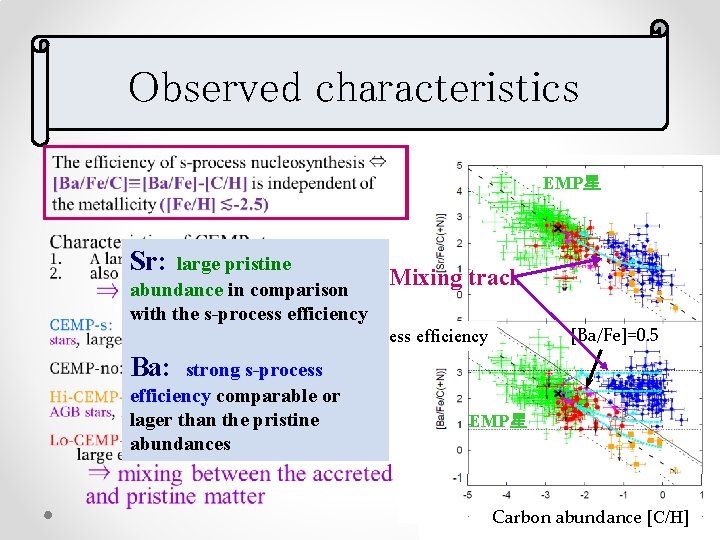
Observed characteristics EMP星 Sr: large pristine abundance in comparison with the s-process efficiency Mixing track [Ba/Fe]=0. 5 s-process efficiency Ba: strong s-process efficiency comparable or lager than the pristine abundances EMP星 Carbon abundance [C/H]
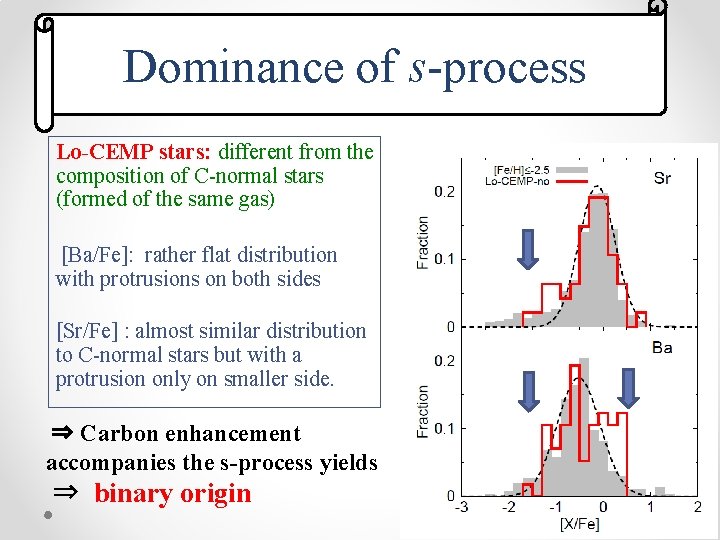
Dominance of s-process Lo-CEMP stars: different from the composition of C-normal stars (formed of the same gas) [Ba/Fe]: rather flat distribution with protrusions on both sides [Sr/Fe] : almost similar distribution to C-normal stars but with a protrusion only on smaller side. ⇒ Carbon enhancement accompanies the s-process yields ⇒ binary origin
Model vs. observation 13 C(α, n)16 O + dilution by carbon later dredged up 22 Ne(α, n)25 Mg
2. Bi-modal period distribution of mother binaries
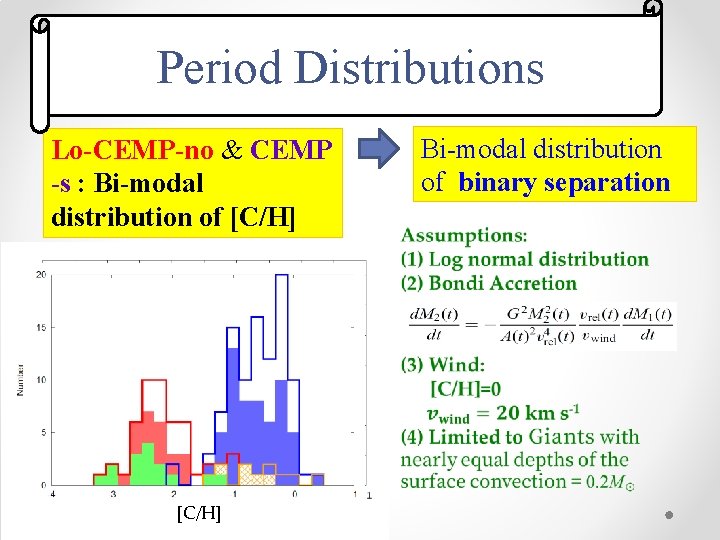
Initial period distributions Period Distributions Lo-CEMP-no & CEMP -s : Bi-modal distribution of [C/H] Giants Lo-CEMP-no [C/H] CEMP-s Bi-modal distribution of binary separation
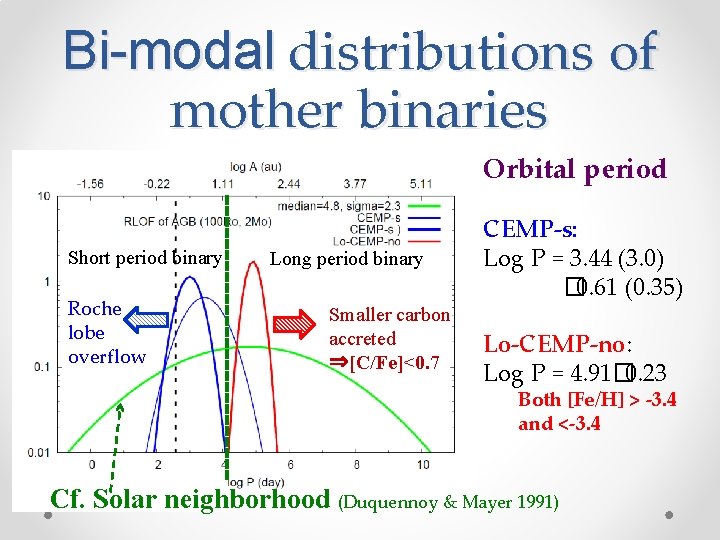
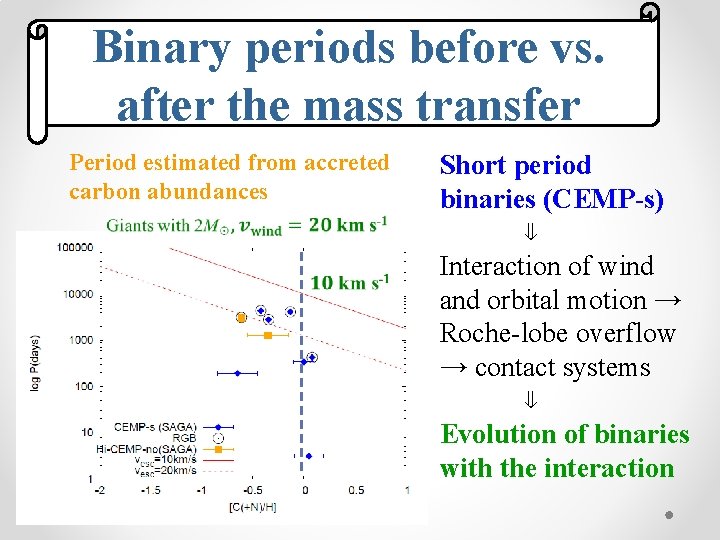
Bi-modal distributions of mother binaries Orbital period Short period binary Roche lobe overflow Long period binary Smaller carbon accreted ⇒[C/Fe]<0. 7 CEMP-s: Log P = 3. 44 (3. 0) � 0. 61 (0. 35) Lo-CEMP-no: Log P = 4. 91� 0. 23 Both [Fe/H] > -3. 4 and <-3. 4 Cf. Solar neighborhood (Duquennoy & Mayer 1991)
3. Formation history of Binaries in the early universe
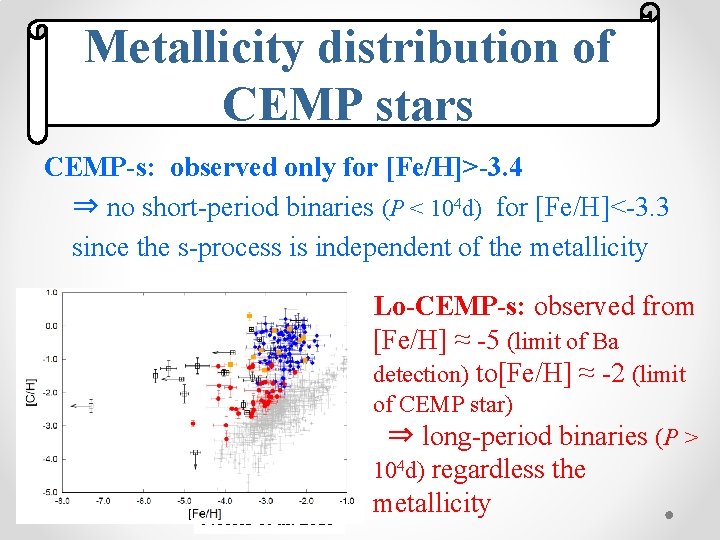
Metallicity distribution of CEMP stars frequency CEMP-s: observed only for [Fe/H]>-3. 4 ⇒ no short-period binaries (P < 104 d) for [Fe/H]<-3. 3 since the s-process is independent of the metallicity CEMP-s CEMPno Norris et al. 2013 Lo-CEMP-s: observed from [Fe/H] ≈ -5 (limit of Ba detection) to[Fe/H] ≈ -2 (limit of CEMP star) ⇒ long-period binaries (P > 104 d) regardless the metallicity
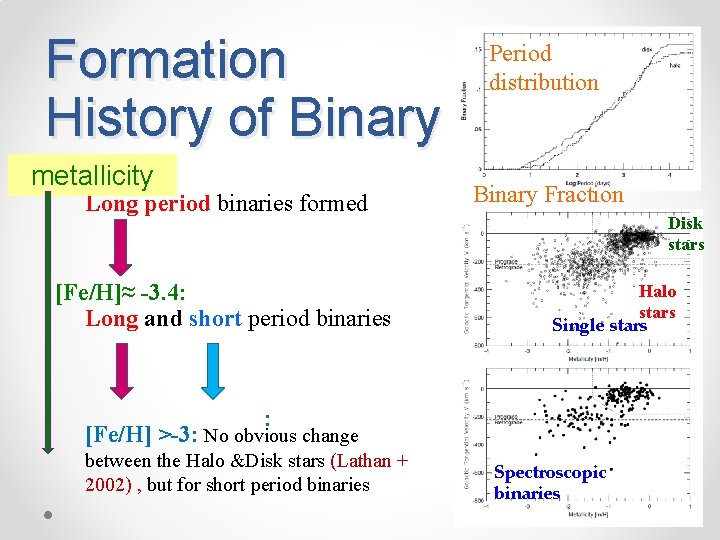
Formation History of Binary metallicity Long period binaries formed [Fe/H]≈ -3. 4: Long and short period binaries Period distribution Binary Fraction Disk stars Halo stars Single stars : [Fe/H] >-3: No obvious change between the Halo &Disk stars (Lathan + 2002) , but for short period binaries Spectroscopic binaries
4. Pathways to low-mass binary formation (with the primaries of AGB stars)
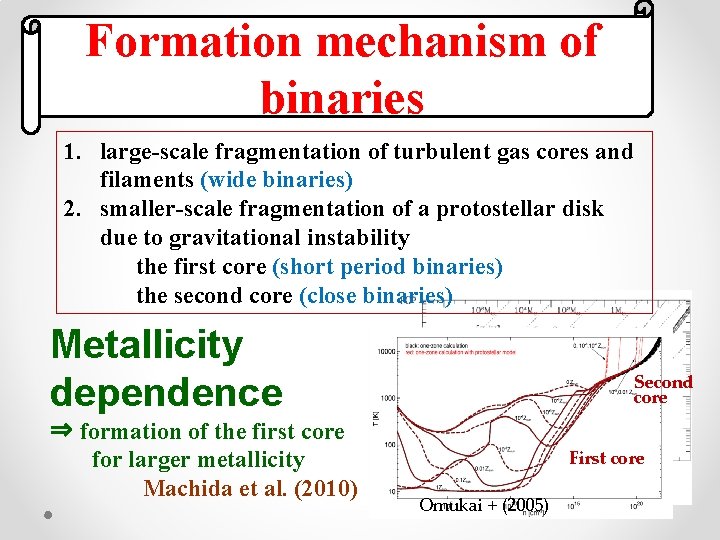
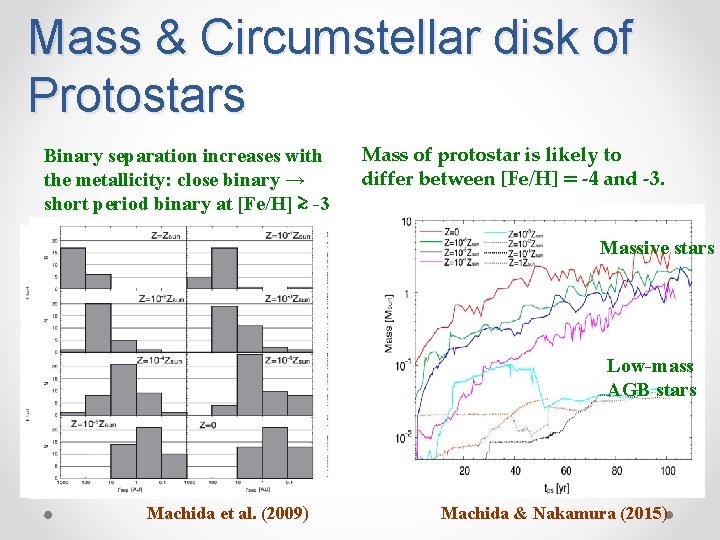
Formation mechanism of binaries 1. large-scale fragmentation of turbulent gas cores and filaments (wide binaries) 2. smaller-scale fragmentation of a protostellar disk due to gravitational instability the first core (short period binaries) the second core (close binaries) Metallicity dependence ⇒ formation of the first core for larger metallicity Machida et al. (2010) Second core First core Omukai + (2005)
Mass & Circumstellar disk of Protostars Binary separation increases with the metallicity: close binary → short period binary at [Fe/H] ≳ -3 Mass of protostar is likely to differ between [Fe/H] = -4 and -3. Massive stars Low-mass AGB stars Machida et al. (2009) Machida & Nakamura (2015)
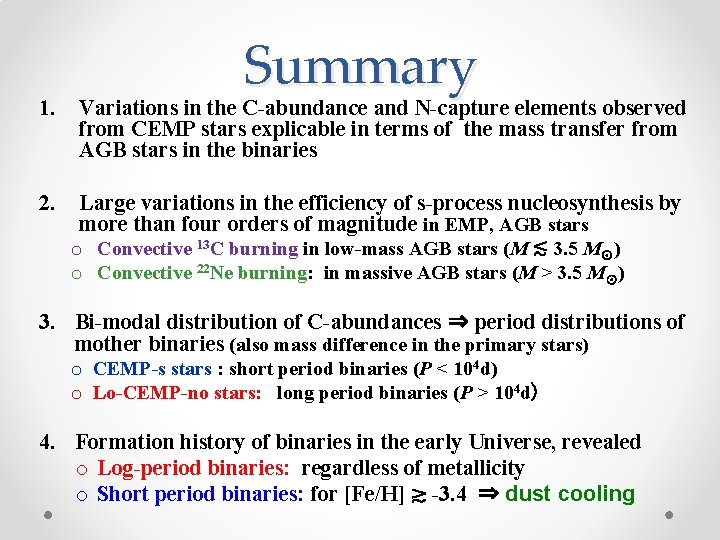
Summary 1. Variations in the C-abundance and N-capture elements observed from CEMP stars explicable in terms of the mass transfer from AGB stars in the binaries 2. Large variations in the efficiency of s-process nucleosynthesis by more than four orders of magnitude in EMP, AGB stars o Convective 13 C burning in low-mass AGB stars (M ≲ 3. 5 M☉) o Convective 22 Ne burning: in massive AGB stars (M > 3. 5 M☉) 3. Bi-modal distribution of C-abundances ⇒ period distributions of mother binaries (also mass difference in the primary stars) o CEMP-s stars : short period binaries (P < 104 d) o Lo-CEMP-no stars: long period binaries (P > 104 d) 4. Formation history of binaries in the early Universe, revealed o Log-period binaries: regardless of metallicity o Short period binaries: for [Fe/H] ≳ -3. 4 ⇒ dust cooling
Binary periods before vs. after the mass transfer Period estimated from accreted carbon abundances Short period binaries (CEMP-s) ⇓ Interaction of wind and orbital motion → Roche-lobe overflow → contact systems ⇓ Evolution of binaries with the interaction