
The Origin of Life Darwin 1871 in some
- Slides: 46
The Origin of Life Darwin (1871): ". . . in some warm little pond with all sorts of ammonia and phosphoric, - light, heat, electricity, etc. present, that a protein compound was chemically formed, ready to undergo still more complex changes, at the present day such matter would be instantly devoured, or absorbed, which would not have been the case before living creatures were formed. "
The Origin of Life 0. Definitions of Life. I. Conditions for the “life-conditions”/ “Warm Little Pond” as we know it. Habitability. II. Chemical evolution Experiments (i. e. Miller, Urey 1953) Origin of the Building Blocks: amino acids, nucleotides, sugars, lipids. Chirality Self-Reproducing Sets of Molecules. Robustness of Life: Temperature, Pressure, Chemical Environment, …. History (i. e. earliest signs of life & where) III. First living systems Why RNA World? Hypercycles Life on surface, the pyrite-world IV. From surface life to cellular life Chemoton The stochastic corrector V. From RNA world to protein world RNAs as enzymes Amino acids as cofactors
Definitions of Life. Physically connected unit that has metabolism, can reproduce and evolve by natural selection. Metabolism: Thermodynamically open system Makes complex molecules from simple monomers Heredity/variability: Balance between fidelity and variability Unlimited possible combination needed
Definitions of Life. As we know it, it will have: Genetic Material Metabolism Cell membrane More Earth centred still: Carbon based Necessitates presence of fluid water & solid core. Stability for Billions of Years.
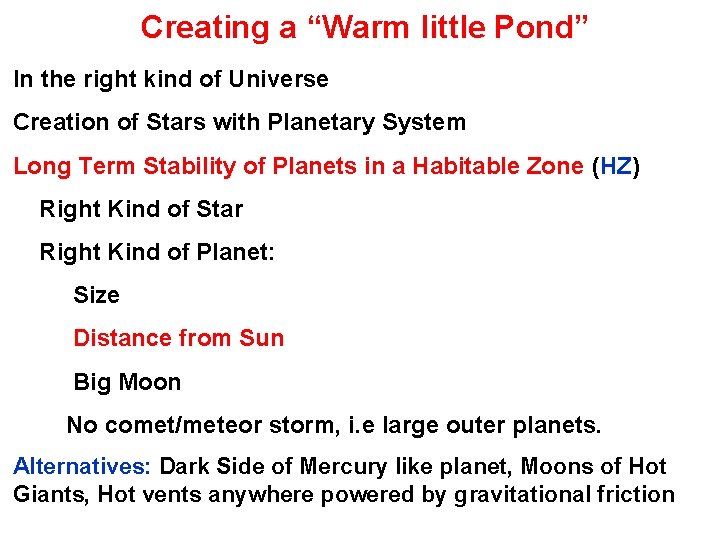
Creating a “Warm little Pond” In the right kind of Universe Creation of Stars with Planetary System Long Term Stability of Planets in a Habitable Zone (HZ) Right Kind of Star Right Kind of Planet: Size Distance from Sun Big Moon No comet/meteor storm, i. e large outer planets. Alternatives: Dark Side of Mercury like planet, Moons of Hot Giants, Hot vents anywhere powered by gravitational friction
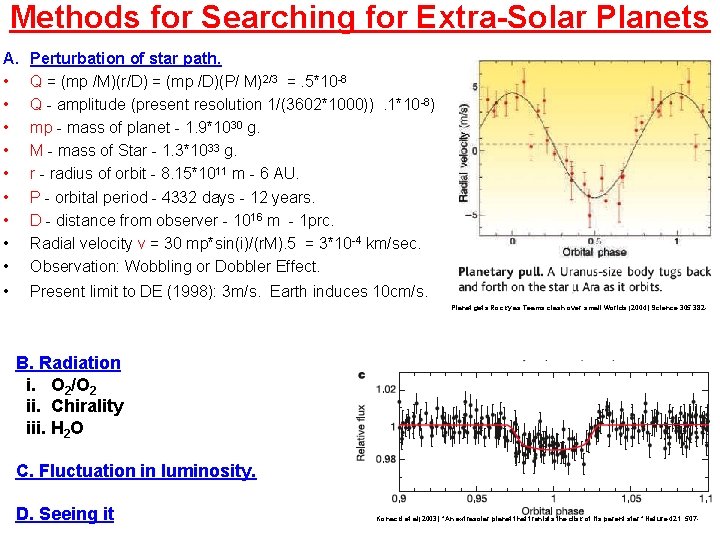
Methods for Searching for Extra-Solar Planets A. • • • Perturbation of star path. Q = (mp /M)(r/D) = (mp /D)(P/ M)2/3 =. 5*10 -8 Q - amplitude (present resolution 1/(3602*1000)). 1*10 -8) mp - mass of planet - 1. 9*1030 g. M - mass of Star - 1. 3*1033 g. r - radius of orbit - 8. 15*1011 m - 6 AU. P - orbital period - 4332 days - 12 years. D - distance from observer - 1016 m - 1 prc. Radial velocity v = 30 mp*sin(i)/(r. M). 5 = 3*10 -4 km/sec. Observation: Wobbling or Dobbler Effect. • Present limit to DE (1998): 3 m/s. Earth induces 10 cm/s. Planet gets Rocky as Teams clash over small Worlds (2004) Science 305. 382 - B. Radiation i. O 2/O 2 ii. Chirality iii. H 2 O C. Fluctuation in luminosity. D. Seeing it Konacki et al(2003) “An extrasolar planet that tranists the disk of its parent star” Nature 421. 507 -
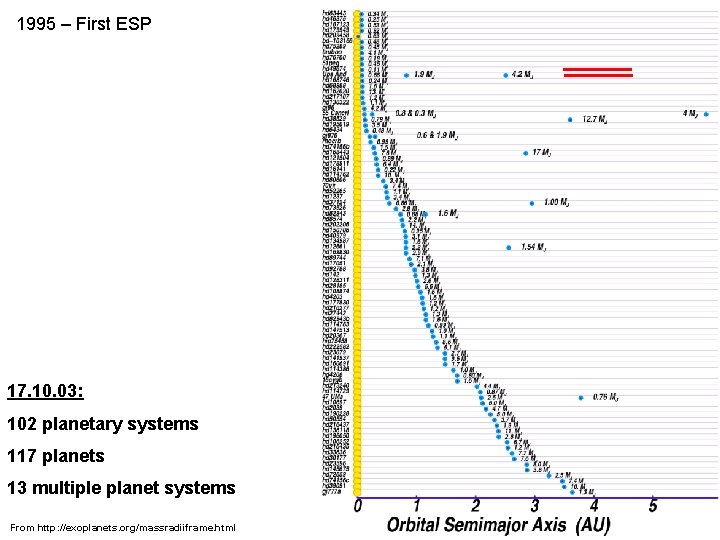
1995 – First ESP 17. 10. 03: 102 planetary systems 117 planets 13 multiple planet systems From http: //exoplanets. org/massradiiframe. html
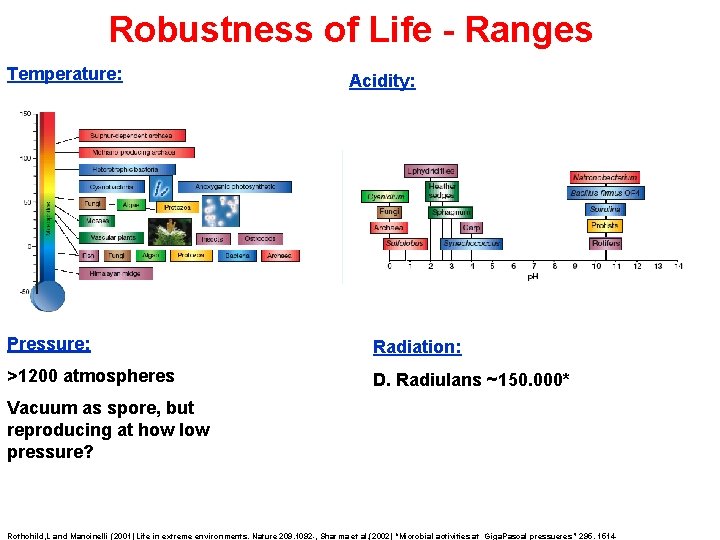
Robustness of Life - Ranges Temperature: Acidity: Pressure: Radiation: >1200 atmospheres D. Radiulans ~150. 000* Vacuum as spore, but reproducing at how low pressure? Rothchild, L and Mancinelli (2001) Life in extreme environments. Nature 209. 1092 -, Sharma et al. (2002) “Microbial activities at Giga. Pascal pressueres” 295. 1514 -
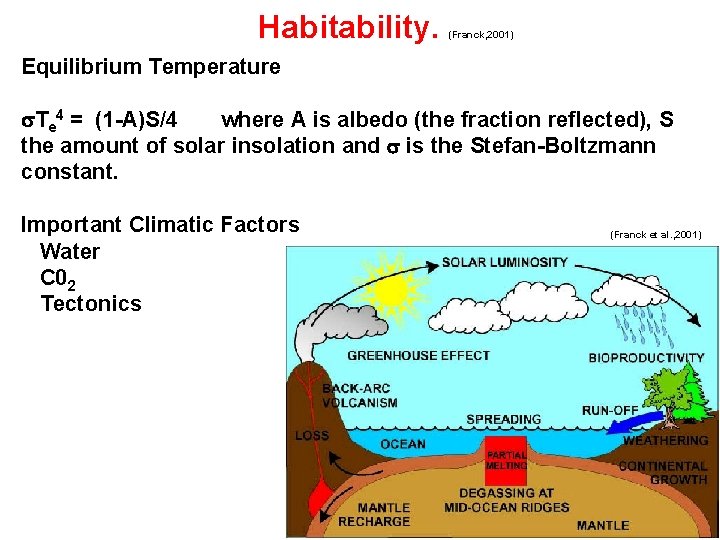
Habitability. (Franck, 2001) Equilibrium Temperature s. Te 4 = (1 -A)S/4 where A is albedo (the fraction reflected), S the amount of solar insolation and s is the Stefan-Boltzmann constant. Important Climatic Factors Water C 02 Tectonics (Franck et al. , 2001)
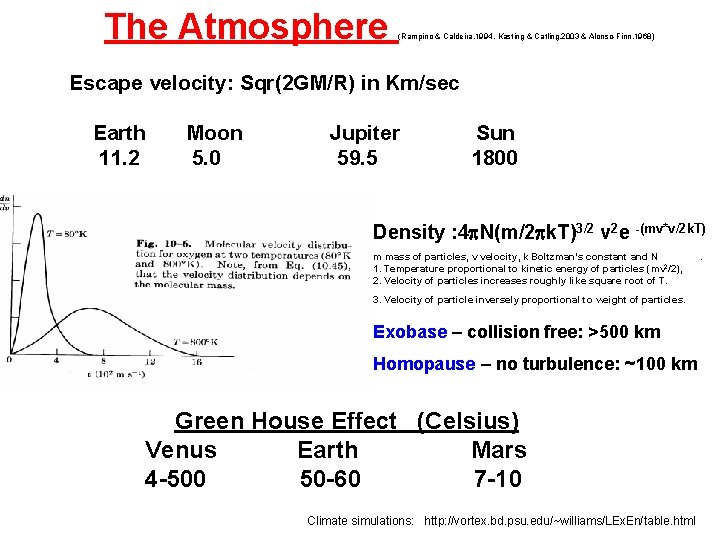
The Atmosphere (Rampino & Caldeira, 1994, Kasting & Catling, 2003 & Alonso-Finn, 1968) Escape velocity: Sqr(2 GM/R) in Km/sec Earth Moon Jupiter Sun 11. 2 5. 0 59. 5 1800 Density : 4 p. N(m/2 pk. T)3/2 v 2 e -(mv*v/2 k. T) m mass of particles, v velocity, k Boltzman's constant and N . 1. Temperature proportional to kinetic energy of particles (mv 2/2), 2. Velocity of particles increases roughly like square root of T. 3. Velocity of particle inversely proportional to weight of particles. Exobase – collision free: >500 km Homopause – no turbulence: ~100 km Green House Effect (Celsius) Venus Earth Mars 4 -500 50 -60 7 -10 Climate simulations: http: //vortex. bd. psu. edu/~williams/LEx. En/table. html
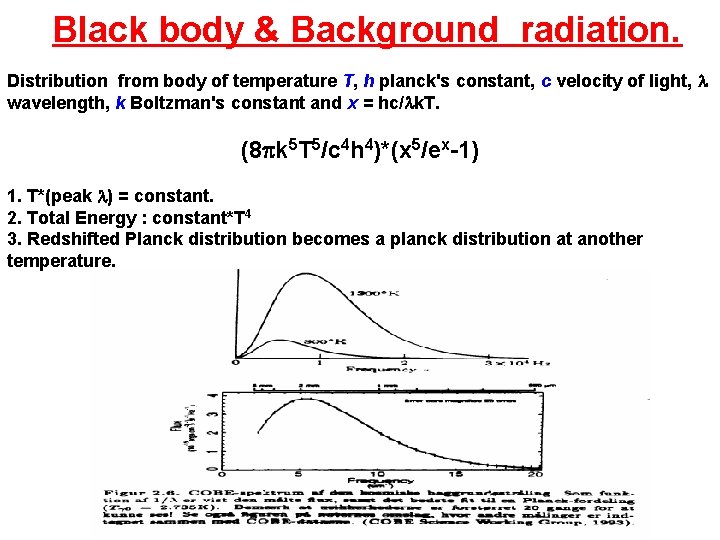
Black body & Background radiation. Distribution from body of temperature T, h planck's constant, c velocity of light, l wavelength, k Boltzman's constant and x = hc/lk. T. (8 pk 5 T 5/c 4 h 4)*(x 5/ex-1) 1. T*(peak l) = constant. 2. Total Energy : constant*T 4 3. Redshifted Planck distribution becomes a planck distribution at another temperature.
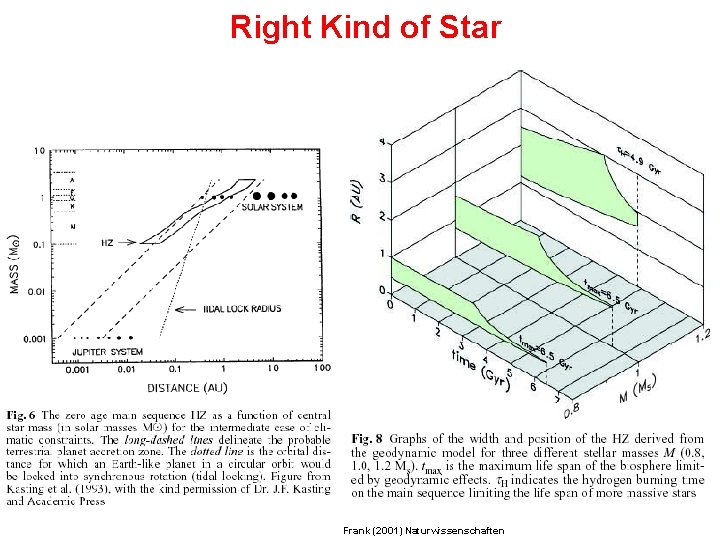
Habitability. Venus - No H 2 O = > no removal of CO 2 from atmosphere by weathering. Earth - The CO 2 is tied up in Ca. CO 3 Mars - Too low temperature & gravity, so no greenhouse developed. No tectonics=> no return of CO 2 to atmosphere. Continuously Habitable Zone - (CHZ)- Water for Billions of Years: HZ: . 95 -1. 37 AU CHZ: . 95 -1. 15 Main Problem: The Sun's increasing luminosity means that the HZ should move out through the solar system. S(t) = S 0/(1 -. 38 t/t 0) -4. 5 Gyr < t < 4. 77 (t 0 = 4. 55 Gyr)
Right Kind of Star Frank (2001) Naturwissenschaften
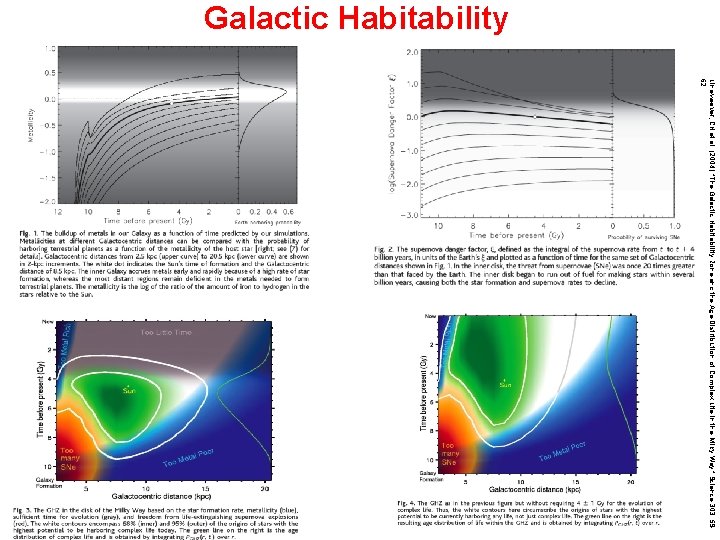
Galactic Habitability Lineweaver, CH et al. (2004) “The Galactic Habitability Zone and the Age Distribution of Complex Life in the Milky Way” Science 303. 5962.
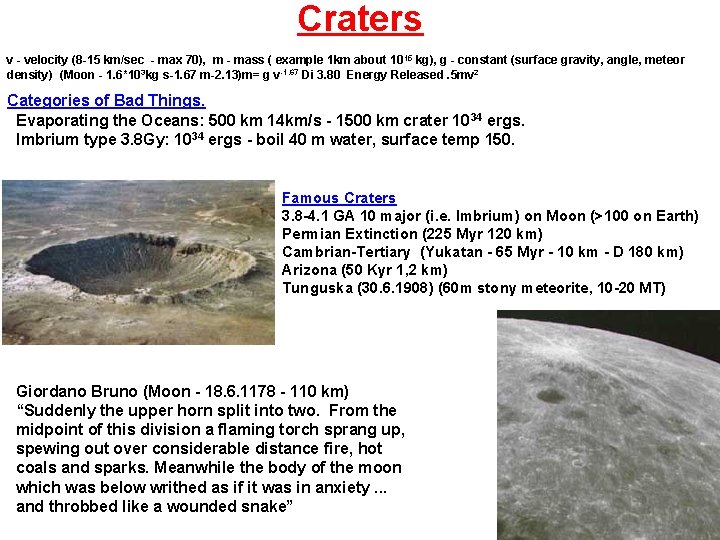
Craters v - velocity (8 -15 km/sec - max 70), m - mass ( example 1 km about 1015 kg), g - constant (surface gravity, angle, meteor density) (Moon - 1. 6*103 kg s-1. 67 m-2. 13)m= g v-1. 67 Di 3. 80 Energy Released. 5 mv 2 Categories of Bad Things. Evaporating the Oceans: 500 km 14 km/s - 1500 km crater 1034 ergs. Imbrium type 3. 8 Gy: 1034 ergs - boil 40 m water, surface temp 150. Famous Craters 3. 8 -4. 1 GA 10 major (i. e. Imbrium) on Moon (>100 on Earth) Permian Extinction (225 Myr 120 km) Cambrian-Tertiary (Yukatan - 65 Myr - 10 km - D 180 km) Arizona (50 Kyr 1, 2 km) Tunguska (30. 6. 1908) (60 m stony meteorite, 10 -20 MT) Giordano Bruno (Moon - 18. 6. 1178 - 110 km) “Suddenly the upper horn split into two. From the midpoint of this division a flaming torch sprang up, spewing out over considerable distance fire, hot coals and sparks. Meanwhile the body of the moon which was below writhed as if it was in anxiety. . . and throbbed like a wounded snake”
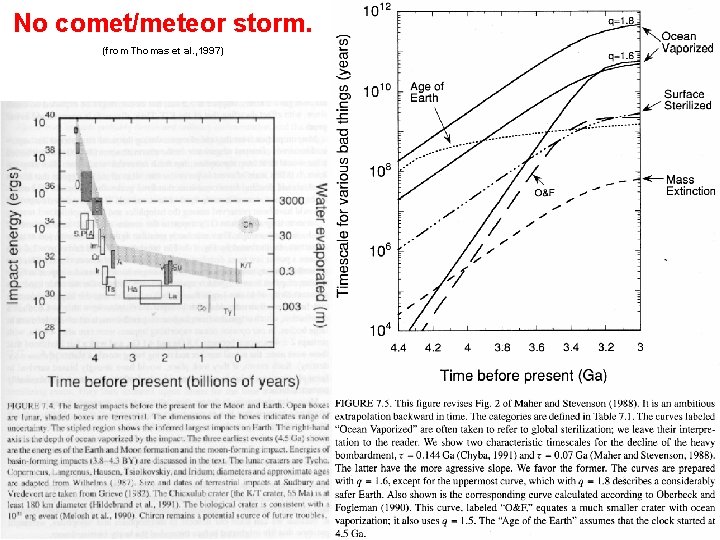
No comet/meteor storm. (from Thomas et al. , 1997)
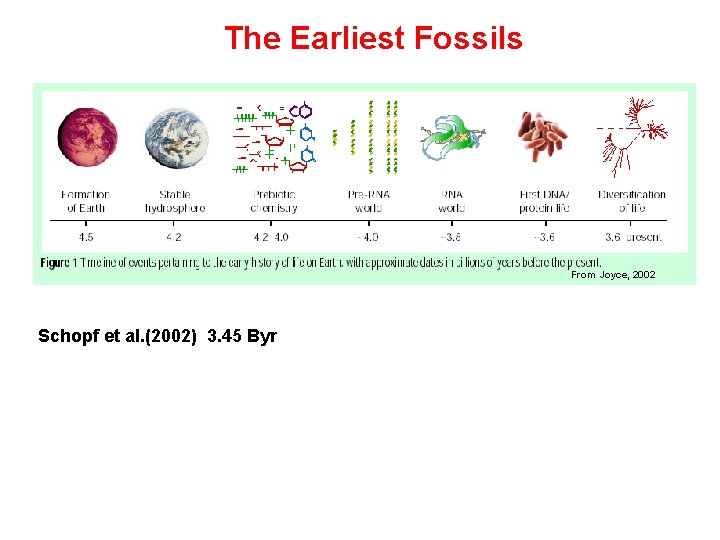
The Earliest Fossils From Joyce, 2002 Schopf et al. (2002) 3. 45 Byr
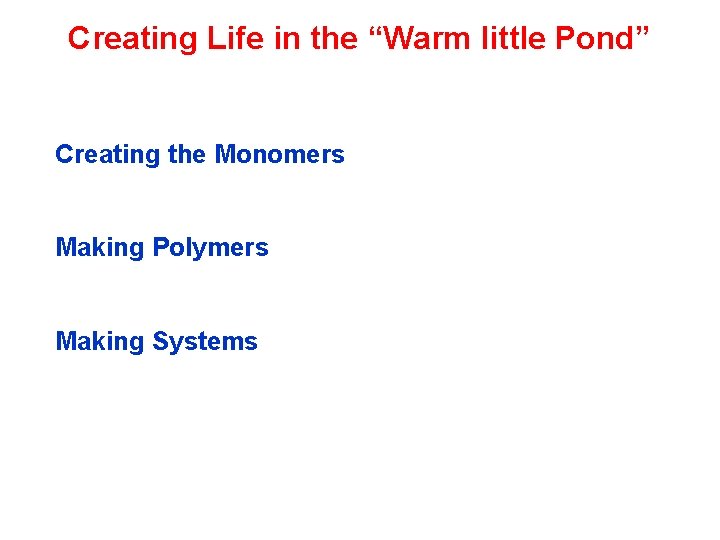
Creating Life in the “Warm little Pond” Creating the Monomers Making Polymers Making Systems
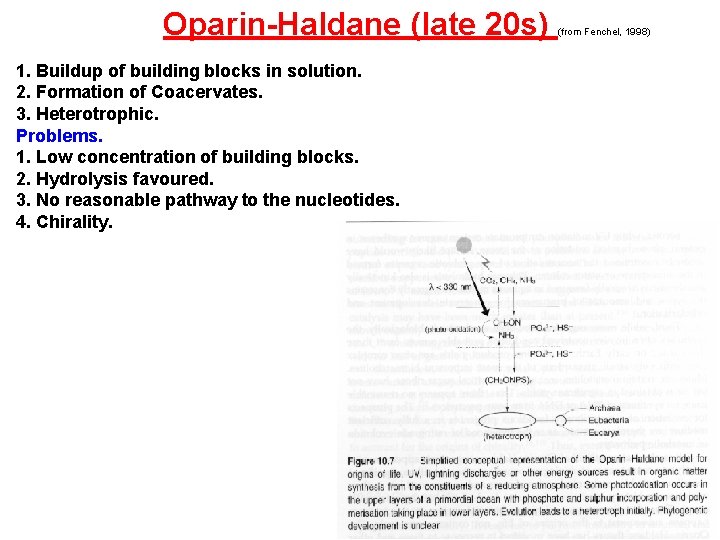
Oparin-Haldane (late 20 s) 1. Buildup of building blocks in solution. 2. Formation of Coacervates. 3. Heterotrophic. Problems. 1. Low concentration of building blocks. 2. Hydrolysis favoured. 3. No reasonable pathway to the nucleotides. 4. Chirality. (from Fenchel, 1998)
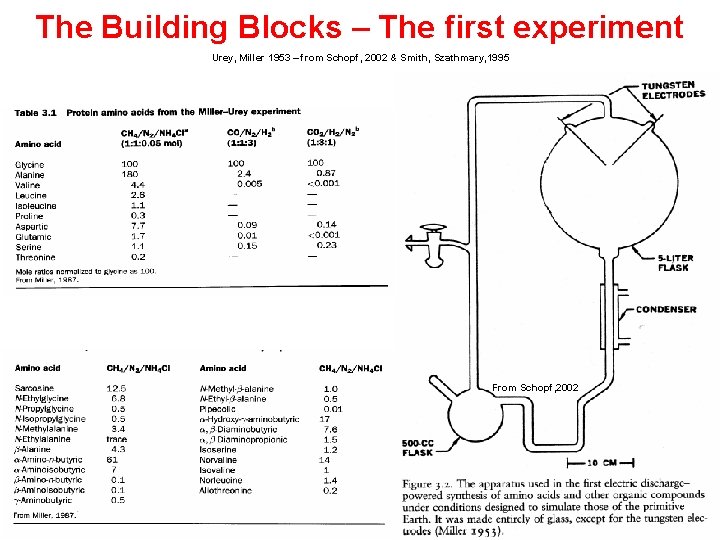
The Building Blocks – The first experiment Urey, Miller 1953 – from Schopf, 2002 & Smith, Szathmary, 1995 From Schopf, 2002
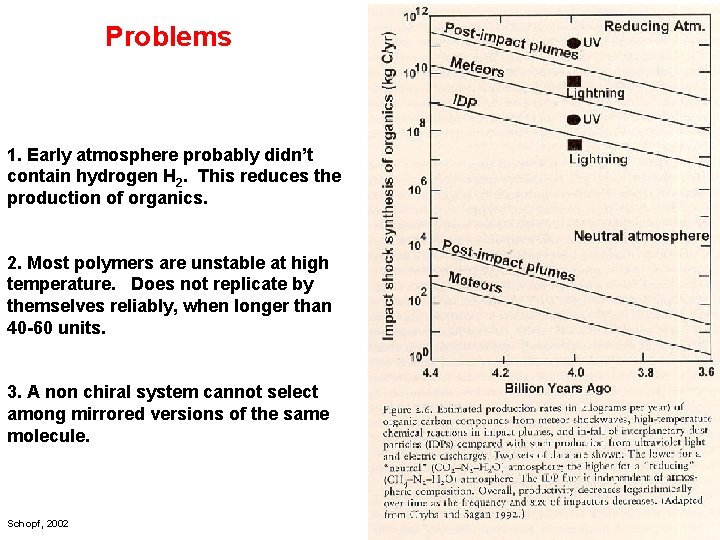
Problems 1. Early atmosphere probably didn’t contain hydrogen H 2. This reduces the production of organics. 2. Most polymers are unstable at high temperature. Does not replicate by themselves reliably, when longer than 40 -60 units. 3. A non chiral system cannot select among mirrored versions of the same molecule. Schopf, 2002
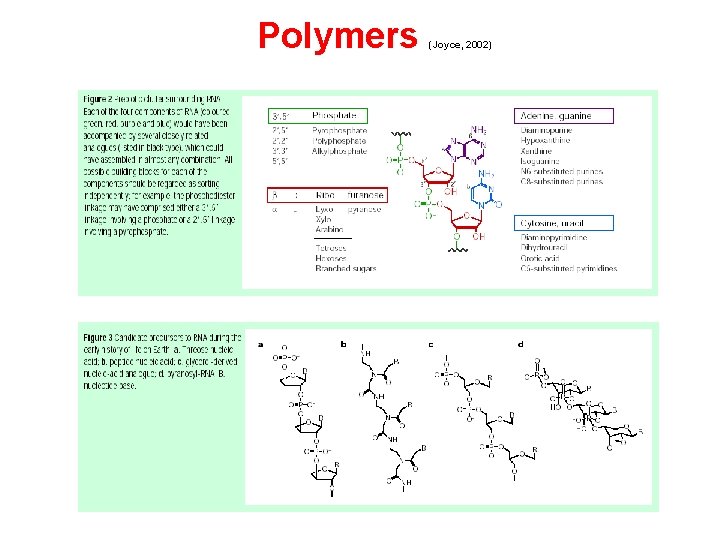
Polymers (Joyce, 2002)
Chirality. Biological Importance of Chirality: i. Is chirality a necessity for life? ii. Life will probably lead to chirality. Questions: 1. How Many "quasi-independent" chiral decisions have been taken in Earth Life? (at least L-amino Acids & D-Sugars. By "quasiindependent" is meant that the molecules are not likely do have influenced each other.
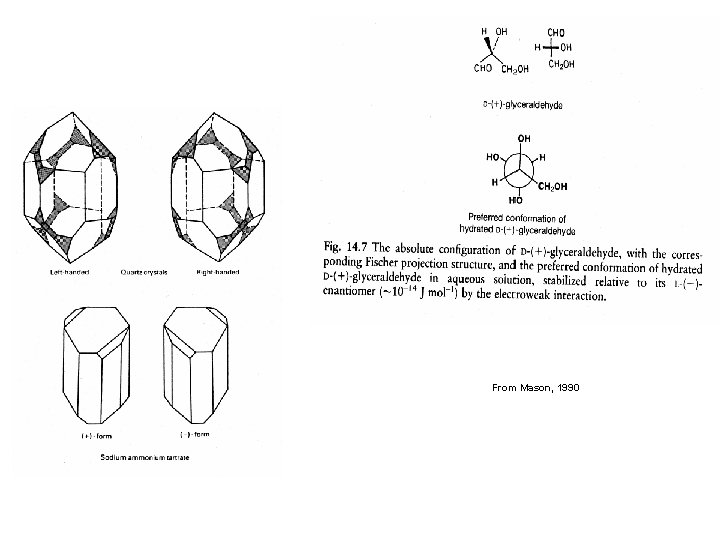
From Mason, 1990
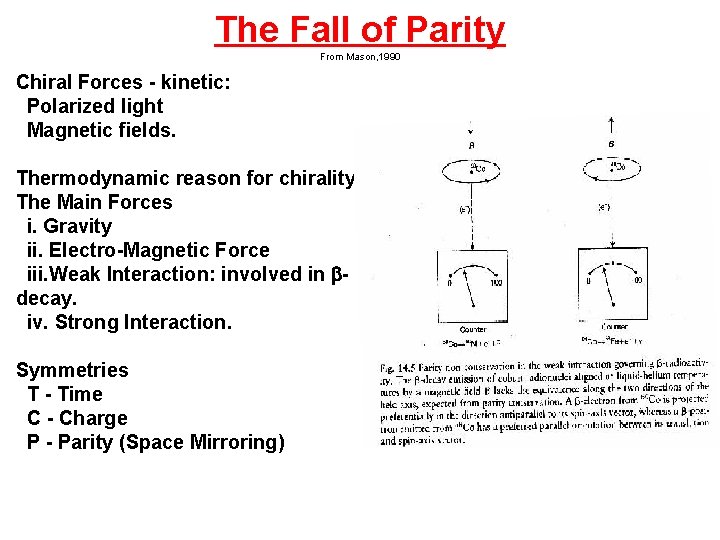
The Fall of Parity From Mason, 1990 Chiral Forces - kinetic: Polarized light Magnetic fields. Thermodynamic reason for chirality: The Main Forces i. Gravity ii. Electro-Magnetic Force iii. Weak Interaction: involved in bdecay. iv. Strong Interaction. Symmetries T - Time C - Charge P - Parity (Space Mirroring)
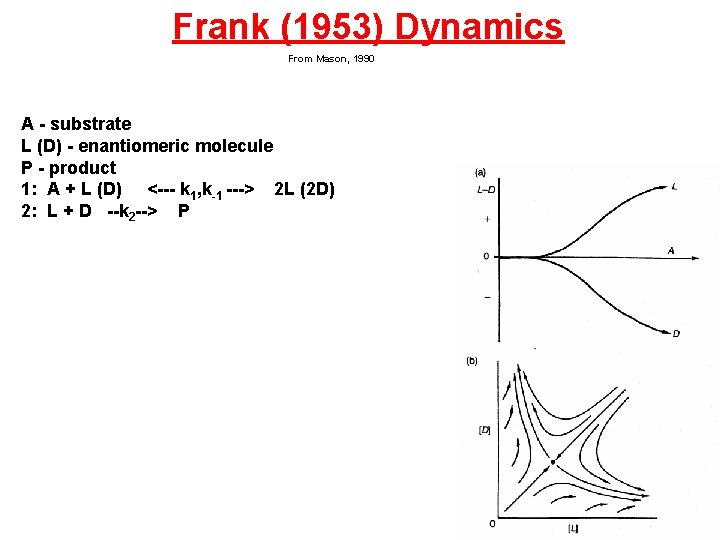
Frank (1953) Dynamics From Mason, 1990 A - substrate L (D) - enantiomeric molecule P - product 1: A + L (D) <--- k 1, k-1 ---> 2 L (2 D) 2: L + D --k 2 --> P
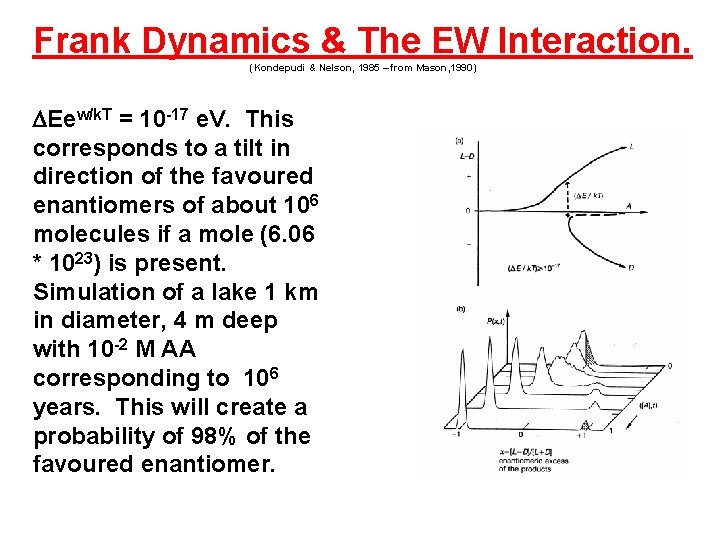
Frank Dynamics & The EW Interaction. (Kondepudi & Nelson, 1985 – from Mason, 1990) DEew/k. T = 10 -17 e. V. This corresponds to a tilt in direction of the favoured enantiomers of about 106 molecules if a mole (6. 06 * 1023) is present. Simulation of a lake 1 km in diameter, 4 m deep with 10 -2 M AA corresponding to 106 years. This will create a probability of 98% of the favoured enantiomer.
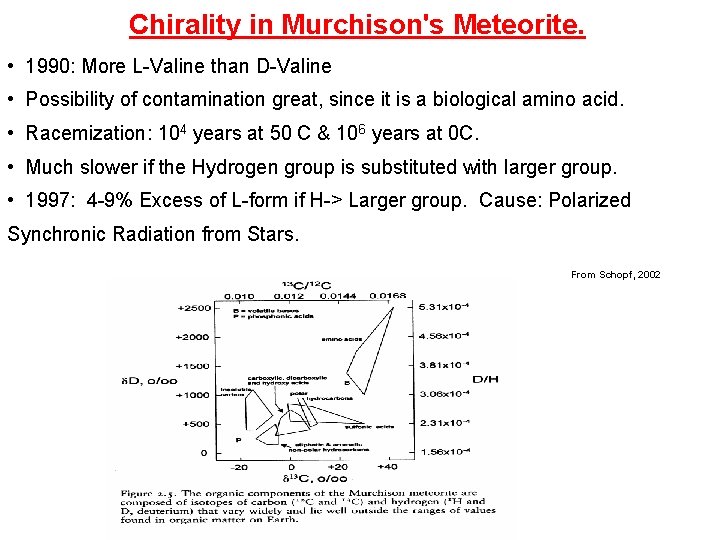
Chirality in Murchison's Meteorite. • 1990: More L-Valine than D-Valine • Possibility of contamination great, since it is a biological amino acid. • Racemization: 104 years at 50 C & 106 years at 0 C. • Much slower if the Hydrogen group is substituted with larger group. • 1997: 4 -9% Excess of L-form if H-> Larger group. Cause: Polarized Synchronic Radiation from Stars. From Schopf, 2002
From biochemical molecules to biochemical systems Made by Isvan Miklos
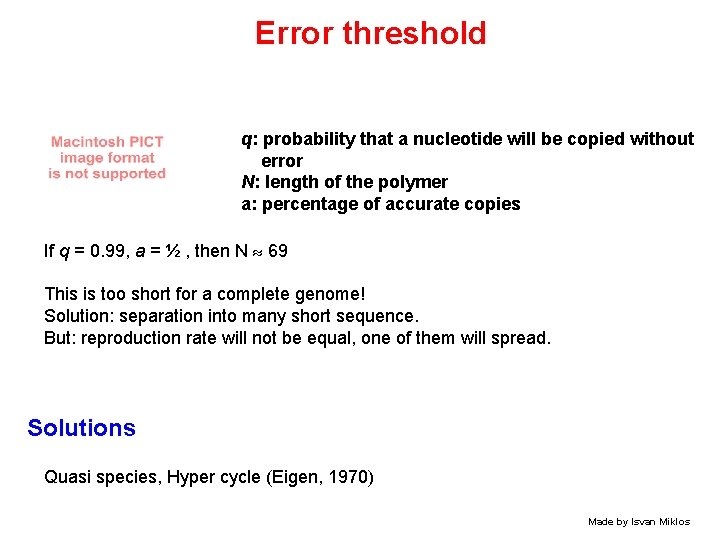
Error threshold q: probability that a nucleotide will be copied without error N: length of the polymer a: percentage of accurate copies If q = 0. 99, a = ½ , then N 69 This is too short for a complete genome! Solution: separation into many short sequence. But: reproduction rate will not be equal, one of them will spread. Solutions Quasi species, Hyper cycle (Eigen, 1970) Made by Isvan Miklos
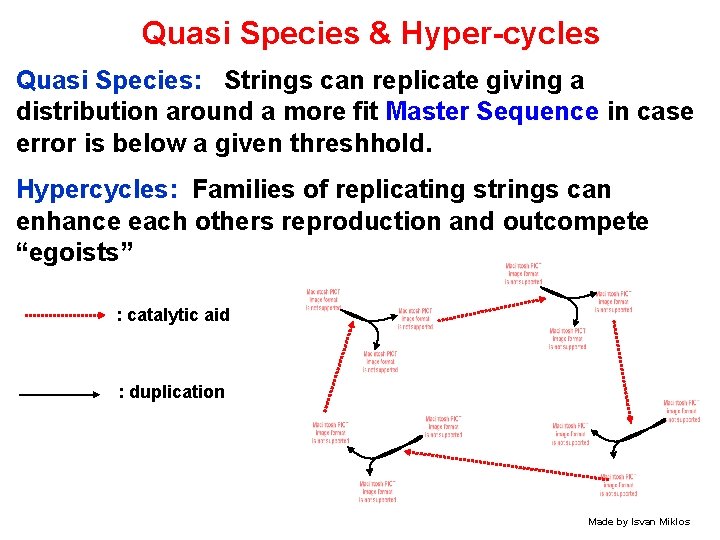
Quasi Species & Hyper-cycles Quasi Species: Strings can replicate giving a distribution around a more fit Master Sequence in case error is below a given threshhold. Hypercycles: Families of replicating strings can enhance each others reproduction and outcompete “egoists” : catalytic aid : duplication Made by Isvan Miklos
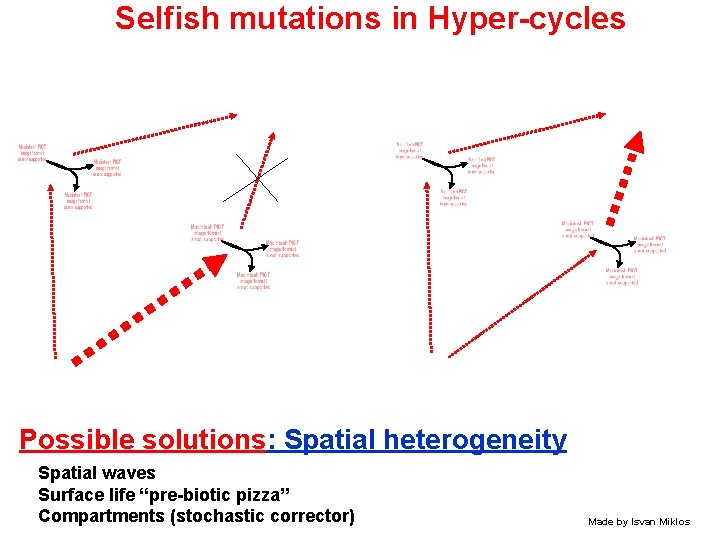
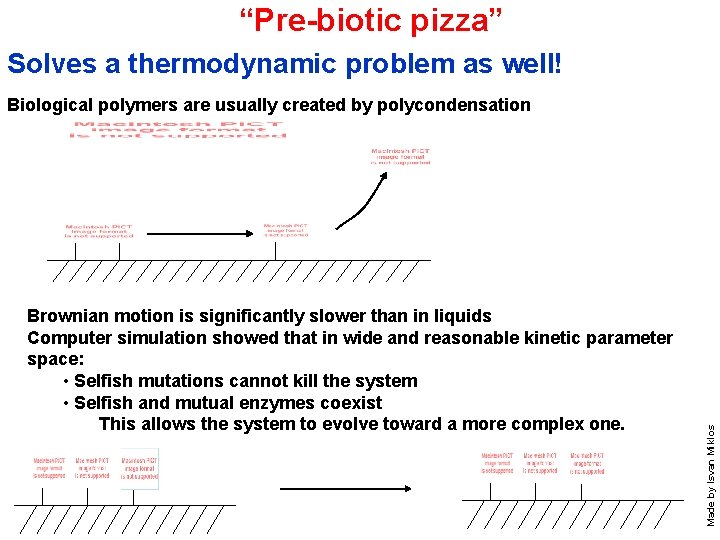
Selfish mutations in Hyper-cycles Possible solutions: Spatial heterogeneity Spatial waves Surface life “pre-biotic pizza” Compartments (stochastic corrector) Made by Isvan Miklos
“Pre-biotic pizza” Solves a thermodynamic problem as well! Brownian motion is significantly slower than in liquids Computer simulation showed that in wide and reasonable kinetic parameter space: • Selfish mutations cannot kill the system • Selfish and mutual enzymes coexist This allows the system to evolve toward a more complex one. Made by Isvan Miklos Biological polymers are usually created by polycondensation
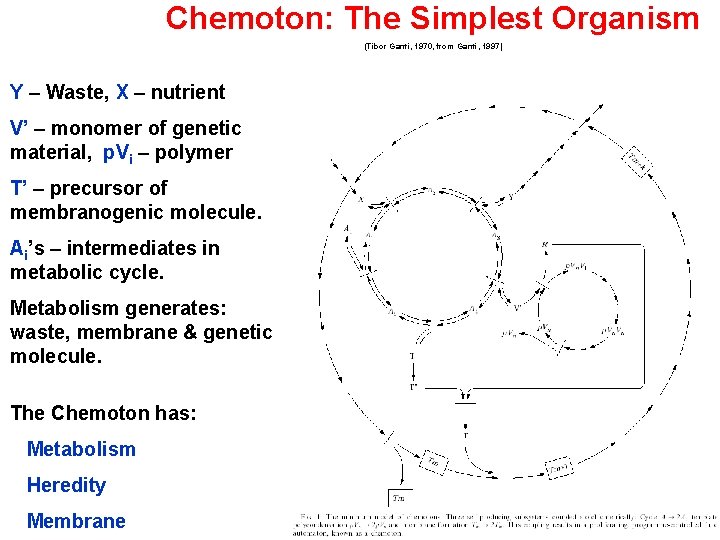
Chemoton: The Simplest Organism (Tibor Ganti, 1970, from Ganti, 1997) Y – Waste, X – nutrient V’ – monomer of genetic material, p. Vi – polymer T’ – precursor of membranogenic molecule. Ai’s – intermediates in metabolic cycle. Metabolism generates: waste, membrane & genetic molecule. The Chemoton has: Metabolism Heredity Membrane
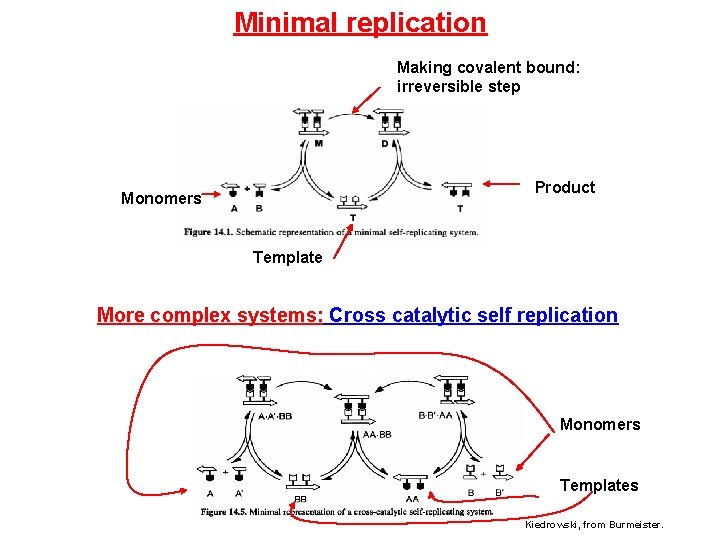
Minimal replication Making covalent bound: irreversible step Product Monomers Template More complex systems: Cross catalytic self replication Monomers Templates Von Kiedrowski, from Burmeister.
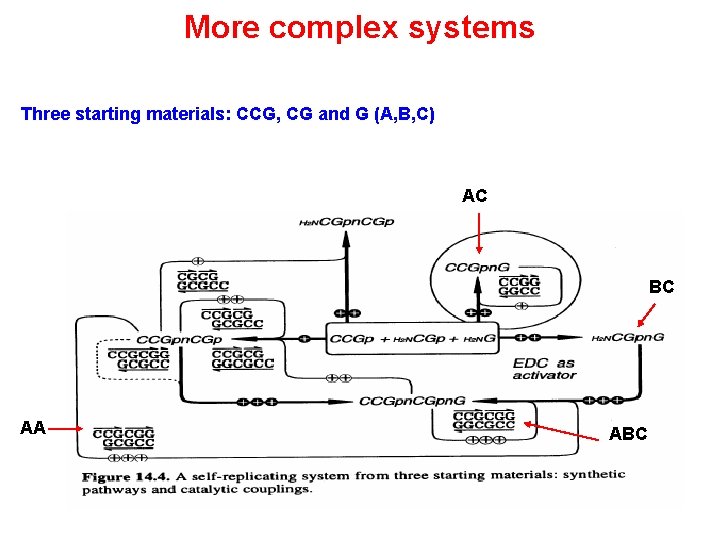
More complex systems Three starting materials: CCG, CG and G (A, B, C) AC BC AA ABC
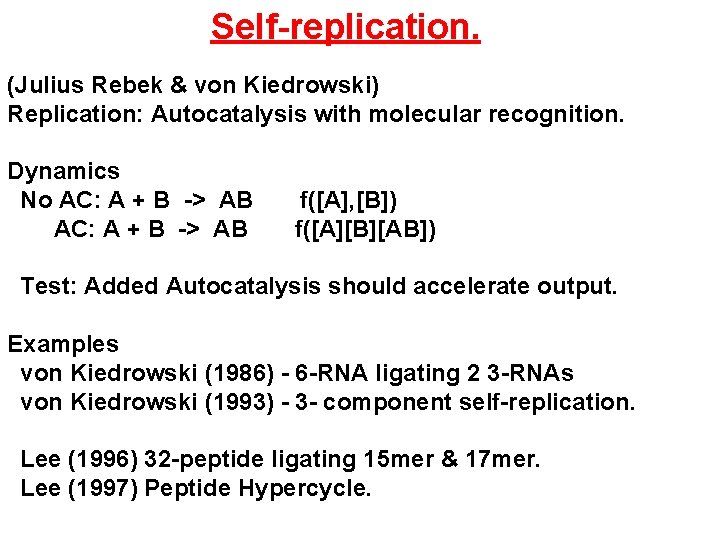
Self-replication. (Julius Rebek & von Kiedrowski) Replication: Autocatalysis with molecular recognition. Dynamics No AC: A + B -> AB f([A], [B]) AC: A + B -> AB f([A][B][AB]) Test: Added Autocatalysis should accelerate output. Examples von Kiedrowski (1986) - 6 -RNA ligating 2 3 -RNAs von Kiedrowski (1993) - 3 - component self-replication. Lee (1996) 32 -peptide ligating 15 mer & 17 mer. Lee (1997) Peptide Hypercycle.
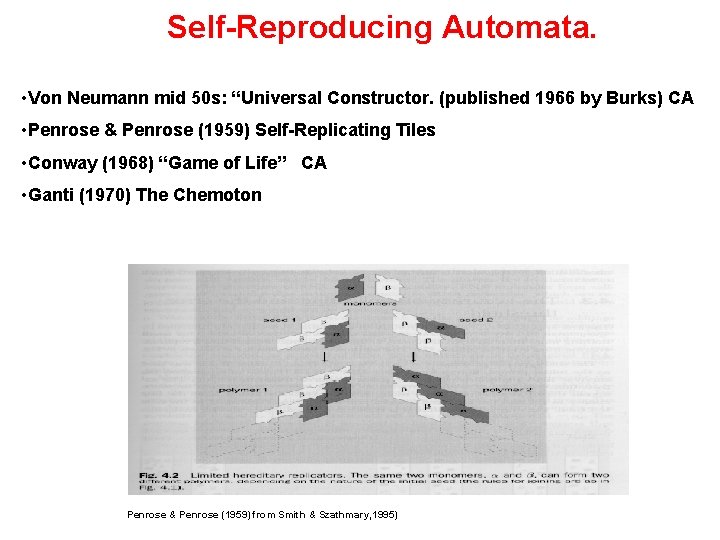
Self-Reproducing Automata. • Von Neumann mid 50 s: “Universal Constructor. (published 1966 by Burks) CA • Penrose & Penrose (1959) Self-Replicating Tiles • Conway (1968) “Game of Life” CA • Ganti (1970) The Chemoton Penrose & Penrose (1959) from Smith & Szathmary, 1995)
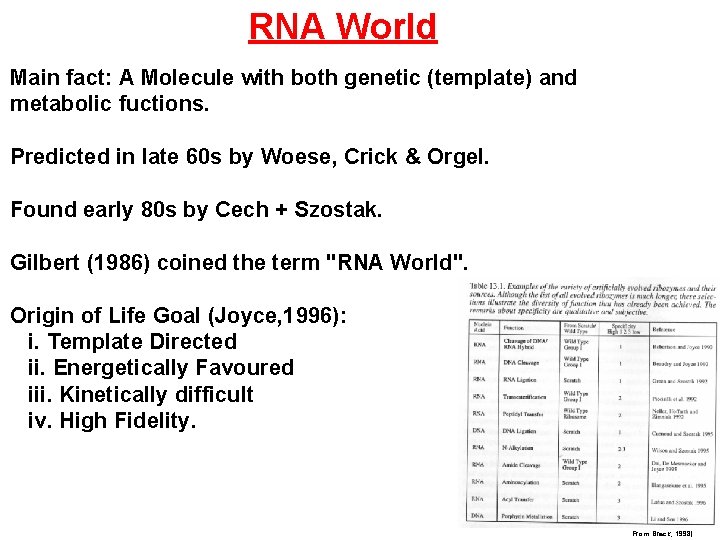
RNA World Main fact: A Molecule with both genetic (template) and metabolic fuctions. Predicted in late 60 s by Woese, Crick & Orgel. Found early 80 s by Cech + Szostak. Gilbert (1986) coined the term "RNA World". Origin of Life Goal (Joyce, 1996): i. Template Directed ii. Energetically Favoured iii. Kinetically difficult iv. High Fidelity. From Brack, 1998)
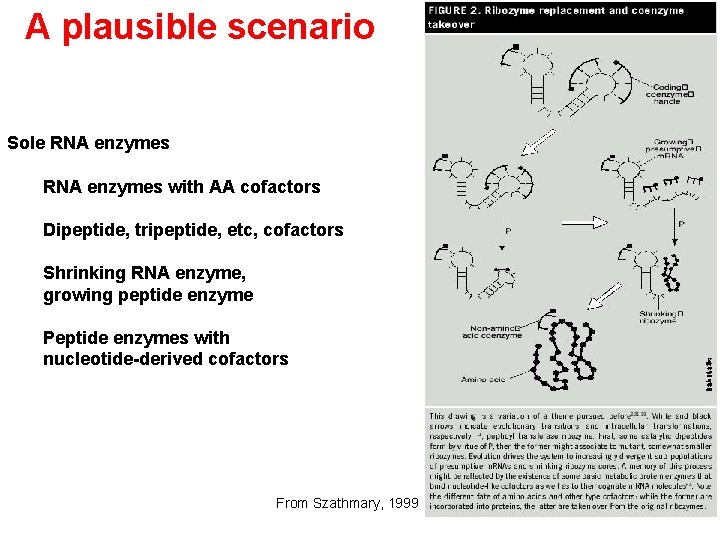
From RNA world to protein world Fact: protein enzymes have better catalytic activity than RNA enzymes have. (20 amino acids vs. 4 nucleic acids) But: Evolution is myopic: an event happening now wouldn’t be selected for just because it will turn out advantageous million years later Therefore we need a plausible scenario
A plausible scenario Sole RNA enzymes with AA cofactors Dipeptide, tripeptide, etc, cofactors Shrinking RNA enzyme, growing peptide enzyme Peptide enzymes with nucleotide-derived cofactors From Szathmary, 1999
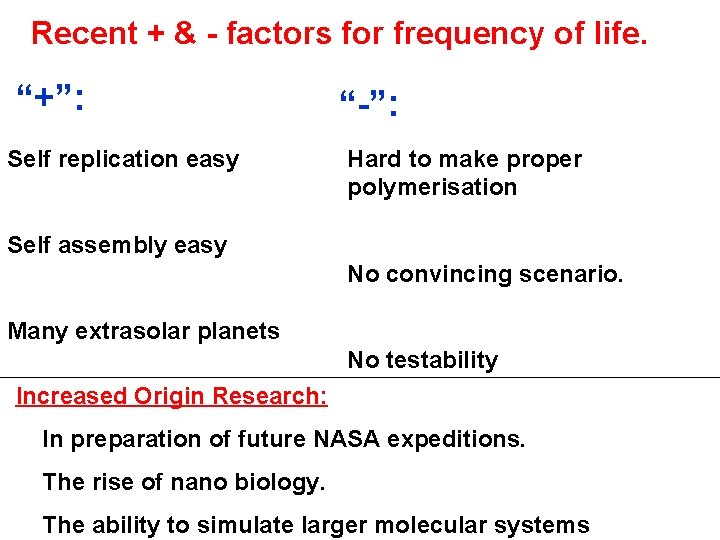
Recent + & - factors for frequency of life. “+”: Self replication easy “-”: Hard to make proper polymerisation Self assembly easy No convincing scenario. Many extrasolar planets No testability Increased Origin Research: In preparation of future NASA expeditions. The rise of nano biology. The ability to simulate larger molecular systems
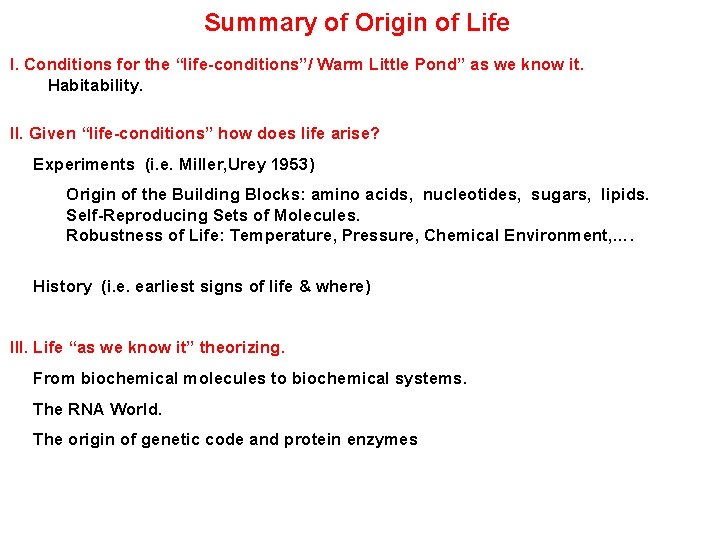
Summary of Origin of Life I. Conditions for the “life-conditions”/ Warm Little Pond” as we know it. Habitability. II. Given “life-conditions” how does life arise? Experiments (i. e. Miller, Urey 1953) Origin of the Building Blocks: amino acids, nucleotides, sugars, lipids. Self-Reproducing Sets of Molecules. Robustness of Life: Temperature, Pressure, Chemical Environment, …. History (i. e. earliest signs of life & where) III. Life “as we know it” theorizing. From biochemical molecules to biochemical systems. The RNA World. The origin of genetic code and protein enzymes
References: Books & WWW Books (2001) “Astrobiology” Bengtson ed. (1994) “Early Life on Earth” Nobel Symposium Very Good Bennet et al. (2003) “Life in the Universe” Addison-Wesley A bit popular. Ignores the difficult problems. Pretty pictures Brack, A. (ed. ) (1998) “The Molecular Origins of Life” CUP Cambridge Atlas of Astronomy (1995) CUP Great visual introduction to Astronomy Dick, S (1998) “Other Worlds” CUP Traces views on extra terrestrial life in literature and religions – surprisingly good. Fenchel, T. et al. (1998) “Bacterial Biogeochemistry” 2 nd Ed. Academic Press Ch. 10 Good overview Fenchel, T. et al. (2002) “Origins of Life and Early Evolution” OUP Good overview, not in depth about chemsitry --> life transition Ganti, T (1971, 2004) “Principle of Life” OUP Lunine, J. (2003) Astrobiology - A Multidiciplinary Approach. Good alround text book. No detailed discussion of theories. Mason, SF (1990) “Chemical Evolution” OUP Highly readable. Maynard Smith, J & E. Szathmary (1995) “Major Transitions in Evolution. ” Chapts. 1 -7 Excellent Morowitz, H. (1992) “Beginings of Cellular Life. ” Schopf, W (ed. ) (2002) “Origin of Life” California Good, basic – a bit old fashioned. Sigmund, K. (1991) “Games of Life” Penguin chapt. 1 excellent introduction to self-reproducing automata Thomas, P. et al. (eds)(1997) Comets and the Origin and Evolution of Life. Springer Good - somewhat specialized toward comets & “bad things”. WWW http: //web 99. arc. nasa. gov/abscon 2/ http: //www. scripps. edu/skaggs/rebek/ http: //nai. arc. nasa. gov/index. cfm http: //www. gla. ac. uk/Project/originoflife/ http: //icarus. cornell. edu/ http: //www. issol. org/ http: //cca. arc. nasa. gov/ http: //exoplanets. org/ http: //www. seti-inst. edu/Welcome. html http: //www. liebertpub. com/AST/default 1. asp http: //icarus. cornell. edu/journal/To. C/index. html http: //vortex. bd. psu. edu/~williams/LEx. En/table. html
References: Articles Artificial Life vol 4. 3 (1998) Special Issue on Self Replicating Automata. Bailey, J. (2001) “Astronomical Sources of Circularly Polarized Light and the Origin of Homochirality” Origins of Life & Evolution of the Biosphere 31. 167 -183. Czaran, T. & Szathmary, E. (2000) Coexistence of replicators in prebiotic evolution. In: Dieckmann, U. , Law, R. , Metz, J. A. J. (eds. ) The geometry of ecological interactions: simplifying spatial complexity. HASA and Cambridge University Press. 2000 pp 116 -134. Franck et al. (2001) “Planetary Habitability” Naturwissenschaften 88. 416 -426. Ganti, T. (1997) “Biogenesis Itself” J. Theor. Biol. 187. 583 -593 Joyce, GF (2002) “The antiquity of RNA-based evolution” Nature 418. 214 -221 Kasting, J & D. Catling (2003) “Evolution of a Habitable Planet” Annu. Rev. Astron. Astrophys. 41. 429 -63 Michael R Rampino and Ken Caldeira ”The Goldilocks Problem: Climatic Evolution and Long-Term Habitability of Terrestrial Planets” Annu. Rev. Astron. Astophys. 1994, Vol. 32: 83 -114 Santos, NC, W. Benz and M. Mayor (2005)“Extrasolar Planets: Constraints for Planet Formation Models” Scienece 310. 2515. Scyba, CF and KP Hand (2005) “Astrobiology: The Study of the Living Universe” Nnu. Rev. Astron. Astrophys. 43. 31 -74 Szathmary, E (1999) The origin of the genetic code: amino acids as cofactors in an RNA world. Trends in Genetics, 15(6). 223 -229. Szostak, J et al. (2001) “Synthesizing life” Nature 409. 387 -390. Shostak, GS (2003) “ Searching for sentience: SETI today” International Journal of Astrobiology 2. 2. 111 -4 Zintzaras, E. , Santos, M. , Szathmary, E. (2002) “Living” under the challenge of information decay: the stochastic corrector model vs. hypercycles. J. theor. Biol. 217. 167 -181.
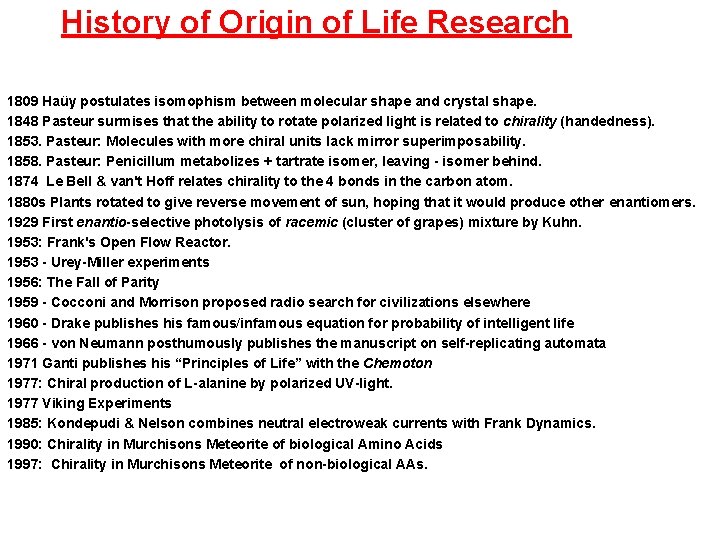
History of Origin of Life Research 1809 Haüy postulates isomophism between molecular shape and crystal shape. 1848 Pasteur surmises that the ability to rotate polarized light is related to chirality (handedness). 1853. Pasteur: Molecules with more chiral units lack mirror superimposability. 1858. Pasteur: Penicillum metabolizes + tartrate isomer, leaving - isomer behind. 1874 Le Bell & van't Hoff relates chirality to the 4 bonds in the carbon atom. 1880 s Plants rotated to give reverse movement of sun, hoping that it would produce other enantiomers. 1929 First enantio-selective photolysis of racemic (cluster of grapes) mixture by Kuhn. 1953: Frank's Open Flow Reactor. 1953 - Urey-Miller experiments 1956: The Fall of Parity 1959 - Cocconi and Morrison proposed radio search for civilizations elsewhere 1960 - Drake publishes his famous/infamous equation for probability of intelligent life 1966 - von Neumann posthumously publishes the manuscript on self-replicating automata 1971 Ganti publishes his “Principles of Life” with the Chemoton 1977: Chiral production of L-alanine by polarized UV-light. 1977 Viking Experiments 1985: Kondepudi & Nelson combines neutral electroweak currents with Frank Dynamics. 1990: Chirality in Murchisons Meteorite of biological Amino Acids 1997: Chirality in Murchisons Meteorite of non-biological AAs.