
43018 Take out your Urban Models chart from
4/30/18 - Take out your Urban Models chart from friday

Models of Urban Development

Concentric Zone Model - Theory represented the American city in a new stage of development - Before the 1870 s, cities such as New York had mixed neighborhoods where merchants’ stores and sweatshop factories were intermingled with mansions and hovels - Rich and poor, immigrant and native-born, rubbed shoulders in the same neighborhoods. In Chicago, Burgess’s home town, the great fire of 1871 leveled the core - Chicago became a segregated city with a concentric pattern - The actual map of the residential area does not exactly match his simplified concentric zones

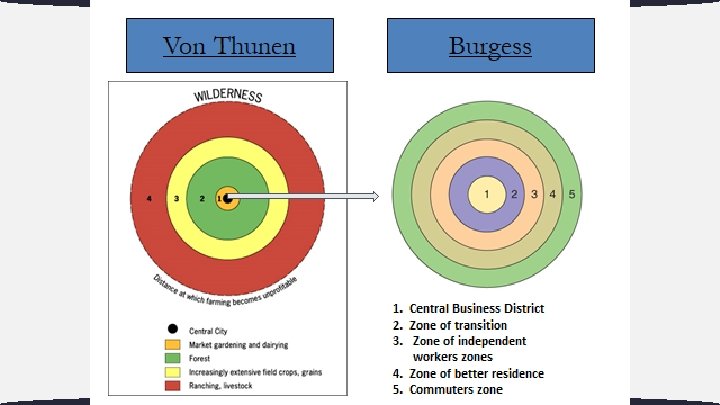
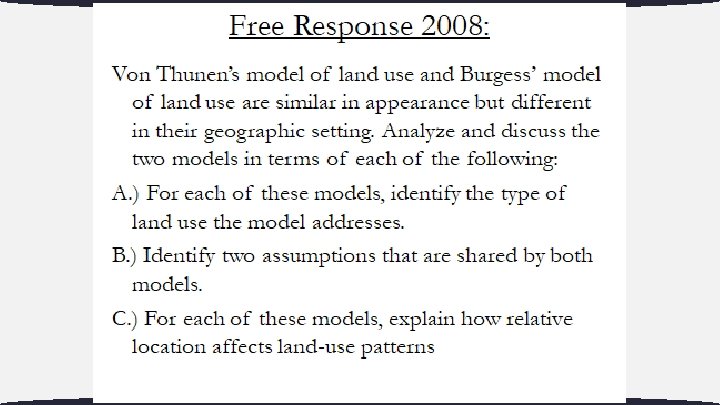
The Concentric Zone Model (Burgess Land Model) - In the concentric zone model, a city grows in a series of rings surrounding the CBD, like the rings of a tree. - The further from the CBD, the better the quality of housing - “Invasion and succession”: refers to continued expansion of CBD and continual push outwards of zones

Zones 1. CBD: nonresidential activities concentrated 2. Transition zone: contains industry and poor quality housing. Immigrants to city first live here 3. Working class homes: modest older homes working class 4. Zone of better residences: newer, more spacious homes 5. Commuter’s Zone: beyond built-up area of the city
Critics of the model - Pointed out even though portions of each zone did exist, rarely were they linked to totally surround the city - Burgess countered there were distinct barriers, such as old industrial centers, preventing the completion of the arc - Others felt Burgess, as a sociologist, overemphasized residential patterns and did not give proper credit to other land uses
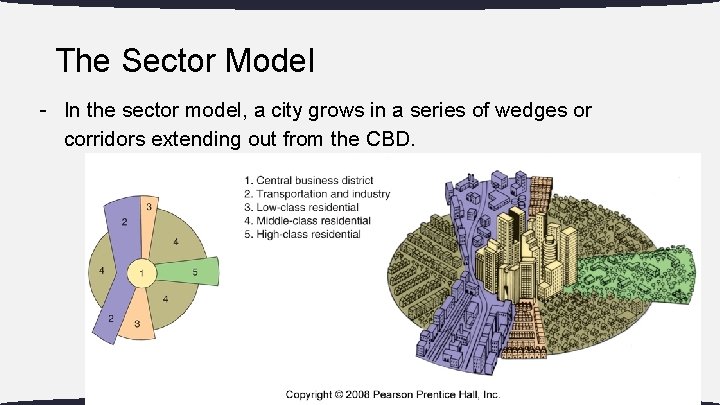
The Sector Model - In the sector model, a city grows in a series of wedges or corridors extending out from the CBD.
The Sector Model - As high-rent sectors develop, areas between them are filled in: - Middle-rent areas move directly next to them, drawing on their prestige - Low-rent areas fill remaining areas - He had the advantage of writing later than Burgess — in the age of the automobile
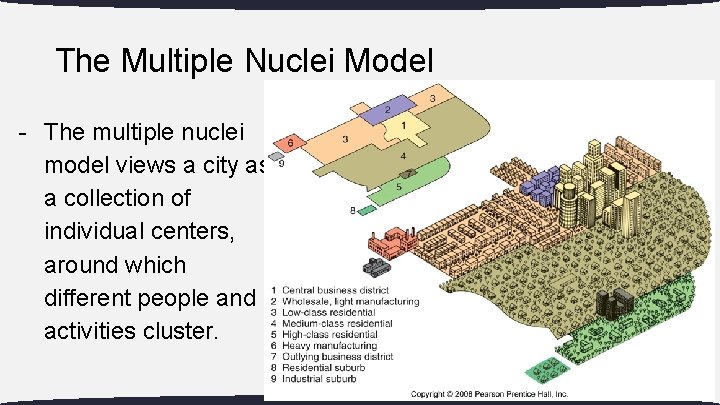
The Multiple Nuclei Model - The multiple nuclei model views a city as a collection of individual centers, around which different people and activities cluster.
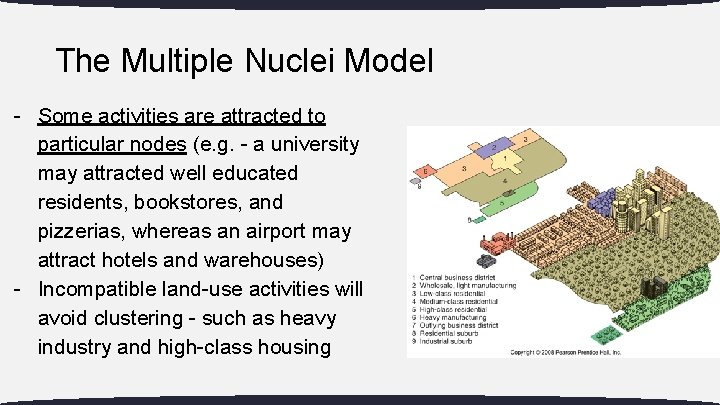
The Multiple Nuclei Model - Some activities are attracted to particular nodes (e. g. - a university may attracted well educated residents, bookstores, and pizzerias, whereas an airport may attract hotels and warehouses) - Incompatible land-use activities will avoid clustering - such as heavy industry and high-class housing
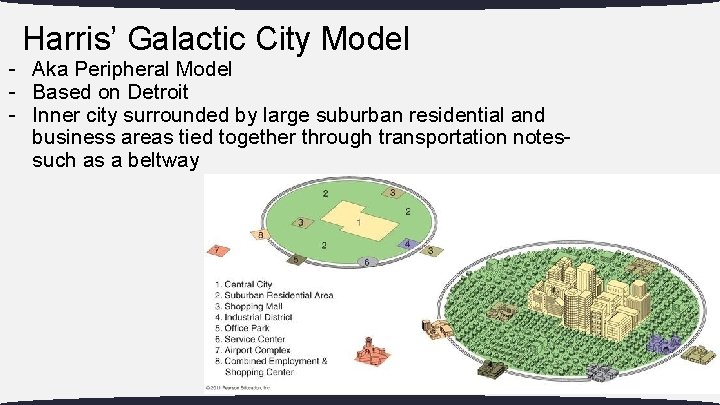
Harris’ Galactic City Model - Aka Peripheral Model - Based on Detroit - Inner city surrounded by large suburban residential and business areas tied together through transportation notessuch as a beltway
Edge Cities and the Urban Realm - Outer city, suburban downtowns, often located near key freeway intersections, often developed around regional shopping centers and industrial parks. Also can have: - office complexes hotels restaurants entertainment facilities sports complexes - May approach 100, 000 in population
Urban Sprawl and Suburbanization - Expansion of population away from central urban areas - Usually car dependent Las Vegas https: //www. flickr. com/photos/gsfc/6955987375/in/photostream/
Geographic Applications of the Models - Concentric Zone: consider 2 families with the same income and ethnic background. 1 owns their home, the other rents. The owner is more likely to live in an outer ring and the renter in inner ring - Sector Model: Given 2 families with their own homes, family with higher income will not live in same sector as lower income family - Multiple Nuclei Model: People of same racial/ethnic background likely to live near one another.
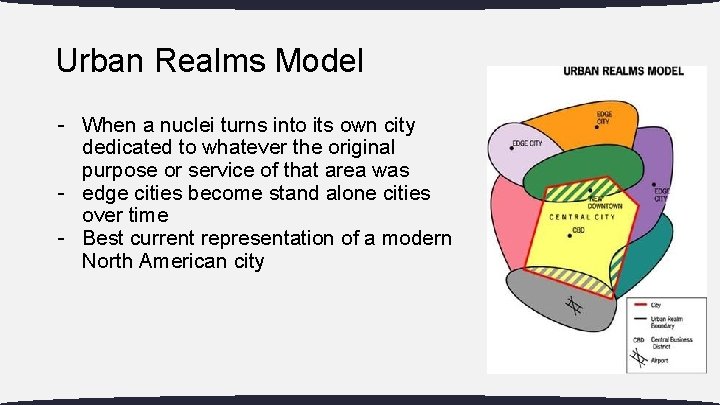
Urban Realms Model - When a nuclei turns into its own city dedicated to whatever the original purpose or service of that area was - edge cities become stand alone cities over time - Best current representation of a modern North American city
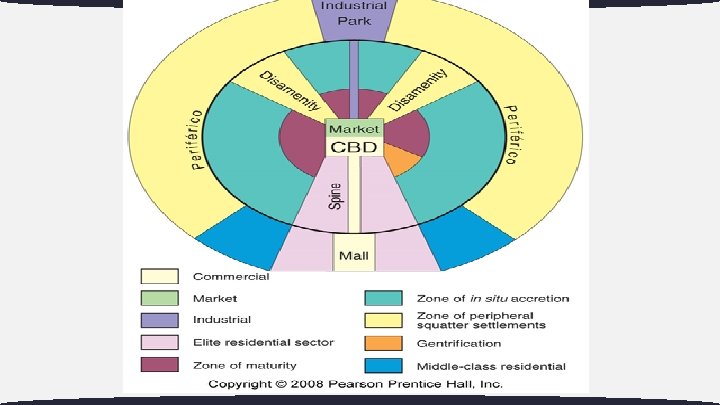
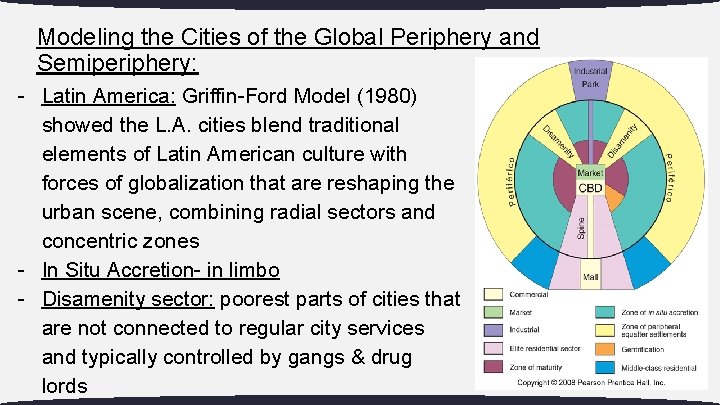
Modeling the Cities of the Global Periphery and Semiperiphery: - Latin America: Griffin-Ford Model (1980) showed the L. A. cities blend traditional elements of Latin American culture with forces of globalization that are reshaping the urban scene, combining radial sectors and concentric zones - In Situ Accretion- in limbo - Disamenity sector: poorest parts of cities that are not connected to regular city services and typically controlled by gangs & drug lords
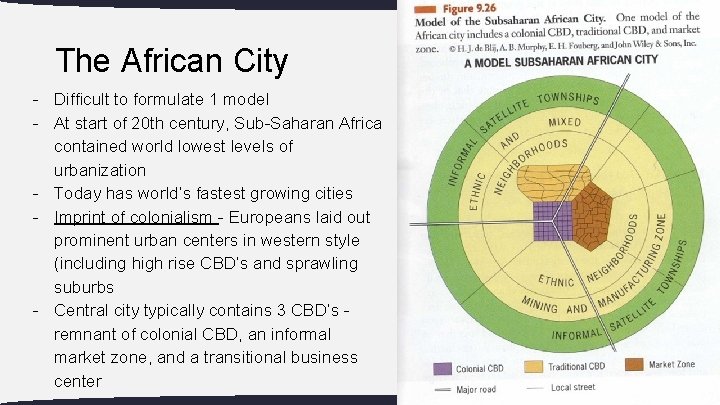
The African City - Difficult to formulate 1 model - At start of 20 th century, Sub-Saharan Africa contained world lowest levels of urbanization - Today has world’s fastest growing cities - Imprint of colonialism - Europeans laid out prominent urban centers in western style (including high rise CBD’s and sprawling suburbs - Central city typically contains 3 CBD’s remnant of colonial CBD, an informal market zone, and a transitional business center
Asian Cities - Located on coasts because built for trade - Ports are very important - Special Economic Zones: - Western companies locate here - Provide jobs (Shanghai and Mumbai) - Entrepots: cities that re-export goods that are brought into their borders, sending items to all areas of the globe - Seoul, South Korea - Singapore (city-state) - Hong Kong, China
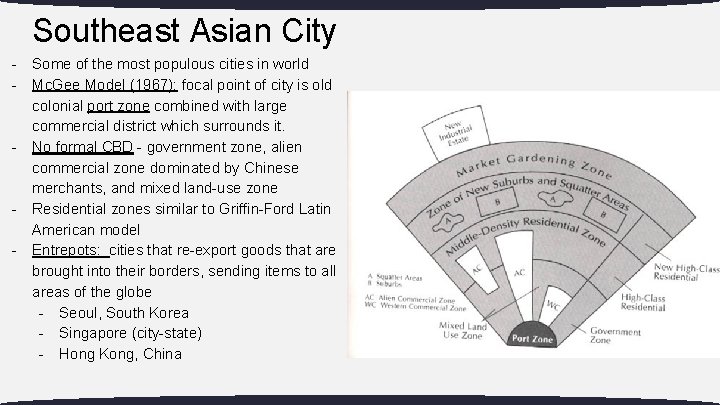
Southeast Asian City - - - Some of the most populous cities in world Mc. Gee Model (1967): focal point of city is old colonial port zone combined with large commercial district which surrounds it. No formal CBD - government zone, alien commercial zone dominated by Chinese merchants, and mixed land-use zone Residential zones similar to Griffin-Ford Latin American model Entrepots: cities that re-export goods that are brought into their borders, sending items to all areas of the globe - Seoul, South Korea - Singapore (city-state) - Hong Kong, China
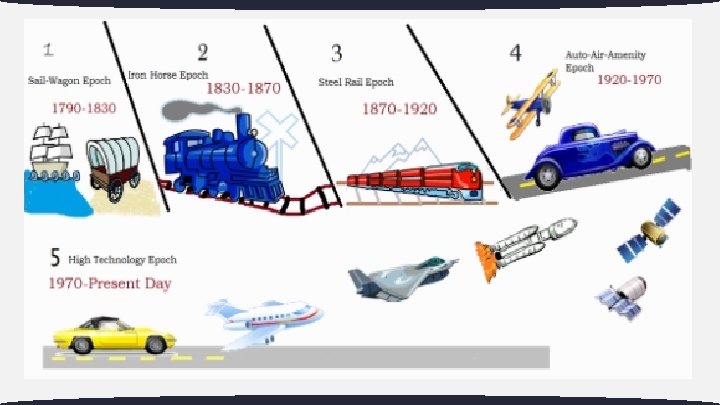
Borchert's Epochs - Refers to five distinct periods in the history of American urbanization and are also known as Borchert's model of urban evolution. - Each epoch is characterized by the impact of a particular transport technology on the creation and differential rates of growth of American cities.
The 5 Epochs - Sail-Wagon Epoch (1790– 1830), cities grow near ports and major waterways which are used for transportation; - Iron Horse Epoch (1830– 70), characterized by impact of steam engine technology, and development of steamboats and regional railroad networks; - Steel Rail Epoch (1870– 1920), dominated by the development of long haul railroads and a national railroad network; - Auto-Air-Amenity Epoch (1920– 70), with growth in the gasoline combustion engine; - High-Technology Epoch (1970–Present Day), expansion in service and information sectors of the economy

APHG FRQ Instructions - full sentences - do an outline on scratch paper - be specific- don't just say Europe… say a region or specific country- show them that you took those map quizzes!!! - NO FIRST PERSON (no “I”) - Write for someone who knows NOTHING, ex- don’t just say CBR… say Crude Birth Rate. - read over your answers!!!
- Slides: 26