Search for radio transients near Galactic centre region
- Slides: 21
Search for radio transients near Galactic centre region Sabyasachi Pal (ICRAR)
Collaborators Scott D. Hyman (USA), Subhashis Roy (NCRA, India), T. Joseph W. Lazio, Paul S. Ray, Namir E. Kassim (NRL, USA) 8 th December 2009, RRI ICRAR 2
Introduction What are transients? Why we do not see many of them in literature? What kind of sources can make transient emission? 8 th December 2009, RRI ICRAR 3
Observation and analysis strategy 8 th December 2009, RRI ICRAR 4
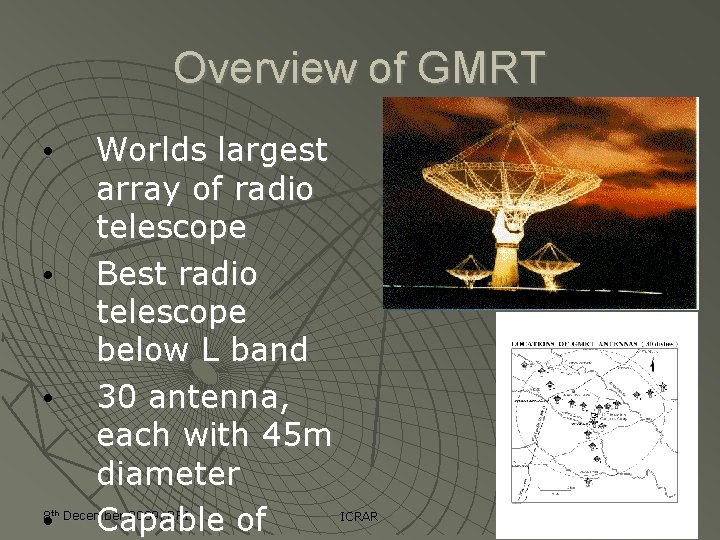
Overview of GMRT • • Worlds largest array of radio telescope Best radio telescope below L band 30 antenna, each with 45 m diameter Capable of 8 th December 2009, RRI ICRAR 5
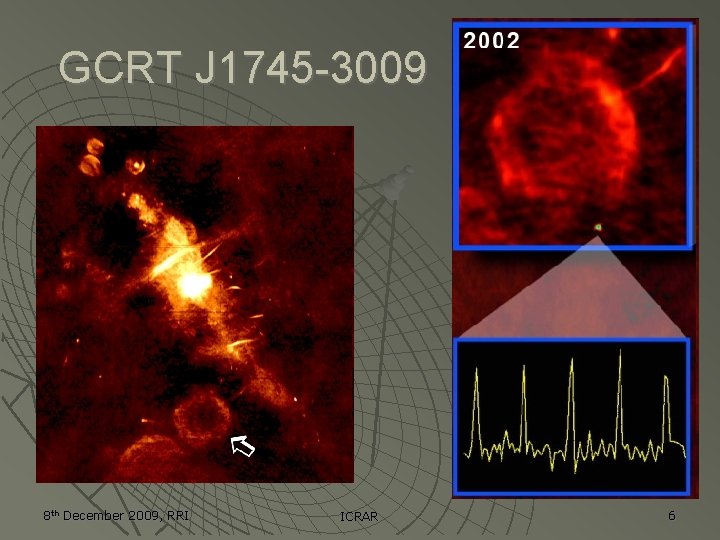
GCRT J 1745 -3009 8 th December 2009, RRI ICRAR 6
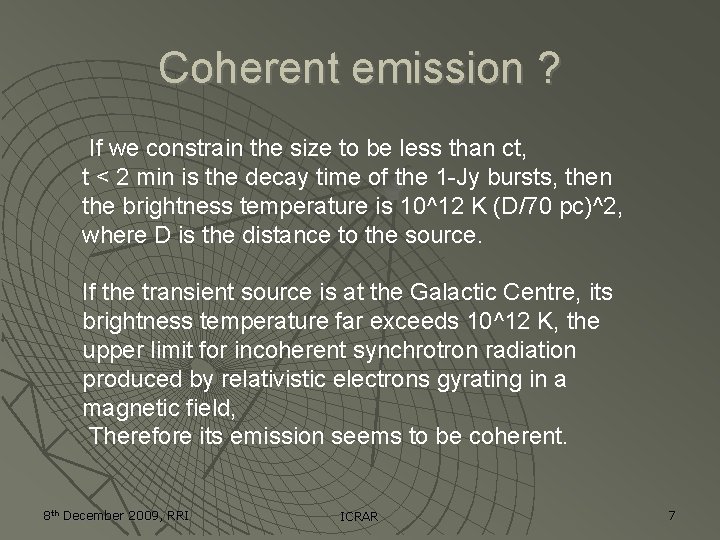
Coherent emission ? If we constrain the size to be less than ct, t < 2 min is the decay time of the 1 -Jy bursts, then the brightness temperature is 10^12 K (D/70 pc)^2, where D is the distance to the source. If the transient source is at the Galactic Centre, its brightness temperature far exceeds 10^12 K, the upper limit for incoherent synchrotron radiation produced by relativistic electrons gyrating in a magnetic field, Therefore its emission seems to be coherent. 8 th December 2009, RRI ICRAR 7
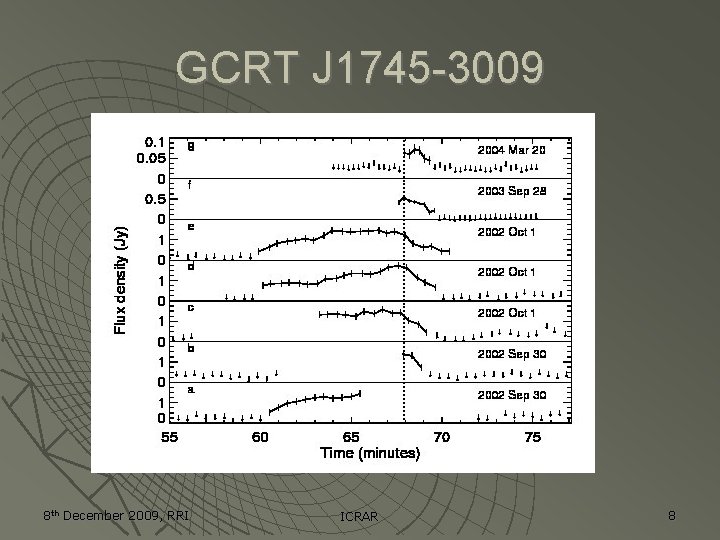
GCRT J 1745 -3009 8 th December 2009, RRI ICRAR 8
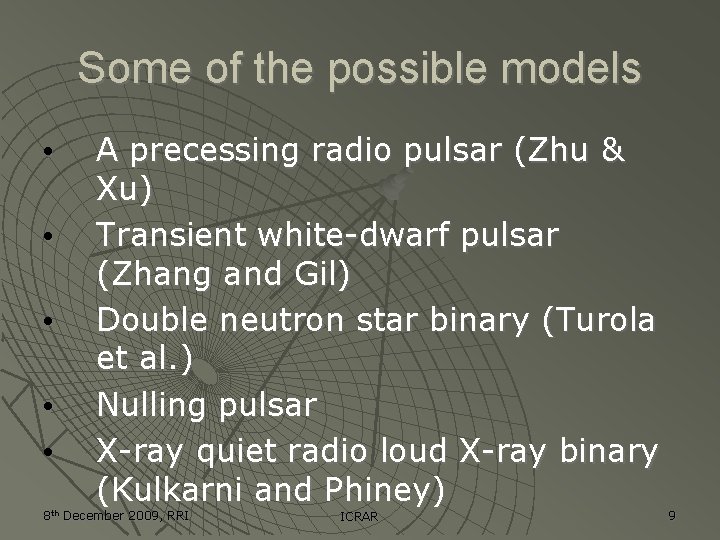
Some of the possible models • • • A precessing radio pulsar (Zhu & Xu) Transient white-dwarf pulsar (Zhang and Gil) Double neutron star binary (Turola et al. ) Nulling pulsar X-ray quiet radio loud X-ray binary (Kulkarni and Phiney) 8 th December 2009, RRI ICRAR 9
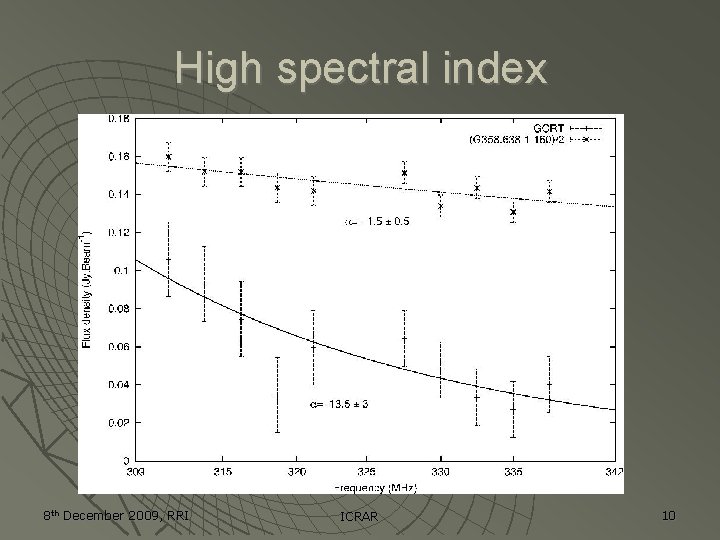
High spectral index 8 th December 2009, RRI ICRAR 10
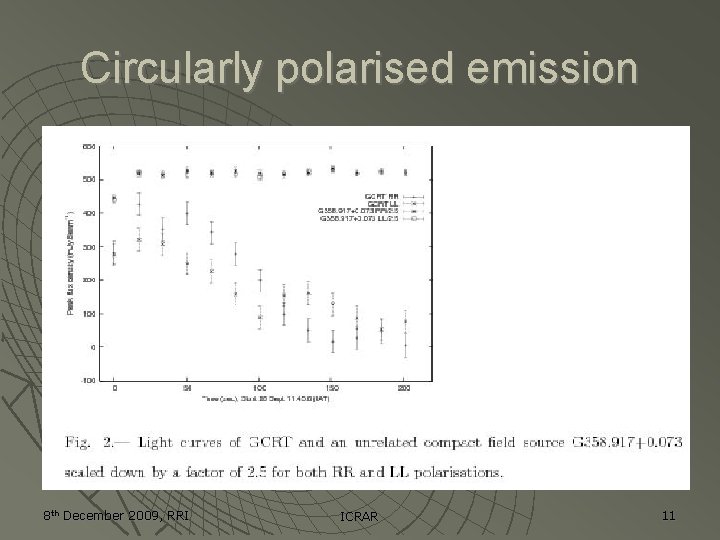
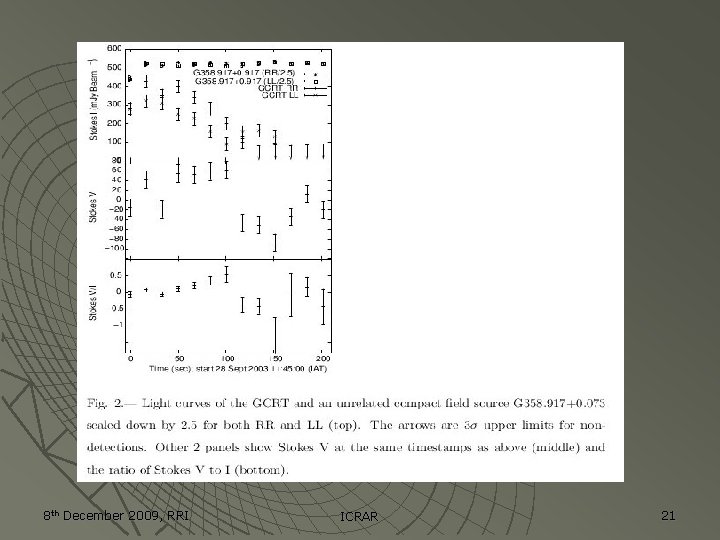
Circularly polarised emission 8 th December 2009, RRI ICRAR 11
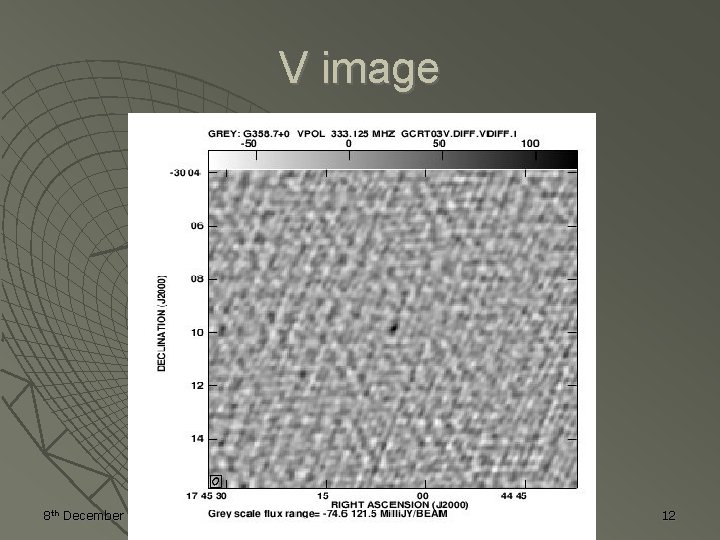
V image 8 th December 2009, RRI ICRAR 12
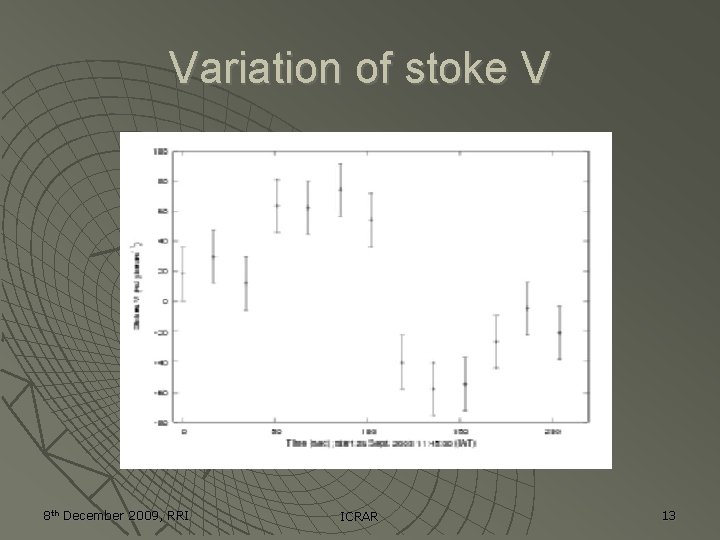
Variation of stoke V 8 th December 2009, RRI ICRAR 13
Maximum size of emission region is 8 R (from the time-scale of change in polarisation) It has to be within 10 pc if the emission is incoherent. 8 th December 2009, RRI ICRAR 14
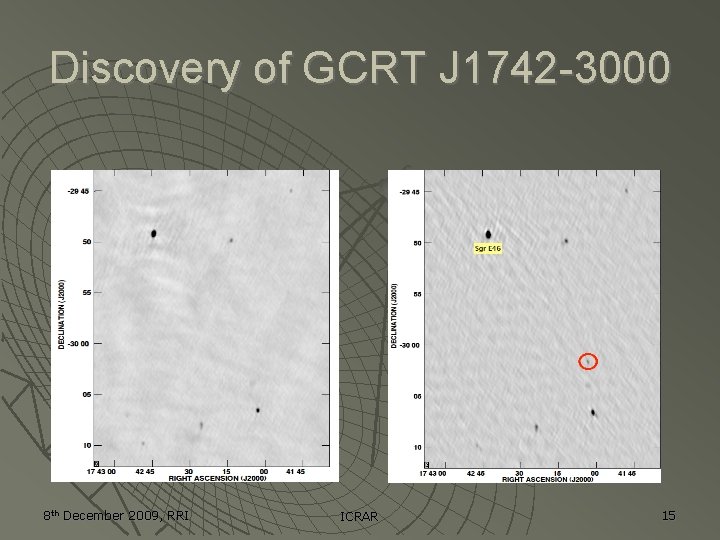
Discovery of GCRT J 1742 -3000 8 th December 2009, RRI ICRAR 15
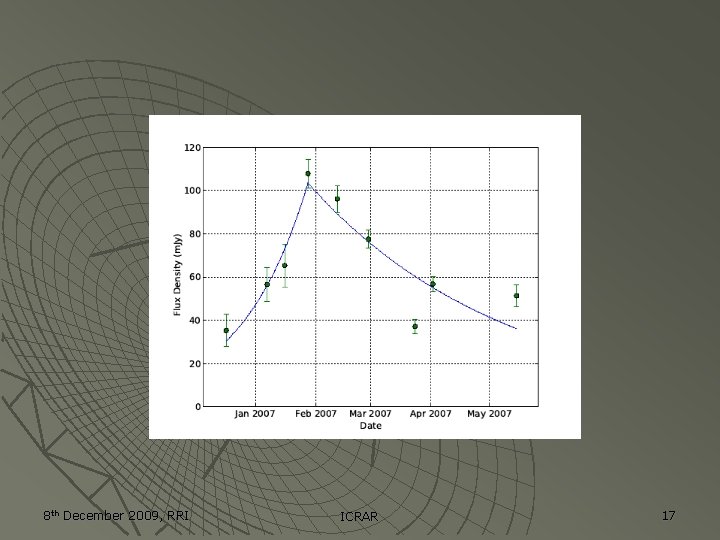
Light curve of GCRT J 1742 -3000 8 th December 2009, RRI ICRAR 16
8 th December 2009, RRI ICRAR 17
No X-ray detection upper limits on the 2 -10 ke. V absorbed flux of 2. 3 E-12 erg cm^-2 s^-1 and an unabsorbed flux of 2. 5 E 12 erg cm^-2 s^-1 New class of transients! 8 th December 2009, RRI ICRAR 18
But future is bright • Keeping in mind that 1 st phase of Lofar and MWA is almost ready and ASKAP is also not far away, the future of science related to transient radio detection is bright enough. Image credit & copyright: Babak Tafreshi (TWAN) 8 th December 2009, RRI ICRAR 19
Thank you 8 th December 2009, RRI ICRAR 20
8 th December 2009, RRI ICRAR 21