FYP WRITING YOUR THESIS CHAPTER 5 CONCLUSION AND


- Slides: 22
FYP - WRITING YOUR THESIS CHAPTER 5 : CONCLUSION AND RECOMMENDATION ROSLAILI ABDUL AZIZ. Ph. D PPKAS
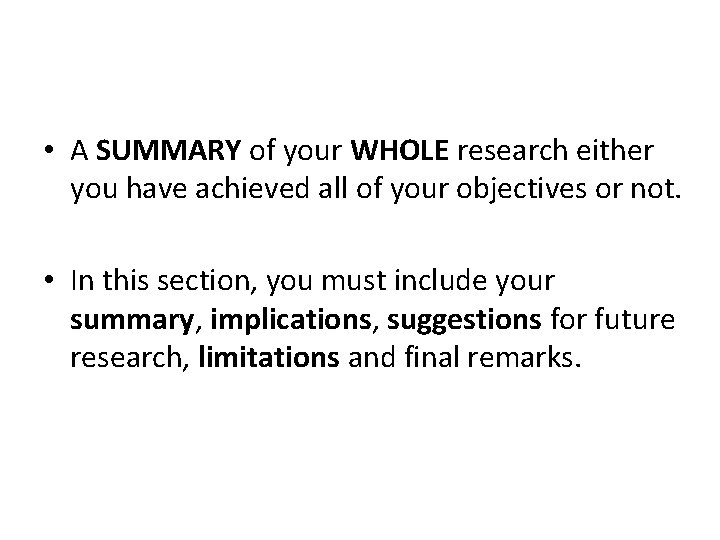
• A SUMMARY of your WHOLE research either you have achieved all of your objectives or not. • In this section, you must include your summary, implications, suggestions for future research, limitations and final remarks.
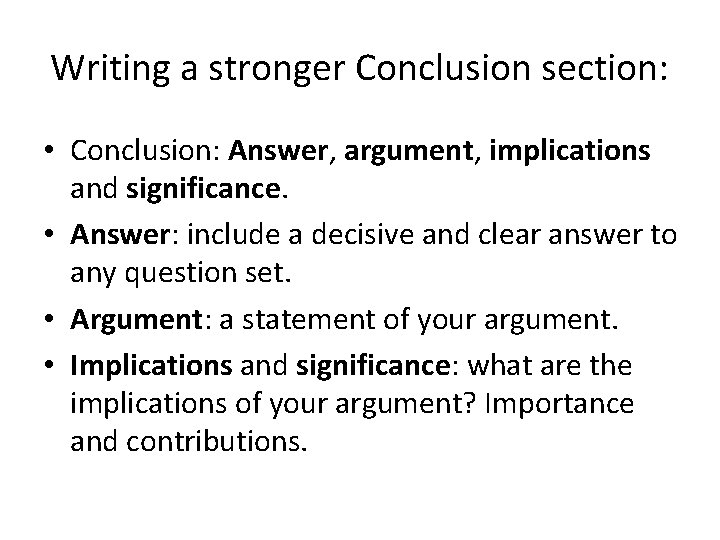
Writing a stronger Conclusion section: • Conclusion: Answer, argument, implications and significance. • Answer: include a decisive and clear answer to any question set. • Argument: a statement of your argument. • Implications and significance: what are the implications of your argument? Importance and contributions.
• Statement of limitations: v Alternatives. v Weaknesses. v What your research will do.
Importance of a conclusion • It is the often LAST piece of text in thesis that examiners read. • Examiners may have read thesis over a series of weeks with interruptions and come back to recap via a quick read of the introduction and conclusion
Basic Functions of a Conclusion 1. To summarize: q What you researched q Nature of your main arguments q How you researched it q What you discovered q What pre-existing views were challenged.
What is an Argument? • An argument takes a stand on an issue. It seeks to persuade an audience of a point of view in much the same way that a lawyer argues a case in a court of law. It is NOT a description or a summary. • A thesis statement is a sentence in which you state an argument about a topic and then describe, briefly, how you will prove your argument. • "The movie ‘JFK’ inaccurately portrays President Kennedy because of the way it ignores Kennedy’s youth, his relationship with his father, and the findings of the Warren Commission. "
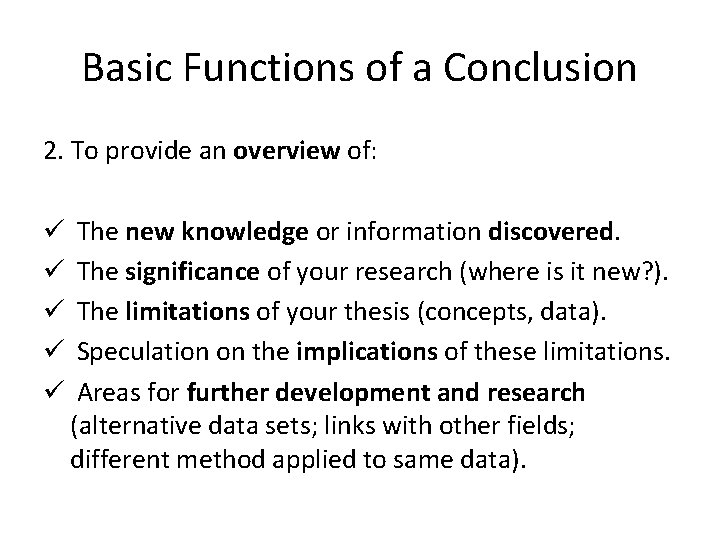
Basic Functions of a Conclusion 2. To provide an overview of: ü ü ü The new knowledge or information discovered. The significance of your research (where is it new? ). The limitations of your thesis (concepts, data). Speculation on the implications of these limitations. Areas for further development and research (alternative data sets; links with other fields; different method applied to same data).
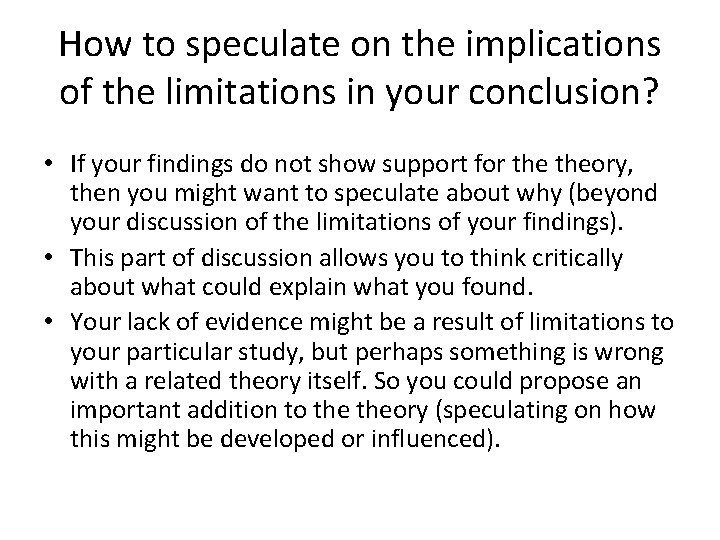
How to speculate on the implications of the limitations in your conclusion? • If your findings do not show support for theory, then you might want to speculate about why (beyond your discussion of the limitations of your findings). • This part of discussion allows you to think critically about what could explain what you found. • Your lack of evidence might be a result of limitations to your particular study, but perhaps something is wrong with a related theory itself. So you could propose an important addition to theory (speculating on how this might be developed or influenced).
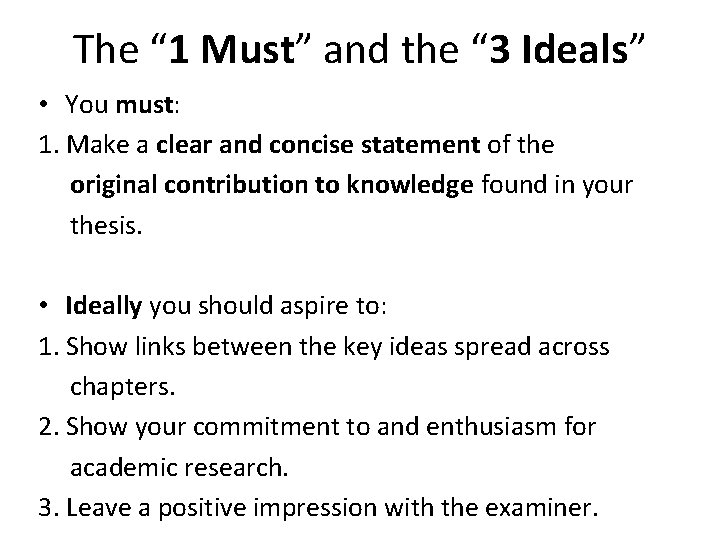
The “ 1 Must” and the “ 3 Ideals” • You must: 1. Make a clear and concise statement of the original contribution to knowledge found in your thesis. • Ideally you should aspire to: 1. Show links between the key ideas spread across chapters. 2. Show your commitment to and enthusiasm for academic research. 3. Leave a positive impression with the examiner.
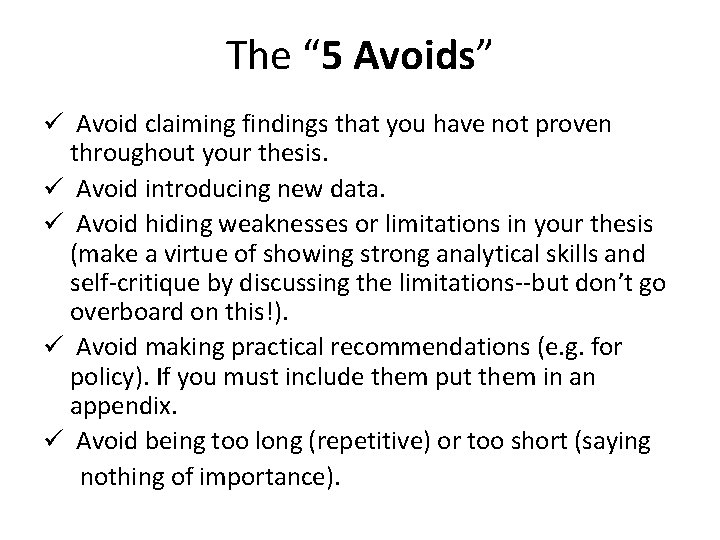
The “ 5 Avoids” ü Avoid claiming findings that you have not proven throughout your thesis. ü Avoid introducing new data. ü Avoid hiding weaknesses or limitations in your thesis (make a virtue of showing strong analytical skills and self-critique by discussing the limitations--but don’t go overboard on this!). ü Avoid making practical recommendations (e. g. for policy). If you must include them put them in an appendix. ü Avoid being too long (repetitive) or too short (saying nothing of importance).
Sample Conclusion Structure (1) • One paragraph stating what you researched and what your original contribution to the field is…then break into sections. • One section on what you researched and how you did it. • One section on what are the main findings were… showing links across chapters (this explains why you chose the structure you did). • One section on possible areas for future research. • Final section reminding readers of the original contribution and significance of your research to your field.
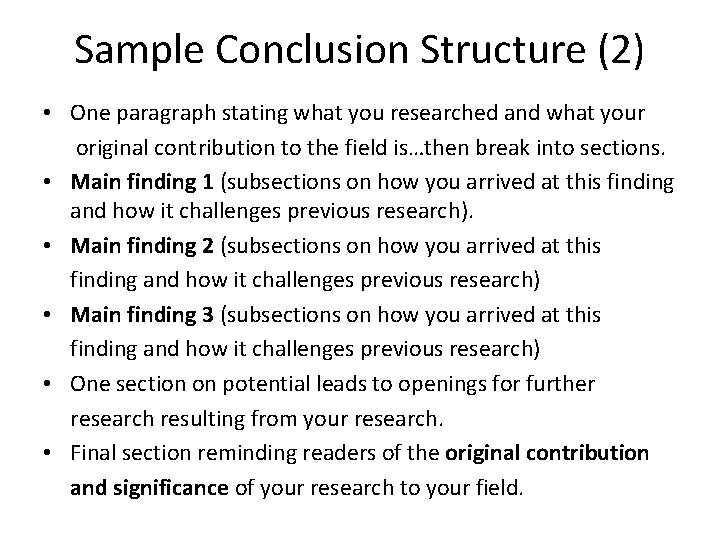
Sample Conclusion Structure (2) • One paragraph stating what you researched and what your original contribution to the field is…then break into sections. • Main finding 1 (subsections on how you arrived at this finding and how it challenges previous research). • Main finding 2 (subsections on how you arrived at this finding and how it challenges previous research) • Main finding 3 (subsections on how you arrived at this finding and how it challenges previous research) • One section on potential leads to openings for further research resulting from your research. • Final section reminding readers of the original contribution and significance of your research to your field.
Concluding Conclusion • Be enthused by the prospect of writing your conclusion… “It’s downhill from here…!” • To avoid the concluding chapter shock… – Start writing notes of content for potential sections of your conclusion as you write other chapters…add bits in as you think of them. – If you find a succinct quote that encapsulates common misunderstandings about your field then use it at the start to bounce off.
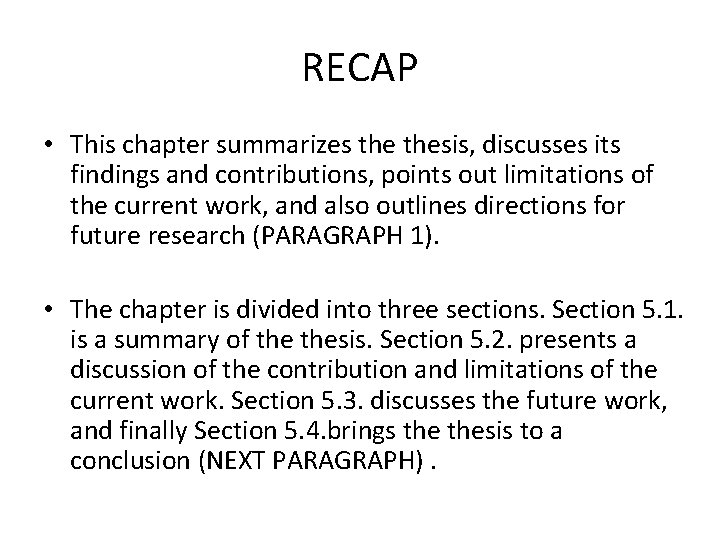
RECAP • This chapter summarizes thesis, discusses its findings and contributions, points out limitations of the current work, and also outlines directions for future research (PARAGRAPH 1). • The chapter is divided into three sections. Section 5. 1. is a summary of thesis. Section 5. 2. presents a discussion of the contribution and limitations of the current work. Section 5. 3. discusses the future work, and finally Section 5. 4. brings thesis to a conclusion (NEXT PARAGRAPH).
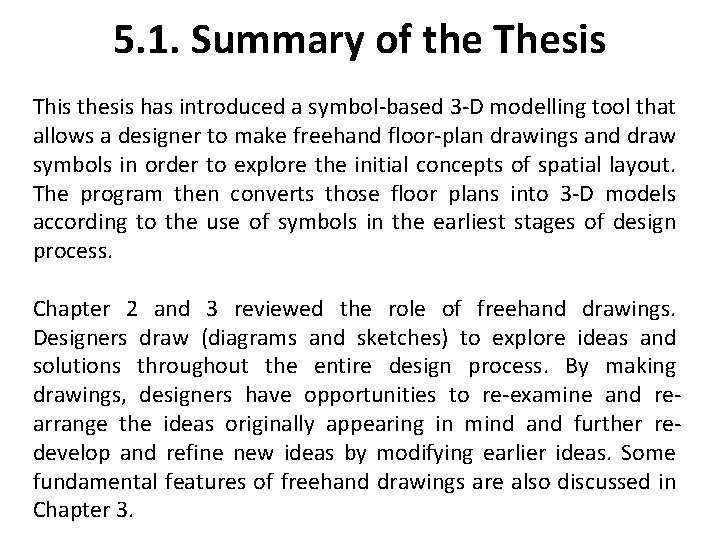
5. 1. Summary of the Thesis This thesis has introduced a symbol-based 3 -D modelling tool that allows a designer to make freehand floor-plan drawings and draw symbols in order to explore the initial concepts of spatial layout. The program then converts those floor plans into 3 -D models according to the use of symbols in the earliest stages of design process. Chapter 2 and 3 reviewed the role of freehand drawings. Designers draw (diagrams and sketches) to explore ideas and solutions throughout the entire design process. By making drawings, designers have opportunities to re-examine and rearrange the ideas originally appearing in mind and further redevelop and refine new ideas by modifying earlier ideas. Some fundamental features of freehand drawings are also discussed in Chapter 3.
5. 2. 1 Contribution of this Thesis This thesis has developed a prototype 3 -D modeling tool, the Space. Maker, for early schematic architectural design. The computational implementation is based on studies of the features of freehand drawings and the use of drawing symbols in freehand floor-plan sketches. The thesis reveals that it is possible to quickly build 3 -D models in the early phases of design process by making freehand floor-plan sketches and integrating designer-defined drawing symbols into freehand sketches, and finally having the modeling tool recognize the features of freehand drawings and pre-defined symbols.
5. 2. 2 Limitations of the Current Work A crucial characteristic of early conceptual freehand drawings is that they indicate not only a designer’s decisions but also the associated degrees of ambiguity, imprecision, and abstraction. By keeping drawings ambiguous and abstract, the early conceptual design can remain flexible and allow any later modifications and adjustments. However, currently the Space. Maker only supports a one-to -one conversion between 2 -D freehand sketches and 3 -D computerized models. Although designers still can flexibly explore the alternatives of spatial configuration by making 2 -D sketches, they only get one 3 -D interpretation of each sketch. One-to-many relations of sketch to model could certainly enhance Space. Maker’s flexibility. In addition, another limitation, related to one-tooneconversion, has to do with recognizing freehand sketching input.
5. 3. Future Work While this thesis has demonstrated the potential of efficiently creating 3 -D models by converting 2 -D freehand drawings, many opportunities for extending the scope of this thesis remain. This section presents some of these directions. One-to-Many Conversion (with explanations) Multi-Direction Recognition (with explanations) Multi-Floor Layout (with explanations)
5. 4. Conclusion Space. Maker is a prototype of a 3 -D modeling tool that aims to enhance the decision making process of spatial configuration for an architectural design by creating 3 -D virtual space and providing designers 3 -D spatial information during the early phases of designing. Meanwhile, the Space. Maker represents my intention to look at a different direction for establishing a 3 D modeling environment that is truly suitable to early conceptual design for the architectural field. We are the designers. We know what we need to make computers be better assistants and inturn make ourselves generate better design solutions. In fact, we already have a powerful means to establish a better design environment on ours own, and that is our knowledge of architectural design.