
ECE FYP BRIEFING RESEARCH METHODOLOGY SEMESTER I 20162017

ECE FYP BRIEFING : RESEARCH METHODOLOGY SEMESTER I, 2016/2017 18 th October 2016
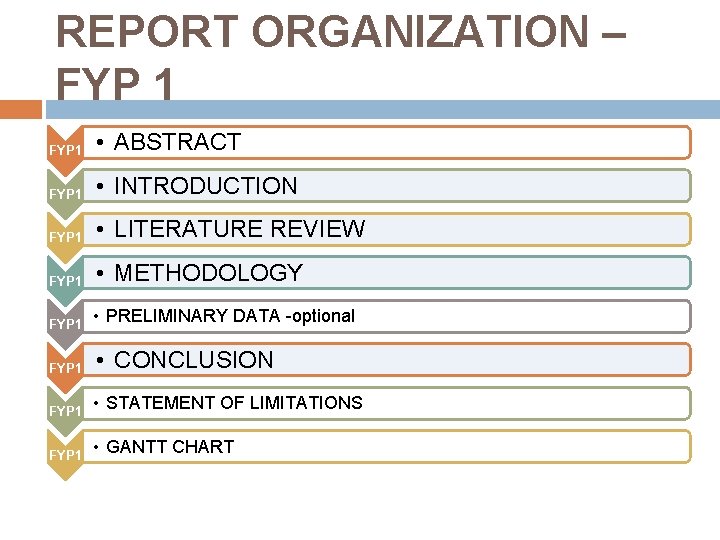
REPORT ORGANIZATION – FYP 1 • ABSTRACT FYP 1 • INTRODUCTION FYP 1 • LITERATURE REVIEW FYP 1 • METHODOLOGY FYP 1 • PRELIMINARY DATA -optional FYP 1 • CONCLUSION FYP 1 • STATEMENT OF LIMITATIONS FYP 1 • GANTT CHART
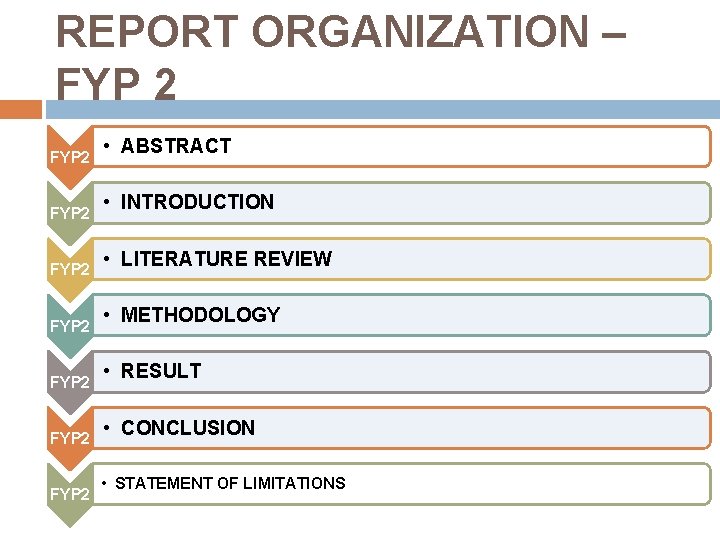
REPORT ORGANIZATION – FYP 2 FYP 2 • ABSTRACT • INTRODUCTION • LITERATURE REVIEW • METHODOLOGY • RESULT • CONCLUSION • STATEMENT OF LIMITATIONS
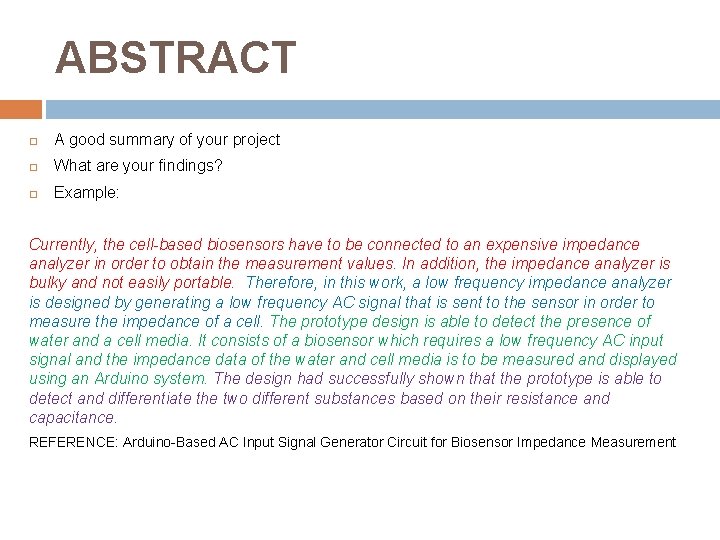
ABSTRACT A good summary of your project What are your findings? Example: Currently, the cell-based biosensors have to be connected to an expensive impedance analyzer in order to obtain the measurement values. In addition, the impedance analyzer is bulky and not easily portable. Therefore, in this work, a low frequency impedance analyzer is designed by generating a low frequency AC signal that is sent to the sensor in order to measure the impedance of a cell. The prototype design is able to detect the presence of water and a cell media. It consists of a biosensor which requires a low frequency AC input signal and the impedance data of the water and cell media is to be measured and displayed using an Arduino system. The design had successfully shown that the prototype is able to detect and differentiate the two different substances based on their resistance and capacitance. REFERENCE: Arduino-Based AC Input Signal Generator Circuit for Biosensor Impedance Measurement
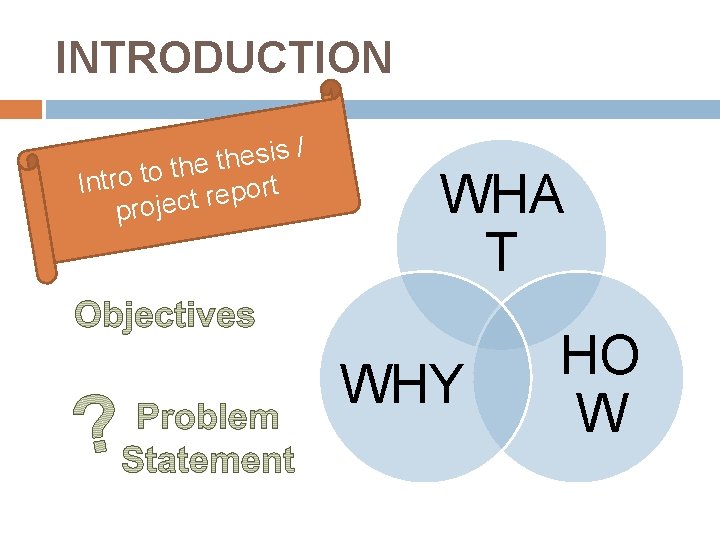
INTRODUCTION / s i s e th e h t o t Intro t r o p e r project WHA T WHY HO W
OVERVIEW Electrical cell-substrate impedance sensing (ECIS) is a valuable tool for real time monitoring of cell behavior such as attachment, mobility, and growth. In order to employ ECIS, the cells need to attach, spread and proliferate on the sensor in the presence of adhesion-promoting protein that mimics the extracellular matrix (ECM) of the cells. The impedance change due to the cell growth and attachment was modeled as an equivalent circuit consisting of resistors and capacitors of both the cell culture media and the cells.
PROBLEM STATEMENT Currently, the impedance measurements were performed using an impedance analyzer which is expensive and also bulky. Efforts have been made to design a portable impedance measuring system. Therefore, this work will focus on producing a low cost impedance analyzer that it is able to detect and differentiate different substances based on their resistance and capacitance. The prototype must be able to perform the measurements using a biosensor at which the impedance data is measured and displayed using an Arduino system.
OBJECTIVES Example of keyword for Objectives � To investigate. . � To analyze. . � To design. . � To validate. . � To simulate. .
METHODOLOGY Explain in one paragraph your proposed methodology Initially, the design of a circuit that produces a low frequency AC input signal is perform using simulation tools such as PSPICE. The circuit is initially tested as an input to a resistor and capacitor and their values are displayed using the Arduino system. Then, the biosensor is connected to the input signal circuitry and the controlled data is measured. Finally, the resistance and capacitance are measured when different substances are placed in the biosensor chamber. The measured data is then compared with the controlled data.
REPORT ORGANIZATION The body of the report consists of five chapters …. This chapter gives an overview on the problem statement, methodology and the objectives of this project. An overview on past research done on the bioelectrical impedance measurement related to this work is presented in Chapter 2. The methodology of this work is presented in Chapter 3. It consist of… Future work and some concluding comments are presented in Chapter 4. .
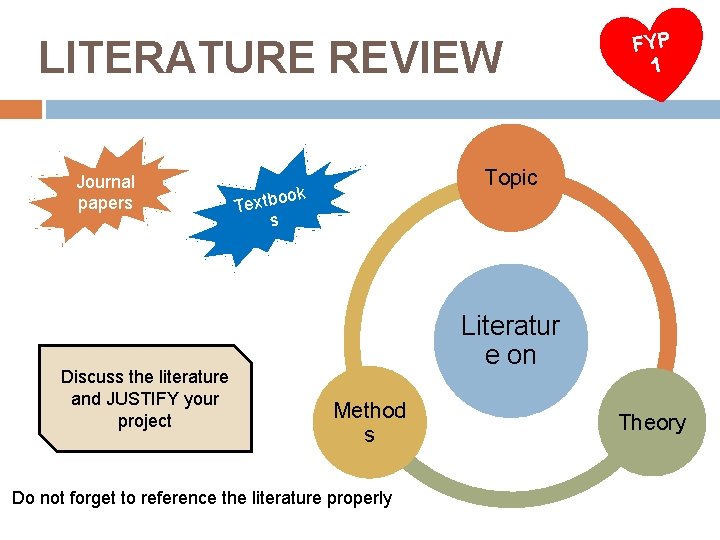
LITERATURE REVIEW Journal papers Discuss the literature and JUSTIFY your project Topic tbook Tex FYP 1 s Literatur e on Method s Do not forget to reference the literature properly Theory
Impose minimum references: 10 -15 references (references latest last 5 years) No Wikipedia and no websites Journals and conference papers Textbooks How to get references? � IEEE Xplore � Google Scholar
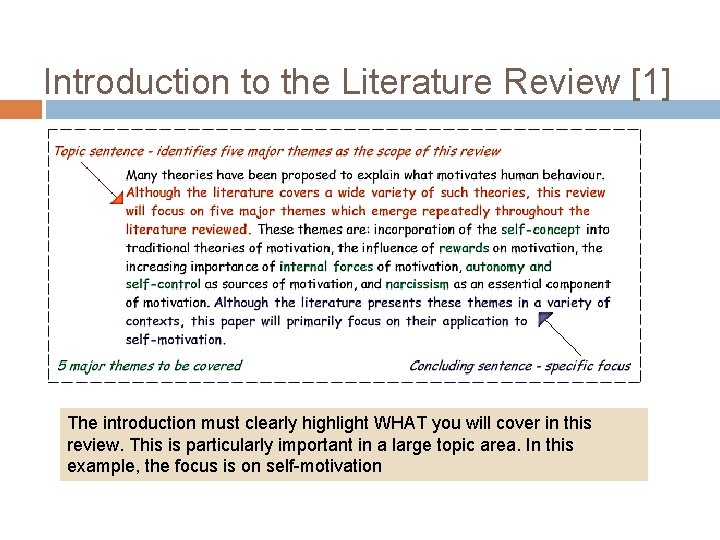
Introduction to the Literature Review [1] The introduction must clearly highlight WHAT you will cover in this review. This is particularly important in a large topic area. In this example, the focus is on self-motivation
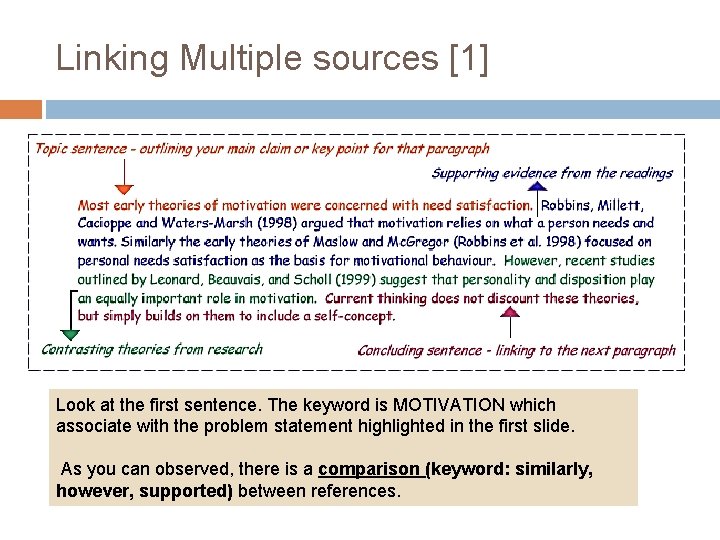
Linking Multiple sources [1] Look at the first sentence. The keyword is MOTIVATION which associate with the problem statement highlighted in the first slide. As you can observed, there is a comparison (keyword: similarly, however, supported) between references.
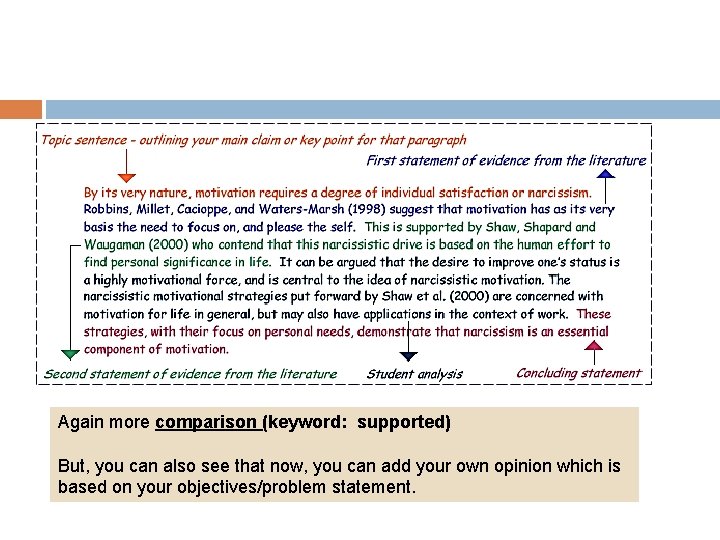
Again more comparison (keyword: supported) But, you can also see that now, you can add your own opinion which is based on your objectives/problem statement.
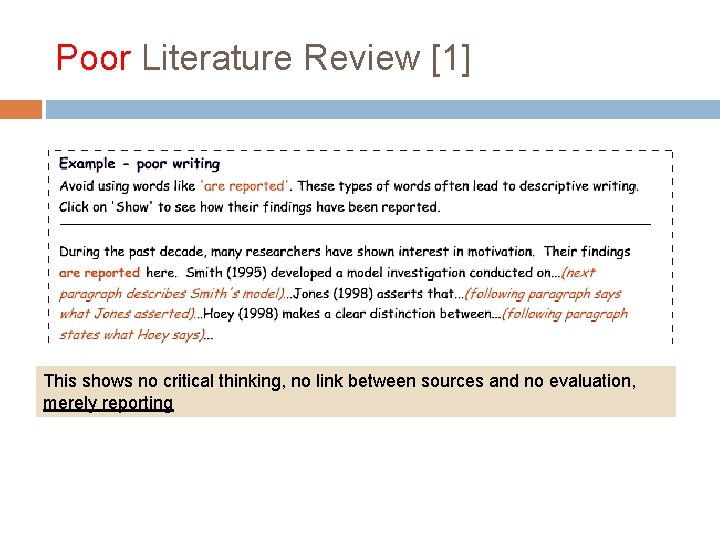
Poor Literature Review [1] This shows no critical thinking, no link between sources and no evaluation, merely reporting
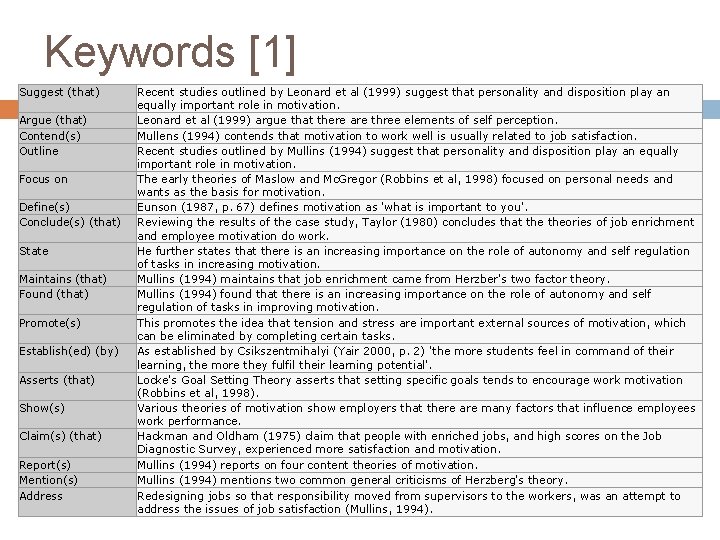
Keywords [1] Suggest (that) Argue (that) Contend(s) Outline Focus on Define(s) Conclude(s) (that) State Maintains (that) Found (that) Promote(s) Establish(ed) (by) Asserts (that) Show(s) Claim(s) (that) Report(s) Mention(s) Address Recent studies outlined by Leonard et al (1999) suggest that personality and disposition play an equally important role in motivation. Leonard et al (1999) argue that there are three elements of self perception. Mullens (1994) contends that motivation to work well is usually related to job satisfaction. Recent studies outlined by Mullins (1994) suggest that personality and disposition play an equally important role in motivation. The early theories of Maslow and Mc. Gregor (Robbins et al, 1998) focused on personal needs and wants as the basis for motivation. Eunson (1987, p. 67) defines motivation as 'what is important to you'. Reviewing the results of the case study, Taylor (1980) concludes that theories of job enrichment and employee motivation do work. He further states that there is an increasing importance on the role of autonomy and self regulation of tasks in increasing motivation. Mullins (1994) maintains that job enrichment came from Herzber's two factor theory. Mullins (1994) found that there is an increasing importance on the role of autonomy and self regulation of tasks in improving motivation. This promotes the idea that tension and stress are important external sources of motivation, which can be eliminated by completing certain tasks. As established by Csikszentmihalyi (Yair 2000, p. 2) 'the more students feel in command of their learning, the more they fulfil their learning potential'. Locke's Goal Setting Theory asserts that setting specific goals tends to encourage work motivation (Robbins et al, 1998). Various theories of motivation show employers that there are many factors that influence employees work performance. Hackman and Oldham (1975) claim that people with enriched jobs, and high scores on the Job Diagnostic Survey, experienced more satisfaction and motivation. Mullins (1994) reports on four content theories of motivation. Mullins (1994) mentions two common general criticisms of Herzberg's theory. Redesigning jobs so that responsibility moved from supervisors to the workers, was an attempt to address the issues of job satisfaction (Mullins, 1994).
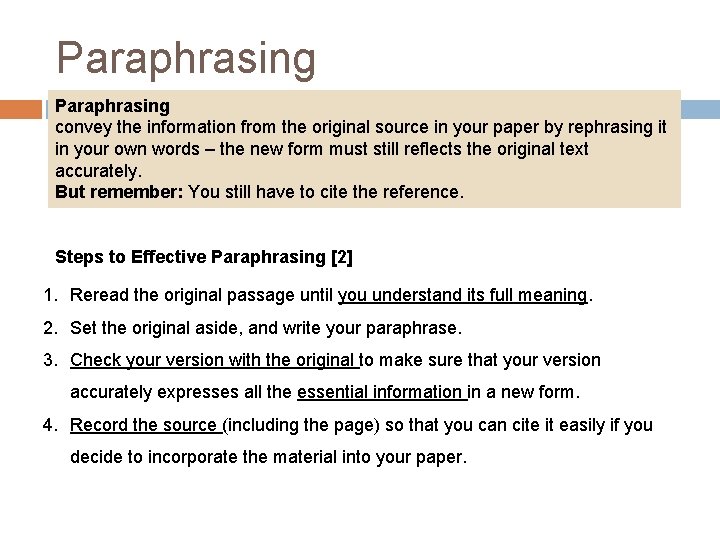
Paraphrasing convey the information from the original source in your paper by rephrasing it in your own words – the new form must still reflects the original text accurately. But remember: You still have to cite the reference. Steps to Effective Paraphrasing [2] 1. Reread the original passage until you understand its full meaning. 2. Set the original aside, and write your paraphrase. 3. Check your version with the original to make sure that your version accurately expresses all the essential information in a new form. 4. Record the source (including the page) so that you can cite it easily if you decide to incorporate the material into your paper.
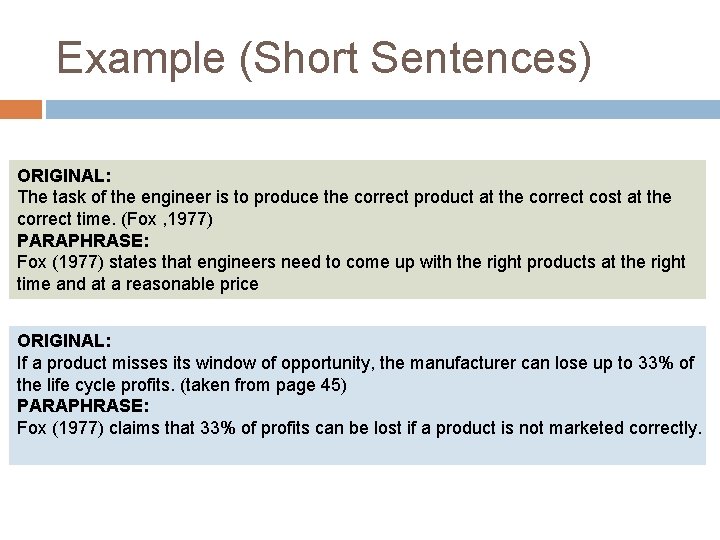
Example (Short Sentences) ORIGINAL: The task of the engineer is to produce the correct product at the correct cost at the correct time. (Fox , 1977) PARAPHRASE: Fox (1977) states that engineers need to come up with the right products at the right time and at a reasonable price ORIGINAL: If a product misses its window of opportunity, the manufacturer can lose up to 33% of the life cycle profits. (taken from page 45) PARAPHRASE: Fox (1977) claims that 33% of profits can be lost if a product is not marketed correctly.
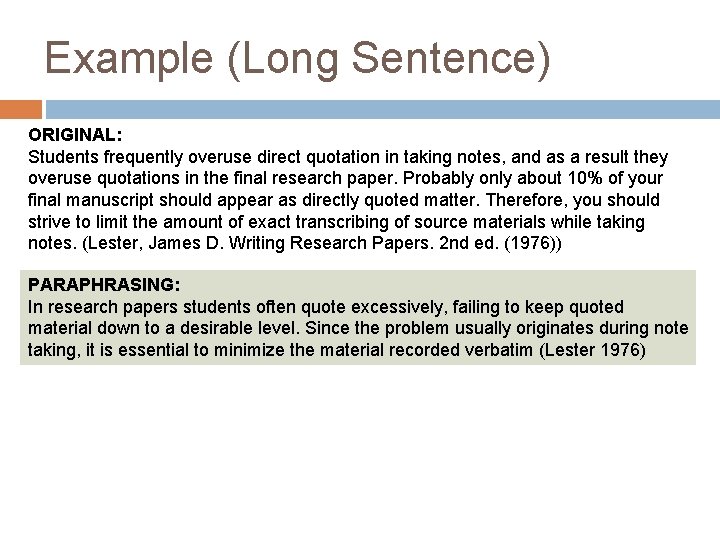
Example (Long Sentence) ORIGINAL: Students frequently overuse direct quotation in taking notes, and as a result they overuse quotations in the final research paper. Probably only about 10% of your final manuscript should appear as directly quoted matter. Therefore, you should strive to limit the amount of exact transcribing of source materials while taking notes. (Lester, James D. Writing Research Papers. 2 nd ed. (1976)) PARAPHRASING: In research papers students often quote excessively, failing to keep quoted material down to a desirable level. Since the problem usually originates during note taking, it is essential to minimize the material recorded verbatim (Lester 1976)

[1] https: //www. dlsweb. rmit. edu. au/lsu/content/2_assess menttasks/assess_tuts/lit_review_LL/writing. html [2] https: //owl. english. purdue. edu/owl/resource/619/03/ [3] https: //airport. unimelb. edu. au/engineering/sources/p araphrasing. php
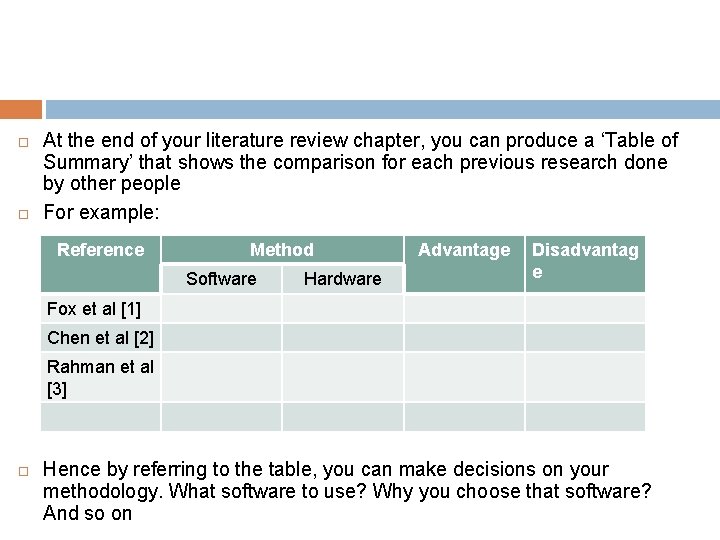
At the end of your literature review chapter, you can produce a ‘Table of Summary’ that shows the comparison for each previous research done by other people For example: Reference Method Software Hardware Advantage Disadvantag e Fox et al [1] Chen et al [2] Rahman et al [3] Hence by referring to the table, you can make decisions on your methodology. What software to use? Why you choose that software? And so on

IMPORTANT ANNOUNCEMENT SUBMISSION OF LITERATURE REVIEW – CHAPTER 2 18 November 2016 (Friday) Submit to the ECE Department Office Cover page can be downloaded from the website The chapter will be evaluated by your supervisor and this will contribute to your final mark Your supervisor will give feedback to you and you can improve the chapter before the report submission

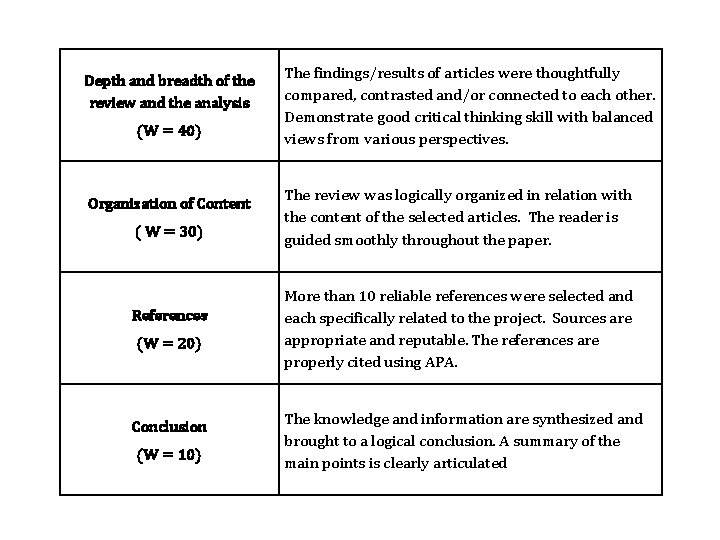
Depth and breadth of the review and the analysis (W = 40) Organization of Content ( W = 30) References (W = 20) Conclusion (W = 10) The findings/results of articles were thoughtfully compared, contrasted and/or connected to each other. Demonstrate good critical thinking skill with balanced views from various perspectives. The review was logically organized in relation with the content of the selected articles. The reader is guided smoothly throughout the paper. More than 10 reliable references were selected and each specifically related to the project. Sources are appropriate and reputable. The references are properly cited using APA. The knowledge and information are synthesized and brought to a logical conclusion. A summary of the main points is clearly articulated
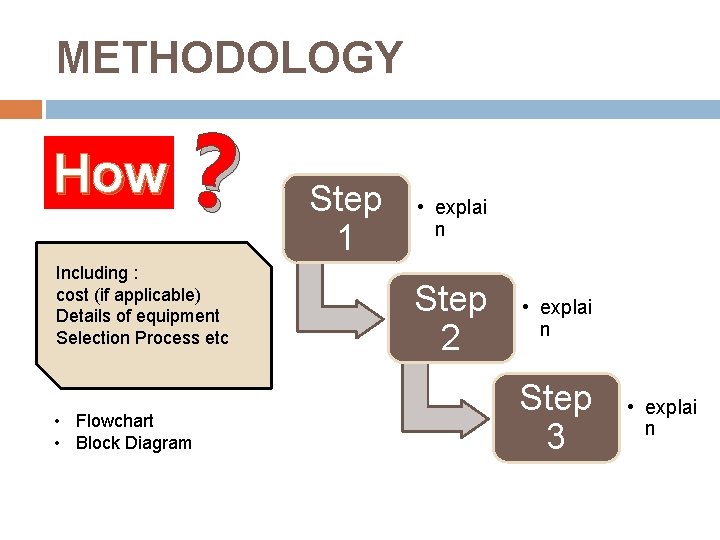
METHODOLOGY How ? Including : cost (if applicable) Details of equipment Selection Process etc • Flowchart • Block Diagram Step 1 • explai n Step 2 • explai n Step 3 • explai n
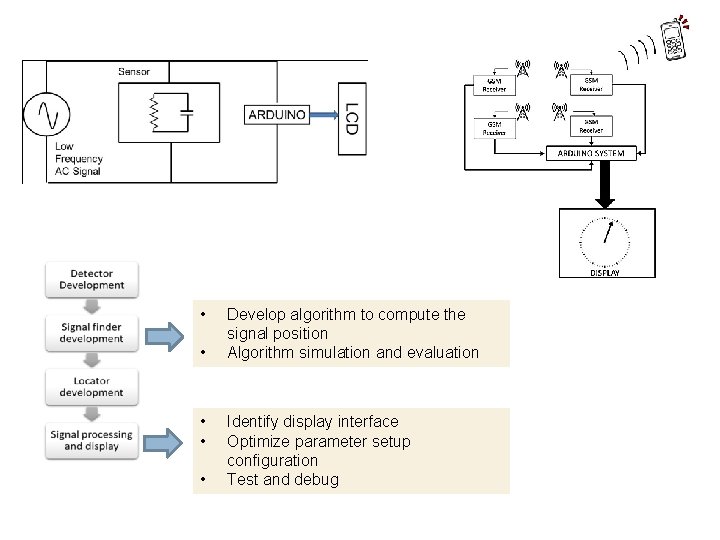
• • • Develop algorithm to compute the signal position Algorithm simulation and evaluation Identify display interface Optimize parameter setup configuration Test and debug
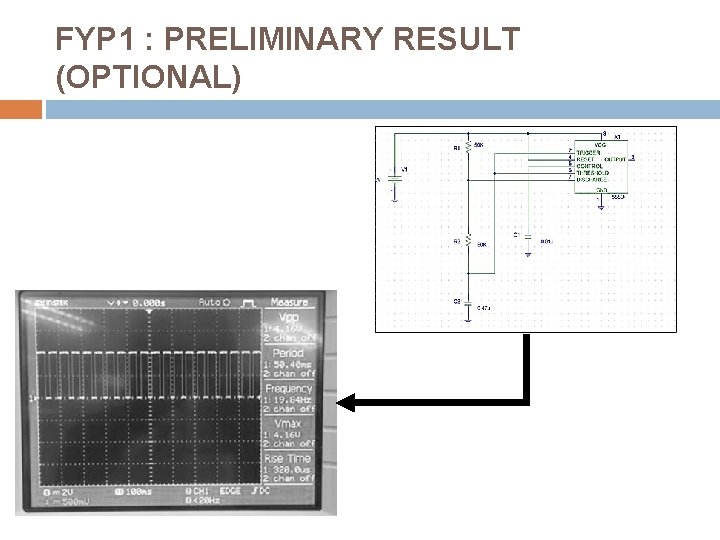
FYP 1 : PRELIMINARY RESULT (OPTIONAL)
CONCLUSION - What are your contributions ? What How Why
Statement of limitations This you may state in the conclusion chapter What are the possible limitations that you can think for your project ? Gantt Chart Example : The research is only valid at room temperature and not temperature above 50 degrees Celcius

INTEGRITY…. AMANAH FYP is an amanah given to you…. . Do the best you can… And be honest with the amanah… Even when it seems difficult…. Every step is rewarded by Allah

Any question ?
- Slides: 32