Fuzzy sets I Prof Dr Jaroslav Ramk Fuzzy
![Examples of t-norms and t-conorms #3 5. q [1, + ) a, b [0,](https://slidetodoc.com/presentation_image/7f6195b0ac5a9bf5234c3654bcb554e2/image-23.jpg "Examples of t-norms and t-conorms #3 5. q [1, + ) a, b [0,")
![L-R fuzzy intervals • L, R : [0, + ) [0, 1] - non-increasing,](https://slidetodoc.com/presentation_image/7f6195b0ac5a9bf5234c3654bcb554e2/image-32.jpg "L-R fuzzy intervals • L, R : [0, + ) [0, 1] - non-increasing,")
- Slides: 38
Fuzzy sets I Prof. Dr. Jaroslav Ramík Fuzzy sets I 1
Content • • Basic definitions Examples Operations with fuzzy sets (FS) t-norms and t-conorms Aggregation operators Extended operations with FS Fuzzy numbers: Convex fuzzy set, fuzzy interval, fuzzy number (FN), triangular FN, trapezoidal FN, L-R fuzzy numbers Fuzzy sets I 2
Basic definitions • • Set - a collection well understood and distinguishable objects of our concept or our thinking about the collection. Fuzzy set - a collection of objects in connection with expression of uncertainty of the property characterizing the objects by grades from interval between 0 and 1. Fuzzy sets I 3
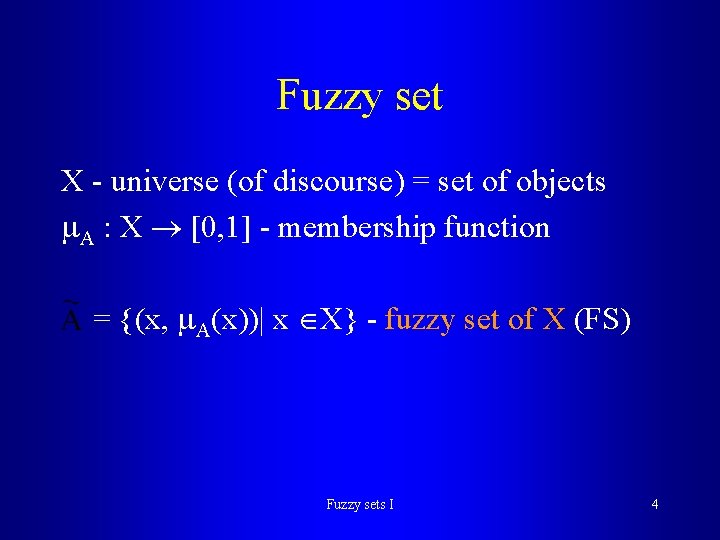
Fuzzy set X - universe (of discourse) = set of objects A : X [0, 1] - membership function = {(x, A(x))| x X} - fuzzy set of X (FS) Fuzzy sets I 4
Examples 1. Feasible daily car production 2. Young man age 3. Number around 8 Fuzzy sets I 5
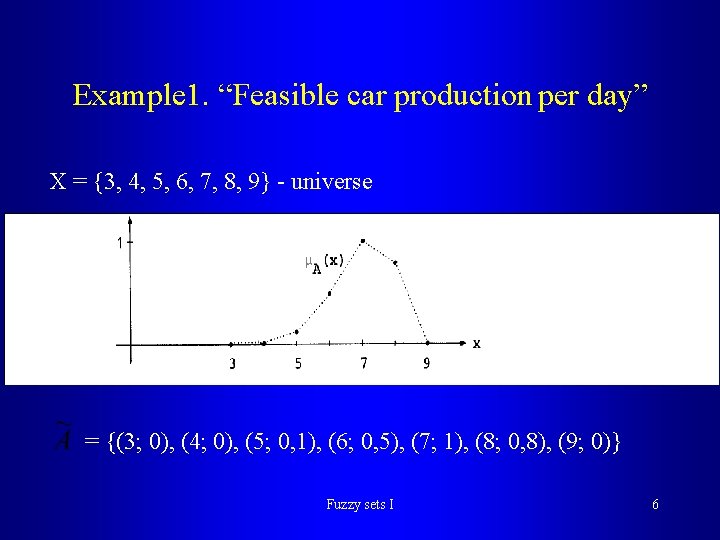
Example 1. “Feasible car production per day” X = {3, 4, 5, 6, 7, 8, 9} - universe = {(3; 0), (4; 0), (5; 0, 1), (6; 0, 5), (7; 1), (8; 0, 8), (9; 0)} Fuzzy sets I 6
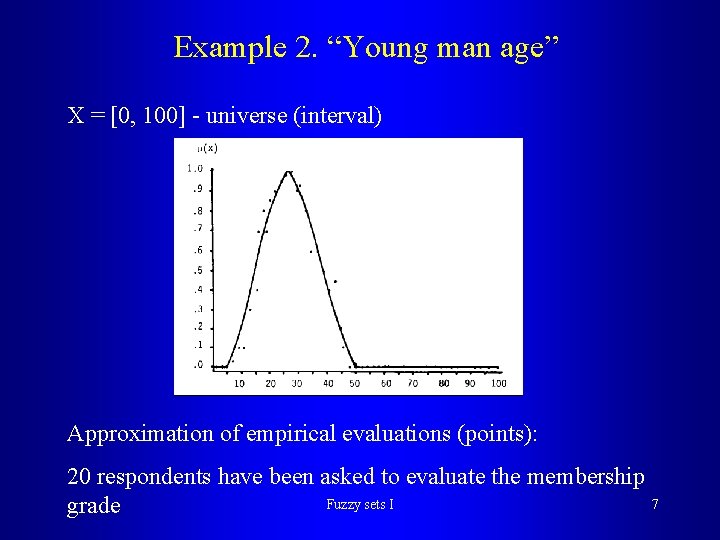
Example 2. “Young man age” X = [0, 100] - universe (interval) Approximation of empirical evaluations (points): 20 respondents have been asked to evaluate the membership Fuzzy sets I 7 grade
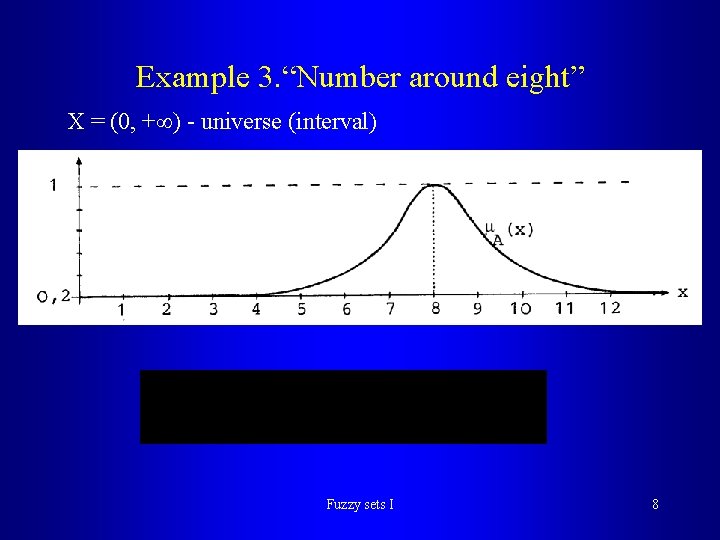
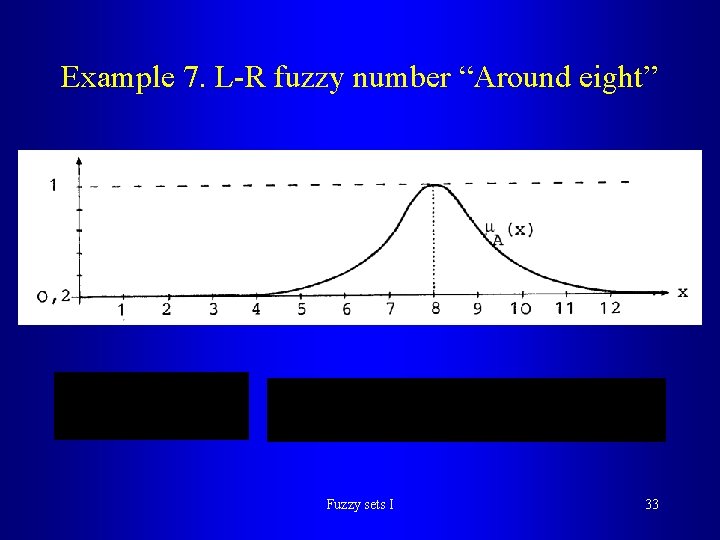
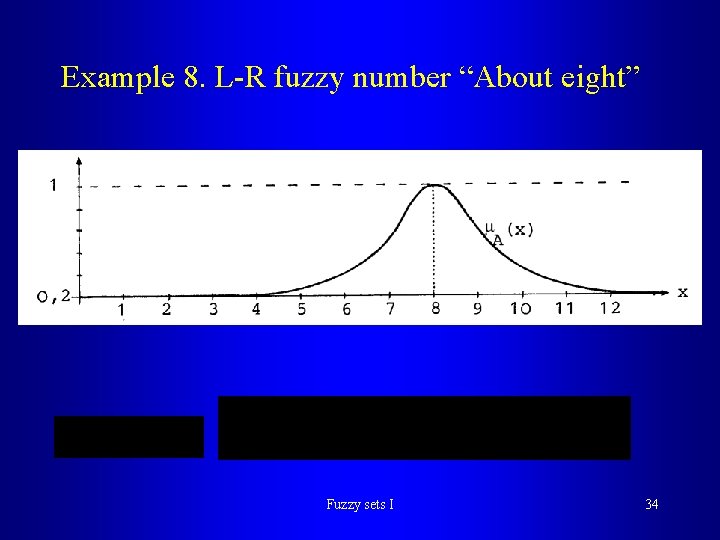
Example 3. “Number around eight” X = (0, + ) - universe (interval) Fuzzy sets I 8
Crisp set • Crisp set A of X = fuzzy set with a special membership function: A : X {0, 1} - characteristic function • Crisp set can be uniquely identified with a set: (non-fuzzy) set A is in fact a (fuzzy) crisp set Fuzzy sets I 9
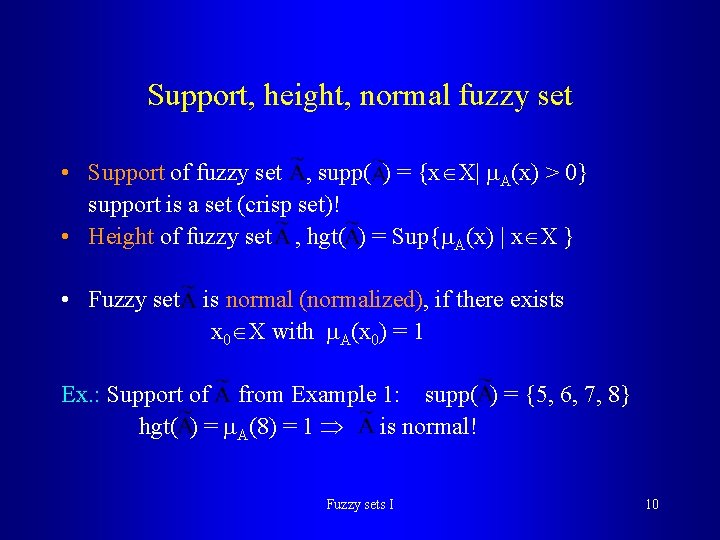
Support, height, normal fuzzy set • Support of fuzzy set , supp( ) = {x X| A(x) > 0} support is a set (crisp set)! • Height of fuzzy set , hgt( ) = Sup{ A(x) | x X } • Fuzzy set is normal (normalized), if there exists x 0 X with A(x 0) = 1 Ex. : Support of from Example 1: supp( ) = {5, 6, 7, 8} hgt( ) = A(8) = 1 is normal! Fuzzy sets I 10
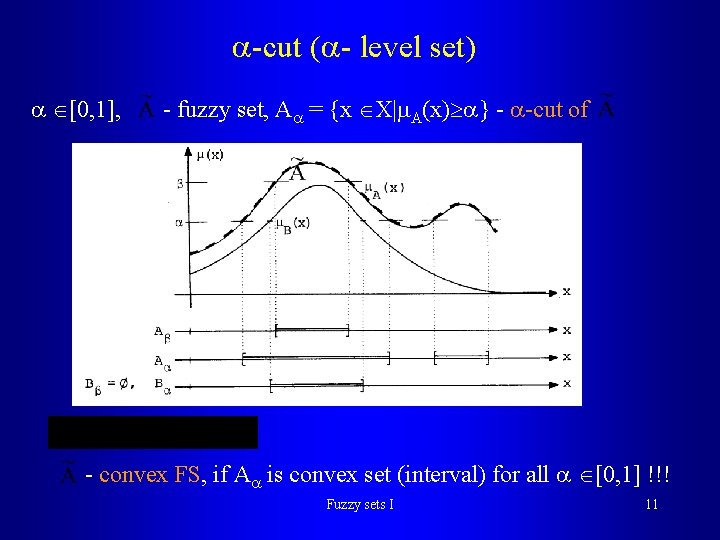
-cut ( - level set) [0, 1], - fuzzy set, A = {x X| A(x) } - -cut of - convex FS, if A is convex set (interval) for all [0, 1] !!! Fuzzy sets I 11
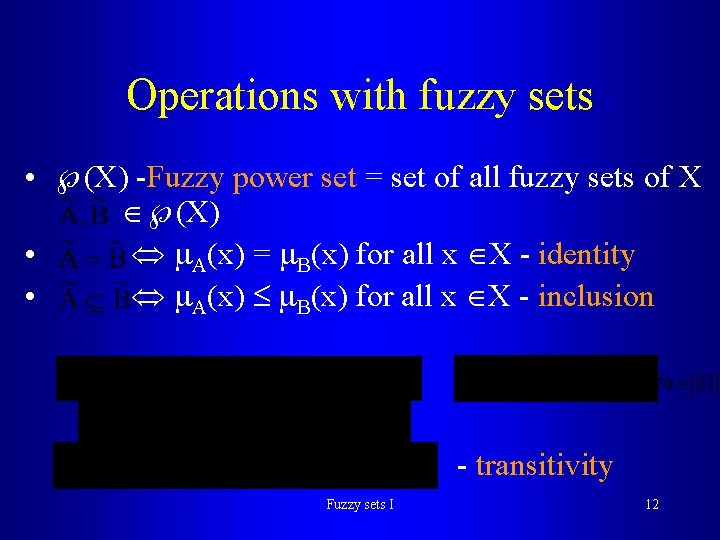
Operations with fuzzy sets • (X) -Fuzzy power set = set of all fuzzy sets of X (X) • A(x) = B(x) for all x X - identity • A(x) B(x) for all x X - inclusion - transitivity Fuzzy sets I 12
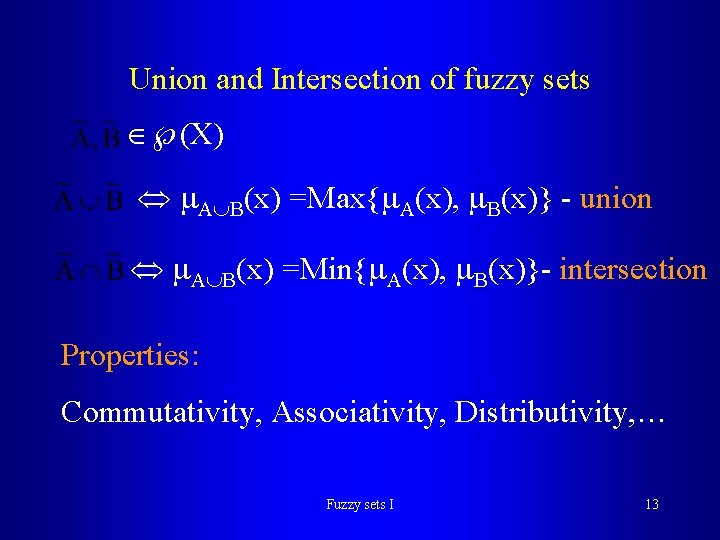
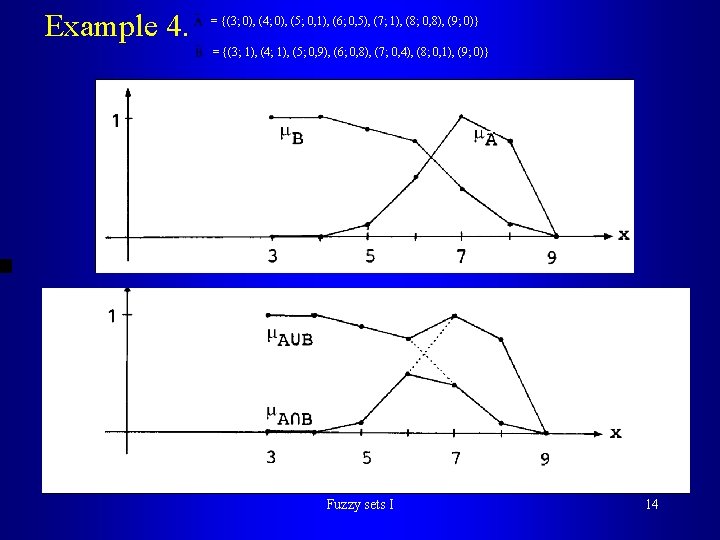
Union and Intersection of fuzzy sets (X) A B(x) =Max{ A(x), B(x)} - union A B(x) =Min{ A(x), B(x)}- intersection Properties: Commutativity, Associativity, Distributivity, … Fuzzy sets I 13
Example 4. = {(3; 0), (4; 0), (5; 0, 1), (6; 0, 5), (7; 1), (8; 0, 8), (9; 0)} = {(3; 1), (4; 1), (5; 0, 9), (6; 0, 8), (7; 0, 4), (8; 0, 1), (9; 0)} Fuzzy sets I 14
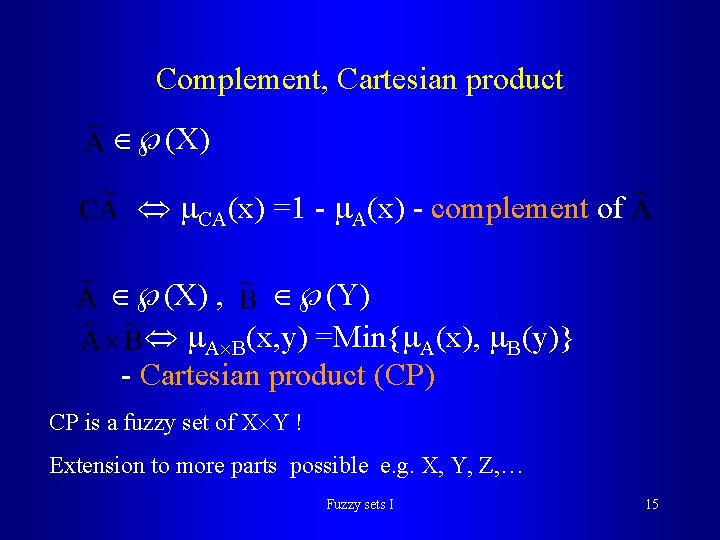
Complement, Cartesian product (X) CA(x) =1 - A(x) - complement of (X) , (Y) A B(x, y) =Min{ A(x), B(y)} - Cartesian product (CP) CP is a fuzzy set of X Y ! Extension to more parts possible e. g. X, Y, Z, … Fuzzy sets I 15
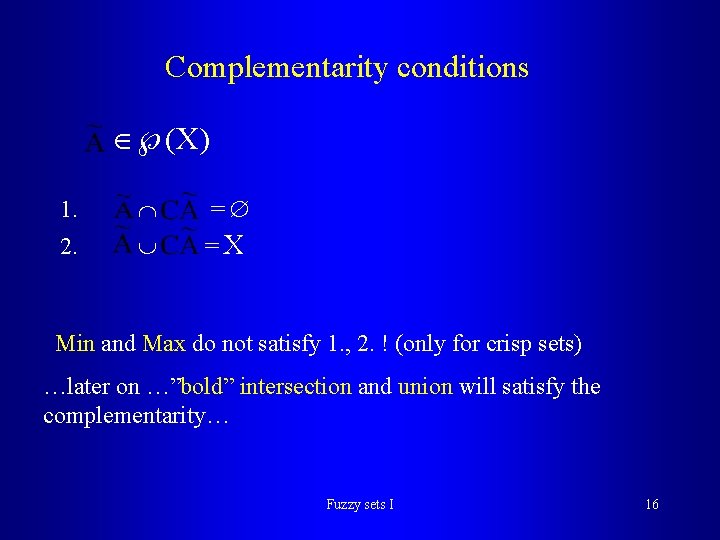
Complementarity conditions (X) 1. = 2. =X Min and Max do not satisfy 1. , 2. ! (only for crisp sets) …later on …”bold” intersection and union will satisfy the complementarity… Fuzzy sets I 16
Examples Fuzzy sets I 17
Extended operations with FS Intersection and Union = operations on (X) Realization by Min and Max operators generalized by t-norms and t-conorms Fuzzy sets I 18
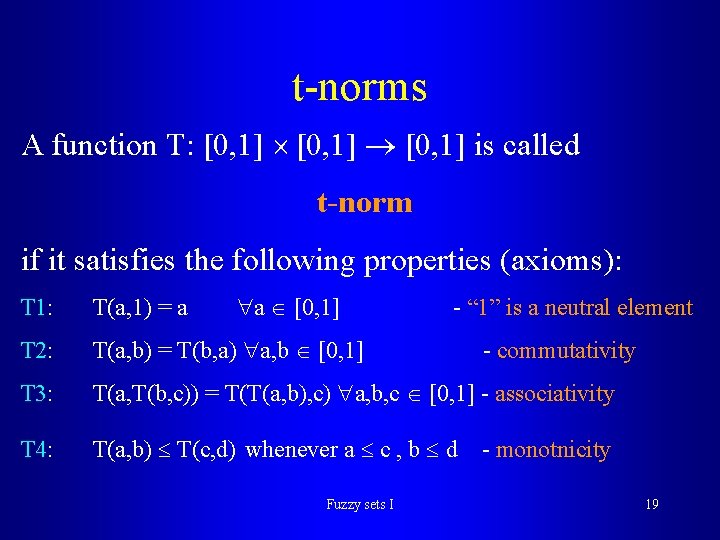
t-norms A function T: [0, 1] is called t-norm if it satisfies the following properties (axioms): a [0, 1] T 1: T(a, 1) = a T 2: T(a, b) = T(b, a) a, b [0, 1] T 3: T(a, T(b, c)) = T(T(a, b), c) a, b, c [0, 1] - associativity T 4: T(a, b) T(c, d) whenever a c , b d Fuzzy sets I - “ 1” is a neutral element - commutativity - monotnicity 19
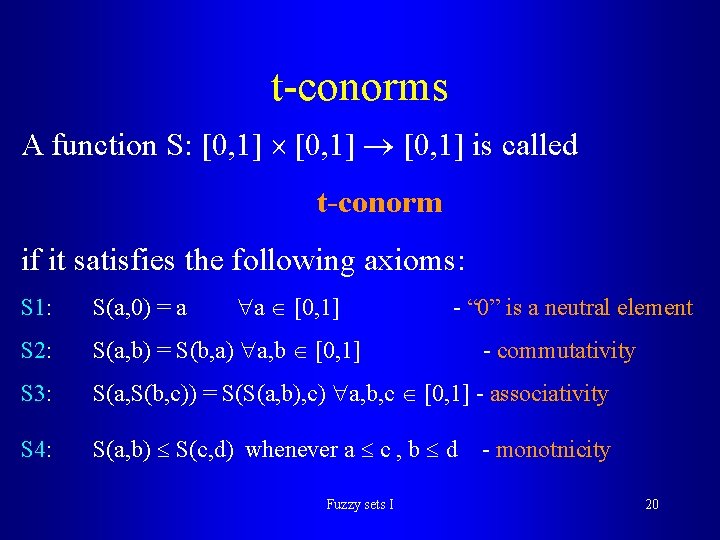
t-conorms A function S: [0, 1] is called t-conorm if it satisfies the following axioms: a [0, 1] S 1: S(a, 0) = a S 2: S(a, b) = S(b, a) a, b [0, 1] S 3: S(a, S(b, c)) = S(S(a, b), c) a, b, c [0, 1] - associativity S 4: S(a, b) S(c, d) whenever a c , b d Fuzzy sets I - “ 0” is a neutral element - commutativity - monotnicity 20
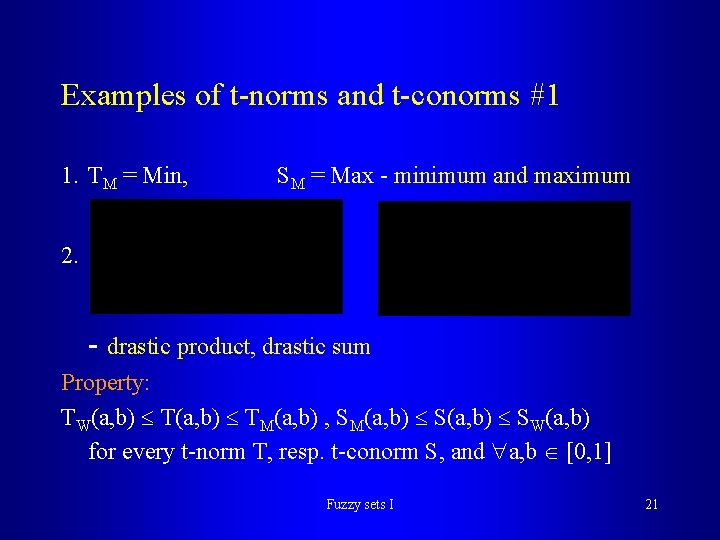
Examples of t-norms and t-conorms #1 1. TM = Min, SM = Max - minimum and maximum 2. - drastic product, drastic sum Property: TW(a, b) TM(a, b) , SM(a, b) SW(a, b) for every t-norm T, resp. t-conorm S, and a, b [0, 1] Fuzzy sets I 21
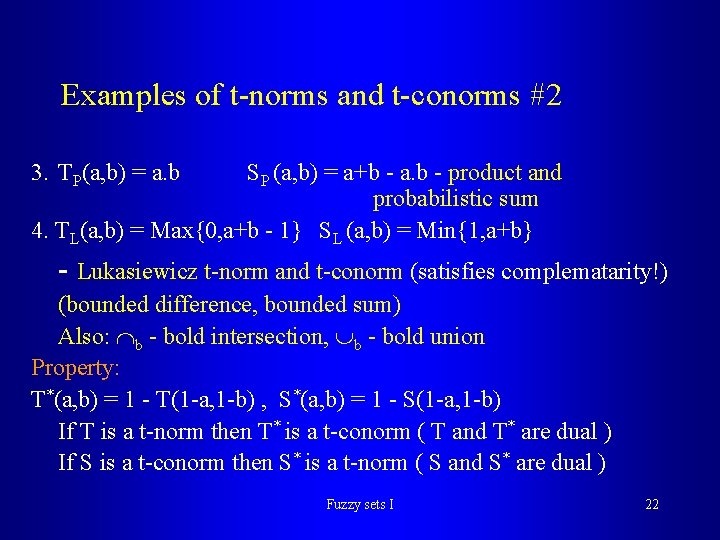
Examples of t-norms and t-conorms #2 3. TP(a, b) = a. b SP (a, b) = a+b - a. b - product and probabilistic sum 4. TL(a, b) = Max{0, a+b - 1} SL (a, b) = Min{1, a+b} - Lukasiewicz t-norm and t-conorm (satisfies complematarity!) (bounded difference, bounded sum) Also: b - bold intersection, b - bold union Property: T*(a, b) = 1 - T(1 -a, 1 -b) , S*(a, b) = 1 - S(1 -a, 1 -b) If T is a t-norm then T* is a t-conorm ( T and T* are dual ) If S is a t-conorm then S* is a t-norm ( S and S* are dual ) Fuzzy sets I 22
Examples of t-norms and t-conorms #3 5. q [1, + ) a, b [0, 1] Yager’s t-norm and t-conorm 6. Einstein, Hamacher, Dubois-Prade product and sum etc. Property: If q =1, then Tq, (Sq) is Lukasiewicz t-norm (t-conorm) If q = + , then Tq, (Sq) is Min (Max) Fuzzy sets I 23
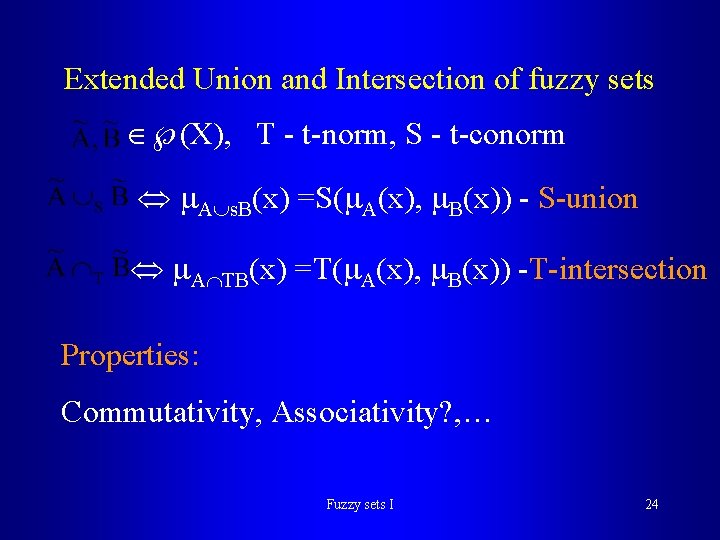
Extended Union and Intersection of fuzzy sets (X), T - t-norm, S - t-conorm A s. B(x) =S( A(x), B(x)) - S-union A TB(x) =T( A(x), B(x)) -T-intersection Properties: Commutativity, Associativity? , … Fuzzy sets I 24
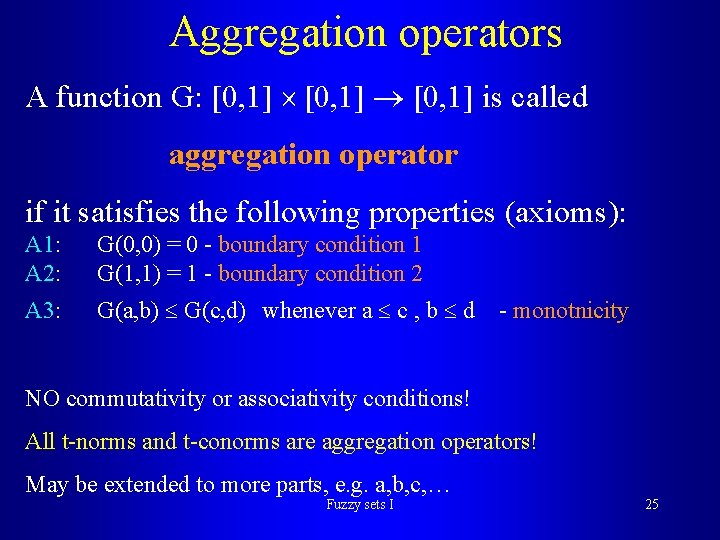
Aggregation operators A function G: [0, 1] is called aggregation operator if it satisfies the following properties (axioms): A 1: A 2: G(0, 0) = 0 - boundary condition 1 G(1, 1) = 1 - boundary condition 2 A 3: G(a, b) G(c, d) whenever a c , b d - monotnicity NO commutativity or associativity conditions! All t-norms and t-conorms are aggregation operators! May be extended to more parts, e. g. a, b, c, … Fuzzy sets I 25
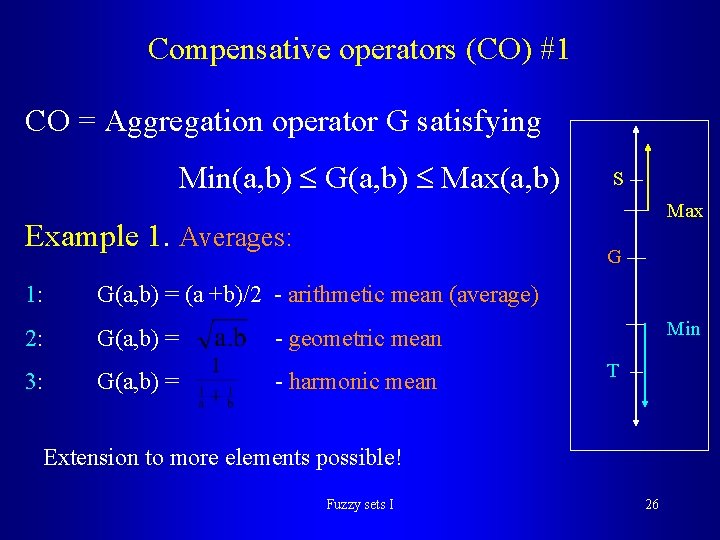
Compensative operators (CO) #1 CO = Aggregation operator G satisfying Min(a, b) G(a, b) Max(a, b) S Max Example 1. Averages: G 1: G(a, b) = (a +b)/2 - arithmetic mean (average) 2: G(a, b) = - geometric mean 3: G(a, b) = - harmonic mean Min T Extension to more elements possible! Fuzzy sets I 26
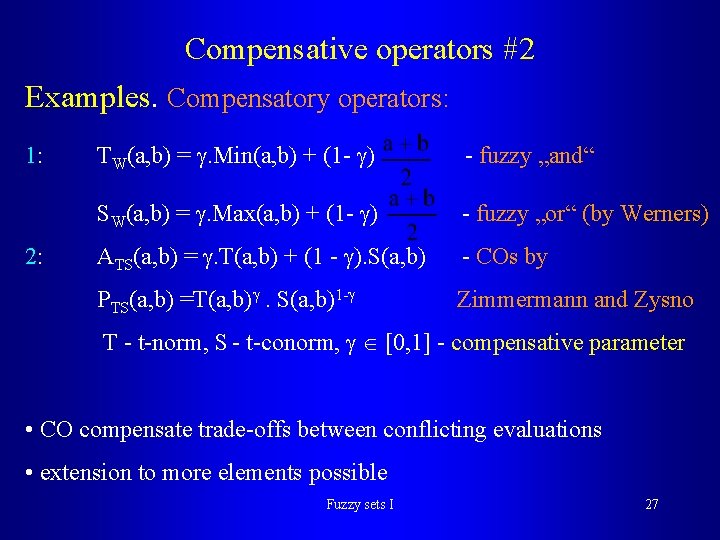
Compensative operators #2 Examples. Compensatory operators: 1: 2: TW(a, b) = . Min(a, b) + (1 - ) - fuzzy „and“ SW(a, b) = . Max(a, b) + (1 - ) - fuzzy „or“ (by Werners) ATS(a, b) = . T(a, b) + (1 - ). S(a, b) - COs by PTS(a, b) =T(a, b) . S(a, b)1 - Zimmermann and Zysno T - t-norm, S - t-conorm, [0, 1] - compensative parameter • CO compensate trade-offs between conflicting evaluations • extension to more elements possible Fuzzy sets I 27
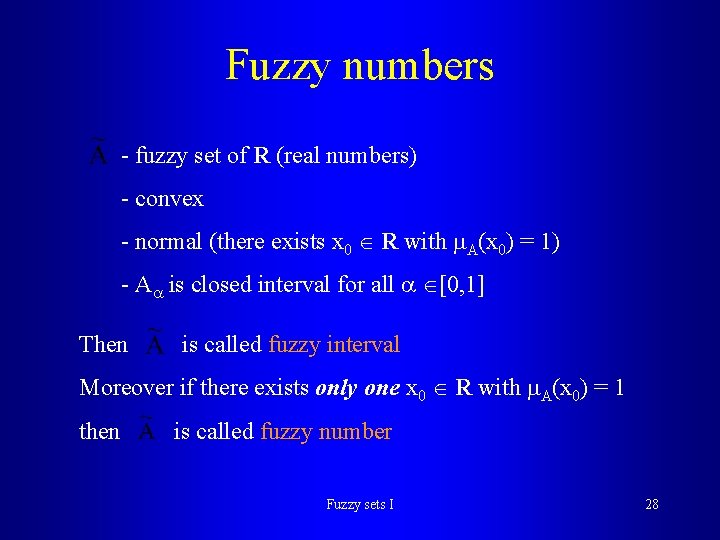
Fuzzy numbers - fuzzy set of R (real numbers) - convex - normal (there exists x 0 R with A(x 0) = 1) - A is closed interval for all [0, 1] Then is called fuzzy interval Moreover if there exists only one x 0 R with A(x 0) = 1 then is called fuzzy number Fuzzy sets I 28
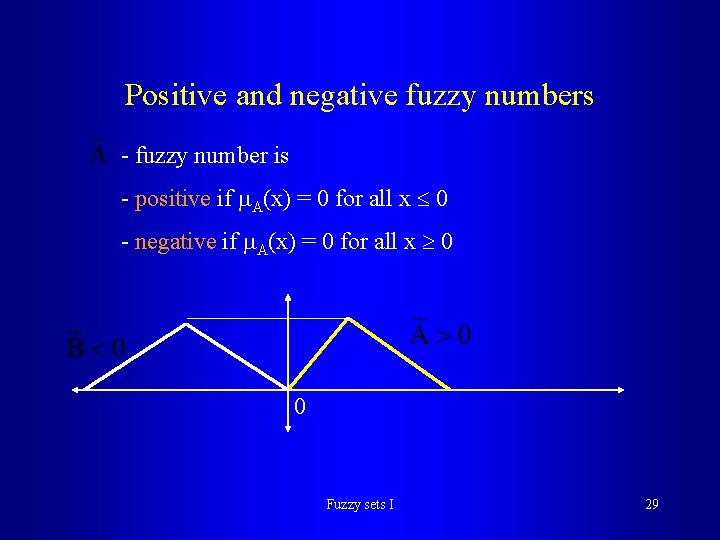
Positive and negative fuzzy numbers - fuzzy number is - positive if A(x) = 0 for all x 0 - negative if A(x) = 0 for all x 0 0 Fuzzy sets I 29
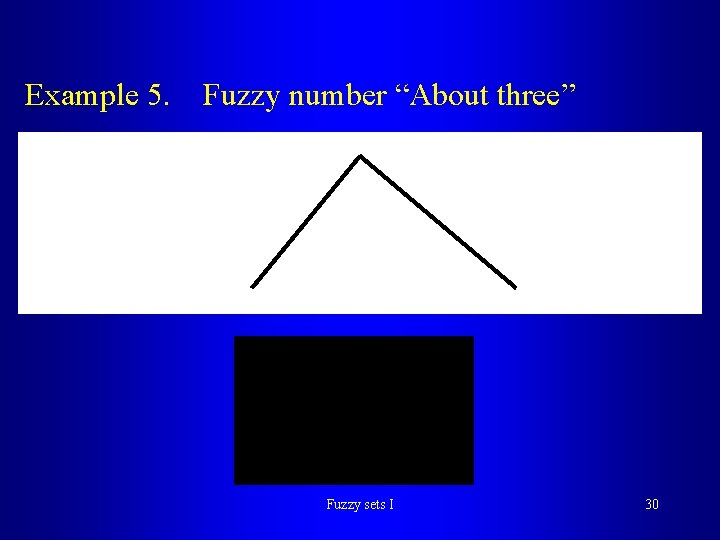
Example 5. Fuzzy number “About three” Fuzzy sets I 30
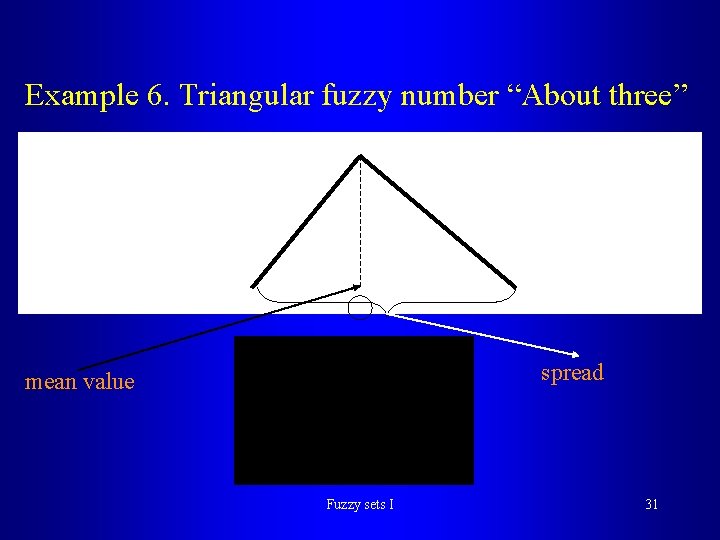
Example 6. Triangular fuzzy number “About three” spread mean value Fuzzy sets I 31
L-R fuzzy intervals • L, R : [0, + ) [0, 1] - non-increasing, non-constant functions - shape functions • L(0) = R(0) = 1, m, n, > 0 - real numbers • - fuzzy interval of L-R-type if • fuzzy number of L-R-type if m = n, L, R - decreasing functions Fuzzy sets I 32
Example 7. L-R fuzzy number “Around eight” Fuzzy sets I 33
Example 8. L-R fuzzy number “About eight” Fuzzy sets I 34
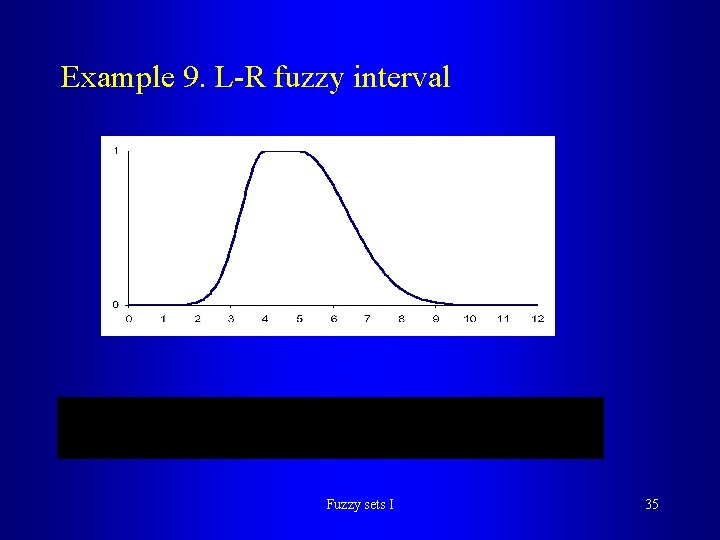
Example 9. L-R fuzzy interval Fuzzy sets I 35
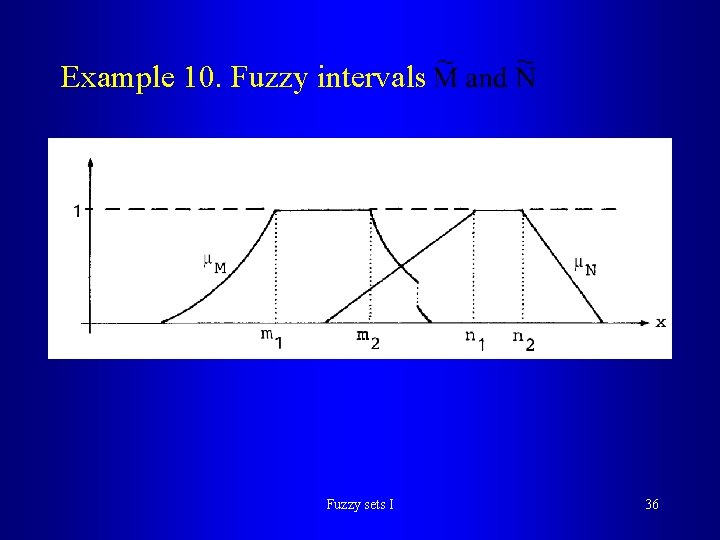
Example 10. Fuzzy intervals Fuzzy sets I 36
Summary • Basic definitions: set, fuzzy set, membership function, crisp set, support, height, normal fuzzy set, -level set • Examples: daily production, young man age, around 8 • Operations with fuzzy sets: fuzzy power set, union, intersection, complement, cartesian product • Extended operations with fuzzy sets: t-norms and t -conorms, compensative operators • Fuzzy numbers: Convex fuzzy set, fuzzy interval, fuzzy number (FN), triangular FN, trapezoidal FN, L-R fuzzy numbers Fuzzy sets I 37
References [1] J. Ramík, M. Vlach: Generalized concavity in fuzzy optimization and decision analysis. Kluwer Academic Publ. Boston, Dordrecht, London, 2001. [2] H. -J. Zimmermann: Fuzzy set theory and its applications. Kluwer Academic Publ. Boston, Dordrecht, London, 1996. [3] H. Rommelfanger: Fuzzy Decision Support - Systeme. Springer - Verlag, Berlin Heidelberg, New York, 1994. [4] H. Rommelfanger, S. Eickemeier: Entscheidungstheorie Klassische Konzepte und Fuzzy - Erweiterungen, Springer Verlag, Berlin Heidelberg, New York, 2002. Fuzzy sets I 38