Fall 2017 Review PrePanel Orientation National Science Foundation


- Slides: 32
Fall 2017 Review Pre-Panel Orientation
National Science Foundation NSF’s Vision - NSF’s vision is a nation that creates and exploits new concepts in science and engineering and provides global leadership in research and education • ~$7. 5 B Budget • 220+ Nobel Laureates supported • Overall: ~362, 000 researchers, postdoctoral fellows, trainees, teachers, and students supported • ~400 startups/small businesses funded each year
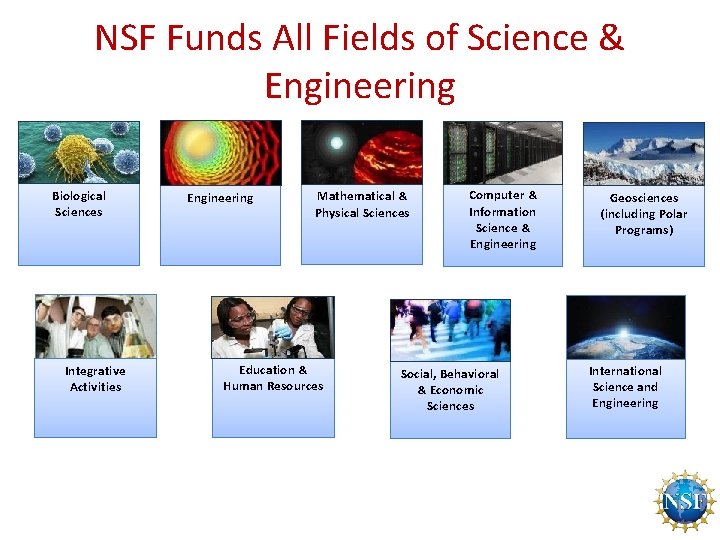
NSF Funds All Fields of Science & Engineering Biological Sciences Integrative Activities Engineering Mathematical & Physical Sciences Education & Human Resources Computer & Information Science & Engineering Social, Behavioral & Economic Sciences Geosciences (including Polar Programs) International Science and Engineering
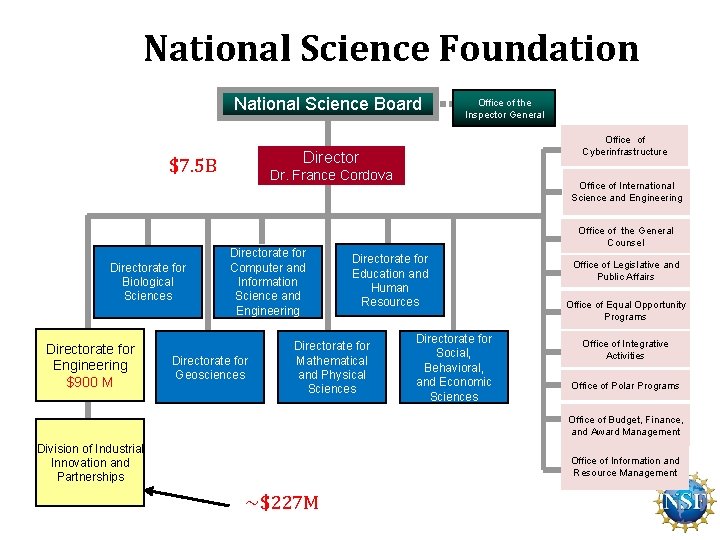
National Science Foundation National Science Board Directorate for Engineering $900 M Office of Cyberinfrastructure Director $7. 5 B Directorate for Biological Sciences Office of the Inspector General Dr. France Cordova Directorate for Computer and Information Science and Engineering Directorate for Geosciences Office of International Science and Engineering Office of the General Counsel Directorate for Education and Human Resources Directorate for Mathematical and Physical Sciences Directorate for Social, Behavioral, and Economic Sciences Office of Legislative and Public Affairs Office of Equal Opportunity Programs Office of Integrative Activities Office of Polar Programs Office of Budget, Finance, and Award Management Division of Industrial Innovation and Partnerships Office of Information and Resource Management ~$227 M
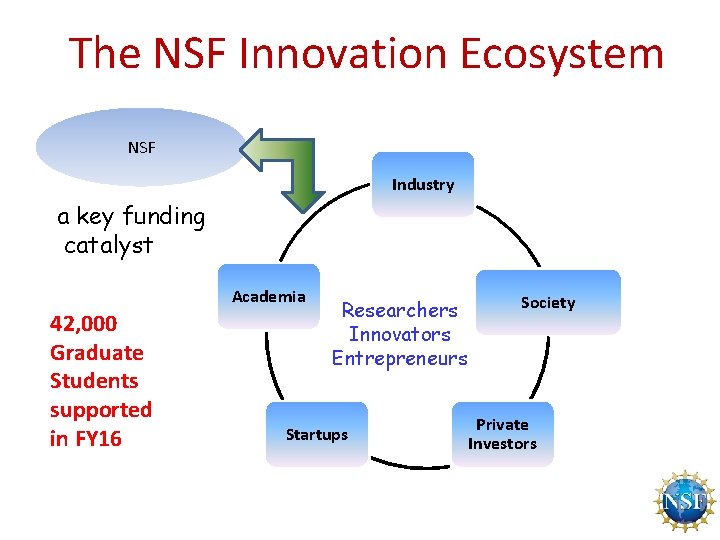
The NSF Innovation Ecosystem NSF Industry a key funding catalyst Academia 42, 000 Graduate Students supported in FY 16 Researchers Innovators Entrepreneurs Startups Society Private Investors
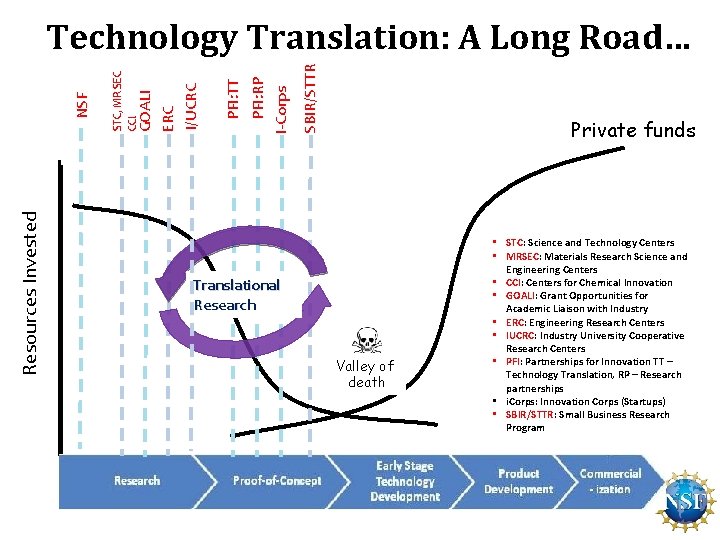
Resources Invested SBIR/STTR PFI: RP I-Corps PFI: TT GOALI ERC I/UCRC STC, MRSEC CCI NSF Technology Translation: A Long Road… Private funds Translational Research Valley of death • STC: Science and Technology Centers • MRSEC: Materials Research Science and Engineering Centers • CCI: Centers for Chemical Innovation • GOALI: Grant Opportunities for Academic Liaison with Industry • ERC: Engineering Research Centers • IUCRC: Industry University Cooperative Research Centers • PFI: Partnerships for Innovation TT – Technology Translation, RP – Research partnerships • i. Corps: Innovation Corps (Startups) • SBIR/STTR: Small Business Research Program
NSF Supports All Areas of Fundamental Research NSF support as a percentage of total federal support for academic research Source: NSF/NCSES, Survey of Federal Funds for Research & Development, FY 2014
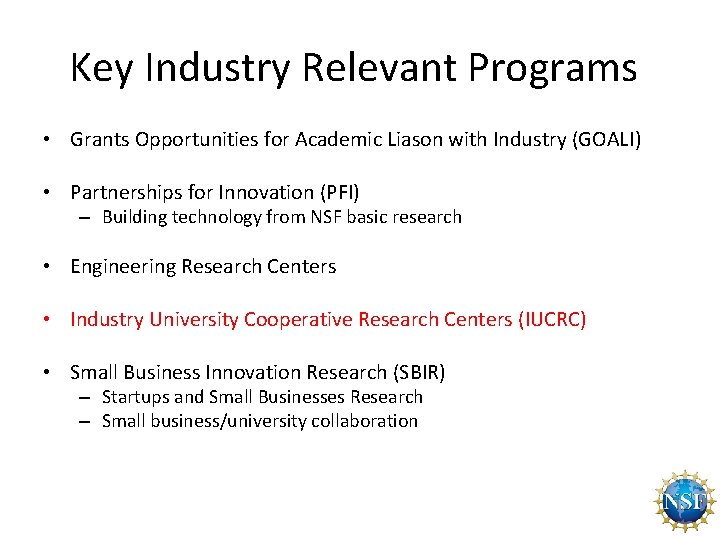
Key Industry Relevant Programs • Grants Opportunities for Academic Liason with Industry (GOALI) • Partnerships for Innovation (PFI) – Building technology from NSF basic research • Engineering Research Centers • Industry University Cooperative Research Centers (IUCRC) • Small Business Innovation Research (SBIR) – Startups and Small Businesses Research – Small business/university collaboration
NSF Funded Centers – A key investment • • • STC: Science and Technology Centers MRSEC: Materials Research Science and Engineering Centers CCI: Centers for Chemical Innovation ERC: Engineering Research Centers IUCRC: Industry/University Cooperative Research Centers Basic Research STC 1987 Applied Use-inspired MRSEC CCI ERC IUCRC 1994, ‘ 98 1985 1973
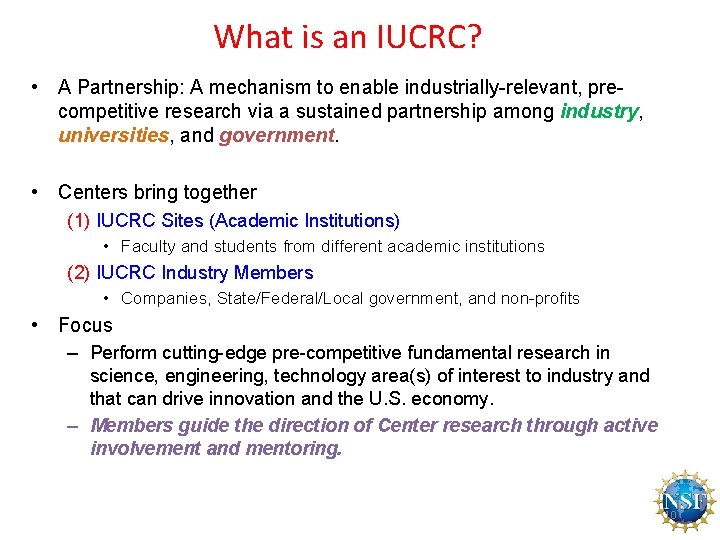
What is an IUCRC? • A Partnership: A mechanism to enable industrially-relevant, precompetitive research via a sustained partnership among industry, universities, and government. • Centers bring together (1) IUCRC Sites (Academic Institutions) • Faculty and students from different academic institutions (2) IUCRC Industry Members • Companies, State/Federal/Local government, and non-profits • Focus – Perform cutting-edge pre-competitive fundamental research in science, engineering, technology area(s) of interest to industry and that can drive innovation and the U. S. economy. – Members guide the direction of Center research through active involvement and mentoring. 10
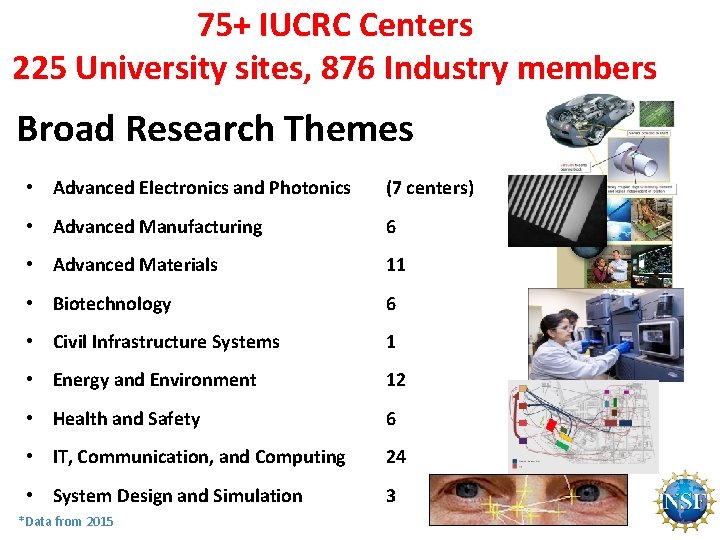
75+ IUCRC Centers 225 University sites, 876 Industry members Broad Research Themes • Advanced Electronics and Photonics (7 centers) • Advanced Manufacturing 6 • Advanced Materials 11 • Biotechnology 6 • Civil Infrastructure Systems 1 • Energy and Environment 12 • Health and Safety 6 • IT, Communication, and Computing 24 • System Design and Simulation 3 *Data from 2015
NSF’s Role Facilitate a Center environment in which long-term relationships between industry and academia can thrive. • Cooperative Agreement & Operational Framework • Provide 40+ year experience managing IUCRCs • Franchise of centers for collaboration • Provide networking opportunities • NSF Award – Seed Funding Opportunities/Oversight
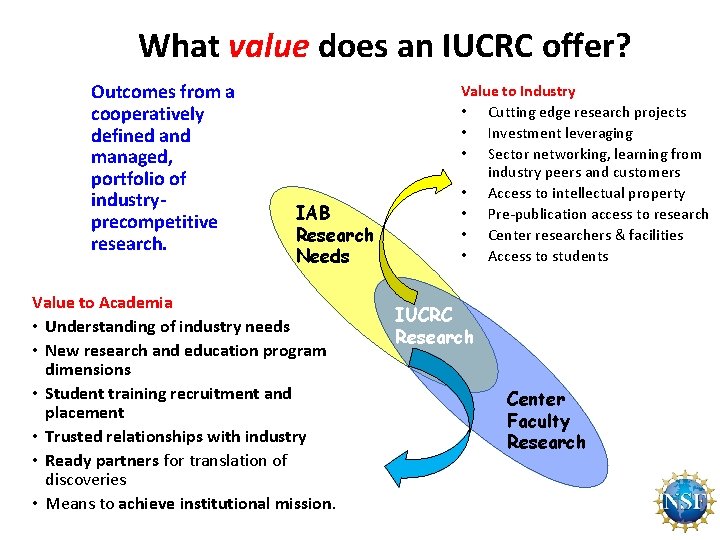
What value does an IUCRC offer? Outcomes from a cooperatively defined and managed, portfolio of industryprecompetitive research. IAB Research Needs Value to Academia • Understanding of industry needs • New research and education program dimensions • Student training recruitment and placement • Trusted relationships with industry • Ready partners for translation of discoveries • Means to achieve institutional mission. Value to Industry • Cutting edge research projects • Investment leveraging • Sector networking, learning from industry peers and customers • Access to intellectual property • Pre-publication access to research • Center researchers & facilities • Access to students IUCRC Research Center Faculty Research
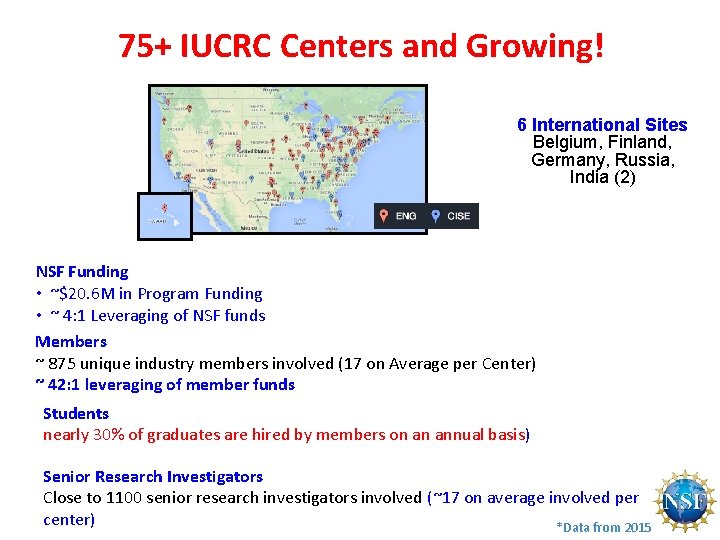
75+ IUCRC Centers and Growing! 6 International Sites Belgium, Finland, Germany, Russia, India (2) NSF Funding • ~$20. 6 M in Program Funding • ~ 4: 1 Leveraging of NSF funds Members ~ 875 unique industry members involved (17 on Average per Center) ~ 42: 1 leveraging of member funds Students nearly 30% of graduates are hired by members on an annual basis) Senior Research Investigators Close to 1100 senior research investigators involved (~17 on average involved per center) *Data from 2015
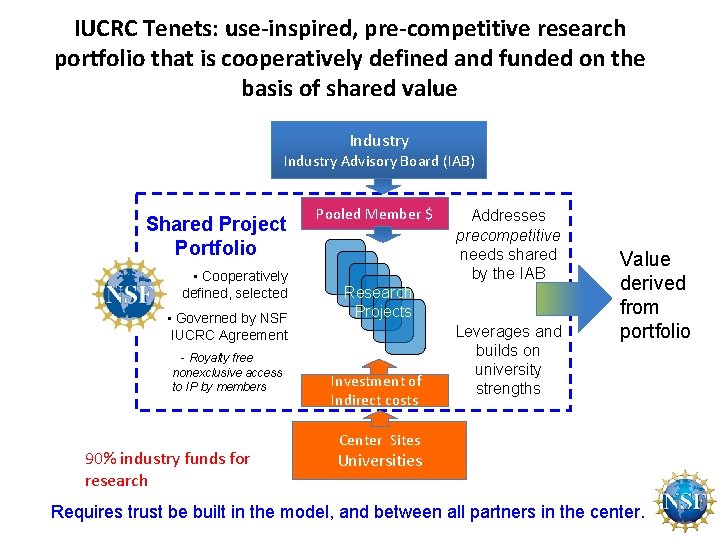
IUCRC Tenets: use-inspired, pre-competitive research portfolio that is cooperatively defined and funded on the basis of shared value Industry Advisory Board (IAB) Shared Project Portfolio • Cooperatively defined, selected • Governed by NSF IUCRC Agreement - Royalty free nonexclusive access to IP by members 90% industry funds for research Pooled Member $ Addresses precompetitive needs shared by the IAB Research Projects Investment of Indirect costs Leverages and builds on university strengths Value derived from portfolio Center Sites Universities Requires trust be built in the model, and between all partners in the center.
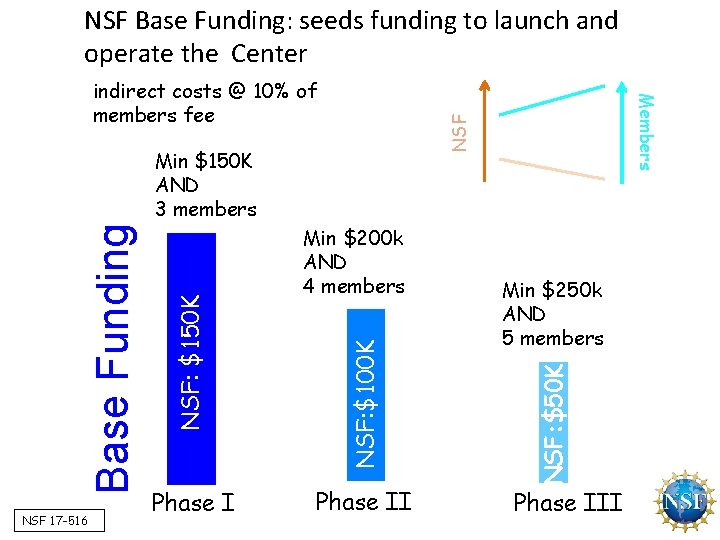
NSF Base Funding: seeds funding to launch and operate the Center NSF 17 -516 NSF Min $200 k AND 4 members Phase II Min $250 k AND 5 members NSF: $50 K Phase I Phases NSF: $100 K NSF: $150 K Base Funding Min $150 K AND 3 members Phase III Members indirect costs @ 10% of members fee
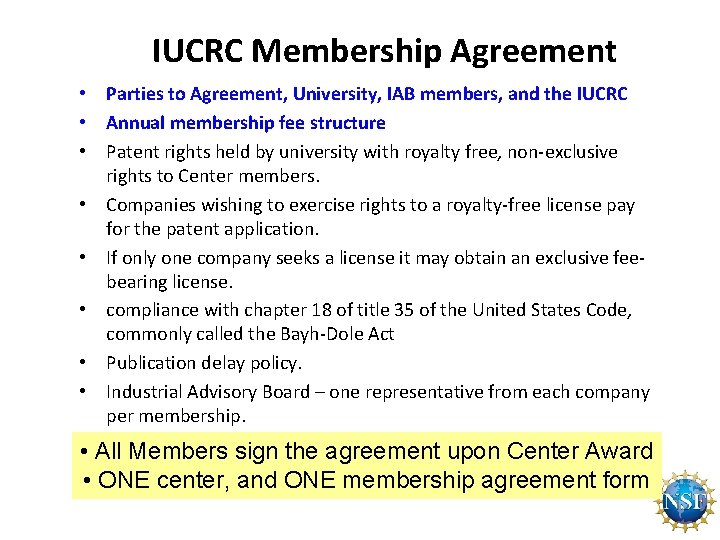
IUCRC Membership Agreement • Parties to Agreement, University, IAB members, and the IUCRC • Annual membership fee structure • Patent rights held by university with royalty free, non-exclusive rights to Center members. • Companies wishing to exercise rights to a royalty-free license pay for the patent application. • If only one company seeks a license it may obtain an exclusive feebearing license. • compliance with chapter 18 of title 35 of the United States Code, commonly called the Bayh-Dole Act • Publication delay policy. • Industrial Advisory Board – one representative from each company per membership. • All Members sign the agreement upon Center Award • ONE center, and ONE membership agreement form
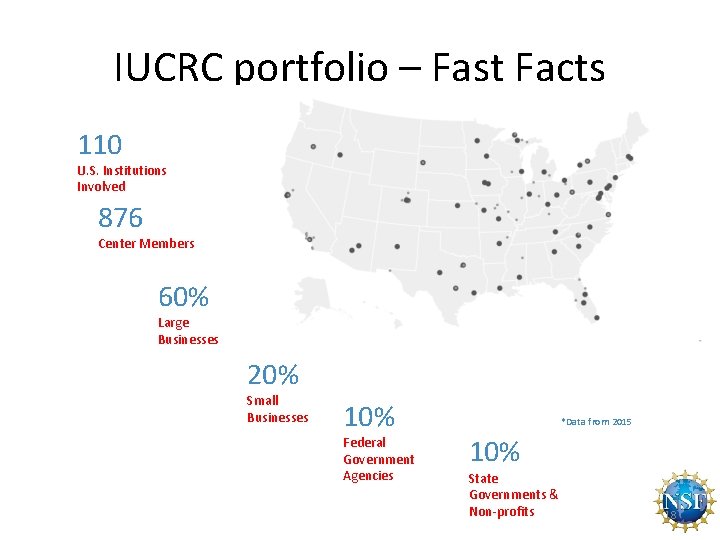
IUCRC portfolio – Fast Facts 110 U. S. Institutions Involved 876 Center Members 60% Large Businesses 20% Small Businesses 10% Federal Government Agencies *Data from 2015 10% State Governments & Non-profits 18
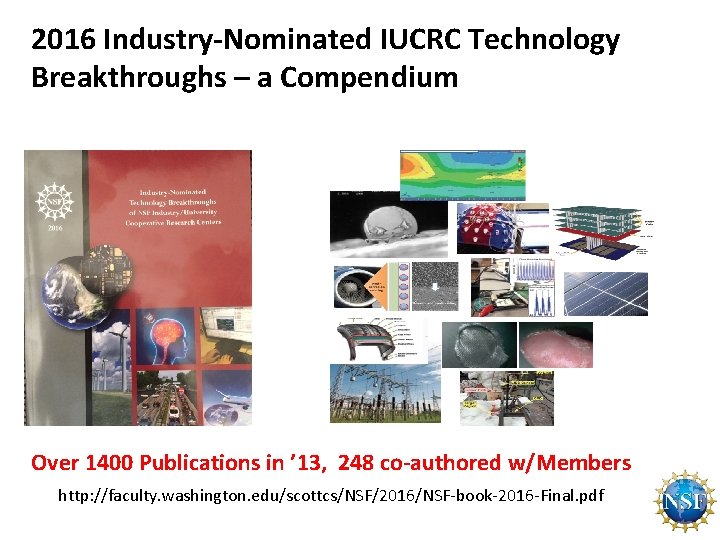
2016 Industry-Nominated IUCRC Technology Breakthroughs – a Compendium Over 1400 Publications in ’ 13, 248 co-authored w/Members http: //faculty. washington. edu/scottcs/NSF/2016/NSF-book-2016 -Final. pdf
Why Do Companies Join an IUCRC? Strategic sector-relevant research……. . R&D Acceleration: Member Follow-on Funding Center products trigger internal R&D projects. An estimated $100 M/year, program-wide, of follow-on funding for I/UCRC projects over the past five years. Impact on R&D: Efficiency and Cost Savings Reduce costs, amplify, and streamline internal research efforts by sharing risks. Intellectual property (IP) Impact FY 15: 108 invention disclosures; 76 patent applications with 20 granted; 12 license agreements; 5 copyrights; and 12 spin-off companies realized. Impact on Commercialization Hundreds of companies have reported commercialization of products, processes and/or services coming from I/UCRC sponsored research. Impact on Human Capital Vehicle for training and evaluating the next generation of scientists and engineers for hire into their organization. …and value derived from cooperatively-defined, use-inspired projects and workforce development
Types of proposals • Seeking a grant in support of a planning meeting workshop (“Planning Grant”) • Seeking a grant for creation of a new Phase I site as part of a new Center, or addition of a site to an existing Center (“Site Grant”) • Transition from a prior solicitation to the current solicitation funding model within a current active Phase (“Funding model transition”) • Transition to a Phase II center after completion of Phase I, or Phase III after completion of Phase II (“Phase Transition”)
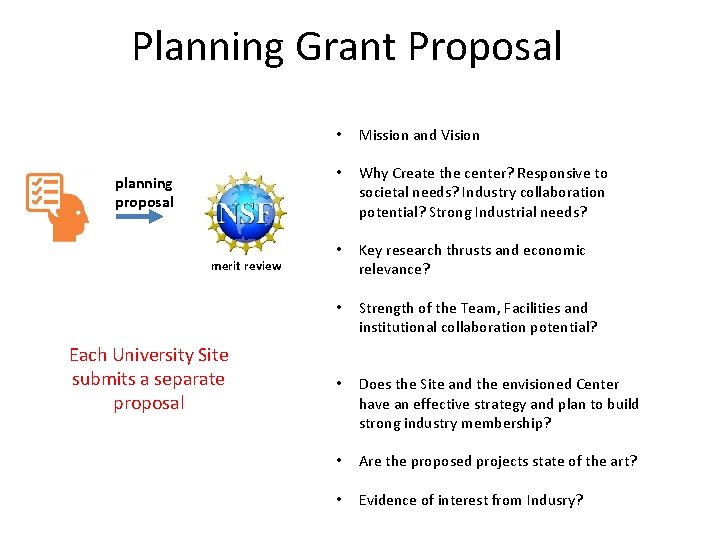
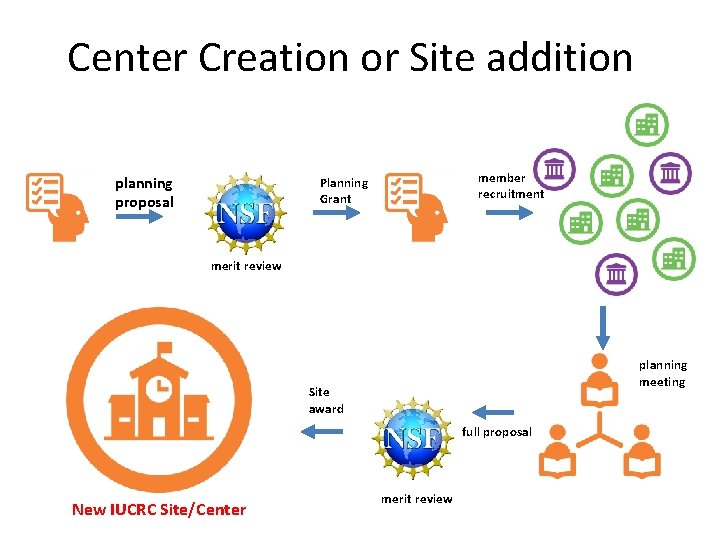
Planning Grant Proposal planning proposal merit review Each University Site submits a separate proposal • Mission and Vision • Why Create the center? Responsive to societal needs? Industry collaboration potential? Strong Industrial needs? • Key research thrusts and economic relevance? • Strength of the Team, Facilities and institutional collaboration potential? • Does the Site and the envisioned Center have an effective strategy and plan to build strong industry membership? • Are the proposed projects state of the art? • Evidence of interest from Indusry?
Center Creation or Site addition planning proposal member recruitment Planning Grant merit review planning meeting Site award full proposal New IUCRC Site/Center merit review
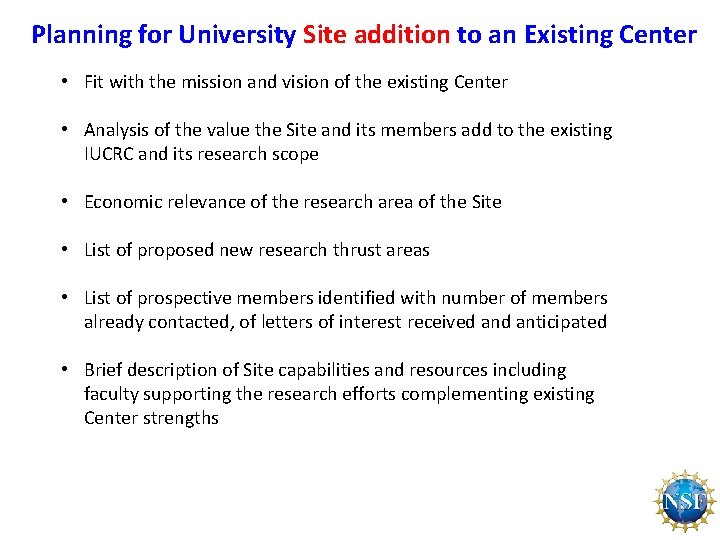
Planning for University Site addition to an Existing Center • Fit with the mission and vision of the existing Center • Analysis of the value the Site and its members add to the existing IUCRC and its research scope • Economic relevance of the research area of the Site • List of proposed new research thrust areas • List of prospective members identified with number of members already contacted, of letters of interest received anticipated • Brief description of Site capabilities and resources including faculty supporting the research efforts complementing existing Center strengths
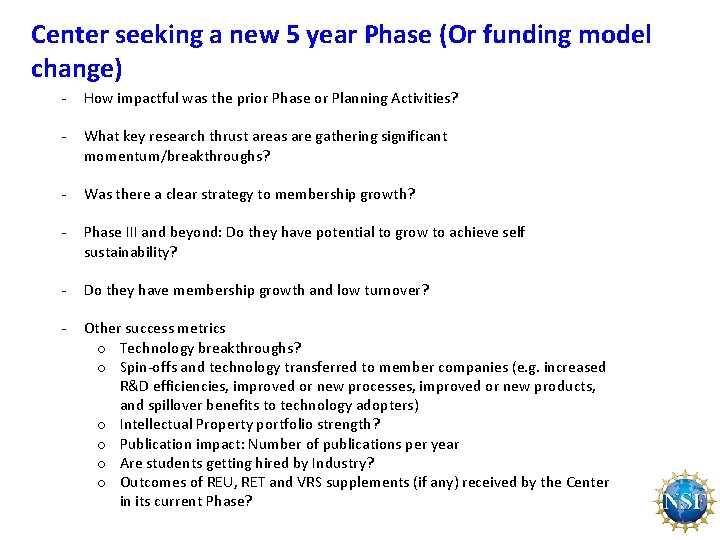
Center seeking a new 5 year Phase (Or funding model change) - How impactful was the prior Phase or Planning Activities? - What key research thrust areas are gathering significant momentum/breakthroughs? - Was there a clear strategy to membership growth? - Phase III and beyond: Do they have potential to grow to achieve self sustainability? - Do they have membership growth and low turnover? - Other success metrics o Technology breakthroughs? o Spin-offs and technology transferred to member companies (e. g. increased R&D efficiencies, improved or new processes, improved or new products, and spillover benefits to technology adopters) o Intellectual Property portfolio strength? o Publication impact: Number of publications per year o Are students getting hired by Industry? o Outcomes of REU, RET and VRS supplements (if any) received by the Center in its current Phase?
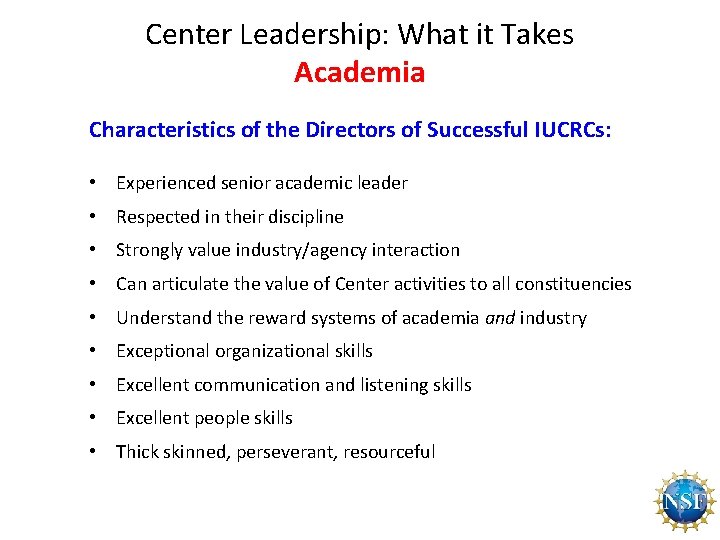
Center Leadership: What it Takes Academia Characteristics of the Directors of Successful IUCRCs: • Experienced senior academic leader • Respected in their discipline • Strongly value industry/agency interaction • Can articulate the value of Center activities to all constituencies • Understand the reward systems of academia and industry • Exceptional organizational skills • Excellent communication and listening skills • Excellent people skills • Thick skinned, perseverant, resourceful
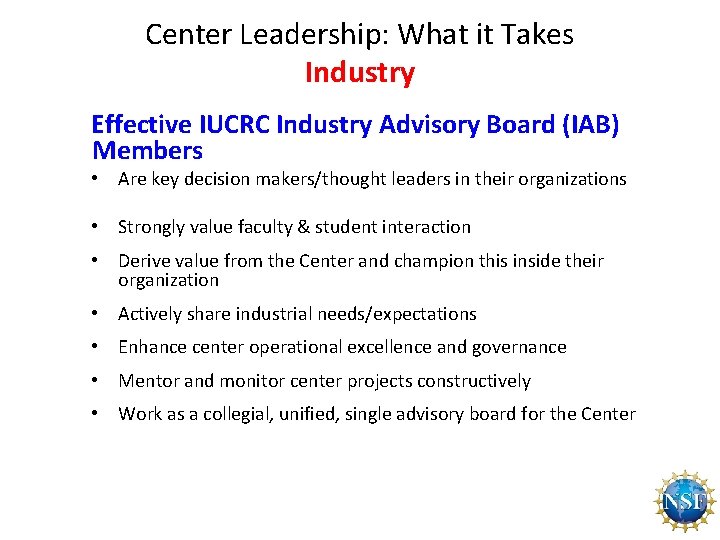
Center Leadership: What it Takes Industry Effective IUCRC Industry Advisory Board (IAB) Members • Are key decision makers/thought leaders in their organizations • Strongly value faculty & student interaction • Derive value from the Center and champion this inside their organization • Actively share industrial needs/expectations • Enhance center operational excellence and governance • Mentor and monitor center projects constructively • Work as a collegial, unified, single advisory board for the Center
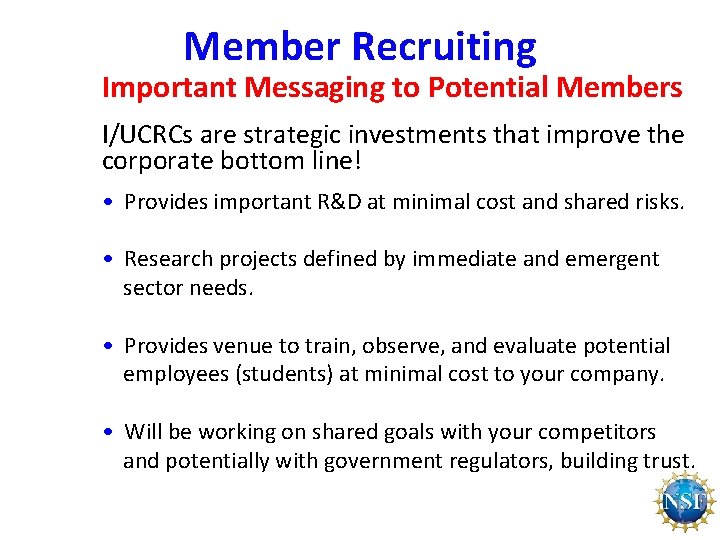
Member Recruiting Important Messaging to Potential Members I/UCRCs are strategic investments that improve the corporate bottom line! • Provides important R&D at minimal cost and shared risks. • Research projects defined by immediate and emergent sector needs. • Provides venue to train, observe, and evaluate potential employees (students) at minimal cost to your company. • Will be working on shared goals with your competitors and potentially with government regulators, building trust.
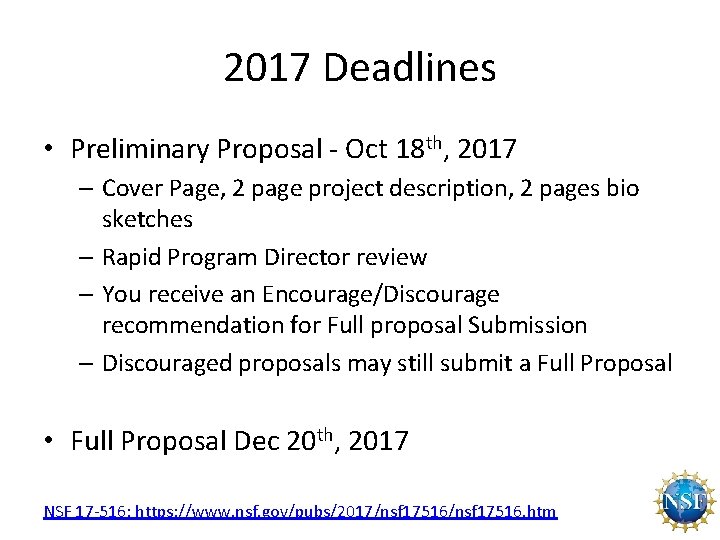
2017 Deadlines • Preliminary Proposal - Oct 18 th, 2017 – Cover Page, 2 page project description, 2 pages bio sketches – Rapid Program Director review – You receive an Encourage/Discourage recommendation for Full proposal Submission – Discouraged proposals may still submit a Full Proposal • Full Proposal Dec 20 th, 2017 NSF 17 -516: https: //www. nsf. gov/pubs/2017/nsf 17516. htm
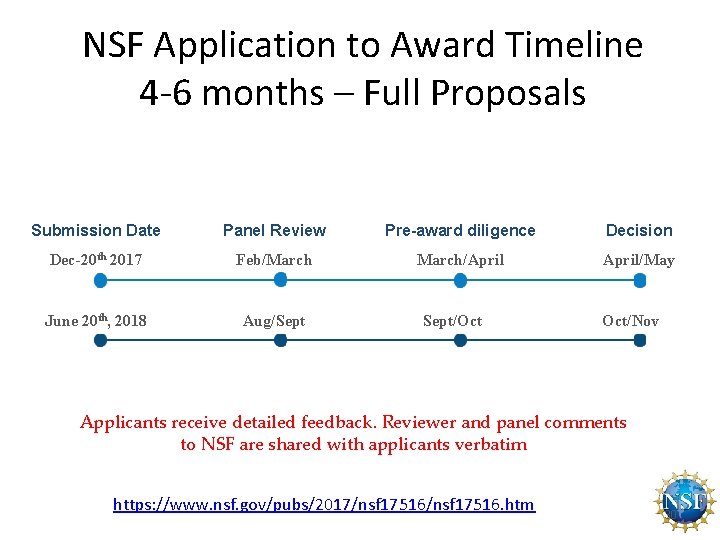
NSF Application to Award Timeline 4 -6 months – Full Proposals Submission Date Panel Review Pre-award diligence Decision Dec-20 th 2017 Feb/March/April/May June 20 th, 2018 Aug/Sept/Oct Oct/Nov Applicants receive detailed feedback. Reviewer and panel comments to NSF are shared with applicants verbatim https: //www. nsf. gov/pubs/2017/nsf 17516. htm 30
Launching and Growing a Successful I/UCRC…. Entails same challenges as launching a startup. Building a successful core of members requires customer discovery, acquisition and retention. Need to know how to position your value proposition. Need to know how to approach, interact and convince your customers (members) of your value.
Questions? • IUCRC Program Directors – email us with your questions – Prakash Balan, pbalan@nsf. gov – Andre Marshall, awmarsha@nsf. gov – Dmitri Perkins, dperkins@nsf. gov • NSF IUCRC Home Page and Center Directory http: //www. iucrc. org • IUCRC Solicitation : Web Search for : “nsf 17516” – https: //www. nsf. gov/publications/pub_summ. jsp? ods_key=nsf 1751 6