ERP Course Workflow Management Systems Readings Chapter 1


- Slides: 35
ERP Course: Workflow Management Systems Readings: Chapter 1 and 3 from Wil van der Aalst Peter Dolog dolog [at] cs [dot] aau [dot] dk E 2 -201 Information Systems November 8, 2006
Workflow Management Systems A workflow management system (WFMS) is a software package that can be used to support the definition, management and execution of workflow processes. A workflow system (WFS) is a system based on a WFMS that supports a specific set of business processes through the execution of computerized process definitions Peter Dolog, ERP Course, Workflow Management Systems 2
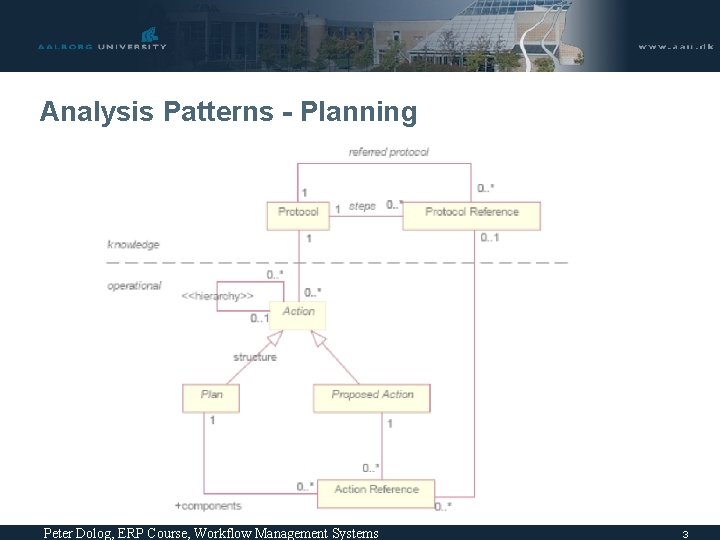
Analysis Patterns - Planning Peter Dolog, ERP Course, Workflow Management Systems 3
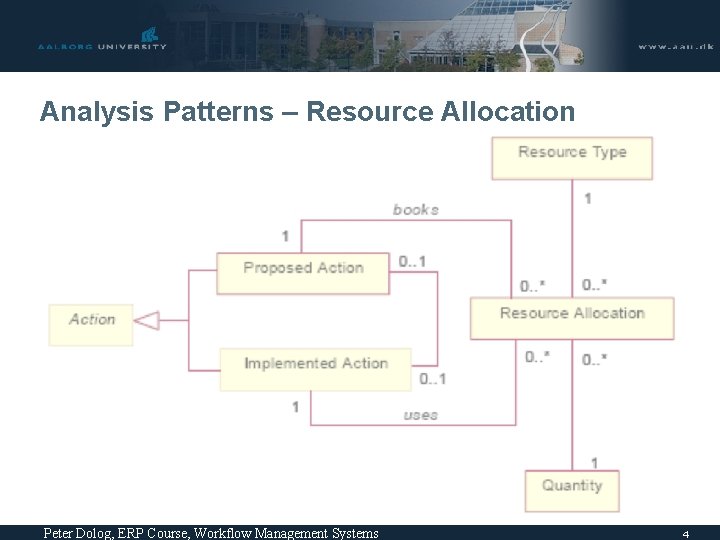
Analysis Patterns – Resource Allocation Peter Dolog, ERP Course, Workflow Management Systems 4
The Same Principle Processes Resources and their classifications Applications – execution Peter Dolog, ERP Course, Workflow Management Systems 5
Separation of Concerns Application WFMS Application UIMS DBMS Operating System Peter Dolog, ERP Course, Workflow Management Systems Operating System 6
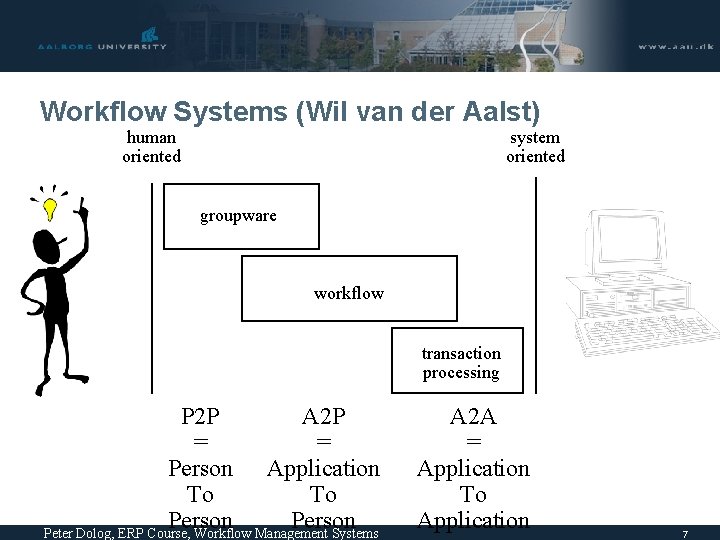
Workflow Systems (Wil van der Aalst) human oriented system oriented groupware workflow transaction processing P 2 P A 2 P = = Person Application To To Person Peter Dolog, ERP Course, Workflow Management Systems A 2 A = Application To Application 7
Basic Concepts Work Process/Procedure Case – thing to be produces Tasks – logical step applicable for many cases Work Items – task + case Activities – task + case + ressource + trigger Still remember the difference between plans and protocols!? Peter Dolog, ERP Course, Workflow Management Systems 8
Processes Primary – produce products Secondary – support processes (maintanance, marketing, financial administration, human resource management) Tertiarty – managerial processes Peter Dolog, ERP Course, Workflow Management Systems 9
Resources Resource (participant, actor, user, agent) A resource can execute certain tasks for certain cases. Human and/or non-human (printer, modem): limited capacity. Resource class A set of resources with similar characteristic(s). Role (skill, competence, qualification) Classification based on what a resource can do. Group (department, team, office, organizational unit) Classification based on the organization Peter Dolog, ERP Course, Workflow Management Systems 10
Resource Organization Hierarchical Matrix Network Peter Dolog, ERP Course, Workflow Management Systems 11
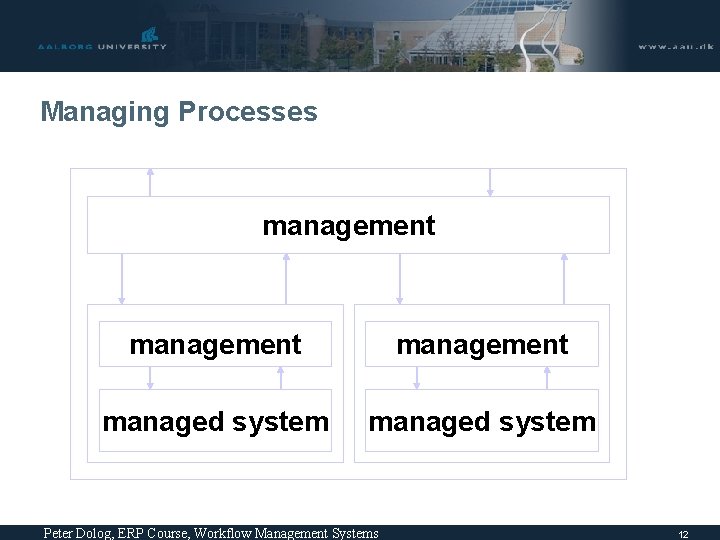
Managing Processes management managed system Peter Dolog, ERP Course, Workflow Management Systems 12
Management Real Time – frequent (control of machines and vehicles) Operational – decisions made regularly (allocation of resources, routing and cases) Tactical – decisions are made periodicaly (capacity planning and budgeting) Strategic – decisions are made on long term basis (structural aspects of processes) Peter Dolog, ERP Course, Workflow Management Systems 13
Information Systems for BP Office Information Systems Transaction-Processing Systems Knowledge Management Systems Decision Support Systems Control Systems Peter Dolog, ERP Course, Workflow Management Systems 14
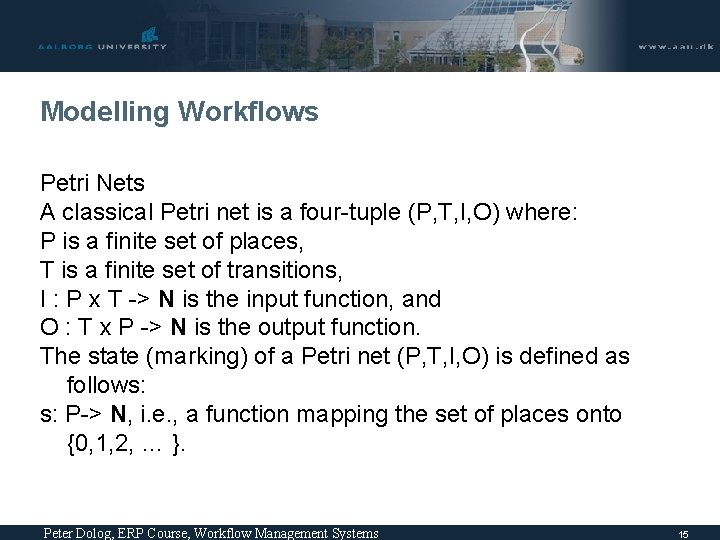
Modelling Workflows Petri Nets A classical Petri net is a four-tuple (P, T, I, O) where: P is a finite set of places, T is a finite set of transitions, I : P x T -> N is the input function, and O : T x P -> N is the output function. The state (marking) of a Petri net (P, T, I, O) is defined as follows: s: P-> N, i. e. , a function mapping the set of places onto {0, 1, 2, … }. Peter Dolog, ERP Course, Workflow Management Systems 15
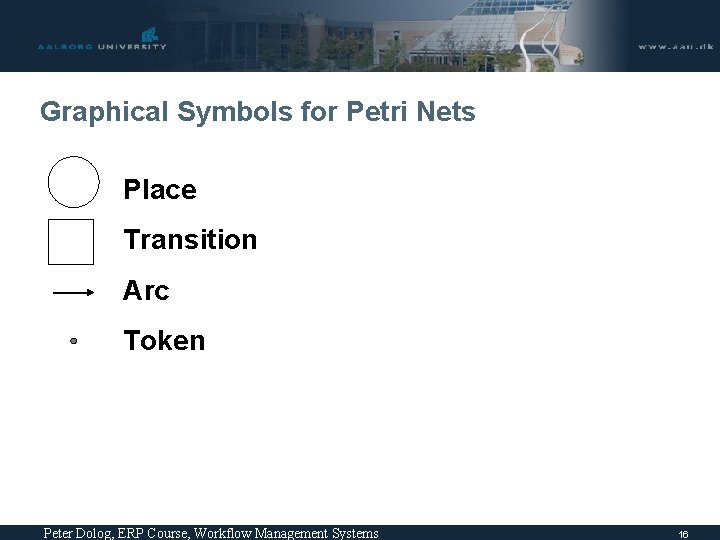
Graphical Symbols for Petri Nets Place Transition Arc Token Peter Dolog, ERP Course, Workflow Management Systems 16
Example Peter Dolog, ERP Course, Workflow Management Systems 17
Roles of Tokens can play the following roles: a physical object, for example a product, a part, a drug, a person; an information object, for example a message, a signal, a report; a collection of objects, for example a truck with products, a warehouse with parts, or an address file; an indicator of a state, for example the indicator of the state in which a process is, or the state of an object; an indicator of a condition: the presence of a token indicates whether a certain condition is fulfilled. Peter Dolog, ERP Course, Workflow Management Systems 18
Roles of Places a type of communication medium, like a telephone line, a middleman, or a communication network; a buffer: for example, a depot, a queue or a post bin; a geographical location, like a place in a warehouse, office or hospital; a possible state or state condition: for example, the floor where an elevator is, or the condition that a specialist is available. Peter Dolog, ERP Course, Workflow Management Systems 19
Role of Transition an event: for example, starting an operation, the death of a patient, a change seasons or the switching of a traffic light from red to green; a transformation of an object, like adapting a product, updating a database, or updating a document; a transport of an object: for example, transporting goods, or sending a file. Peter Dolog, ERP Course, Workflow Management Systems 20
Network Structures Causality Human Intervension Parallelism (AND-split - AND-join) Choice (XOR-split – XOR-join) Iteration (XOR-join - XOR-split) Capacity constraints • Feedback loop • Mutual exclusion • Alternating Peter Dolog, ERP Course, Workflow Management Systems 21
Mappings to Domain Symbols Peter Dolog, ERP Course, Workflow Management Systems 22
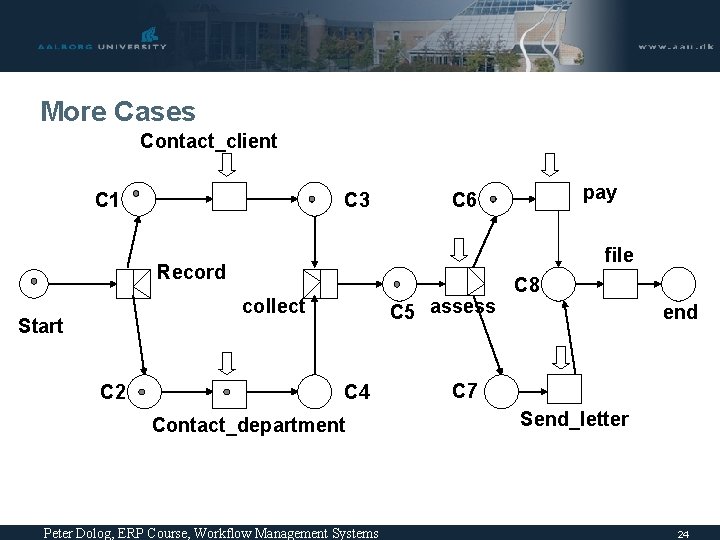
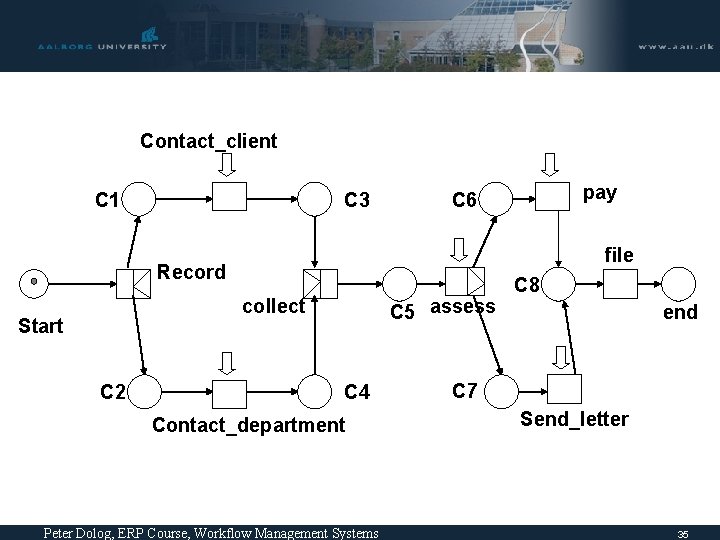
Process for Insurance Complaint Contact_client C 1 C 3 file Record collect Start C 2 pay C 6 C 5 assess C 4 Contact_department Peter Dolog, ERP Course, Workflow Management Systems C 8 end C 7 Send_letter 23
More Cases Contact_client C 1 C 3 file Record collect Start C 2 pay C 6 C 5 assess C 4 Contact_department Peter Dolog, ERP Course, Workflow Management Systems C 8 end C 7 Send_letter 24
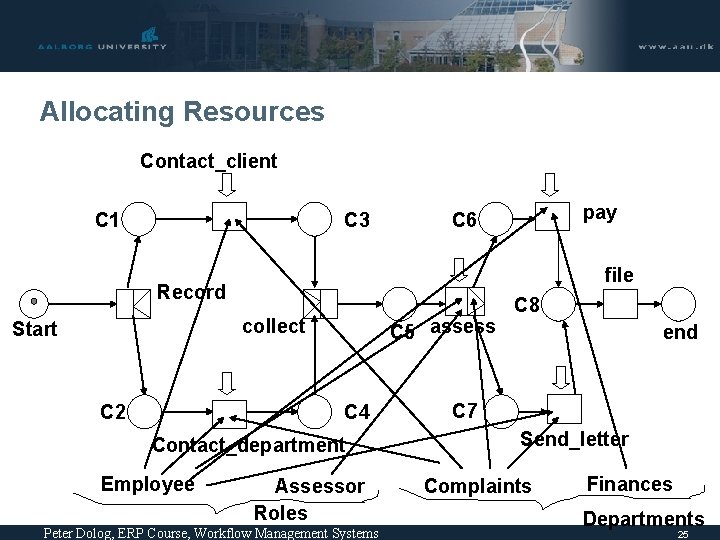
Allocating Resources Contact_client C 1 C 3 file Record collect Start C 2 C 5 assess C 4 Contact_department Employee pay C 6 Assessor Roles Peter Dolog, ERP Course, Workflow Management Systems C 8 end C 7 Send_letter Complaints Finances Departments 25
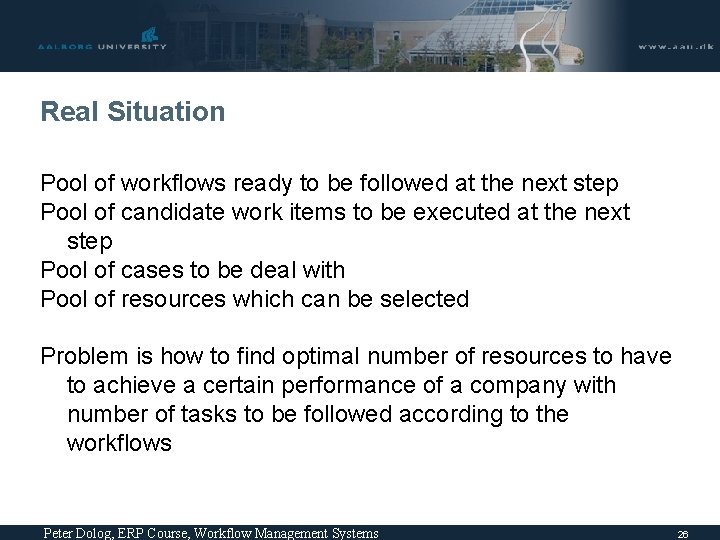
Real Situation Pool of workflows ready to be followed at the next step Pool of candidate work items to be executed at the next step Pool of cases to be deal with Pool of resources which can be selected Problem is how to find optimal number of resources to have to achieve a certain performance of a company with number of tasks to be followed according to the workflows Peter Dolog, ERP Course, Workflow Management Systems 26
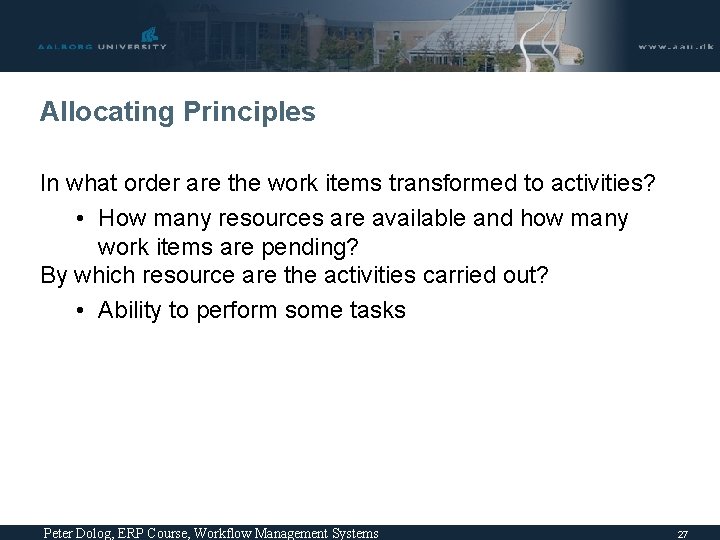
Allocating Principles In what order are the work items transformed to activities? • How many resources are available and how many work items are pending? By which resource are the activities carried out? • Ability to perform some tasks Peter Dolog, ERP Course, Workflow Management Systems 27
Heuristics for work item allocation FIFO LIFO Shortes Processing Time (SPT) Shortest Rest-Processing Time (SRPT) Longest Rest-Processing Time (LRPT) Earliest Due Date (EDD) Peter Dolog, ERP Course, Workflow Management Systems 28
Heuristics for Resource Allocation Let resource practice its specialty As far as possible, let a resource do similar tasks in succession Strive for the greatest possible flexibility for the near future Allocation methods in workflow engines: Push driven approach: • Matching resource properties with work items properties Pull driven approach • Resources themselves take an initiative Peter Dolog, ERP Course, Workflow Management Systems 29
Bottlenecks in the Workflows Number of cases in progress too large Completion time too long compare to the actual processing time Level of service too low Peter Dolog, ERP Course, Workflow Management Systems 30
Performance Indicators External performance indicators (case-oriented) • Avarage completion time, reliability of completion time Internal performance inficators (ressource oriented) • What effort is required to achieve external performance • Level of resource utilization, number of cases per ressource, in progress, number of rollbacks, rate of turnover Peter Dolog, ERP Course, Workflow Management Systems 31
(Re-)designing Workflows What? – select a workflow that has to be re. designed Why? – establish an objective of the workflow to be (re)designed How? – esteblish steps which must be carried out and in which oder Who? – allocate resources Peter Dolog, ERP Course, Workflow Management Systems 32
Principles Establish Objectives Ingnore the existance of resources when defining the process As far as possible, make one person responsible for processing of a case (case manager) Check the need for each task Consider the scope of tasks Strive for the simplest possible process Carefully weigh a generic process vs. several versions of the same process Peter Dolog, ERP Course, Workflow Management Systems 33
Principles (cntd. ) Carefully weigh specialization vs. generalization As far as possible, try to achieve parallel processing of tasks Investigate the new opportunities opened up by recent developments in networking and databases Treat geographically scattered resources as if they are centralized Allow a resource to practice its specialty As far as possible, allow the resource to perform similar tasks in succession Try to achieve as much flexibility as possible for the future Allow a ressource to work as much as possible on the same case Peter Dolog, ERP Course, Workflow Management Systems 34
Contact_client C 1 C 3 file Record collect Start C 2 pay C 6 C 5 assess C 4 Contact_department Peter Dolog, ERP Course, Workflow Management Systems C 8 end C 7 Send_letter 35