
Unleashing Business Innovation with Integrated Service Management Peter
Unleashing Business Innovation with Integrated Service Management Peter Edwards Executive Consultant, Integrated Service Management IBM Asia Pacific President, IT Service Management Forum (it. SMF) Singapore 1 ITIL 2011 & ISM Overview
Presentation Agenda • An overview of ITIL 2011 (otherwise known as ITIL 3. 1) • An overview of an Integrated Service Management framework 2 ITIL 2011 & ISM Overview
An Overview of ITIL 2011 Acknowledgements: A significant amount of content in this section of the presentation is obtained from publicly available documents on the OGC ITIL web-site (particularly “ITIL 2011 – Summary of Updates”): http: //www. best-management-practice. com/IT-Service-Management-ITIL/ 3 ITIL 2011 & ISM Overview
About ITIL 2011 • Released on 29 July 2011 as a refinement and clarification of ITIL v 3 • ITIL 2011 is an update, not a new version. The updates to the publications are designed to: – Resolve any errors or inconsistencies in the text and diagrams, both in content and presentation. – Improve the publications by addressing issues raised in the Change Control Log. These are largely to do with clarity, consistency, correctness and completeness. – Address suggestions for change made by the training community to make ITIL easier to teach. – Review the Service Strategy publication to ensure that the concepts are explained in the clearest, most concise and accessible way possible. There is no notion of simplifying the concepts; rather, improving the exposition of the ideas. 4 ITIL 2011 & ISM Overview
Global Changes • The updated ITIL publications share a similar standard structure (including a standard structure for chapters), to improve consistency and aid navigation. • Some content has been reorganized to improve flow and readability, and ensure alignment across the suite – including clarification around interfaces, and inputs and outputs across the service lifecycle. • Terminology has been clarified and made consistent across the publications and the ITIL glossary (there is an updated glossary which is free for download). 5 ITIL 2011 & ISM Overview

The ITIL 2011 Processes Service Strategy Service Design Strategy mgmt for IT services Design coordination Service portfolio mgmt Service catalogue mgmt Financial mgmt for IT services Service level mgmt Demand mgmt Availability mgmt Business relationship mgmt Service Transition Service Operation Transition planning & support Event mgmt Change mgmt Request fulfilment Service asset & configuration mgmt Problem mgmt Capacity mgmt Release & deployment mgmt IT service continuity mgmt Service validation & testing Information security mgmt Change evaluation Supplier mgmt Knowledge mgmt Significant changes / new process 6 ITIL 2011 & ISM Overview Incident mgmt Access mgmt Continual Service Improvement 7 Step Improvement process incorporating the PDCA cycle
Service Strategy • ITIL Service Strategy provides guidance on the importance for all organizations of a well-defined business strategy, underpinned by an effective IT strategy. • The processes within service strategy have now been more clearly named and defined: – The newly defined process of strategy management for IT services is responsible for developing and maintaining business and IT strategies, and there are now separate descriptions of business strategy and IT strategy. – Financial management has been expanded to include some of the key elements included in the earlier ITIL publications such as accounting, budgeting and charging. – Business relationship management and demand management are now covered as processes. • More detail has been included regarding governance, the difference between governance and management, a governance framework, and how service management relates to governance • Some coverage has been added on how IT service management is impacted by the prevalence of cloud computing and a new appendix has been added specifically covering service strategy and the cloud 7 ITIL 2011 & ISM Overview

Service Design • ITIL Service Design provides guidance for the design of appropriate and innovative IT services to meet current and future agreed business requirements. • A number of concepts and principles have been clarified, – The flow and management of activity throughout the overall service design stage with the addition of the “design coordination” process. – Clarification of the five aspects of service design – Clearer description of the transition of a service from pipeline to catalogue to retired – The service catalogue language has been revised with regard to the customer’s view of the service catalogue, versus the technical or IT view. 8 ITIL 2011 & ISM Overview
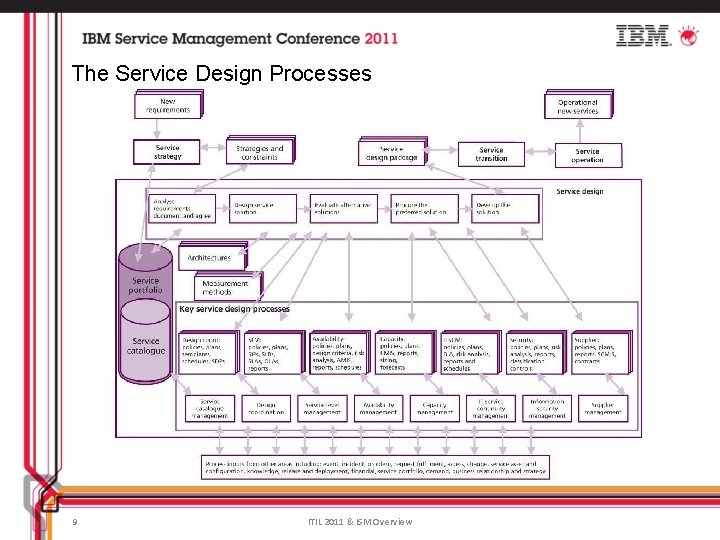
The Service Design Processes 9 ITIL 2011 & ISM Overview
Service Transition • The main focus of ITIL Service Transition is on the introduction of new and changed services. However the scope also includes transition of service provider capabilities, technology and management architectures, processes, and measurement methods and metrics. – The structure, content and relationships of the configuration management system (CMS) and service knowledge management system (SKMS) have been clarified – There is new content explaining how a change proposal should be used. – The evaluation process has been renamed ‘change evaluation’ and the purpose and scope have been modified to help clarify when and how this process should be used. – The service asset and configuration management process has additional content relating to asset management – There are improvements in the flow and integration of a number of processes, including change management, release and deployment management, and change evaluation. 10 ITIL 2011 & ISM Overview
Service Operation – Process flows have been updated or added for all processes including request fulfillment, access management and event management. – Key principles – including guidance around service requests and request models, and proactive problem management – have been clarified. – Explanation has been added on how basic events flow into filters and rule engines to produce meaningful event information. – The relationship between application management activities versus application development activities is clarified. – There is an expanded section on problem analysis techniques, procedure flow for incident matching and guidance for escalating incidents to problem management. – The guidance for managing physical facilities has been expanded. 11 ITIL 2011 & ISM Overview
Continual Service Improvement • ITIL Continual Service Improvement provides guidance for the identification of improvement opportunities in all aspects of the service lifecycle. – The seven-step improvement process – and its relationship with the Deming ‘Plan-Do-Check-Act’ cycle and knowledge management – has been clarified. – The concept of a CSI register has been introduced as a place to record details of all improvement initiatives within an organization. 12 ITIL 2011 & ISM Overview
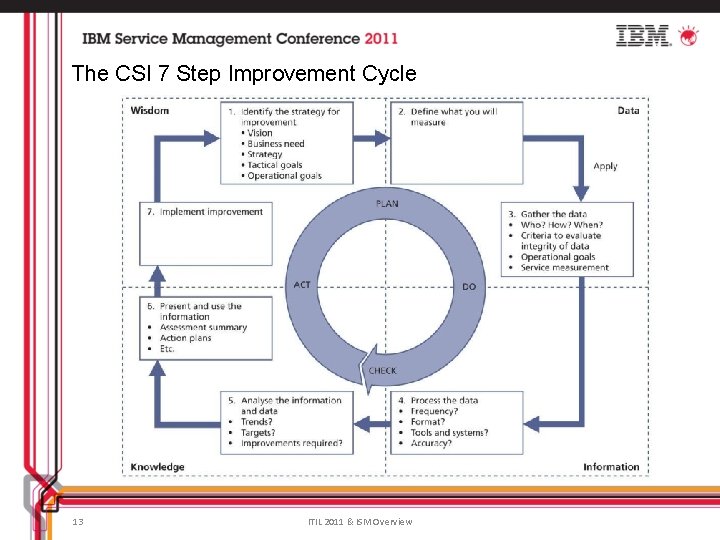
The CSI 7 Step Improvement Cycle 13 ITIL 2011 & ISM Overview
FAQs • Do I need to be re-certified? Will I have to take a bridging exam? – Candidates who hold existing ITIL certification will not need to become re-certified. The accreditor has no plans to introduce any bridging examinations for the update, as the core ITIL process areas and principles have not changed significantly. – However, updates will be reflected in the syllabuses and examinations for new qualifications • When will the updated examinations be available? – The updated syllabuses and examinations are available from 8 August 2011. 14 ITIL 2011 & ISM Overview
Integrated Service Management 15 ITIL 2011 & ISM Overview
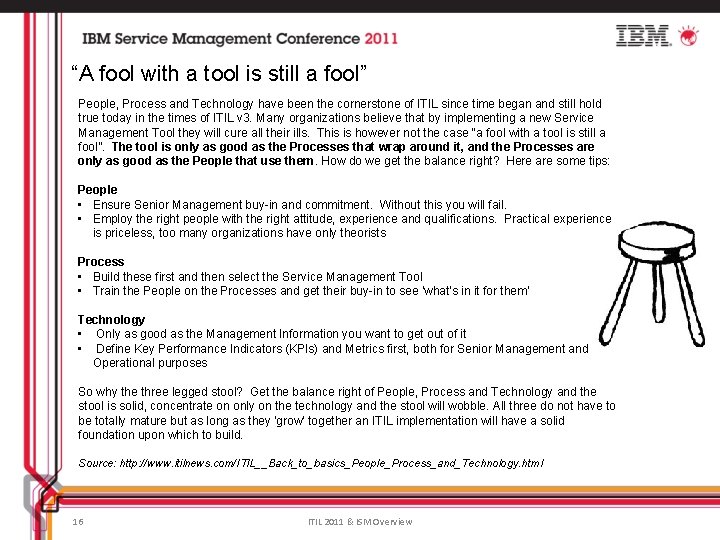
“A fool with a tool is still a fool” People, Process and Technology have been the cornerstone of ITIL since time began and still hold true today in the times of ITIL v 3. Many organizations believe that by implementing a new Service Management Tool they will cure all their ills. This is however not the case “a fool with a tool is still a fool”. The tool is only as good as the Processes that wrap around it, and the Processes are only as good as the People that use them. How do we get the balance right? Here are some tips: People • Ensure Senior Management buy-in and commitment. Without this you will fail. • Employ the right people with the right attitude, experience and qualifications. Practical experience is priceless, too many organizations have only theorists Process • Build these first and then select the Service Management Tool • Train the People on the Processes and get their buy-in to see 'what's in it for them' Technology • Only as good as the Management Information you want to get out of it • Define Key Performance Indicators (KPIs) and Metrics first, both for Senior Management and Operational purposes So why the three legged stool? Get the balance right of People, Process and Technology and the stool is solid, concentrate on only on the technology and the stool will wobble. All three do not have to be totally mature but as long as they 'grow' together an ITIL implementation will have a solid foundation upon which to build. Source: http: //www. itilnews. com/ITIL__Back_to_basics_People_Process_and_Technology. html 16 ITIL 2011 & ISM Overview
… but “ITIL v 3’s promise is realized through IT service automation” In a survey conducted by Forrester Consulting, they found that: • Reduced labor costs surfaced as one of the top measured benefits achieved from automation for every process considered. Customer satisfaction improvements were called out by nearly as many respondents, followed by increased integrated process capability/maturity. Almost 70% of those surveyed have seen more than a 10% labor cost reduction. • Integrated services automation delivers the greatest impact. An integrated approach allows IT to address the complete IT value chain, applying an integrated suite of components that enables each part of the IT organization to work in conjunction with the other parts. For 49% to 65% of enterprises automating individual processes, automation integration ranked as important or extremely important. • IT service automation improves IT‐business alignment. Automation can provide a link between IT’s operational spend and performance and the key business activities prioritized by management. By redefining the conversation between IT and business units, focus shifts to the business value enabled by IT. • Source: Forrester Consulting: Efficiency Through Automation, January 4, 2011 17 ITIL 2011 & ISM Overview
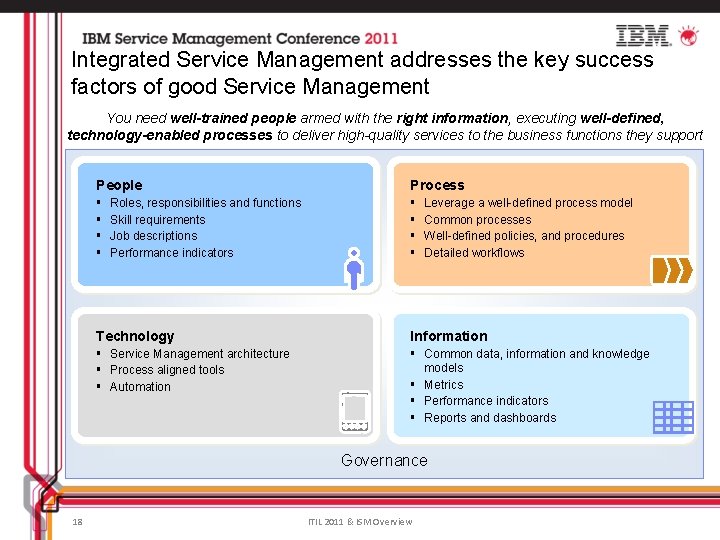
Integrated Service Management addresses the key success factors of good Service Management You need well-trained people armed with the right information, executing well-defined, technology-enabled processes to deliver high-quality services to the business functions they support People Process § § § § Roles, responsibilities and functions Skill requirements Job descriptions Performance indicators Leverage a well-defined process model Common processes Well-defined policies, and procedures Detailed workflows Technology Information § Service Management architecture § Process aligned tools § Automation § Common data, information and knowledge models § Metrics § Performance indicators § Reports and dashboards Governance 18 ITIL 2011 & ISM Overview
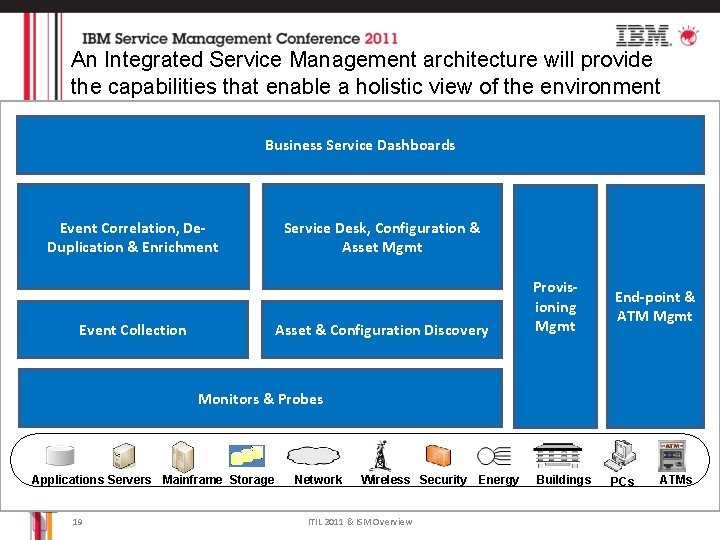
An Integrated Service Management architecture will provide the capabilities that enable a holistic view of the environment Business Service Dashboards Event Correlation, De. Duplication & Enrichment Event Collection Service Desk, Configuration & Asset Mgmt Asset & Configuration Discovery Provisioning Mgmt End-point & ATM Mgmt Monitors & Probes Applications Servers Mainframe Storage 19 Network Wireless Security Energy ITIL 2011 & ISM Overview Buildings PCs ATMs
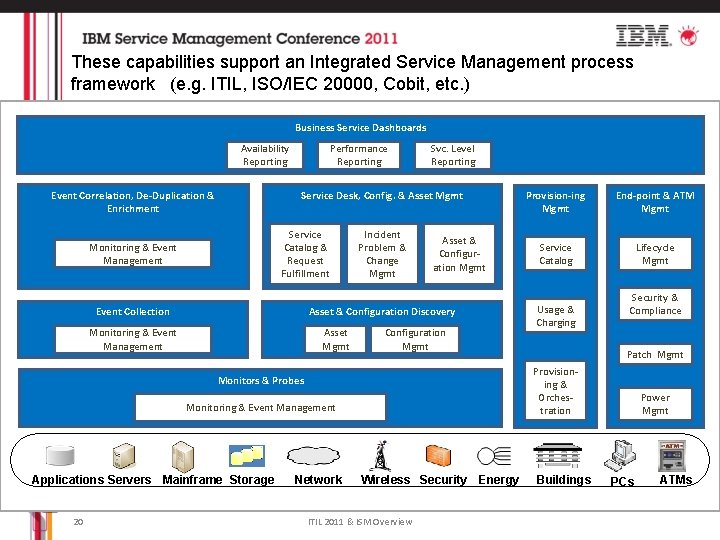
These capabilities support an Integrated Service Management process framework (e. g. ITIL, ISO/IEC 20000, Cobit, etc. ) Business Service Dashboards Availability Reporting Event Correlation, De-Duplication & Enrichment Performance Reporting Svc. Level Reporting Service Desk, Config. & Asset Mgmt Service Catalog & Request Fulfillment Monitoring & Event Management Event Collection Incident Problem & Change Mgmt Asset & Configuration Discovery Asset Mgmt Monitoring & Event Management Configuration Mgmt Monitoring & Event Management 20 Network End-point & ATM Mgmt Service Catalog Lifecycle Mgmt Usage & Charging Security & Compliance Patch Mgmt Provisioning & Orchestration Monitors & Probes Applications Servers Mainframe Storage Provision-ing Mgmt Wireless Security Energy ITIL 2011 & ISM Overview Buildings Power Mgmt PCs ATMs
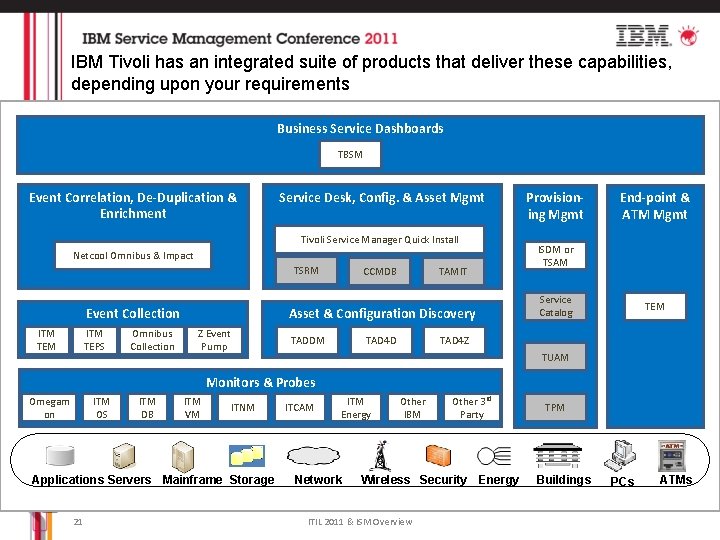
IBM Tivoli has an integrated suite of products that deliver these capabilities, depending upon your requirements Business Service Dashboards TBSM Event Correlation, De-Duplication & Enrichment Service Desk, Config. & Asset Mgmt Tivoli Service Manager Quick Install Netcool Omnibus & Impact TSRM Event Collection ITM TEM ITM TEPS Omnibus Collection CCMDB TAMIT Asset & Configuration Discovery Z Event Pump TADDM TAD 4 D Provisioning Mgmt End-point & ATM Mgmt ISDM or TSAM Service Catalog TEM TAD 4 Z TUAM Monitors & Probes Omegam on ITM OS ITM DB ITM VM ITNM Applications Servers Mainframe Storage 21 ITCAM ITM Energy Network Other IBM Other 3 rd Party Wireless Security Energy ITIL 2011 & ISM Overview TPM Buildings PCs ATMs
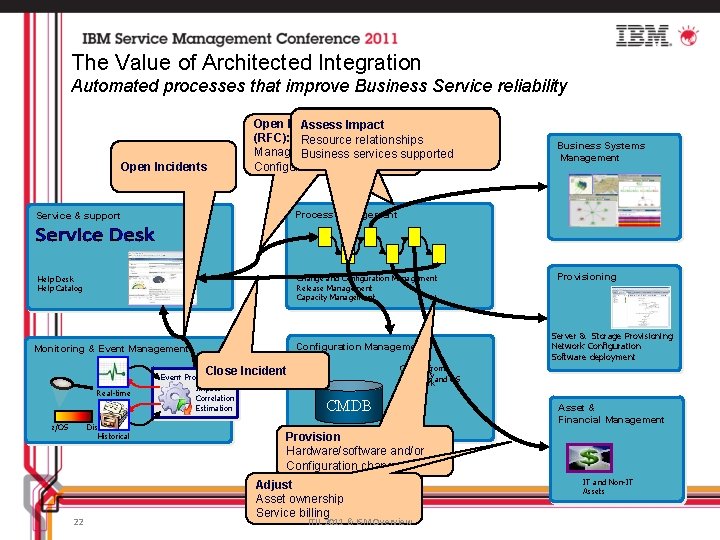
The Value of Architected Integration Automated processes that improve Business Service reliability Open Incidents Open Request Change Assessfor Impact (RFC): Resource relationships Managed. Business through Change services&supported Configuration Process Service & support Process Management Help Desk Help Catalog Change and Configuration Management Release Management Capacity Management Configuration Management Monitoring & Event Management Real-time z/OS Distributed Historical 22 Provisioning Server & Storage Provisioning Network Configuration Software deployment CI Data from: §§ Storage §§ Security Servers Networkand OS Close Incident Event Processing Impact Correlation Estimation Business Systems Management CMDB Asset & Financial Management Provision Hardware/software and/or Configuration changes Adjust Asset ownership Service billing ITIL 2011 & ISM Overview IT and Non-IT Assets
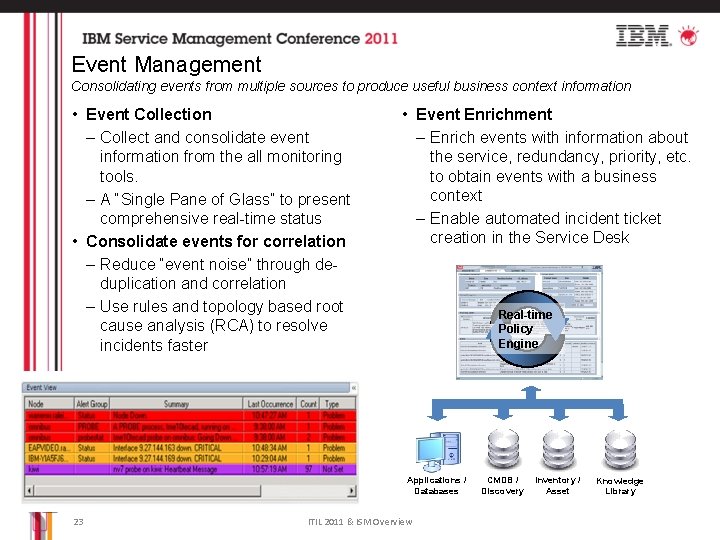
Event Management Consolidating events from multiple sources to produce useful business context information • Event Collection – Collect and consolidate event information from the all monitoring tools. – A “Single Pane of Glass” to present comprehensive real-time status • Consolidate events for correlation – Reduce “event noise” through deduplication and correlation – Use rules and topology based root cause analysis (RCA) to resolve incidents faster • Event Enrichment – Enrich events with information about the service, redundancy, priority, etc. to obtain events with a business context – Enable automated incident ticket creation in the Service Desk Real-time Policy Engine Applications / Databases 23 ITIL 2011 & ISM Overview CMDB / Discovery Inventory / Asset Knowledge Library
An Integrated Service Management framework improves efficiency through automation, and improves MTTR Monitoring & Event Management Business Service Management • Improve Incident resolution, Mean Time To Recovery (MTTR) and Availability by consolidating monitoring of all platforms to a “single role-based pane of glass” • Improve incident avoidance with dynamic thresholds to spot abnormal behavior and report on future capacity bottlenecks • Automate incident ticket generation based on business based rules • Identify the impact of IT incidents on business services, and prioritize them relative to business impact. • Visualize dependencies between business services and supporting IT components to determine root cause of incidents. • Improve management and reporting against Service Level Agreements 24 ITIL 2011 & ISM Overview
There is also a clear business case and ROI for implementation of an Integrated Service Management platform • IDC report* shows a 54% reduction in MTTR and time spent investigating / managing incidents – P 1 resolution is often reduced from 3 -4 hours to 12 hours • Customers can reduce time for Root Cause Analysis by about 10 -20% through having a view of IT components that are associated with critical applications, and understanding the impact of key resource downtime on the business services. • With reduction in time to resolve incidents, one of our customers was able to service an additional 7757 calls each month. Typical saving range 2535% * “A Return on Investment Analysis of IBM Tivoli Netcool”, IDC December 2010 25 ITIL 2011 & ISM Overview
Thank You! Peter Edwards Executive Consultant, Integrated Service Management Email: edwardsp@sg. ibm. com 26 ITIL 2011 & ISM Overview
- Slides: 26