Hour 1 ERP Systems Overview Introduction to ERP
- Slides: 29
Hour 1: ERP Systems Overview Introduction to ERP System Options
ERP Claims • Create value through integrating activities across organization • Implementation of best practices • Standardization of processes • One-source data • On-line access to information
Role in Business • Accounting basis • US products – some extension of MRP • Combine business computing – Unified system sharing one set of data – Advantages in efficiency, accuracy • Best Practices – Apply the best process for each function
Historical Growth • 1970 s & 1980 s – more development than growth • 1990 s – became widely adopted by large firms • Late 1990 s – growth exploded with fears of Y 2 K problems • Post-2000 – growth slowed – Saturated market, economy dipped – Seeking to • Fill in gaps with larger firms • Make products useful for smaller firms • Emphasize Internet
Benefits of ERP • Davenport [1998]: – Increases speed of information flows • O’Leary [2000]: – Create value through integration of activities – Best practices improve operations – Standardization increases efficiency – One-source data more accurate, easier to access
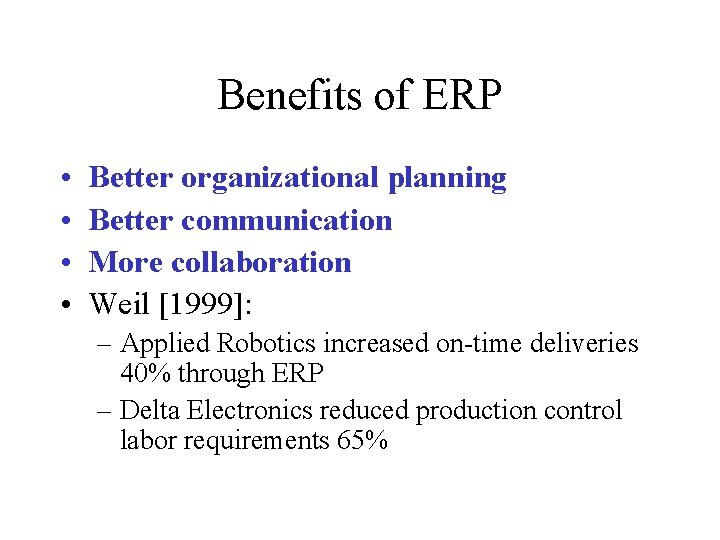
Benefits of ERP • • Better organizational planning Better communication More collaboration Weil [1999]: – Applied Robotics increased on-time deliveries 40% through ERP – Delta Electronics reduced production control labor requirements 65%
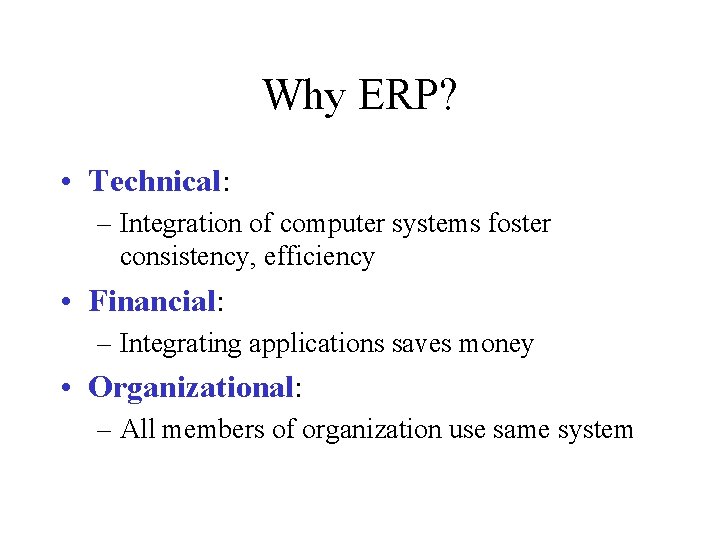
Why ERP? • Technical: – Integration of computer systems foster consistency, efficiency • Financial: – Integrating applications saves money • Organizational: – All members of organization use same system
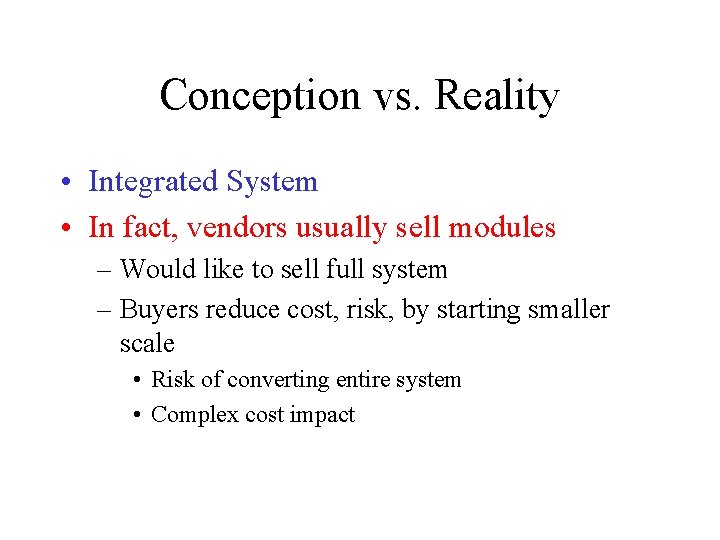
Conception vs. Reality • Integrated System • In fact, vendors usually sell modules – Would like to sell full system – Buyers reduce cost, risk, by starting smaller scale • Risk of converting entire system • Complex cost impact
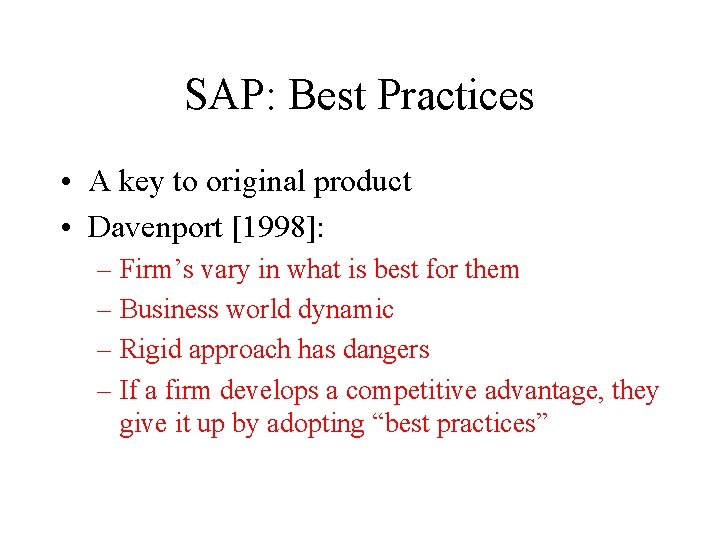
SAP: Best Practices • A key to original product • Davenport [1998]: – Firm’s vary in what is best for them – Business world dynamic – Rigid approach has dangers – If a firm develops a competitive advantage, they give it up by adopting “best practices”
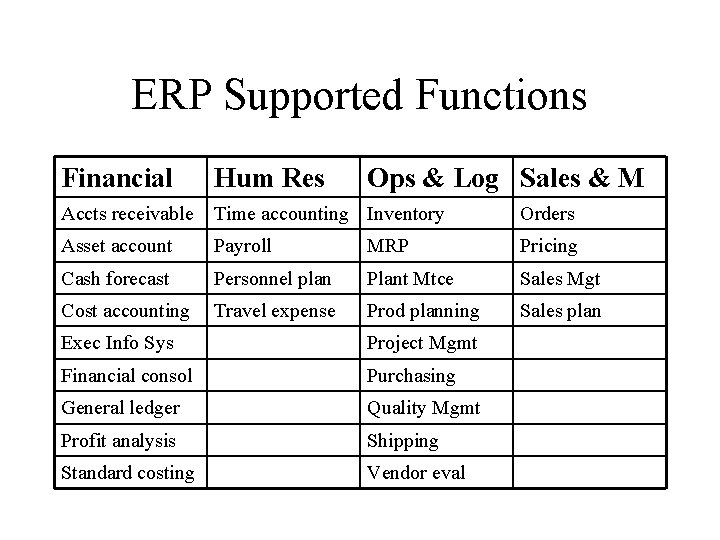
ERP Supported Functions Financial Hum Res Ops & Log Sales & M Accts receivable Time accounting Inventory Orders Asset account Payroll MRP Pricing Cash forecast Personnel plan Plant Mtce Sales Mgt Cost accounting Travel expense Prod planning Sales plan Exec Info Sys Project Mgmt Financial consol Purchasing General ledger Quality Mgmt Profit analysis Shipping Standard costing Vendor eval
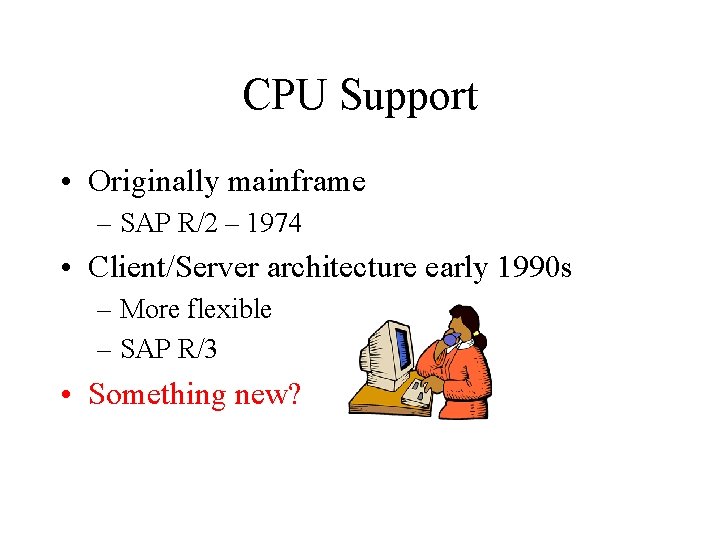
CPU Support • Originally mainframe – SAP R/2 – 1974 • Client/Server architecture early 1990 s – More flexible – SAP R/3 • Something new?
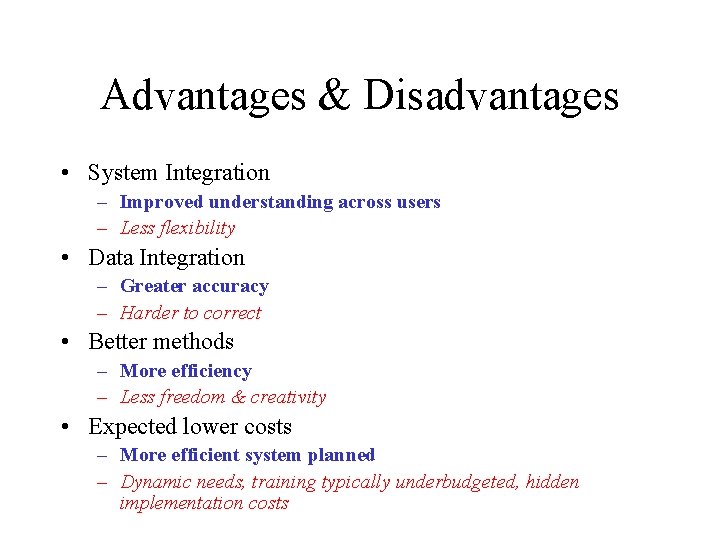
Advantages & Disadvantages • System Integration – Improved understanding across users – Less flexibility • Data Integration – Greater accuracy – Harder to correct • Better methods – More efficiency – Less freedom & creativity • Expected lower costs – More efficient system planned – Dynamic needs, training typically underbudgeted, hidden implementation costs
ERP System Options & Selection Methods Alternative ERP project forms Budgeting methods
IS/IT Projects • Typically – Late – Over budget – Fail to satisfy design specifications • ERP projects – Are larger than normal – Can be expedited (if you do it vendor’s way) – Cost range $5 million to over $100 million (+)
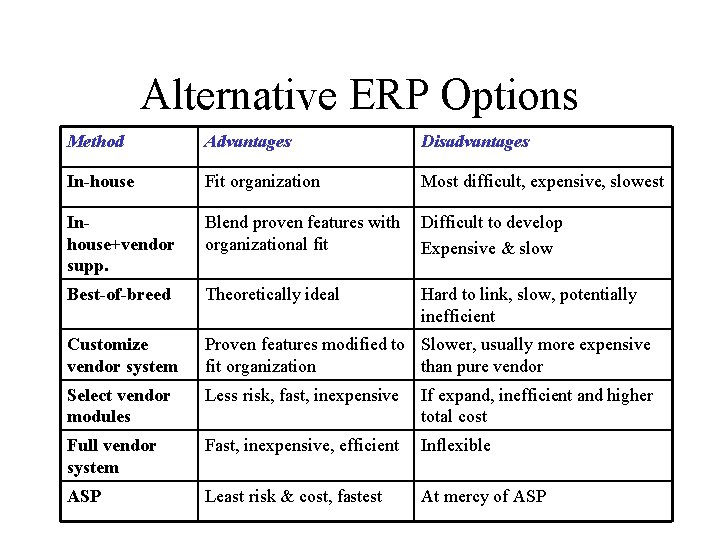
Alternative ERP Options Method Advantages Disadvantages In-house Fit organization Most difficult, expensive, slowest Inhouse+vendor supp. Blend proven features with organizational fit Difficult to develop Expensive & slow Best-of-breed Theoretically ideal Hard to link, slow, potentially inefficient Customize vendor system Proven features modified to Slower, usually more expensive fit organization than pure vendor Select vendor modules Less risk, fast, inexpensive If expand, inefficient and higher total cost Full vendor system Fast, inexpensive, efficient Inflexible ASP Least risk & cost, fastest At mercy of ASP
Changing Nature of IT • Technology is highly dynamic • ERP projects often take years to install – Vendors are responding by expediting • As long as you do it their way • Improved versions may be on market by the time you install your system – This is one advantage of an ASP
IT Selection Practice • Hinton & Kaye [1996]: – IT tends to be viewed as capital budgeting – Implication is that clear financial return is expected • Sound thinking, but benefits often intangible (yet real) • Some strategic investments require bold judgment • Conversely, companies have gone broke buying IT
Financial techniques for Capital Budgeting 1. Payback 2. Discounted cash flow 3. Cost-benefit analysis These are the more formal mechanisms implied by Hinton & Kaye as capital budgeting Anything with as great an impact as ERP needs to have some estimate of cost, benefits – Need to recognize that precise numbers not worth obtaining
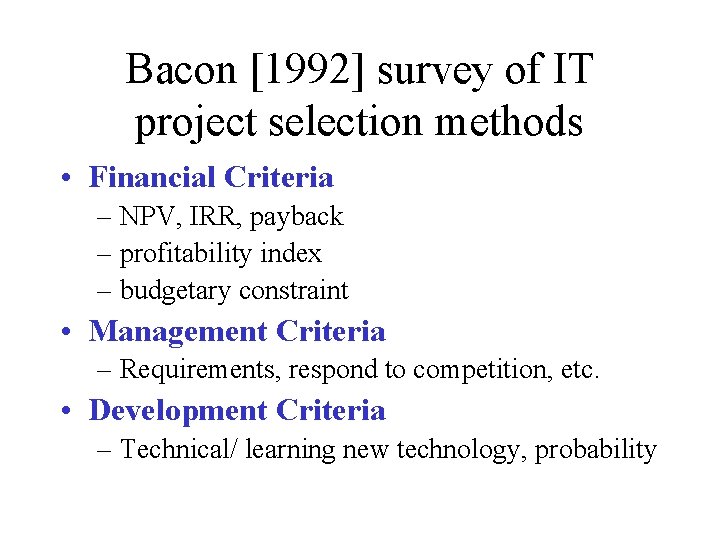
Bacon [1992] survey of IT project selection methods • Financial Criteria – NPV, IRR, payback – profitability index – budgetary constraint • Management Criteria – Requirements, respond to competition, etc. • Development Criteria – Technical/ learning new technology, probability
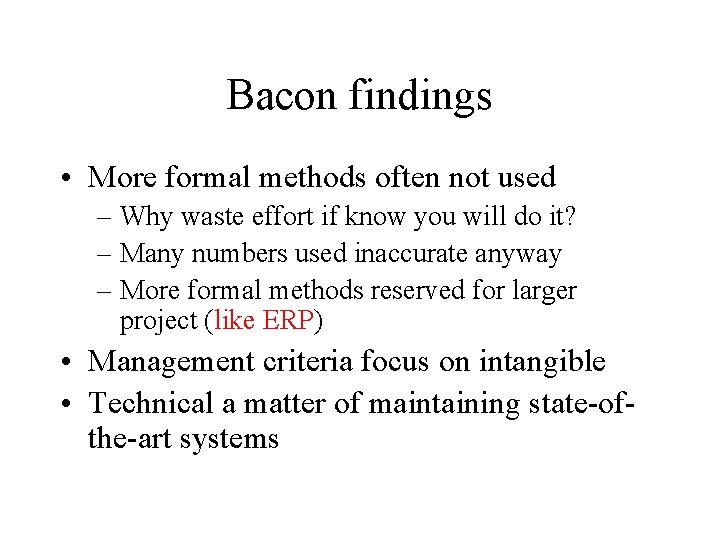
Bacon findings • More formal methods often not used – Why waste effort if know you will do it? – Many numbers used inaccurate anyway – More formal methods reserved for larger project (like ERP) • Management criteria focus on intangible • Technical a matter of maintaining state-ofthe-art systems
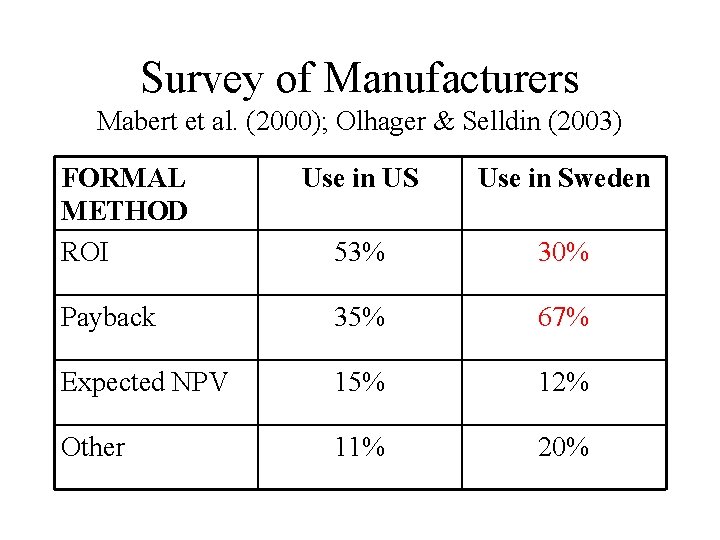
Survey of Manufacturers Mabert et al. (2000); Olhager & Selldin (2003) FORMAL METHOD ROI Use in US Use in Sweden 53% 30% Payback 35% 67% Expected NPV 15% 12% Other 11% 20%
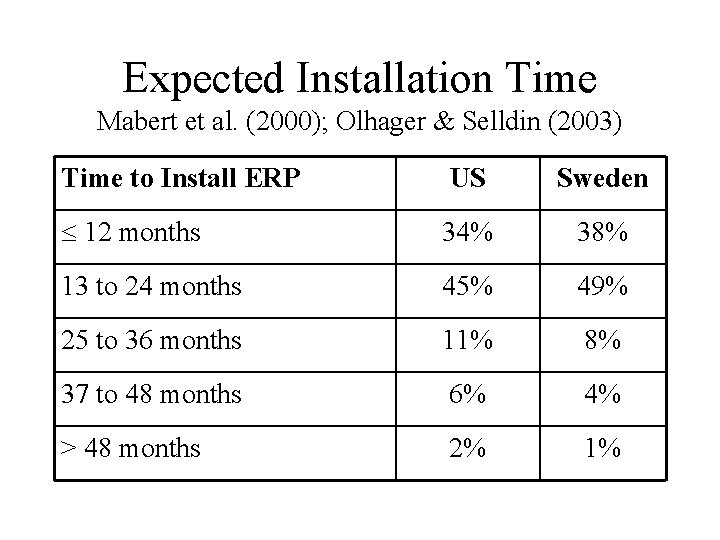
Expected Installation Time Mabert et al. (2000); Olhager & Selldin (2003) Time to Install ERP US Sweden 12 months 34% 38% 13 to 24 months 45% 49% 25 to 36 months 11% 8% 37 to 48 months 6% 4% > 48 months 2% 1%
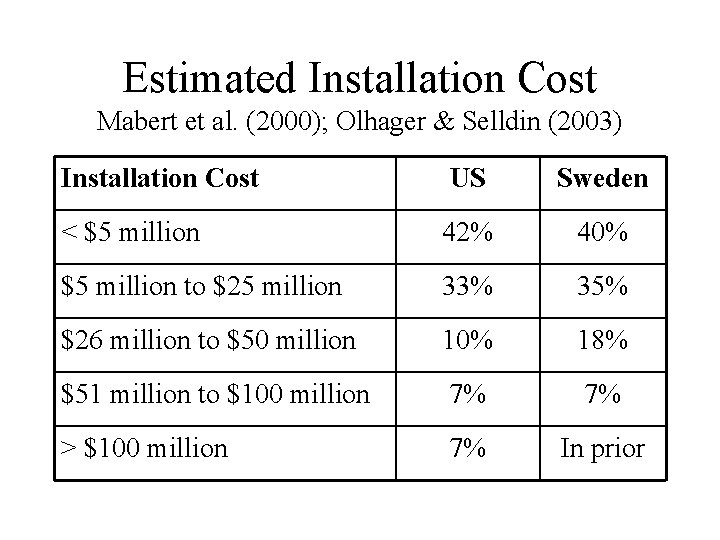
Estimated Installation Cost Mabert et al. (2000); Olhager & Selldin (2003) Installation Cost US Sweden < $5 million 42% 40% $5 million to $25 million 33% 35% $26 million to $50 million 10% 18% $51 million to $100 million 7% 7% > $100 million 7% In prior
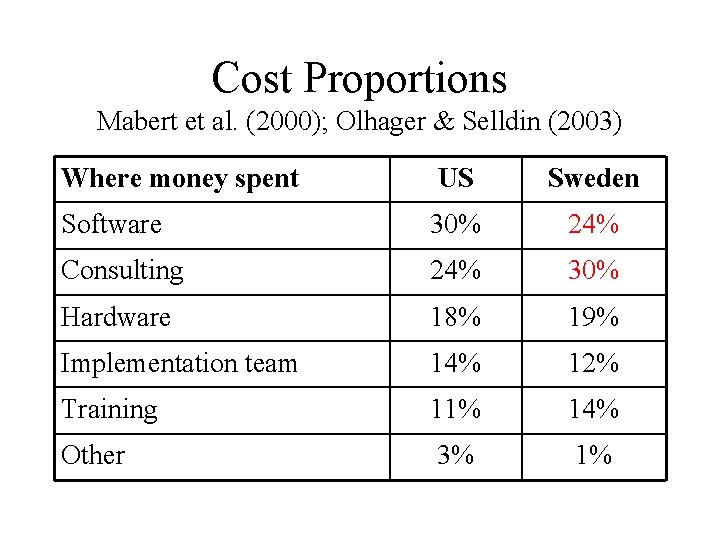
Cost Proportions Mabert et al. (2000); Olhager & Selldin (2003) Where money spent US Sweden Software 30% 24% Consulting 24% 30% Hardware 18% 19% Implementation team 14% 12% Training 11% 14% Other 3% 1%
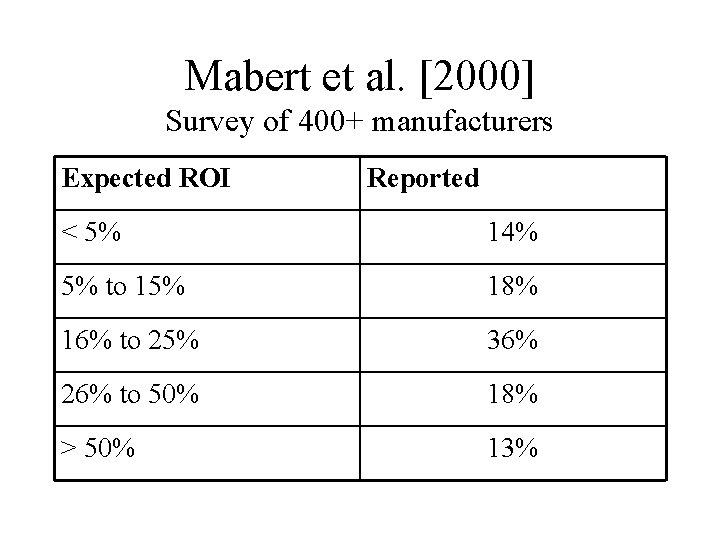
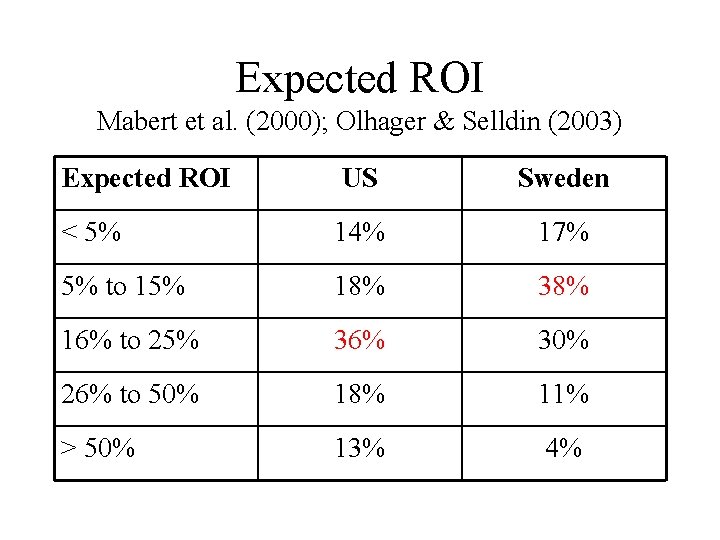
Mabert et al. [2000] Survey of 400+ manufacturers Expected ROI Reported < 5% 14% 5% to 15% 18% 16% to 25% 36% 26% to 50% 18% > 50% 13%
Expected ROI Mabert et al. (2000); Olhager & Selldin (2003) Expected ROI US Sweden < 5% 14% 17% 5% to 15% 18% 38% 16% to 25% 36% 30% 26% to 50% 18% 11% > 50% 13% 4%
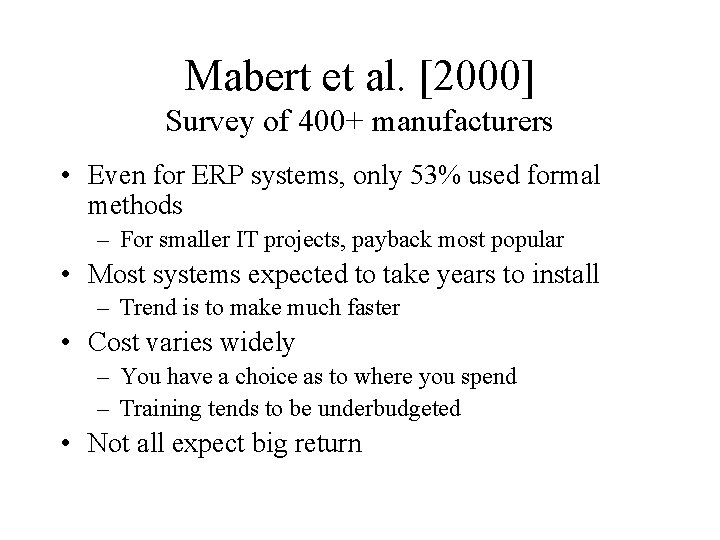
Mabert et al. [2000] Survey of 400+ manufacturers • Even for ERP systems, only 53% used formal methods – For smaller IT projects, payback most popular • Most systems expected to take years to install – Trend is to make much faster • Cost varies widely – You have a choice as to where you spend – Training tends to be underbudgeted • Not all expect big return
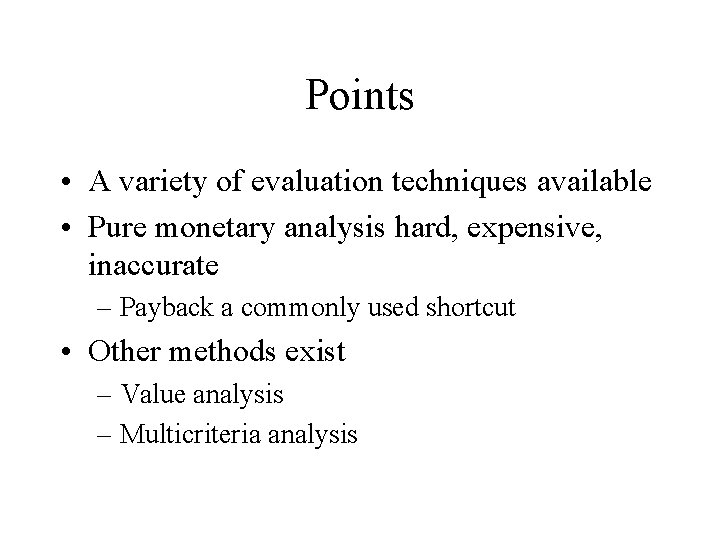
Points • A variety of evaluation techniques available • Pure monetary analysis hard, expensive, inaccurate – Payback a commonly used shortcut • Other methods exist – Value analysis – Multicriteria analysis
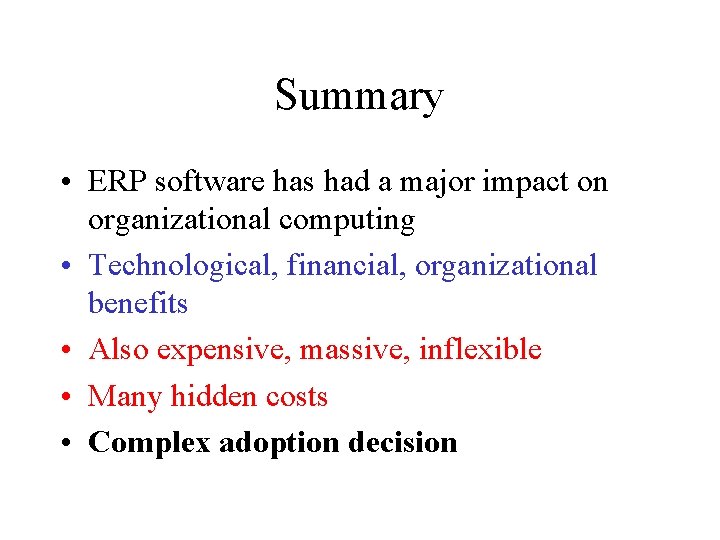
Summary • ERP software has had a major impact on organizational computing • Technological, financial, organizational benefits • Also expensive, massive, inflexible • Many hidden costs • Complex adoption decision