ENGLISH LITERATURE PROF LOREDANA SALIS LM 38 A
- Slides: 46
ENGLISH LITERATURE PROF. LOREDANA SALIS LM- 38 A. Y. 2018 -2019 I semester
Course information 60 hours (12 cfu) LM-38 Dates: 2/10 to 05/12/2018 Lectures: 6 hours p. w. (average) Exams: June …. 13 Dec; 28 Jan. ; 11 Feb; 7 & 21
Timetable Lectures: Tuesday: 10: 00 -11: 30 Wednesday: 16: 30 -18: 00 «Satta» Thursday: 15: 00 -16: 30 Office Aula Nivola Aula Mediateca Aula Wagner hours: semester I after class on Tuesdays, but it may vary (always double check)
Additional info (1) Contact details: lsalis@uniss. it �Course materials: textbooks & photocopies (photocopies at Copisteria 110 elode, V. Zanfarino) �Language: English �End-of-course revision lecture
Assessment Oral examination will assess: - knowledge of authors and their contexts; - ability to read critically; - ability to analyse texts with good critical language competence. Students are assessed on the basis of their knowledge of themes and the texts analysed during the course as well as the literary, critical and communicative skills
Contents & Materials Contents: the course is dedicated to theme of OTHERING SELVES
Course aims & objectives 1 Othering selves: this year’s course furthers students’ knowledge of Anglophone literatures and cultural contexts through critical readings of literary texts which narrate and represent diversity. Students will reflect upon the use and efficacy of discursive practices in strategies of exclusion (social, racial, religious) as well as the place of literature and of literacy in processes of dissemination of the vocabularies of race but also of renegotiation of alterity, cultural encounters, self-narrative,
Aims & objectives (2): To improve students’ knowledge of the history of literature in the English language, to develop specific reading strategies, to relate texts to contexts, to familiarise with different narrative genres, functions and modes (especially theatre, the short story and the novel); to reflect upon aspects of legacy and reception.
Course contents Primary sources: Mary Shelley [1818], Frankenstein. Or the Modern Prometheus. [English edn]; Elizabeth Gaskell [1855], “An Accursed Race”, in Round the Sofa and other Stories, pp. 216 -236 (photocopied material); Robert Louis Stevenson [1886], Dr Jekyll and Mr Hyde. Harmondsworth: Penguin, 1994: pp. 88. Roddy Doyle, “Guess Who’s Coming for the Dinner”; “New Boy”, in The Deportees and other Stories. London: Jonathan Cape, 2007: pp. 1 -26; pp. 78 -99.
Course contents One of the following: C. Marlowe, The Jew of Malta R. Doyle, “The Pram” E. Gaskell, Lois the Witch M. Morrissy, Diaspora W. Shakespeare, Othello W. Shakespeare, The Merchant of Venice
Course contents: secondary sources Daniela Montini, The Language of Fiction. Pratiche di lettura del testo narrativo. Roma: Carocci, 2009, pp. : 15 -20 (“Narrare”); 25 -26 (“Plot/story”); 37 -46 (“Tempo”); 69 -73 (“Il narratore”); 89 -92 (“Il punto di vista”); 99 -104 (“Il discorso”); 113 -115 (“Il lettore”); 123124 (“Il personaggio”). The Norton Anthology of English Literature, vol. 2, ed. Stephen Greenblatt. New York: Norton, 2006: “The Romantic Period: 17851830” (pp. 1 -25); “The Victorian Age”, pp. 979 -1000; “The Twentieth century and after: pp. 1827 -1850. Ania Loomba, “The vocabularies of race”, in Shakespeare, Race, Colonialism. Oxford: OUP, 2002, pp. 22 -44; Robbie Mc. Veigh, “Nick, Nack, Paddywhack: Anti-Irish racism and the racialisation of Irishness', in Mc. Veigh, Lentin eds. , Racism and anti-racism in Ireland. Belfast: Beyond the Pale, 2002, pp. 136 -152.
Additional reading (optional for attending SS) STUDENTS WHO CANNOT ATTEND CLASSES ARE INVITED TO READ THE FOLLOWING ADDITIONAL SOURCES. THESE ARE MEANT SPECIFICALLY TO AID THEM IN PREPARING FOR THE EXAM: Jurij Lotman, “Caccia alle streghe. Semiotica della paura”, in EC, pdf (photocopied material) (14 pp. ); Ania Loomba, Martin Orkin, Post-colonial Shakespeares. London: Routledge: 1998, [cap. I: pp. 1 -19]; Daniela Montini, The Language of Fiction. Pratiche di lettura del testo narrativo. Roma: Carocci, 2009 (140 pp. ). Photocopied material : Copisteria 110 e. Lode, Via Zanfarino, Sassari
To begin with… OTHERING SELVES ?
The Master-Slave dialectic In “The Master-Slave dialectic” (1807) F. Hegel suggests that in its encounter with the other, self-consciousness sees that other as both self and not-self. Self-consciousness “does not see the other as [another] essential being, but sees itself in the other”, and conversely, self-identity is (or originates in) the “exclusion of everything other outside itself” and that “other is [thus] unessential, negative”, that is, not-self.
in other words… ‘we’ use the Other to define ourselves: ‘we’ understand ourselves in relation to what ‘we’ are not. *** The category of the Other is as primordial as consciousness itself. In the most primitive societies, in the most ancient mythologies, one finds the expression of a duality – that of the Self and the Other (Simone de Beauvoir, 1949)
René Girard: the scapegoat mechanism and its victims; Jurij Lotman: fear and the witch hunts
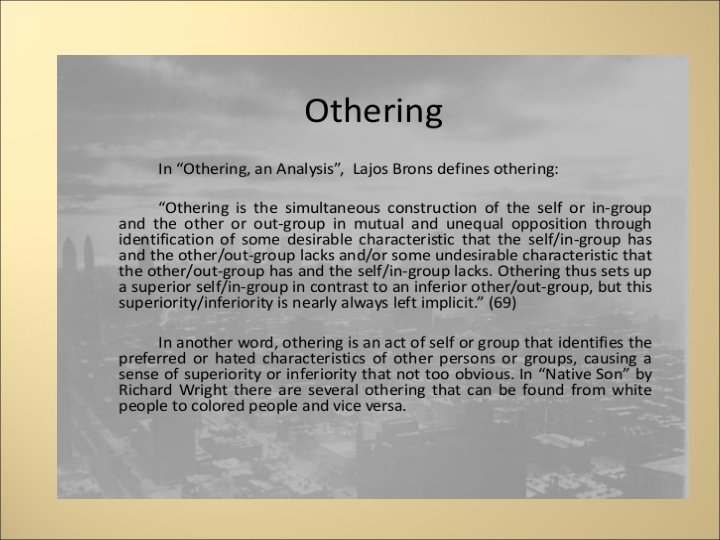
Othering as a social and cultural practice The vocabulary of race (Ania Loomba) (a “dedicated” grammar or discourse) Language is the vehicle of this process Othering as a discursive practice outside language there is no self: the self is a product of language, the self is constructed through narrative. So is the Other)
literature and the Other Selected texts from Herbert, G. Chaucer, Richard Hooker Christopher Marlowe, John Webster Edmund Spencer William Shakespeare Maria Edgeworth, Charles Dickens Matthew Arnold Punch …. See separate file
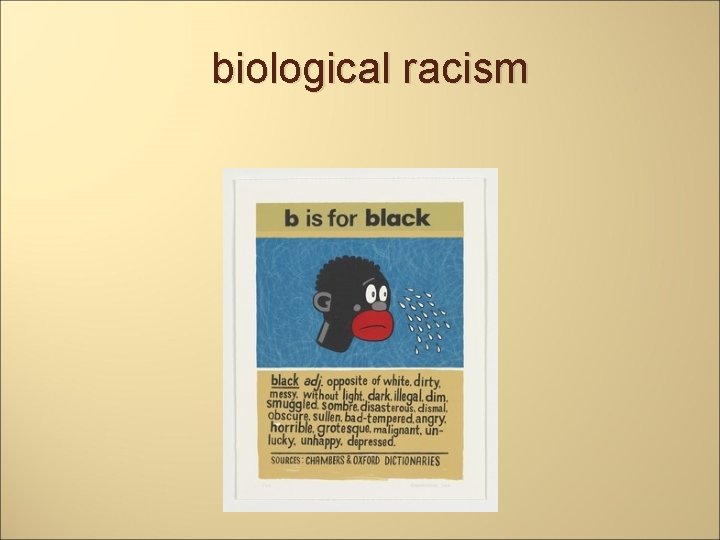
biological racism
Romanticism its relationship with the 1700 s Major cultural aspects Nature vs culture? Romantic literature – The Lyrical Ballads The gothic as a narrative mode and a discursive tool Emotions and passions Other and self – the idea of the ‘monster’
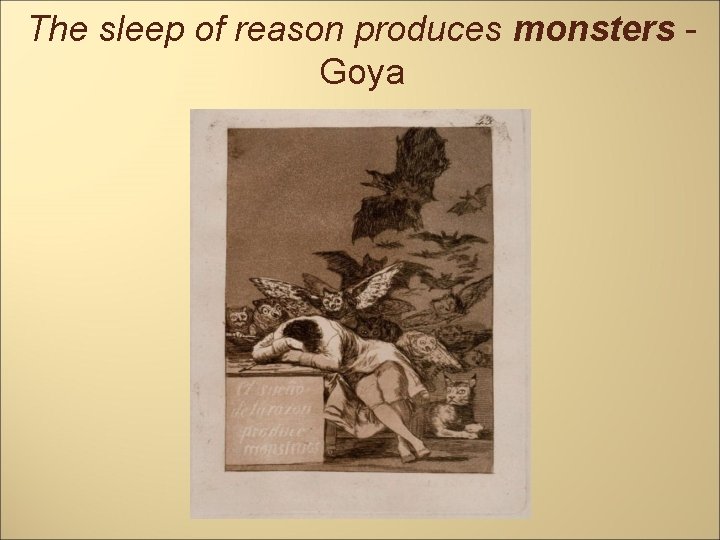
The sleep of reason produces monsters Goya
Aldous Huxley (1894 -1963) on Goya’s Sleep of Reason: “ ‘The dream of reason produces monsters, ’ […] admits of more than one interpretation. When reason sleeps, the absurd and loathsome creatures of superstition wake and are active, goading their victim to an ignoble frenzy. But this is not all. Reason may also dream without sleeping, may intoxicate itself, as it did during the French Revolution, with the daydreams of inevitable progress, of liberty, equality, and fraternity imposed by violence, of human selfsufficiency and the ending of sorrow…by political rearrangements and a better technology…”
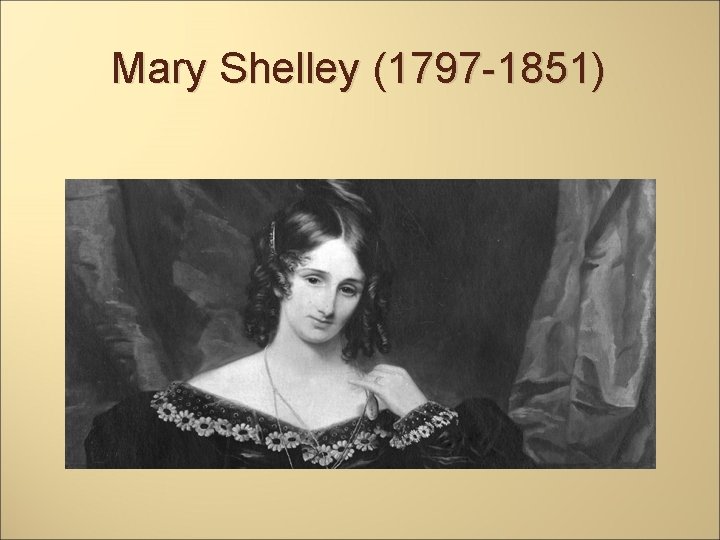
Mary Shelley (1797 -1851)
Frankenstein – text and context Mary Shelley The gothic tradition Middle Ages and the Age of Reason Frankenstein (1818) Title Structure, themes, setting Othering selves – creating monsters
THE MODERN VICE OF UNREST: Traces of past narrative conventions (letters, diaries, memoirs, travels); Novel vs Romance (canon and anti-canon, realism vs fantasy and adventure); Didactic novel – conduct / moral / educating the masses (contrast novels; evangelical novels; how-to manuals) Readership: 5 times larger than that of previous centuries Publishing market: editors and publishers (Longman, Dickens, Household Words, All the Year Round) The ‘Victorian novel’ and its dissemination (triple-deckers, serialised stories, one-volume cheap editions)
Realist novels: recounting the “Truth” Sentimental novels Gothic novels Historical novels Industrial novels Social-problem novels The Origins of Species (1859) doubts / fear of the unknown / the quest negotiating/ questioning non-negotiable dichotomies (country-city, male-female, high-low, rich-poor) External omniscient Narrator / disrupting order (reassuring frame)
Elizabeth Gaskell (1810 -1865) Robert Louis Stevenson (18501894) ways of narrating the (Victorian) self and shaping the (Victorian) Other
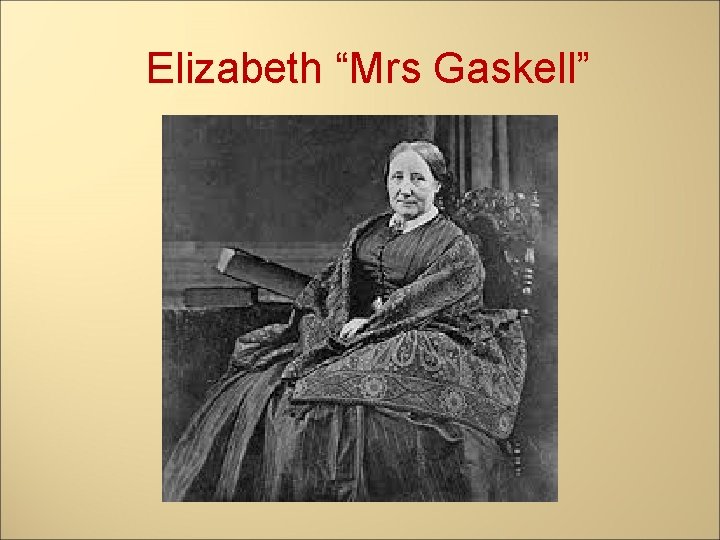
Elizabeth “Mrs Gaskell”
Elizabeth “Mrs Gaskell” Becoming Mrs Gaskell (from Mary Barton on) From novel to short story An Accursed Race: texts and contexts An Accursed Race: a “pseudo-fictional piece” Two editions: 1855 (Household Words) and 1859 (Round the Sofa) Narrative conventions, stucture, sources and themes. Intentio autoris.
E. Gaskell, An Accursed Race Narrative style: what genre is this? Reflect on the cultural and political context of Gaskell’s ‘tale’? ; Reflect on the value of the tale in terms of social critique of Victorian England; Consider Gaskell’s revisitation of the tale between the 1855 and the 1859 edition; the narrative frame and the task of the Narrator What is the ‘tale’ about?
Imperialist rethoric & Victorian and bourgeois value system Themes: 1) racism as a discoursive practice; the semiotics of fear (Lotman) and the scapegoat mechanism (Girard) – the roots of all evil racism is depicted as a global phenomenon, but the scope of the tale is to reflect on the fact that the English too, as well as the French and the Spaniards, have been responsible, in fact they still are responsible for discriminating against the Cagots ( «We have…we have had our prejudices» ) nb: the Cagots, an ethnic minority, represent any subject / subaltern ethnic group – reflect on the dynamics of social exclusion Gaskell’s social engagement – critique of the master’s rethoric
Themes: 1 I) the place of literature in a country’s cultural development and narrative of the self and of the other The art of narrating as a path to self-betterment or as a way to change – SOCIAL STORYTELLING Dr Dawson, the man of science, narrates himself into a philosopher (he who loves knowledge, and knowledge means truth to him) and he narrates himself into a philologist (he who loves the logos, and through language seeks the truth, he becomes the truthteller) reflect on the use of narrative conventions, intertextaulity and multiple voices (historical sources, the Bible, Mrs Hand’s tombstone, the small door Dawson sees)
Elizabeth Gaskell An Accursed Race (audiobook) https: //www. youtube. com/watch? v =B 3 nv 3 WU 9 Whg
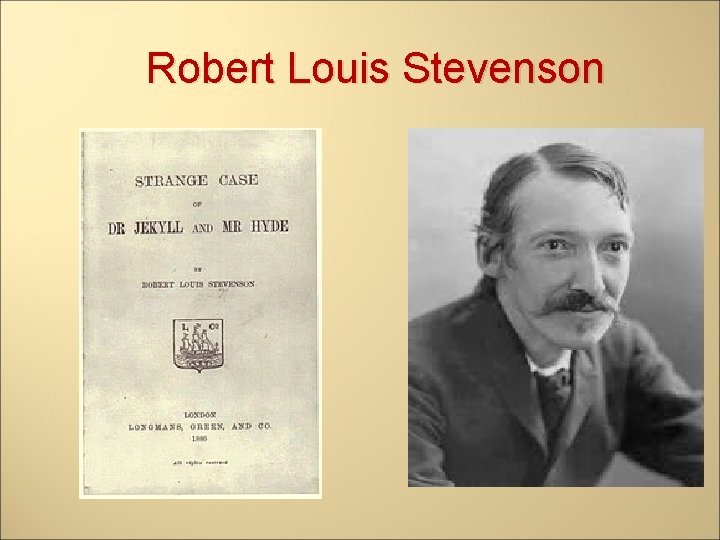
Robert Louis Stevenson
The strange case of Dr Jekyll and Mr. Hyde 1. 2. 3. 4. 5. 6. 7. 8. 9. 10. Story of the door Search for Mr. Hyde Dr Jekyll was quite at ease The Carew murder case Incident of the letter Remarkable incident of Dr Lanyon Incident at the window The last night Dr Lanyon’s narrative Henry Jekyll’s full statement of the case
R. L. Stevenson The strange case of Dr Jekyll and Mr Hyde Reflect on the cultural and political context of the novella’s creation; The gothis tradition: use of themes, tropes, narrative conventions (eg. Shelley’s Frankenstein, 1818) – intertextuality; Use of the gothic to articulate an individual’s path to self-knowledge and consequently knowledge of the Other
Reflect on the allegorical significance of Jekyll’s story in terms of Stevenson’s view / critique of late-Victorian strict morality and social (bourgeois) values – AGENCY; the «creature» discourse and the sense of a limit: Jekyll’s quest (who am I? ), Utterson’s quest (who is Hyde? ). Use of doors and windows – the limen; self-narrative as the individual’s quest – Jekylls is Hyde, and Hyde is Jekyll - The theme of the DOUBLE; Narrative as an antidote to contamination, to unchecked violence, as exploration and experience of desire, basic instincts, pure pleasures vs mortification of the soul and of the senses (compare and contrast Utterson and Jekyll)
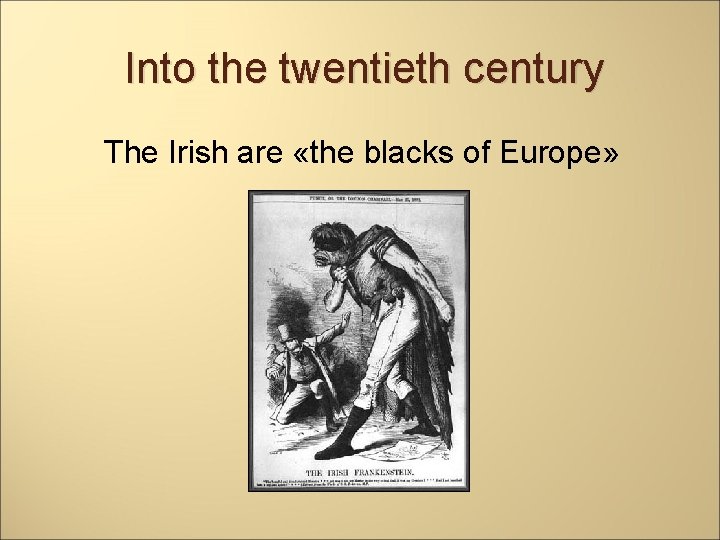
Into the twentieth century The Irish are «the blacks of Europe»
Ireland in the 1990 s – the empire strikes back Context: Ireland in the 1990, the Celtic Tiger Years Northern Ireland – the Troubles, the Good Friday Agreement (1998) A booming economy (Ryanair, Riverdance, Guinness, U 2, Cranberries, St. Patrick’s Day; the Football World Championship; the Eurocontest)
Roddy Doyle The Deportees & other stories Text and context Doyle’s use of the short story and its relation to Joyce’s stories in Dubliners Significance of the title – echoes of the Shoa in the Irish psyche (traumas of the past - the FAMINE, THE EVICTIONS, English colonisation and its effects) The new Irish – immigration and social change Anti-Irish racism and Irish racism?
Readings: 1 Guess who’s coming for the dinner? Self and other: domestication of the other? ; Othering the self: the Nigerian ‘lad’ – AIDS, Live Aid, the tracksuit, the perfume (class, gender and ethnic markers); Use of food to facilitate cultural encounters; Love across the divide: references to the 1967 film starring Sidney Poitier; Language (register and style); verbal
Readings: 2 New Boy Self and other: domestication of the other? ; The world as seen through the eyes of a child – the outsider, the ‘black’ boy; Narraritive strategy: insight, memory, past and present, tension Use of language: sentence structure, focus on HE, singling out (scapgoat mechanism), the vocabularies of childhood vs the instituion - MISS Language (register and style); verbal communication; silence
New Boy Short film adaptation, dir. Steph Green https: //www. youtube. com/watch? v=Fdeio. Vnd. U hs&t=70 s
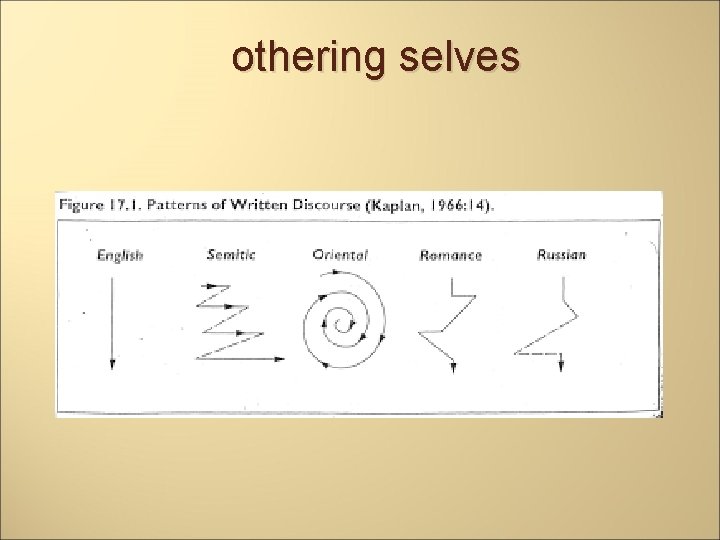
othering selves
End of course revision: 1. Materials (see list above) 2. Revision class (gathering thoughts)