Engineering Materials Cement 1 Contents Introduction Classification of

- Slides: 26
Engineering Materials Cement 1
Contents • • Introduction Classification of cements Portland Cement Raw materials of Portland cement Cement Manufacturing Process Flow chart of Portland Cement manufacturing process Cement Manufacturing Video Mixing and Crushing • • Dry Process Wet Process • Burning Process • • • View of complete setup Rotary Klin zones Chemical Reactions • Grinding and Packaging • Setting and hardening • • • Flow chart Sequence Chemical Reactions • Special Cement 2
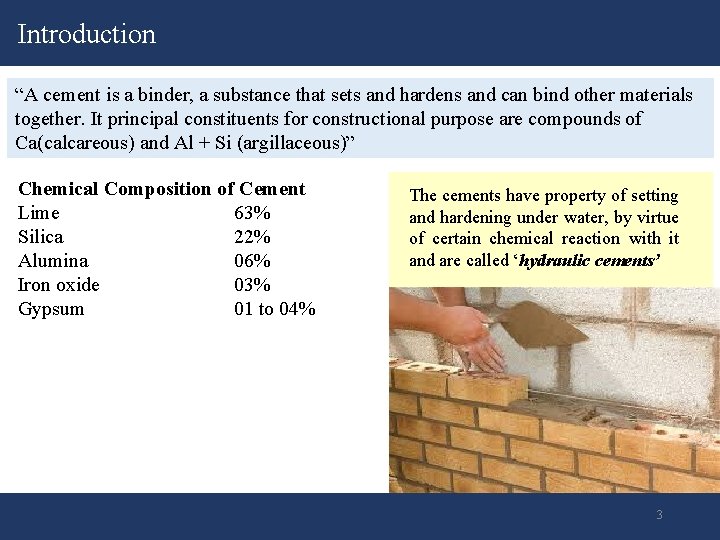
Introduction “A cement is a binder, a substance that sets and hardens and can bind other materials together. It principal constituents for constructional purpose are compounds of Ca(calcareous) and Al + Si (argillaceous)” Chemical Composition of Cement Lime 63% Silica 22% Alumina 06% Iron oxide 03% Gypsum 01 to 04% The cements have property of setting and hardening under water, by virtue of certain chemical reaction with it and are called ‘hydraulic cements’ 3
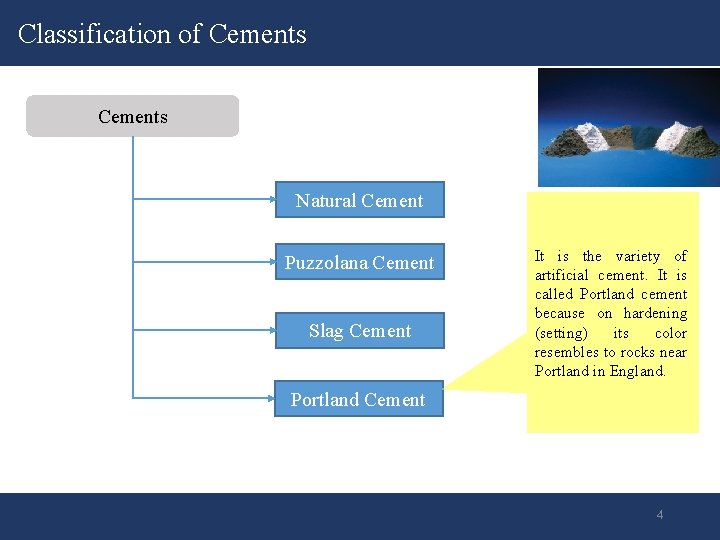
Classification of Cements Natural Cement Puzzolana Cement Slag Cement It is the variety of artificial cement. It is called Portland cement because on hardening (setting) its color resembles to rocks near Portland in England. Portland Cement 4
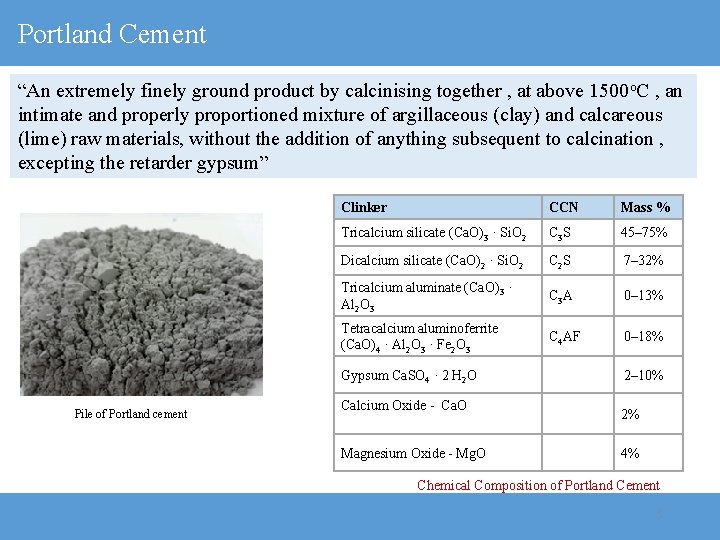
Portland Cement “An extremely finely ground product by calcinising together , at above 1500 o. C , an intimate and properly proportioned mixture of argillaceous (clay) and calcareous (lime) raw materials, without the addition of anything subsequent to calcination , excepting the retarder gypsum” Clinker CCN Mass % Tricalcium silicate (Ca. O)3 · Si. O 2 C 3 S 45– 75% Dicalcium silicate (Ca. O)2 · Si. O 2 C 2 S 7– 32% Tricalcium aluminate (Ca. O)3 · Al 2 O 3 C 3 A 0– 13% Tetracalcium aluminoferrite (Ca. O)4 · Al 2 O 3 · Fe 2 O 3 C 4 AF 0– 18% Gypsum Ca. SO 4 · 2 H 2 O Pile of Portland cement Calcium Oxide - Ca. O Magnesium Oxide - Mg. O 2– 10% 2% 4% Chemical Composition of Portland Cement 5
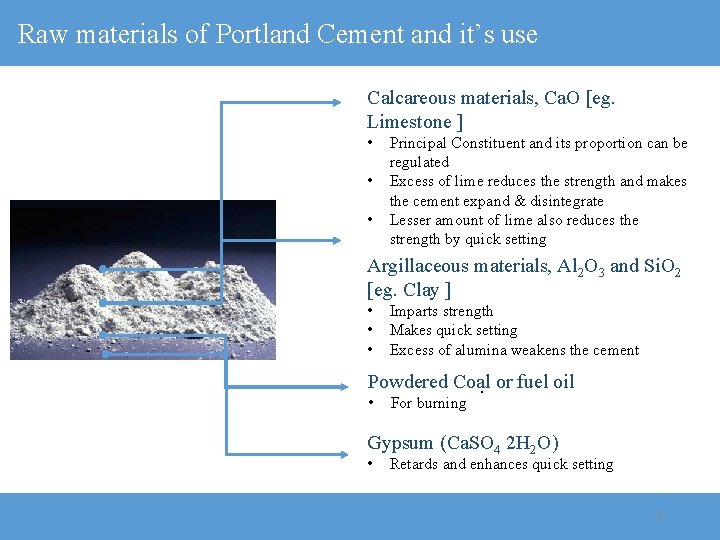
Raw materials of Portland Cement and it’s use Calcareous materials, Ca. O [eg. Limestone ] • • • Principal Constituent and its proportion can be regulated Excess of lime reduces the strength and makes the cement expand & disintegrate Lesser amount of lime also reduces the strength by quick setting Argillaceous materials, Al 2 O 3 and Si. O 2 [eg. Clay ] • • • Imparts strength Makes quick setting Excess of alumina weakens the cement Powdered Coal or fuel oil. • For burning Gypsum (Ca. SO 4 2 H 2 O) • Retards and enhances quick setting 6
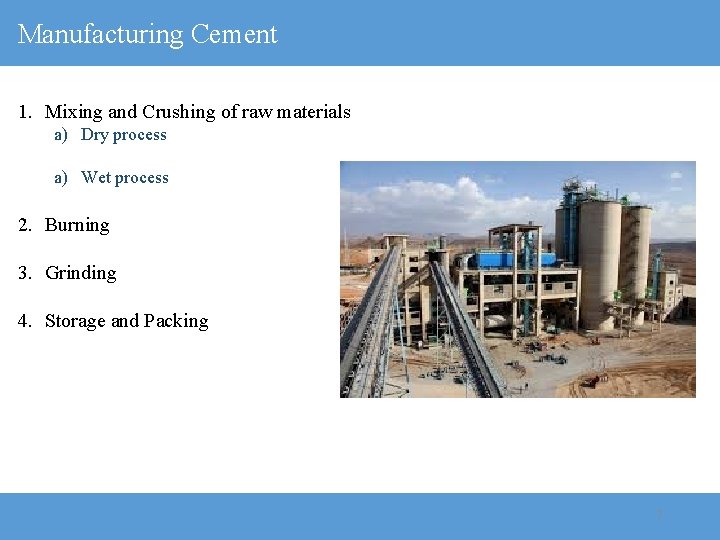
Manufacturing Cement 1. Mixing and Crushing of raw materials a) Dry process a) Wet process 2. Burning 3. Grinding 4. Storage and Packing 7
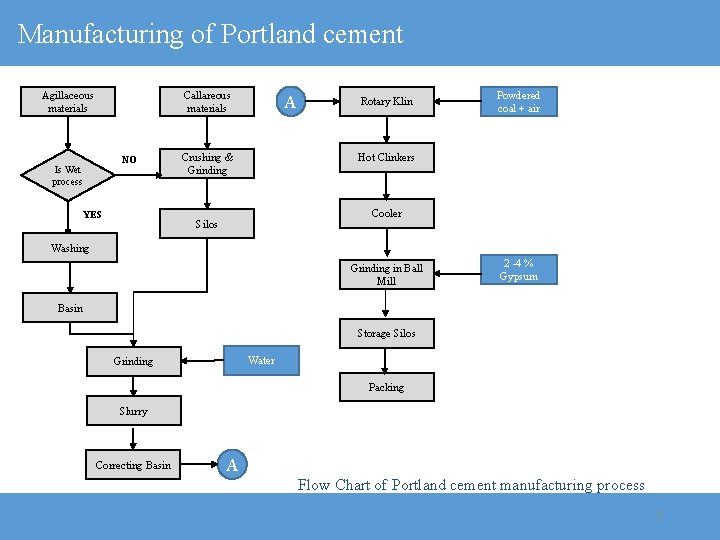
Manufacturing of Portland cement Agillaceous materials Callareous materials NO Is Wet process YES A Rotary Klin Powdered coal + air Hot Clinkers Crushing & Grinding Cooler Silos Washing Grinding in Ball Mill 2 -4 % Gypsum Basin Storage Silos Water Grinding Packing Slurry Correcting Basin A Flow Chart of Portland cement manufacturing process 8
Cement Manufacturing Process : Video 9
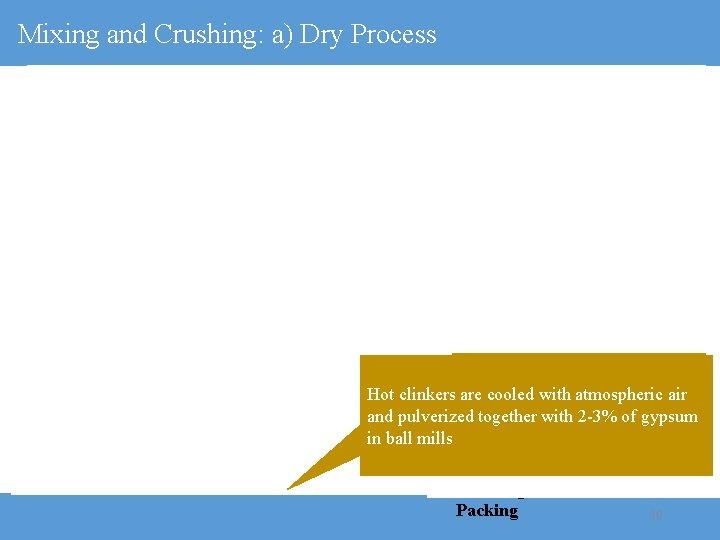
Mixing and Crushing: a) Dry Process • Raw materials are crushed , powdered and mixed in right proportion ( Dry Raw mix ) 2. Burning • Stored in silos 1. Mixing • Burning of dry raw mix is carried out in rotary kiln • Klin rotates at speed of 1 RPM and is slightly inclined in position of 5 – 6 o C Hot clinkers are cooled with atmospheric air and pulverized together with 2 -3% of gypsum in ball mills 3. Grinding 4. Storage & Packing 10
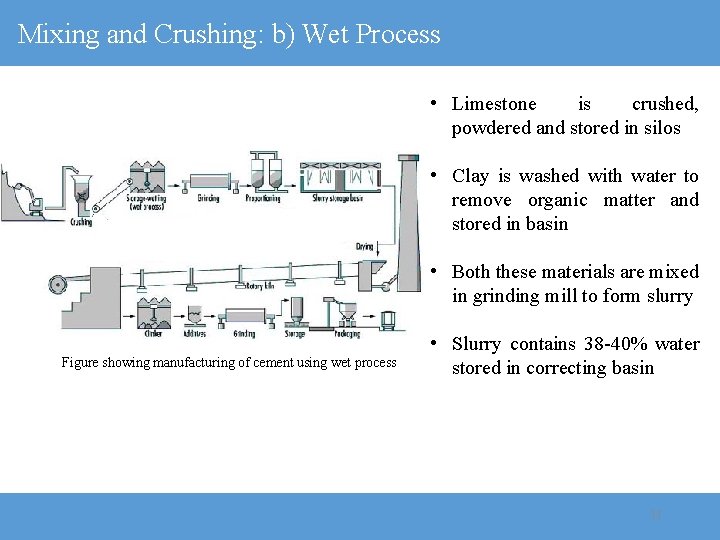
Mixing and Crushing: b) Wet Process • Limestone is crushed, powdered and stored in silos • Clay is washed with water to remove organic matter and stored in basin • Both these materials are mixed in grinding mill to form slurry Figure showing manufacturing of cement using wet process • Slurry contains 38 -40% water stored in correcting basin 11
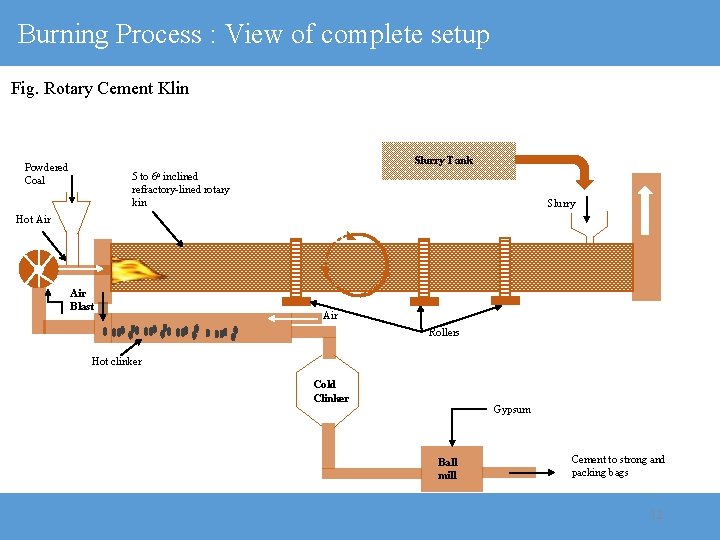
Burning Process : View of complete setup Fig. Rotary Cement Klin Slurry Tank Powdered Coal 5 to 6 o inclined refractory-lined rotary kin Slurry Hot Air Blast Air Rollers Hot clinker Cold Clinker Gypsum Ball mill Cement to strong and packing bags 12
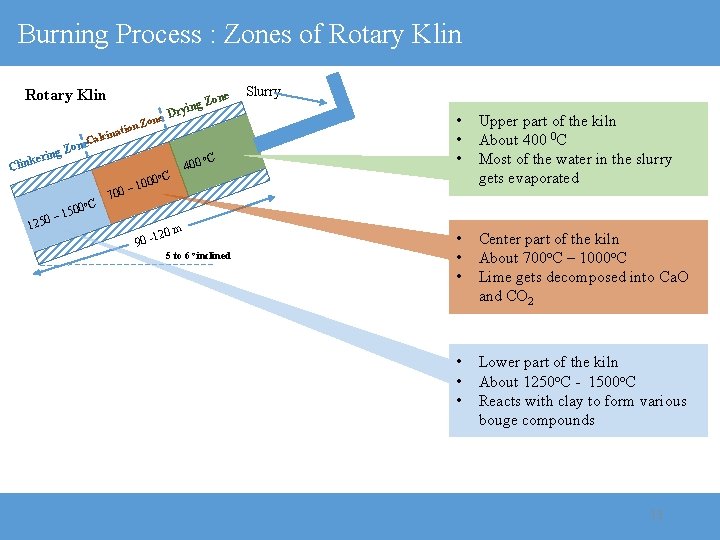
Burning Process : Zones of Rotary Klin g Z ryin one ne D i Calc one Cl Z ring e k n i o on Z nati o 00 C 5 1 – 1250 o. C 0 – 10 700 0 o C 90 - 400 m 120 5 to 6 o inclined Slurry • • • Upper part of the kiln About 400 0 C Most of the water in the slurry gets evaporated • • • Center part of the kiln About 700 o. C – 1000 o. C Lime gets decomposed into Ca. O and CO 2 • • • Lower part of the kiln About 1250 o. C - 1500 o. C Reacts with clay to form various bouge compounds 13
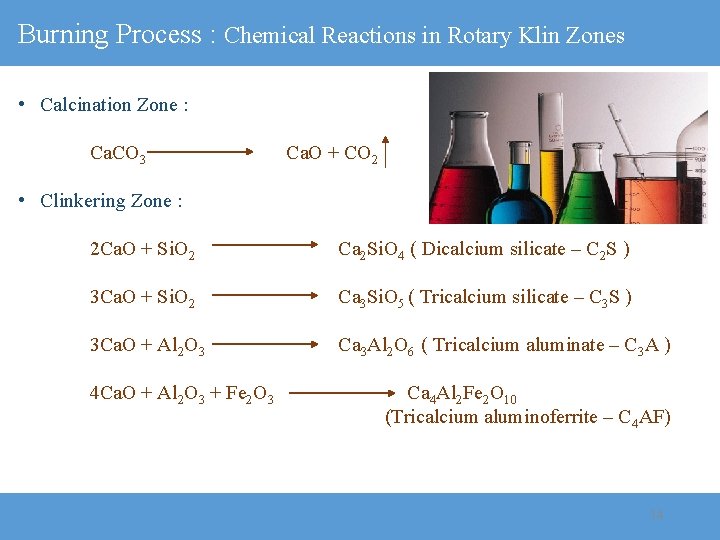
Burning Process : Chemical Reactions in Rotary Klin Zones • Calcination Zone : Ca. CO 3 Ca. O + CO 2 • Clinkering Zone : 2 Ca. O + Si. O 2 Ca 2 Si. O 4 ( Dicalcium silicate – C 2 S ) 3 Ca. O + Si. O 2 Ca 3 Si. O 5 ( Tricalcium silicate – C 3 S ) 3 Ca. O + Al 2 O 3 Ca 3 Al 2 O 6 ( Tricalcium aluminate – C 3 A ) 4 Ca. O + Al 2 O 3 + Fe 2 O 3 Ca 4 Al 2 Fe 2 O 10 (Tricalcium aluminoferrite – C 4 AF) 14
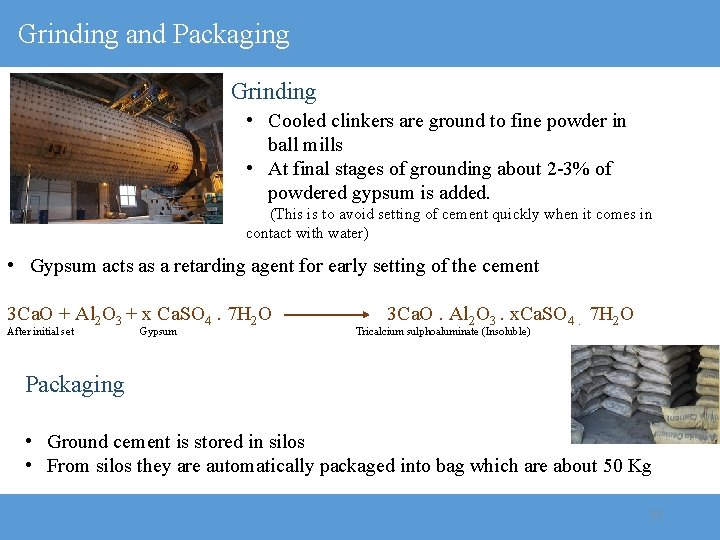
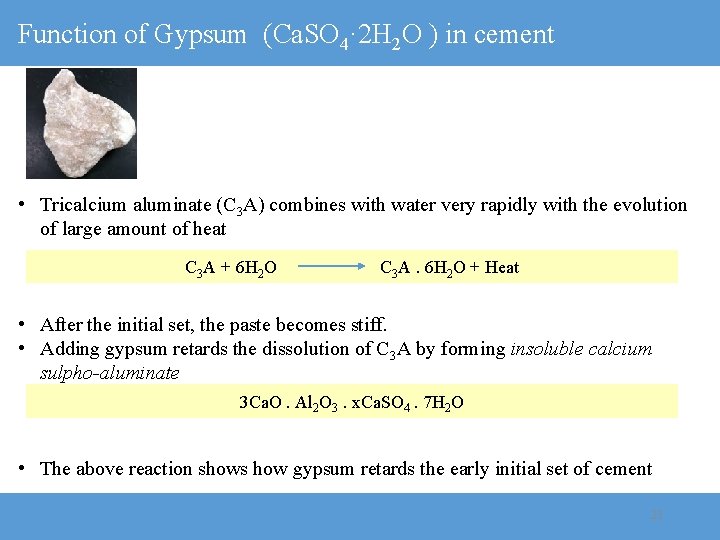
Grinding and Packaging Grinding • Cooled clinkers are ground to fine powder in ball mills • At final stages of grounding about 2 -3% of powdered gypsum is added. (This is to avoid setting of cement quickly when it comes in contact with water) • Gypsum acts as a retarding agent for early setting of the cement 3 Ca. O + Al 2 O 3 + x Ca. SO 4. 7 H 2 O 3 Ca. O. Al 2 O 3. x. Ca. SO 4. 7 H 2 O After initial set Gypsum Tricalcium sulphoaluminate (Insoluble) Packaging • Ground cement is stored in silos • From silos they are automatically packaged into bag which are about 50 Kg 15
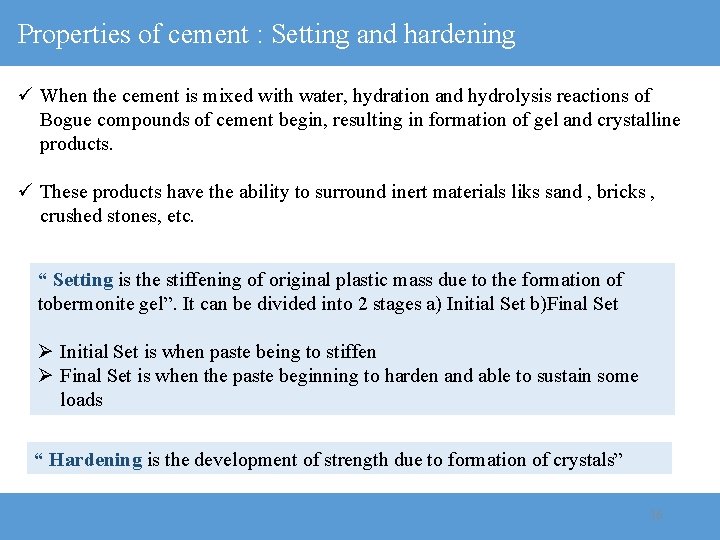
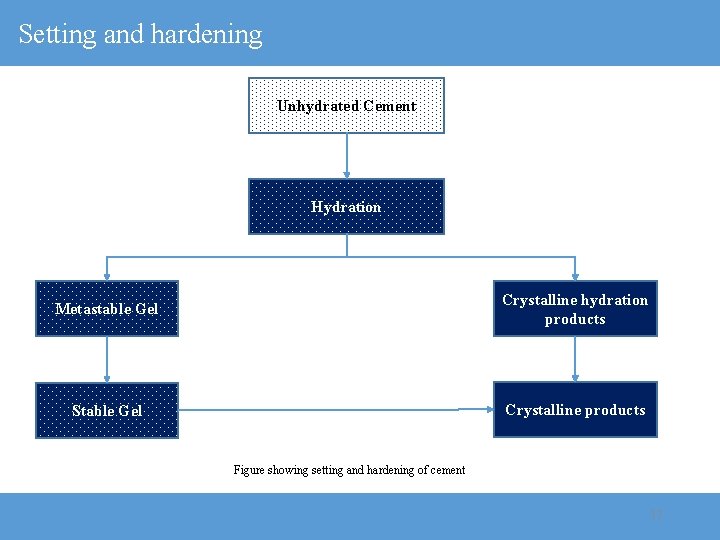
Properties of cement : Setting and hardening ü When the cement is mixed with water, hydration and hydrolysis reactions of Bogue compounds of cement begin, resulting in formation of gel and crystalline products. ü These products have the ability to surround inert materials liks sand , bricks , crushed stones, etc. “ Setting is the stiffening of original plastic mass due to the formation of tobermonite gel”. It can be divided into 2 stages a) Initial Set b)Final Set Ø Initial Set is when paste being to stiffen Ø Final Set is when the paste beginning to harden and able to sustain some loads “ Hardening is the development of strength due to formation of crystals” 16
Setting and hardening Unhydrated Cement Hydration Metastable Gel Crystalline hydration products Stable Gel Crystalline products Figure showing setting and hardening of cement 17
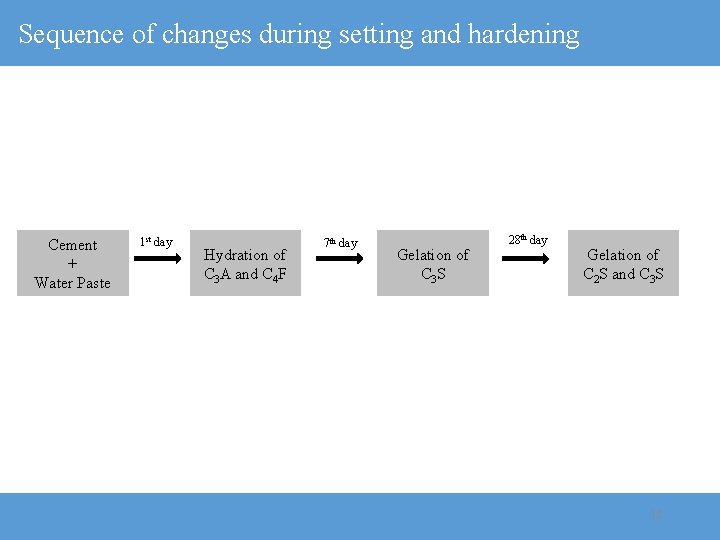
Sequence of changes during setting and hardening Cement + Water Paste 1 st day Hydration of C 3 A and C 4 F 7 th day Gelation of C 3 S 28 th day Gelation of C 2 S and C 3 S 18
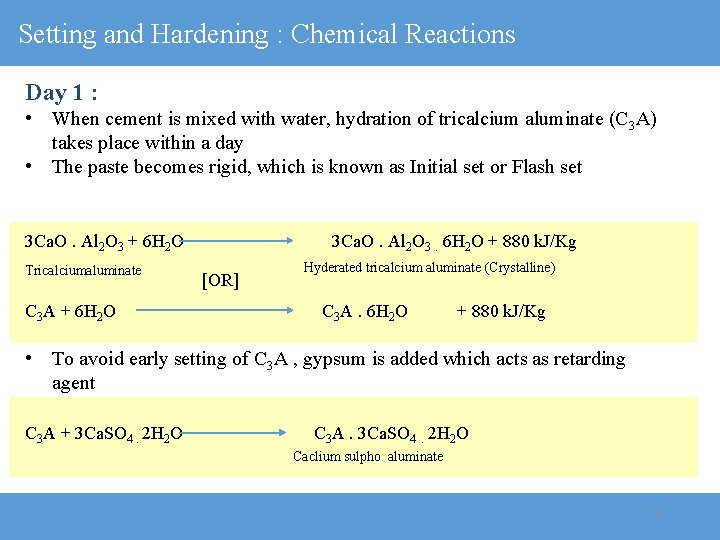
Setting and Hardening : Chemical Reactions Day 1 : • When cement is mixed with water, hydration of tricalcium aluminate (C 3 A) takes place within a day • The paste becomes rigid, which is known as Initial set or Flash set 3 Ca. O. Al 2 O 3 + 6 H 2 O 3 Ca. O. Al 2 O 3. 6 H 2 O + 880 k. J/Kg Tricalciumaluminate C 3 A + 6 H 2 O [OR] Hyderated tricalcium aluminate (Crystalline) C 3 A. 6 H 2 O + 880 k. J/Kg • To avoid early setting of C 3 A , gypsum is added which acts as retarding agent C 3 A + 3 Ca. SO 4. 2 H 2 O C 3 A. 3 Ca. SO 4. 2 H 2 O Caclium sulpho aluminate 19
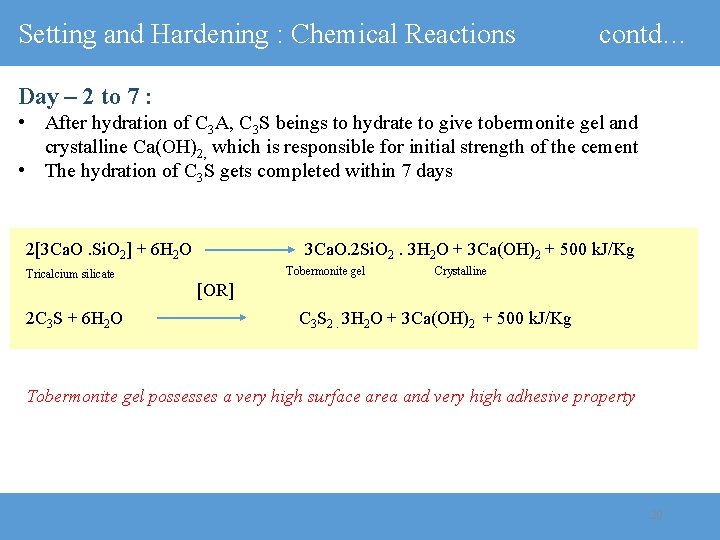
Setting and Hardening : Chemical Reactions contd… Day – 2 to 7 : • After hydration of C 3 A, C 3 S beings to hydrate to give tobermonite gel and crystalline Ca(OH)2, which is responsible for initial strength of the cement • The hydration of C 3 S gets completed within 7 days 2[3 Ca. O. Si. O 2] + 6 H 2 O 3 Ca. O. 2 Si. O 2. 3 H 2 O + 3 Ca(OH)2 + 500 k. J/Kg Tricalcium silicate Tobermonite gel Crystalline [OR] 2 C 3 S + 6 H 2 O C 3 S 2. 3 H 2 O + 3 Ca(OH)2 + 500 k. J/Kg Tobermonite gel possesses a very high surface area and very high adhesive property 20
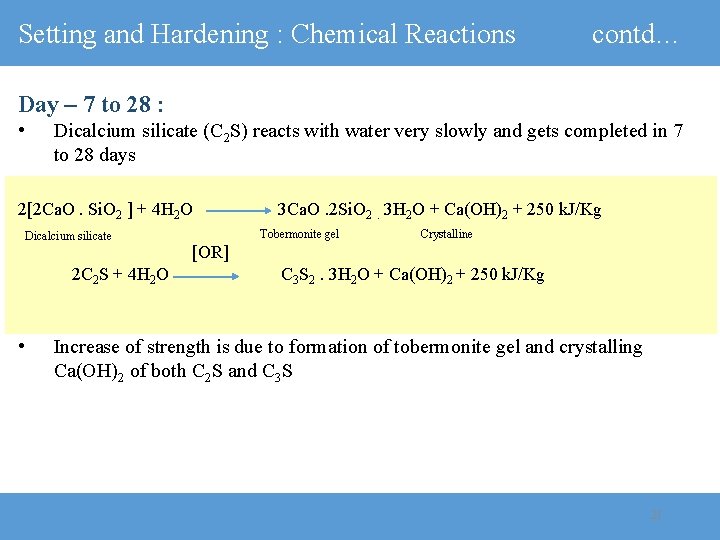
Setting and Hardening : Chemical Reactions contd… Day – 7 to 28 : • Dicalcium silicate (C 2 S) reacts with water very slowly and gets completed in 7 to 28 days 2[2 Ca. O. Si. O 2 ] + 4 H 2 O 3 Ca. O. 2 Si. O 2. 3 H 2 O + Ca(OH)2 + 250 k. J/Kg Dicalcium silicate Tobermonite gel Crystalline [OR] 2 C 2 S + 4 H 2 O C 3 S 2. 3 H 2 O + Ca(OH)2 + 250 k. J/Kg • Increase of strength is due to formation of tobermonite gel and crystalling Ca(OH)2 of both C 2 S and C 3 S 21
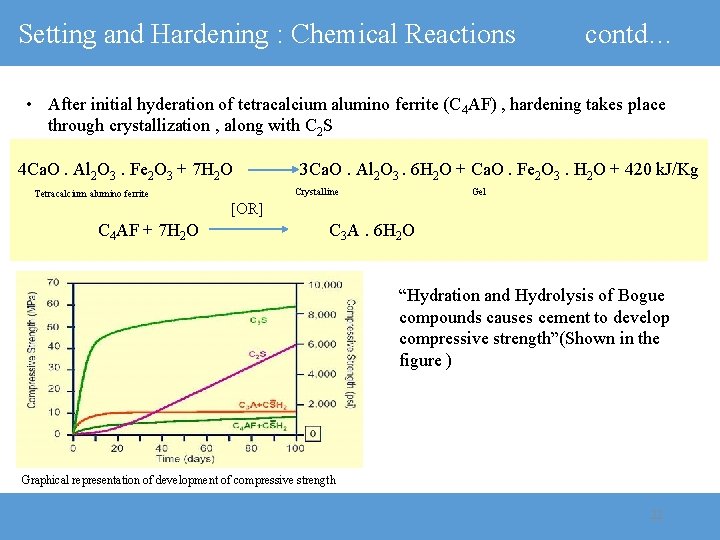
Setting and Hardening : Chemical Reactions contd… • After initial hyderation of tetracalcium alumino ferrite (C 4 AF) , hardening takes place through crystallization , along with C 2 S 4 Ca. O. Al 2 O 3. Fe 2 O 3 + 7 H 2 O 3 Ca. O. Al 2 O 3. 6 H 2 O + Ca. O. Fe 2 O 3. H 2 O + 420 k. J/Kg Crystalline Gel Tetracalcium alumino ferrite [OR] C 4 AF + 7 H 2 O C 3 A. 6 H 2 O “Hydration and Hydrolysis of Bogue compounds causes cement to develop compressive strength”(Shown in the figure ) Graphical representation of development of compressive strength 22
Function of Gypsum (Ca. SO 4· 2 H 2 O ) in cement • Tricalcium aluminate (C 3 A) combines with water very rapidly with the evolution of large amount of heat C 3 A + 6 H 2 O C 3 A. 6 H 2 O + Heat • After the initial set, the paste becomes stiff. • Adding gypsum retards the dissolution of C 3 A by forming insoluble calcium sulpho-aluminate 3 Ca. O. Al 2 O 3. x. Ca. SO 4. 7 H 2 O • The above reaction shows how gypsum retards the early initial set of cement 23
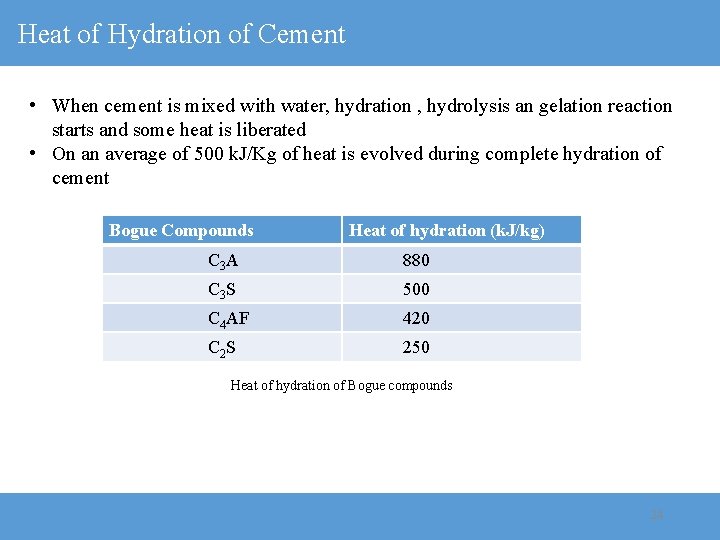
Heat of Hydration of Cement • When cement is mixed with water, hydration , hydrolysis an gelation reaction starts and some heat is liberated • On an average of 500 k. J/Kg of heat is evolved during complete hydration of cement Bogue Compounds Heat of hydration (k. J/kg) C 3 A 880 C 3 S 500 C 4 AF 420 C 2 S 250 Heat of hydration of Bogue compounds 24
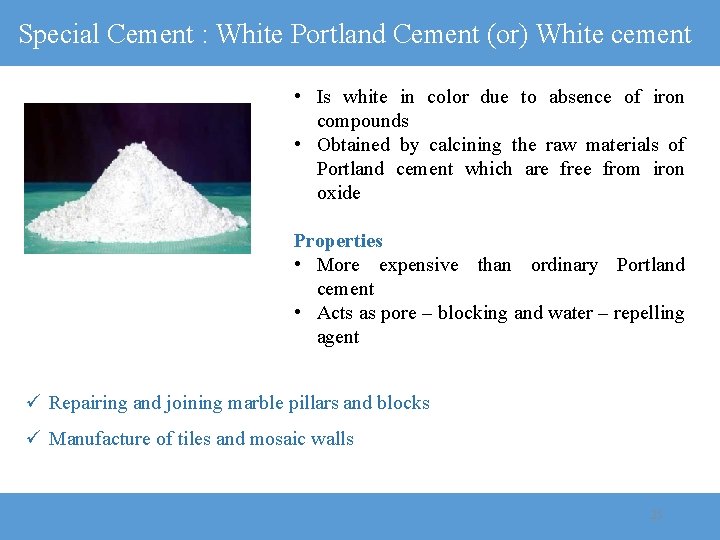
Special Cement : White Portland Cement (or) White cement • Is white in color due to absence of iron compounds • Obtained by calcining the raw materials of Portland cement which are free from iron oxide Properties • More expensive than ordinary Portland cement • Acts as pore – blocking and water – repelling agent ü Repairing and joining marble pillars and blocks ü Manufacture of tiles and mosaic walls 25
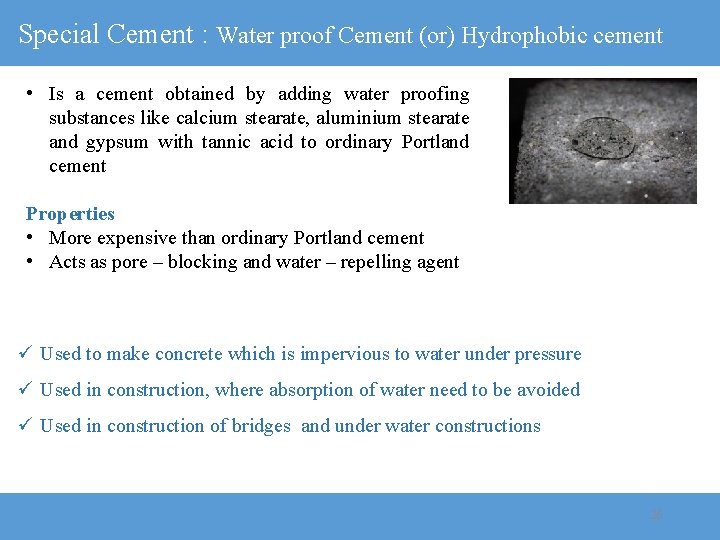
Special Cement : Water proof Cement (or) Hydrophobic cement • Is a cement obtained by adding water proofing substances like calcium stearate, aluminium stearate and gypsum with tannic acid to ordinary Portland cement Properties • More expensive than ordinary Portland cement • Acts as pore – blocking and water – repelling agent ü Used to make concrete which is impervious to water under pressure ü Used in construction, where absorption of water need to be avoided ü Used in construction of bridges and under water constructions 26