Eiger at the Australian Synchrotron Tom CaradocDavies Jun

- Slides: 17
Eiger at the Australian Synchrotron Tom Caradoc-Davies, Jun Aishima, David Aragao Australian Synchrotron / Monash University Melbourne, Australia
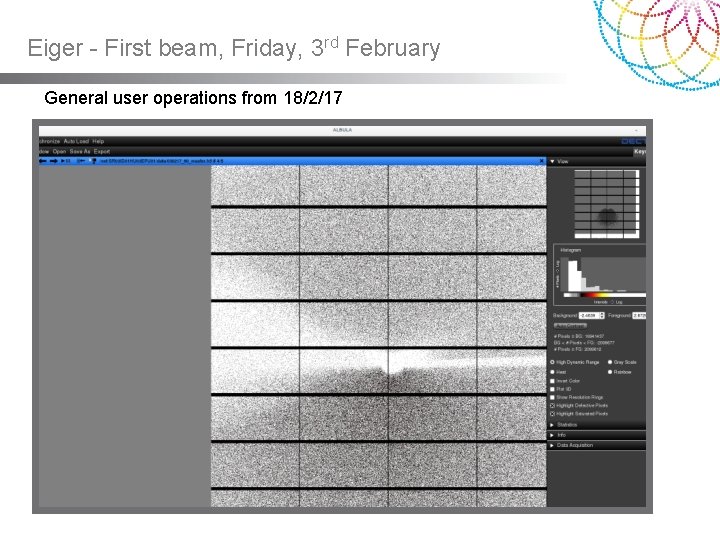
Eiger - First beam, Friday, 3 rd February General user operations from 18/2/17
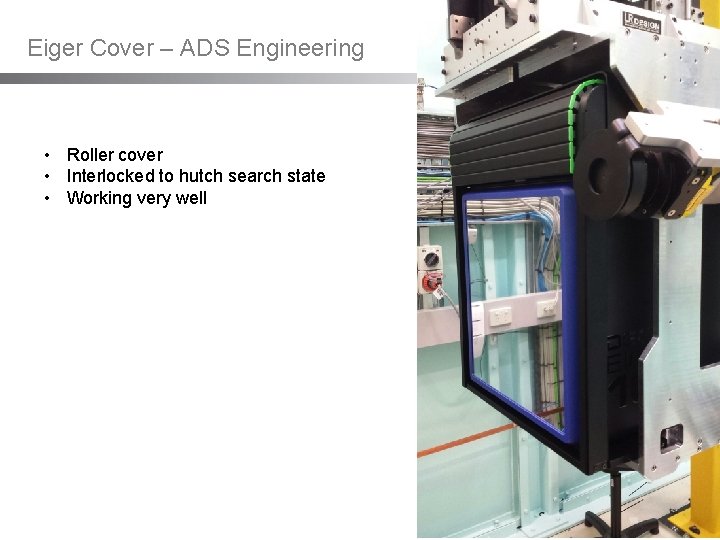
Eiger Cover – ADS Engineering • Roller cover • Interlocked to hutch search state • Working very well
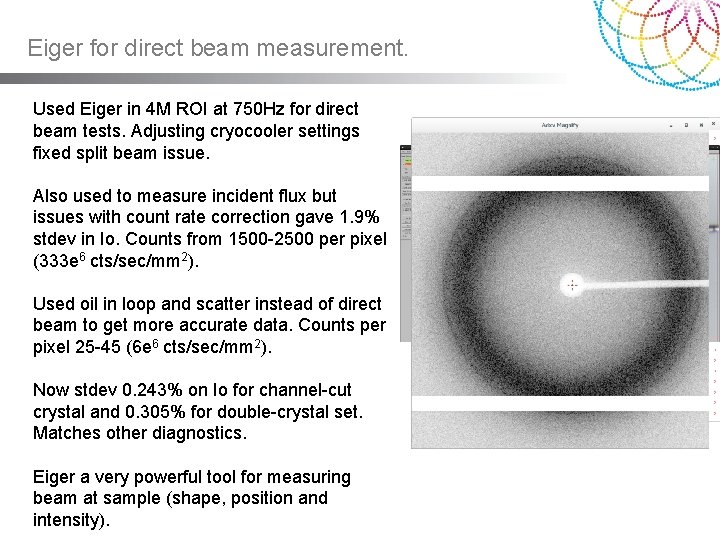
Eiger for direct beam measurement. Used Eiger in 4 M ROI at 750 Hz for direct beam tests. Adjusting cryocooler settings fixed split beam issue. Also used to measure incident flux but issues with count rate correction gave 1. 9% stdev in Io. Counts from 1500 -2500 per pixel (333 e 6 cts/sec/mm 2). Used oil in loop and scatter instead of direct beam to get more accurate data. Counts per pixel 25 -45 (6 e 6 cts/sec/mm 2). Now stdev 0. 243% on Io for channel-cut crystal and 0. 305% for double-crystal set. Matches other diagnostics. Eiger a very powerful tool for measuring beam at sample (shape, position and intensity).
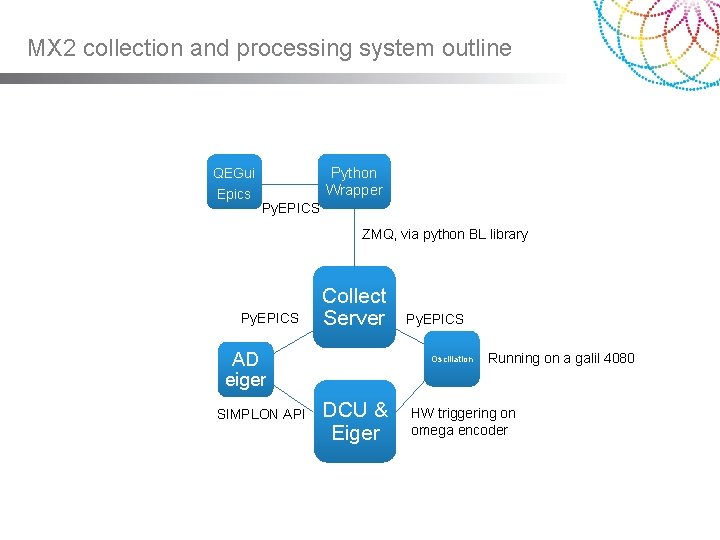
MX 2 collection and processing system outline Python Wrapper QEGui Epics Py. EPICS ZMQ, via python BL library Py. EPICS Collect Server AD eiger SIMPLON API Py. EPICS Oscillation DCU & Eiger Running on a galil 4080 HW triggering on omega encoder
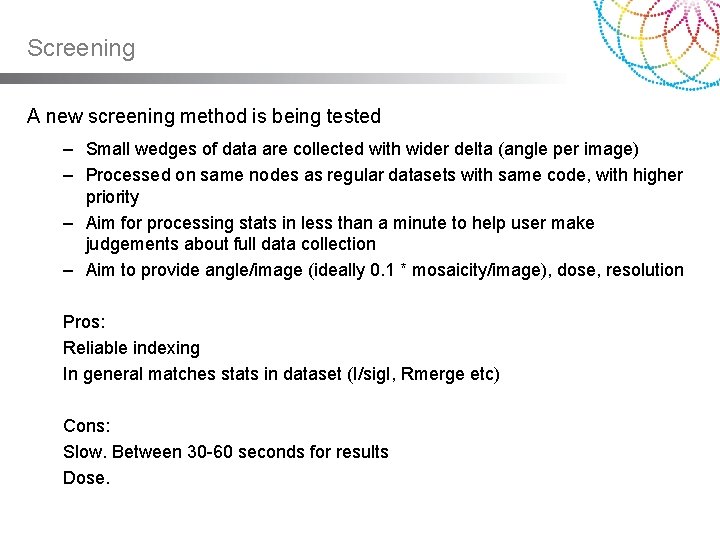
Screening A new screening method is being tested – Small wedges of data are collected with wider delta (angle per image) – Processed on same nodes as regular datasets with same code, with higher priority – Aim for processing stats in less than a minute to help user make judgements about full data collection – Aim to provide angle/image (ideally 0. 1 * mosaicity/image), dose, resolution Pros: Reliable indexing In general matches stats in dataset (I/sig. I, Rmerge etc) Cons: Slow. Between 30 -60 seconds for results Dose.
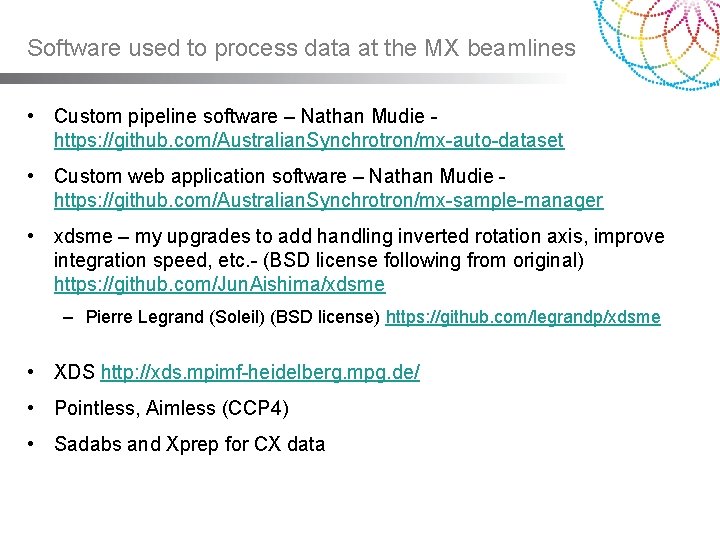
Software used to process data at the MX beamlines • Custom pipeline software – Nathan Mudie https: //github. com/Australian. Synchrotron/mx-auto-dataset • Custom web application software – Nathan Mudie https: //github. com/Australian. Synchrotron/mx-sample-manager • xdsme – my upgrades to add handling inverted rotation axis, improve integration speed, etc. - (BSD license following from original) https: //github. com/Jun. Aishima/xdsme – Pierre Legrand (Soleil) (BSD license) https: //github. com/legrandp/xdsme • XDS http: //xds. mpimf-heidelberg. mpg. de/ • Pointless, Aimless (CCP 4) • Sadabs and Xprep for CX data
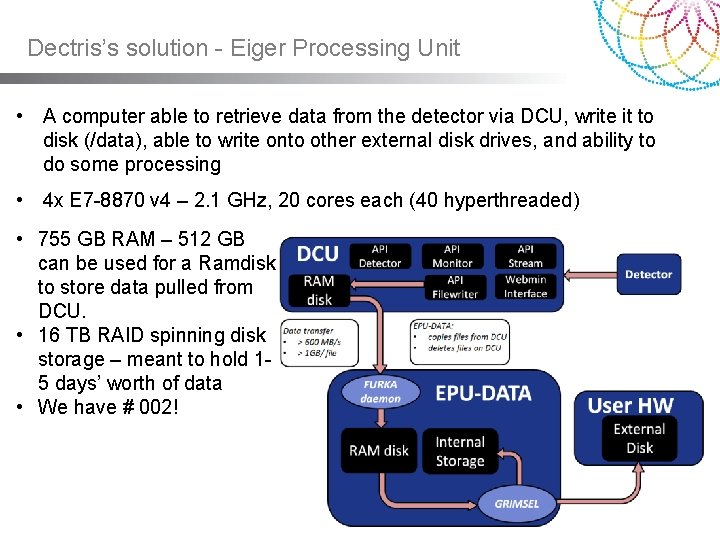
Dectris’s solution - Eiger Processing Unit • A computer able to retrieve data from the detector via DCU, write it to disk (/data), able to write onto other external disk drives, and ability to do some processing • 4 x E 7 -8870 v 4 – 2. 1 GHz, 20 cores each (40 hyperthreaded) • 755 GB RAM – 512 GB can be used for a Ramdisk to store data pulled from DCU. • 16 TB RAID spinning disk storage – meant to hold 15 days’ worth of data • We have # 002!
Benchmarking the EPU • 9 k image lysozyme dataset collected at the SLS – kindly provided for us by Andreas Forster (Dectris) – More representative of fine sliced experiments than the publicly available 16 M 900 image insulin dataset or 9 M 1800 image transthryretin dataset • Goal was to be able to process a dataset (collected at the maximum rate) in less than 4 x the data collection time when using 3 of the 4 CPUs – This was verified by Dectris and us using the 9 k image dataset and 120 threads. • Dectris have recommended that 16 -40 threads be reserved for Furka/Grimsel • Comparison with two Dell 730 servers (node 1 and node 2) – 2 x E 5 -2650 v 3 at 2. 3 GHz, total 20 cores (40 hyperthreaded) – 64 GB RAM
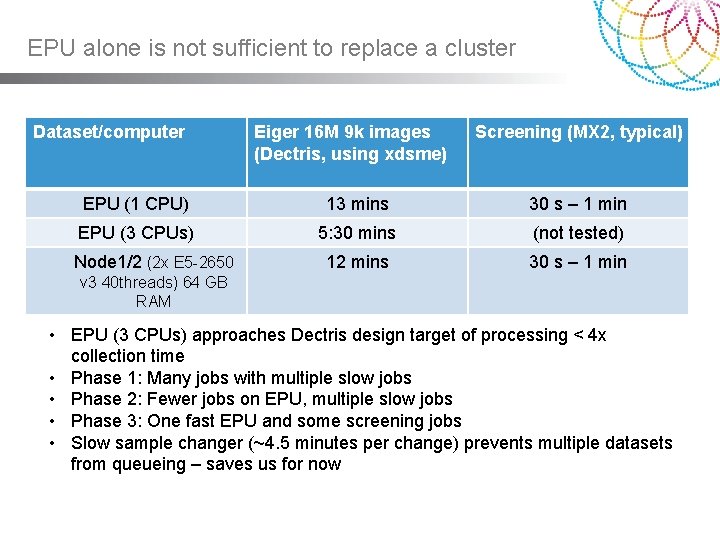
EPU alone is not sufficient to replace a cluster Dataset/computer Eiger 16 M 9 k images (Dectris, using xdsme) Screening (MX 2, typical) EPU (1 CPU) 13 mins 30 s – 1 min EPU (3 CPUs) 5: 30 mins (not tested) 12 mins 30 s – 1 min Node 1/2 (2 x E 5 -2650 v 3 40 threads) 64 GB RAM • EPU (3 CPUs) approaches Dectris design target of processing < 4 x collection time • Phase 1: Many jobs with multiple slow jobs • Phase 2: Fewer jobs on EPU, multiple slow jobs • Phase 3: One fast EPU and some screening jobs • Slow sample changer (~4. 5 minutes per change) prevents multiple datasets from queueing – saves us for now
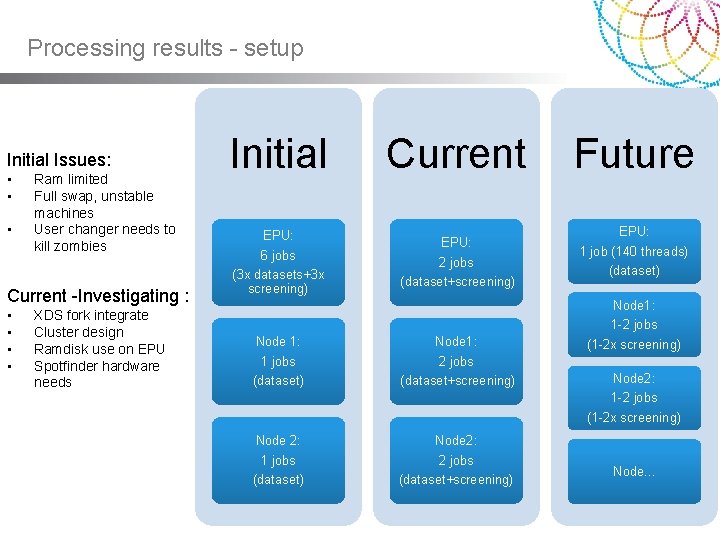
Processing results - setup Initial Issues: • • • Ram limited Full swap, unstable machines User changer needs to kill zombies Current -Investigating : • • XDS fork integrate Cluster design Ramdisk use on EPU Spotfinder hardware needs Initial Current EPU: 6 jobs (3 x datasets+3 x screening) EPU: 2 jobs (dataset+screening) Node 1: 1 jobs (dataset) Node 1: 2 jobs (dataset+screening) Node 2: 1 jobs (dataset) Node 2: 2 jobs (dataset+screening) Future EPU: 1 job (140 threads) (dataset) Node 1: 1 -2 jobs (1 -2 x screening) Node 2: 1 -2 jobs (1 -2 x screening) Node. . .
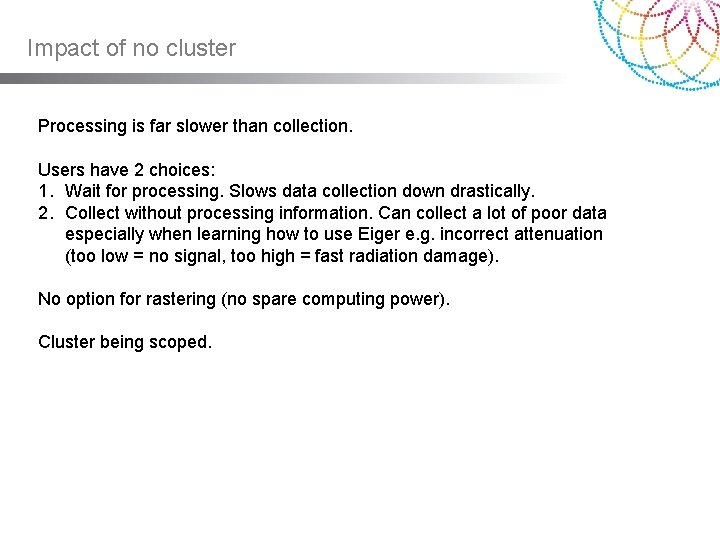
Impact of no cluster Processing is far slower than collection. Users have 2 choices: 1. Wait for processing. Slows data collection down drastically. 2. Collect without processing information. Can collect a lot of poor data especially when learning how to use Eiger e. g. incorrect attenuation (too low = no signal, too high = fast radiation damage). No option for rastering (no spare computing power). Cluster being scoped.
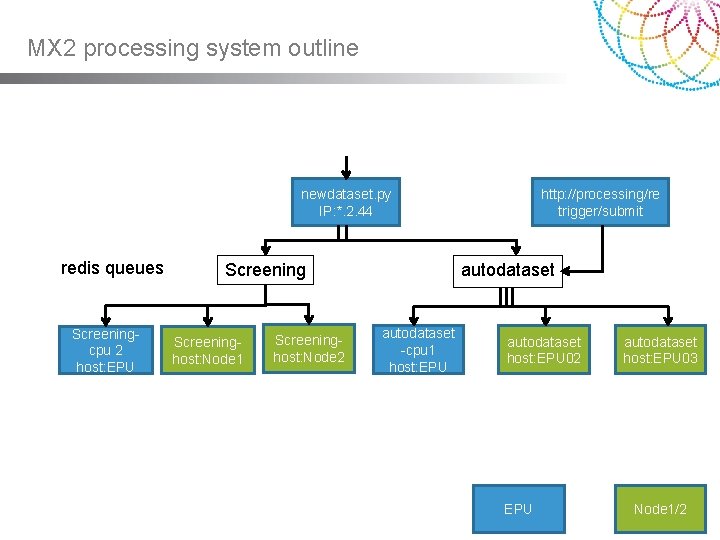
MX 2 processing system outline http: //processing/re trigger/submit newdataset. py IP: *. 2. 44 redis queues Screeningcpu 2 host: EPU Screeninghost: Node 1 Screeninghost: Node 2 autodataset -cpu 1 host: EPU autodataset host: EPU 02 EPU autodataset host: EPU 03 Node 1/2
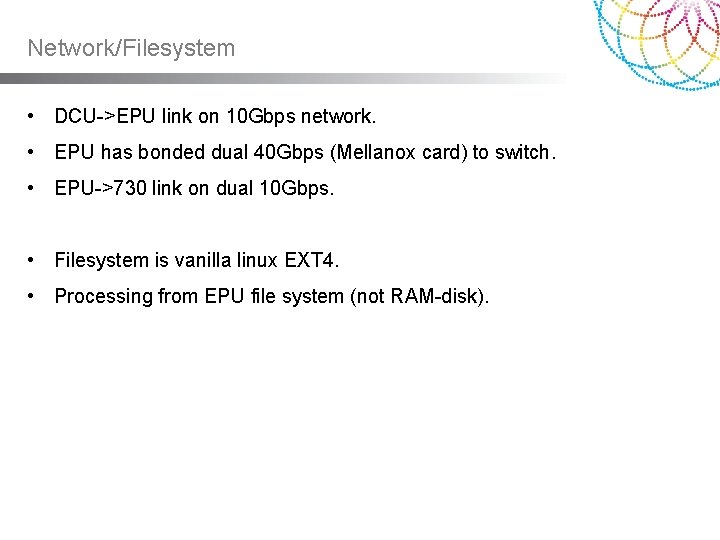
Network/Filesystem • DCU->EPU link on 10 Gbps network. • EPU has bonded dual 40 Gbps (Mellanox card) to switch. • EPU->730 link on dual 10 Gbps. • Filesystem is vanilla linux EXT 4. • Processing from EPU file system (not RAM-disk).
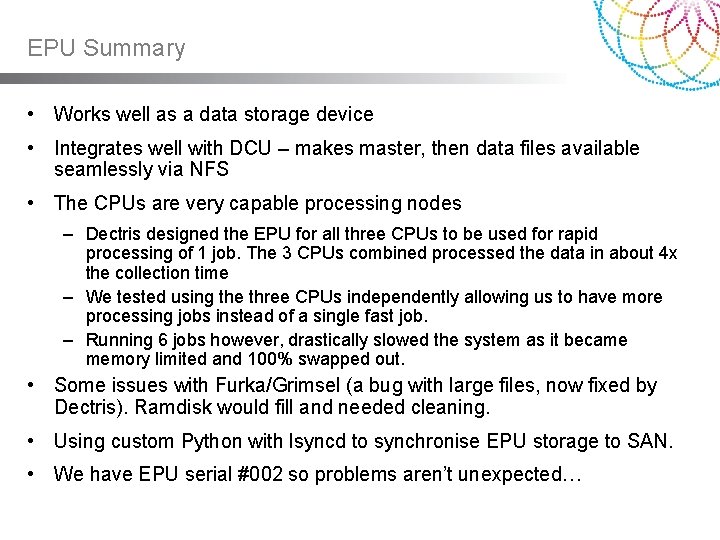
EPU Summary • Works well as a data storage device • Integrates well with DCU – makes master, then data files available seamlessly via NFS • The CPUs are very capable processing nodes – Dectris designed the EPU for all three CPUs to be used for rapid processing of 1 job. The 3 CPUs combined processed the data in about 4 x the collection time – We tested using the three CPUs independently allowing us to have more processing jobs instead of a single fast job. – Running 6 jobs however, drastically slowed the system as it became memory limited and 100% swapped out. • Some issues with Furka/Grimsel (a bug with large files, now fixed by Dectris). Ramdisk would fill and needed cleaning. • Using custom Python with lsyncd to synchronise EPU storage to SAN. • We have EPU serial #002 so problems aren’t unexpected…
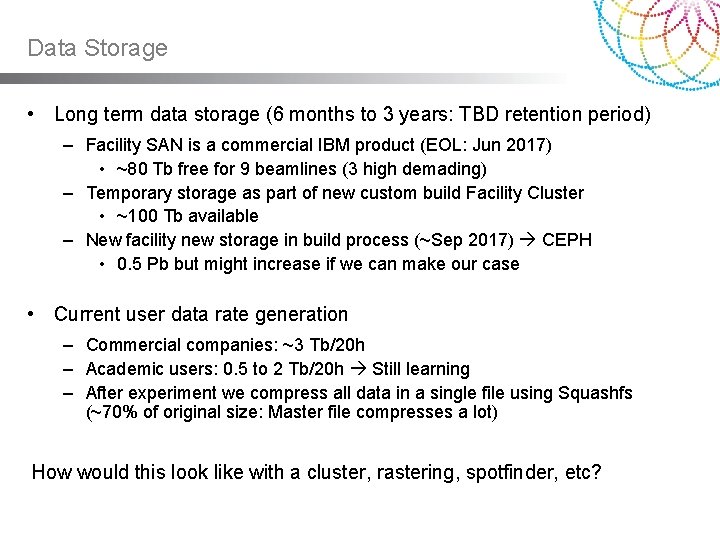
Data Storage • Long term data storage (6 months to 3 years: TBD retention period) – Facility SAN is a commercial IBM product (EOL: Jun 2017) • ~80 Tb free for 9 beamlines (3 high demading) – Temporary storage as part of new custom build Facility Cluster • ~100 Tb available – New facility new storage in build process (~Sep 2017) CEPH • 0. 5 Pb but might increase if we can make our case • Current user data rate generation – Commercial companies: ~3 Tb/20 h – Academic users: 0. 5 to 2 Tb/20 h Still learning – After experiment we compress all data in a single file using Squashfs (~70% of original size: Master file compresses a lot) How would this look like with a cluster, rastering, spotfinder, etc?
ACKNOWLEDGMENTS MX team – Tom Caradoc-Davies, David Aragao, Daniel Ericsson, Stephen Harrop*, Sofia Macedo, Santosh Panjikar, Jason Price, Alan Riboldi. Tunnicliffe, Rachel Williamson Nathan Mudie IT Group – Uli Felzmann*, Robbie Clarken, Andreas Moll Dectris – Andreas Forster, Diego Gaemperle SLS – Simon Ebner, Zac Panepucci, Meitian Wang HDRMX – http: //hdrmx. medsbio. org NSLS 2 – Bruno Martins for AD Eiger Centre for Advanced Molecular Imaging – for jointly funding my position! 17