
Synchrotron radiation R Bartolini John Adams Institute for
Synchrotron radiation R. Bartolini John Adams Institute for Accelerator Science, University of Oxford and Diamond Light Source JUAS 2014 27 -31 January 2014
Contents Introduction to synchrotron radiation properties of synchrotron radiation synchrotron light sources angular distribution of power radiated by accelerated particles angular and frequency distribution of energy radiated: radiation from undulators and wigglers Storage ring light sources electron beam dynamics in storage rings radiation damping and radiation excitation emittance and brilliance low emittance lattices diffraction limited storage rings R. Bartolini, JUAS, 27 -31 January 2014 2/59

Effects of synchrotron radiation on electron beam dynamics The electrons radiate energy: the equations of motion have a dissipative term; the system is non conservative and Liouville’s theorem does not apply; The emission of radiation leads to damping of the betatron and synchrotron oscillations Radiation is not emitted continuously but in individual photons. The energy emitted is a random variable with a known distribution (from theory of synchrotron radiation seen in previous lectures) This randomness introduce fluctuations which tend to increase the betatron and synchrotron oscillations Damping and growth reach an equilibrium in an electron synchrotron. This equilibrium defines the characteristics of the electron beam (e. g. emittance, energy spread, bunch size, etc) R. Bartolini, JUAS, 27 -31 January 2014 3/59
Effects of synchrotron radiation on electron beam dynamics We will now look at the effect of radiation damping on the three planes of motion We will use two equivalent formalisms: damping from the equations of motion in phase space damping as a change in the Courant-Snyder invariant The system is non-conservative hence the Courant-Snyder invariant – i. e. the area of the ellipse in phase space, is no longer a constant of motion We will then consider the effect of radiation quantum excitation on the three planes of motion We will use the formalism of the change of the Courant-Snyder invariant R. Bartolini, JUAS, 27 -31 January 2014 4/59
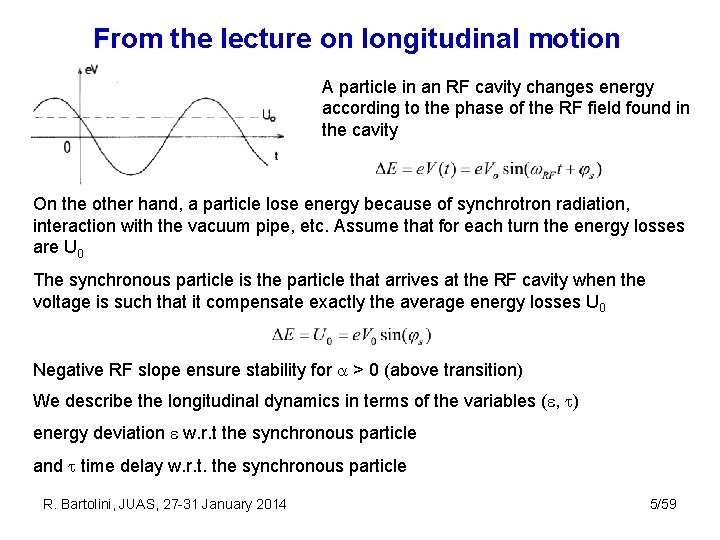
From the lecture on longitudinal motion A particle in an RF cavity changes energy according to the phase of the RF field found in the cavity On the other hand, a particle lose energy because of synchrotron radiation, interaction with the vacuum pipe, etc. Assume that for each turn the energy losses are U 0 The synchronous particle is the particle that arrives at the RF cavity when the voltage is such that it compensate exactly the average energy losses U 0 Negative RF slope ensure stability for > 0 (above transition) We describe the longitudinal dynamics in terms of the variables ( , ) energy deviation w. r. t the synchronous particle and time delay w. r. t. the synchronous particle R. Bartolini, JUAS, 27 -31 January 2014 5/59
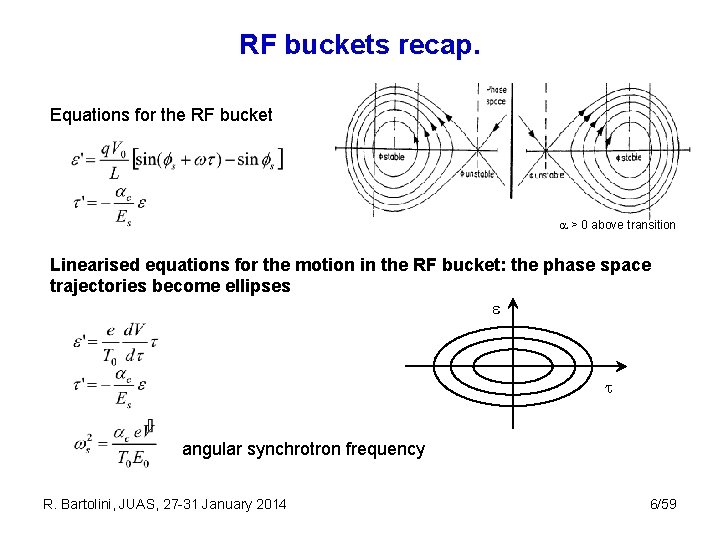
RF buckets recap. Equations for the RF bucket > 0 above transition Linearised equations for the motion in the RF bucket: the phase space trajectories become ellipses angular synchrotron frequency R. Bartolini, JUAS, 27 -31 January 2014 6/59
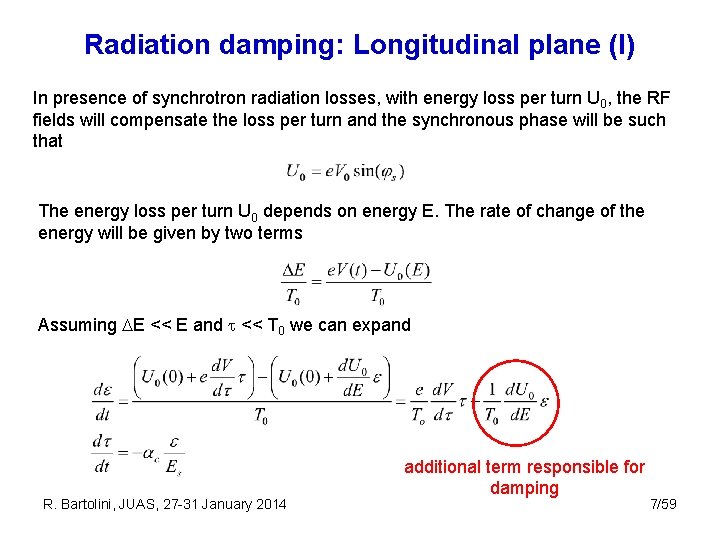
Radiation damping: Longitudinal plane (I) In presence of synchrotron radiation losses, with energy loss per turn U 0, the RF fields will compensate the loss per turn and the synchronous phase will be such that The energy loss per turn U 0 depends on energy E. The rate of change of the energy will be given by two terms Assuming E << E and << T 0 we can expand R. Bartolini, JUAS, 27 -31 January 2014 additional term responsible for damping 7/59
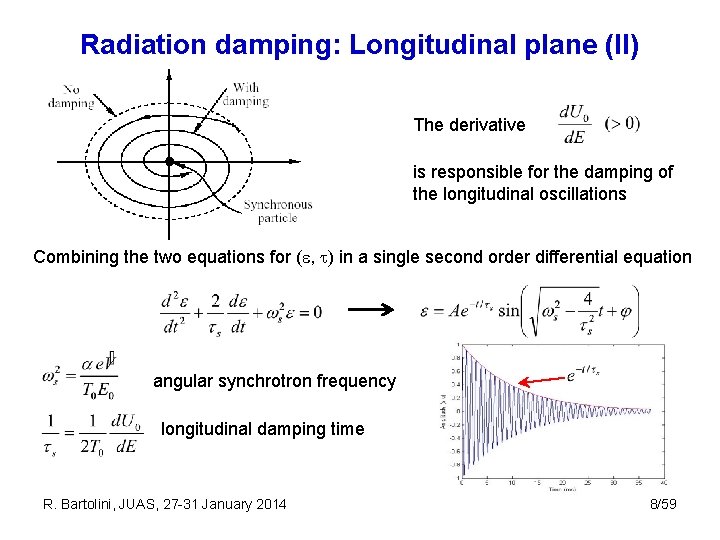
Radiation damping: Longitudinal plane (II) The derivative is responsible for the damping of the longitudinal oscillations Combining the two equations for ( , ) in a single second order differential equation angular synchrotron frequency longitudinal damping time R. Bartolini, JUAS, 27 -31 January 2014 8/59
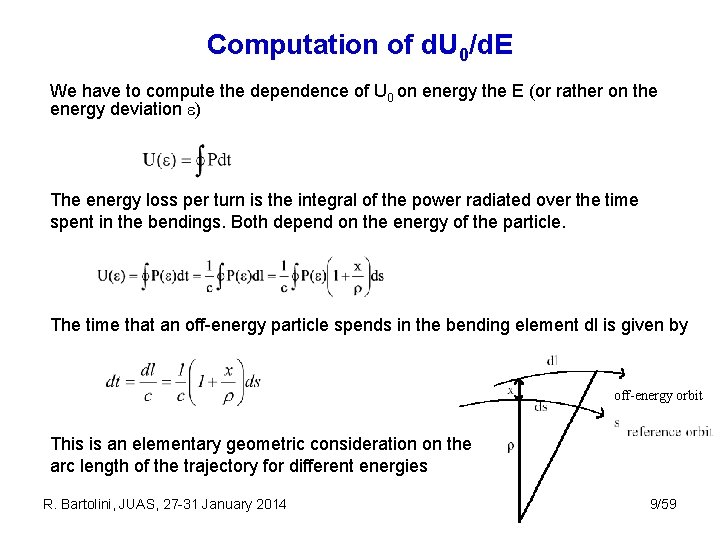
Computation of d. U 0/d. E We have to compute the dependence of U 0 on energy the E (or rather on the energy deviation ) The energy loss per turn is the integral of the power radiated over the time spent in the bendings. Both depend on the energy of the particle. The time that an off-energy particle spends in the bending element dl is given by off-energy orbit This is an elementary geometric consideration on the arc length of the trajectory for different energies R. Bartolini, JUAS, 27 -31 January 2014 9/59
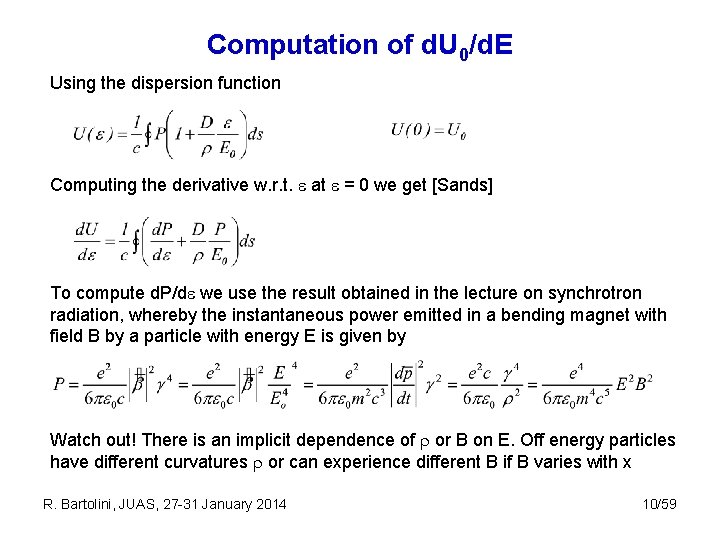
Computation of d. U 0/d. E Using the dispersion function Computing the derivative w. r. t. at = 0 we get [Sands] To compute d. P/d we use the result obtained in the lecture on synchrotron radiation, whereby the instantaneous power emitted in a bending magnet with field B by a particle with energy E is given by Watch out! There is an implicit dependence of or B on E. Off energy particles have different curvatures or can experience different B if B varies with x R. Bartolini, JUAS, 27 -31 January 2014 10/59
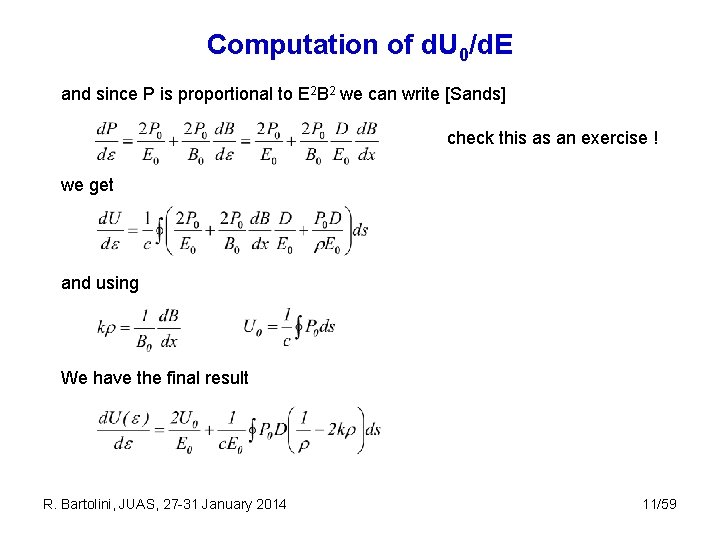
Computation of d. U 0/d. E and since P is proportional to E 2 B 2 we can write [Sands] check this as an exercise ! we get and using We have the final result R. Bartolini, JUAS, 27 -31 January 2014 11/59
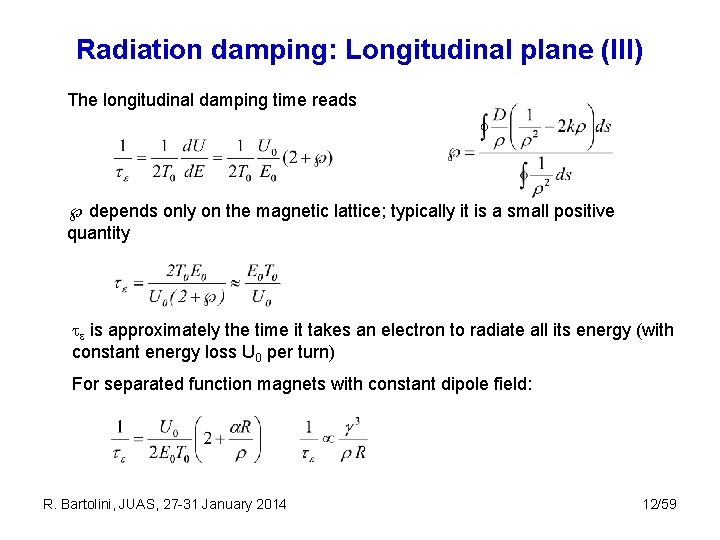
Radiation damping: Longitudinal plane (III) The longitudinal damping time reads depends only on the magnetic lattice; typically it is a small positive quantity is approximately the time it takes an electron to radiate all its energy (with constant energy loss U 0 per turn) For separated function magnets with constant dipole field: R. Bartolini, JUAS, 27 -31 January 2014 12/59
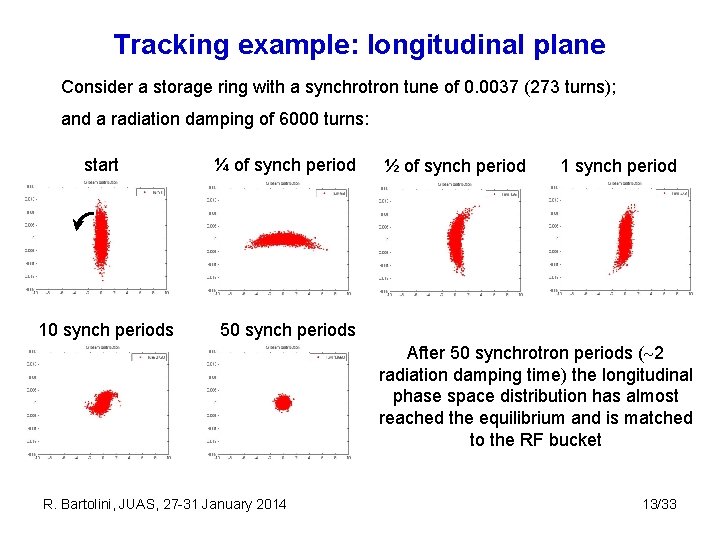
Tracking example: longitudinal plane Consider a storage ring with a synchrotron tune of 0. 0037 (273 turns); and a radiation damping of 6000 turns: start ¼ of synch period 10 synch periods 50 synch periods ½ of synch period 1 synch period After 50 synchrotron periods ( 2 radiation damping time) the longitudinal phase space distribution has almost reached the equilibrium and is matched to the RF bucket R. Bartolini, JUAS, 27 -31 January 2014 13/33
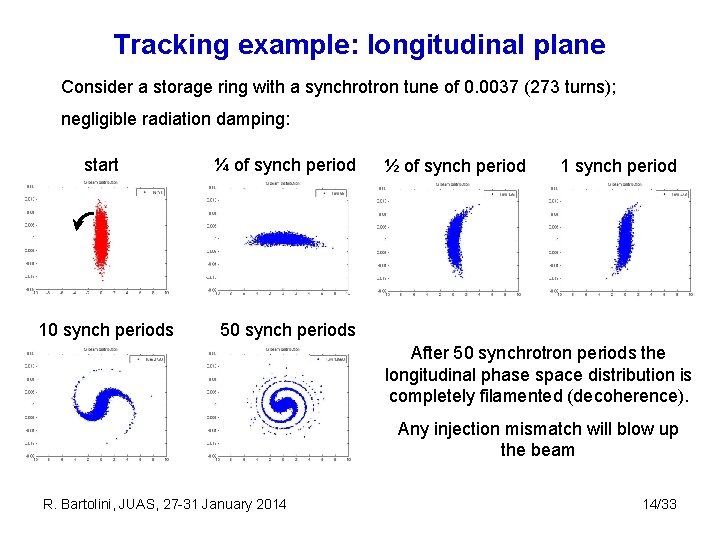
Tracking example: longitudinal plane Consider a storage ring with a synchrotron tune of 0. 0037 (273 turns); negligible radiation damping: start ¼ of synch period 10 synch periods 50 synch periods ½ of synch period 1 synch period After 50 synchrotron periods the longitudinal phase space distribution is completely filamented (decoherence). Any injection mismatch will blow up the beam R. Bartolini, JUAS, 27 -31 January 2014 14/33
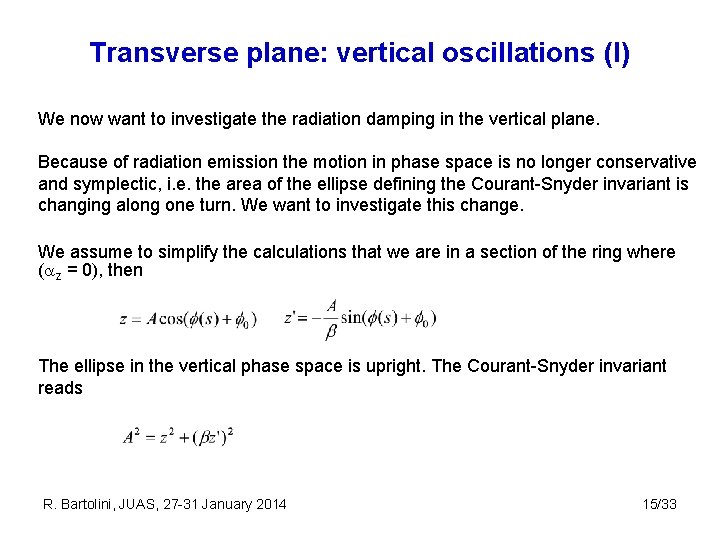
Transverse plane: vertical oscillations (I) We now want to investigate the radiation damping in the vertical plane. Because of radiation emission the motion in phase space is no longer conservative and symplectic, i. e. the area of the ellipse defining the Courant-Snyder invariant is changing along one turn. We want to investigate this change. We assume to simplify the calculations that we are in a section of the ring where ( z = 0), then The ellipse in the vertical phase space is upright. The Courant-Snyder invariant reads R. Bartolini, JUAS, 27 -31 January 2014 15/33
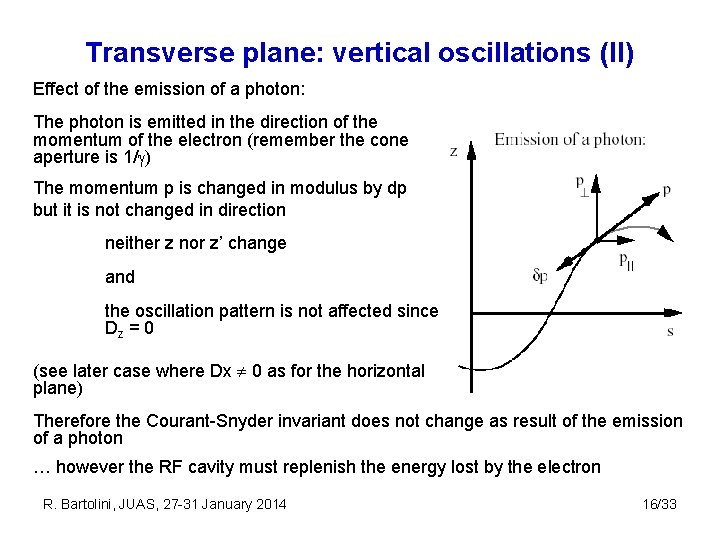
Transverse plane: vertical oscillations (II) Effect of the emission of a photon: The photon is emitted in the direction of the momentum of the electron (remember the cone aperture is 1/ ) The momentum p is changed in modulus by dp but it is not changed in direction neither z nor z’ change and the oscillation pattern is not affected since Dz = 0 (see later case where Dx 0 as for the horizontal plane) Therefore the Courant-Snyder invariant does not change as result of the emission of a photon … however the RF cavity must replenish the energy lost by the electron R. Bartolini, JUAS, 27 -31 January 2014 16/33
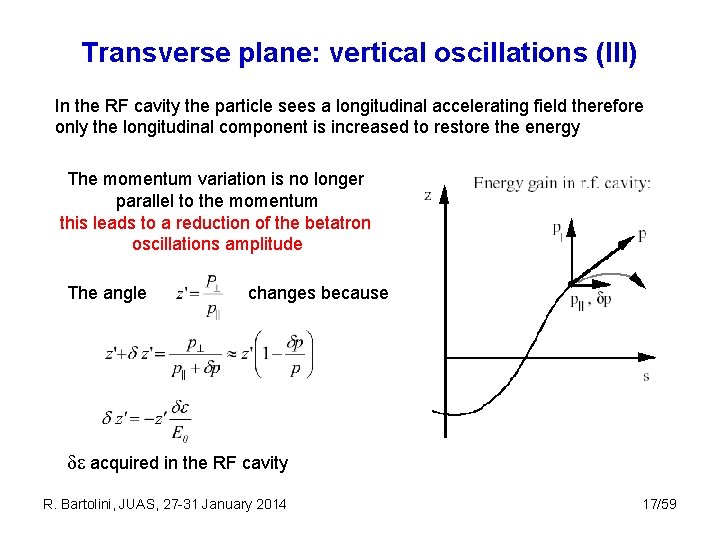
Transverse plane: vertical oscillations (III) In the RF cavity the particle sees a longitudinal accelerating field therefore only the longitudinal component is increased to restore the energy The momentum variation is no longer parallel to the momentum this leads to a reduction of the betatron oscillations amplitude The angle changes because acquired in the RF cavity R. Bartolini, JUAS, 27 -31 January 2014 17/59
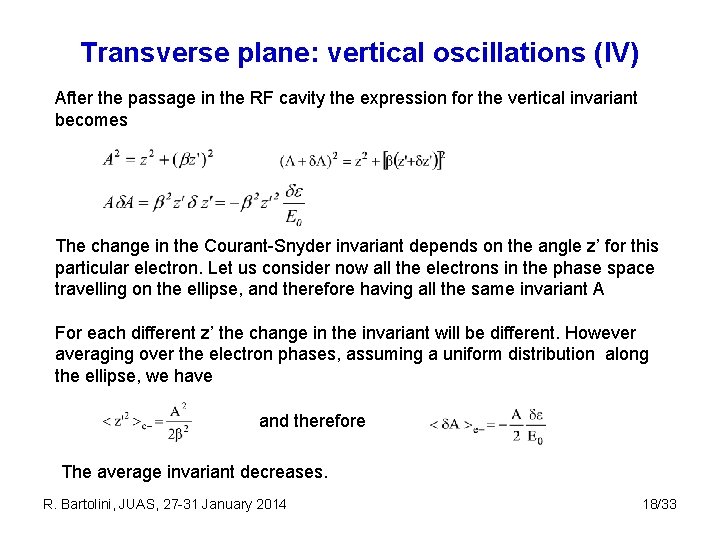
Transverse plane: vertical oscillations (IV) After the passage in the RF cavity the expression for the vertical invariant becomes The change in the Courant-Snyder invariant depends on the angle z’ for this particular electron. Let us consider now all the electrons in the phase space travelling on the ellipse, and therefore having all the same invariant A For each different z’ the change in the invariant will be different. However averaging over the electron phases, assuming a uniform distribution along the ellipse, we have and therefore The average invariant decreases. R. Bartolini, JUAS, 27 -31 January 2014 18/33
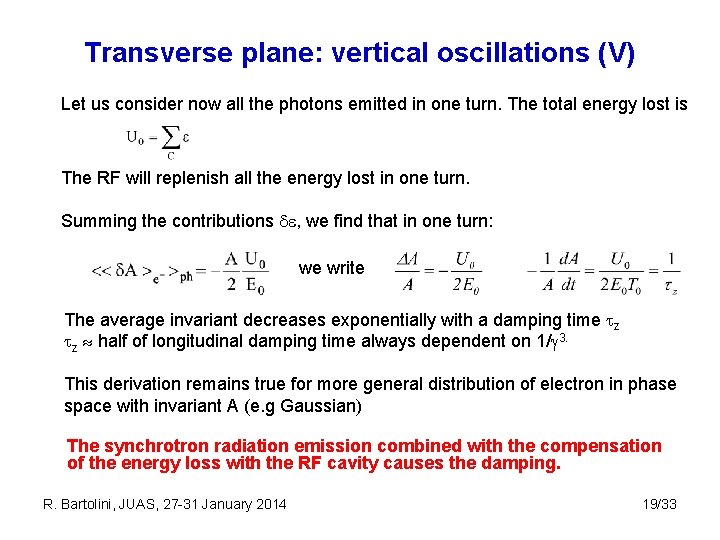
Transverse plane: vertical oscillations (V) Let us consider now all the photons emitted in one turn. The total energy lost is The RF will replenish all the energy lost in one turn. Summing the contributions , we find that in one turn: we write The average invariant decreases exponentially with a damping time z z half of longitudinal damping time always dependent on 1/ 3. This derivation remains true for more general distribution of electron in phase space with invariant A (e. g Gaussian) The synchrotron radiation emission combined with the compensation of the energy loss with the RF cavity causes the damping. R. Bartolini, JUAS, 27 -31 January 2014 19/33
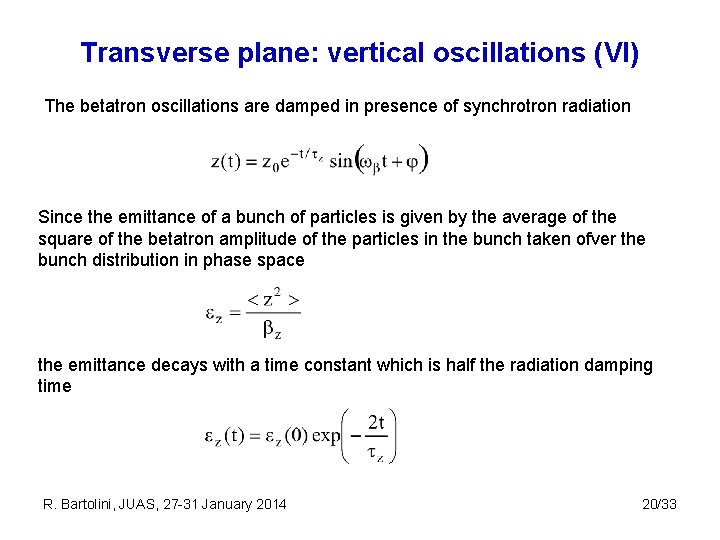
Transverse plane: vertical oscillations (VI) The betatron oscillations are damped in presence of synchrotron radiation Since the emittance of a bunch of particles is given by the average of the square of the betatron amplitude of the particles in the bunch taken ofver the bunch distribution in phase space the emittance decays with a time constant which is half the radiation damping time R. Bartolini, JUAS, 27 -31 January 2014 20/33
Transverse plane: horizontal oscillations (I) The damping of the horizontal oscillation can be treated with the same formalism used for the vertical plane, e. g. • consider the electron travelling on an ellipse in phase space with invariant A • compute the change in coordinates due to the emission of one photon • compute the change of coordinates due to the passage in the RF • averaging over all electron with the same invariant • compute the change in the average invariant for all photons emitted in one turn The new and fundamental difference is that in the horizontal plane we do not neglect the dispersion, i. e. Dx 0 The reference orbit changes when a quantum is emitted because of Dx in the bendings. The electron will oscillate around its new off-energy orbit. In details: R. Bartolini, JUAS, 27 -31 January 2014 21/33
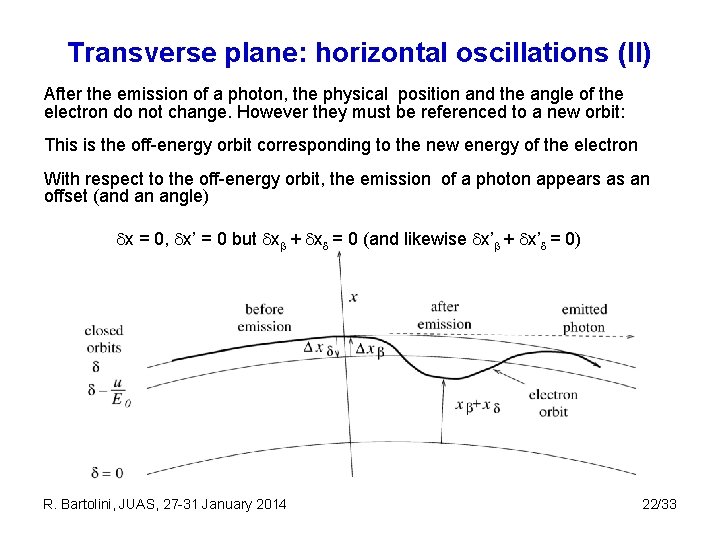
Transverse plane: horizontal oscillations (II) After the emission of a photon, the physical position and the angle of the electron do not change. However they must be referenced to a new orbit: This is the off-energy orbit corresponding to the new energy of the electron With respect to the off-energy orbit, the emission of a photon appears as an offset (and an angle) x = 0, x’ = 0 but x + x = 0 (and likewise x’ + x’ = 0) R. Bartolini, JUAS, 27 -31 January 2014 22/33
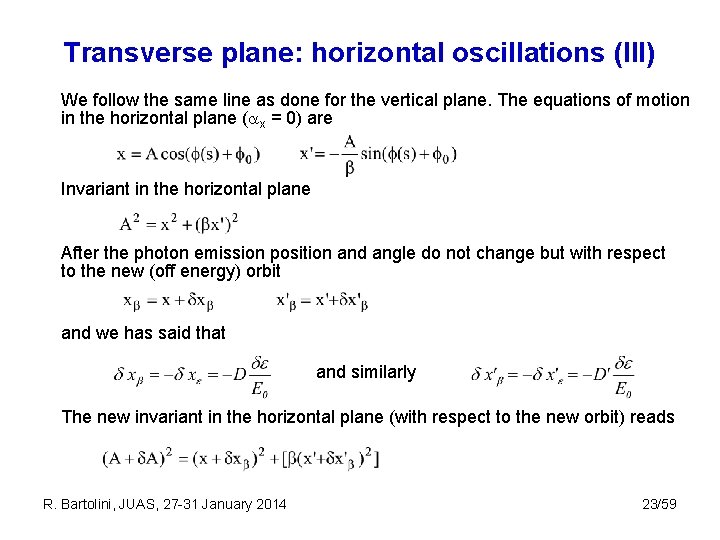
Transverse plane: horizontal oscillations (III) We follow the same line as done for the vertical plane. The equations of motion in the horizontal plane ( x = 0) are Invariant in the horizontal plane After the photon emission position and angle do not change but with respect to the new (off energy) orbit and we has said that and similarly The new invariant in the horizontal plane (with respect to the new orbit) reads R. Bartolini, JUAS, 27 -31 January 2014 23/59
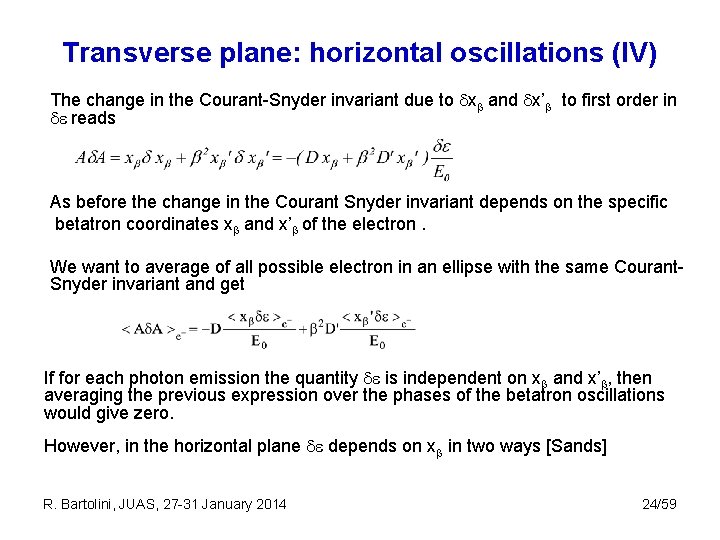
Transverse plane: horizontal oscillations (IV) The change in the Courant-Snyder invariant due to x and x’ to first order in reads As before the change in the Courant Snyder invariant depends on the specific betatron coordinates x and x’ of the electron. We want to average of all possible electron in an ellipse with the same Courant. Snyder invariant and get If for each photon emission the quantity is independent on x and x’ , then averaging the previous expression over the phases of the betatron oscillations would give zero. However, in the horizontal plane depends on x in two ways [Sands] R. Bartolini, JUAS, 27 -31 January 2014 24/59
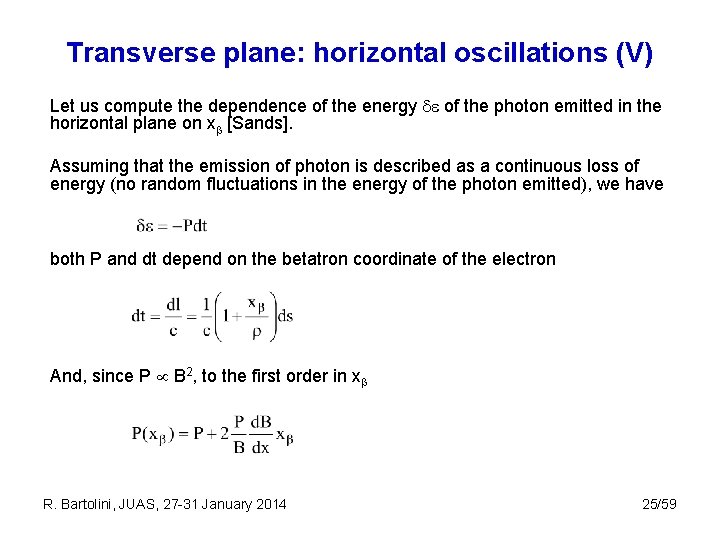
Transverse plane: horizontal oscillations (V) Let us compute the dependence of the energy of the photon emitted in the horizontal plane on x [Sands]. Assuming that the emission of photon is described as a continuous loss of energy (no random fluctuations in the energy of the photon emitted), we have both P and dt depend on the betatron coordinate of the electron And, since P B 2, to the first order in x R. Bartolini, JUAS, 27 -31 January 2014 25/59
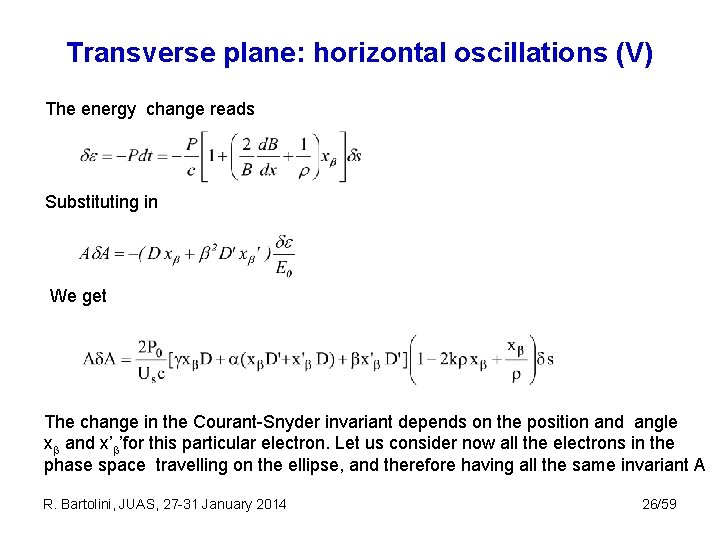
Transverse plane: horizontal oscillations (V) The energy change reads Substituting in We get The change in the Courant-Snyder invariant depends on the position and angle x and x’ ’for this particular electron. Let us consider now all the electrons in the phase space travelling on the ellipse, and therefore having all the same invariant A R. Bartolini, JUAS, 27 -31 January 2014 26/59
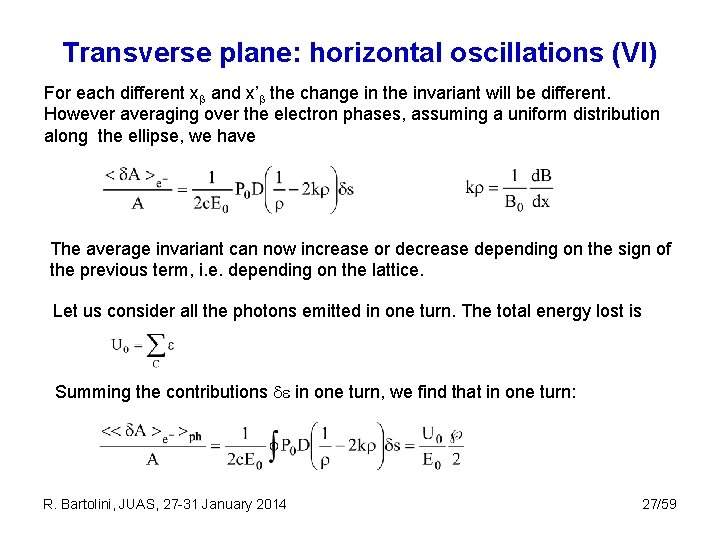
Transverse plane: horizontal oscillations (VI) For each different x and x’ the change in the invariant will be different. However averaging over the electron phases, assuming a uniform distribution along the ellipse, we have The average invariant can now increase or decrease depending on the sign of the previous term, i. e. depending on the lattice. Let us consider all the photons emitted in one turn. The total energy lost is Summing the contributions in one turn, we find that in one turn: R. Bartolini, JUAS, 27 -31 January 2014 27/59
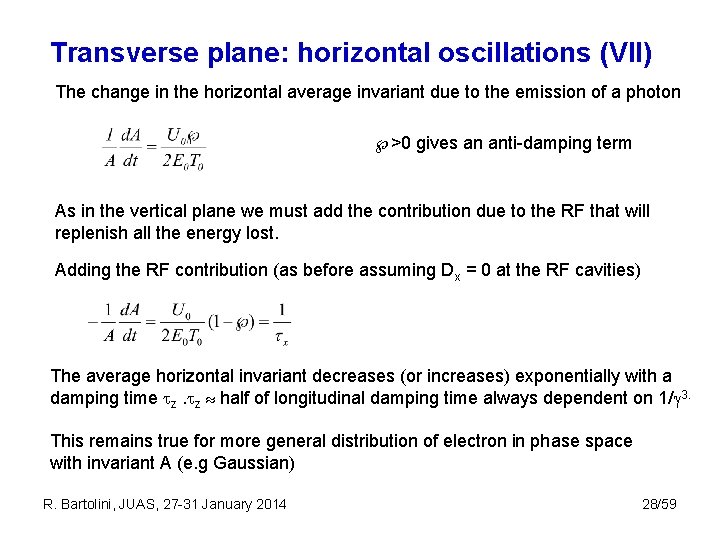
Transverse plane: horizontal oscillations (VII) The change in the horizontal average invariant due to the emission of a photon >0 gives an anti-damping term As in the vertical plane we must add the contribution due to the RF that will replenish all the energy lost. Adding the RF contribution (as before assuming Dx = 0 at the RF cavities) The average horizontal invariant decreases (or increases) exponentially with a damping time z. z half of longitudinal damping time always dependent on 1/ 3. This remains true for more general distribution of electron in phase space with invariant A (e. g Gaussian) R. Bartolini, JUAS, 27 -31 January 2014 28/59
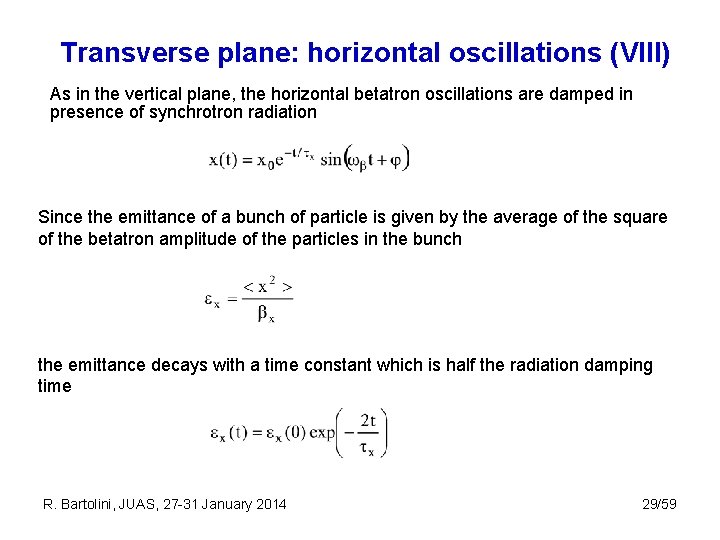
Transverse plane: horizontal oscillations (VIII) As in the vertical plane, the horizontal betatron oscillations are damped in presence of synchrotron radiation Since the emittance of a bunch of particle is given by the average of the square of the betatron amplitude of the particles in the bunch the emittance decays with a time constant which is half the radiation damping time R. Bartolini, JUAS, 27 -31 January 2014 29/59
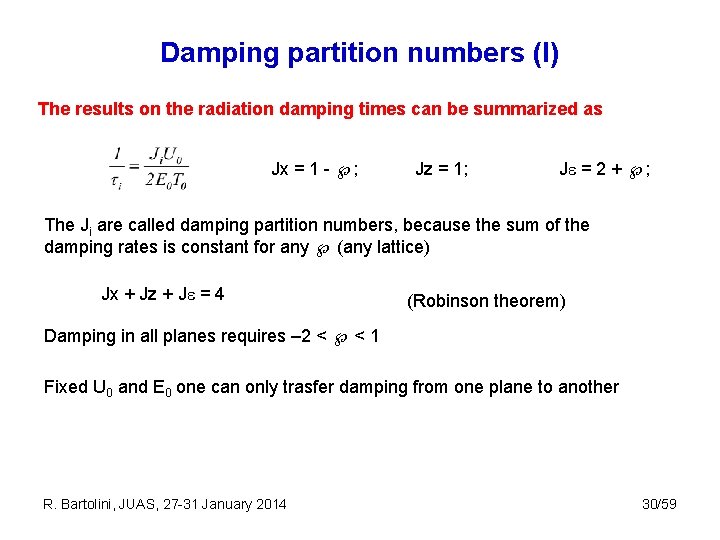
Damping partition numbers (I) The results on the radiation damping times can be summarized as Jx = 1 - ; Jz = 1; J = 2 + ; The Ji are called damping partition numbers, because the sum of the damping rates is constant for any (any lattice) Jx + Jz + J = 4 (Robinson theorem) Damping in all planes requires – 2 < < 1 Fixed U 0 and E 0 one can only trasfer damping from one plane to another R. Bartolini, JUAS, 27 -31 January 2014 30/59
Adjustment of damping rates Modification of all damping rates: Increase losses U 0 Adding damping wigglers to increase U 0 is done in damping rings to decrease the emittance Repartition of damping rates on different planes: Robinson wigglers: increase longitudinal damping time by decreasing the horizontal damping (reducing d. U/d. E) Change RF: change the orbit in quadrupoles which changes and reduces x R. Bartolini, JUAS, 27 -31 January 2014 31/59
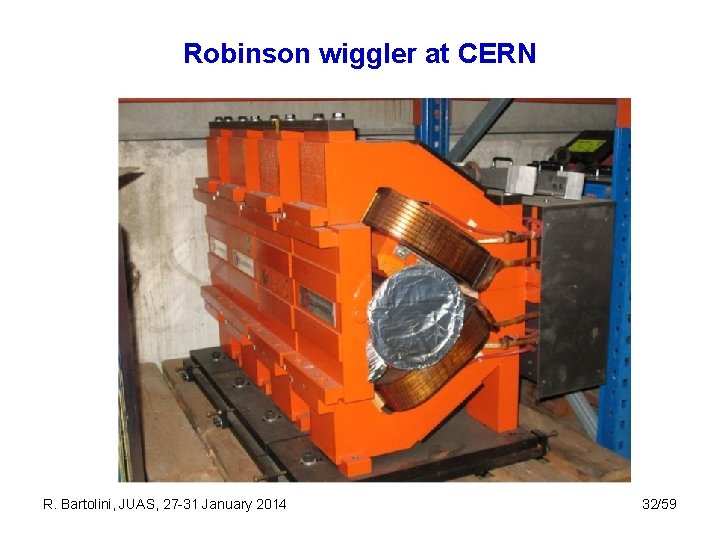
Robinson wiggler at CERN R. Bartolini, JUAS, 27 -31 January 2014 32/59
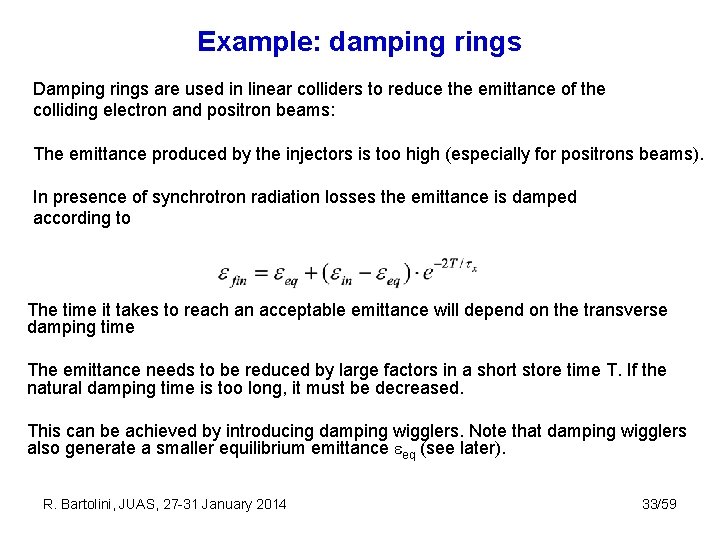
Example: damping rings Damping rings are used in linear colliders to reduce the emittance of the colliding electron and positron beams: The emittance produced by the injectors is too high (especially for positrons beams). In presence of synchrotron radiation losses the emittance is damped according to The time it takes to reach an acceptable emittance will depend on the transverse damping time The emittance needs to be reduced by large factors in a short store time T. If the natural damping time is too long, it must be decreased. This can be achieved by introducing damping wigglers. Note that damping wigglers also generate a smaller equilibrium emittance eq (see later). R. Bartolini, JUAS, 27 -31 January 2014 33/59
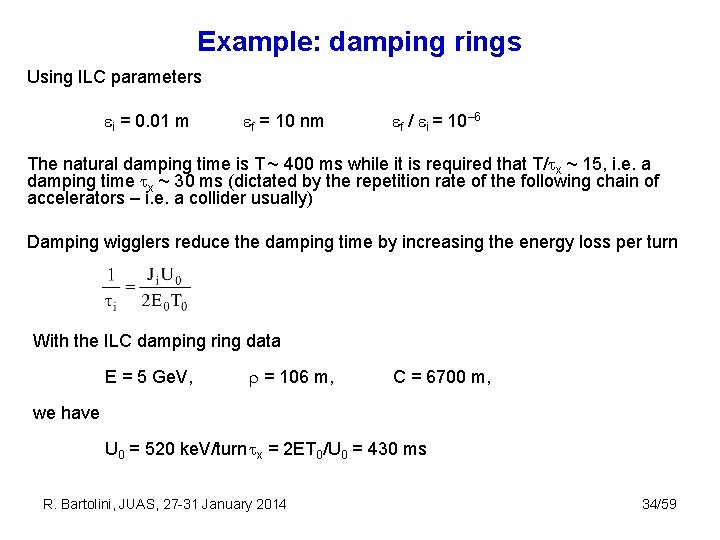
Example: damping rings Using ILC parameters i = 0. 01 m f = 10 nm f / i = 10– 6 The natural damping time is T ~ 400 ms while it is required that T/ x ~ 15, i. e. a damping time x ~ 30 ms (dictated by the repetition rate of the following chain of accelerators – i. e. a collider usually) Damping wigglers reduce the damping time by increasing the energy loss per turn With the ILC damping ring data E = 5 Ge. V, = 106 m, C = 6700 m, we have U 0 = 520 ke. V/turn x = 2 ET 0/U 0 = 430 ms R. Bartolini, JUAS, 27 -31 January 2014 34/59
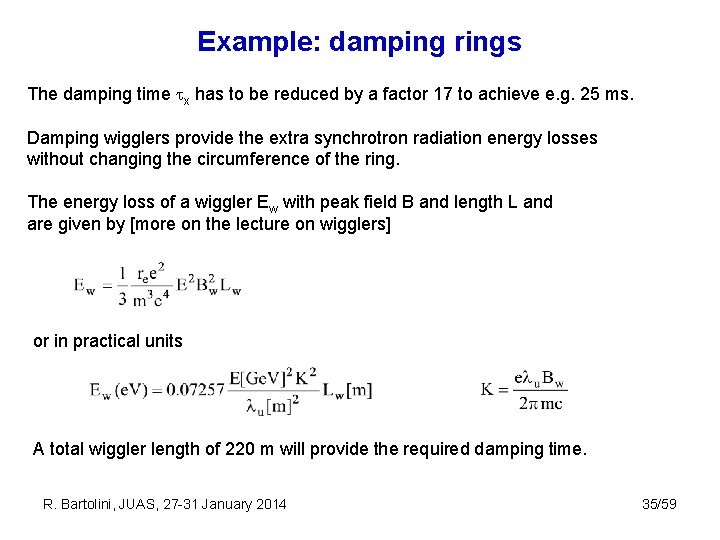
Example: damping rings The damping time x has to be reduced by a factor 17 to achieve e. g. 25 ms. Damping wigglers provide the extra synchrotron radiation energy losses without changing the circumference of the ring. The energy loss of a wiggler Ew with peak field B and length L and are given by [more on the lecture on wigglers] or in practical units A total wiggler length of 220 m will provide the required damping time. R. Bartolini, JUAS, 27 -31 January 2014 35/59
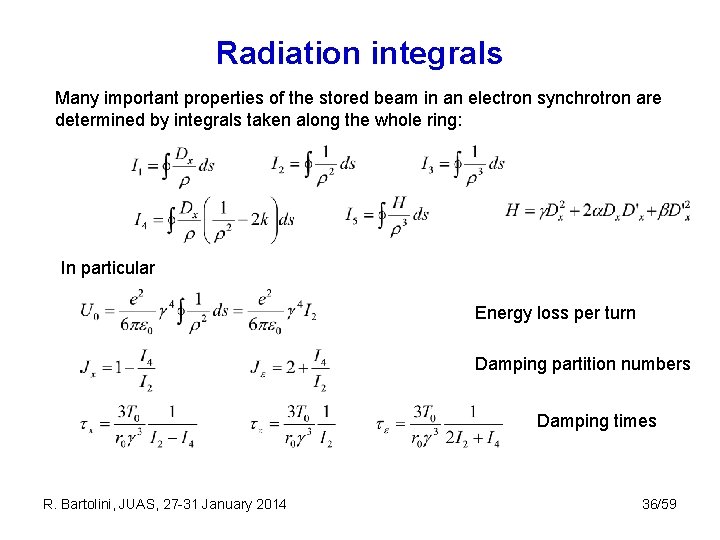
Radiation integrals Many important properties of the stored beam in an electron synchrotron are determined by integrals taken along the whole ring: In particular Energy loss per turn Damping partition numbers Damping times R. Bartolini, JUAS, 27 -31 January 2014 36/59
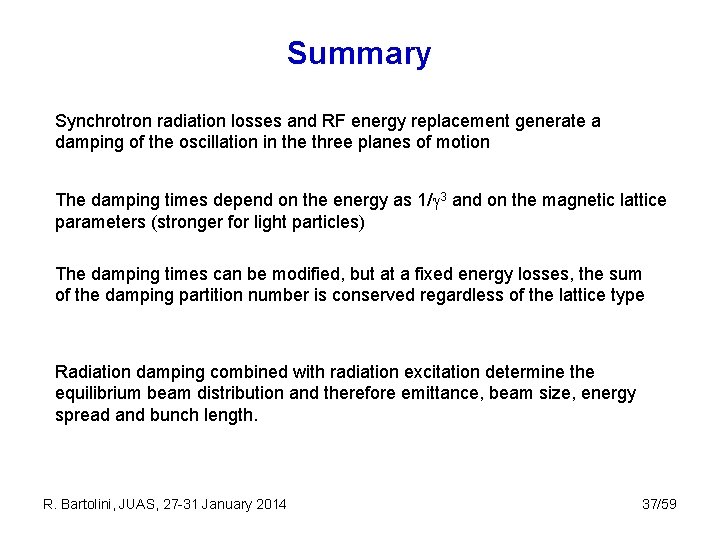
Summary Synchrotron radiation losses and RF energy replacement generate a damping of the oscillation in the three planes of motion The damping times depend on the energy as 1/ 3 and on the magnetic lattice parameters (stronger for light particles) The damping times can be modified, but at a fixed energy losses, the sum of the damping partition number is conserved regardless of the lattice type Radiation damping combined with radiation excitation determine the equilibrium beam distribution and therefore emittance, beam size, energy spread and bunch length. R. Bartolini, JUAS, 27 -31 January 2014 37/59
Quantum nature of synchrotron emission The radiated energy is emitted in quanta: each quantum carries an energy u = ħ ; The emission process is instantaneous and the time of emission of individual quanta are statistically independent; The distribution of the energy of the emitted photons can be computed from the spectral distribution of the synchrotron radiation; The emission of a photon changes suddenly the energy of the emitting electron and perturbs the orbit inducing synchrotron and betatron oscillations. These oscillations grow until reaching an equilibrium when balanced by radiation damping Quantum excitation prevents reaching zero emittance in both planes with pure damping. R. Bartolini, JUAS, 27 -31 January 2014 38/59
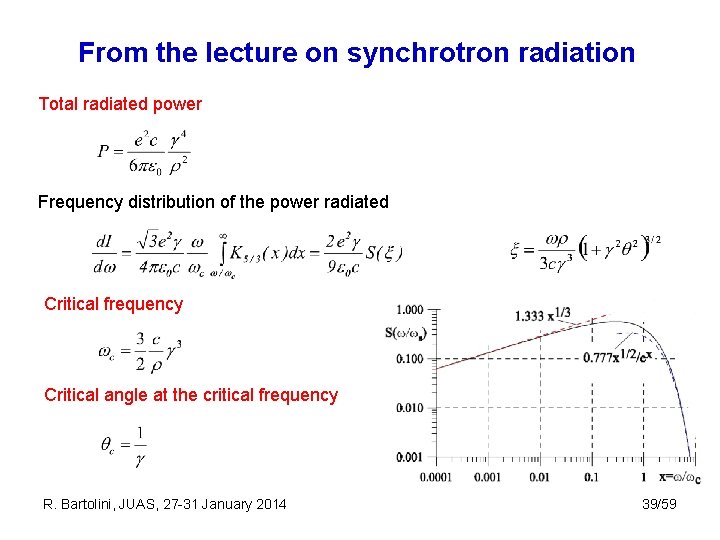
From the lecture on synchrotron radiation Total radiated power Frequency distribution of the power radiated Critical frequency Critical angle at the critical frequency R. Bartolini, JUAS, 27 -31 January 2014 39/59
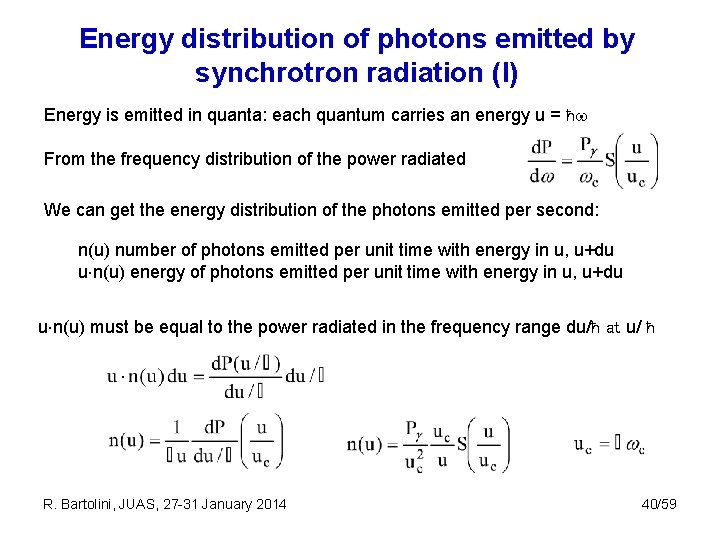
Energy distribution of photons emitted by synchrotron radiation (I) Energy is emitted in quanta: each quantum carries an energy u = ħ From the frequency distribution of the power radiated We can get the energy distribution of the photons emitted per second: n(u) number of photons emitted per unit time with energy in u, u+du u n(u) energy of photons emitted per unit time with energy in u, u+du u n(u) must be equal to the power radiated in the frequency range du/ħ at u/ ħ R. Bartolini, JUAS, 27 -31 January 2014 40/59
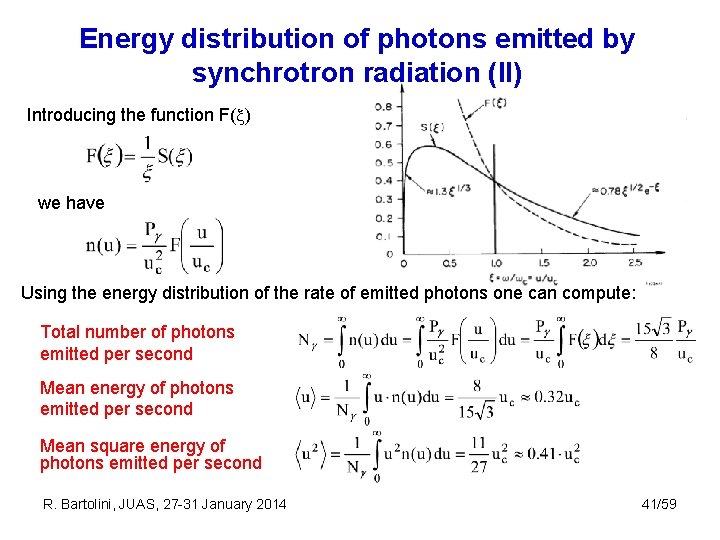
Energy distribution of photons emitted by synchrotron radiation (II) Introducing the function F( ) we have Using the energy distribution of the rate of emitted photons one can compute: Total number of photons emitted per second Mean energy of photons emitted per second Mean square energy of photons emitted per second R. Bartolini, JUAS, 27 -31 January 2014 41/59
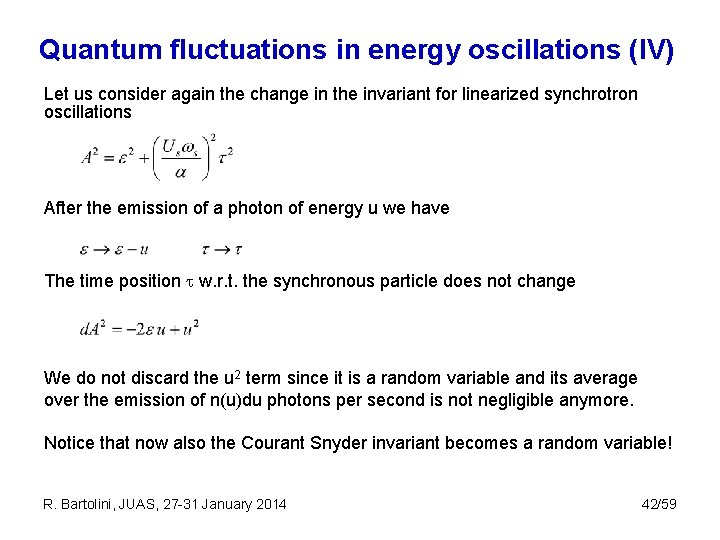
Quantum fluctuations in energy oscillations (IV) Let us consider again the change in the invariant for linearized synchrotron oscillations After the emission of a photon of energy u we have The time position w. r. t. the synchronous particle does not change We do not discard the u 2 term since it is a random variable and its average over the emission of n(u)du photons per second is not negligible anymore. Notice that now also the Courant Snyder invariant becomes a random variable! R. Bartolini, JUAS, 27 -31 January 2014 42/59
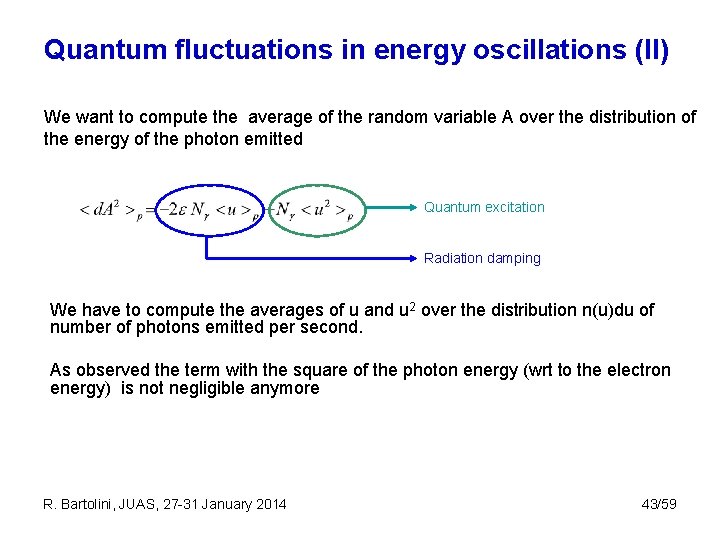
Quantum fluctuations in energy oscillations (II) We want to compute the average of the random variable A over the distribution of the energy of the photon emitted Quantum excitation Radiation damping We have to compute the averages of u and u 2 over the distribution n(u)du of number of photons emitted per second. As observed the term with the square of the photon energy (wrt to the electron energy) is not negligible anymore R. Bartolini, JUAS, 27 -31 January 2014 43/59
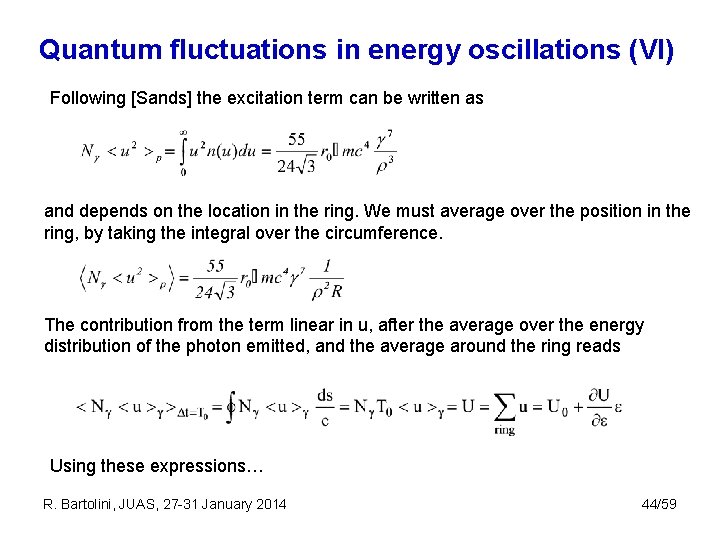
Quantum fluctuations in energy oscillations (VI) Following [Sands] the excitation term can be written as and depends on the location in the ring. We must average over the position in the ring, by taking the integral over the circumference. The contribution from the term linear in u, after the average over the energy distribution of the photon emitted, and the average around the ring reads Using these expressions… R. Bartolini, JUAS, 27 -31 January 2014 44/59
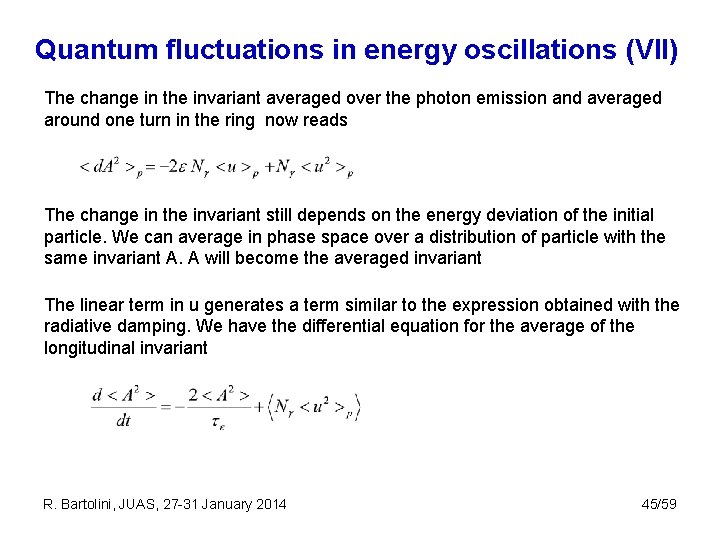
Quantum fluctuations in energy oscillations (VII) The change in the invariant averaged over the photon emission and averaged around one turn in the ring now reads The change in the invariant still depends on the energy deviation of the initial particle. We can average in phase space over a distribution of particle with the same invariant A. A will become the averaged invariant The linear term in u generates a term similar to the expression obtained with the radiative damping. We have the differential equation for the average of the longitudinal invariant R. Bartolini, JUAS, 27 -31 January 2014 45/59
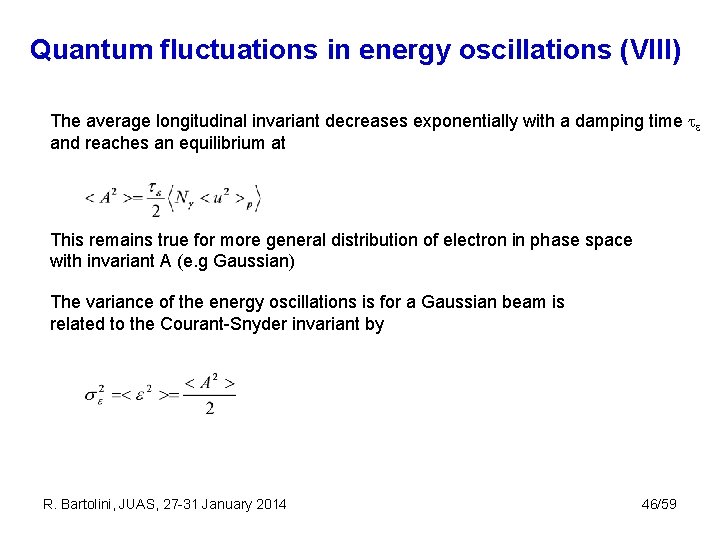
Quantum fluctuations in energy oscillations (VIII) The average longitudinal invariant decreases exponentially with a damping time and reaches an equilibrium at This remains true for more general distribution of electron in phase space with invariant A (e. g Gaussian) The variance of the energy oscillations is for a Gaussian beam is related to the Courant-Snyder invariant by R. Bartolini, JUAS, 27 -31 January 2014 46/59
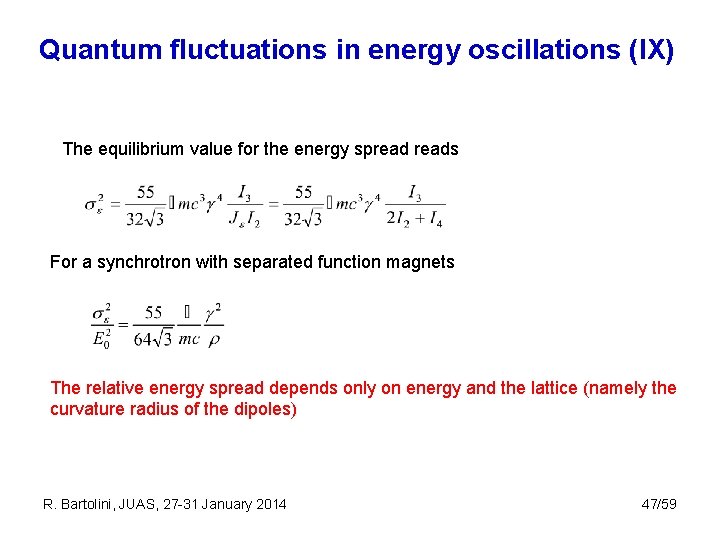
Quantum fluctuations in energy oscillations (IX) The equilibrium value for the energy spreads For a synchrotron with separated function magnets The relative energy spread depends only on energy and the lattice (namely the curvature radius of the dipoles) R. Bartolini, JUAS, 27 -31 January 2014 47/59
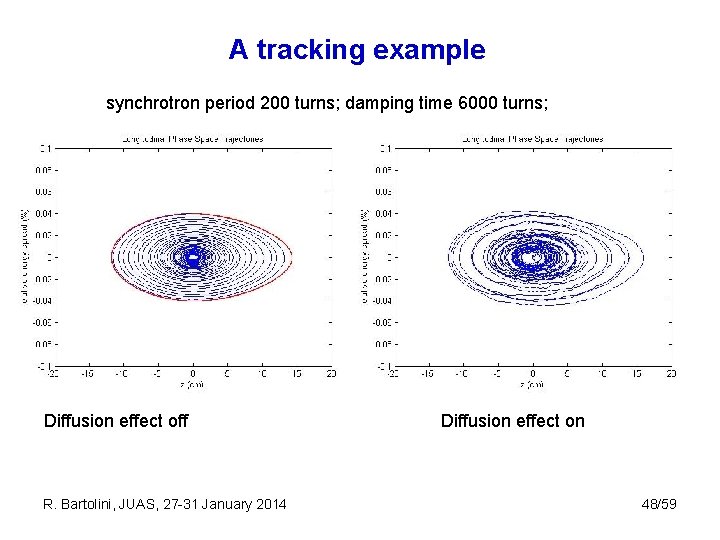
A tracking example synchrotron period 200 turns; damping time 6000 turns; Diffusion effect off R. Bartolini, JUAS, 27 -31 January 2014 Diffusion effect on 48/59
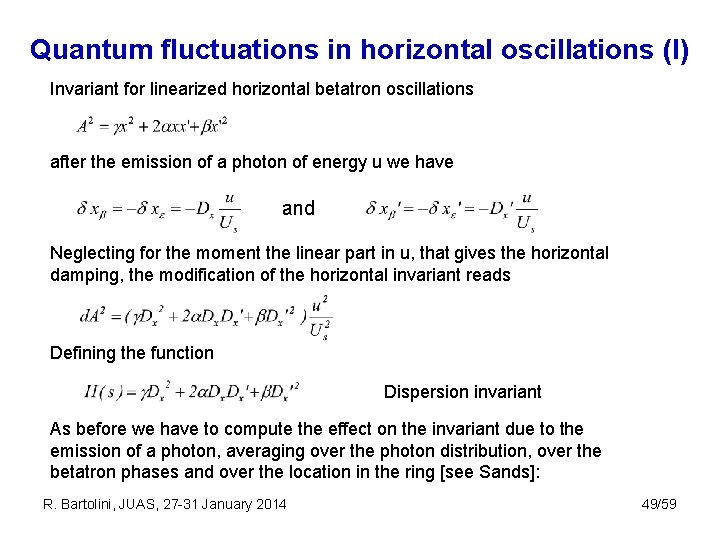
Quantum fluctuations in horizontal oscillations (I) Invariant for linearized horizontal betatron oscillations after the emission of a photon of energy u we have and Neglecting for the moment the linear part in u, that gives the horizontal damping, the modification of the horizontal invariant reads Defining the function Dispersion invariant As before we have to compute the effect on the invariant due to the emission of a photon, averaging over the photon distribution, over the betatron phases and over the location in the ring [see Sands]: R. Bartolini, JUAS, 27 -31 January 2014 49/59
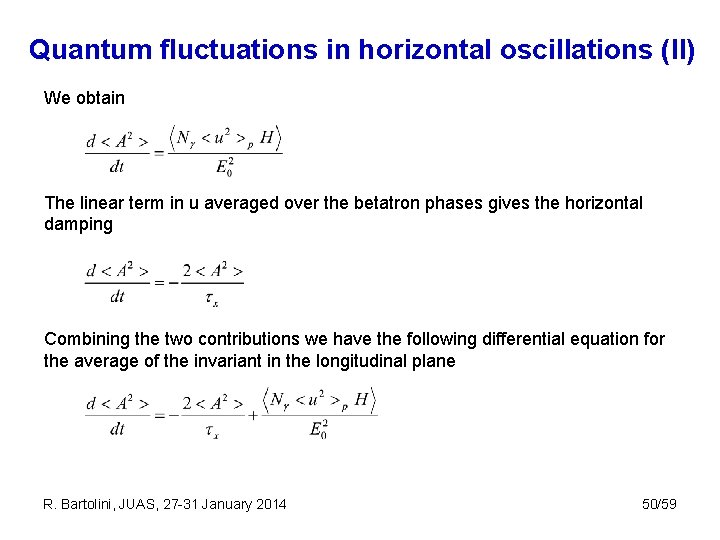
Quantum fluctuations in horizontal oscillations (II) We obtain The linear term in u averaged over the betatron phases gives the horizontal damping Combining the two contributions we have the following differential equation for the average of the invariant in the longitudinal plane R. Bartolini, JUAS, 27 -31 January 2014 50/59
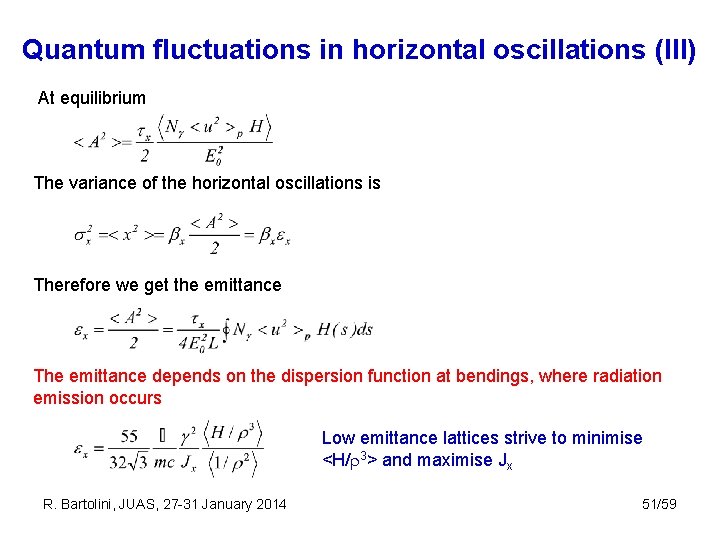
Quantum fluctuations in horizontal oscillations (III) At equilibrium The variance of the horizontal oscillations is Therefore we get the emittance The emittance depends on the dispersion function at bendings, where radiation emission occurs Low emittance lattices strive to minimise <H/ 3> and maximise Jx R. Bartolini, JUAS, 27 -31 January 2014 51/59
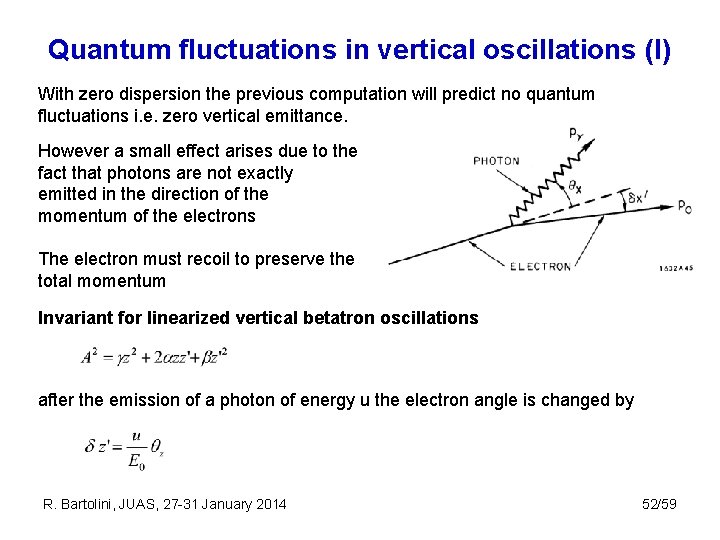
Quantum fluctuations in vertical oscillations (I) With zero dispersion the previous computation will predict no quantum fluctuations i. e. zero vertical emittance. However a small effect arises due to the fact that photons are not exactly emitted in the direction of the momentum of the electrons The electron must recoil to preserve the total momentum Invariant for linearized vertical betatron oscillations after the emission of a photon of energy u the electron angle is changed by R. Bartolini, JUAS, 27 -31 January 2014 52/59
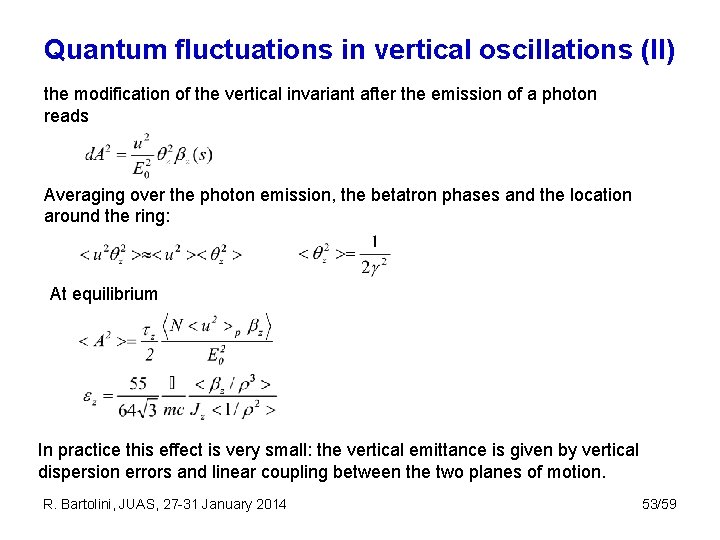
Quantum fluctuations in vertical oscillations (II) the modification of the vertical invariant after the emission of a photon reads Averaging over the photon emission, the betatron phases and the location around the ring: At equilibrium In practice this effect is very small: the vertical emittance is given by vertical dispersion errors and linear coupling between the two planes of motion. R. Bartolini, JUAS, 27 -31 January 2014 53/59
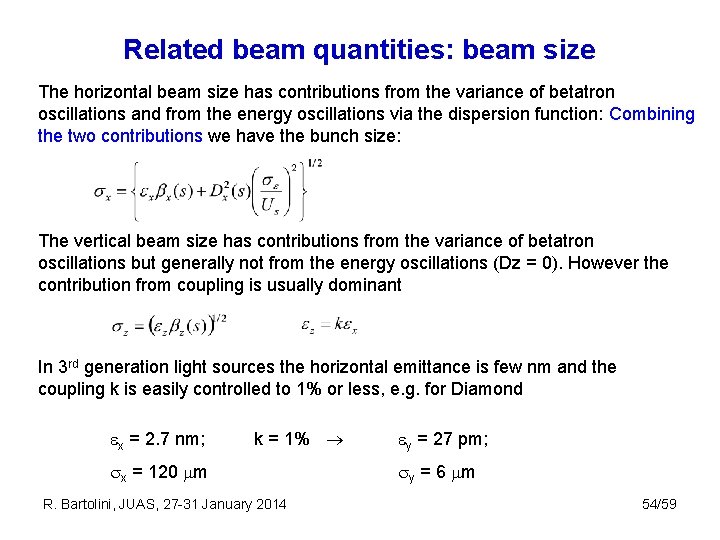
Related beam quantities: beam size The horizontal beam size has contributions from the variance of betatron oscillations and from the energy oscillations via the dispersion function: Combining the two contributions we have the bunch size: The vertical beam size has contributions from the variance of betatron oscillations but generally not from the energy oscillations (Dz = 0). However the contribution from coupling is usually dominant In 3 rd generation light sources the horizontal emittance is few nm and the coupling k is easily controlled to 1% or less, e. g. for Diamond x = 2. 7 nm; k = 1% x = 120 m R. Bartolini, JUAS, 27 -31 January 2014 y = 27 pm; y = 6 m 54/59
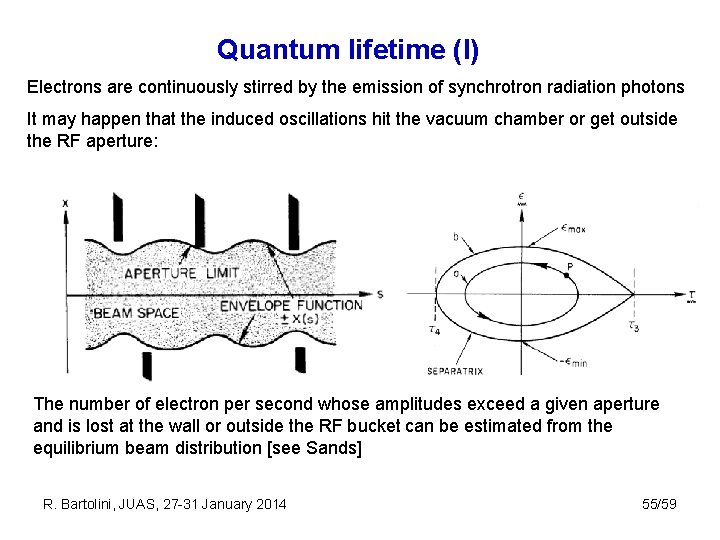
Quantum lifetime (I) Electrons are continuously stirred by the emission of synchrotron radiation photons It may happen that the induced oscillations hit the vacuum chamber or get outside the RF aperture: The number of electron per second whose amplitudes exceed a given aperture and is lost at the wall or outside the RF bucket can be estimated from the equilibrium beam distribution [see Sands] R. Bartolini, JUAS, 27 -31 January 2014 55/59
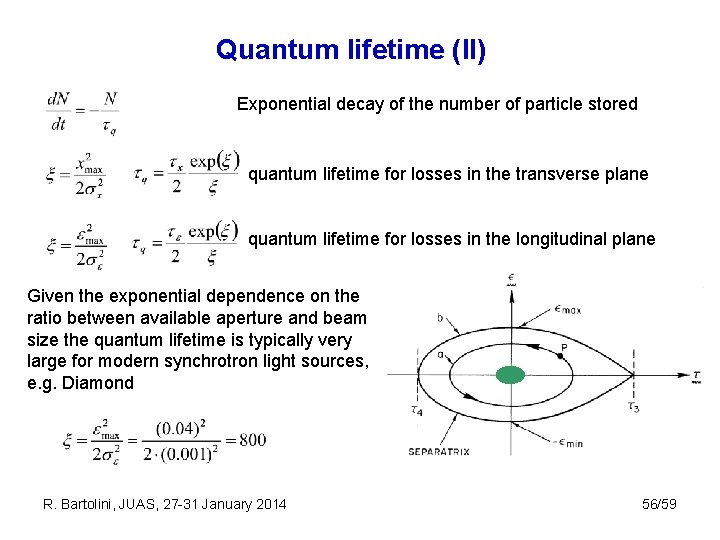
Quantum lifetime (II) Exponential decay of the number of particle stored quantum lifetime for losses in the transverse plane quantum lifetime for losses in the longitudinal plane Given the exponential dependence on the ratio between available aperture and beam size the quantum lifetime is typically very large for modern synchrotron light sources, e. g. Diamond R. Bartolini, JUAS, 27 -31 January 2014 56/59
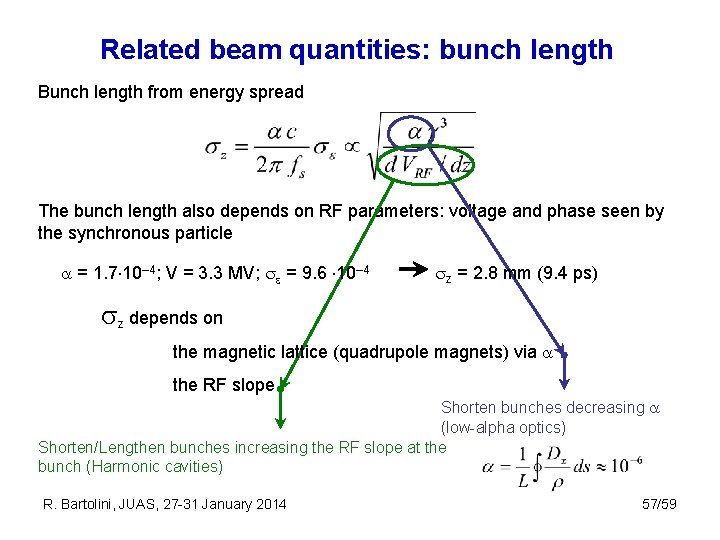
Related beam quantities: bunch length Bunch length from energy spread The bunch length also depends on RF parameters: voltage and phase seen by the synchronous particle = 1. 7 10– 4; V = 3. 3 MV; = 9. 6 10– 4 z = 2. 8 mm (9. 4 ps) z depends on the magnetic lattice (quadrupole magnets) via the RF slope Shorten bunches decreasing (low-alpha optics) Shorten/Lengthen bunches increasing the RF slope at the bunch (Harmonic cavities) R. Bartolini, JUAS, 27 -31 January 2014 57/59
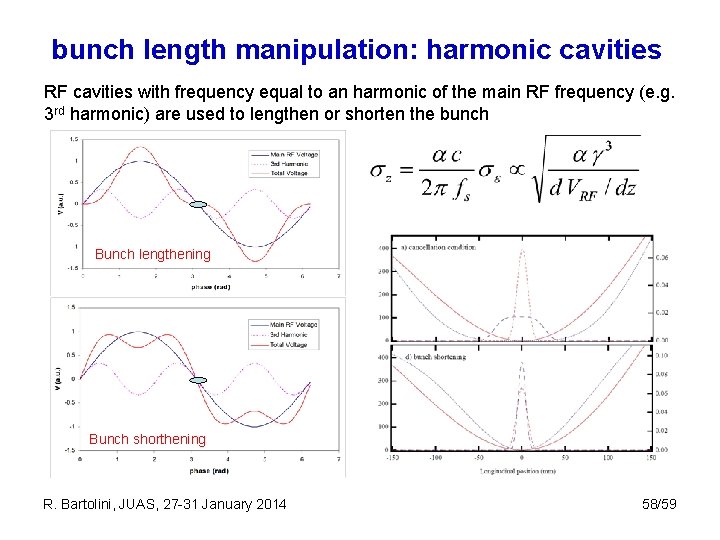
bunch length manipulation: harmonic cavities RF cavities with frequency equal to an harmonic of the main RF frequency (e. g. 3 rd harmonic) are used to lengthen or shorten the bunch Bunch lengthening Bunch shorthening R. Bartolini, JUAS, 27 -31 January 2014 58/59
Summary The emission of synchrotron radiation occurs in quanta of discrete energy The fluctuation in the energy of the emitted photons introduce a noise in the various oscillation modes causing the amplitude to grow Radiation excitation combined with radiation damping determine the equilibrium beam distribution and therefore emittance, beam size, energy spread and bunch length. The excitation process is responsible for a loss mechanism described by the quantum lifetime The emittance is a crucial parameter in the operation of synchrotron light source. The minimum theoretical emittance depends on the square of the energy and the inverse cube of the number of dipoles R. Bartolini, JUAS, 27 -31 January 2014 59/59
- Slides: 59