
Coherent Synchrotron Radiation in Particle Accelerators Rui Li

- Slides: 44
Coherent Synchrotron Radiation in Particle Accelerators Rui Li Jefferson Lab
To address the questions: • What is coherent synchrotron radiation (CSR)? • Why is it a concern in particle accelerators? • How we investigate the problem? • What is the present status of CSR research?
Outline • Synchrotron Radiation by a Single Electron • Coherent Synchrotron Radiation (CSR) by an Electron Bunch • Collective CSR Interaction for High Brightness Beams • CSR Effect in Particle Accelerators • Investigation of the CSR Effects
1. Synchrotron Radiation by a Single Electron
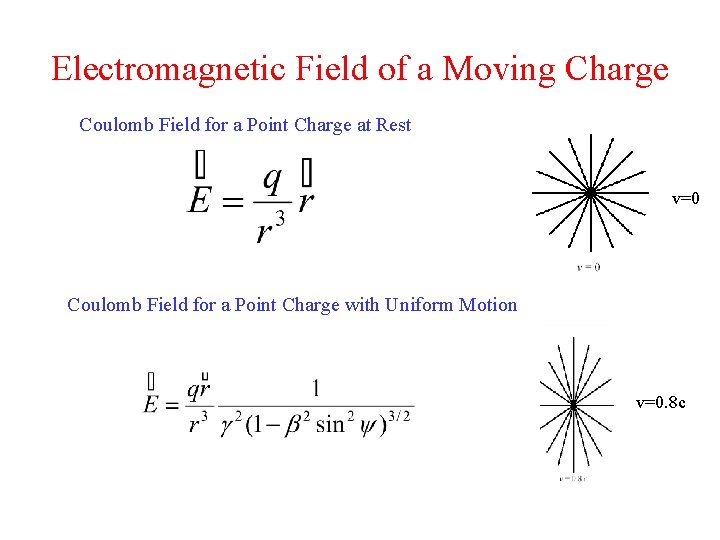
Electromagnetic Field of a Moving Charge Coulomb Field for a Point Charge at Rest v=0 Coulomb Field for a Point Charge with Uniform Motion v=0. 8 c
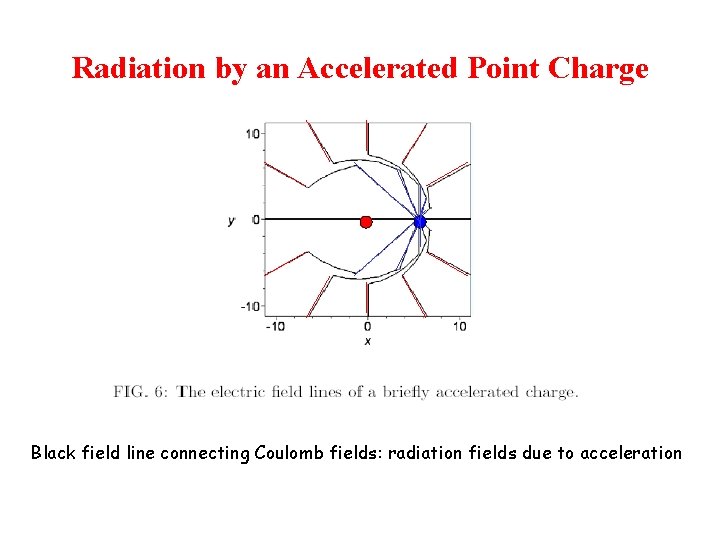
Radiation by an Accelerated Point Charge Black field line connecting Coulomb fields: radiation fields due to acceleration
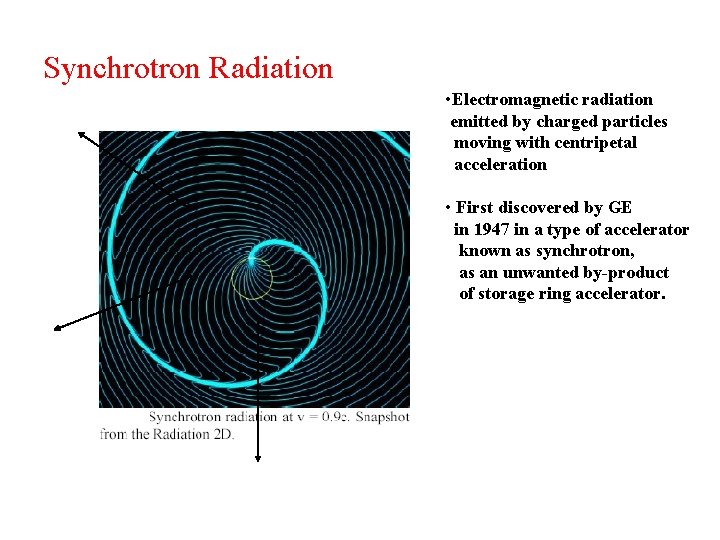
Synchrotron Radiation • Electromagnetic radiation emitted by charged particles moving with centripetal acceleration • First discovered by GE in 1947 in a type of accelerator known as synchrotron, as an unwanted by-product of storage ring accelerator.
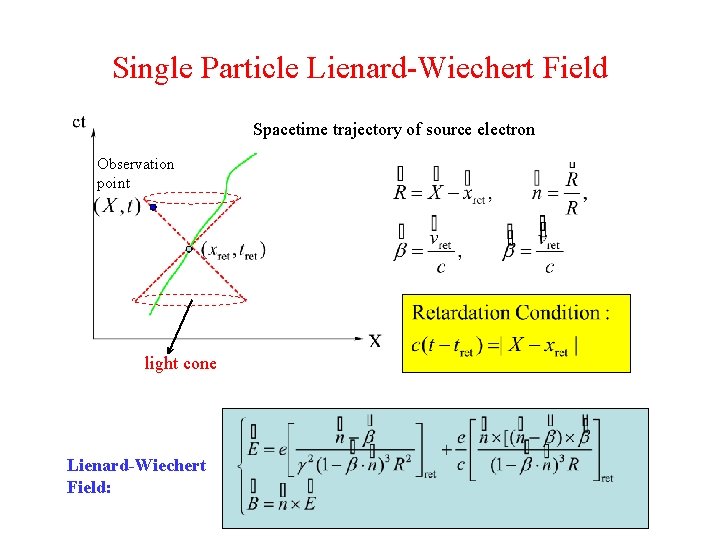
Single Particle Lienard-Wiechert Field Spacetime trajectory of source electron Observation point light cone Lienard-Wiechert Field:
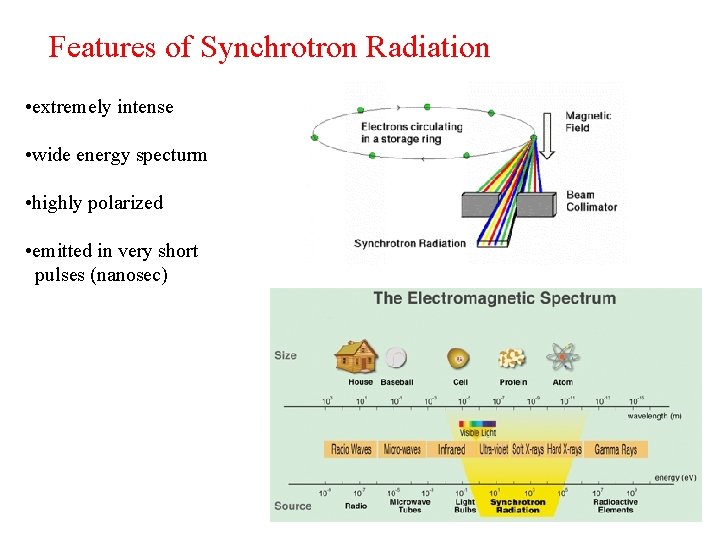
Features of Synchrotron Radiation • extremely intense • wide energy specturm • highly polarized • emitted in very short pulses (nanosec)
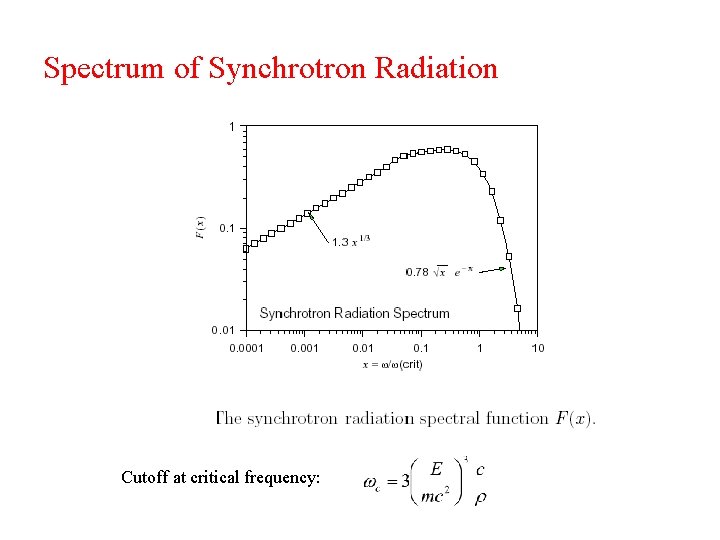
Spectrum of Synchrotron Radiation Cutoff at critical frequency:
2. Coherent Synchrotron Radiation (CSR) by an Electron Bunch
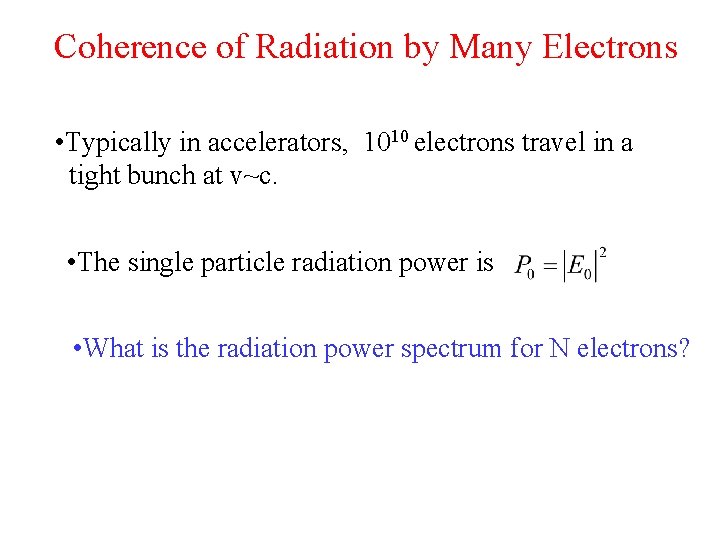
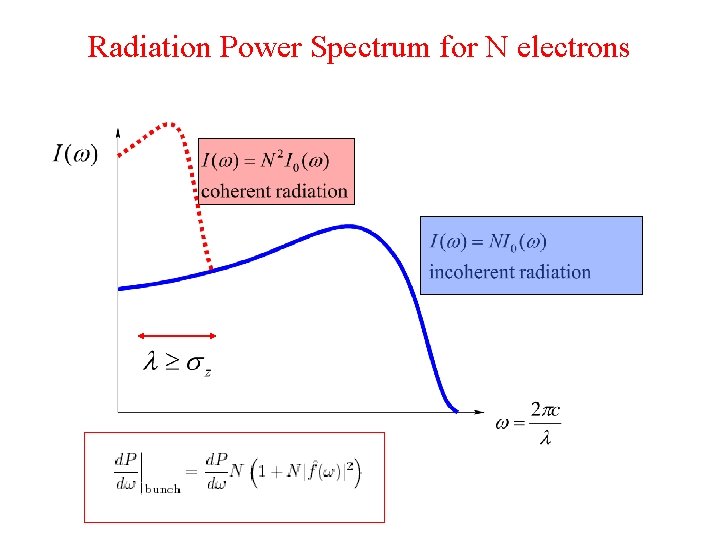
Coherence of Radiation by Many Electrons • Typically in accelerators, 1010 electrons travel in a tight bunch at v~c. • The single particle radiation power is • What is the radiation power spectrum for N electrons?
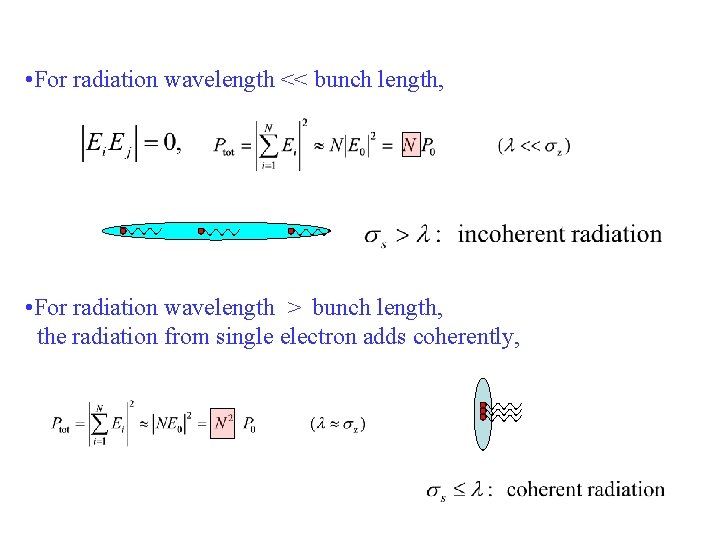
• For radiation wavelength << bunch length, • For radiation wavelength > bunch length, the radiation from single electron adds coherently,
Radiation Power Spectrum for N electrons
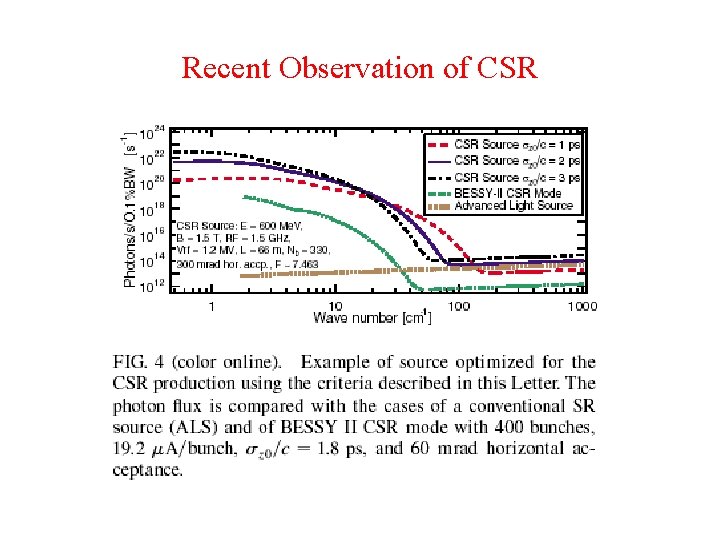
Recent Observation of CSR
3. Collective CSR Interaction for High Brightness Beams
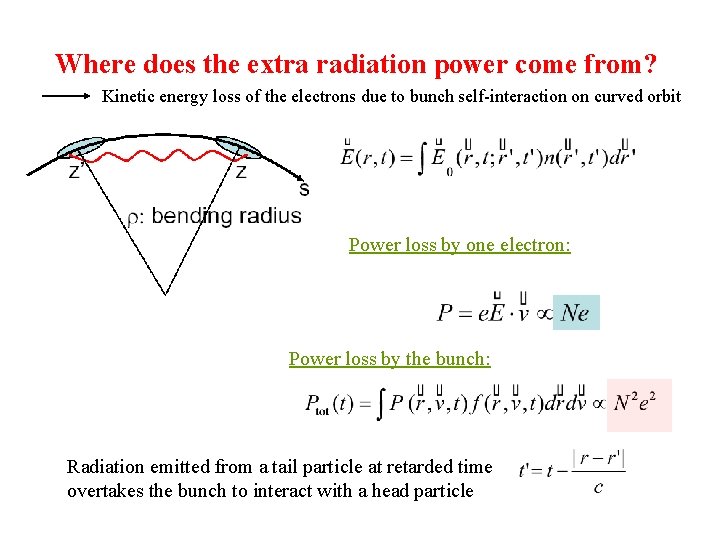
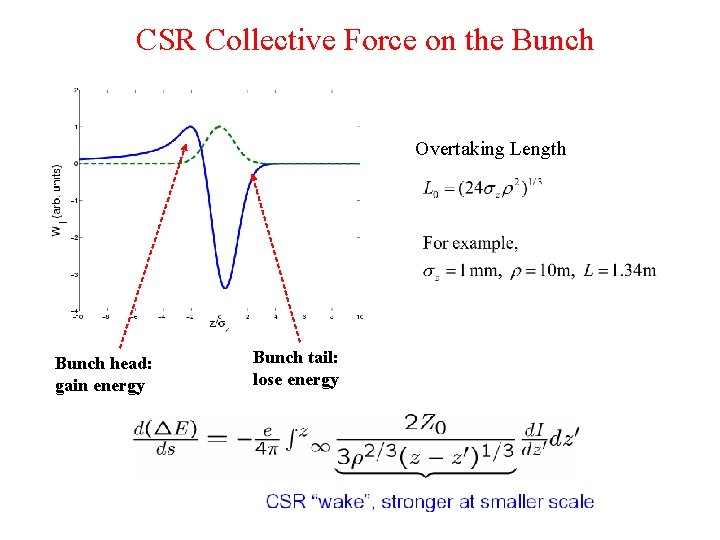
Where does the extra radiation power come from? Kinetic energy loss of the electrons due to bunch self-interaction on curved orbit Power loss by one electron: Power loss by the bunch: Radiation emitted from a tail particle at retarded time overtakes the bunch to interact with a head particle
CSR Collective Force on the Bunch Overtaking Length Bunch head: gain energy Bunch tail: lose energy
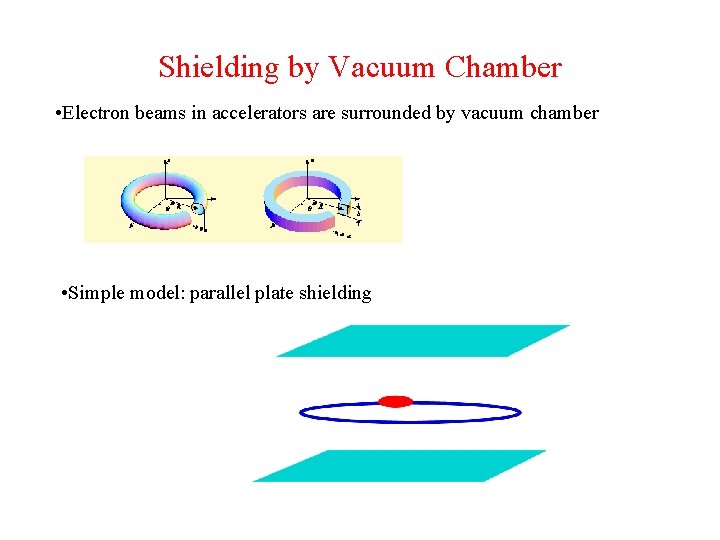
Shielding by Vacuum Chamber • Electron beams in accelerators are surrounded by vacuum chamber • Simple model: parallel plate shielding
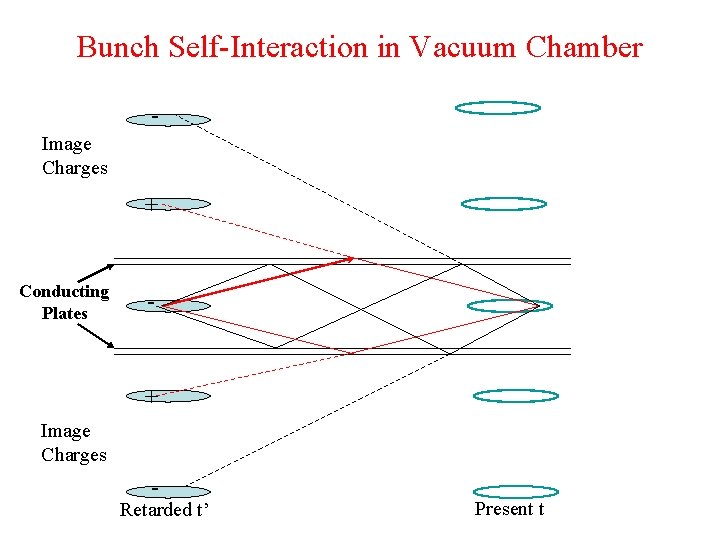
Bunch Self-Interaction in Vacuum Chamber Image Charges + Conducting Plates - + Image Charges - Retarded t’ Present t
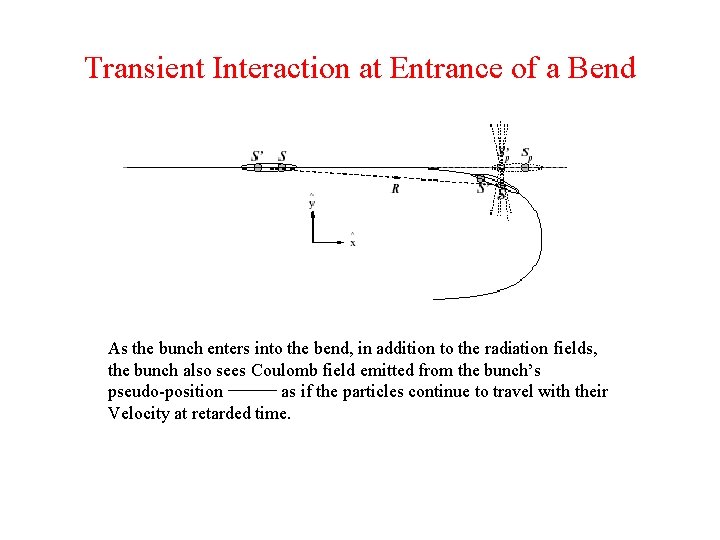
Transient Interaction at Entrance of a Bend As the bunch enters into the bend, in addition to the radiation fields, the bunch also sees Coulomb field emitted from the bunch’s pseudo-position as if the particles continue to travel with their Velocity at retarded time.
4. CSR Effect in Particle Accelerators
Accelerator Facilities with High Brightness Electron Beams A. Light Sources • Storage Ring Light Souces • Linac Based Free Electron Laser B. Colliders • Storage Ring Colliders • Linear Colliders
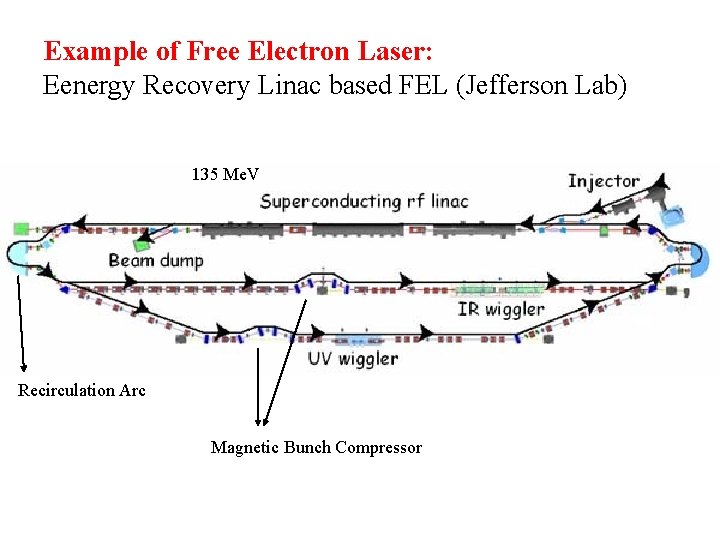
Example of Free Electron Laser: Eenergy Recovery Linac based FEL (Jefferson Lab) 135 Me. V Recirculation Arc Magnetic Bunch Compressor
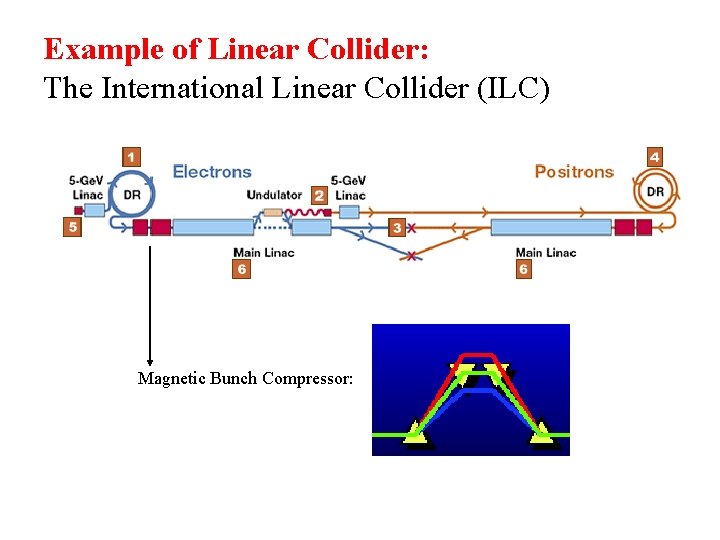
Example of Linear Collider: The International Linear Collider (ILC) Magnetic Bunch Compressor:
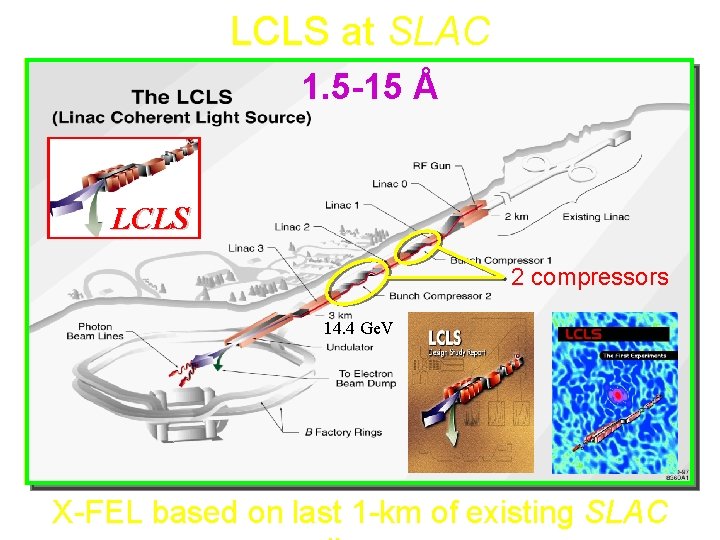
LCLS at SLAC 1. 5 -15 Å LCLS 2 compressors 14. 4 Ge. V X-FEL based on last 1 -km of existing SLAC
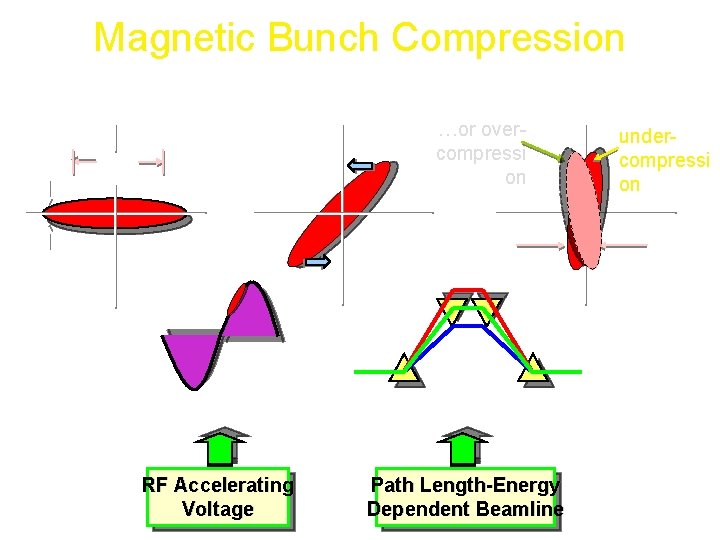
Magnetic Bunch Compression DE/E sz 0 ‘chirp’ z …or overcompressi on DE/E z s. E/E V = V 0 sin(wt) RF Accelerating Voltage Dz = R 56 DE/E Path Length-Energy Dependent Beamline undercompressi on z sz
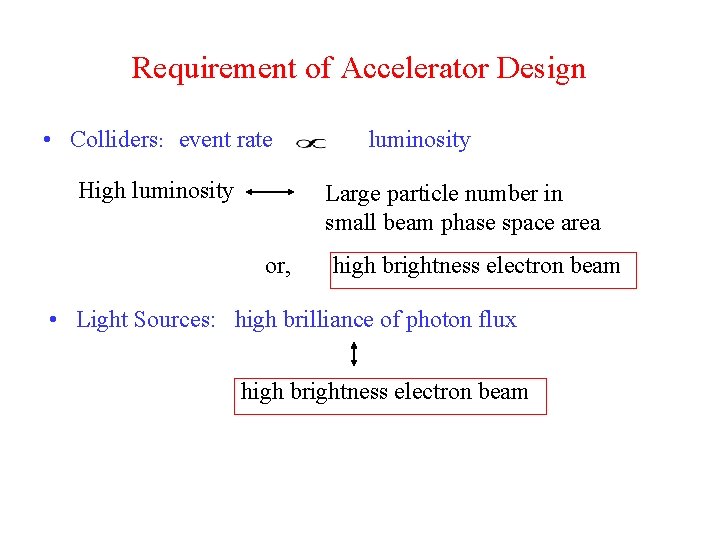
Requirement of Accelerator Design • Colliders: event rate High luminosity Large particle number in small beam phase space area or, high brightness electron beam • Light Sources: high brilliance of photon flux high brightness electron beam
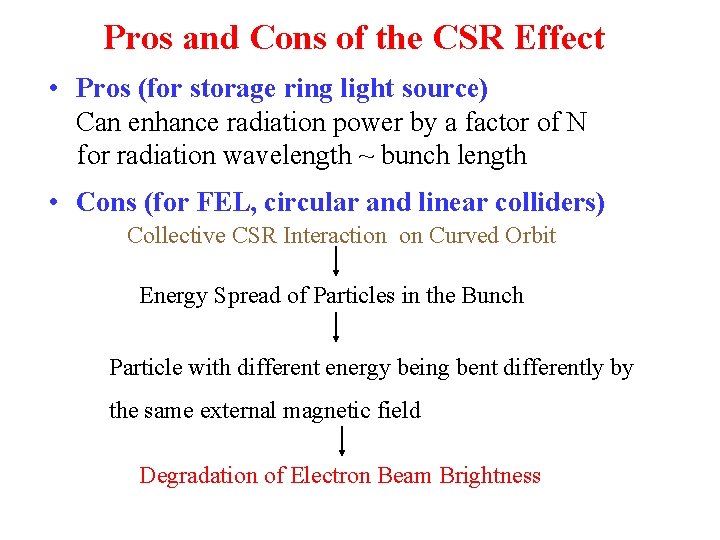
Pros and Cons of the CSR Effect • Pros (for storage ring light source) Can enhance radiation power by a factor of N for radiation wavelength ~ bunch length • Cons (for FEL, circular and linear colliders) Collective CSR Interaction on Curved Orbit Energy Spread of Particles in the Bunch Particle with different energy being bent differently by the same external magnetic field Degradation of Electron Beam Brightness
5. Investigation of the CSR Effect • Theory • Numerical Simulation • Experiment
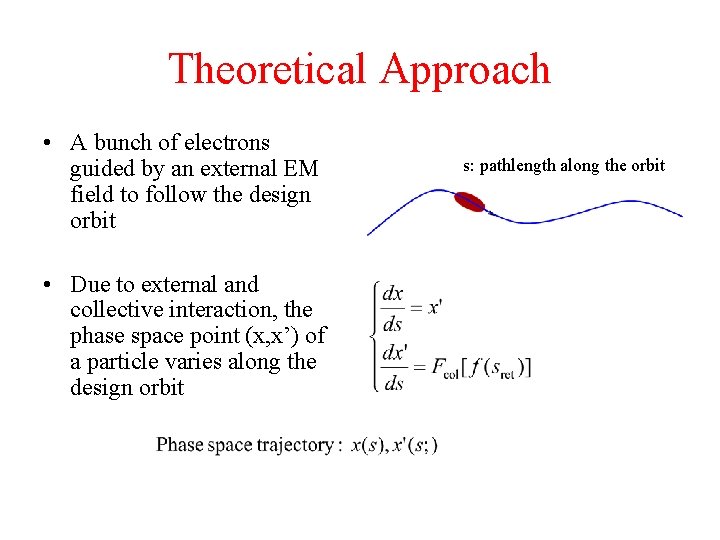
Theoretical Approach • A bunch of electrons guided by an external EM field to follow the design orbit • Due to external and collective interaction, the phase space point (x, x’) of a particle varies along the design orbit s: pathlength along the orbit
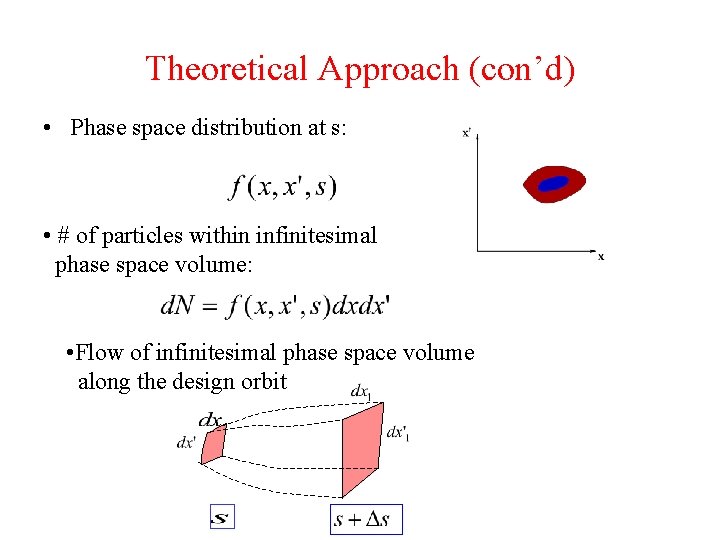
Theoretical Approach (con’d) • Phase space distribution at s: • # of particles within infinitesimal phase space volume: • Flow of infinitesimal phase space volume along the design orbit
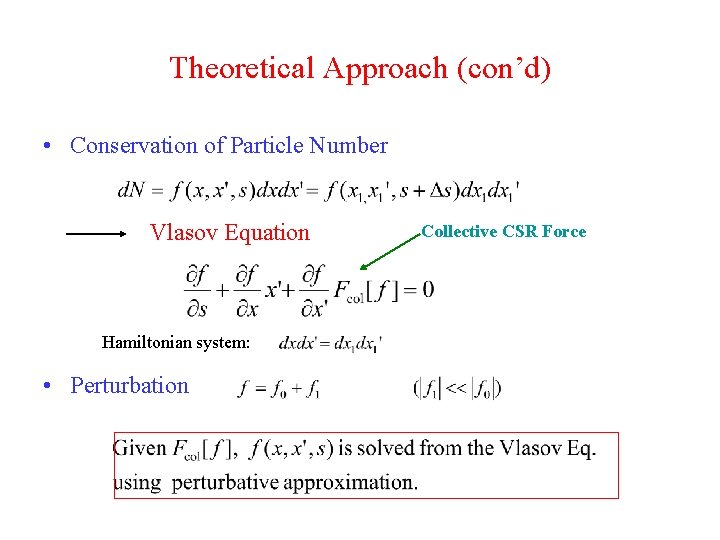
Theoretical Approach (con’d) • Conservation of Particle Number Vlasov Equation Hamiltonian system: • Perturbation Collective CSR Force
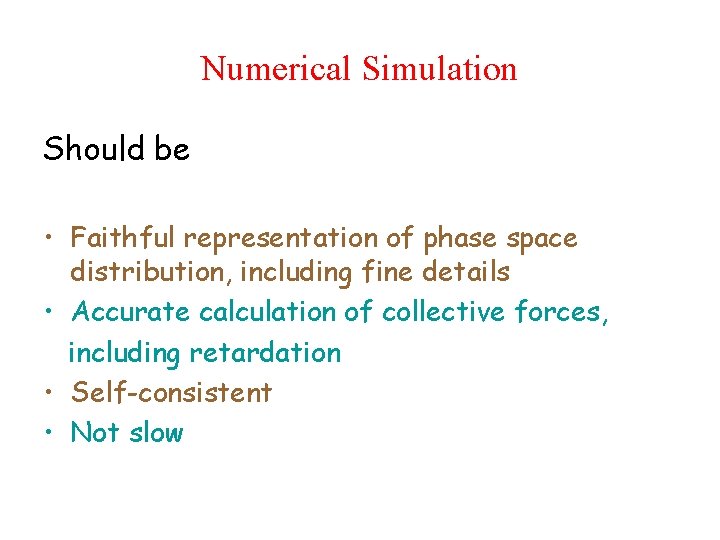
Numerical Simulation Should be • Faithful representation of phase space distribution, including fine details • Accurate calculation of collective forces, including retardation • Self-consistent • Not slow
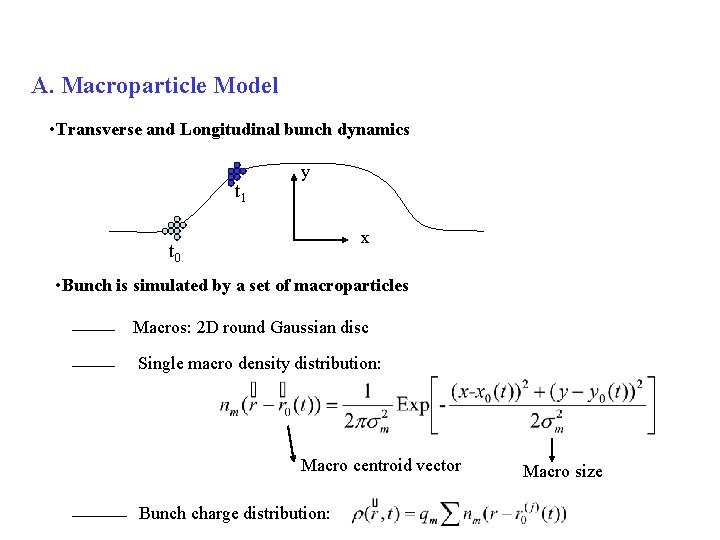
A. Macroparticle Model • Transverse and Longitudinal bunch dynamics t 1 y x t 0 • Bunch is simulated by a set of macroparticles Macros: 2 D round Gaussian disc Single macro density distribution: Macro centroid vector Bunch charge distribution: Macro size
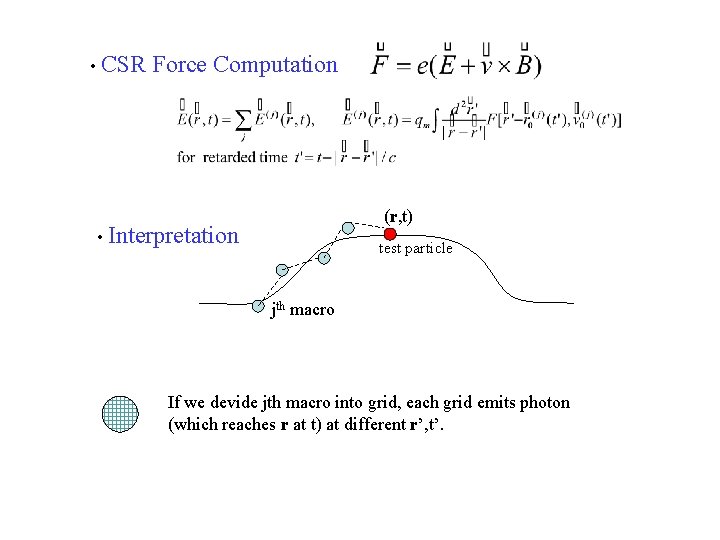
• CSR Force Computation (r, t) • Interpretation test particle jth macro If we devide jth macro into grid, each grid emits photon (which reaches r at t) at different r’, t’.
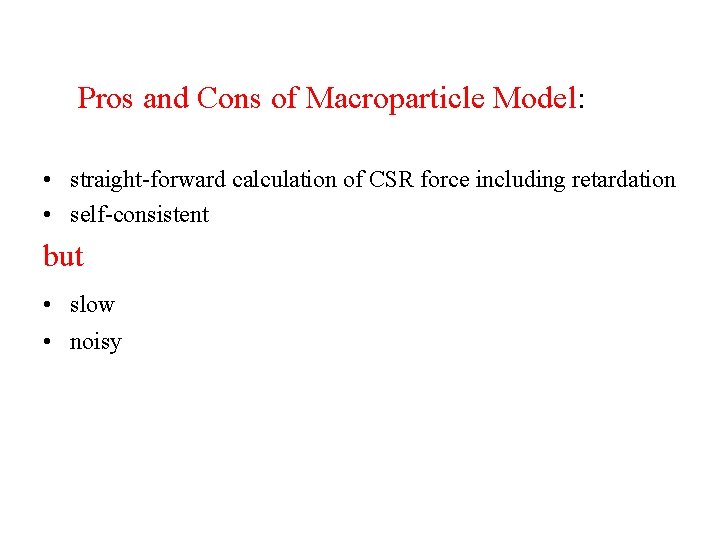
Pros and Cons of Macroparticle Model: • straight-forward calculation of CSR force including retardation • self-consistent but • slow • noisy
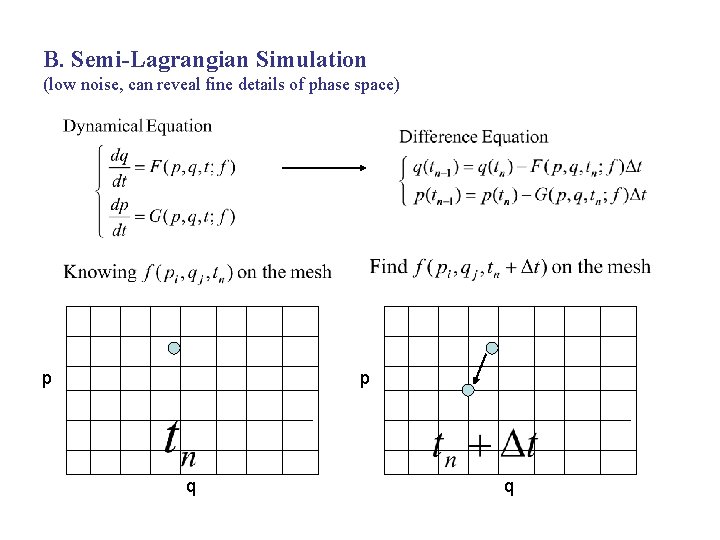
B. Semi-Lagrangian Simulation (low noise, can reveal fine details of phase space) p p q q
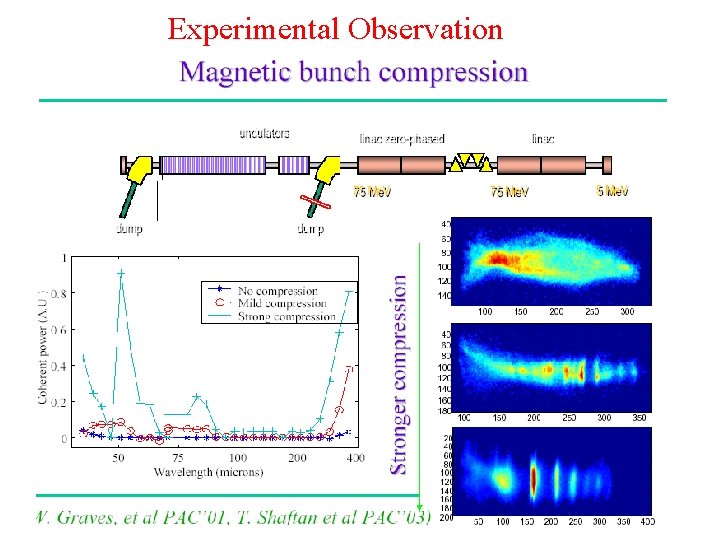
Experimental Observation
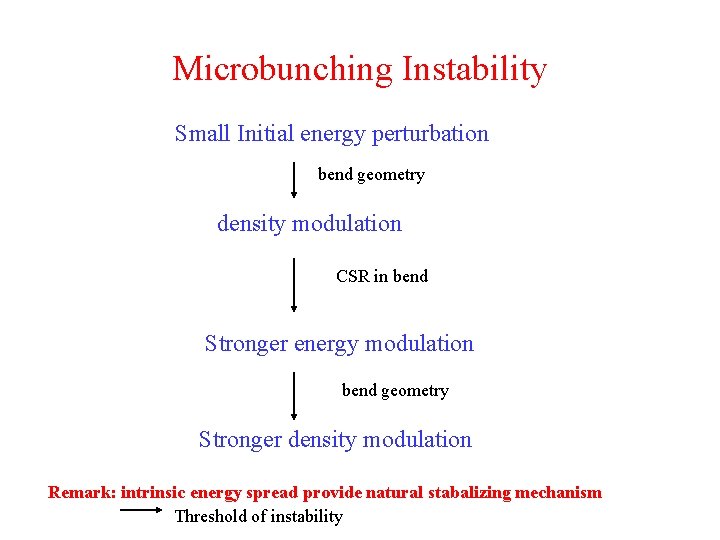
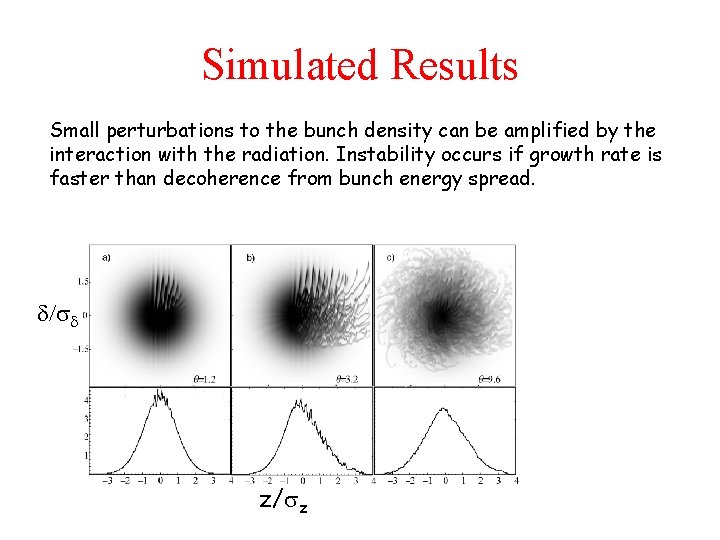
Microbunching Instability Small Initial energy perturbation bend geometry density modulation CSR in bend Stronger energy modulation bend geometry Stronger density modulation Remark: intrinsic energy spread provide natural stabalizing mechanism Threshold of instability
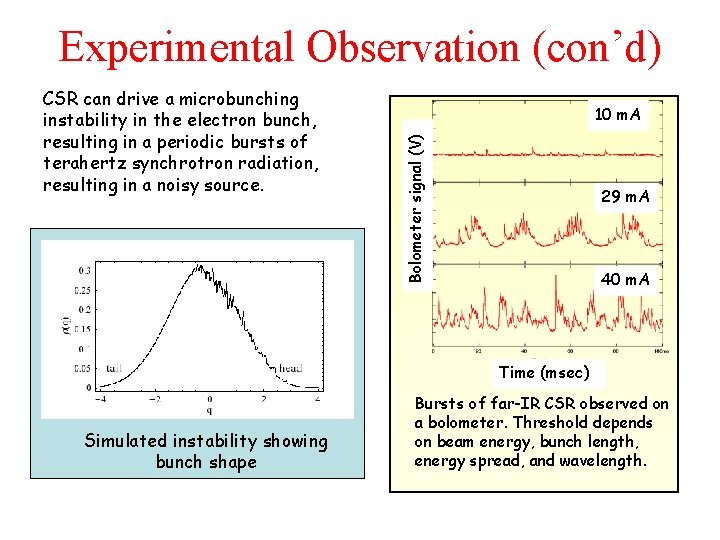
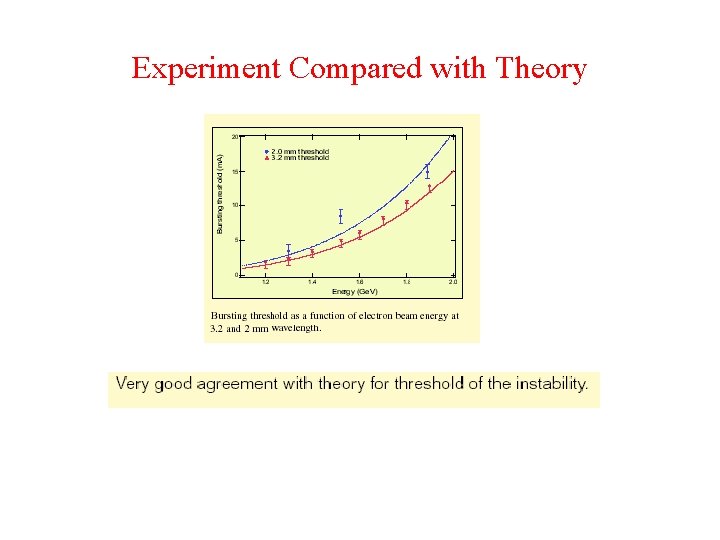
Experimental Observation (con’d) 10 m. A Bolometer signal (V) CSR can drive a microbunching instability in the electron bunch, resulting in a periodic bursts of terahertz synchrotron radiation, resulting in a noisy source. 29 m. A 40 m. A Time (msec) Simulated instability showing bunch shape Bursts of far-IR CSR observed on a bolometer. Threshold depends on beam energy, bunch length, energy spread, and wavelength.
Simulated Results Small perturbations to the bunch density can be amplified by the interaction with the radiation. Instability occurs if growth rate is faster than decoherence from bunch energy spread. /s z/sz
Experiment Compared with Theory
Conclusion • Coherent synchrotron radiation is recognized as an important factor to impact beam dynamics for high brightness beams transporting in magnetic bends. • The retardation and sensitivity of this effect pose serious challenge to theory, simulation and experiments. • Big progress has been made on each aspects. However, more detailed and precise understanding and simulation of CSR are needed in order to have predictive power for machine design.