Drug and Therapeutics Committee Session 1 Drug and



- Slides: 35
Drug and Therapeutics Committee Session 1. Drug and Therapeutics Committee —Overview
Objectives § Understand role of the Drug and Therapeutics Committee (DTC) § Understand DTC structure and organization and its relationship to other hospital committees § Understand the DTC’s functions including— § § § Advisory responsibilities Development of policies and procedures Formulary management Identification of medicine use problems Promotion of strategies to improve medicine use and medicine safety § Discuss the importance of the DTC in promoting rational use of medicines, especially antimicrobial use and injections
Outline § § § Key Definitions Introduction Role and Functions of the DTC Organization and Structure of the DTC Activity 1. Review of Participants’ DTCs § Issues and Challenges § Summary
Key Definitions (1) § DTC–also called a Pharmacy and Therapeutics Committee § Committee designated to ensure the safe and effective use of medicines in the facility or area under its jurisdiction § Evaluates the clinical use of medicines § Develops policies for managing medicine use § Administers and manages the formulary system
Key Definitions (2) § Formulary–A list of medicines that are approved for use in the health care system by authorized prescribers § Formulary committee–The committee dedicated to selecting, developing, and maintaining a list of approved medicines for the hospital or clinic § Formulary system– A system of periodically evaluating and selecting medicines for the formulary, and maintaining it; also providing information in a suitable manual or list
Introduction: Why DTCs Are Important § Medicines can save lives and improve quality of life but are expensive (30– 40% budget), widely misused, and can be dangerous (adverse drug reactions [ADRs] are common) § Important benefits of a DTC— § Selection of effective, safe, high quality, cost-effective medicines for the formulary § Monitoring and identification of medicine use problems § Improved medicines use, including antimicrobial use § Improved quality of patient care and health outcomes § Management of antimicrobial resistance § Increased staff and patient knowledge § Management of ADRs and medication errors § Improved medicine procurement and inventory management § Management of pharmaceutical expenditures
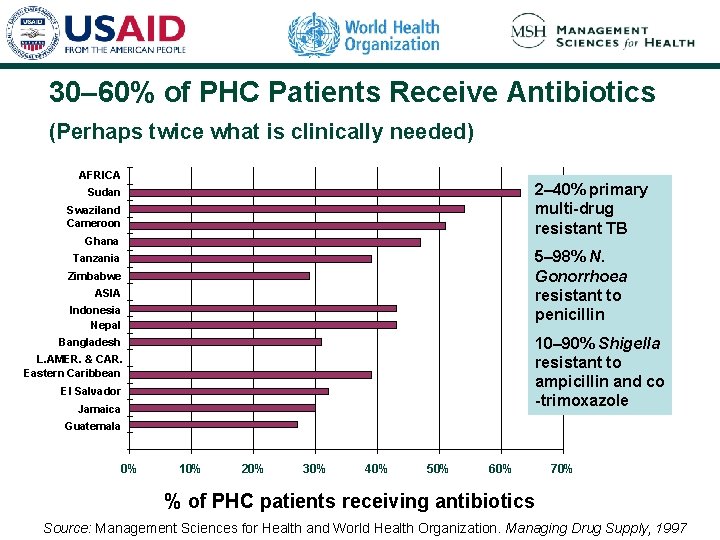
30– 60% of PHC Patients Receive Antibiotics (Perhaps twice what is clinically needed) AFRICA 2– 40% primary multi-drug resistant TB Sudan Swaziland Cameroon Ghana 5– 98% N. Gonorrhoea resistant to penicillin Tanzania Zimbabwe ASIA Indonesia Nepal 10– 90% Shigella resistant to ampicillin and co -trimoxazole Bangladesh L. AMER. & CAR. Eastern Caribbean El Salvador Jamaica Guatemala 0% 10% 20% 30% 40% 50% 60% 70% % of PHC patients receiving antibiotics Source: Management Sciences for Health and World Health Organization. Managing Drug Supply, 1997
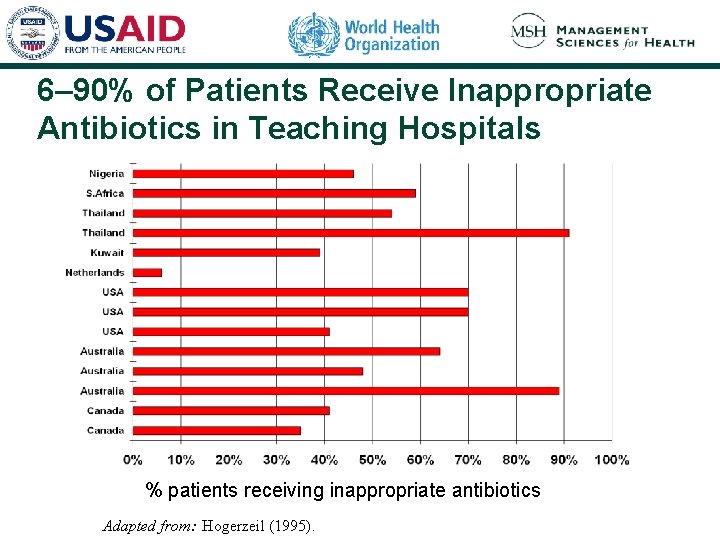
6– 90% of Patients Receive Inappropriate Antibiotics in Teaching Hospitals % patients receiving inappropriate antibiotics Adapted from: Hogerzeil (1995).
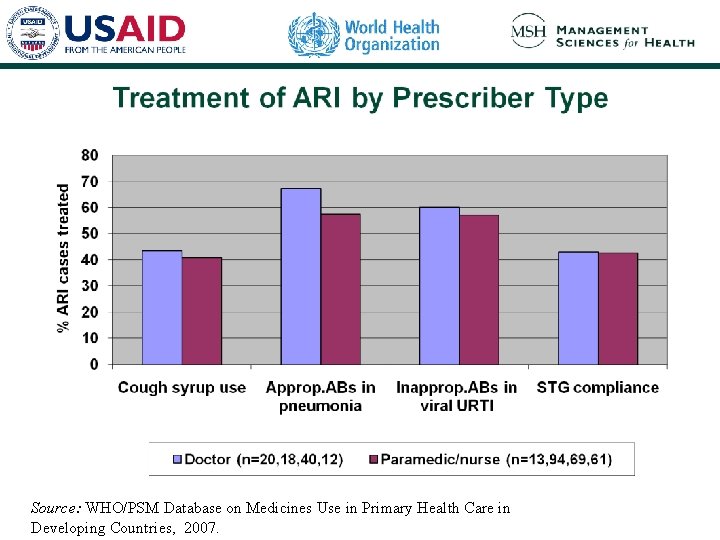
Source: WHO/PSM Database on Medicines Use in Primary Health Care in Developing Countries, 2007.
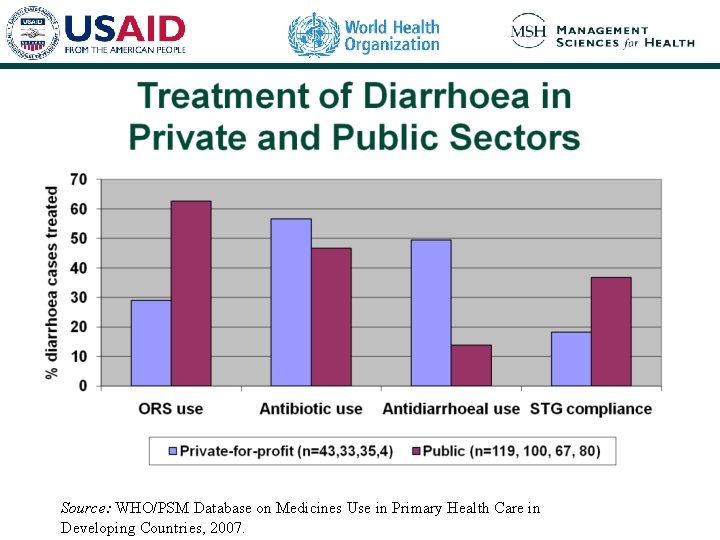
Source: WHO/PSM Database on Medicines Use in Primary Health Care in Developing Countries, 2007.
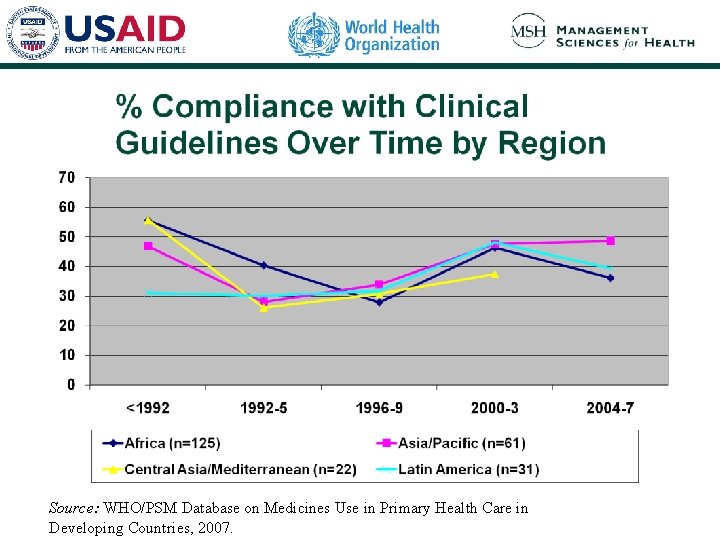
Source: WHO/PSM Database on Medicines Use in Primary Health Care in Developing Countries, 2007.
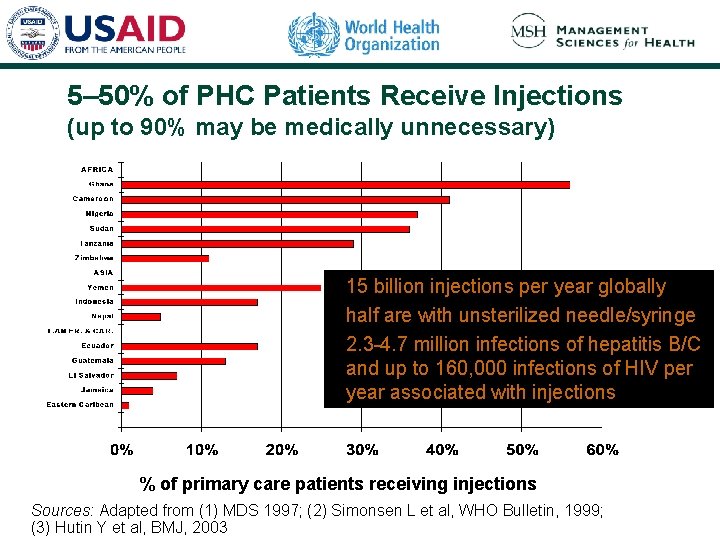
5– 50% of PHC Patients Receive Injections (up to 90% may be medically unnecessary) ä 15 billion injections per year globally ä half are with unsterilized needle/syringe ä 2. 3 -4. 7 million infections of hepatitis B/C and up to 160, 000 infections of HIV per year associated with injections % of primary care patients receiving injections Sources: Adapted from (1) MDS 1997; (2) Simonsen L et al, WHO Bulletin, 1999; (3) Hutin Y et al, BMJ, 2003
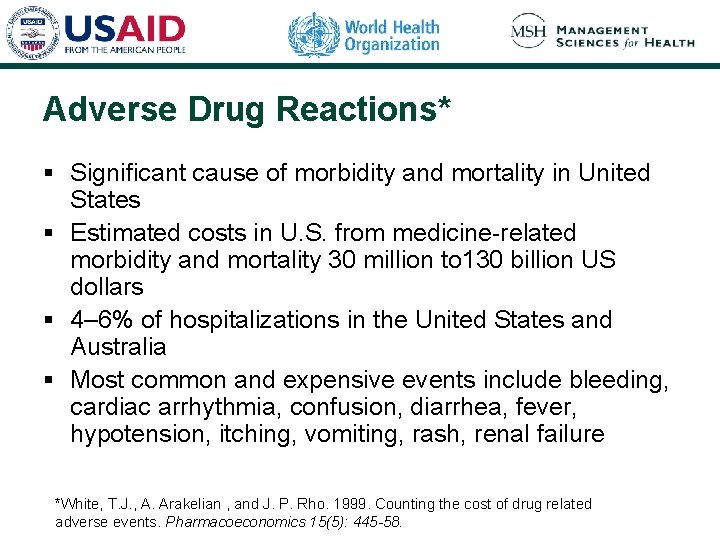
Adverse Drug Reactions* § Significant cause of morbidity and mortality in United States § Estimated costs in U. S. from medicine-related morbidity and mortality 30 million to 130 billion US dollars § 4– 6% of hospitalizations in the United States and Australia § Most common and expensive events include bleeding, cardiac arrhythmia, confusion, diarrhea, fever, hypotension, itching, vomiting, rash, renal failure *White, T. J. , A. Arakelian , and J. P. Rho. 1999. Counting the cost of drug related adverse events. Pharmacoeconomics 15(5): 445 -58.
Role of the DTC The committee that evaluates the clinical use of medicines, develops policies for managing medicine use and administration, and manages the formulary system
Functions of a DTC § To promote better quality of care and more rational use of medicines through— § Advising medical, pharmacy, and administrative staff § Developing pharmaceutical policies and procedures § Evaluating and selecting formulary medicines § Identifying medicine use problems § Promoting interventions to improve medicine use § Managing ADRs and medication errors
DTC Advisory Functions § Advise medical, administrative, and pharmacy departments § Advise and support other hospital organizations on medicine-related issues § Participate in hospital committees and departments on all matters concerning medicines
Drug Policies and Procedures § Lack of policies will adversely affect medicine selection, procurement, distribution, and use § The DTC has the most expertise to develop policies on— § § § New, nonformulary, restricted, investigational medicines Monitoring and evaluation of medicine use Interventions to promote rational use of medicines Pharmaceutical management issues in the hospital Pharmaceutical promotion (pharmaceutical representatives and literature)
Evaluating and Selecting Medicines for the Formulary § Explicit evaluation criteria § Efficacy, relative efficacy, effectiveness § Safety, quality, cost § Consistent decision-making § Evidence-based § Local context § Transparency § Evaluation process uses current literature § Primary sources (especially randomized controlled trials) § Secondary sources (bulletins and reviews) § Reliable and current tertiary sources (textbooks)
Identifying Medicine Use Problems (1) § Pharmaceutical procurement and availability § Pharmaceutical distribution § Medicine prescribing § Administration and use § ADR reports § Medication error reports § Antimicrobial resistance surveillance reports
Identifying Medicine Use Problems (2) (Sources of data and types of analysis) § Aggregate consumption data— § From records of procurement records, pharmacy stock, patient records § ABC, VEN, DDD analysis § ADR reports § Medication error reports § Antimicrobial resistance surveillance reports § Health facility indicators and hospital antimicrobial indicators —indicate general trends in prescribing § Drug use evaluation (DUE)— § Indicates whether specific diseases are being treated with the correct medicine or whether specific medicines are being given for the correct indications § Includes continuous monitoring and feedback
Promoting Interventions to Improve Pharmaceutical Use § Educational programs § Pharmaceutical bulletins and newsletters § In-service education § Managerial programs § § Standard treatment guidelines (STGs) DUE Clinical pharmacy programs Structured order forms, automatic stop orders § Regulatory programs § Pharmaceutical registration § Professional licensing § Licensing of outlets
Managing ADRs and Medication Errors § The DTC should have a plan to— § Monitor § Assess § Report § Correct identified problems § Prevent ADRs
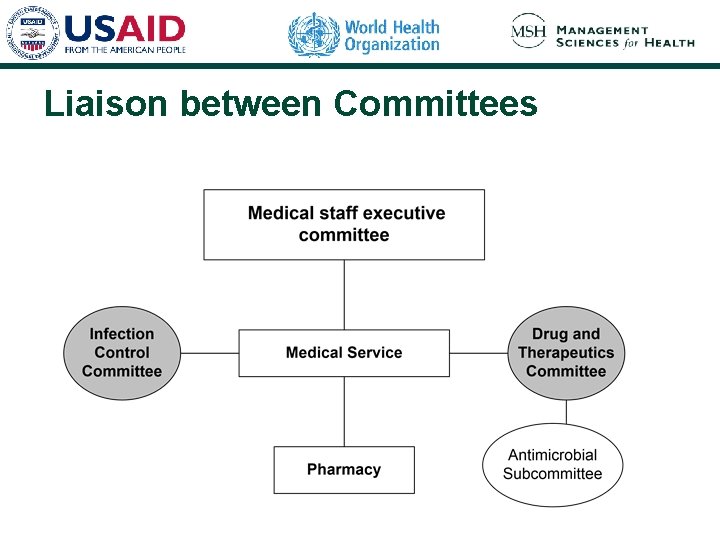
DTC: Structure and Organization (1) § Membership from medical, pharmacy, administration, nursing, public health § Chief doctor is often the chairman § Chief pharmacist is often the secretary § Liaison with Infection Control Committee and Antimicrobial Subcommittee § Regular meetings and regular attendance with minutes § Documented goals, terms of reference, policies, decisions
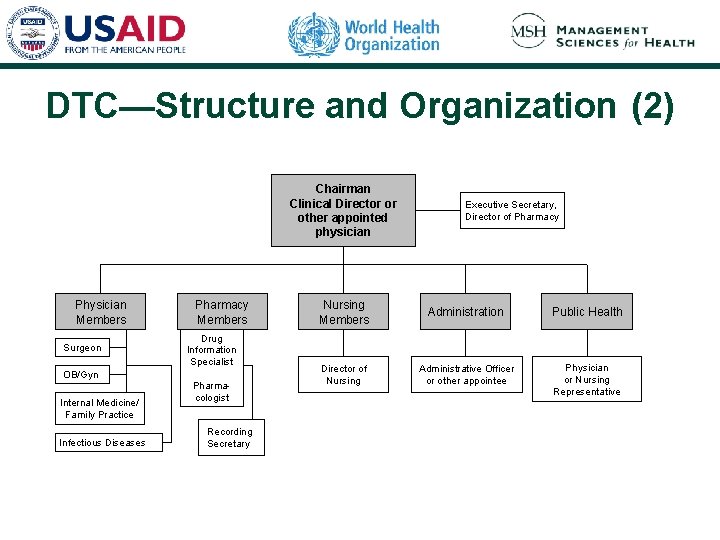
DTC—Structure and Organization (2) Chairman Clinical Director or other appointed physician Physician Members Surgeon OB/Gyn Internal Medicine/ Family Practice Infectious Diseases Pharmacy Members Drug Information Specialist Pharmacologist Recording Secretary Executive Secretary, Director of Pharmacy Nursing Members Administration Public Health Director of Nursing Administrative Officer or other appointee Physician or Nursing Representative
Antimicrobial Subcommittee (To promote better use of antimicrobials) § Addresses issues relating to antimicrobials including correct prescribing § Develops policies concerning use of antimicrobials for approval by the DTC and medical staff § Assists in evaluating and selecting antimicrobials for the formulary § Organizes educational programs for health care staff § Monitors antimicrobial resistance patterns
Infection Control Committee (May overlap with some antimicrobial subcommittee functions) § Develops and recommends policies and procedures pertaining to infection control § Addresses environmental issues including food handling, laundry, hand washing, cleaning § Obtains and manages bacteriological data § Recognizes and investigates outbreaks of infections in the hospital and community § Educates and trains health care workers, patients, and nonmedical caregivers on infection control
Liaison between Committees
DTCs—Guiding Principles § Transparent and unbiased decision making § Explicit criteria and process § Documentation § Absence of conflict of interest including pharmaceutical manufacturers and suppliers § Development and enforcement of a strict ethics policy for all activities of the committee § Objectivity—Evidence-based approach and levels of evidence § Consistency—Uniformity between formulary and STGs and between regional and national health care programs § Impact orientation—Indicators of process, impact, and outcome
Factors Critical to Success § Establish clear goals and purpose § Obtain wide representation on the committee—prescribers, nurses, pharmacists, and administration; obtain motivated, respected, and dynamic chairperson § Permit no relation between committee and pharmaceutical manufacturers or suppliers § Communicate all DTC information, policies, procedures, recommendations, and actions to staff § Obtain official status from the administration (local hospital director and regional health bureaus) with strong management support § Develop medical and pharmacy departments and local professional schools support § Ensure contextual incentives
Monitoring DTC Performance: Process Indicators § Is there a DTC document that indicates its terms of reference including goals, objectives, functions, and membership? § Is there a DTC budget? § What percentage of DTC members attend more than half of meetings? § How many DTC meetings are held per year? § Are there documented criteria for addition and deletion to the formulary? § Have STGs been developed, adapted, adopted, and implemented? § How many education programs were presented in the last year? § How many intervention studies to improve medicine use been conducted? § How many DUEs have been undertaken? § Is there any documented policy for controlling access of pharmaceutical representatives and promotional literature to hospital staff?
Monitoring DTC Performance— Impact and Outcome Indicators § Medicine selection § Number of medicines in the hospital formulary § % prescribed drugs belonging to the hospital formulary § Number of antimicrobials in the formulary § Prescribing quality § % of patients treated in accordance with STGs § % of pharmaceutical treatments meeting agreed criteria of DUE § Drug safety § Mortality and morbidity rates per annum due to adverse consequences of medicine use (ADRs and medication errors) § Financial sustainability § Cost of DTC activities versus the money saved through improving drug use and decreasing wastage
Activity 1 § What kind of DTCs do we have represented today? (Fill out questionnaire) § What major functions do they perform? § What are the issues and challenges to effectively implementing and maintaining a DTC?
Summary (1) § The DTC evaluates the clinical use of medicines, develops the policies for managing medicine use, and manages the formulary system—these actions will result in improved patient care.
Summary (2) § Functions of a DTC include— § Advising hospital departments § Developing pharmaceutical policies and procedures § Evaluating and selecting medicines for the formulary § Identifying medicine use problems § Promoting effective interventions to improve medicine use (including educational, managerial, and regulatory methods) § Managing ADRs and medication errors
Summary (3)—Factors Critical to Success § Clear goals and purpose § Wide representation—prescribers, nurses, pharmacists, administration § No relationships between DTC and manufacturers or suppliers § Communication to staff of all DTC information, policies, procedures, recommendations, and actions § Official status approved by the administration (local and Ministry of Health) with strong management support § Motivated, respected, and dynamic DTC chairperson and members § Promotion and support by medical and pharmacy departments and local professional schools § Contextual incentives