
Pillars of WARF Therapeutics Invest Develop Partner v
- Slides: 17
Pillars of WARF Therapeutics: Invest - Develop - Partner v Mission: To partner with UW and MIR Principal Investigators (PIs) interested in translational research, invest to discover & develop novel drug like molecules that modulate validated targets and improve human disease, and partner with biocentric companies to develop and commercialize v WARF Therapeutics: A team of industry trained “Drug Hunters” with expertise in navigating the pre-clinical drug discovery space v Aspirational Goals & Benefits: § Continue the UW legacy & deliver novel medicines to patients with unmet medical needs § Revenue stream for PIs, UW, and WARF Investing in research, making a difference. Jonathan Young - January 2019 1
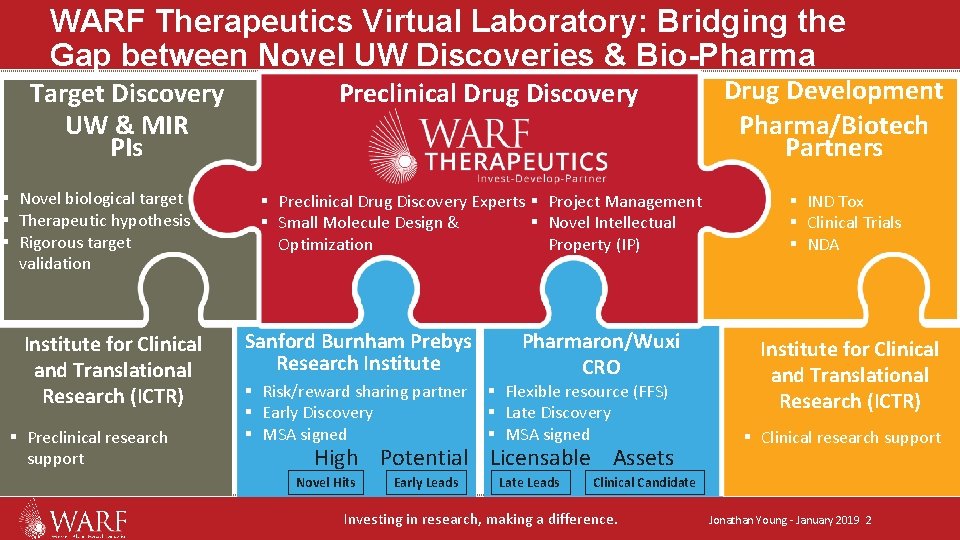
WARF Therapeutics Virtual Laboratory: Bridging the Gap between Novel UW Discoveries & Bio-Pharma Target Discovery UW & MIR PIs § Novel biological target § Therapeutic hypothesis § Rigorous target validation Institute for Clinical and Translational Research (ICTR) § Preclinical research support Preclinical Drug Discovery § Preclinical Drug Discovery Experts § Project Management § Small Molecule Design & § Novel Intellectual Optimization Property (IP) Sanford Burnham Prebys Research Institute § Risk/reward sharing partner § Early Discovery § MSA signed Pharmaron/Wuxi CRO § Flexible resource (FFS) § Late Discovery § MSA signed High Potential Licensable Assets Novel Hits Early Leads Late Leads Drug Development Pharma/Biotech Partners § IND Tox § Clinical Trials § NDA Institute for Clinical and Translational Research (ICTR) § Clinical research support Clinical Candidate Investing in research, making a difference. Jonathan Young - January 2019 2
Rationale for the 5 R Philosophy Investing in research, making a difference.
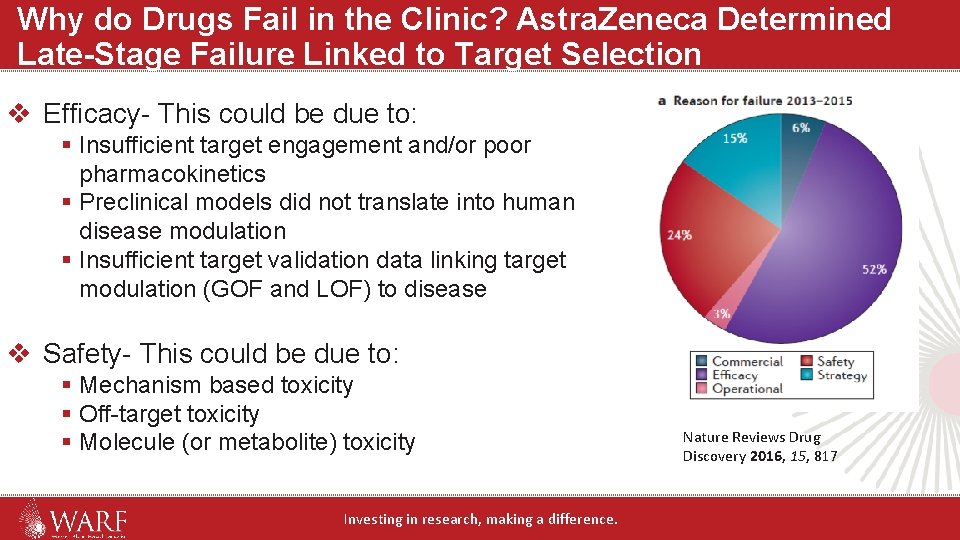
Why do Drugs Fail in the Clinic? Astra. Zeneca Determined Late-Stage Failure Linked to Target Selection v Efficacy- This could be due to: § Insufficient target engagement and/or poor pharmacokinetics § Preclinical models did not translate into human disease modulation § Insufficient target validation data linking target modulation (GOF and LOF) to disease v Safety- This could be due to: § Mechanism based toxicity § Off-target toxicity § Molecule (or metabolite) toxicity Investing in research, making a difference. Nature Reviews Drug Discovery 2016, 15, 817
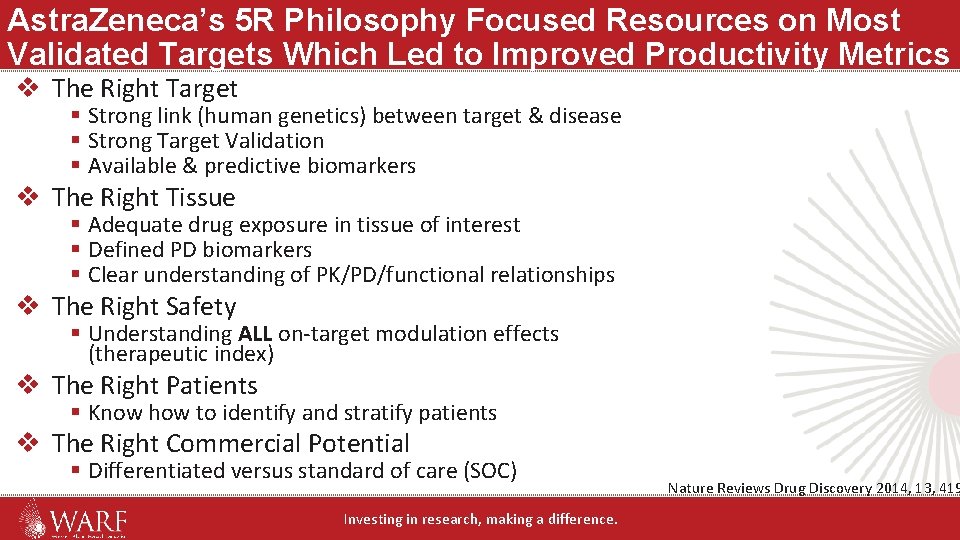
Astra. Zeneca’s 5 R Philosophy Focused Resources on Most Validated Targets Which Led to Improved Productivity Metrics v The Right Target § Strong link (human genetics) between target & disease § Strong Target Validation § Available & predictive biomarkers v The Right Tissue § Adequate drug exposure in tissue of interest § Defined PD biomarkers § Clear understanding of PK/PD/functional relationships v The Right Safety § Understanding ALL on-target modulation effects (therapeutic index) v The Right Patients § Know how to identify and stratify patients v The Right Commercial Potential § Differentiated versus standard of care (SOC) Investing in research, making a difference. Nature Reviews Drug Discovery 2014, 13, 419
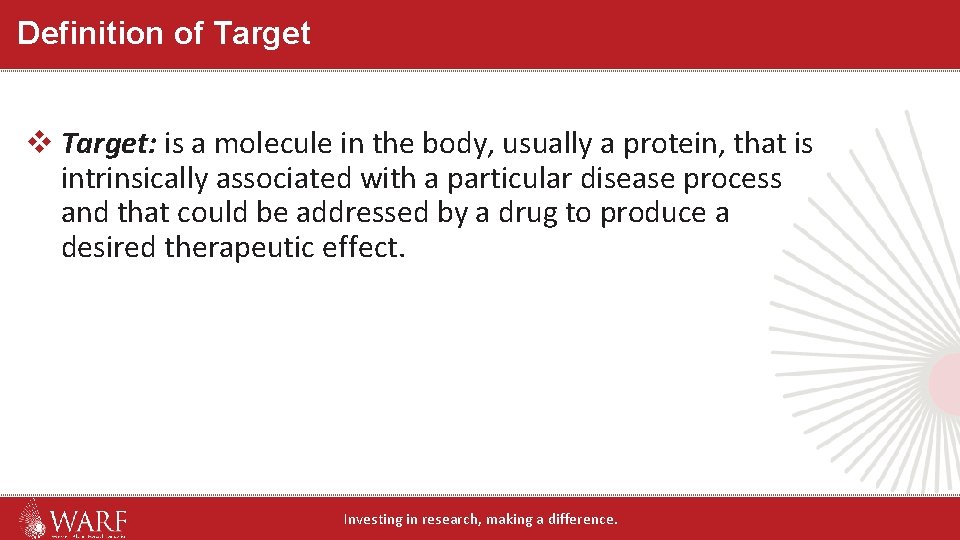
Definition of Target v Target: is a molecule in the body, usually a protein, that is intrinsically associated with a particular disease process and that could be addressed by a drug to produce a desired therapeutic effect. Investing in research, making a difference.
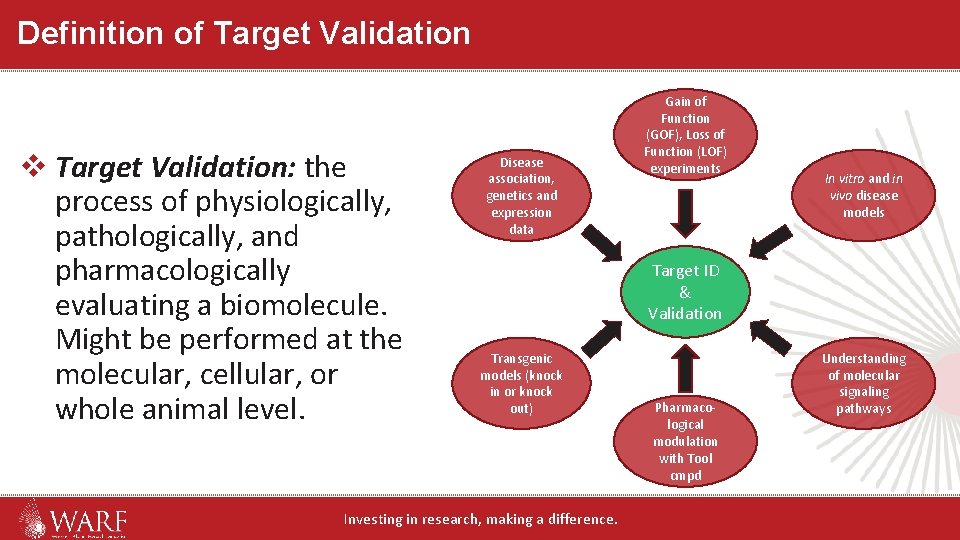
Definition of Target Validation v Target Validation: the process of physiologically, pathologically, and pharmacologically evaluating a biomolecule. Might be performed at the molecular, cellular, or whole animal level. Disease association, genetics and expression data Gain of Function (GOF), Loss of Function (LOF) experiments In vitro and in vivo disease models Target ID & Validation Transgenic models (knock in or knock out) Investing in research, making a difference. Pharmacological modulation with Tool cmpd Understanding of molecular signaling pathways
TEMPLATES & INSTRUCTIONS Investing in research, making a difference.
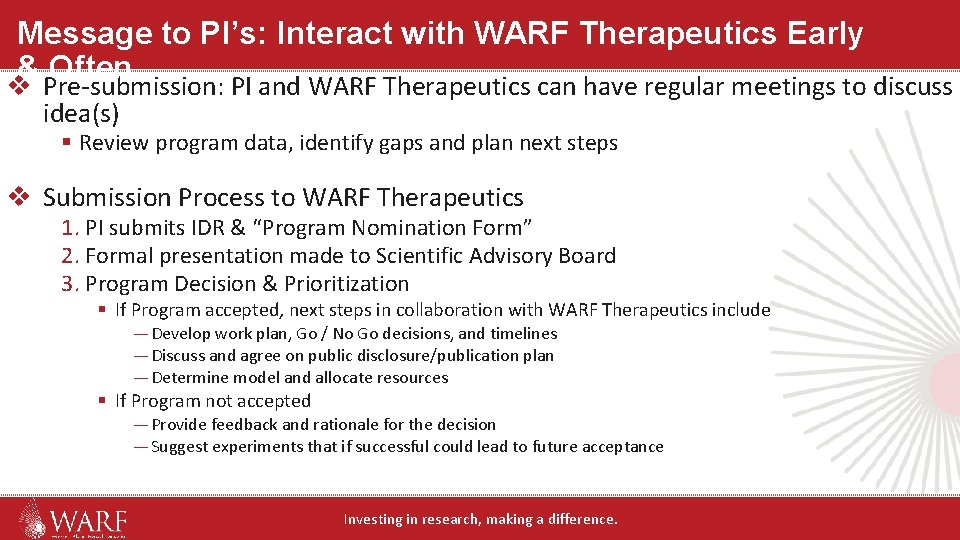
Message to PI’s: Interact with WARF Therapeutics Early & Often v Pre-submission: PI and WARF Therapeutics can have regular meetings to discuss idea(s) § Review program data, identify gaps and plan next steps v Submission Process to WARF Therapeutics 1. PI submits IDR & “Program Nomination Form” 2. Formal presentation made to Scientific Advisory Board 3. Program Decision & Prioritization § If Program accepted, next steps in collaboration with WARF Therapeutics include ― Develop work plan, Go / No Go decisions, and timelines ― Discuss and agree on public disclosure/publication plan ― Determine model and allocate resources § If Program not accepted ― Provide feedback and rationale for the decision ― Suggest experiments that if successful could lead to future acceptance Investing in research, making a difference.
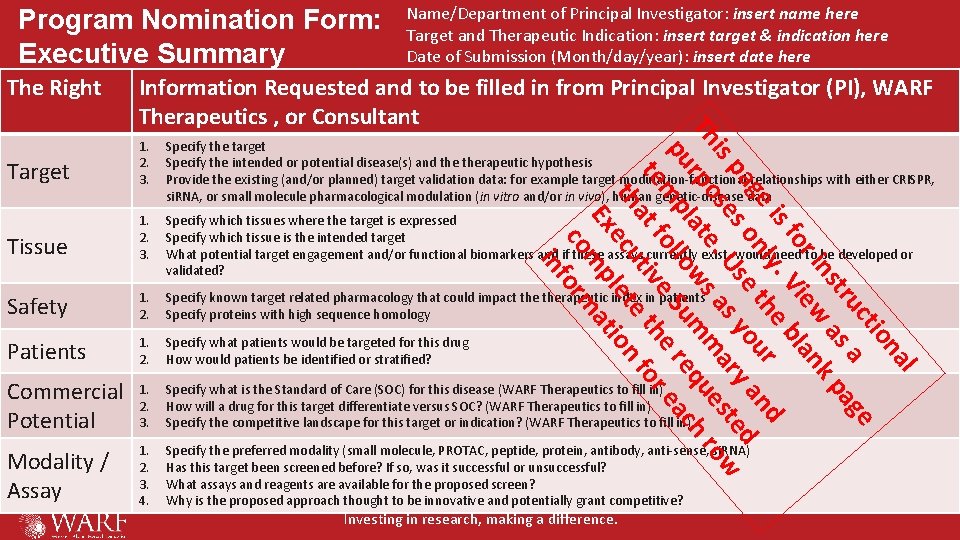
Program Nomination Form: Executive Summary The Right Name/Department of Principal Investigator: insert name here Target and Therapeutic Indication: insert target & indication here Date of Submission (Month/day/year): insert date here al on cti ge tru s a a ns w a nk p ri fo Vie la is ly. he b r d t u ge n an pa s o se yo y ed is se. U as ar st ow Th rpo late ws mm que h r pu mp ollo Su e re eac te at f tive th for th ecu lete ion Ex mp at co form Information Requested and to be filled in from Principal Investigator (PI), WARF Therapeutics , or Consultant Specify the target Specify the intended or potential disease(s) and therapeutic hypothesis Provide the existing (and/or planned) target validation data: for example target modulation-functional relationships with either CRISPR, si. RNA, or small molecule pharmacological modulation (in vitro and/or in vivo), human genetic-disease data Tissue 1. 2. 3. Specify which tissues where the target is expressed Specify which tissue is the intended target What potential target engagement and/or functional biomarkers and if these assays currently exist, would need to be developed or validated? Safety 1. 2. Specify known target related pharmacology that could impact therapeutic index in patients Specify proteins with high sequence homology Patients 1. 2. Specify what patients would be targeted for this drug How would patients be identified or stratified? Commercial Potential 1. 2. 3. Specify what is the Standard of Care (SOC) for this disease (WARF Therapeutics to fill in) How will a drug for this target differentiate versus SOC? (WARF Therapeutics to fill in) Specify the competitive landscape for this target or indication? (WARF Therapeutics to fill in) Modality / Assay 1. 2. 3. 4. Specify the preferred modality (small molecule, PROTAC, peptide, protein, antibody, anti-sense, si. RNA) Has this target been screened before? If so, was it successful or unsuccessful? What assays and reagents are available for the proposed screen? Why is the proposed approach thought to be innovative and potentially grant competitive? in Target 1. 2. 3. Investing in research, making a difference.
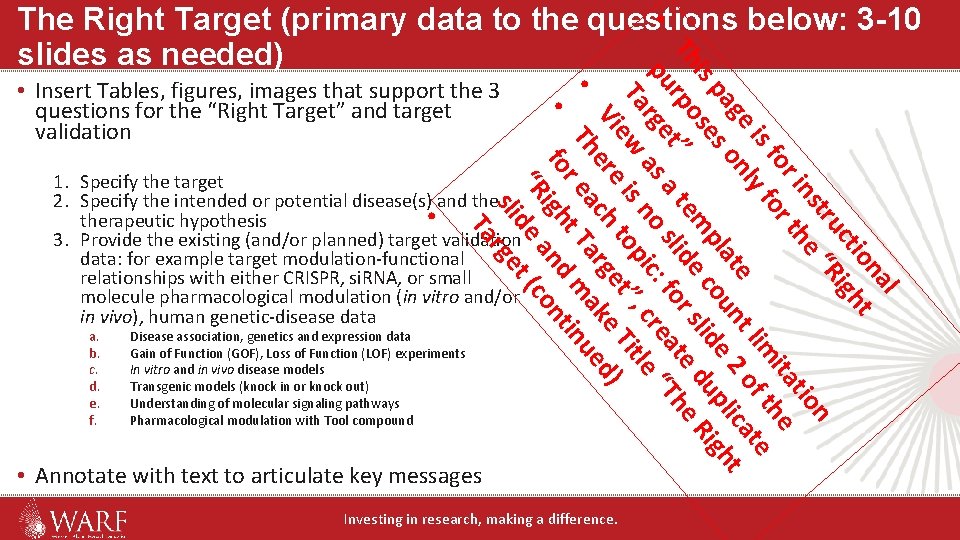
al on t cti igh tru “R n io ns e at r i th t i fo or he is ly f lim f t te ge n te nt 2 o ica t a l pa s o ou e pl gh p d c i l is se du Ri m Th rpo t” te lide or s te he • pu rge as a o s ic: f crea e “T Ta ew is n top t”, Titl Vi re h ge e d) he eac Tar ak ue • T m tin or ht d • f n g i on a “R de t (c sli rge Ta The Right Target (primary data to the questions below: 3 -10 slides as needed) • Insert Tables, figures, images that support the 3 questions for the “Right Target” and target validation • 1. Specify the target 2. Specify the intended or potential disease(s) and therapeutic hypothesis 3. Provide the existing (and/or planned) target validation data: for example target modulation-functional relationships with either CRISPR, si. RNA, or small molecule pharmacological modulation (in vitro and/or in vivo), human genetic-disease data a. b. c. d. e. f. Disease association, genetics and expression data Gain of Function (GOF), Loss of Function (LOF) experiments In vitro and in vivo disease models Transgenic models (knock in or knock out) Understanding of molecular signaling pathways Pharmacological modulation with Tool compound • Annotate with text to articulate key messages Investing in research, making a difference.
The Right Target (continued) Investing in research, making a difference.
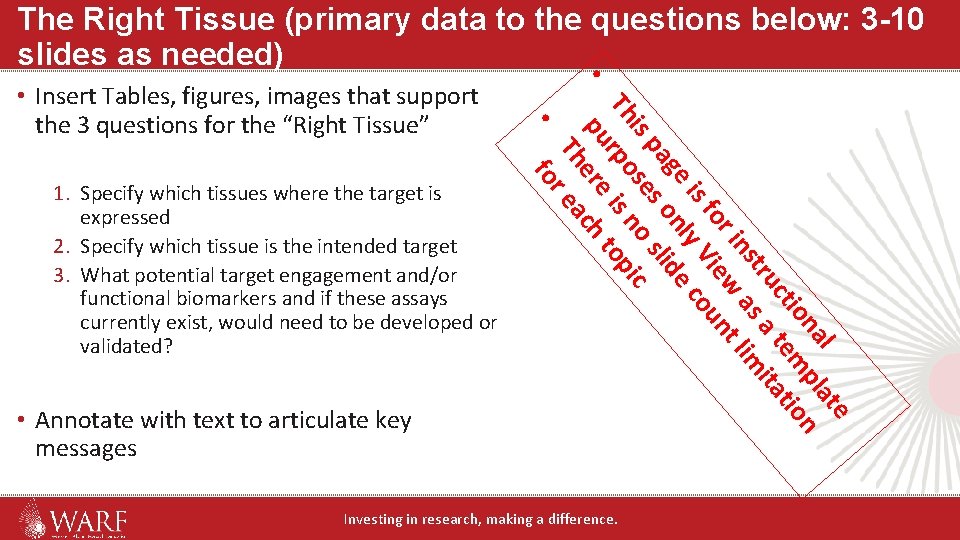
The Right Tissue (primary data to the questions below: 3 -10 slides as needed) te al la on mp on cti te ati tru s a it ns a lim ri w t fo ie un is ly V co ge n de pa s o sli is se o ic Th rpo is n op • pu ere ch t Th r ea • Annotate with text to articulate key messages fo 1. Specify which tissues where the target is expressed 2. Specify which tissue is the intended target 3. What potential target engagement and/or functional biomarkers and if these assays currently exist, would need to be developed or validated? • • Insert Tables, figures, images that support the 3 questions for the “Right Tissue” Investing in research, making a difference.
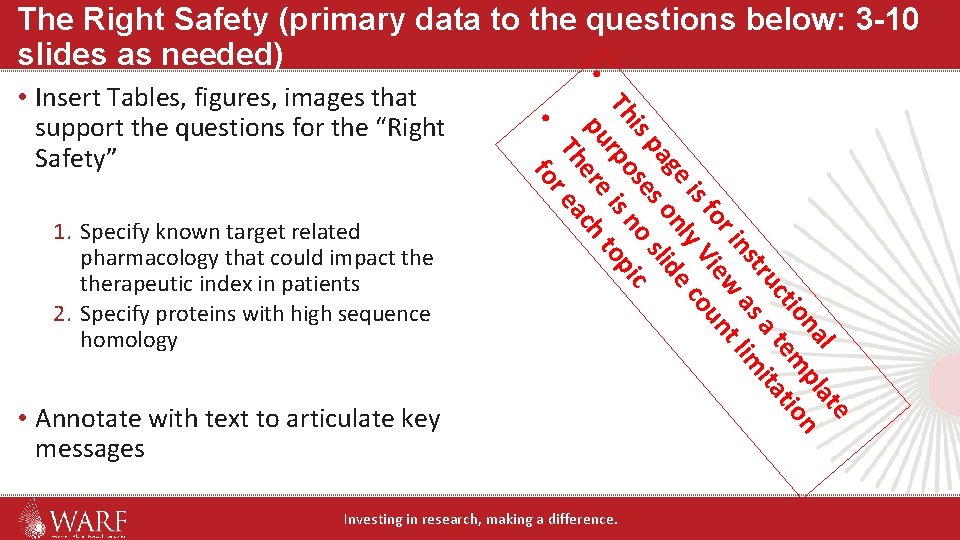
The Right Safety (primary data to the questions below: 3 -10 slides as needed) te al la on mp on cti te ati tru s a it ns a lim ri w t fo ie un is ly V co ge n de pa s o sli is se o ic Th rpo is n op • pu ere ch t Th r ea • Annotate with text to articulate key messages fo 1. Specify known target related pharmacology that could impact therapeutic index in patients 2. Specify proteins with high sequence homology • • Insert Tables, figures, images that support the questions for the “Right Safety” Investing in research, making a difference.
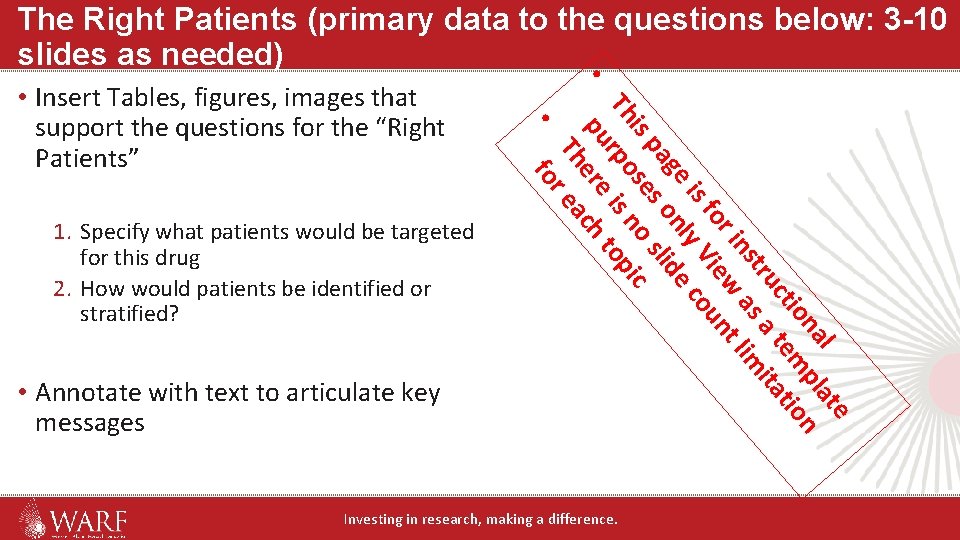
The Right Patients (primary data to the questions below: 3 -10 slides as needed) te al la on mp on cti te ati tru s a it ns a lim ri w t fo ie un is ly V co ge n de pa s o sli is se o ic Th rpo is n op • pu ere ch t Th r ea • Annotate with text to articulate key messages fo 1. Specify what patients would be targeted for this drug 2. How would patients be identified or stratified? • • Insert Tables, figures, images that support the questions for the “Right Patients” Investing in research, making a difference.
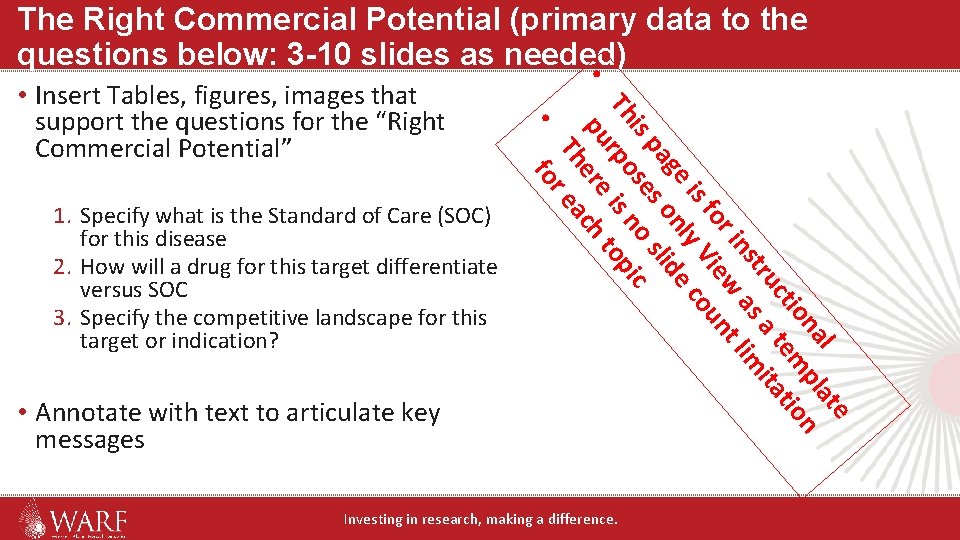
The Right Commercial Potential (primary data to the questions below: 3 -10 slides as needed) te al la on mp on cti te ati tru s a it ns a lim ri w t fo ie un is ly V co ge n de pa s o sli is se o ic Th rpo is n op • pu ere ch t Th r ea • • Insert Tables, figures, images that support the questions for the “Right Commercial Potential” fo 1. Specify what is the Standard of Care (SOC) for this disease 2. How will a drug for this target differentiate versus SOC 3. Specify the competitive landscape for this target or indication? • Annotate with text to articulate key messages Investing in research, making a difference.
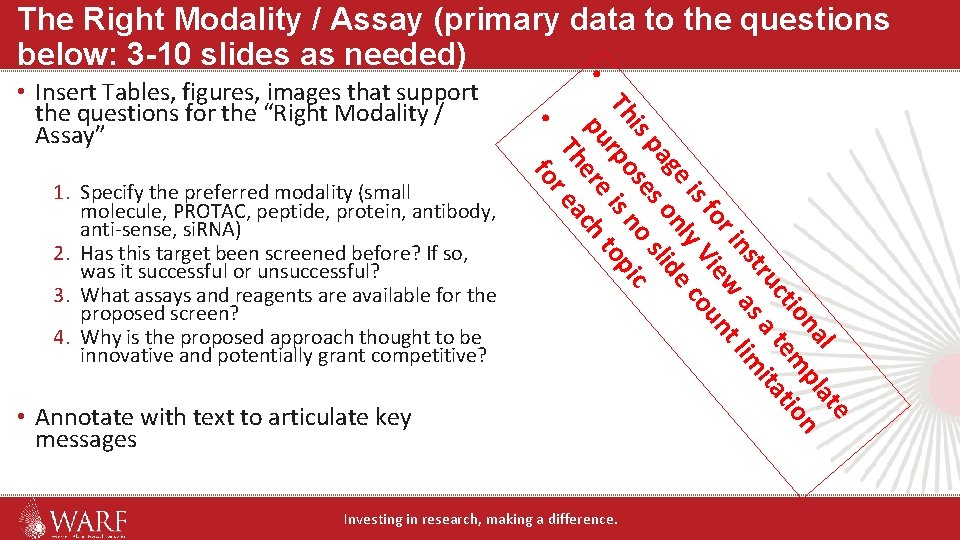
The Right Modality / Assay (primary data to the questions below: 3 -10 slides as needed) te al la on mp on cti te ati tru s a it ns a lim ri w t fo ie un is ly V co ge n de pa s o sli is se o ic Th rpo is n op • pu ere ch t Th r ea • Annotate with text to articulate key messages fo 1. Specify the preferred modality (small molecule, PROTAC, peptide, protein, antibody, anti-sense, si. RNA) 2. Has this target been screened before? If so, was it successful or unsuccessful? 3. What assays and reagents are available for the proposed screen? 4. Why is the proposed approach thought to be innovative and potentially grant competitive? • • Insert Tables, figures, images that support the questions for the “Right Modality / Assay” Investing in research, making a difference.