Drown Prevention Adaptive Swimming What is Drowning World

- Slides: 28
Drown Prevention & Adaptive Swimming
What is Drowning? World Health Organization: "the process of experiencing respiratory impairment from submersion/immersion in liquid“ Fata vs. Non-Fatal Drowning Suffocation leads to fatal drowning
How long does it take? IN THE TIME IT TAKES TO. . . • Cross a room for a towel (10 seconds), a child in a bathtub can be submerged. • Answer the phone (2 minutes), a child can lose consciousness. • Sign for a package at the front door (4 -6 minutes), a child submerged in a tub or pool can sustain permanent brain damage
What is Dry Drowning? • Dr. Mary Aitken, Arkansas Children’s Hospital • Not a well-accepted medical term. In fact, the World Congress on Drowning, an international advisory body, discourages the use of the term. • In many cases, people who are rescued by lifeguards recover quickly, but those with symptoms like respiratory distress, cough, and/or vomiting will require evaluation and emergency department care. • Parents should always get medical evaluation if they are worried, but should know that most symptoms develop immediately, and that the frightening cases shared in the media are rare cases where symptoms develop 4 -6 hours after the event. • In these cases, the children show symptoms that indicate that there is a problem. Any child that has persistent or worsening cough, fast breathing, vomiting, fever, or changes in mental status after being submerged in water should be taken to the nearest emergency room for immediate evaluation.
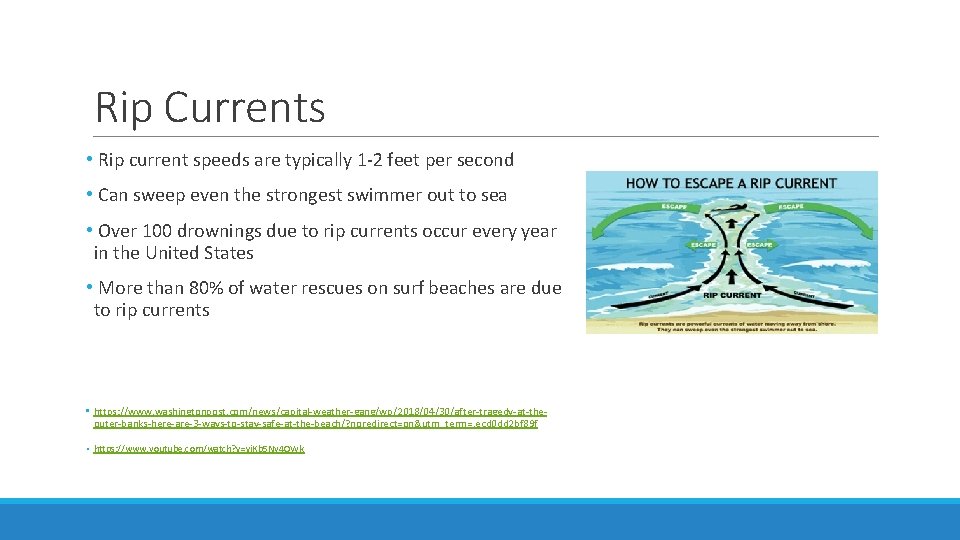
Rip Currents • Rip current speeds are typically 1 -2 feet per second • Can sweep even the strongest swimmer out to sea • Over 100 drownings due to rip currents occur every year in the United States • More than 80% of water rescues on surf beaches are due to rip currents • https: //www. washingtonpost. com/news/capital-weather-gang/wp/2018/04/30/after-tragedy-at-theouter-banks-here-are-3 -ways-to-stay-safe-at-the-beach/? noredirect=on&utm_term=. ecd 0 dd 2 bf 89 f • https: //www. youtube. com/watch? v=vi. Kb 5 Ny 4 OWk
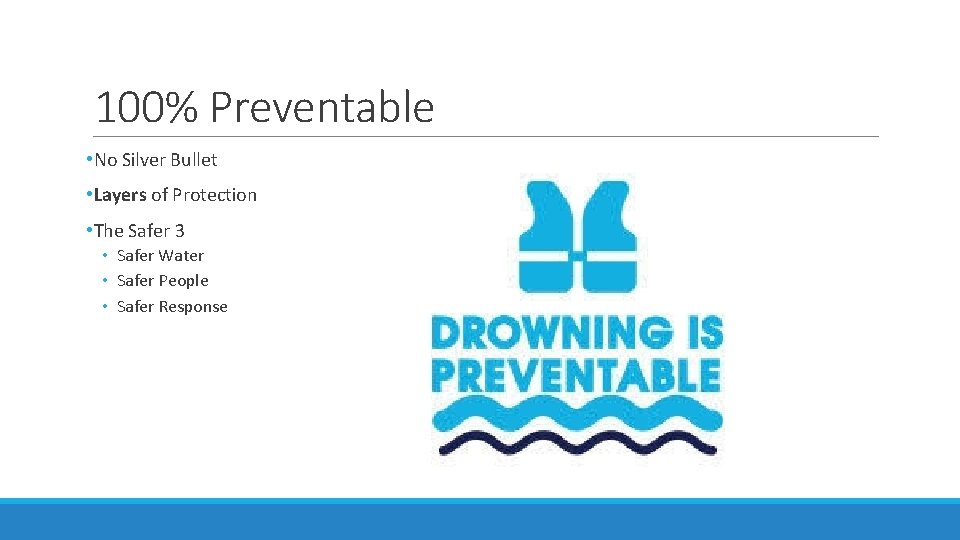
100% Preventable • No Silver Bullet • Layers of Protection • The Safer 3 • Safer Water • Safer People • Safer Response
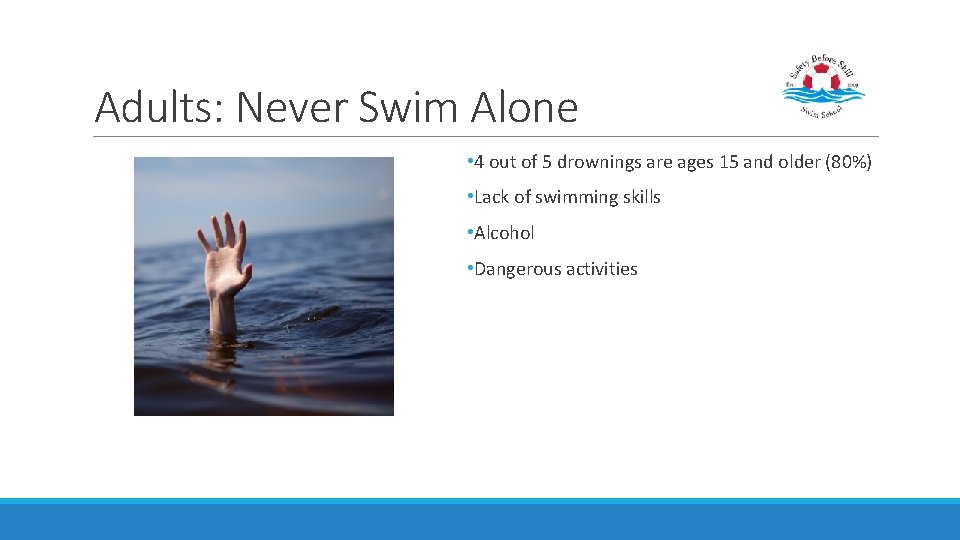
Adults: Never Swim Alone • 4 out of 5 drownings are ages 15 and older (80%) • Lack of swimming skills • Alcohol • Dangerous activities
We are missing an important conversation • Drowning the #1 cause of accidental death for children ages 1 -4. • Drowning is the #2 cause of accidental death for children ages 4 -14. • For every 1 child that has a fatal drowning, there are 5 more that survive, and 50% suffer complications such as brain damage • Those with Autism are 160 times more likely to drown, it is #1 cause of accident death.
Swift and Silent • There is no call for help • No waving of the hands • Less than 60 seconds A Texas mother was charged after a witness reportedly claimed she was using her phone while three of her children drowned in an apartment complex pool in 2015. https: //www. youtube. com/watch? v=7 e. KUDc 2 qee. Y
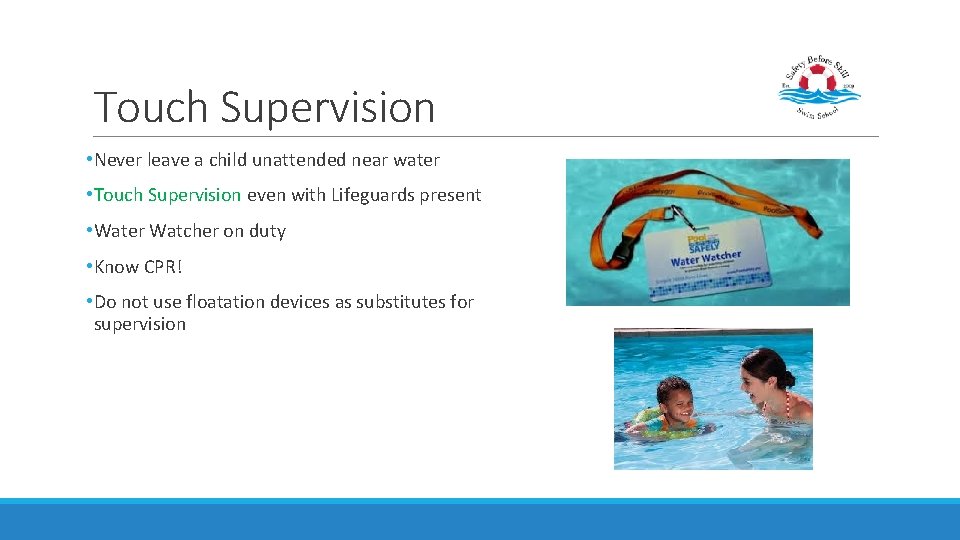
Touch Supervision • Never leave a child unattended near water • Touch Supervision even with Lifeguards present • Water Watcher on duty • Know CPR! • Do not use floatation devices as substitutes for supervision
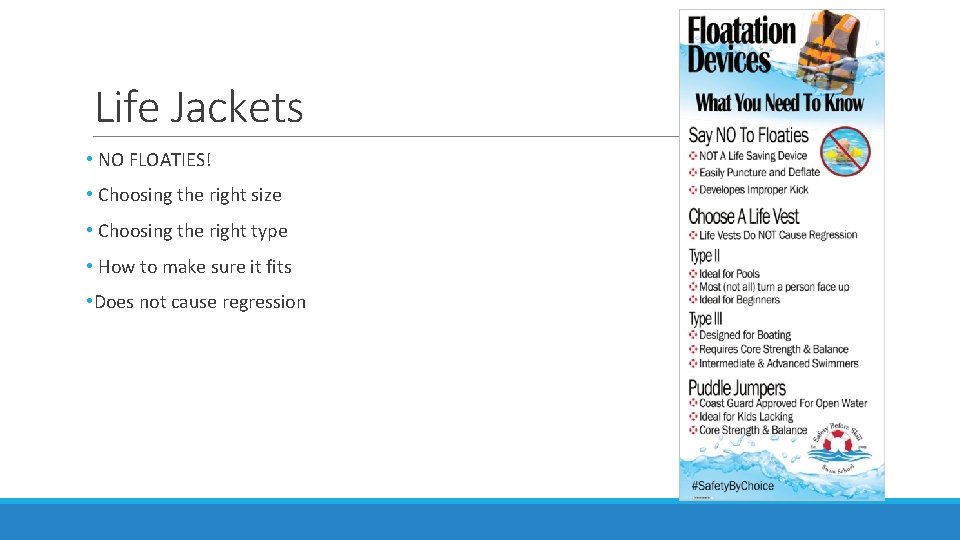
Life Jackets • NO FLOATIES! • Choosing the right size • Choosing the right type • How to make sure it fits • Does not cause regression
Home Pools • The home should be isolated from the pool with a fence at least 60” tall, with a self-closing, self-latching gate. The gate should open away from the pool, and should never be propped open. • Doors and windows should be alarmed to alert adults when opened. Doors should be self-closing and self-latching. • Power-operated pool safety covers are the most convenient and efficient. Solar/floating pool covers are not safety devices. • Keep a phone at poolside so that you never have to leave the pool to answer the phone, and can call for help if needed. • Learn CPR and rescue breathing. • Keep a life-saving ring, shepherd’s hook and CPR instructions mounted at poolside. • Remove toys from in and around the pool when not in use. • Don’t use floating chlorine dispensers that look like toys. • Instruct babysitters about potential pool hazards, and emphasize the need for constant supervision. • Responsibilities of pool ownership include ensuring children in the home learn to swim, and that adults know CPR.
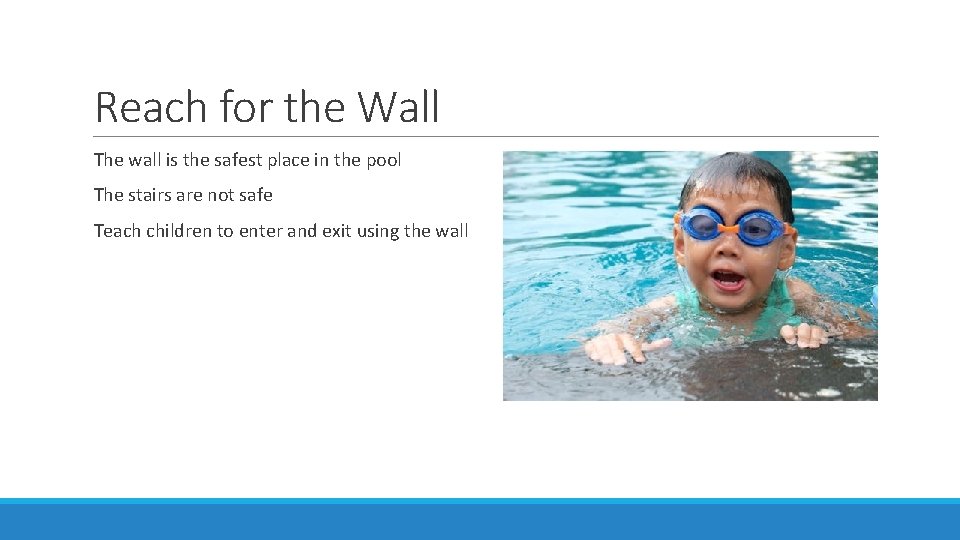
Reach for the Wall The wall is the safest place in the pool The stairs are not safe Teach children to enter and exit using the wall
Swim Lessons Decrease the risk of drowning by 88%! No on is DROWNPROOF Nurturing and positive approach
We Welcome Students with Special Needs! We are proud to be a swim school that offers life-saving skills and swim instruction to clients of all ages with a variety of special needs. Our senior coaches are trained to handle: ◦ ◦ ◦ ◦ Autism Spectrum Seizure Disorders Cerebral Palsy Down's Syndrome Sensory Disorders Speech and Language Disorders, including Non-verbal Swimmers Physical disabilities Apraxia
Autism Spectrum Drowning is the #1 cause of accidental death, for all ages, on the Autism Spectrum 91 percent of all wandering-related deaths among autistic children were due to accidental drowning, according to the National Autism Association. According to the Autism Spectrum Disorder Foundation (ASDF), “Swimming provides invaluable therapy for children with autism, as well as providing a social outlet for them. Swimming can help an autistic child improve their speech, coordination, social skills, self-esteem, and cognitive processing. ”
Online Profile Safety Before Skill partners with Arkansas Children's Hospital and the Dennis Developmental Center to provide additional internal coach education regarding special needs, social stories and a questionnaire for parents to communicate effectively with their coach. We offer each parent the opportunity to complete the "Special Needs Swimmer Profile, " designed by Clinicians at the ACH Dennis Developmental Center, online. It is a valuable communication tool between the parent and coach.
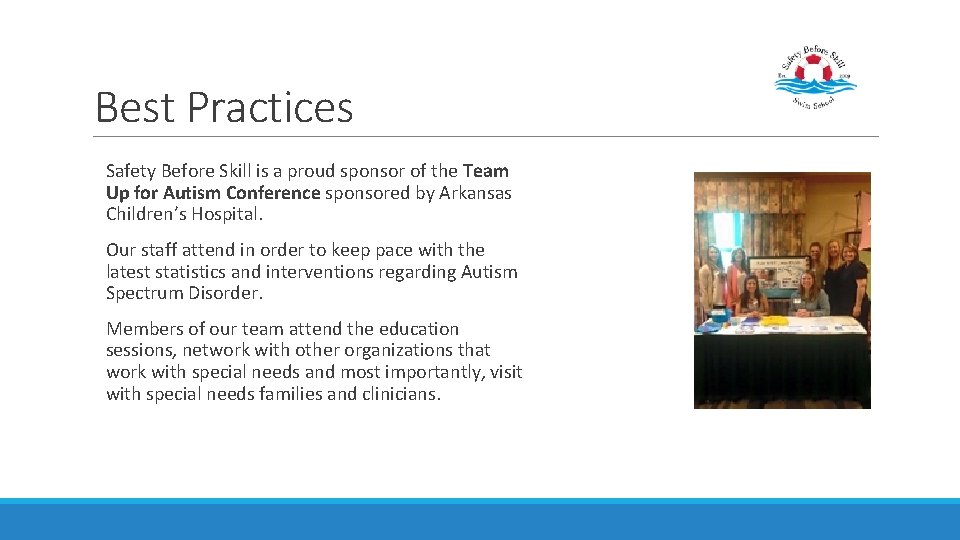
Best Practices Safety Before Skill is a proud sponsor of the Team Up for Autism Conference sponsored by Arkansas Children’s Hospital. Our staff attend in order to keep pace with the latest statistics and interventions regarding Autism Spectrum Disorder. Members of our team attend the education sessions, network with other organizations that work with special needs and most importantly, visit with special needs families and clinicians.
We are Certified Safety Before Skill is a certified Swim Angelfish swim school. Swim Angelfish is an adaptive swim program that provides training and certifications for special needs and autism swim lessons. The certification consists of 16 hours of classroom study and monthly continuing education.
Starfish Aquatics Institute We are also certified with the internationally recognized Starfish Aquatics Institute Children with Challenges and Adapted Aquatics programs. The Children with Challenges Course was developed as a collaborative effort between the Aquatic Therapy and Rehab Institute (ATRI), USA Swimming Foundation, and Starfish Aquatics Institute (SAI). Adaptive Aquatics Certification covers 21 disabilities
Safety Before Skill Benchmarks We educate parents and students on: • Asking Permission • Touch Supervision • Lifejacket Use • Rescue Skills, Reach and Throw • Reach for the wall • Roll to Float • CPR
Adaptive Swimming Ø Modifying Øteaching environment ØSkills ØEquipment Øinstructional strategies
Attention, Balance and Coordination • Organize the Central Nervous System • Vestibular System • Hard Input on the wall • Spinning • Drifting and swinging • Up and Down
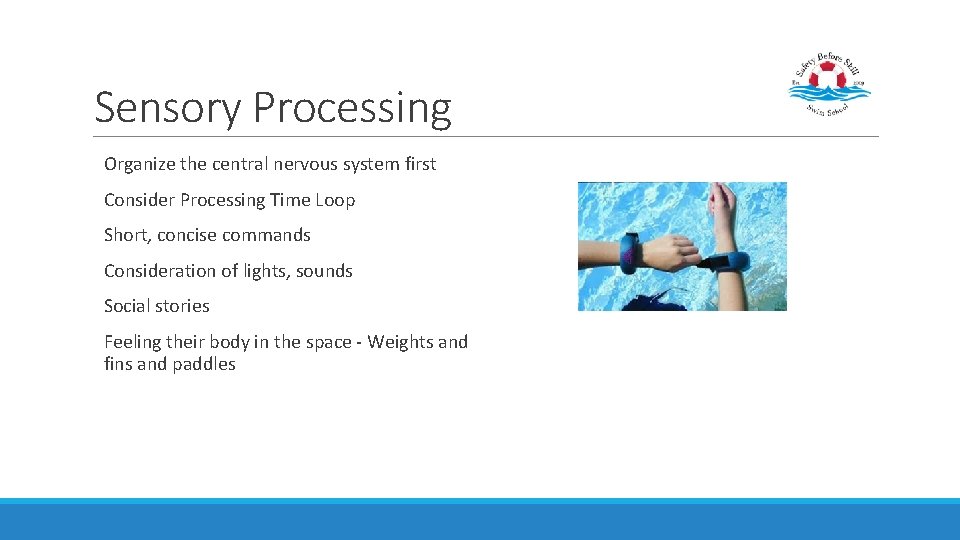
Sensory Processing Organize the central nervous system first Consider Processing Time Loop Short, concise commands Consideration of lights, sounds Social stories Feeling their body in the space - Weights and fins and paddles
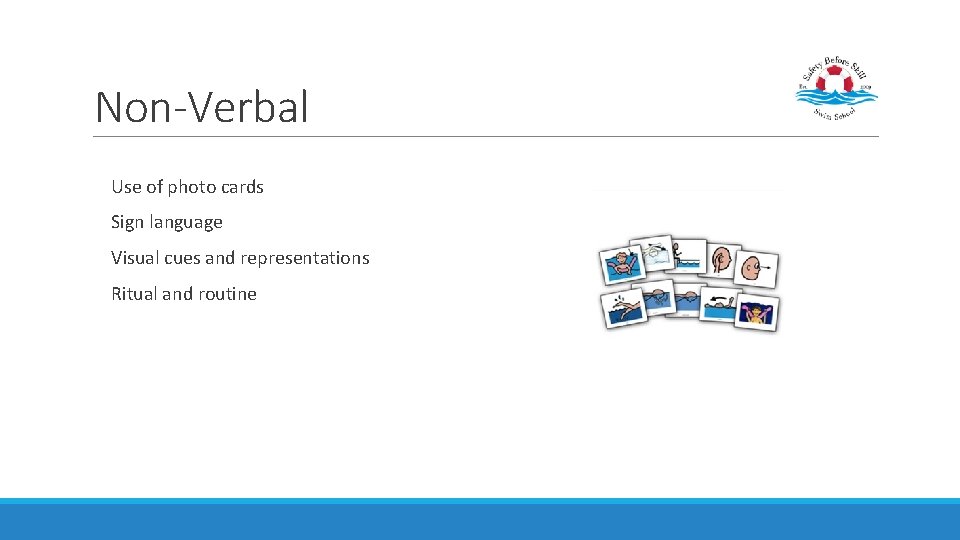
Non-Verbal Use of photo cards Sign language Visual cues and representations Ritual and routine
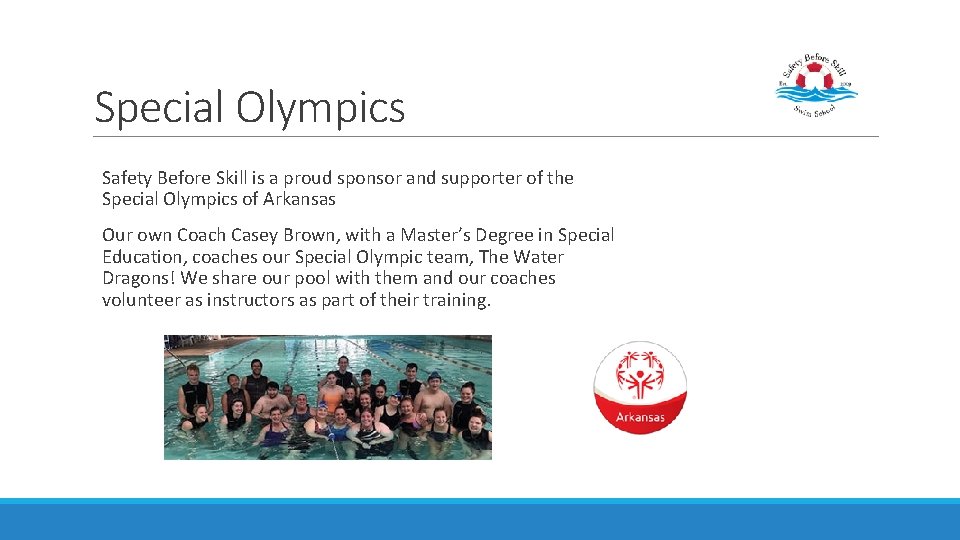
Special Olympics Safety Before Skill is a proud sponsor and supporter of the Special Olympics of Arkansas Our own Coach Casey Brown, with a Master’s Degree in Special Education, coaches our Special Olympic team, The Water Dragons! We share our pool with them and our coaches volunteer as instructors as part of their training.
What can you do? • Remember that Drowning is Swift and Silent • Never Swim Alone • Assign a water watcher/ Touch Supervision • Teach Them to Ask permission – Pool Please? • Always wear a lifejacket in or near the water • Take swim lessons • Learn CPR • Place barriers: fences, locks and alarms • Do not leave toys around the water • Educate caregivers https: //www. youtube. com/watch? v=Px. JZLAac. UOY
Resources Safety Before Skill: www. safetybeforeskill. com Centers for Disease Control: https: //www. poolsafely. gov/ National Drowning Prevention Alliance: https: //ndpa. org/