Motivation Video Silent Drowning Facts 1 2 million
- Slides: 27
Motivation Video: Silent Drowning
Facts Ø≈ 1. 2 million people die of drowning each year around the world, 50% below the age of 6 Ø 29% of drowning deaths involving children occur in public pools with certified lifeguards present. Drowning Prevention Foundation Ø In 2004, there were 3, 308 unintentional drownings in the United States, an average of nine people per day. (CDC 2006) U. S. Centers for Disease Control and Prevention ØOf all preschoolers who drown, 70 percent are in the care of one or both parents at the time of the drowning and 75 percent are missing from sight for five minutes or less. Orange County, CA, Fire Authority
Present Solutions: Poseidon: ØHelping lifeguards “see what they can’t see” ØCamera surveillance ØAlert communicated via pager and co-ordinates of the victim known Reasons for failure: ØExpensive- Operators of a six-lane expect to pay upwards of $150, 000 in hardware, software and installation costs ØRushed to market before it was ready ØBlockage of underwater cameras
GESS Team Shivam Kishore – Chief Executive Officer Elis Micka – Chief Design Engineer Suleiman Mohamed – Chief Software Engineer Gurman Thind – Chief Hardware Engineer Mehdi Elahi – Chief Research Engineer
i. Life. Guard and its Goals: ØEffective assistive device to alert lifeguards when a person is drowning ØUses underwater acoustic and in air Radio Frequency (RF) communication Ø Triggers strobe and siren warnings in receivers positioned along the perimeter of ponds and pools (as well as lifeguard pagers) after a predetermined amount of time underwater ØReduce the stress and burden of the lifeguards Ø Target children and elderly ØKeep the installation cost under $2000
Market Research ØSpoke to a lot of lifeguards Ø Made sure that the need for the product exists Ø Discussed the idea with many parents having young children Ø Lifeguard Interview Video
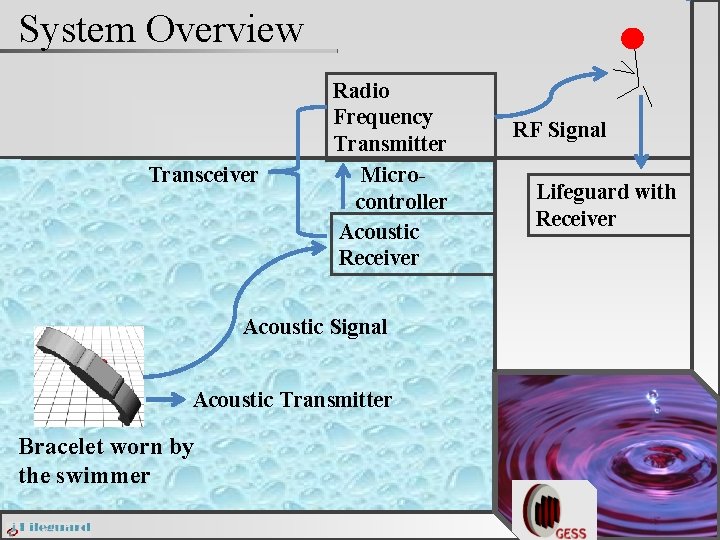
System Overview Transceiver Radio Frequency Transmitter Microcontroller Acoustic Receiver Acoustic Signal Acoustic Transmitter Bracelet worn by the swimmer RF Signal Lifeguard with Receiver
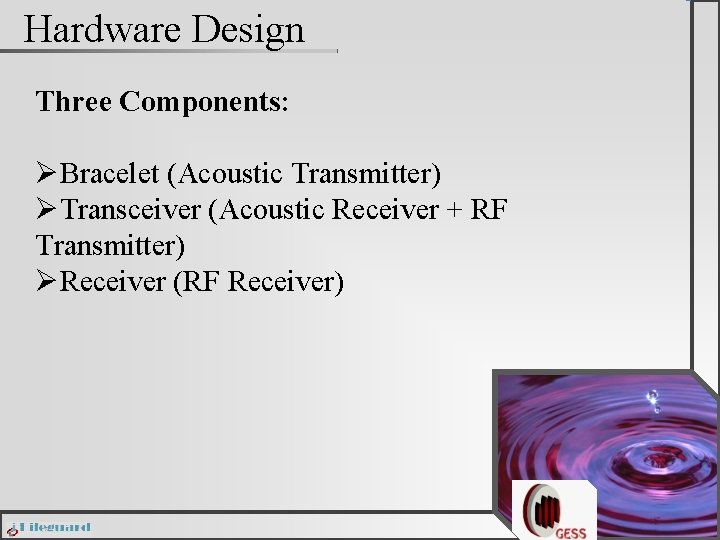
Hardware Design Three Components: ØBracelet (Acoustic Transmitter) ØTransceiver (Acoustic Receiver + RF Transmitter) ØReceiver (RF Receiver)
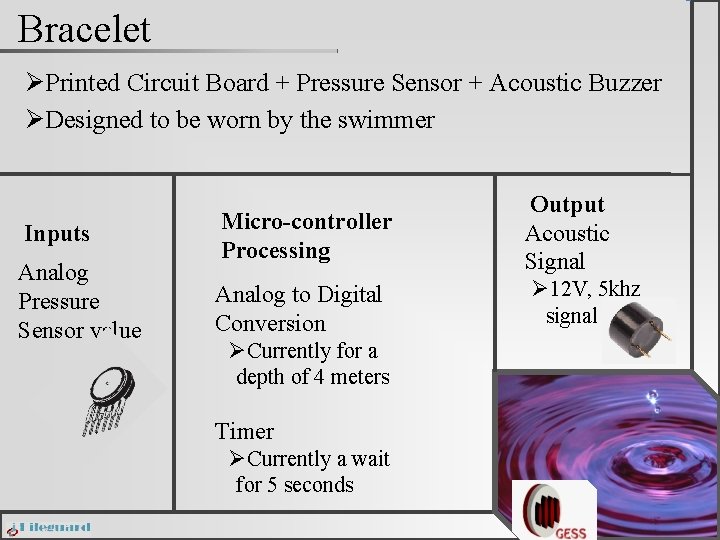
Bracelet ØPrinted Circuit Board + Pressure Sensor + Acoustic Buzzer ØDesigned to be worn by the swimmer Inputs Analog Pressure Sensor value Micro-controller Processing Analog to Digital Conversion ØCurrently for a depth of 4 meters Timer ØCurrently a wait for 5 seconds Output Acoustic Signal Ø 12 V, 5 khz signal
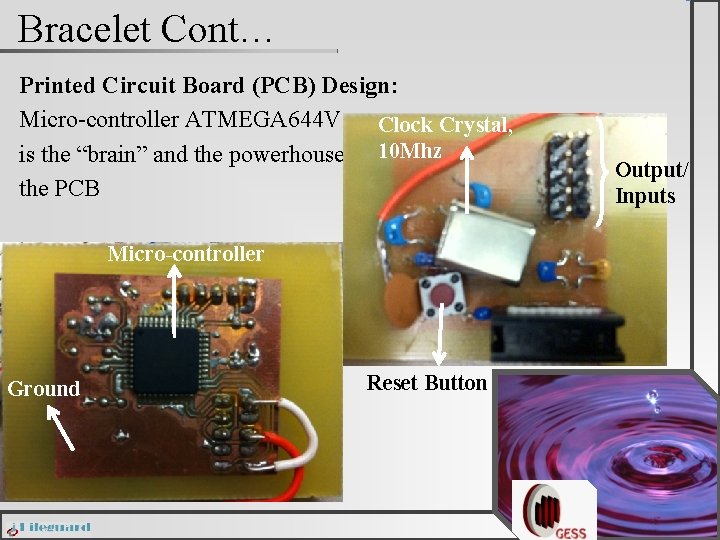
Bracelet Cont… Printed Circuit Board (PCB) Design: Micro-controller ATMEGA 644 V Clock Crystal, is the “brain” and the powerhouse of 10 Mhz the PCB Micro-controller Ground Reset Button Output/ Inputs
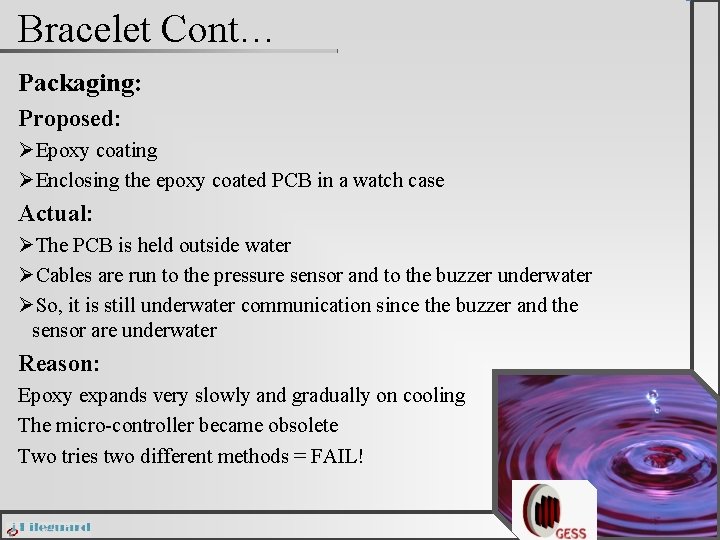
Bracelet Cont… Packaging: Proposed: ØEpoxy coating ØEnclosing the epoxy coated PCB in a watch case Actual: ØThe PCB is held outside water ØCables are run to the pressure sensor and to the buzzer underwater ØSo, it is still underwater communication since the buzzer and the sensor are underwater Reason: Epoxy expands very slowly and gradually on cooling The micro-controller became obsolete Two tries two different methods = FAIL!
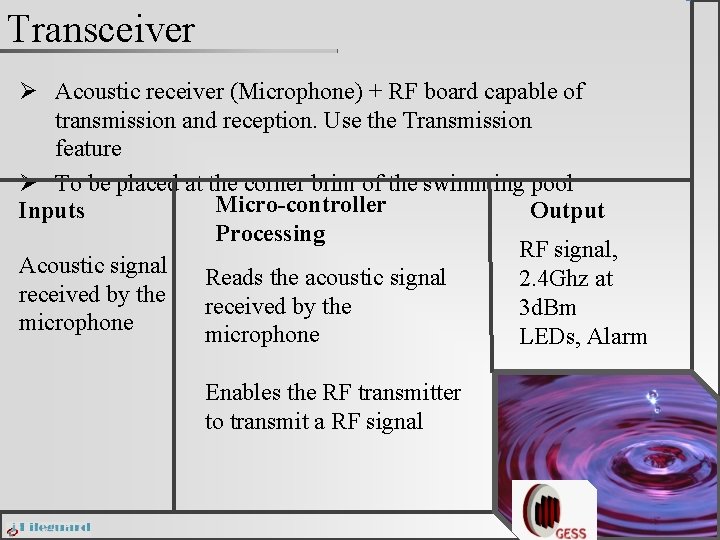
Transceiver Ø Acoustic receiver (Microphone) + RF board capable of transmission and reception. Use the Transmission feature Ø To be placed at the corner brim of the swimming pool Micro-controller Inputs Output Processing RF signal, Acoustic signal Reads the acoustic signal 2. 4 Ghz at received by the 3 d. Bm microphone LEDs, Alarm Enables the RF transmitter to transmit a RF signal
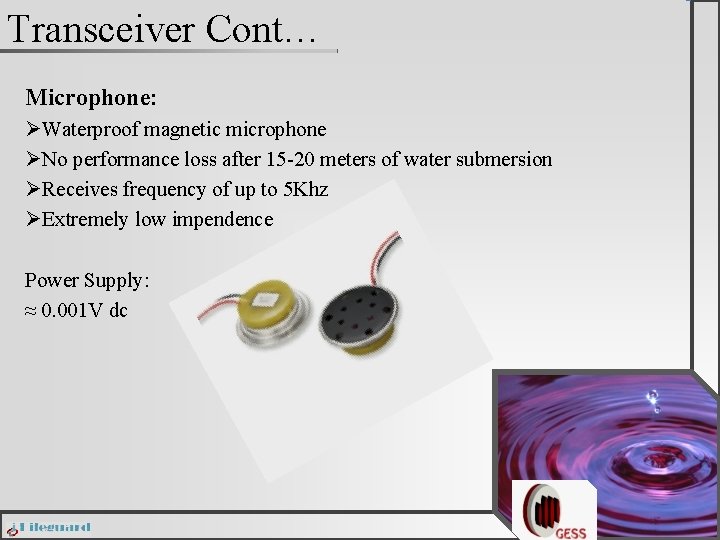
Transceiver Cont… Microphone: ØWaterproof magnetic microphone ØNo performance loss after 15 -20 meters of water submersion ØReceives frequency of up to 5 Khz ØExtremely low impendence Power Supply: ≈ 0. 001 V dc
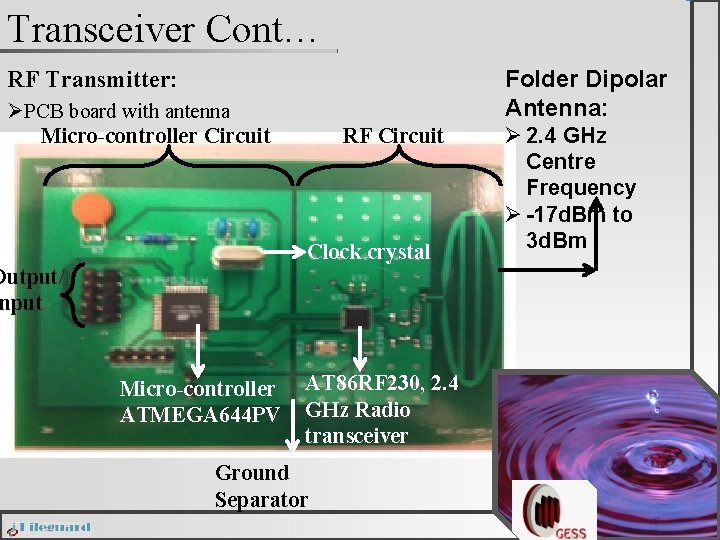
Transceiver Cont… Folder Dipolar Antenna: RF Transmitter: ØPCB board with antenna Micro-controller Circuit RF Circuit Clock crystal Output/ nput Micro-controller ATMEGA 644 PV AT 86 RF 230, 2. 4 GHz Radio transceiver Ground Separator Ø 2. 4 GHz Centre Frequency Ø -17 d. Bm to 3 d. Bm
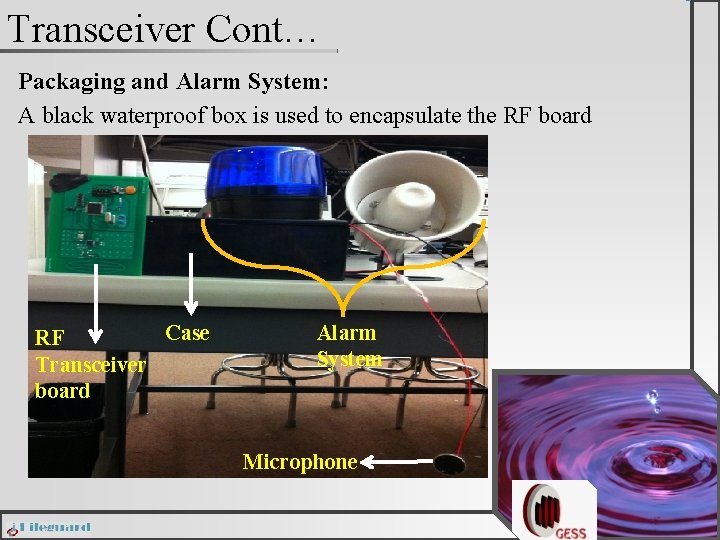
Transceiver Cont… Packaging and Alarm System: A black waterproof box is used to encapsulate the RF board Case RF Transceiver board Alarm System Microphone
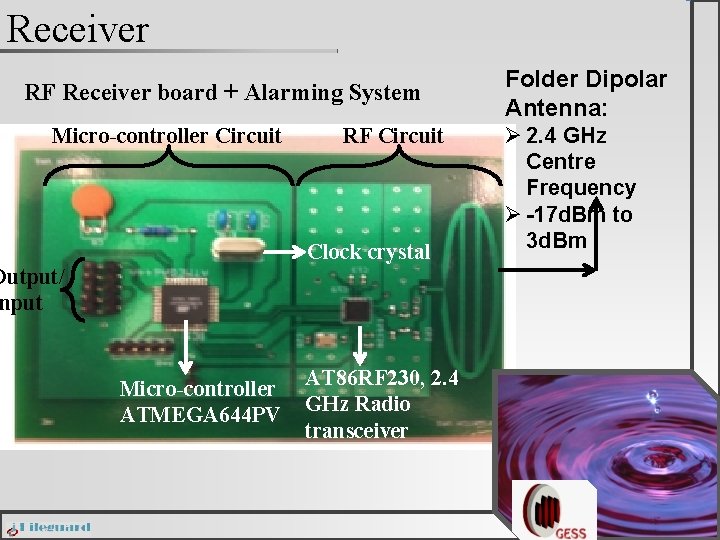
Receiver RF Receiver board + Alarming System Micro-controller Circuit RF Circuit Clock crystal Output/ nput Micro-controller ATMEGA 644 PV AT 86 RF 230, 2. 4 GHz Radio transceiver Folder Dipolar Antenna: Ø 2. 4 GHz Centre Frequency Ø -17 d. Bm to 3 d. Bm
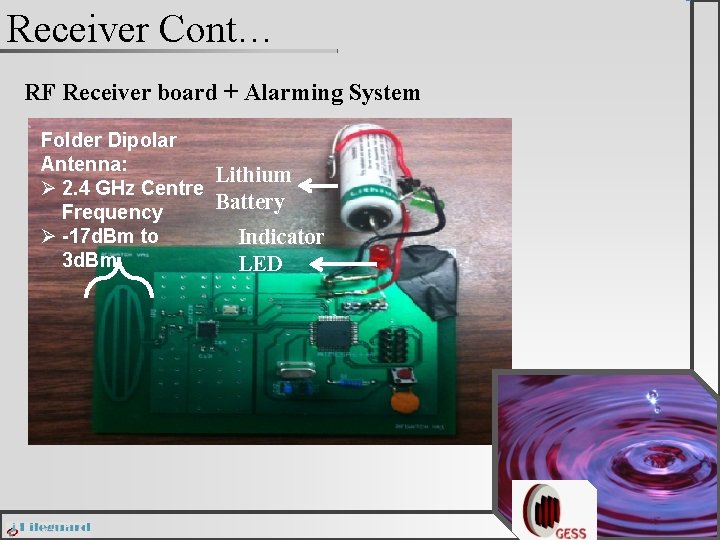
Receiver Cont… RF Receiver board + Alarming System Folder Dipolar Antenna: Lithium Ø 2. 4 GHz Centre Battery Frequency Ø -17 d. Bm to Indicator 3 d. Bm LED
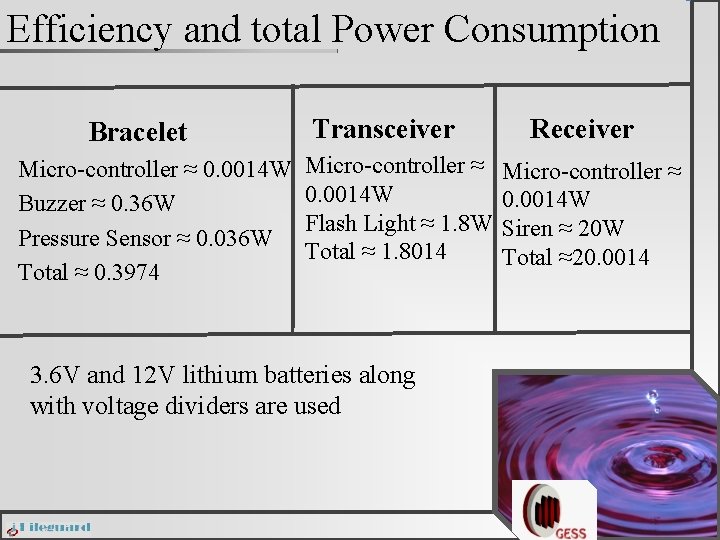
Efficiency and total Power Consumption Bracelet Micro-controller ≈ 0. 0014 W Buzzer ≈ 0. 36 W Pressure Sensor ≈ 0. 036 W Total ≈ 0. 3974 Transceiver Micro-controller ≈ 0. 0014 W Flash Light ≈ 1. 8 W Total ≈ 1. 8014 3. 6 V and 12 V lithium batteries along with voltage dividers are used Receiver Micro-controller ≈ 0. 0014 W Siren ≈ 20 W Total ≈20. 0014
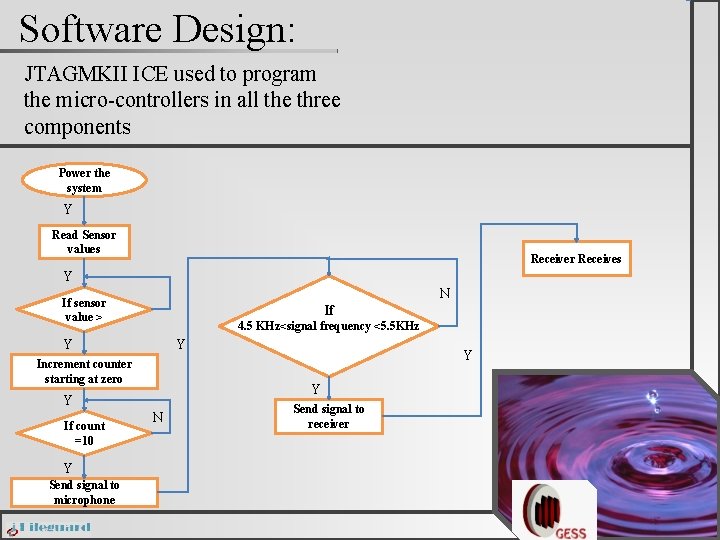
Software Design: JTAGMKII ICE used to program the micro-controllers in all the three components Power the system Y Read Sensor values Receiver Receives Y N If sensor value > If 4. 5 KHz<signal frequency <5. 5 KHz Y Y Increment counter starting at zero Y Y If count =10 Y Send signal to microphone Y N Send signal to receiver
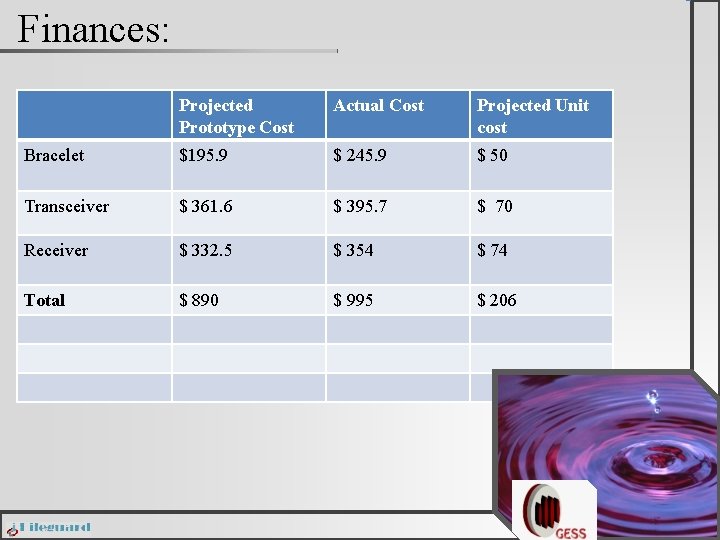
Finances: Component Projected Prototype Cost Actual Cost Projected Unit cost Bracelet $195. 9 $ 245. 9 $ 50 Transceiver $ 361. 6 $ 395. 7 $ 70 Receiver $ 332. 5 $ 354 $ 74 Total $ 890 $ 995 $ 206
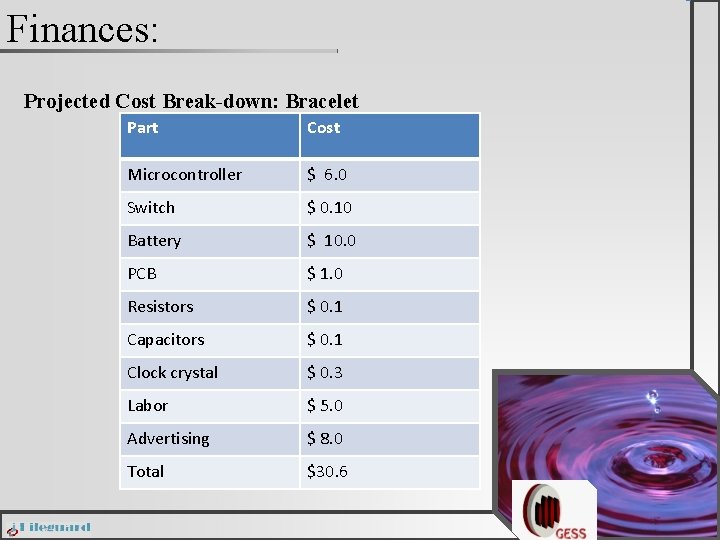
Finances: Projected Cost Break-down: Bracelet Part Cost Microcontroller $ 6. 0 Switch $ 0. 10 Battery $ 10. 0 PCB $ 1. 0 Resistors $ 0. 1 Capacitors $ 0. 1 Clock crystal $ 0. 3 Labor $ 5. 0 Advertising $ 8. 0 Total $30. 6
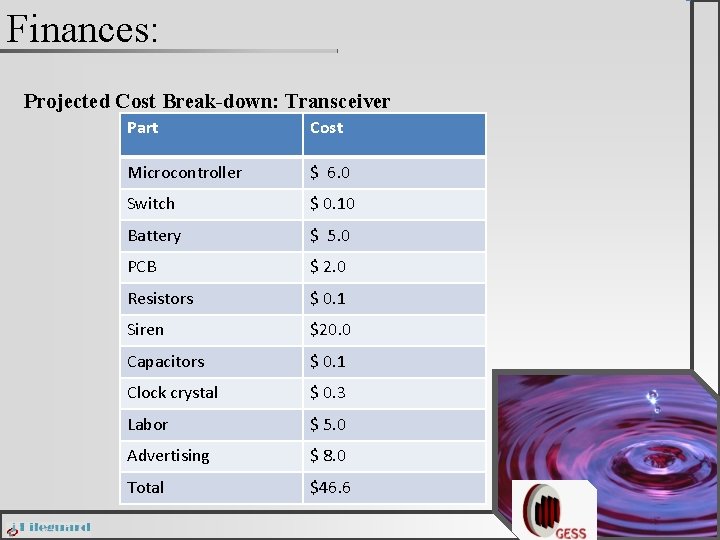
Finances: Projected Cost Break-down: Transceiver Part Cost Microcontroller $ 6. 0 Switch $ 0. 10 Battery $ 5. 0 PCB $ 2. 0 Resistors $ 0. 1 Siren $20. 0 Capacitors $ 0. 1 Clock crystal $ 0. 3 Labor $ 5. 0 Advertising $ 8. 0 Total $46. 6
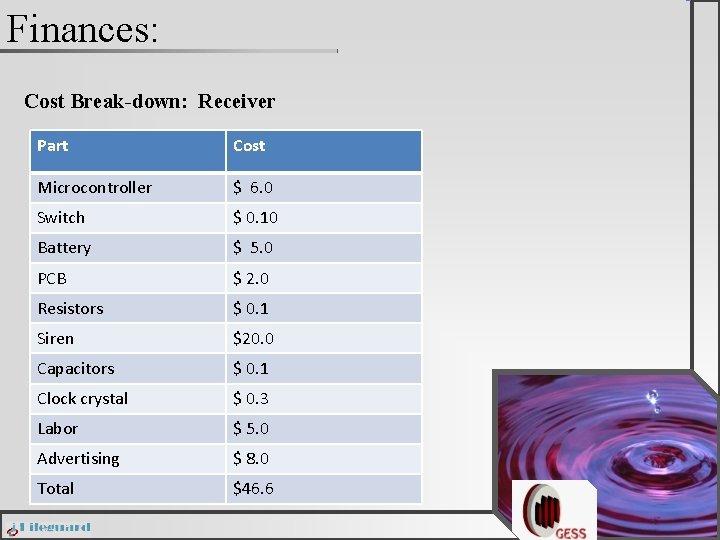
Finances: Cost Break-down: Receiver Part Cost Microcontroller $ 6. 0 Switch $ 0. 10 Battery $ 5. 0 PCB $ 2. 0 Resistors $ 0. 1 Siren $20. 0 Capacitors $ 0. 1 Clock crystal $ 0. 3 Labor $ 5. 0 Advertising $ 8. 0 Total $46. 6
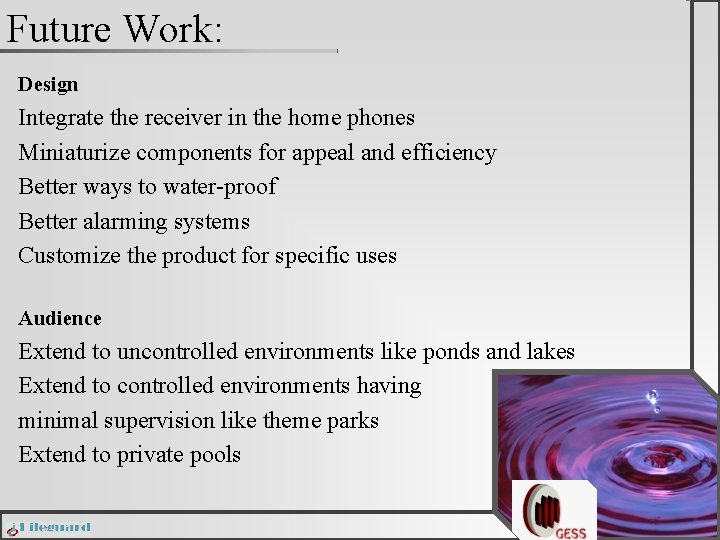
Future Work: Design Integrate the receiver in the home phones Miniaturize components for appeal and efficiency Better ways to water-proof Better alarming systems Customize the product for specific uses Audience Extend to uncontrolled environments like ponds and lakes Extend to controlled environments having minimal supervision like theme parks Extend to private pools
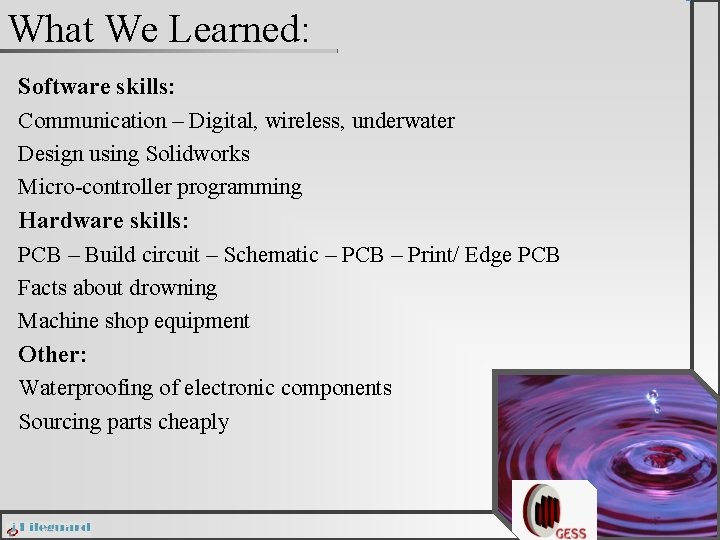
What We Learned: Software skills: Communication – Digital, wireless, underwater Design using Solidworks Micro-controller programming Hardware skills: PCB – Build circuit – Schematic – PCB – Print/ Edge PCB Facts about drowning Machine shop equipment Other: Waterproofing of electronic components Sourcing parts cheaply
Acknowledgments Ø Dr. Lakshman One (Advice on Electronics) Ø Dr. John Bird (Underwater communication) ØMelanie Klapstock (Aquatics Assistant) Ø Dr Ash M. Parameswaran (Advice on Electronics) Ø Dr. Sami Muhaidat (Advice on Digital communication) Ø Dr. Shawn Stapleton(Advice on Digital communication) Ø Mike Sjoerdsma (Advice on details of project) Ø Dr. Andrew Rawicz (Advice on details of project) Ø ESSS (Funding)
Conclusion ØAddress issues of long term waterproofing solutions ØWorking prototype done, tested and re-tested to provide Proof of Concept Øi. Life. Guard has a high market potential Øi. Life. Guard has the potential to be integrated in existing products like wrist watches and home phones