Drawing Monsters 15 Solutions Troika Consulting Improv Prototyping
- Slides: 30
Drawing Monsters – 15% Solutions – Troika Consulting Improv Prototyping – Discovery and Action Dialog What, So What, Now What? A Liberating Structures String Nancy White Full Circle Associates http: //www. fullcirc. com
“Um, I’m not so sure about …” Drawing Monsters (a punctuation) From Lynda Barry https: //www. drawnandquarterly. com/syllabus and http: //thenearsightedmonkey. tumblr. com/search/syllabus What do we fear? How can we use that fear as a way to discover what to do next? To engage the ideas/skills/energy of those around us in those next steps? This Liberating Structure string riffs on Lynda Barry’s fabulous Drawing Monsters, turning it into a “punctuation” for other LS. In LS terminology, a punctuation is something that creates a moment of reflection or connection between two or more Liberating Structures.
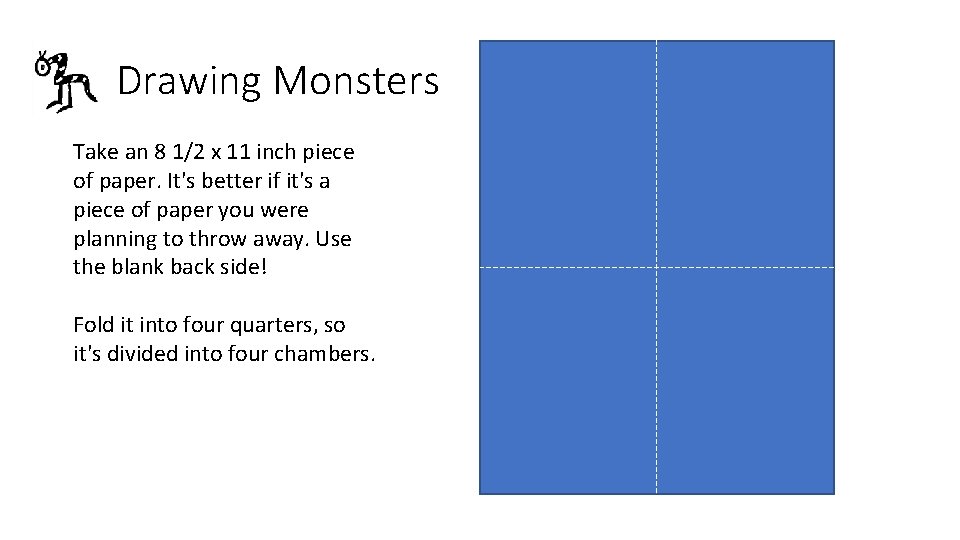
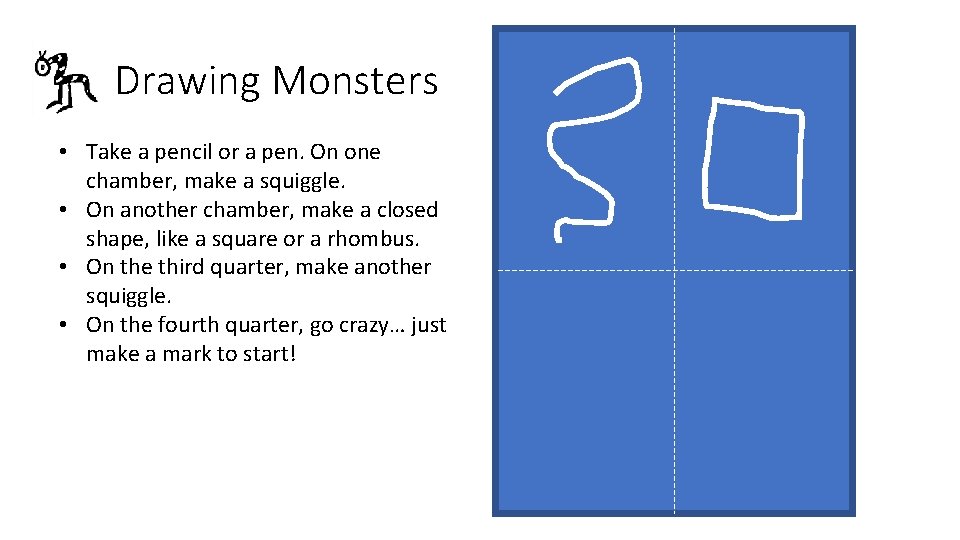
Drawing Monsters Take an 8 1/2 x 11 inch piece of paper. It's better if it's a piece of paper you were planning to throw away. Use the blank back side! Fold it into four quarters, so it's divided into four chambers.
Drawing Monsters • Take a pencil or a pen. On one chamber, make a squiggle. • On another chamber, make a closed shape, like a square or a rhombus. • On the third quarter, make another squiggle. • On the fourth quarter, go crazy… just make a mark to start!
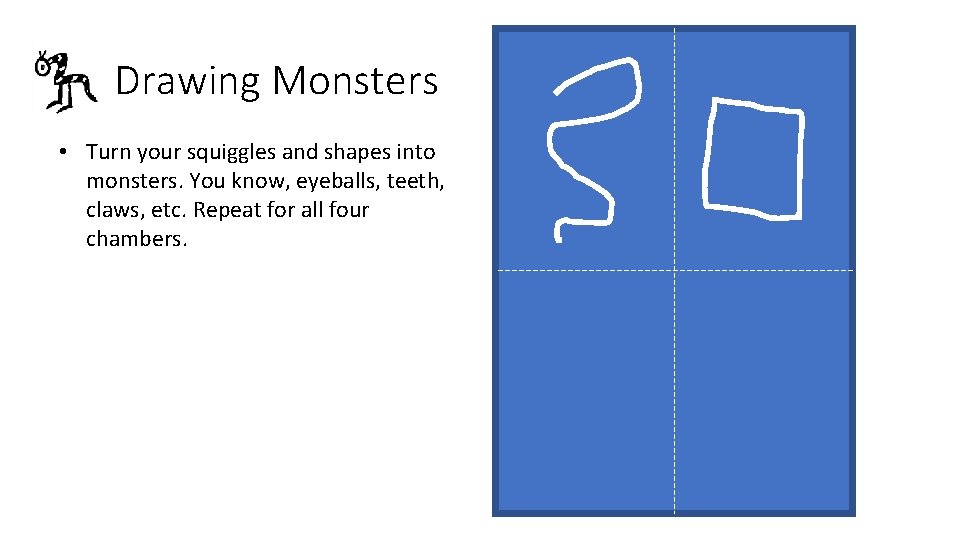
Drawing Monsters • Turn your squiggles and shapes into monsters. You know, eyeballs, teeth, claws, etc. Repeat for all four chambers.
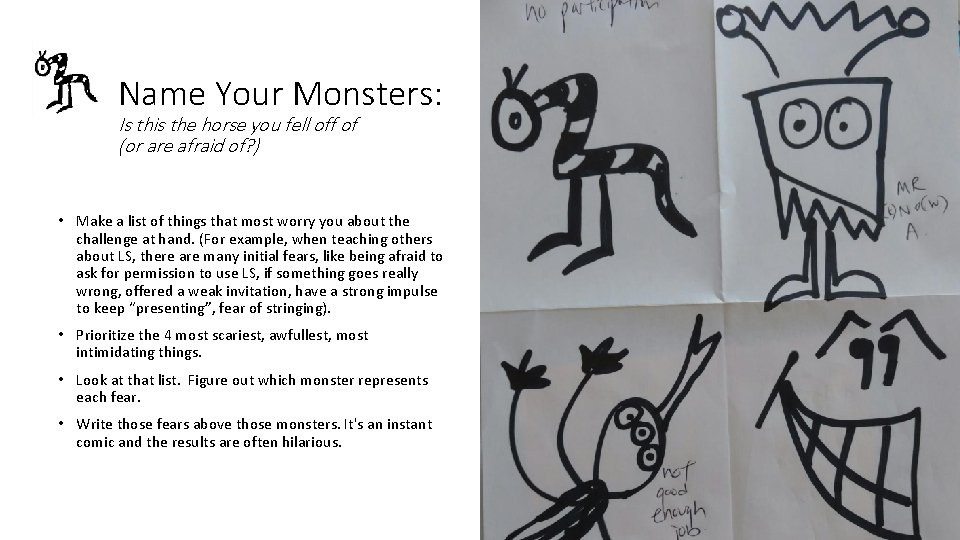
Name Your Monsters: Is this the horse you fell off of (or are afraid of? ) • Make a list of things that most worry you about the challenge at hand. (For example, when teaching others about LS, there are many initial fears, like being afraid to ask for permission to use LS, if something goes really wrong, offered a weak invitation, have a strong impulse to keep “presenting”, fear of stringing). • Prioritize the 4 most scariest, awfullest, most intimidating things. • Look at that list. Figure out which monster represents each fear. • Write those fears above those monsters. It's an instant comic and the results are often hilarious.
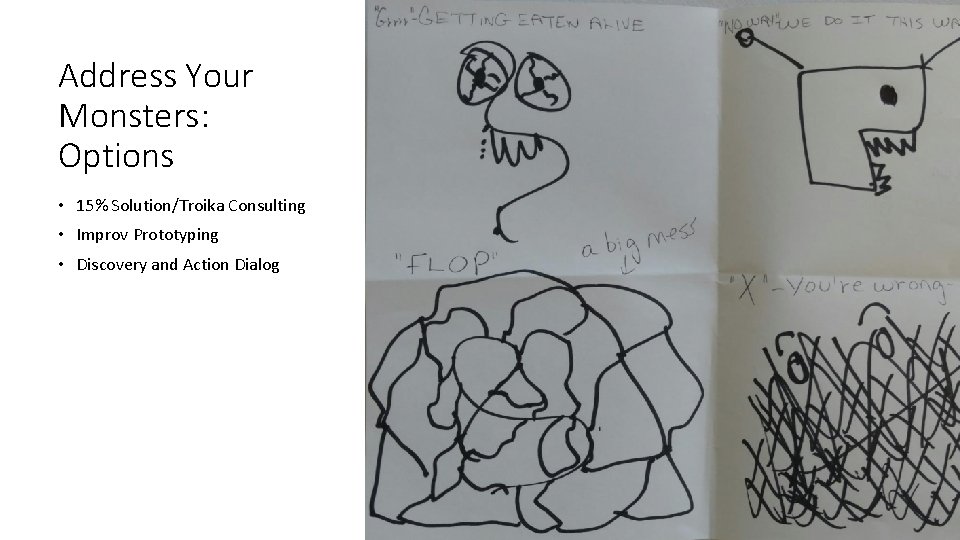
Address Your Monsters: Options • 15% Solution/Troika Consulting • Improv Prototyping • Discovery and Action Dialog
The 15% solution Noticing and using the influence, discretion and power individuals have right now. – Keith Mc. Candless http: //www. liberatingstructures. com/7 -15 -solutions/ 8
15% Insights on Our Monsters • Always there for the asking (and taking) • Most unused or unnoticed source of influence • BIG things may emerge via Butterfly effect • Reinventing the wheel is OK • Each 15% solution adds to your understanding of what is possible • Clear, common purpose and boundaries generate coherence among many solutions • Energizing, motivating and liberating
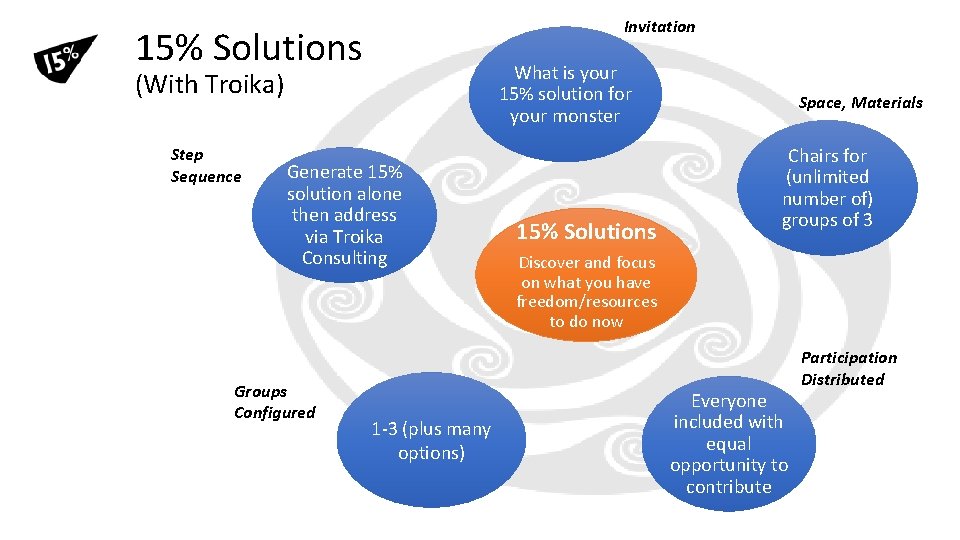
Invitation 15% Solutions What is your 15% solution for your monster (With Troika) Step Sequence Generate 15% solution alone then address via Troika Consulting Groups Configured 1 -3 (plus many options) 15% Solutions Space, Materials Chairs for (unlimited number of) groups of 3 Discover and focus on what you have freedom/resources to do now Everyone included with equal opportunity to contribute Participation Distributed
Troika Consulting
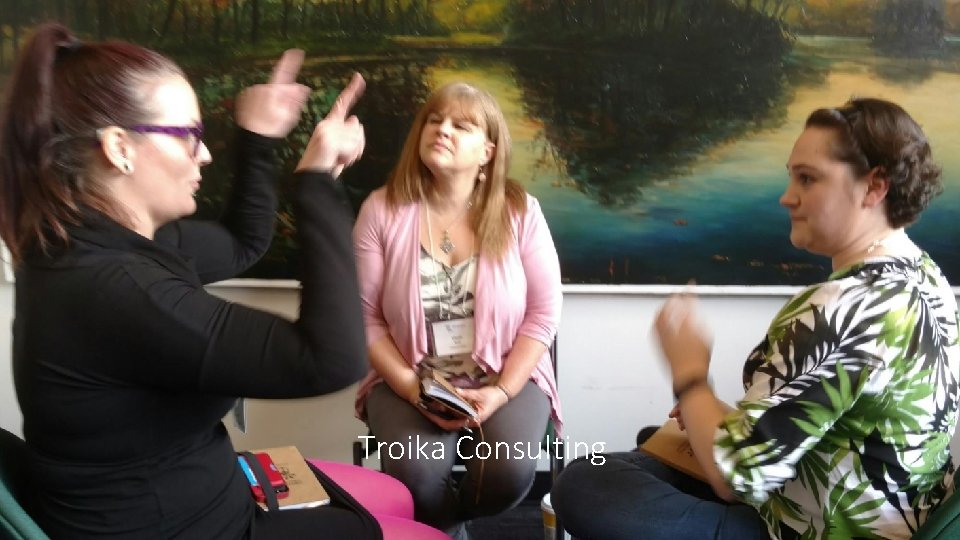
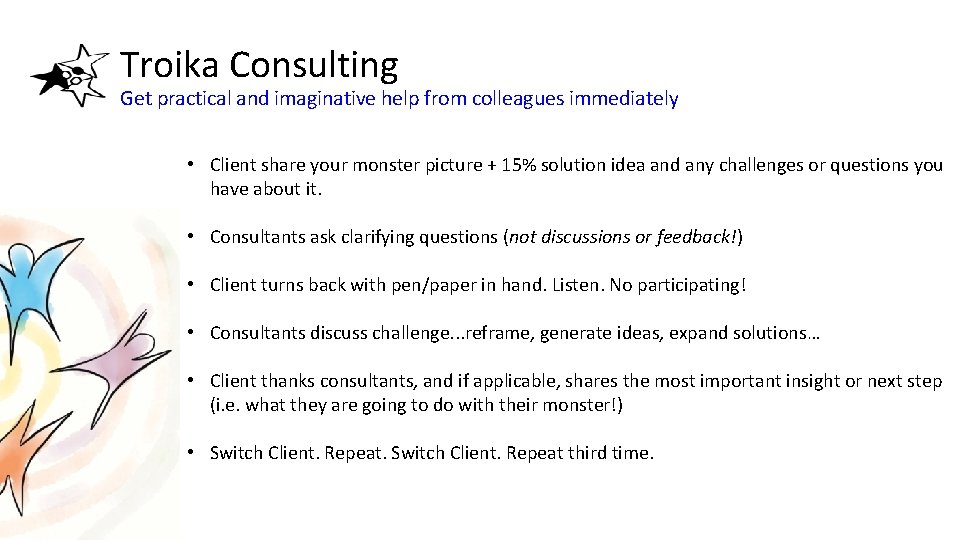
Troika Consulting Get practical and imaginative help from colleagues immediately • Client share your monster picture + 15% solution idea and any challenges or questions you have about it. • Consultants ask clarifying questions (not discussions or feedback!) • Client turns back with pen/paper in hand. Listen. No participating! • Consultants discuss challenge. . . reframe, generate ideas, expand solutions… • Client thanks consultants, and if applicable, shares the most important insight or next step (i. e. what they are going to do with their monster!) • Switch Client. Repeat third time.
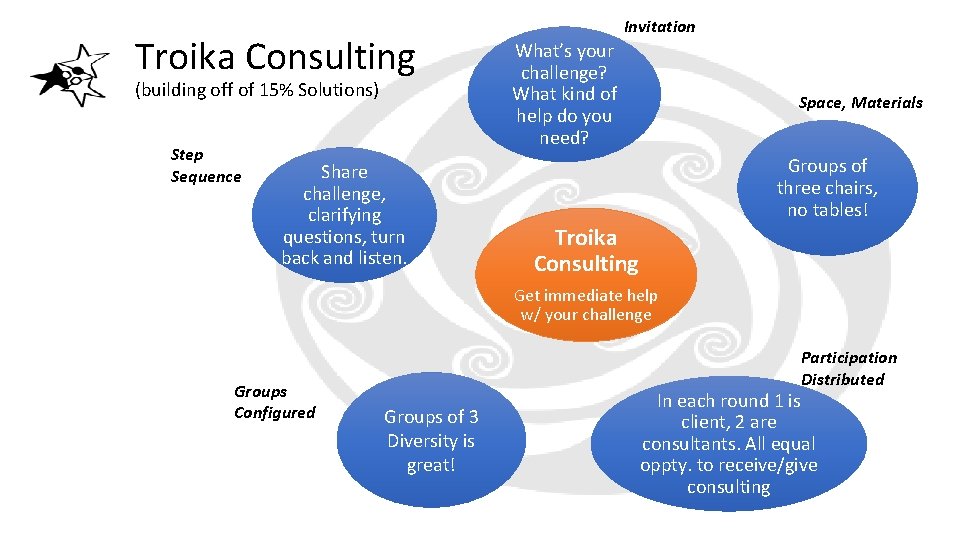
Troika Consulting (building off of 15% Solutions) Step Sequence Share challenge, clarifying questions, turn back and listen. Invitation What’s your challenge? What kind of help do you need? Space, Materials Groups of three chairs, no tables! Troika Consulting Get immediate help w/ your challenge Groups Configured Participation Distributed Groups of 3 Diversity is great! In each round 1 is client, 2 are consultants. All equal oppty. to receive/give consulting
Improv Prototyping
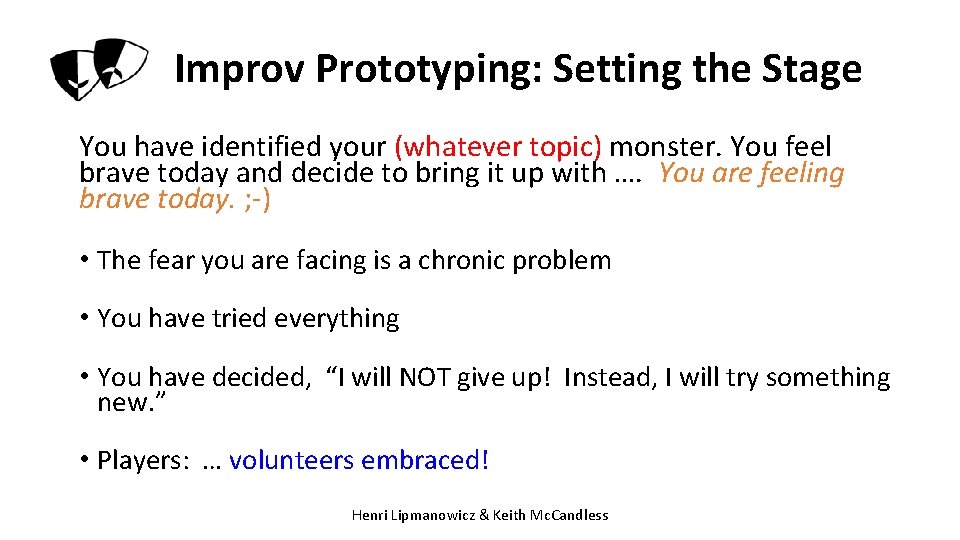
Improv Prototyping: Setting the Stage You have identified your (whatever topic) monster. You feel brave today and decide to bring it up with …. You are feeling brave today. ; -) • The fear you are facing is a chronic problem • You have tried everything • You have decided, “I will NOT give up! Instead, I will try something new. ” • Players: … volunteers embraced! Henri Lipmanowicz & Keith Mc. Candless
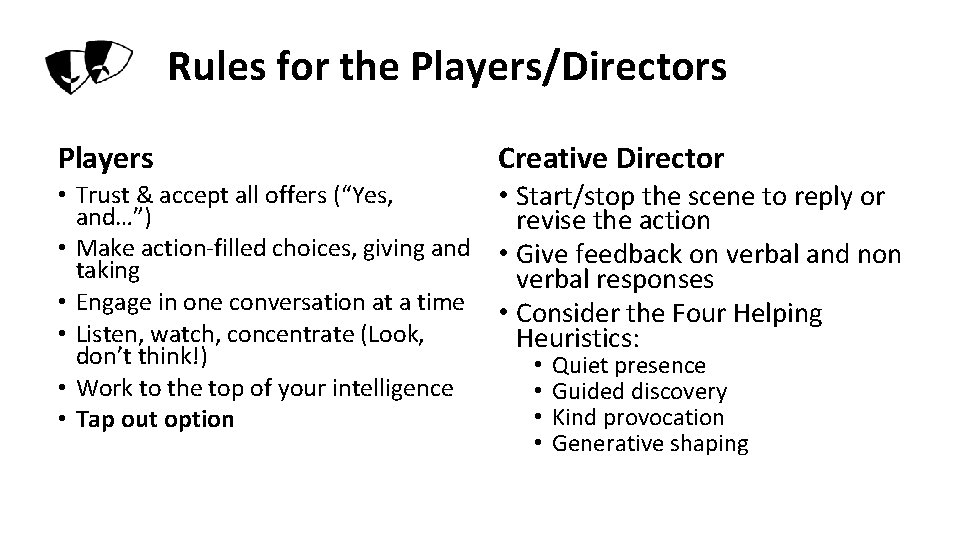
Rules for the Players/Directors Players Creative Director • Trust & accept all offers (“Yes, and…”) • Make action-filled choices, giving and taking • Engage in one conversation at a time • Listen, watch, concentrate (Look, don’t think!) • Work to the top of your intelligence • Tap out option • Start/stop the scene to reply or revise the action • Give feedback on verbal and non verbal responses • Consider the Four Helping Heuristics: • • Quiet presence Guided discovery Kind provocation Generative shaping
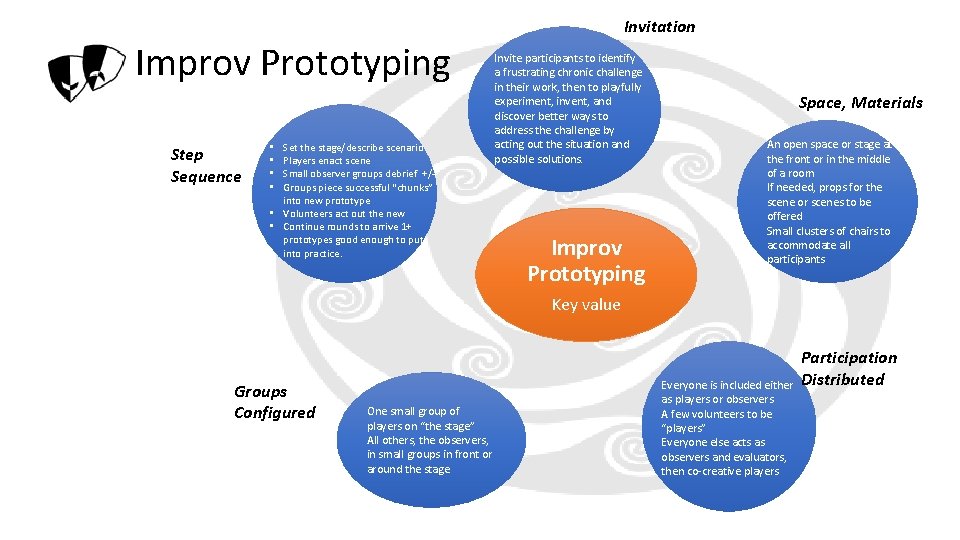
Improv Prototyping Step Sequence Set the stage/describe scenario Players enact scene Small observer groups debrief +/Groups piece successful “chunks” into new prototype • Volunteers act out the new • Continue rounds to arrive 1+ prototypes good enough to put into practice. • • Invitation Invite participants to identify a frustrating chronic challenge in their work, then to playfully experiment, invent, and discover better ways to address the challenge by acting out the situation and possible solutions. Improv Prototyping Space, Materials An open space or stage at the front or in the middle of a room If needed, props for the scene or scenes to be offered Small clusters of chairs to accommodate all participants Key value Groups Configured One small group of players on “the stage” All others, the observers, in small groups in front or around the stage Everyone is included either as players or observers A few volunteers to be “players” Everyone else acts as observers and evaluators, then co-creative players Participation Distributed
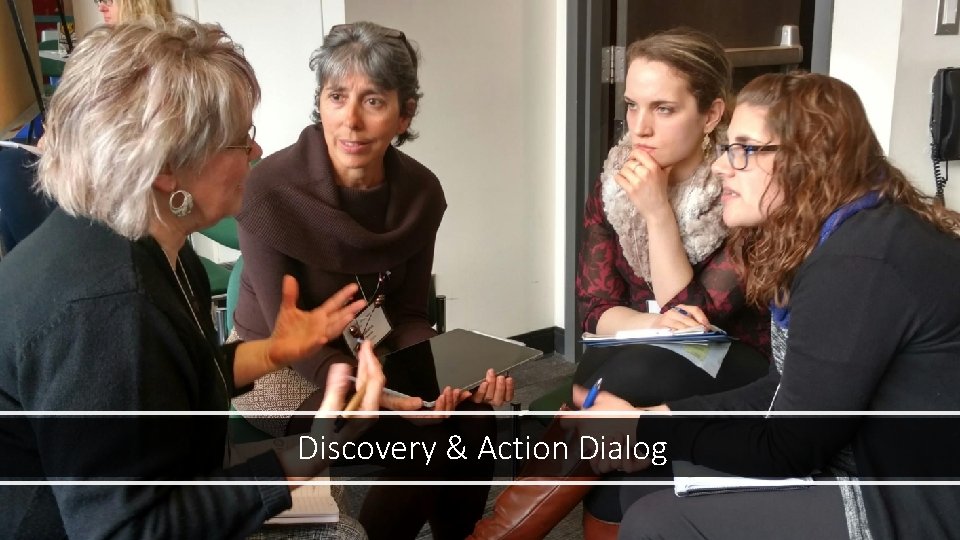
Discovery & Action Dialog
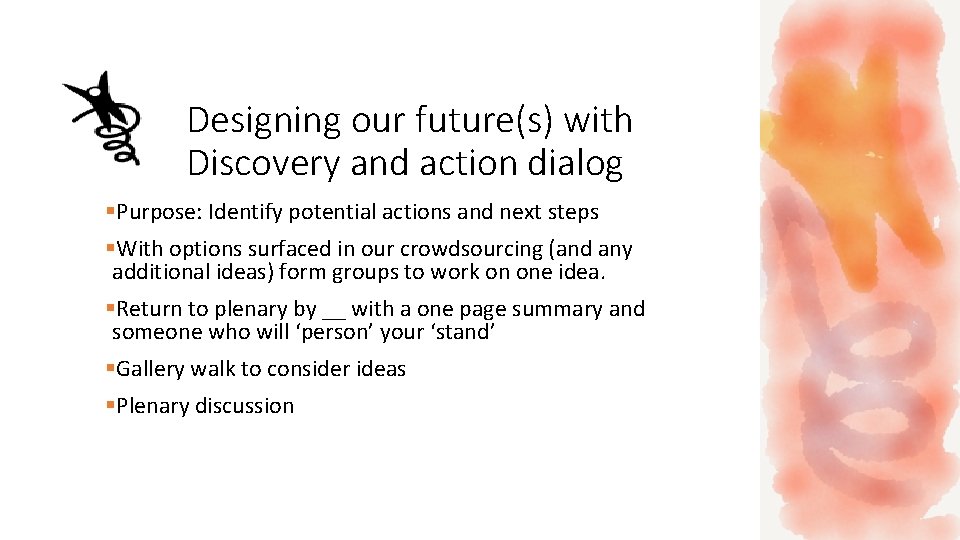
Designing our future(s) with Discovery and action dialog §Purpose: Identify potential actions and next steps §With options surfaced in our crowdsourcing (and any additional ideas) form groups to work on one idea. §Return to plenary by __ with a one page summary and someone who will ‘person’ your ‘stand’ §Gallery walk to consider ideas §Plenary discussion
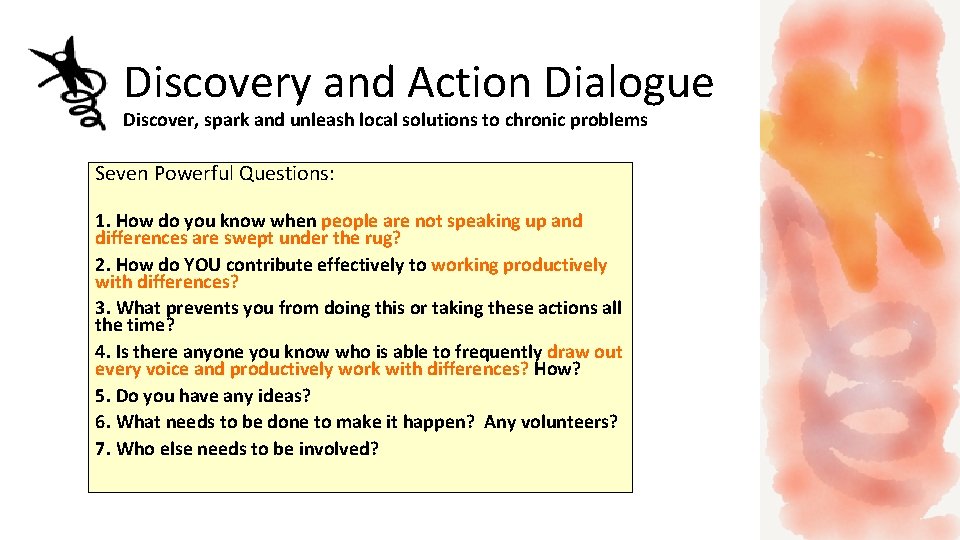
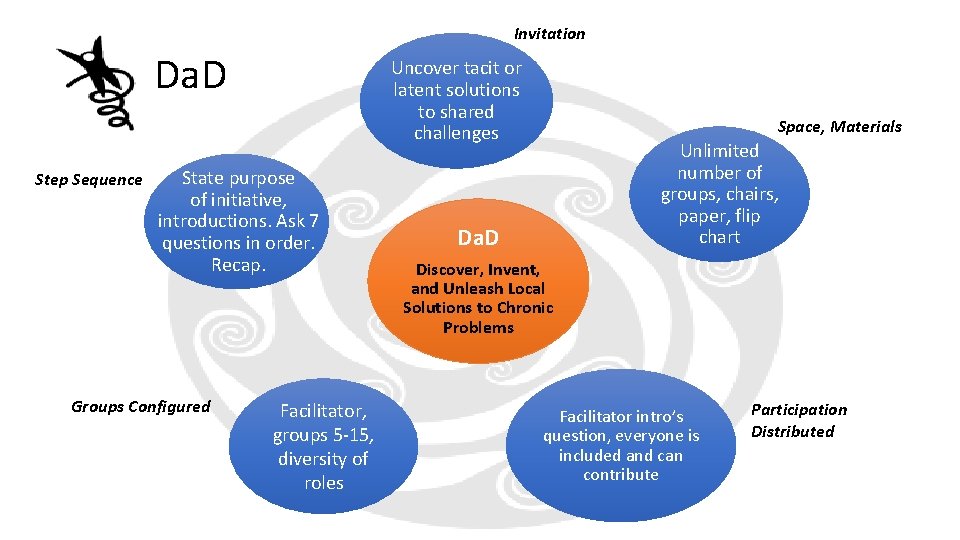
Discovery and Action Dialogue Discover, spark and unleash local solutions to chronic problems Seven Powerful Questions: 1. How do you know when people are not speaking up and differences are swept under the rug? 2. How do YOU contribute effectively to working productively with differences? 3. What prevents you from doing this or taking these actions all the time? 4. Is there anyone you know who is able to frequently draw out every voice and productively work with differences? How? 5. Do you have any ideas? 6. What needs to be done to make it happen? Any volunteers? 7. Who else needs to be involved?
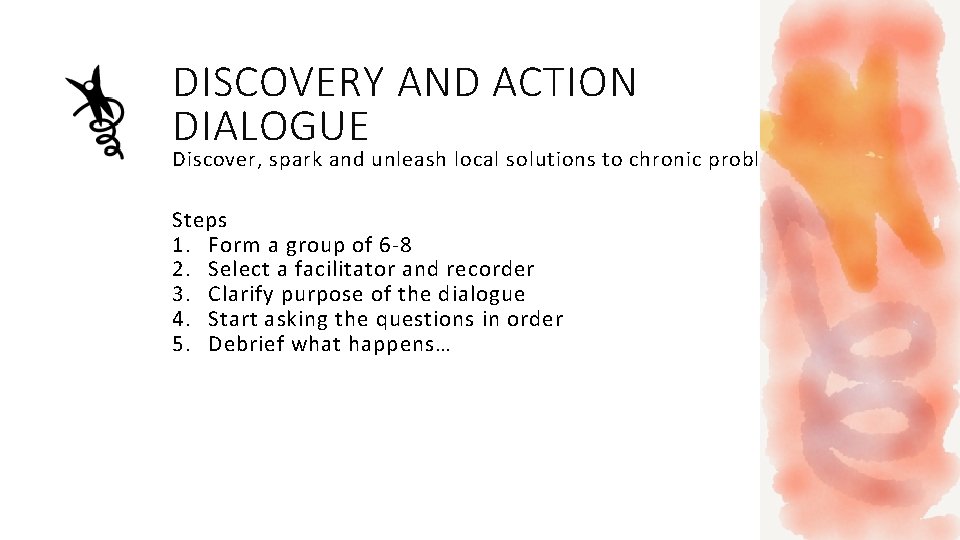
DISCOVERY AND ACTION DIALOGUE Discover, spark and unleash local solutions to chronic problems Steps 1. Form a group of 6 -8 2. Select a facilitator and recorder 3. Clarify purpose of the dialogue 4. Start asking the questions in order 5. Debrief what happens…
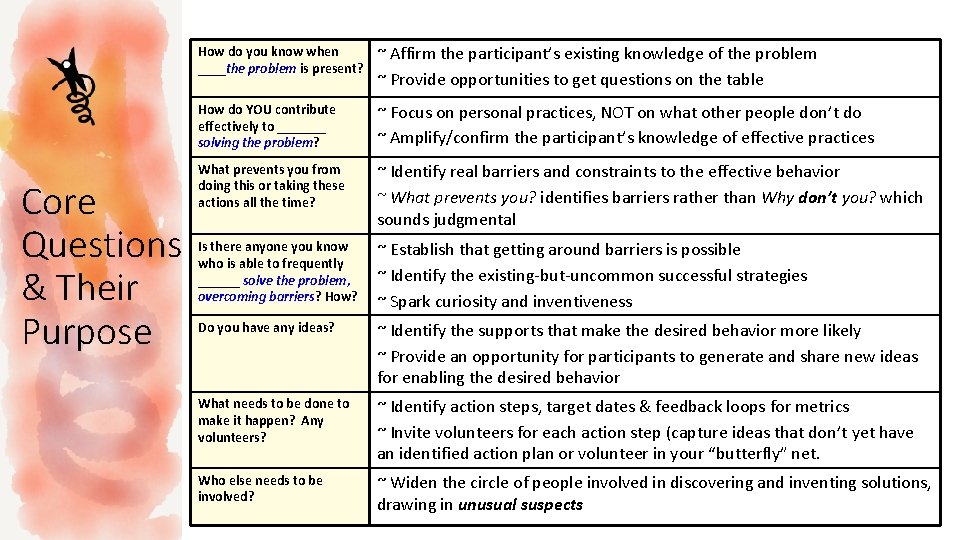
Core Questions & Their Purpose How do you know when ____the problem is present? ~ Affirm the participant’s existing knowledge of the problem ~ Provide opportunities to get questions on the table How do YOU contribute effectively to _______ solving the problem? ~ Focus on personal practices, NOT on what other people don’t do ~ Amplify/confirm the participant’s knowledge of effective practices What prevents you from doing this or taking these actions all the time? ~ Identify real barriers and constraints to the effective behavior ~ What prevents you? identifies barriers rather than Why don’t you? which sounds judgmental Is there anyone you know who is able to frequently ______ solve the problem, overcoming barriers? How? ~ Establish that getting around barriers is possible ~ Identify the existing-but-uncommon successful strategies ~ Spark curiosity and inventiveness Do you have any ideas? ~ Identify the supports that make the desired behavior more likely ~ Provide an opportunity for participants to generate and share new ideas for enabling the desired behavior What needs to be done to make it happen? Any volunteers? ~ Identify action steps, target dates & feedback loops for metrics ~ Invite volunteers for each action step (capture ideas that don’t yet have an identified action plan or volunteer in your “butterfly” net. Who else needs to be involved? ~ Widen the circle of people involved in discovering and inventing solutions, drawing in unusual suspects
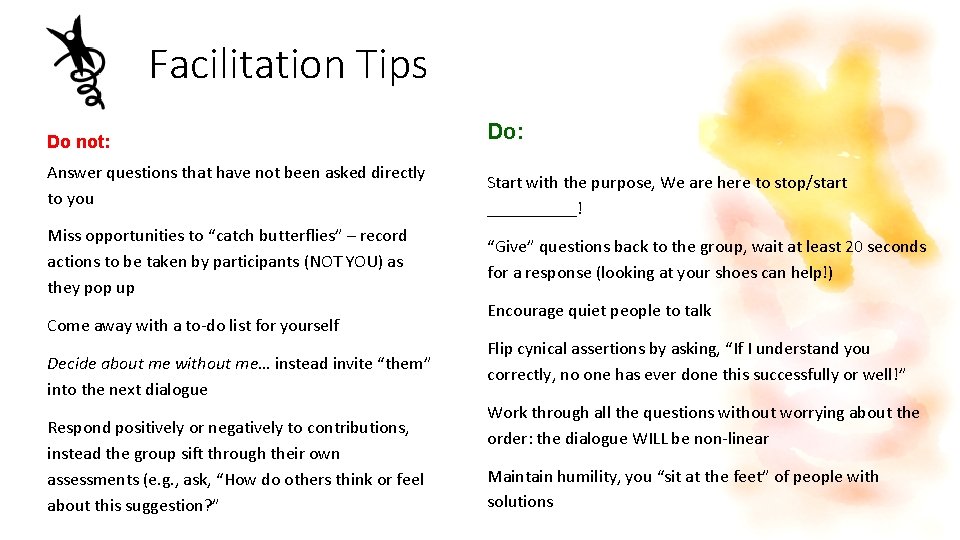
Facilitation Tips Do not: Answer questions that have not been asked directly to you Miss opportunities to “catch butterflies” – record actions to be taken by participants (NOT YOU) as they pop up Come away with a to-do list for yourself Decide about me without me… instead invite “them” into the next dialogue Respond positively or negatively to contributions, instead the group sift through their own assessments (e. g. , ask, “How do others think or feel about this suggestion? ” Do: Start with the purpose, We are here to stop/start _____! “Give” questions back to the group, wait at least 20 seconds for a response (looking at your shoes can help!) Encourage quiet people to talk Flip cynical assertions by asking, “If I understand you correctly, no one has ever done this successfully or well!” Work through all the questions without worrying about the order: the dialogue WILL be non-linear Maintain humility, you “sit at the feet” of people with solutions
Invitation Da. D Step Sequence Uncover tacit or latent solutions to shared challenges State purpose of initiative, introductions. Ask 7 questions in order. Recap. Groups Configured Facilitator, groups 5 -15, diversity of roles Space, Materials Unlimited number of groups, chairs, paper, flip chart Da. D Discover, Invent, and Unleash Local Solutions to Chronic Problems Facilitator intro’s question, everyone is included and can contribute Participation Distributed
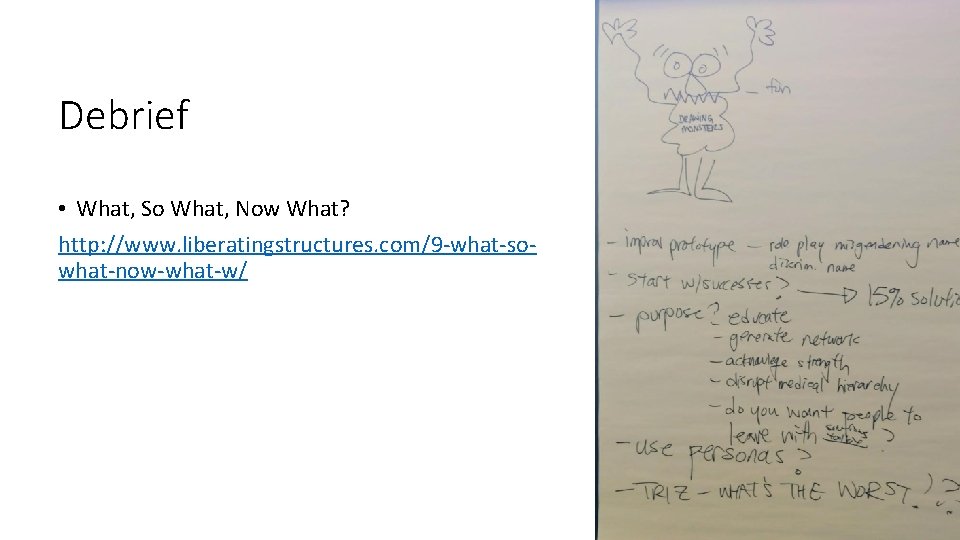
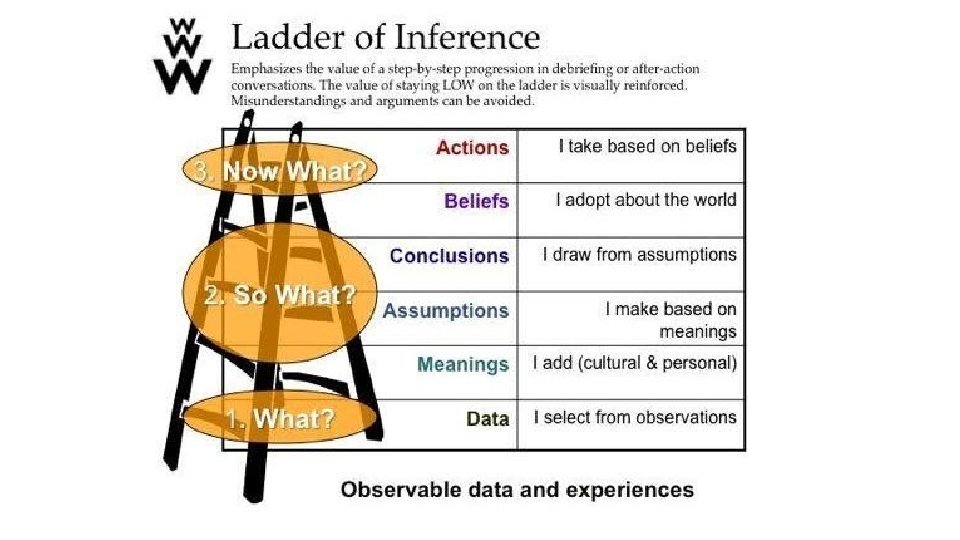
Debrief • What, So What, Now What? http: //www. liberatingstructures. com/9 -what-sowhat-now-what-w/
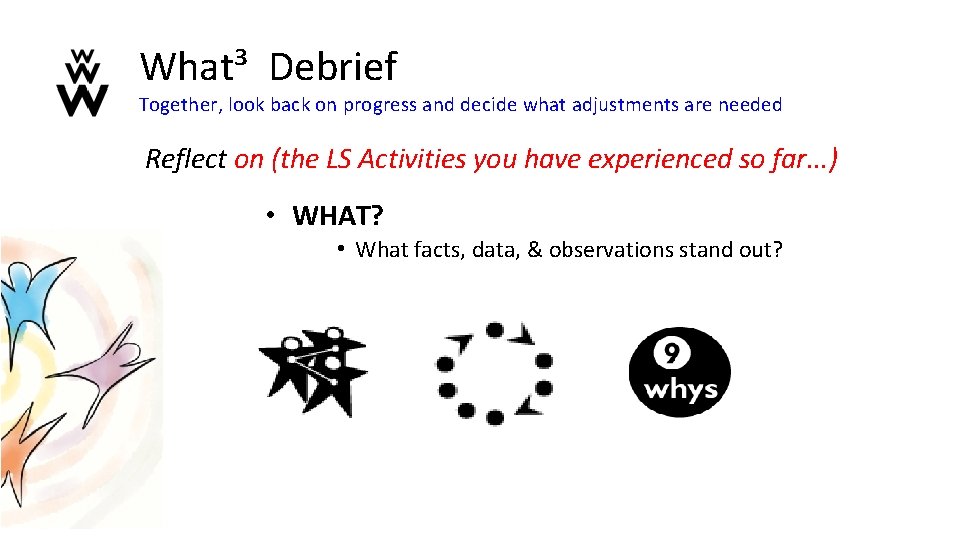
What³ Debrief Together, look back on progress and decide what adjustments are needed Reflect on (the LS Activities you have experienced so far. . . ) • WHAT? • What facts, data, & observations stand out?
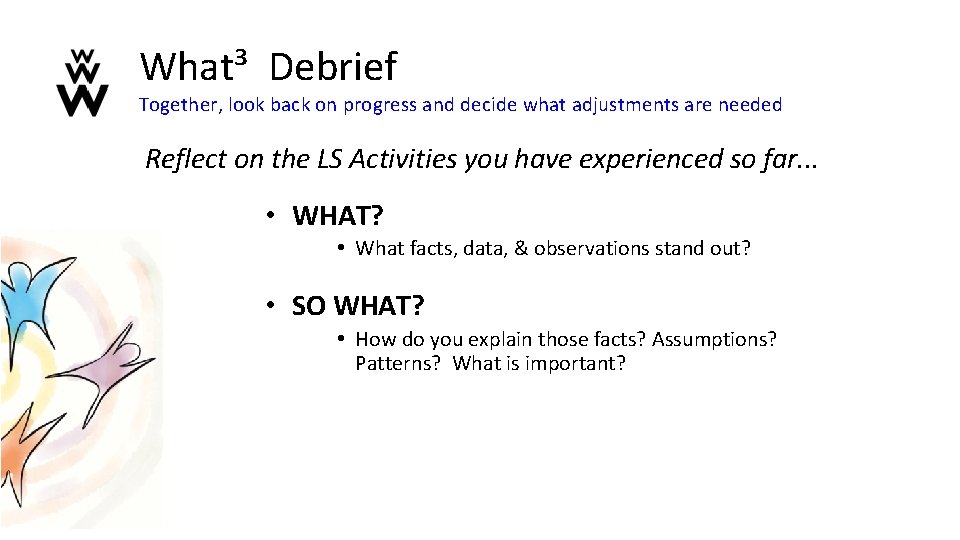
What³ Debrief Together, look back on progress and decide what adjustments are needed Reflect on the LS Activities you have experienced so far. . . • WHAT? • What facts, data, & observations stand out? • SO WHAT? • How do you explain those facts? Assumptions? Patterns? What is important?
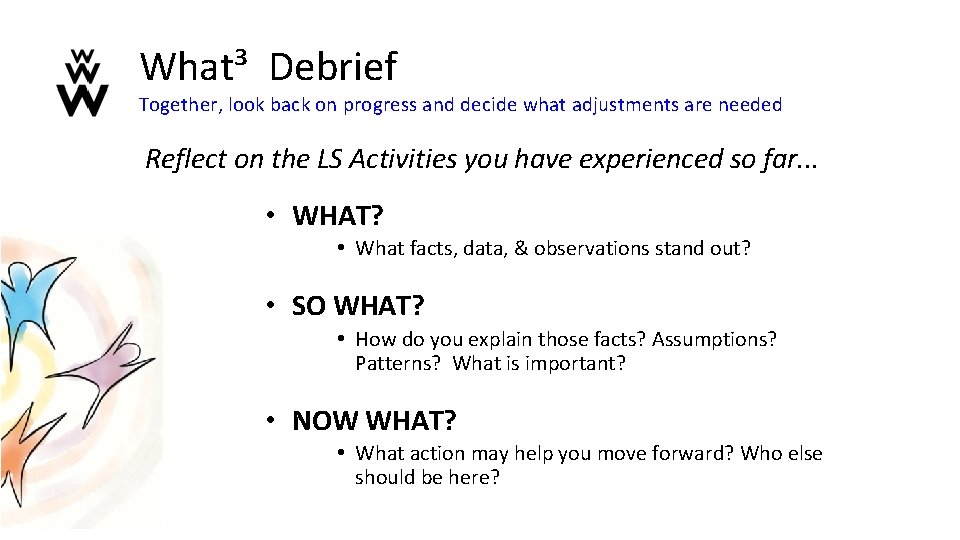
What³ Debrief Together, look back on progress and decide what adjustments are needed Reflect on the LS Activities you have experienced so far. . . • WHAT? • What facts, data, & observations stand out? • SO WHAT? • How do you explain those facts? Assumptions? Patterns? What is important? • NOW WHAT? • What action may help you move forward? Who else should be here?
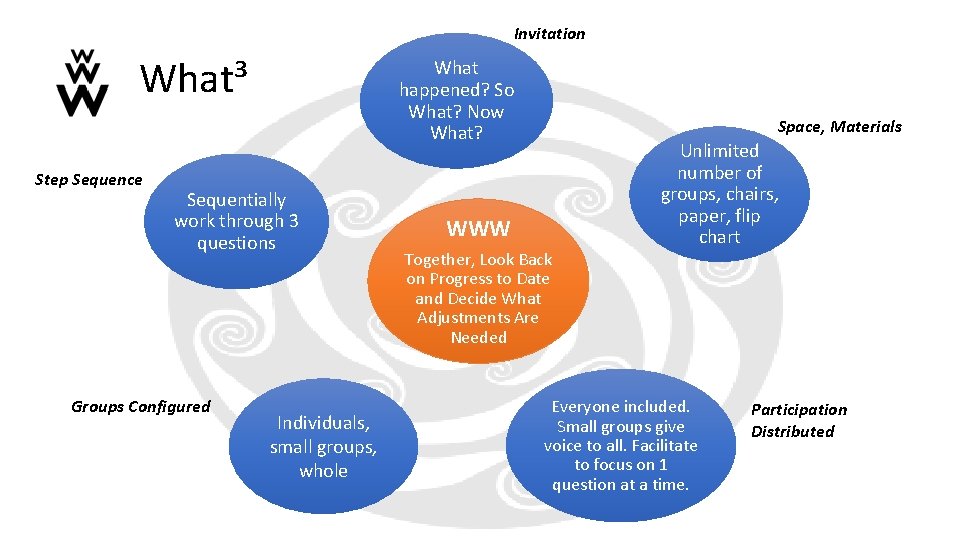
Invitation What³ Step Sequence What happened? So What? Now What? Sequentially work through 3 questions Groups Configured Individuals, small groups, whole Space, Materials WWW Together, Look Back on Progress to Date and Decide What Adjustments Are Needed Unlimited number of groups, chairs, paper, flip chart Everyone included. Small groups give voice to all. Facilitate to focus on 1 question at a time. Participation Distributed