Dr Lynn Donahue PSJS 250 Social Change through





- Slides: 43
Dr. Lynn Donahue PSJS 250: Social Change through Service CULTURAL SENSITIVITY IN SERVICE LEARNING
EMPATHY
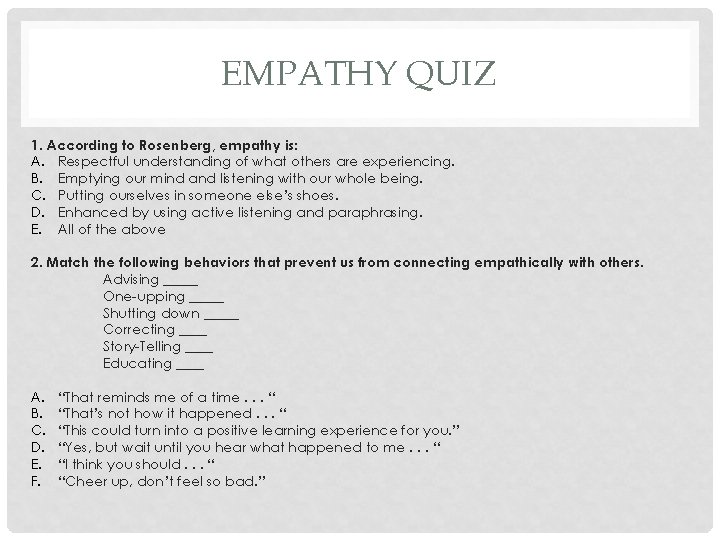
EMPATHY QUIZ 1. According to Rosenberg, empathy is: A. Respectful understanding of what others are experiencing. B. Emptying our mind and listening with our whole being. C. Putting ourselves in someone else’s shoes. D. Enhanced by using active listening and paraphrasing. E. All of the above 2. Match the following behaviors that prevent us from connecting empathically with others. Advising _____ One-upping _____ Shutting down _____ Correcting ____ Story-Telling ____ Educating ____ A. B. C. D. E. F. “That reminds me of a time. . . “ “That’s not how it happened. . . “ “This could turn into a positive learning experience for you. ” “Yes, but wait until you hear what happened to me. . . “ “I think you should. . . “ “Cheer up, don’t feel so bad. ”
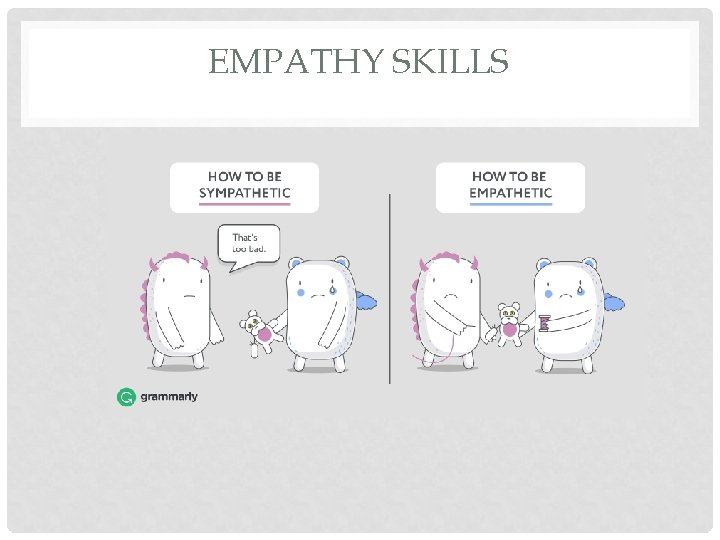
EMPATHY SKILLS
EMPATHY SKILLS • Paraphrasing Reflect back what you thought you heard to make sure what you heard was correct. • Re-phrase content and feelings to encourage additional conversation.
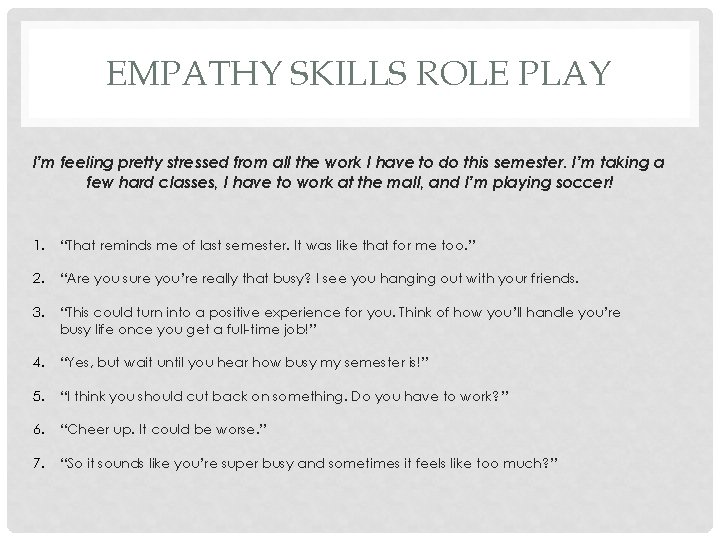
EMPATHY SKILLS ROLE PLAY I’m feeling pretty stressed from all the work I have to do this semester. I’m taking a few hard classes, I have to work at the mall, and I’m playing soccer! 1. “That reminds me of last semester. It was like that for me too. ” 2. “Are you sure you’re really that busy? I see you hanging out with your friends. 3. “This could turn into a positive experience for you. Think of how you’ll handle you’re busy life once you get a full-time job!” 4. “Yes, but wait until you hear how busy my semester is!” 5. “I think you should cut back on something. Do you have to work? ” 6. “Cheer up. It could be worse. ” 7. “So it sounds like you’re super busy and sometimes it feels like too much? ”
Video Empathy Video
REFLECTION AND DISCUSSION 1. According to Rosenberg AND the guest speaker, what is empathy? 2. How can empathy be developed and practiced? 3. How do you think you have been empathic to date with your work? 4. What have you learned about empathy that can be applied to your next visit on-site? Use specific examples from your servicelearning work when answering this question.
HIDDEN BIAS
WHAT IS HIDDEN BIAS? • Feelings and attitudes about other people based on characteristics such as race, ethnicity, age, and appearance. • Biases that are activated involuntarily and without an individual’s awareness or intentional control. • Associations that are developed over the course of a lifetime beginning at an early age through exposure to direct and indirect messages. • Implicit associations that do not necessarily align with our declared beliefs or even reflect stances we would explicitly endorse. http: //kirwaninstitute. osu. edu/research/understanding-implicit-bias/
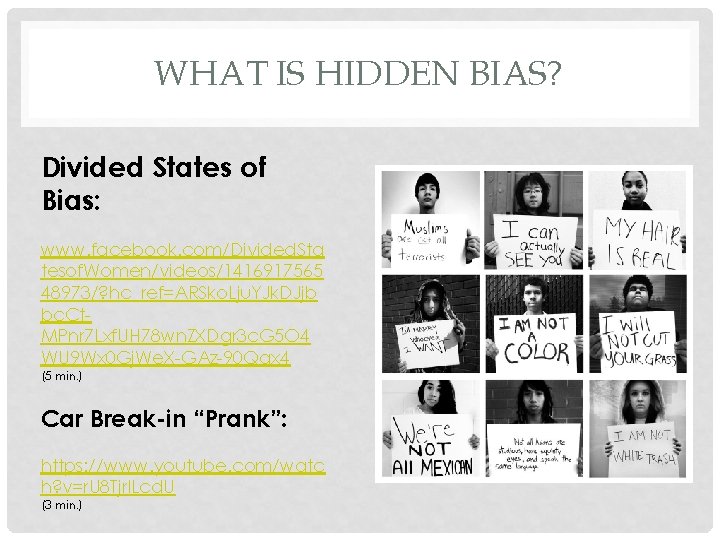
WHAT IS HIDDEN BIAS? Divided States of Bias: www. facebook. com/Divided. Sta tesof. Women/videos/1416917565 48973/? hc_ref=ARSko. Lju. YJk. DJjb bc. Ct. MPnr 7 Lxf. UH 78 wn. ZXDgr 3 c. G 5 O 4 WU 9 Wx 0 Gj. We. X-GAz-90 Qax 4 (5 min. ) Car Break-in “Prank”: https: //www. youtube. com/watc h? v=r. U 8 Tjr. ILcd. U (3 min. )
WE CAN’T ADDRESS WHAT WE DON’T NOTICE OR KNOW Awareness Test https: //www. youtube. com/watch? v=Ahg 6 qcgoay 4 Implicit Bias Test https: //implicit. harvard. edu/implicit/
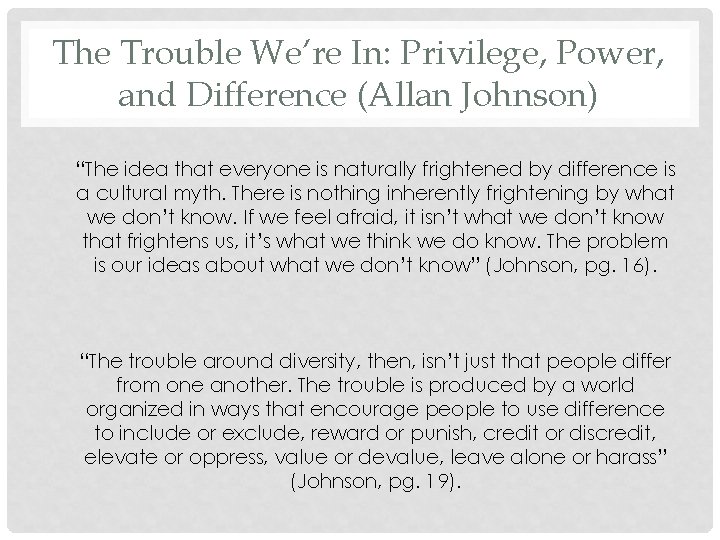
PRIVILEGE Johnson, Allen. “The Trouble We’re In: Privilege, Power, and Difference”
MAPPING DIFFERENCE The real illusion connection to difference is the assumption that people are naturally afraid of what they don’t know or understand. This makes it inevitable that you’ll fear or distrust people who aren’t like you, in spite of your good intentions. This is a Myth! This thinking justifies keeping outsiders on the outside and treating them badly if they get in. There is nothing inherently frightening about what we don’t know. It’s what we think we don’t know that frightens us. The trouble is not that we’re different. The trouble is how we use difference to include or exclude, reward or punish, discredit or elevate, value or devalue.
SOCIAL CONSTRUCTION OF DIFFERENCE Unless you live in a culture that recognizes that differences in skin color are meaningful, they are socially irrelevant. A “black women” in Africa who has not experienced racism will not think of herself as black. When she comes to the United States where privilege is organized according to race, she becomes black because people assign her to that category and treat her differently as a result. In the past, Irish, Italians, and Jews were considered inferior race when immigrated here and were excluded and exploited.
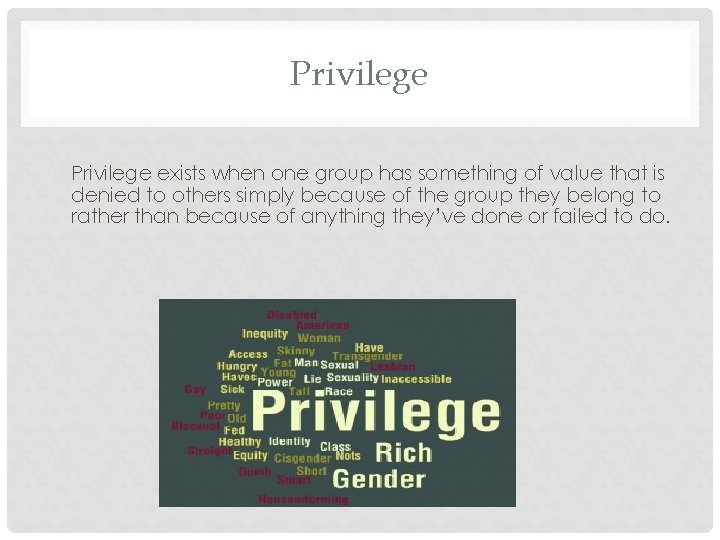
Privilege exists when one group has something of value that is denied to others simply because of the group they belong to rather than because of anything they’ve done or failed to do.
TWO TYPES OF PRIVILEGE 1. Unearned Entitlements: Things people should have (feeling safe in public spaces or working at a location where valued). 2. Conferred Dominance – When one group has power over another (white vs. black, women vs. men, young vs. old)
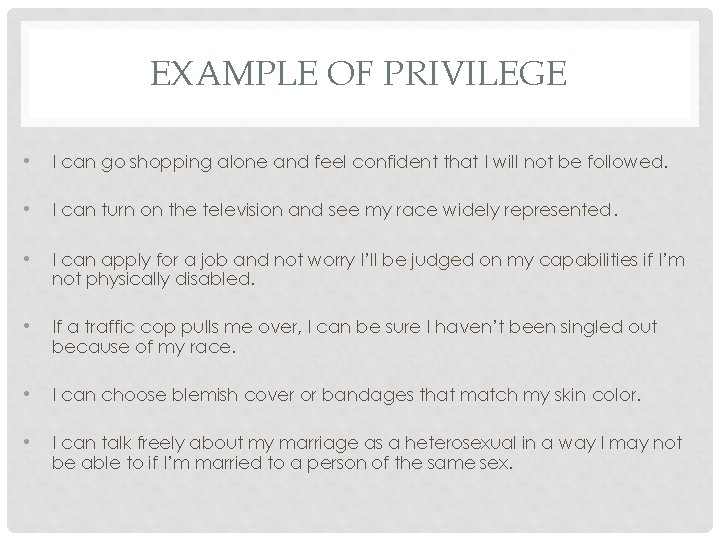
EXAMPLE OF PRIVILEGE • I can go shopping alone and feel confident that I will not be followed. • I can turn on the television and see my race widely represented. • I can apply for a job and not worry I’ll be judged on my capabilities if I’m not physically disabled. • If a traffic cop pulls me over, I can be sure I haven’t been singled out because of my race. • I can choose blemish cover or bandages that match my skin color. • I can talk freely about my marriage as a heterosexual in a way I may not be able to if I’m married to a person of the same sex.
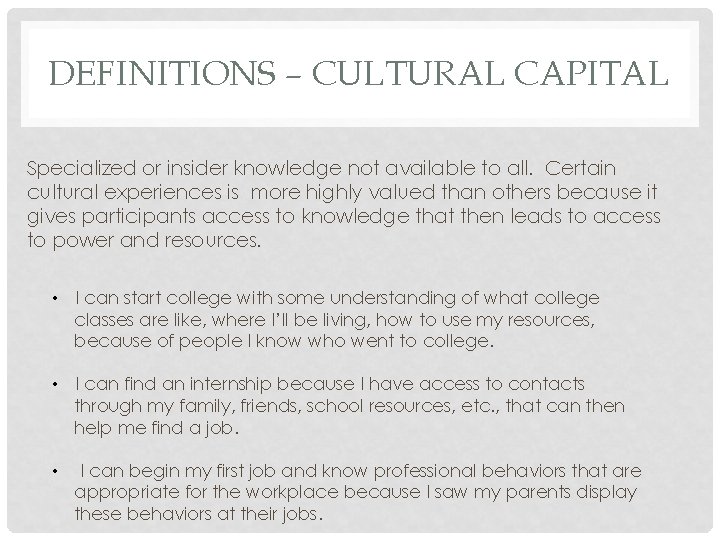
DEFINITIONS – CULTURAL CAPITAL Specialized or insider knowledge not available to all. Certain cultural experiences is more highly valued than others because it gives participants access to knowledge that then leads to access to power and resources. • I can start college with some understanding of what college classes are like, where I’ll be living, how to use my resources, because of people I know who went to college. • I can find an internship because I have access to contacts through my family, friends, school resources, etc. , that can then help me find a job. • I can begin my first job and know professional behaviors that are appropriate for the workplace because I saw my parents display these behaviors at their jobs.
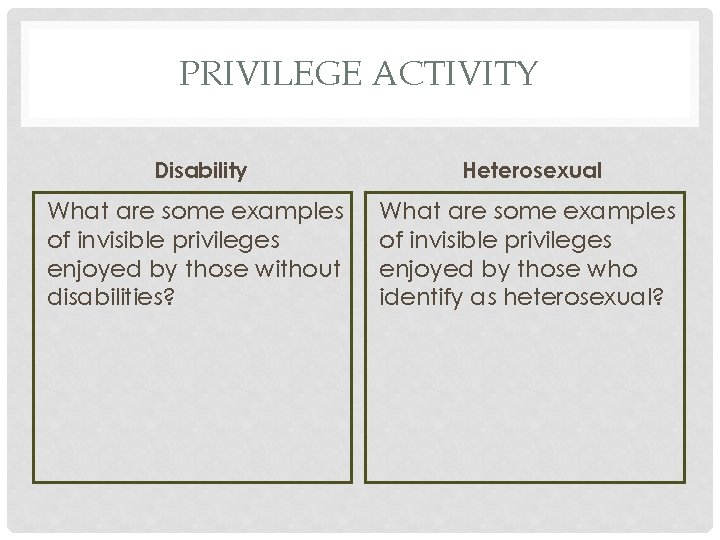
PRIVILEGE ACTIVITY Disability Heterosexual What are some examples of invisible privileges enjoyed by those without disabilities? What are some examples of invisible privileges enjoyed by those who identify as heterosexual?
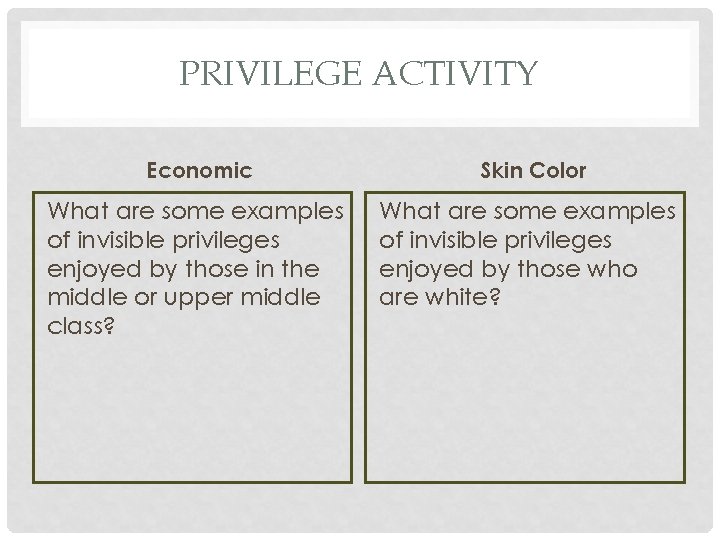
PRIVILEGE ACTIVITY Economic Skin Color What are some examples of invisible privileges enjoyed by those in the middle or upper middle class? What are some examples of invisible privileges enjoyed by those who are white?
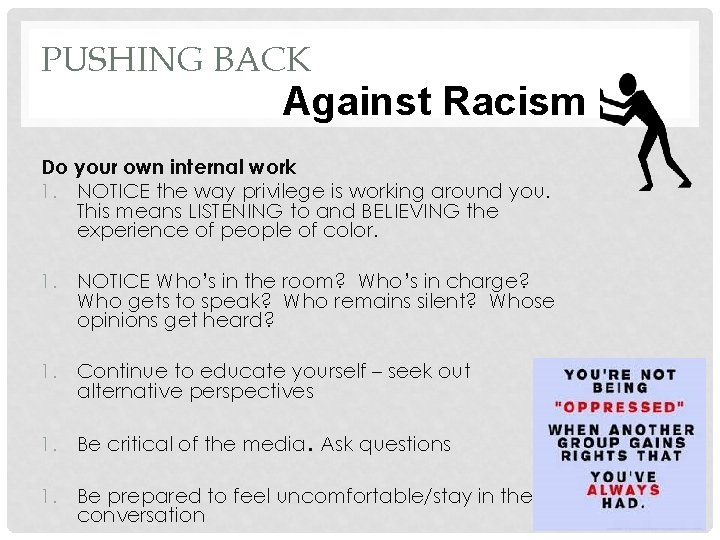
PUSHING BACK Against Racism Do your own internal work 1. NOTICE the way privilege is working around you. This means LISTENING to and BELIEVING the experience of people of color. 1. NOTICE Who’s in the room? Who’s in charge? Who gets to speak? Who remains silent? Whose opinions get heard? 1. Continue to educate yourself – seek out alternative perspectives 1. Be critical of the media. Ask questions 1. Be prepared to feel uncomfortable/stay in the conversation
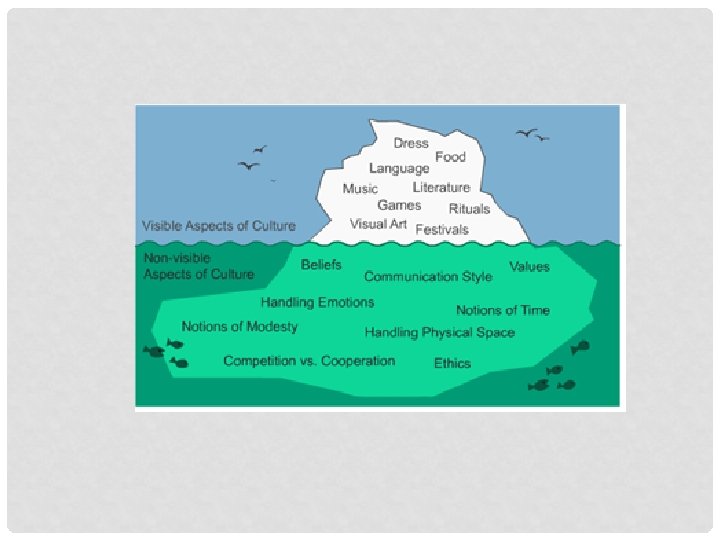
CULTURE
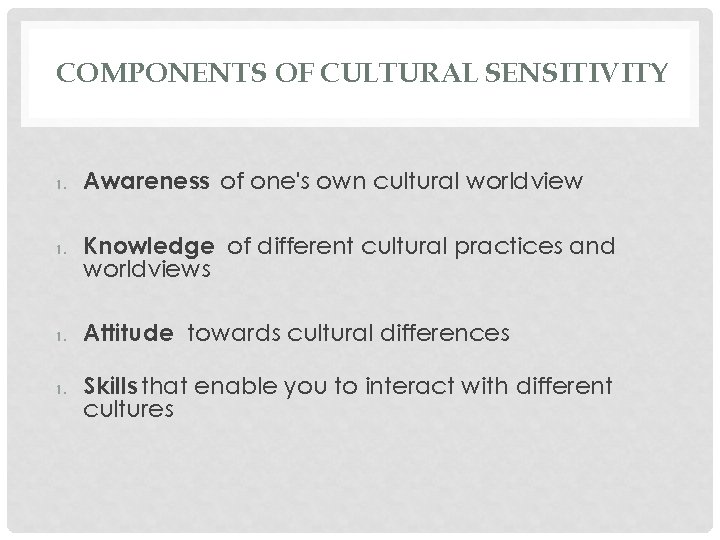
COMPONENTS OF CULTURAL SENSITIVITY 1. 1. Awareness of one's own cultural worldview Knowledge of different cultural practices and worldviews Attitude towards cultural differences Skills that enable you to interact with different cultures
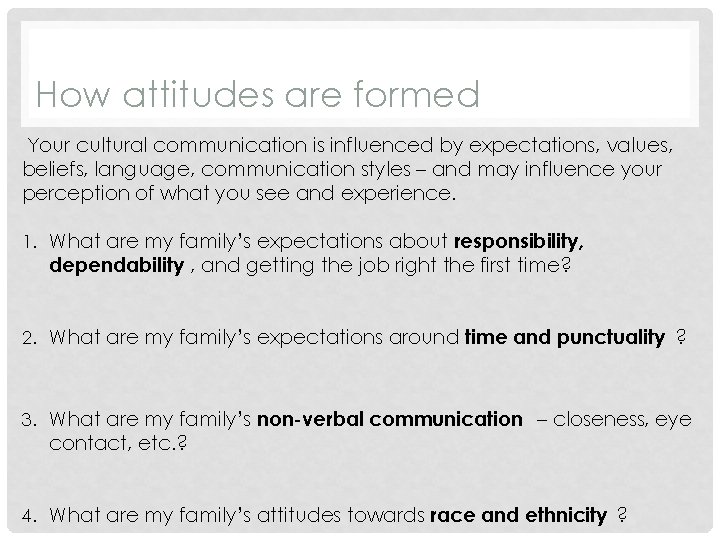
How attitudes are formed Your cultural communication is influenced by expectations, values, beliefs, language, communication styles – and may influence your perception of what you see and experience. 1. What are my family’s expectations about responsibility, dependability , and getting the job right the first time? 2. What are my family’s expectations around time and punctuality ? 3. What are my family’s non-verbal communication – closeness, eye contact, etc. ? 4. What are my family’s attitudes towards race and ethnicity ?
SOCIAL IDENTITY AND PERCEPTION
The Trouble We’re In: Privilege, Power, and Difference (Allan Johnson) “The idea that everyone is naturally frightened by difference is a cultural myth. There is nothing inherently frightening by what we don’t know. If we feel afraid, it isn’t what we don’t know that frightens us, it’s what we think we do know. The problem is our ideas about what we don’t know” (Johnson, pg. 16). “The trouble around diversity, then, isn’t just that people differ from one another. The trouble is produced by a world organized in ways that encourage people to use difference to include or exclude, reward or punish, credit or discredit, elevate or oppress, value or devalue, leave alone or harass” (Johnson, pg. 19).
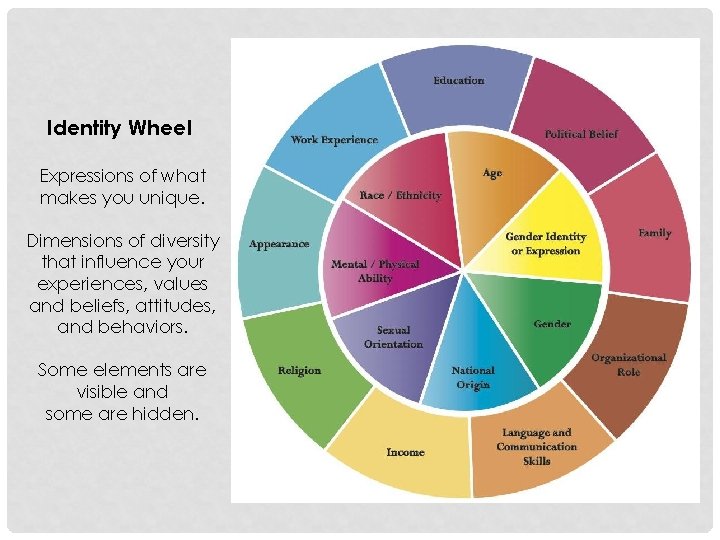
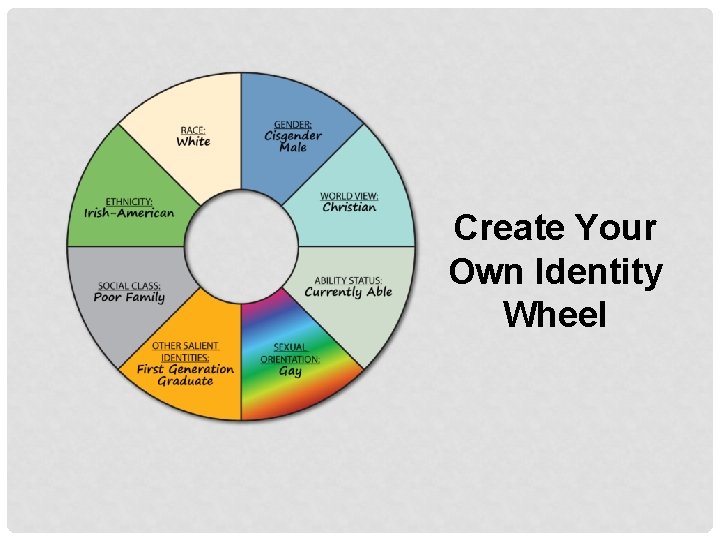
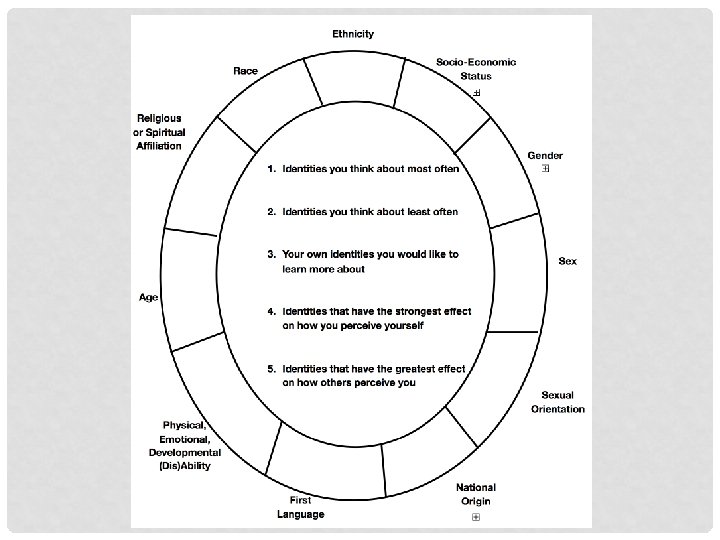
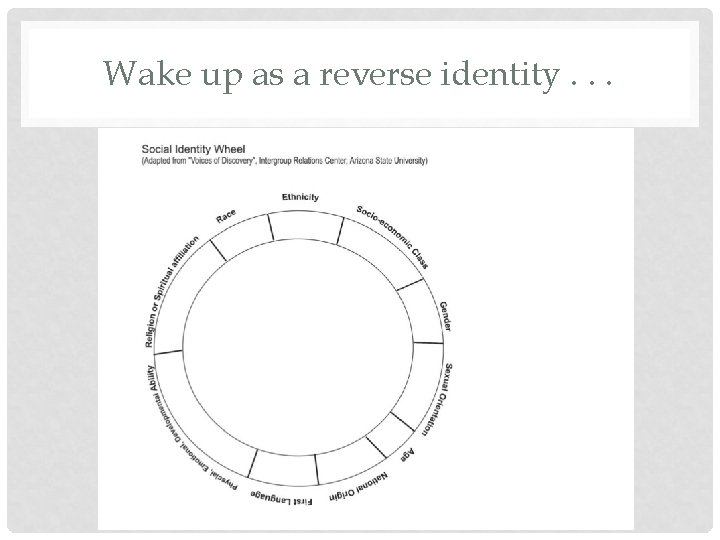
Identity Wheel Expressions of what makes you unique. Dimensions of diversity that influence your experiences, values and beliefs, attitudes, and behaviors. Some elements are visible and some are hidden.
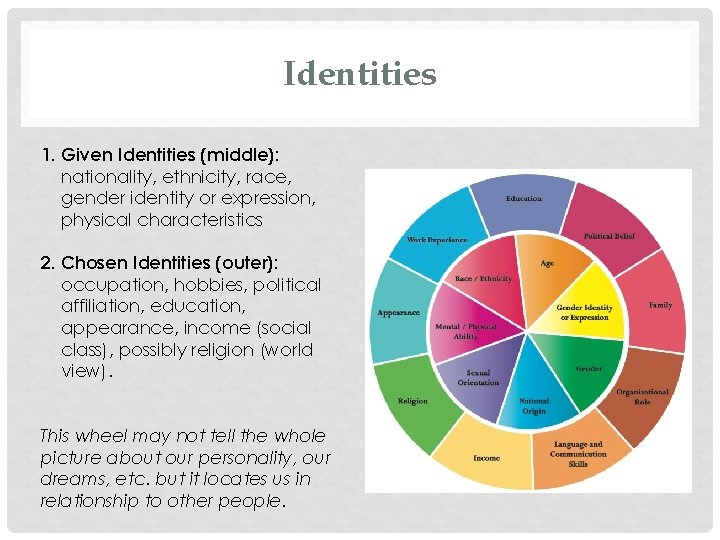
Identities 1. Given Identities (middle): nationality, ethnicity, race, gender identity or expression, physical characteristics 2. Chosen Identities (outer): occupation, hobbies, political affiliation, education, appearance, income (social class), possibly religion (world view). This wheel may not tell the whole picture about our personality, our dreams, etc. but it locates us in relationship to other people.
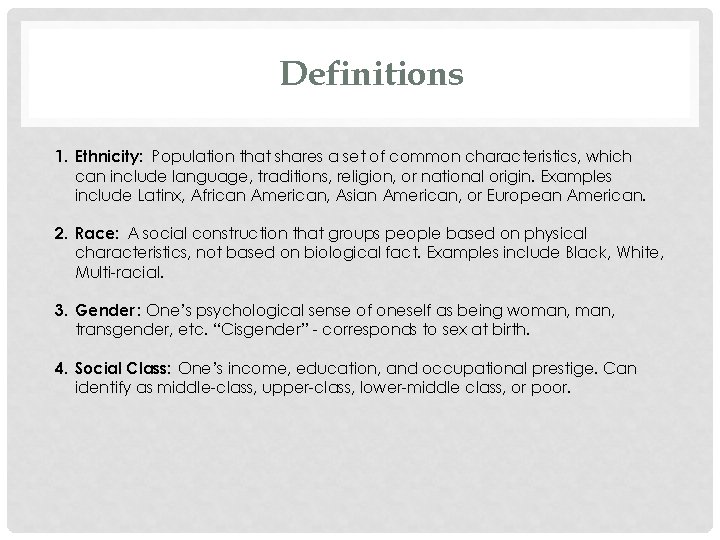
Definitions 1. Ethnicity: Population that shares a set of common characteristics, which can include language, traditions, religion, or national origin. Examples include Latinx, African American, Asian American, or European American. 2. Race: A social construction that groups people based on physical characteristics, not based on biological fact. Examples include Black, White, Multi-racial. 3. Gender : One’s psychological sense of oneself as being woman, transgender, etc. “Cisgender” - corresponds to sex at birth. 4. Social Class: One’s income, education, and occupational prestige. Can identify as middle-class, upper-class, lower-middle class, or poor.
Create Your Own Identity Wheel
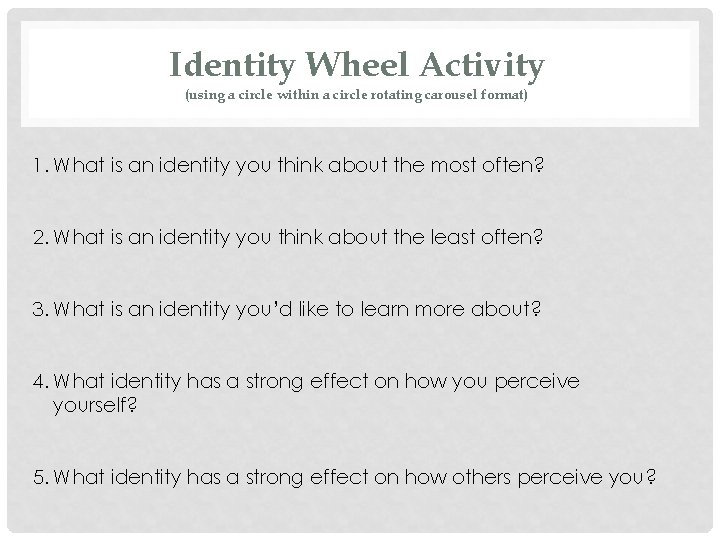
Identity Wheel Activity (using a circle within a circle rotating carousel format) 1. What is an identity you think about the most often? 2. What is an identity you think about the least often? 3. What is an identity you’d like to learn more about? 4. What identity has a strong effect on how you perceive yourself? 5. What identity has a strong effect on how others perceive you?
Wake up as a reverse identity. . .
Putting it Together - Carly is a curious 7 year old African American 2 nd grader who loves coming to school to see her friend and her teacher, but dreads reading and writing. The words feel confusing to her and when she tries to put her ideas on paper, they come out all wrong. She only has a few books at home, but she thinks they’re for babies. Sometimes she just feels like giving up. It doesn’t help that a few times a week she misses her ELA class and keeps on falling behind. Some of the kids tease her for not reading out loud well. She gets so angry when they do this that she just wants to hit them, or cry. She loves when her best friend sticks up for her and tells them to leave her alone because she was told not to complain and keep her head down. Her teacher helps, but he sometimes seems too busy with the other kids. She wishes she could just play all day.
Application What concepts have you learned that can help you understand Carly? What concepts have you learned that you could use to help her? 1. Empathy 2. Hidden Bias 3. Privilege 4. Cultural Capital 5. Cultural attitudes 6. Social identity – economic status, race, gender, ability 7. Assets 8. Resiliency 9. Trauma 10. Single Story
Reflection #6 1. What overlapping stories are you identifying in the culture you are working with and how might they contrast with or be similar to yours? 2. How can your understanding of "hidden bias“, "single story“, and “social identity” equip you to interact effectively with diverse populations?
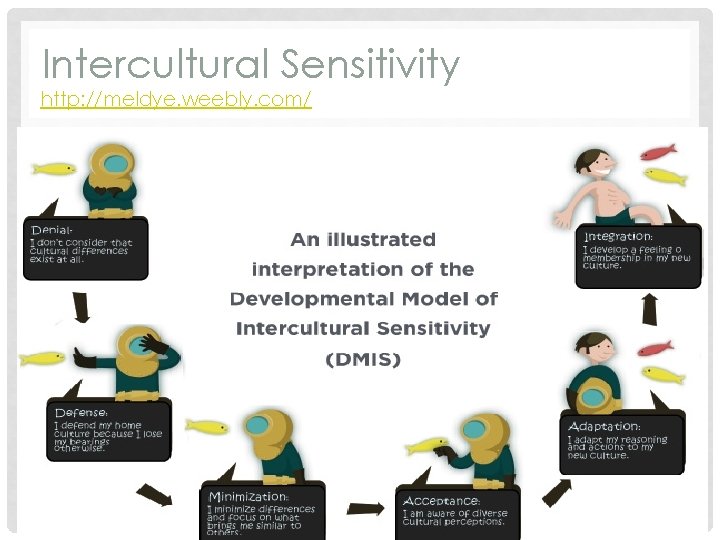
Intercultural Sensitivity http: //meldye. weebly. com/
A SINGLE STORY
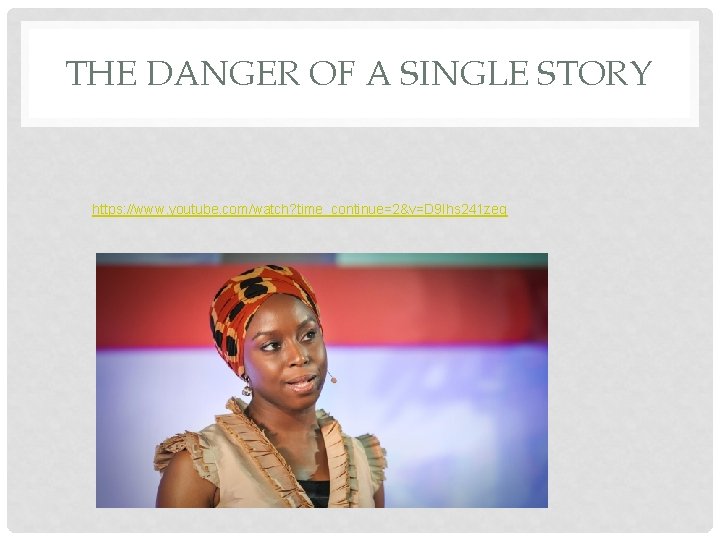
THE DANGER OF A SINGLE STORY https: //www. youtube. com/watch? time_continue=2&v=D 9 Ihs 241 zeg
How do we Achieve Cultural Sensitivity? ○ Understand we can’t know everything about every group of people. Be careful of stereotyping, but allow yourself to make some generalizations ○ Cultural sensitivity comes when human differences are celebrated instead of viewed with skepticism. ○ Instead of treating others like you’d like to be treated – treat others like they would like to be treated. ○ Meet people where they are and acknowledge cultural differences. View behavior within a cultural context
REFLECTION AND DISCUSSION 1. What are your cultural beliefs, attitudes, behaviors, and "rules of class"? 2. How do they contrast with or are similar to the beliefs, attitudes, behaviors, and "rules of class" of the “culture” you are working with? 3. Chimamanda Adichie in The Danger of a Single Story says “our lives, our cultures, are composed of many overlapping stories”. What overlapping stories are you identifying in the culture you are working with and how might they contrast with or be similar to yours? 4. What hidden biases might be present? Now put this all together. 5. How does your understanding of culture, "Single Story, " and hidden bias help you interact effectively with diverse populations at your SL site? Provide examples.