
Speaker Firms and Organization Presented By Marashlian Donahue
Speaker Firms and Organization: Presented By: Marashlian & Donahue, PLLC Seth L. Williams Attorney Ifrah Law Michelle Cohen Member Partner Firms: Marashlian & Donahue, PLLC Nathaniel J. Hardy Of Counsel Thank you for logging into today’s event. Please note we are in standby mode. All Microphones will be muted until the event starts. We will be back with speaker instructions @ 9: 55 am. Any Questions? Please email: info@theknowledegroup. org Group Registration Policy Please note ALL participants must be registered or they will not be able to access the event. If you have more than one person from your company attending, you must fill out the group registration form. We reserve the right to disconnect any unauthorized users from this event and to deny violators admission to future events. To obtain a group registration please send a note to info@theknowledgegroup. org or call 646. 202. 9344. 1 March 31, 2016
Ø Please note the FAQ. HELP TAB located to the right of the main presentation. On this page you will find answers to the top questions asked by attendees during webcast such as how to fix audio issues, where to download the slides and what to do if you miss a secret word. To access this tab, click the FAQ. HELP Tab to the right of the main presentation when you’re done click the tab of the main presentation to get back. Ø For those viewing the webcast on a mobile device, please note: o o o o These instructions are for Apple and Android devices only. If you are using a Windows tablet, please follow the instructions for viewing the webcast on a PC. The FAQ. HELP TAB will not be visible on mobile devices. You will receive the frequently asked questions & other pertinent info through the apps chat window function on your device. On Apple devices you must tap the screen anywhere to see the task bar which will show up as a blue bar across the top of the screen. Click the chat icon then click the chat with all to access the FAQ’s. Feel free to submit questions by using the “questions” function built-in to the app on your device. You may use your device’s “pinch to zoom function” to enlarge the slide images on your screen. Headphones are highly recommended. In the event of audio difficulties, a dial-in number is available and will be provided via the app’s chat function on your device. 2 March 31, 2016
Ø Follow us on Twitter, that’s @Know_Group to receive updates for this event as well as other news and pertinent info. Ø If you experience any technical difficulties during today’s Web. Ex session, please contact our Technical Support @ 866 -779 -3239. We will post the dial information in the chat window to the right shortly and it’s available in the FAQ. Help Tab on the right. Ø You may ask a question at anytime throughout the presentation today via the chat window on the lower right hand side of your screen. Questions will be aggregated and addressed during the Q&A segment. Ø Please note, this call is being recorded for playback purposes. Ø If anyone was unable to log in to the online webcast and needs to download a copy of the Power. Point presentation for today’s event, please send an email to: info@theknowledgegroup. org. If you’re already logged in to the online Webcast, we will post a link to download the files shortly and it’s available in the FAQ. Help Tab 3 March 31, 2016
Ø If you are listening on a laptop, you may need to use headphones as some laptops speakers are not sufficiently amplified enough to hear the presentations. If you do not have headphones and cannot hear the webcast send an email to info@theknowledgegroup. org and we will send you the dial in phone number. Ø About an hour or so after the event, you'll be sent a survey via email asking you for your feedback on your experience with this event today - it's designed to take less than two minutes to complete, and it helps us to understand how to wisely invest your time in future events. Your feedback is greatly appreciated. If you are applying for continuing education credit, completions of the surveys are mandatory as per your state boards and bars. 6 secret words (3 for each credit hour) will be given throughout the presentation. We will ask you to fill these words into the survey as proof of your attendance. Please stay tuned for the secret word. If you miss a secret word please refer to the FAQ. Help tab to the right. Ø Speakers, I will be giving out the secret words at randomly selected times. I may have to break into your presentation briefly to read the secret word. Pardon the interruption. 4 March 31, 2016
Welcome to the Knowledge Group Unlimited Subscription Programs. We have Two Options Available for You: FREE UNLIMITED: This program is free of charge with no further costs or obligations. It includes: ü Unlimited access to over 15, 000 pages of course material from all Knowledge Group Webcasts. ü Subscribers to this program can download any slides, white papers, or supplemental material covered during all live webcasts. ü 50% discount for purchase of all Live webcasts and downloaded recordings. PAID UNLIMITED: Our most comprehensive and cost-effective plan, for a one-time fee: ü Access to all LIVE Webcasts (Normally $199 to $349 for each event without a subscription). Including: Bring-a-Friend – Invite a client or associate outside your firm to attend for FREE. Sign up for as many webcasts as you wish. ü Access to all of Recorded/Archived Events & Course Material includes 1, 500+ hours of audio material (Normally $299 for each event without a subscription). ü Free Certificate of Attendance Processing (Normally $49 Per Course without a subscription). ü Access to over 15, 000 pages of course material from Knowledge Group Webcasts. ü Ability to invite a guest of your choice to attend any live webcast Free of charge (Exclusive benefit only available for PAID UNLIMITED subscribers). ü 6 Month Subscription is $499 with No Additional Fees Other options are available. ü Special Offer: Sign up today and add 2 of your colleagues to your plan for free Check the “Triple Play” box on the sign-up sheet contained in the link below. https: //gkc. memberclicks. net/index. php? option=com_mc&view=mc&mcid=form_157964 5 March 31, 2016
Knowledge Group UNLIMITED PAID Subscription Programs Pricing: Individual Subscription Fees: (2 Options) Semi-Annual: $499 one-time fee for a 6 month subscription with unlimited access to all webcasts, recordings, and materials. Annual: $799 one-time fee for a 12 month unlimited subscription with unlimited access to all webcasts, recordings, and materials. Group plans are available. See the registration form for details. Best ways to sign up: 1. Fill out the sign up form attached to the post conference survey email. 2. Sign up online by clicking the link contained in the post conference survey email. 3. Click the link below or the one we just posted in the chat window to the right. https: //gkc. memberclicks. net/index. php? option=com_mc&view=mc&mcid=form_157964 Questions: Send an email to: info@theknowledgegroup. org with “Unlimited” in the subject. 6 March 31, 2016
Partner Firms: Ifrah Law was formed in 2009 for the express purpose of bringing the sophistication of a large firm and the personalized service of a smaller firm to clients who have critical litigation matters. Headquartered a block from the White House in Washington, D. C. , Ifrah Law is a leading provider of compliance and litigation services to corporations. The firm has a particular focus on serving clients who have 21 st century legal needs, which includes internet advertising and marketing and i. Gaming. Ifrah Law has been at the center of most of the important Internet marketing and i. Gaming-related litigations in the past several years, including defending companies in several major class actions. The firm’s attorneys are equally skilled in providing regulatory and compliance advice to companies as they are with defending their clients in government investigations that venture into new and unchartered areas of the law. Marashlian & Donahue, PLLC, The Comm. Law Group, is a full service law firm located in the Washington, DC metropolitan area catering to businesses operating in and around the dynamic and diverse communications, mass media and information technology industries. While specializing in federal (Federal Communications Commission / Federal Trade Commission) and state (Public Utility Commission / Attorney General) regulatory matters, The. Comm. Law Group’s practice is both deep and broad, covering everything from commercial law to complex litigation and the burgeoning data privacy and cyber-security fields. The Comm. Law Group is the “go to” law firm for businesses ranging from start-ups to Fortune 100 corporations from around the globe and was recently featured in the. Wall Street Journal as one of the Capital Region's Premier Law Firms. In an unprecedented era of change in the legal profession, The Comm. Law Group is also well-recognized as an innovator and thought leader (The Lawyer Who Connected The Dots A Decade Before Anyone Else ). 7 March 31, 2016
Brief Speaker Bios: Michelle Cohen’s practice is focused on a myriad of sectors within the E-Commerce industry – technology, manufacturing, and compliance. Michelle helps ensure that clients’ communications comply with the laws and regulations regarding marketing and privacy – whether through sweepstakes/contests, telemarketing, email marketing or beyond. Michelle’s communications experience includes licensing, enforcement, contracts, rulemaking and advocacy. When clients find themselves involved in an enforcement matter with the Federal Trade Commission, Federal Communications Commission or state agencies, Michelle’s deep knowledge in these areas and her strong footing in the privacy community help her to resolve issues in the most expedient manner possible. Seth L. Williams Mr. Williams is an Associate with Marashlian & Donahue, PLLC. He advises clients on a wide range of domestic and international telecommunications matters, including universal service compliance, telecommunications tax issues, and the TCPA. Mr. Williams’s TCPA practice covers the full range of matters faced by telecommunications providers and end users. He has extensive experience with the FCC’s rules implementing the TCPA, including representing clients before the FCC and advising clients on the FCC’s evolving interpretation of the TCPA. Mr. Williams also defends clients in TCPA litigation. Nathaniel J. Hardy Mr. Hardy is Of Counsel with Marashlian & Donahue, PLLC and his practice encompasses a wide range of regulatory, transactional, intellectual property and public policy matters for communications and media clients. His experience covers the range of regulatory matters faced by entities subject to government or administrative oversight. Mr. Hardy also has extensive experience with the FCC’s spectrum auction process; including the application, bidding and licensing portions of auctions and seeking redress for unfavorable auction decisions rendered by the FCC. ► For more information about the speakers, you can visit: https: //theknowledgegroup. org/event-homepage/? event_id=1439 8 March 31, 2016
In June 2015, the US Court of Appeals for the Eighth Circuit determined in Golan v. Veritas Entertainment, LLC that the purpose rather than the content of a telephone solicitation identifies whether it is prohibited telemarketing under the Telephone Consumer Protection Act (TCPA). The case in issue arose from unsolicited, prerecorded telephone calls promoting the movie 'Last Ounce of Courage'. The plaintiffs, Ron and Dorit Golan filed a putative class action complaint after they received unsolicited, prerecorded messages on their home telephone stating “Liberty. This is a public survey call. We may call back later. ” The message is the shorter version of the message that was played to people who answered the call. The Golans alleged that Veritas Entertainment had initiated the phone calls as part of telemarketing campaign to promote the movie, violating the TCPA. The district court dismissed the complaint, ruling that the Golans did not suffer injury because the messages did not contain an advertisement or solicitation that violates the TCPA, and since they received the shorter version of the prerecorded message, the claims were not typical of the putative class members and they were therefore inadequate class representatives. However, the Eighth Circuit reversed, and held that although the calls were not considered as advertising because they did not mention property, goods or services, they would still qualify as "telemarketing" under the TCPA because the phone call was initiated to promote the movie. This case serves as a reminder for firms to be compliant with the TCPA. Aside from the TCPA, firms should also be familiar with the Federal Trade Commission’s Telemarketing Sales Rule, the rule that protects consumers against fraudulent telemarketing calls. It is important to establish telemarketing strategies in compliance with these laws and rules in order to avoid class action lawsuits. 9 March 31, 2016
In this two-hour LIVE Webcast, a panel of distinguished professionals and thought leaders organized by The Knowledge Group will help companies understand the significant ruling of the Golan v. Veritas Entertainment, Speakers will also offer best practices in developing and implementing effective telemarketing strategies in compliance with the TCPA and the FTC’s Telemarketing Sales Rule. In a two-hour LIVE Webcast, the speakers will discuss: • • • Analyzing the Golan v. Veritas Entertainment Eighth Circuit Ruling Understanding the difference between 'advertisement' and 'telemarketing' under TCPA Strategic Telemarketing Compliance Overview of the FTC’s Telemarketing Sales Rule Updates on TCPA 10 March 31, 2016
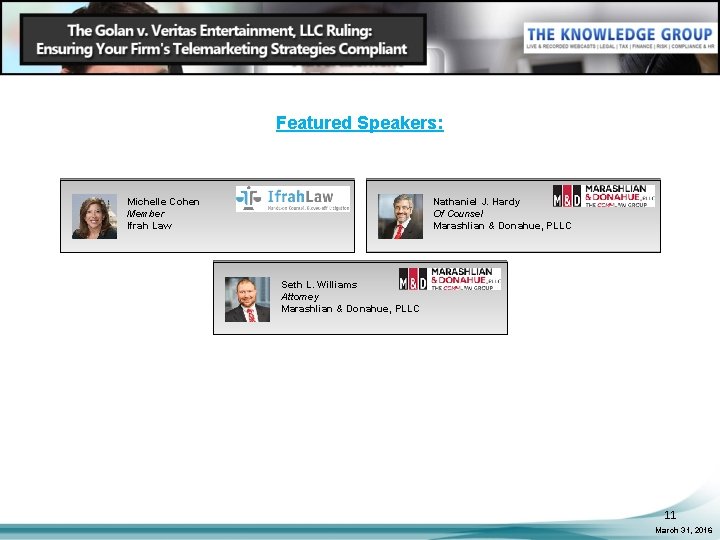
Featured Speakers: Michelle Cohen Member Ifrah Law Nathaniel J. Hardy Of Counsel Marashlian & Donahue, PLLC Seth L. Williams Attorney Marashlian & Donahue, PLLC 11 March 31, 2016
Michelle Cohen Member Ifrah Law Introduction Michelle Cohen’s practice is focused on a myriad of sectors within the E-Commerce industry – technology, manufacturing, and compliance. Michelle helps ensure that clients’ communications comply with the laws and regulations regarding marketing and privacy – whether through sweepstakes/contests, telemarketing, email marketing or beyond. Michelle’s communications experience includes licensing, enforcement, contracts, rulemaking and advocacy. When clients find themselves involved in an enforcement matter with the Federal Trade Commission, Federal Communications Commission or state agencies, Michelle’s deep knowledge in these areas and her strong footing in the privacy community help her to resolve issues in the most expedient manner possible. In fact, Michelle has been handling TCPA cases since the law was first implemented in 1992 and she is one of the few lawyers to have a TCPA citation that was issued to a client by the FCC, rescinded. Michelle has received certification as a Certified Information Privacy Professional (CIPP-US) from the International Association of Privacy Professionals (IAPP). 12 March 31, 2016
Nathaniel J. Hardy Of Counsel Marashlian & Donahue, PLLC Introduction Mr. Hardy is Of Counsel with Marashlian & Donahue, PLLC and his practice encompasses a wide range of regulatory, transactional, intellectual property and public policy matters for communications and media clients. His experience covers the range of regulatory matters faced by entities subject to government or administrative oversight. Mr. Hardy also has extensive experience with the FCC’s spectrum auction process; including the application, bidding and licensing portions of auctions and seeking redress for unfavorable auction decisions rendered by the FCC. Mr. Hardy’s transactional practice includes drafting and negotiating purchase agreements, licensing agreements, and programming and carriage agreements for clients. He also provides guidance and advice on intellectual property issues, including copyright and trademark registration and protection, and data collection, privacy and consumer protection matters, including compliance with the TCPA and TSR. 13 March 31, 2016
Seth L. Williams Attorney Marashlian & Donahue, PLLC Introduction Mr. Williams is an Associate with Marashlian & Donahue, PLLC. He advises clients on a wide range of domestic and international telecommunications matters, including universal service compliance, telecommunications tax issues, and the TCPA. Mr. Williams’s TCPA practice covers the full range of matters faced by telecommunications providers and end users. He has extensive experience with the FCC’s rules implementing the TCPA, including representing clients before the FCC and advising clients on the FCC’s evolving interpretation of the TCPA. Mr. Williams also defends clients in TCPA litigation. Prior to joining Marashlian & Donahue, Mr. Williams earned an LL. M. in communications law from Catholic University after completing his J. D. at Indiana University. During law school and his LL. M. program, he clerked at the FCC in the Audio Division and for then-Chairwoman Mignon Clyburn’s office. 14 March 31, 2016
Understanding the Golan Case § What is the TCPA? Telephone Consumer Protection Act enacted in 1991 in response to proliferation of autodialed and artificial calls - Intended to protect consumer privacy limit the number of unwanted calls - TCPA enacted in 1991 to address growing concern of autodialed and artificial calls - TCPA provisions found in 47 U. S. C. § 227 - FCC’s implementing rules found in 47 C. F. R. § 64. 1200 15 March 31, 2016
Understanding the Golan Case What does the TCPA do? § Statute creates a private right of action for actual damages or $500 ($1, 500 for willful violations) per call/text/faxes. § Calls and Text Messages: Restricts ability to make autodialed or prerecorded/artificial voice calls. Generally require consent to make such calls. § Facsimile Advertisements: Requires consent and opt out notices. § Do Not Call Rules: Requires that businesses subscribe to and observe the National Do Not Call Registry as well as maintain their own internal Do Not Call lists. 16 March 31, 2016
Understanding the Golan Case § The scope of restrictions on calls and texts under the TCPA vary based on: - the type of device or entity receiving the communication; - the form, purpose, and content of the communication; - the identity of the caller; - and whether the caller has obtained consent from the called party. § Thus, the facts in each case are critical to assess liability or compliance risks 17 March 31, 2016
Understanding the Golan Case § There is a telemarketing/sales ecosystem § So who is liable when there are numerous involved parties? Those who ''initiate any telephone call" in violation of the rules. 47 C. F. R. § 64. 1200. Or those who “take the steps necessary to physically place a telephone call” OR “so involved in placing the call as to be deemed to have initiated it. ” § Courts have also applied Common law vicarious liability principles of agency and ratification. § Dobkin v. Enter. Fin. Grp. Inc. , No. 2: 14 -CV-01989 WHW. 2014 WL 4354070, at *3 (D. N. J. Sept. 3, 2014). 18 March 31, 2016
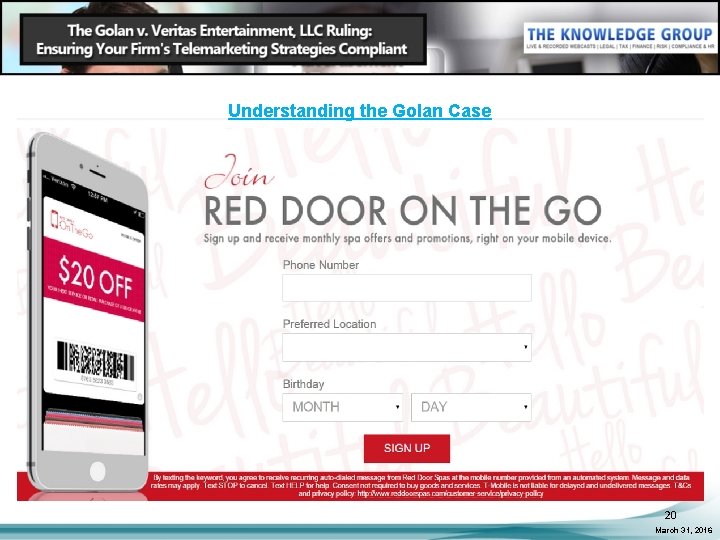
Understanding the Golan Case § Consent - What degree of consent is required? § 2012 FCC removed “established business relationship” exemption from consent requirement § Prior Express Written Consent: - Advertising/Telemarketing calls made to cellular phones using an ATDS, or using an artificial or prerecorded voice; - Advertising/Telemarketing calls made to residential land lines using an artificial or prerecorded voice. § Prior Express Written Consent must include a clear and conspicuous disclosure informing the consenting party: By executing the agreement, the person authorizes the seller to deliver or cause to be delivered telemarketing calls using an autodialer or an artificial or prerecorded voice; and The person is not required to sign the agreement (directly or indirectly), or agree to enter into such an agreement as a condition of purchasing any property, goods, or services 19 March 31, 2016
Understanding the Golan Case 20 March 31, 2016
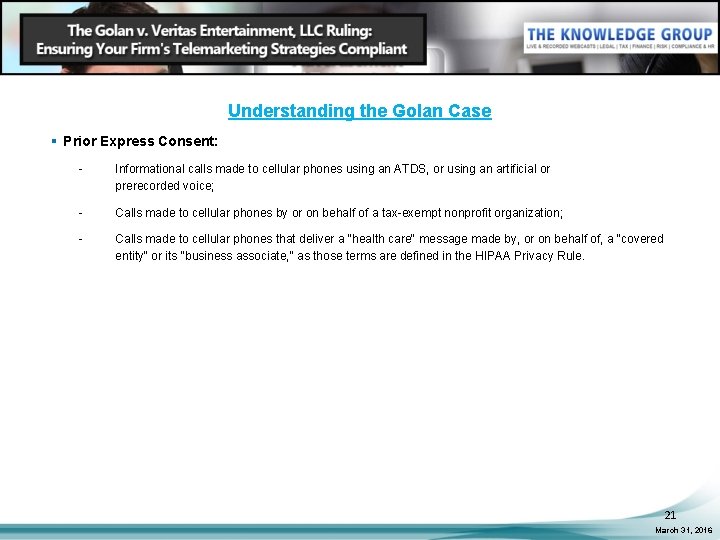
Understanding the Golan Case § Prior Express Consent: - Informational calls made to cellular phones using an ATDS, or using an artificial or prerecorded voice; - Calls made to cellular phones by or on behalf of a tax-exempt nonprofit organization; - Calls made to cellular phones that deliver a "health care" message made by, or on behalf of, a "covered entity" or its "business associate, " as those terms are defined in the HIPAA Privacy Rule. 21 March 31, 2016
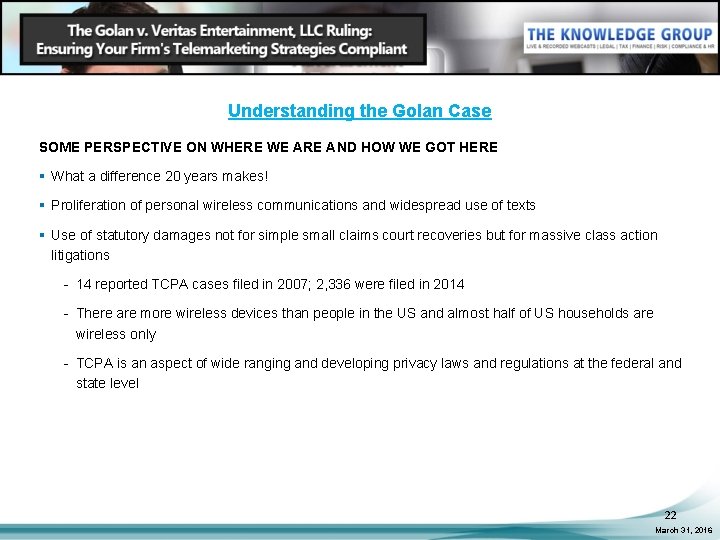
Understanding the Golan Case SOME PERSPECTIVE ON WHERE WE ARE AND HOW WE GOT HERE § What a difference 20 years makes! § Proliferation of personal wireless communications and widespread use of texts § Use of statutory damages not for simple small claims court recoveries but for massive class action litigations - 14 reported TCPA cases filed in 2007; 2, 336 were filed in 2014 - There are more wireless devices than people in the US and almost half of US households are wireless only - TCPA is an aspect of wide ranging and developing privacy laws and regulations at the federal and state level 22 March 31, 2016
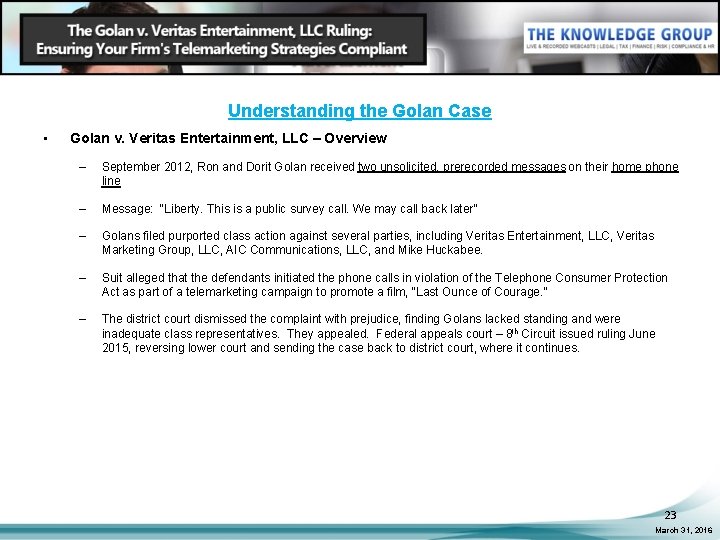
Understanding the Golan Case • Golan v. Veritas Entertainment, LLC – Overview – September 2012, Ron and Dorit Golan received two unsolicited, prerecorded messages on their home phone line – Message: “Liberty. This is a public survey call. We may call back later” – Golans filed purported class action against several parties, including Veritas Entertainment, LLC, Veritas Marketing Group, LLC, AIC Communications, LLC, and Mike Huckabee. – Suit alleged that the defendants initiated the phone calls in violation of the Telephone Consumer Protection Act as part of a telemarketing campaign to promote a film, “Last Ounce of Courage. ” – The district court dismissed the complaint with prejudice, finding Golans lacked standing and were inadequate class representatives. They appealed. Federal appeals court – 8 th Circuit issued ruling June 2015, reversing lower court and sending the case back to district court, where it continues. 23 March 31, 2016
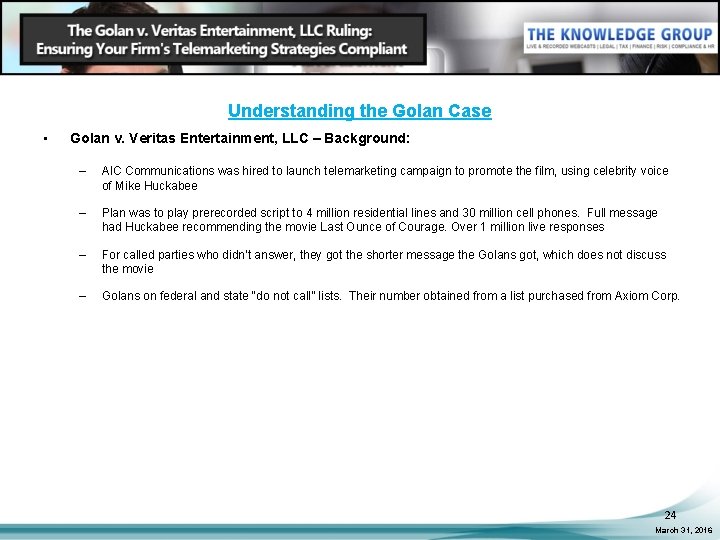
Understanding the Golan Case • Golan v. Veritas Entertainment, LLC – Background: – AIC Communications was hired to launch telemarketing campaign to promote the film, using celebrity voice of Mike Huckabee – Plan was to play prerecorded script to 4 million residential lines and 30 million cell phones. Full message had Huckabee recommending the movie Last Ounce of Courage. Over 1 million live responses – For called parties who didn’t answer, they got the shorter message the Golans got, which does not discuss the movie – Golans on federal and state “do not call” lists. Their number obtained from a list purchased from Axiom Corp. 24 March 31, 2016
Understanding the Golan Case • Golan v. Veritas Entertainment, LLC – Procedural Path – District Court concluded Golans had not suffered injury in fact because none of the messages they received “contained an advertisement, telemarketing message, or telephone solicitation” in violation of the TCPA or Missouri do not call law – Lower court also concluded Golans inadequate class representatives because they heard only the shortened version of call and were subject to a “unique defense” – Defendants contended no TCPA violations because messages Golans got did not contain advertisement or qualify as telemarketing under TCPA – FCC exempted artificial or prerecorded calls to residential lines which are “made for a commercial purpose but does not include or introduce an advertisement or constitute telemarketing. ” 47 CFR § 64. 1200(a)(3)(iii) – Advertisement – “material advertising the commercial availability or quality of any property, goods, or services. ” 47 CFR § 64. 1200(f)(1) – Telemarketing – “initiation of a telephone call or message for the purpose of encouraging the purchase or rental of, or investment in, property, goods, or services, which is transmitted to any person. ” 47 CFR § 64. 1200(f)(12) 25 March 31, 2016
Understanding the Golan Case • Golan v. Veritas Entertainment, LLC – 8 th Circuit Decision – 8 th Circuit held that while content controlled whether they were advertisements, their purpose controlled whether they were telemarketing – “Neither the TCPA nor its implementing regulations ‘require an explicit mention of a good, product, or service’ where the implication of an improper purpose is ‘clear from the context. ’” – “’Telemarketing’ occurs when the context of a call indicates that it was initiated and transmitted to a person for the purpose of promoting property, goods or services. ” – Here the context of calls initiated they were for the purpose of promoting the movie – Court held that since the calls were initiated and transmitted to the Golans to promote Last Ounce of Courage, they qualified as telemarketing even though the messages never referenced the film – Since each call initiated for purpose of promoting movie, Golans appropriate class members 26 March 31, 2016
Understanding the Golan Case • Golan v. Veritas Entertainment, LLC – Where Things Stand Now – Case remanded back to federal district court in Missouri – Second amended complaint filed – Some defendants answered, some did not, and may default – Huckabee got dismissed; other motions to dismiss denied – Court ruled Huckabee’s celebrity voice recording and his modification of script were not enough to impute liability to him for the calls – Veritas Entertainment administratively dissolved; counsel withdrew – Suit continues 27 March 31, 2016
Understanding the Golan Case Today, virtually all businesses that communicate with or market to their customers are at risk of a class action lawsuit. For example: § Tech companies - sued for facilitating unauthorized texts with cutting-edge apps. § Movie Studios- sued for calling target TV watchers about channel line-up changes and for sending texts promoting films. § Retailers - sued for their customer loyalty promotional text programs. § Utilities - sued for sending service interruption texts. § Hospitals - sued for collection calls as well as treatment-related calls like appointment and prescription reminders. § Pharmacies - sued for sending prescription reminders. § Banks - sued for everything from collection calls to fraud alerts. § Delivery companies- sued for delivery confirmation and customer survey communications. § Hotel chains, and other hospitality companies - sued for telemarketing calls and texts. 28 March 31, 2016
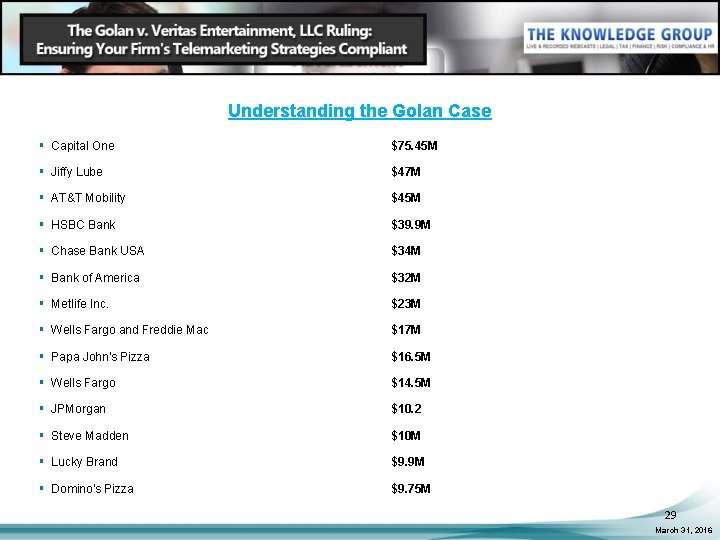
Understanding the Golan Case § Capital One $75. 45 M § Jiffy Lube $47 M § AT&T Mobility $45 M § HSBC Bank $39. 9 M § Chase Bank USA $34 M § Bank of America $32 M § Metlife Inc. $23 M § Wells Fargo and Freddie Mac $17 M § Papa John's Pizza $16. 5 M § Wells Fargo $14. 5 M § JPMorgan $10. 2 § Steve Madden $10 M § Lucky Brand $9. 9 M § Domino's Pizza $9. 75 M 29 March 31, 2016
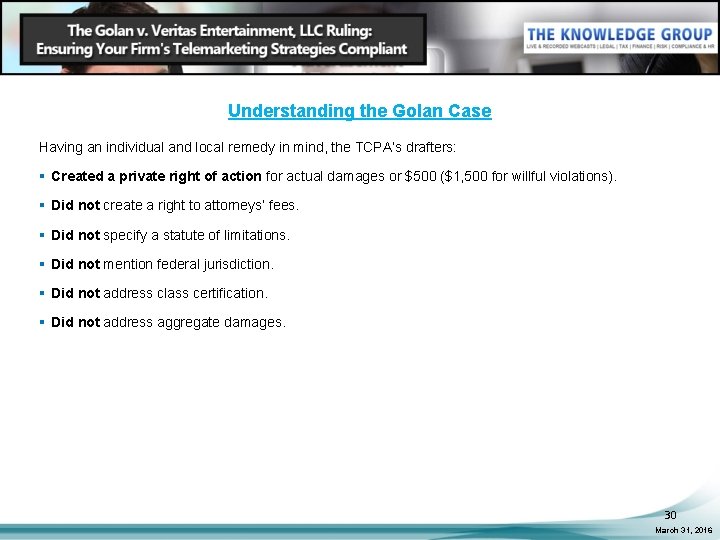
Understanding the Golan Case Having an individual and local remedy in mind, the TCPA’s drafters: § Created a private right of action for actual damages or $500 ($1, 500 for willful violations). § Did not create a right to attorneys’ fees. § Did not specify a statute of limitations. § Did not mention federal jurisdiction. § Did not address class certification. § Did not address aggregate damages. 30 March 31, 2016
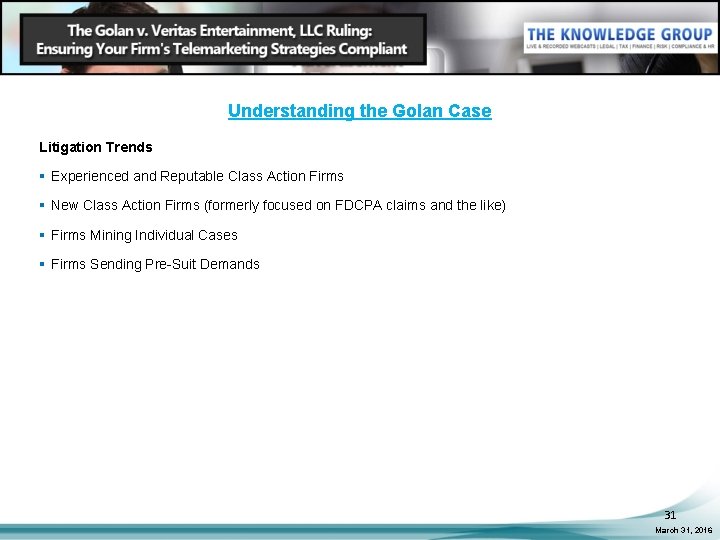
Understanding the Golan Case Litigation Trends § Experienced and Reputable Class Action Firms § New Class Action Firms (formerly focused on FDCPA claims and the like) § Firms Mining Individual Cases § Firms Sending Pre-Suit Demands 31 March 31, 2016
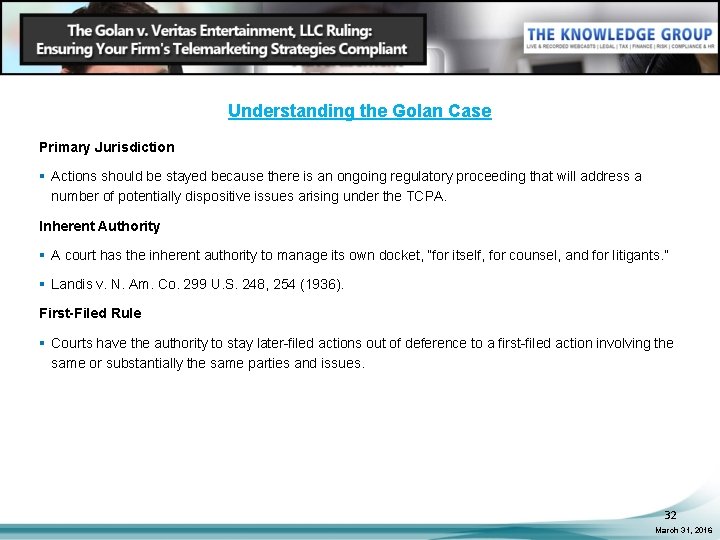
Understanding the Golan Case Primary Jurisdiction § Actions should be stayed because there is an ongoing regulatory proceeding that will address a number of potentially dispositive issues arising under the TCPA. Inherent Authority § A court has the inherent authority to manage its own docket, “for itself, for counsel, and for litigants. ” § Landis v. N. Am. Co. 299 U. S. 248, 254 (1936). First-Filed Rule § Courts have the authority to stay later-filed actions out of deference to a first-filed action involving the same or substantially the same parties and issues. 32 March 31, 2016
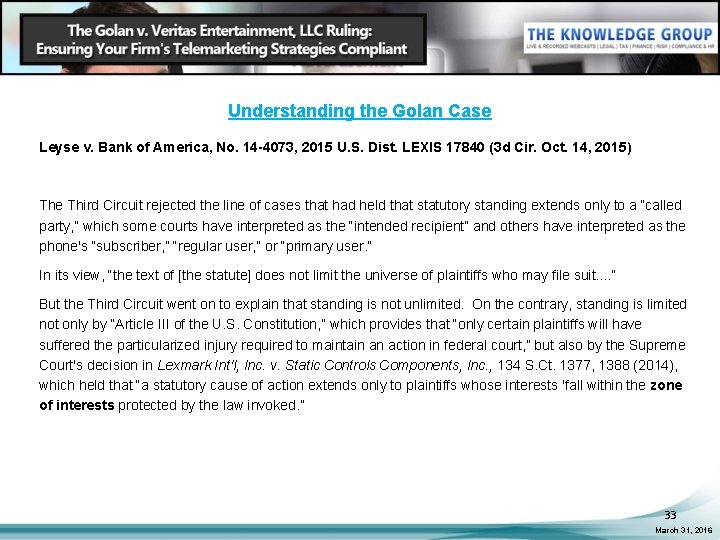
Understanding the Golan Case Leyse v. Bank of America, No. 14 -4073, 2015 U. S. Dist. LEXIS 17840 (3 d Cir. Oct. 14, 2015) The Third Circuit rejected the line of cases that had held that statutory standing extends only to a “called party, ” which some courts have interpreted as the “intended recipient” and others have interpreted as the phone's “subscriber, ” “regular user, ” or “primary user. ” In its view, “the text of [the statute] does not limit the universe of plaintiffs who may file suit. . ” But the Third Circuit went on to explain that standing is not unlimited. On the contrary, standing is limited not only by “Article III of the U. S. Constitution, ” which provides that “only certain plaintiffs will have suffered the particularized injury required to maintain an action in federal court, ” but also by the Supreme Court's decision in Lexmark Int'l, Inc. v. Static Controls Components, Inc. , 134 S. Ct. 1377, 1388 (2014), which held that “a statutory cause of action extends only to plaintiffs whose interests 'fall within the zone of interests protected by the law invoked. ” 33 March 31, 2016
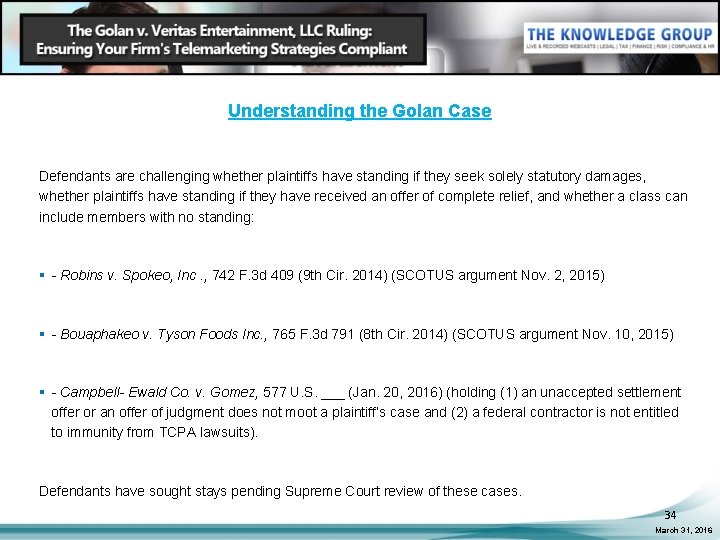
Understanding the Golan Case Defendants are challenging whether plaintiffs have standing if they seek solely statutory damages, whether plaintiffs have standing if they have received an offer of complete relief, and whether a class can include members with no standing: § - Robins v. Spokeo, Inc. , 742 F. 3 d 409 (9 th Cir. 2014) (SCOTUS argument Nov. 2, 2015) § - Bouaphakeo v. Tyson Foods Inc. , 765 F. 3 d 791 (8 th Cir. 2014) (SCOTUS argument Nov. 10, 2015) § - Campbell- Ewald Co. v. Gomez, 577 U. S. ___ (Jan. 20, 2016) (holding (1) an unaccepted settlement offer or an offer of judgment does not moot a plaintiff’s case and (2) a federal contractor is not entitled to immunity from TCPA lawsuits). Defendants have sought stays pending Supreme Court review of these cases. 34 March 31, 2016
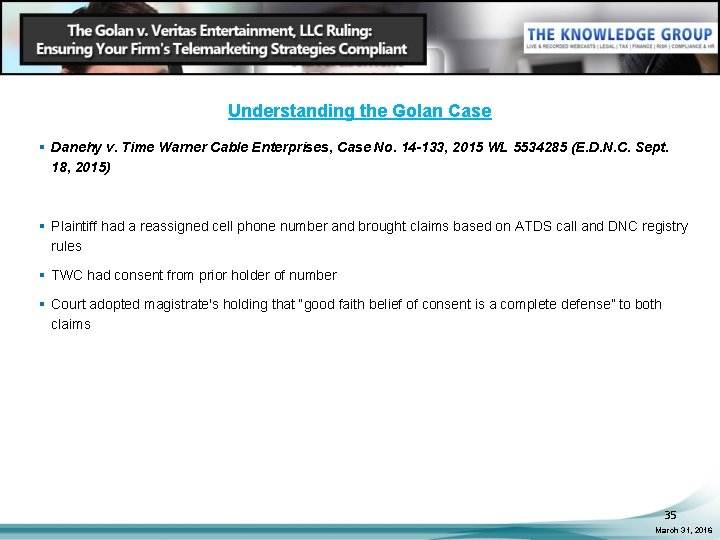
Understanding the Golan Case § Danehy v. Time Warner Cable Enterprises, Case No. 14 -133, 2015 WL 5534285 (E. D. N. C. Sept. 18, 2015) § Plaintiff had a reassigned cell phone number and brought claims based on ATDS call and DNC registry rules § TWC had consent from prior holder of number § Court adopted magistrate's holding that “good faith belief of consent is a complete defense” to both claims 35 March 31, 2016
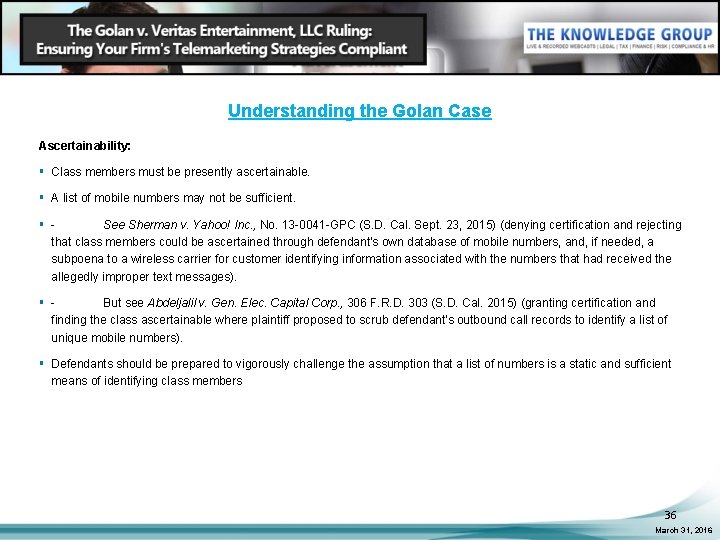
Understanding the Golan Case Ascertainability: § Class members must be presently ascertainable. § A list of mobile numbers may not be sufficient. § See Sherman v. Yahoo! Inc. , No. 13 -0041 -GPC (S. D. Cal. Sept. 23, 2015) (denying certification and rejecting that class members could be ascertained through defendant's own database of mobile numbers, and, if needed, a subpoena to a wireless carrier for customer identifying information associated with the numbers that had received the allegedly improper text messages). § But see Abdeljalil v. Gen. Elec. Capital Corp. , 306 F. R. D. 303 (S. D. Cal. 2015) (granting certification and finding the class ascertainable where plaintiff proposed to scrub defendant's outbound call records to identify a list of unique mobile numbers). § Defendants should be prepared to vigorously challenge the assumption that a list of numbers is a static and sufficient means of identifying class members 36 March 31, 2016
Understanding the Golan Case Commonality and Predominance: § Blair v. The CBR Group, Inc. , No. 13 -0134 (S. D. Cal. Aug. 26, 2015) ("[D]etermining whether a particular class member provided his or her wireless phone number to an underlying creditor requires an individualized inquiry into the particular circumstances in which the debt arose, and such individualized inquiries predominate. . "). § Shamblin v. Obama for Am. , No. 13 -2428, 2015 U. S. Dist. LEXIS 54849, at *17 (M. D. Fla. Apr. 27, 2015) (finding an absence of “'classwide' proof on these outcome-determinative issues" because "individualized proof will be required for each and every plaintiff") § Gannon v. Network Tel. Servs. , Inc. , No. 12 -9777, 2013 WL 2450199, at *3 (C. D. Cal. June 5, 2013) (denying certification because court "would have to hold 'mini-trials' to determine who received unauthorized text messages" and who had consented) § Jamison v. First Credit Servs. , Inc. , 290 F. R. D. 92, 106 -07 (N. D. III. 2013) ("[I]ssues of individualized consent predominate when a defendant sets forth specific evidence showing that a significant percentage of the putative class consented to receiving calls. ") § Hicks v. Client Servs. , Inc. , 07 -61822 -CIV, 2008 WL 5479111, at *8 (S. D. Fla. Dec. 11, 2008) (denying class certification because "ultimately [the issue of] consent. . . would have to be determined on an 37 individual basis at trial") March 31, 2016
Understanding the Golan Case Superiority: § Superiority is questionable if plaintiff has no actual damages and can obtain substantial statutory damages in an individual action: § Forman v. Data Transfer, Inc. , 164 F. R. D. 400, 405 (E. D. Pa. 1995) ("A class action would be inconsistent with the specific and personal remedy provided by Congress to address the minor nuisance of unsolicited facsimile advertisements. ") § Local Baking Prods. , Inc. v. Westfield Rental Mart, Inc. , No. A-4852 -12 T 4 (N. J. Super. Ct. App. Div. June 23, 2014) (finding certification inferior). § Hazel's Cup & Saucer, LLC v. Around The Globe Travel, Inc. , 15 N. E. 3 d 220 (Mass. App. Ct. 2014) (finding certification superior). 38 March 31, 2016
Understanding the Golan Case Courts have generally found that TCPA claims fall within the scope of broadly worded arbitration agreements: § Cyganiewicz v. Sallie Mae, Inc. , No. 13 -40067, 2013 U. S. Dist. LEXIS 153554 (D. Mass. Oct. 24, 2013). § Delgado v. Progress Fin. Co. , No. 14 -0033, 2014 WL 1756282 (E. D. Cal. May 1, 2014). § Mendoza v. Ad Astra Recovery Servs. , Inc. , No. 13 -6922, 2014 WL 47777 (C. D. Cal. Jan. 6, 2014). § Sherman v. RMH, LLC, No. 13 -1986, 2014 WL 30318 (S. D. Cal. Jan. 2, 2014). § Rice v. Credit One Fin. , No. 15 -0130, 2015 WL 4528933 (E. D. N. C. July 27, 2015). 39 March 31, 2016
Understanding the Golan Case § CE Design, Ltd. v. Prism Business Media, Inc. , 606 F. 3 d 443, 446 (7 th Cir. 2010). "The Administrative Orders Review Act, better known as the Hobbs Act, reserves to the courts of appeals the power 'to enjoin, set aside, suspend (in whole or in part), or to determine the validity of' all final FCC orders, see 28 U. S. C. § 2342(1); 47 U. S. C. § 402(a), and that before seeking relief from an appellate court, a party aggrieved by the FCC's final order must petition the FCC for reconsideration, see 47 U. S. C. § 405(a). " Affirming district court holding that "CE Design's characterization of the EBR exemption as 'unauthorized' amounted to an indirect challenge to the FCC's rule, and accordingly, it concluded that it lacked jurisdiction to consider the validity of the EBR exemption. " § Mais v. Gulf Coast Collection Bureau, Inc. , 768 F. 3 d 1110, 1119 (11 th Cir. 2014). "The district court exceeded its jurisdiction by declaring the 2008 FCC Ruling to be inconsistent with the TCPA. " § The Hobbs Act prevents a district court from making such considerations regardless of which party challenges the validity of an FCC ruling. § Leyse v. Clear Channel Broad. , Inc. , 545 F. App'x 444, 458 (6 th Cir. 2013) cert. denied, 135 S. Ct. 57, 190 L. Ed. 2 d 31 (2014). § Court held that "a facial attack on the TCPA exemption" in the FCC regulations was confined by the Hobbs Act. 40 March 31, 2016
Understanding the Golan Case § FCC Attempts to Create Clarity - Issues Declaratory Ruling and Order on July 10, 2015 - Resolved 19 petitions for declaratory ruling and 2 petitions for rulemaking, some of which had been pending for years - Decision generally takes a very “pro-consumer” approach to the TCPA 41 March 31, 2016
Understanding the Golan Case § Important Issues from Declaratory Ruling and Order - Definition of Autodialer - Maker of Call - Called Party vs. Intended Party & Reassigned Numbers - One Call Safe Harbor - “On Demand” Text Responses Removed from TCPA Liability - Revocation of Consent 42 March 31, 2016
Understanding the Golan Case § Definition of Automatic Telephone Dialing System - Equipment which has the capacity – (A) to store or produce telephone numbers to be called, using random or sequential number generator; and (B) to dial such numbers. - FCC’s definition covers virtually all modern dialing equipment • Capacity includes both current capacity AND “Potential ability” • An autodialer dials number without human intervention - “Callers cannot avoid obtaining consent by dividing ownership of pieces of dialing equipment that work in concert among multiple entities. ” Declaratory Ruling at ¶ 10. 43 March 31, 2016
Understanding the Golan Case § Maker of Call - Making a call can include physically placing a call or being so involved in the placing of a call to be deemed to have initiated it - Of particular importance to Application developers and calling platform providers § Key Factors: - Taking affirmative steps to send a message or make a call - Selecting who and when a person is called - Crafting or assisting in creating the content of the message sent - Supporting fraudulent number spoofing and/or Caller ID blocking services § Collect calling providers do not initiate calls when they provide pre-acceptance information to a call recipient 44 March 31, 2016
Understanding the Golan Case § Called Party vs. Intended Party & Reassigned Numbers - The TCPA requires the consent not of the intended recipient of a call, but of the current subscriber - This means that a caller that calls a reassigned number intending to reach a party that has consented to the call may still face TCPA liability - One-call safe harbor • Caller may make one call to determine if number has been reassigned. 45 March 31, 2016
Understanding the Golan Case § “On Demand” Text Responses Removed from TCPA Liability § A one-time text message sent immediately after a consumer’s request for the text does not violate the TCPA - The text must be: • Requested by the consumer • One-time only message • Sent immediately in response (within 5 minutes found to be presumptively immediate in opt-out request context) • Contain only the information request by the consumer 46 March 31, 2016
Understanding the Golan Case § Revocation of Consent § The majority found that consent may be revoked at any time in “any reasonable manner" including orally or in writing. Examples: § Consumer-initiated calls § Requests made in response to a caller's call § Oral requests at an in-store bill payment location. 47 March 31, 2016
Understanding the Golan Case § Compliance Risk Issues and Challenges - Broad definition of Autodialer • Definition encompasses most modern dialing equipment • Human intervention as a way to limit TCPA liability • One difficulty with the human intervention test is that the Commission did not adopt a brightline test, instead it will use a case-by-case analysis • Because of the FCC’s case-by-case approach, more human intervention is better (For example, a one-touch press-to-dialing option may not offer as much protection as a dialing option that requires an agent to dial the entire 10 digit number) 48 March 31, 2016
Understanding the Golan Case - Capturing Consumer Consents and Revocations • Updating Consents is imperative • Documenting Consents – critical because callers bear burden of proving consent • Consent can travel with a ported number, but will only be as good as the original consent 49 March 31, 2016
Understanding the Golan Case - Confirming Numbers remain w/ person that provided consent - Party that initiates or makes a call • Especially important for app developers and calling platforms • More autonomy for end user/customer the better, but Text. Me Petition in Omnibus Order shows app developers can retain some control over a message and still not be deemed the maker of a call • See also Dialing Services NAL with respect to dialing platforms • DO NOT help customers spoof numbers as a dialing platform 50 March 31, 2016
Understanding the Golan Case § MANAGING COMPLIANCE - Maintaining and Scrubbing Against Business-Specific Do Not Call Lists - Scrubbing Number Lists against National Do Not Call List - Differentiating landline and mobile numbers - Scrubbing Number Lists against Ported Number Lists - Scrubbing Number Lists against Consent Records 51 March 31, 2016
Understanding the Golan Case - Developing systems to track consent, including FCC’s suggested best practices from the Omnibus Order (This is not a safe harbor) • periodically emailing or mailing customers to ask them to update their contact information, including telephone numbers; • require customers to inform the caller when they change telephone numbers in contracts with customers; • include interactive opt-out mechanisms in all autodialed or prerecorded calls so called parties can report wrong numbers; • provide customer service representatives with the ability to record wrong numbers while making outbound calls; • provide customer service representatives with the ability to record new numbers for customers when they receive calls from the customers; • recognize “triple tones” indicating that a number has been disconnected when making autodialed or live telephone calls and record the number as disconnected and likely to be reassigned; • establish policies that automatically note numbers as having been reassigned if a customer cannot be reached at a number after a period of time; and • enable customers to update contact information in response to a text message. 52 March 31, 2016
Understanding the Golan Case § Appeal of the Declaratory Ruling and Order § The Declaratory Ruling and Order was effective immediately on its release § The consolidated appeal is pending in the D. C. Circuit under the name: ACA International, et al. v. FCC and United States of America § Main issues and criticisms on appeal: - Expansion of autodialer definition - Revocation of consent - Meaning of “called party” - New exemptions created by the Ruling - Briefing is underway 53 March 31, 2016
Understanding the Golan Case § Broad Reach of Autodialer Definition § Definition encompasses most modern dialing equipment, although a rotary-dial phone “is too attenuated” to meet the definition - “[A]ccording to the order…equipment that could conceivably function as an autodialer in the future counts as an autodialer today…. That is like the FAA regulating vehicles because with enough modifications cars and trucks could fly, and then using a skateboard as an example of a vehicle that does not meet the definition. ” Declaratory Ruling and Order, Statement of Commissioner O’Reilly at 128 § Lack of Bright Line Human Intervention Test 54 March 31, 2016
Understanding the Golan Case § FCC Misinterpreted Called Party Definition § Called party should have been interpreted to be party that was intended to receive call, not the subscriber or customary user § Strict liability for calling reassigned numbers compounded by definition of Called Party § One-Call safe harbor not sufficient to protect callers 55 March 31, 2016
Understanding the Golan Case § Revocation of Consent is Impractical § The TCPA itself is silent about whether consent can be revoked. § Courts were split on the significance of that silence. § The majority found that consent may be revoked at any time in “any reasonable manner" including orally or in writing. Examples: - Consumer-initiated calls - Requests made in response to a caller's call - Oral requests at an in-store bill payment location. § This may cause companies to revise Do-Not-Call policies, rewrite customer contracts, and retrain customer-facing personnel. § May also cause companies to establish centralized processes for registering and updating customers' communications preferences. 56 March 31, 2016
Understanding the Golan Case “[The majority] shift[s] the burden of compliance away from telemarketers and onto legitimate businesses, sometimes in absurd ways. For instance, how could any retail business possibly comply with the provision that consumers can revoke consent orally ‘at an in-store bill payment location’? Would they have to record and review every single conversation between customers and employees? Would a harried cashier at Mc. Donald’s have to be trained in the nuances of customer consent for TCPA purposes? What exactly would constitute revocation in such circumstances? Could a customer simply walk up to a Mc. Donald’s counter, provide his contact information and a summary ‘I’m not lovin’ it, ’ and put the onus on the company? The prospects make one grimace. ” July 10, 2015 DR&O, Statement of Commissioner Pai at 11 57 March 31, 2016
Understanding the Golan Case § Vendors § Lead Generators § Courts have held sellers vicariously liable for the conduct of their third-party agents. The FCC has as well. § See In re Joint Petition filed by Dish Network, LLC, 28 F. C. C. R. 6574 (2013); aff’d, Dish Network L. L. C. v. FCC, 552 Fed. App’x 1 (D. C. Cir. Jan. 22, 2014). Although “a seller does not generally ‘initiate’ calls made through a third-party telemarketer within the meaning of the TCPA, it nonetheless may be held vicariously liable under federal common law principles of agency for violations of either section 227(b) or section 227(c) that are committed by third-party telemarketers. ” Dish Network Order ¶ 1. 58 March 31, 2016
Understanding the Golan Case § Regulatory Forecasts - Possible Congressional action to address perceived problems with Declaratory Ruling § Continuing aggressive enforcement by FCC’s Enforcement Bureau • See Call-Em-All, Phonevite, and Political. Robocalls, First National Bank Citations • Travel Club Marketing, Inc. Forfeiture Order • Expect More policing of Terms of Service Agreements by the Enforcement Bureau • FCC’s Enforcement Bureau letter to Paypal • Lyft and First National Bank Citations 59 March 31, 2016
Understanding the Golan Case • Other TCPA Developments – Section 301 of Bipartisan Budget Act of 2015 amends TCPA to create exception to prior express consent requirement for automated calls to cellular or residential telephones, provided calls for the purpose of collecting debts owed to or guaranteed by the U. S. government. – FCC required to issue regulations within 9 months of enactment – deadline is August 2 – FCC will issue notice of proposed rulemaking. Some details available in letters to members of Congress – Next steps: FCC will issue NPRM, there will be a comment period, followed by an order announcing new rules • – It was circulated to the other Commissioners by the Chairman in February Other issues to be addressed – what about calls now – i. e. , prior to issuance of new rules. What about reassigned numbers? 60 March 31, 2016
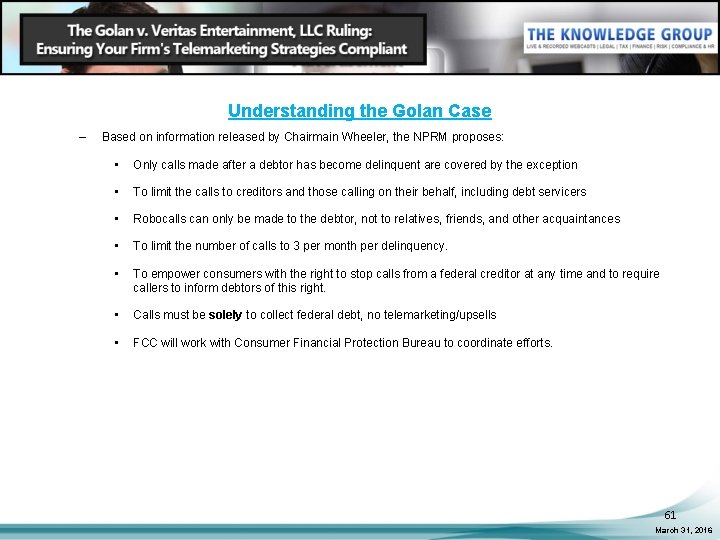
Understanding the Golan Case – Based on information released by Chairmain Wheeler, the NPRM proposes: • Only calls made after a debtor has become delinquent are covered by the exception • To limit the calls to creditors and those calling on their behalf, including debt servicers • Robocalls can only be made to the debtor, not to relatives, friends, and other acquaintances • To limit the number of calls to 3 per month per delinquency. • To empower consumers with the right to stop calls from a federal creditor at any time and to require callers to inform debtors of this right. • Calls must be solely to collect federal debt, no telemarketing/upsells • FCC will work with Consumer Financial Protection Bureau to coordinate efforts. 61 March 31, 2016
Contact Info: Michelle Cohen Member Ifrah Law Nathaniel J. Hardy Of Counsel Marashlian & Donahue, PLLC E: michelle@ifrahlaw. com T: (202) 524 -4144 E: njh@commlawgroup. com T: (703) 714 -1322 Seth L. Williams Attorney Marashlian & Donahue, PLLC E: slw@Comm. Lawgroup. com T: (703) 714 -1326 62 March 31, 2016
Q&A: Michelle Cohen Member Ifrah Law Nathaniel J. Hardy Of Counsel Marashlian & Donahue, PLLC Seth L. Williams Attorney Marashlian & Donahue, PLLC ► You may ask a question at anytime throughout the presentation today. Simply click on the question mark icon located on the floating tool bar on the bottom right side of your screen. Type your question in the box that appears and click send. ► Questions will be answered in the order they are received. 63 March 31, 2016
Welcome to the Knowledge Group Unlimited Subscription Programs. We have Two Options Available for You: FREE UNLIMITED: This program is free of charge with no further costs or obligations. It includes: ü Unlimited access to over 15, 000 pages of course material from all Knowledge Group Webcasts. ü Subscribers to this program can download any slides, white papers, or supplemental material covered during all live webcasts. ü 50% discount for purchase of all Live webcasts and downloaded recordings. PAID UNLIMITED: Our most comprehensive and cost-effective plan, for a one-time fee: ü Access to all LIVE Webcasts (Normally $199 to $349 for each event without a subscription). Including: Bring-a-Friend – Invite a client or associate outside your firm to attend for FREE. Sign up for as many webcasts as you wish. ü Access to all of Recorded/Archived Events & Course Material includes 1, 500+ hours of audio material (Normally $299 for each event without a subscription). ü Free Certificate of Attendance Processing (Normally $49 Per Course without a subscription). ü Access to over 15, 000 pages of course material from Knowledge Group Webcasts. ü Ability to invite a guest of your choice to attend any live webcast Free of charge (Exclusive benefit only available for PAID UNLIMITED subscribers). ü 6 Month Subscription is $499 with No Additional Fees Other options are available. ü Special Offer: Sign up today and add 2 of your colleagues to your plan for free Check the “Triple Play” box on the sign-up sheet contained in the link below. https: //gkc. memberclicks. net/index. php? option=com_mc&view=mc&mcid=form_157964 64 March 31, 2016
Knowledge Group UNLIMITED PAID Subscription Programs Pricing: Individual Subscription Fees: (2 Options) Semi-Annual: $499 one-time fee for a 6 month subscription with unlimited access to all webcasts, recordings, and materials. Annual: $799 one-time fee for a 12 month unlimited subscription with unlimited access to all webcasts, recordings, and materials. Group plans are available. See the registration form for details. Best ways to sign up: 1. Fill out the sign up form attached to the post conference survey email. 2. Sign up online by clicking the link contained in the post conference survey email. 3. Click the link below or the one we just posted in the chat window to the right. https: //gkc. memberclicks. net/index. php? option=com_mc&view=mc&mcid=form_157964 Questions: Send an email to: info@theknowledgegroup. org with “Unlimited” in the subject. 65 March 31, 2016
ABOUT THE KNOWLEDGE GROUP The Knowledge Group is an organization that produces live webcasts which examine regulatory changes and their impacts across a variety of industries. “We bring together the world's leading authorities and industry participants through informative two-hour webcasts to study the impact of changing regulations. ” If you would like to be informed of other upcoming events, please click here. Disclaimer: The Knowledge Group is producing this event for information purposes only. We do not intend to provide or offer business advice. The contents of this event are based upon the opinions of our speakers. The Knowledge Group does not warrant their accuracy and completeness. The statements made by them are based on their independent opinions and does not necessarily reflect that of The Knowledge Group‘s views. In no event shall The Knowledge Group be liable to any person or business entity for any special, direct, indirect, punitive, incidental or consequential damages as a result of any information gathered from this webcast. Certain images and/or photos on this page are the copyrighted property of 123 RF Limited, their Contributors or Licensed Partners and are being used with permission under license. These images and/or photos may not be copied or downloaded without permission from 123 RF Limited 66 March 31, 2016
- Slides: 66