Does Fit Matter in Event Sponsorship Linked Marketing
- Slides: 18
Does Fit Matter in Event Sponsorship. Linked Marketing? Angeline Close, University of Texas, Austin Russell Lacey, Xavier University, Cincinnati 2012 American Marketing Association Summer Educators’ Conference Consumer Behavior and Sports & Special Event Marketing SIG Session August 18, 2012
Role of Fit • Over 40, 000 sponsored events annually take place in US (IEG 2011) • Managers keenly interested in how event sponsorship strengthen their brands; event marketers depend on sponsors to raise revenues and help absorb costs • Event marketers provide value to sponsors by looking for ways to enhance fit between their hosted experience and sponsor • Does fit matter to event and sponsor?
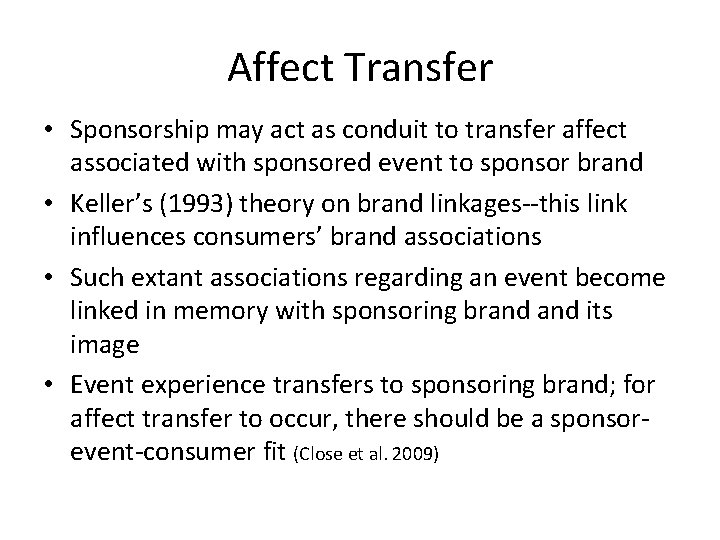
Affect Transfer • Sponsorship may act as conduit to transfer affect associated with sponsored event to sponsor brand • Keller’s (1993) theory on brand linkages--this link influences consumers’ brand associations • Such extant associations regarding an event become linked in memory with sponsoring brand its image • Event experience transfers to sponsoring brand; for affect transfer to occur, there should be a sponsorevent-consumer fit (Close et al. 2009)
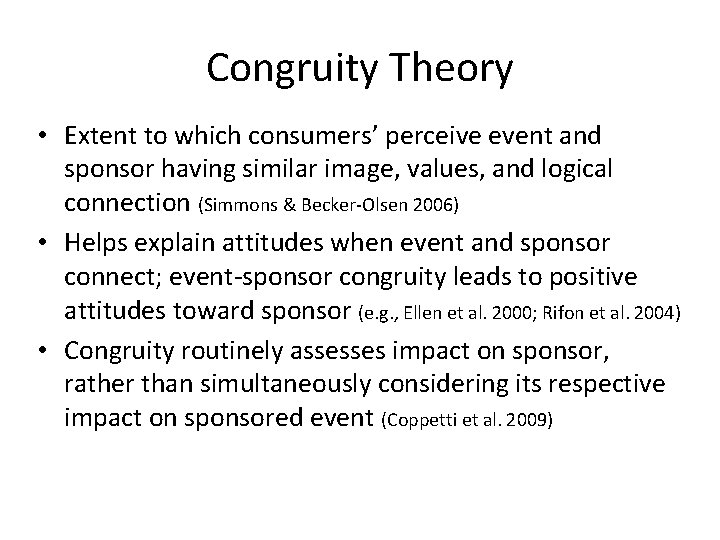
Congruity Theory • Extent to which consumers’ perceive event and sponsor having similar image, values, and logical connection (Simmons & Becker-Olsen 2006) • Helps explain attitudes when event and sponsor connect; event-sponsor congruity leads to positive attitudes toward sponsor (e. g. , Ellen et al. 2000; Rifon et al. 2004) • Congruity routinely assesses impact on sponsor, rather than simultaneously considering its respective impact on sponsored event (Coppetti et al. 2009)
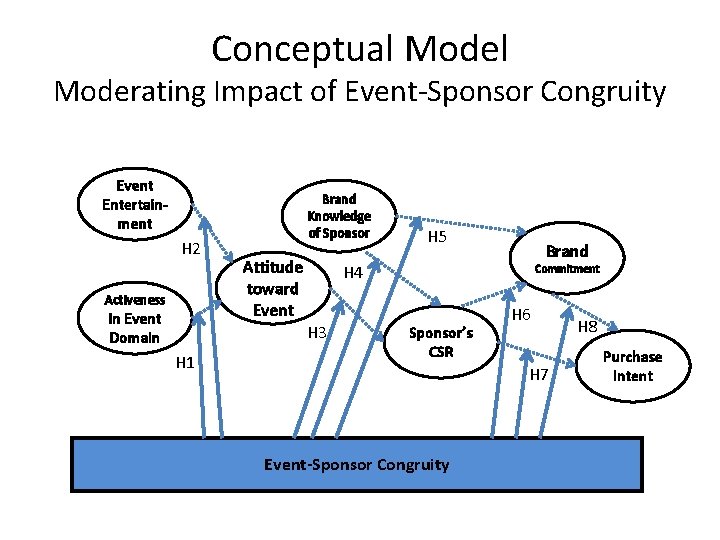
Conceptual Moderating Impact of Event-Sponsor Congruity Event Entertainment H 2 Activeness in Event Domain Brand Knowledge of Sponsor Attitude toward Event Brand H 4 H 3 H 1 H 5 Commitment Sponsor’s CSR H 6 H 7 Event-Sponsor Congruity H 8 Purchase Intent
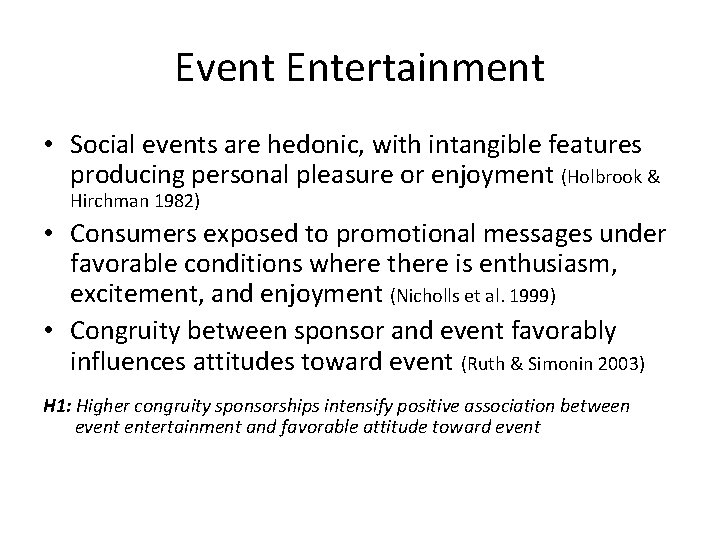
Event Entertainment • Social events are hedonic, with intangible features producing personal pleasure or enjoyment (Holbrook & Hirchman 1982) • Consumers exposed to promotional messages under favorable conditions where there is enthusiasm, excitement, and enjoyment (Nicholls et al. 1999) • Congruity between sponsor and event favorably influences attitudes toward event (Ruth & Simonin 2003) H 1: Higher congruity sponsorships intensify positive association between event entertainment and favorable attitude toward event
Activeness in Event Domain • Consumers drawn to events congruent with their lifestyles (Kahle et al. 1996) • Attendees who feel passion about domain of event are more likely to hold favorable attitudes toward event (Close et al. 2006) • Congruity influences relationship between attendee’s familiarity with event and thoughts about it (Roy & Cornwell 2004) H 2: Higher congruity sponsorships intensify positive association between activeness in event domain and attitude toward event
Attitude Toward Event • Attitudes are relatively stable internal evaluations; once attitudes toward event formed, they can have strong impact on sponsor (Dean 2002) • Consumers more likely to perceive congruity if they perceive sponsor doing what is right (Becker-Olsen & Hill 2006) • Positive sentiments about sponsorship play valuable role in strengthening sponsor’s CSR (Geue & Plewa 2010) H 3: Higher congruity sponsorships intensify positive association between attitude toward event and perceived CSR of sponsor
Sponsor’s Perceived CSR • CSR refers to firm’s activities and status relative to its societal or stakeholder obligations (Sen & Bhattacharya 2001) • Knowledgeable consumers more engaged with brand its CSR activities (Algeshheimer et al. 2005); congruity studies should relate to varying brand knowledge conditions (Sen & Bhattacharya 2001) H 4: Higher congruity sponsorships intensify positive association between brand knowledge of sponsor and perceived CSR of sponsor
Brand Knowledge • Brand knowledge in sponsorship terms relates to more abstract and intangible brand associations held in minds of consumers about sponsor (Roy & Cornwell 2003) • Consumers need brand knowledge to establish commitment to sponsor’s brands (Keller 1993) • Consumers’ familiarity with sponsor impacts what they think about sponsor’s brand when they link brand to sponsored events (Carrillat et al. 2010) H 5: Higher congruity sponsorships intensify positive association between brand knowledge and brand commitment
Brand Commitment • Brand commitment entails preference and reluctance to seek competing brands (Raju et al. 2009) • Sponsored events with a CSR benefactor strengthens brand commitment driven by favorable affective association consumers make about sponsor • Strong CSR perceptions by strengthening consumer’s emotional attachment to brand (Lichtenstein et al. 2004); consumers may transfer impressions of sponsor’s CSR efforts to commitment to sponsor’s brands H 6: Higher congruity sponsorships intensify positive association between perceived CSR of sponsor and brand commitment
Purchase Intent • In addition to brand commitment, companies sponsor events to increase consumers’ willingness to buy the sponsor’s products; CSR initiatives create context for purchase decisions (Pirsch et al. 2007) • Perceived congruity influences whether consumers reward sponsor for its community activities; higher fit between entities contribute to higher purchase intent (Roth & Romeo 2000) H 7: Higher congruity sponsorships intensify positive association between perceptions of CSR and purchase intent H 8: Higher congruity sponsorships intensify positive association between brand commitment and purchase intent
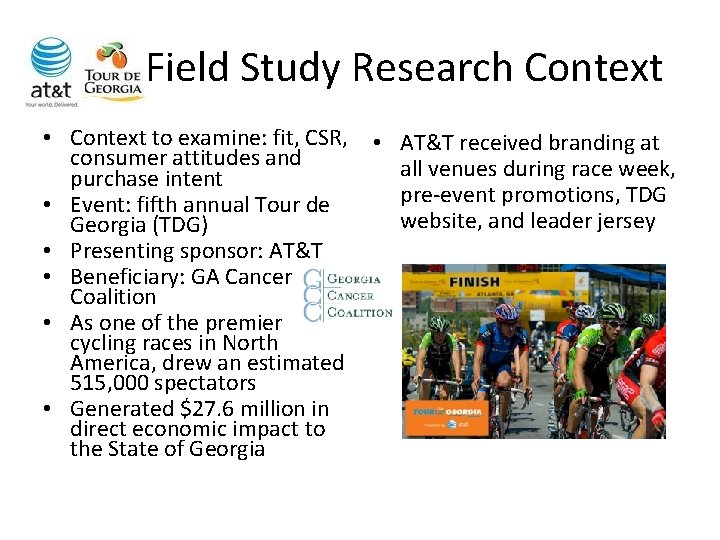
Field Study Research Context • Context to examine: fit, CSR, consumer attitudes and purchase intent • Event: fifth annual Tour de Georgia (TDG) • Presenting sponsor: AT&T • Beneficiary: GA Cancer Coalition • As one of the premier cycling races in North America, drew an estimated 515, 000 spectators • Generated $27. 6 million in direct economic impact to the State of Georgia • AT&T received branding at all venues during race week, pre-event promotions, TDG website, and leader jersey
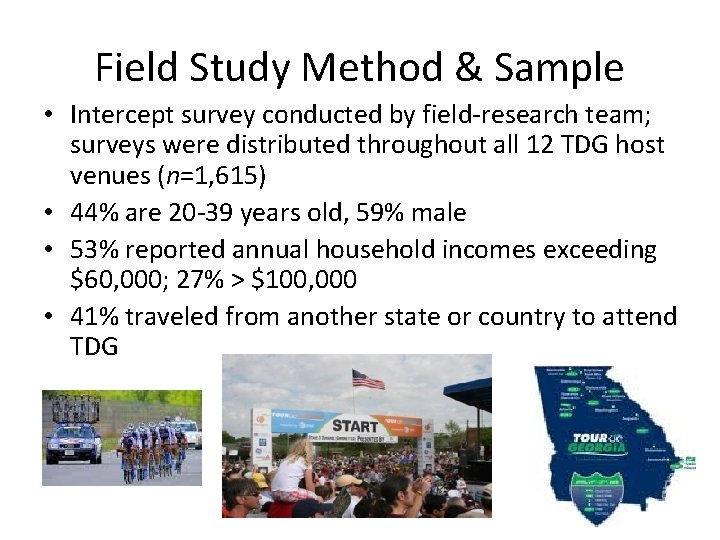
Field Study Method & Sample • Intercept survey conducted by field-research team; surveys were distributed throughout all 12 TDG host venues (n=1, 615) • 44% are 20 -39 years old, 59% male • 53% reported annual household incomes exceeding $60, 000; 27% > $100, 000 • 41% traveled from another state or country to attend TDG
Measurement & Scale Items All constructs used 5 -point Likert-type scales, anchored by 1=strongly disagree/ 5=strongly agree: • Modified 5 -item scale tapping Event-Sponsor Congruity from Speed & Thompson (2000) • Adapted Lichtenstein et al. ’s (2004) 5 -item scale to measure CSR perceptions • Lumpkin & Darden (1989) provided 3 measures of Activeness in Event Domain • Chandon et al. (2000) developed separate 3 -item scales to measure Event Entertainment and Attitude toward the Event • Adapted Bloch et al. ’s (1989) 3 -item scale to measure Brand Knowledge • Yoo et al. (2000) provided 3 -item scale to measure Brand Commitment • Adapted Baker & Churchill (1977) 4 -item scale to measure Purchase Intent
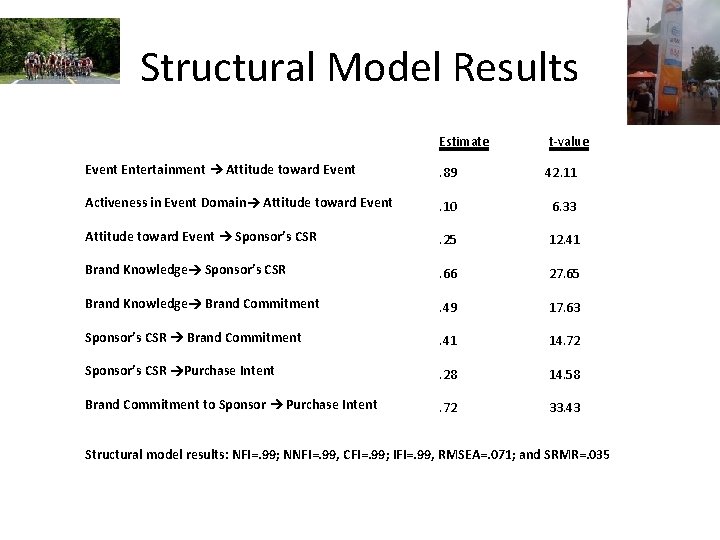
Structural Model Results Estimate t-value Event Entertainment Attitude toward Event . 89 42. 11 Activeness in Event Domain Attitude toward Event . 10 6. 33 Attitude toward Event Sponsor’s CSR . 25 12. 41 Brand Knowledge Sponsor’s CSR . 66 27. 65 Brand Knowledge Brand Commitment . 49 17. 63 Sponsor’s CSR Brand Commitment . 41 14. 72 Sponsor’s CSR Purchase Intent . 28 14. 58 Brand Commitment to Sponsor Purchase Intent . 72 33. 43 Structural model results: NFI=. 99; NNFI=. 99, CFI=. 99; IFI=. 99, RMSEA=. 071; and SRMR=. 035
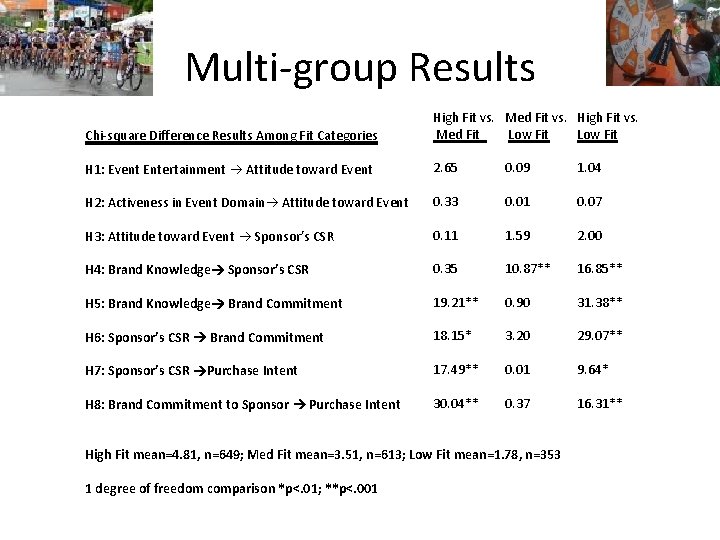
Multi-group Results Chi-square Difference Results Among Fit Categories High Fit vs. Med Fit vs. High Fit vs. Med Fit Low Fit H 1: Event Entertainment Attitude toward Event 2. 65 0. 09 1. 04 H 2: Activeness in Event Domain Attitude toward Event 0. 33 0. 01 0. 07 H 3: Attitude toward Event Sponsor’s CSR 0. 11 1. 59 2. 00 H 4: Brand Knowledge Sponsor’s CSR 0. 35 10. 87** 16. 85** H 5: Brand Knowledge Brand Commitment 19. 21** 0. 90 31. 38** H 6: Sponsor’s CSR Brand Commitment 18. 15* 3. 20 29. 07** H 7: Sponsor’s CSR Purchase Intent 17. 49** 0. 01 9. 64* H 8: Brand Commitment to Sponsor Purchase Intent 30. 04** 0. 37 16. 31** High Fit mean=4. 81, n=649; Med Fit mean=3. 51, n=613; Low Fit mean=1. 78, n=353 1 degree of freedom comparison *p<. 01; **p<. 001
Discussion • Real-world evidence that event-sponsor fit promotes positive marketing outcomes to sponsor • Model illustrates how CSR serves as mediator for transcending favorable attitudes towards event to enhancing attitudes and preferences for sponsor • We uncovered asymmetrical impact of fit on sponsor and event – Results show congruity plays role in consumers’ perceptions of sponsor brand purchase intentions – Fit did not influence consumers’ evaluation of event