Digital Introduction North America Channel Partner Module 051810
- Slides: 16
Digital Introduction North America Channel Partner Module 051810 VERTEX STANDARD is registered in the US Patent & Trademark Office. All other product or service names are the property of their respective owners. © Vertex Standard Co. Ltd. 2010
Why Digital? ● Improved performance and extended range ● Clear, consistent audio quality ● Increased systems capability vs. analog ● Better spectrum efficiency ● Regulatory requirement
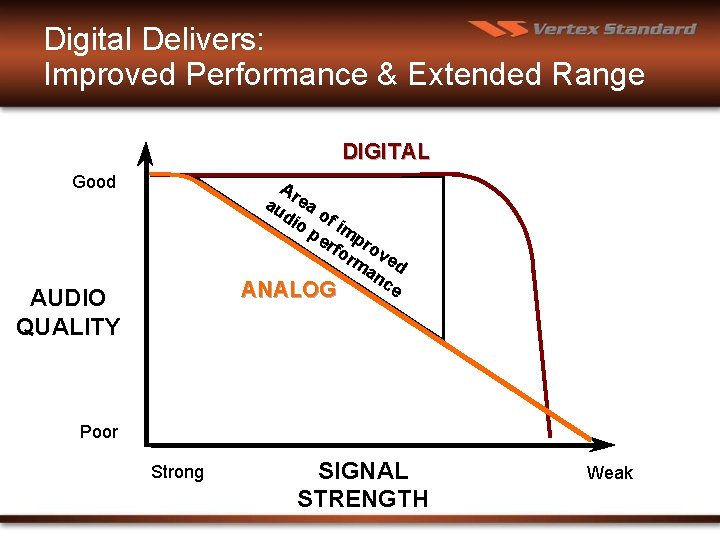
Digital Delivers: Improved Performance & Extended Range DIGITAL Good A au rea dio of pe imp rfo rov rm ed an ce ANALOG AUDIO QUALITY Poor Strong SIGNAL STRENGTH Weak
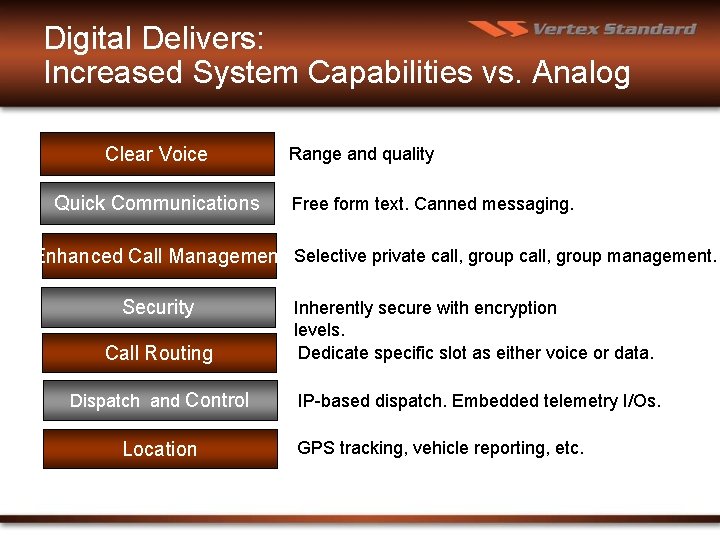
Digital Delivers: Increased System Capabilities vs. Analog Clear Voice Quick Communications Range and quality Free form text. Canned messaging. Enhanced Call Management Selective private call, group management. Security Call Routing Dispatch and Control Location Inherently secure with encryption levels. Dedicate specific slot as either voice or data. IP-based dispatch. Embedded telemetry I/Os. GPS tracking, vehicle reporting, etc.
TDMA Digital Advantage VERTEX STANDARD is registered in the US Patent & Trademark Office. All other product or service names are the property of their respective owners. © Vertex Standard Co. Ltd. 2010
TDMA Digital Advantage Vertex Standard is committed to developing digital communications to bring customers a new choice in TDMA digital technology that provides: • double the capacity on existing licensed channels • increased coverage • longer battery life, and • superior audio performance.
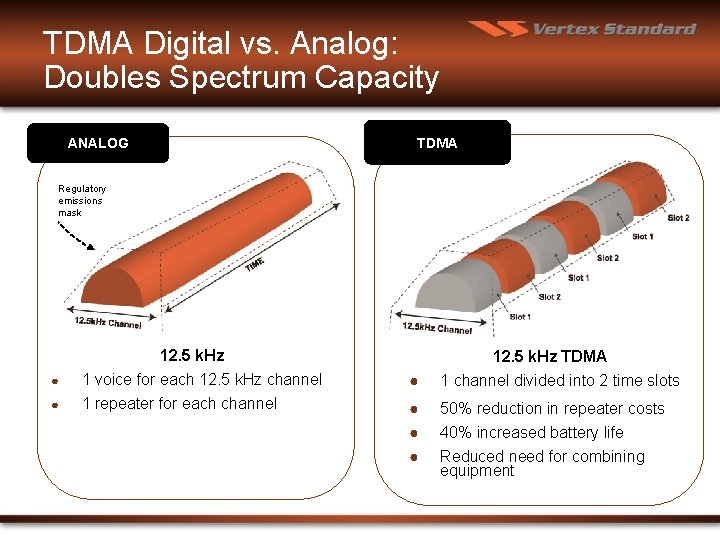
TDMA Digital vs. Analog: Doubles Spectrum Capacity TDMA ANALOG Regulatory emissions mask 12. 5 k. Hz ● ● 1 voice for each 12. 5 k. Hz channel 1 repeater for each channel 12. 5 k. Hz TDMA ● 1 channel divided into 2 time slots ● ● ● 50% reduction in repeater costs 40% increased battery life Reduced need for combining equipment
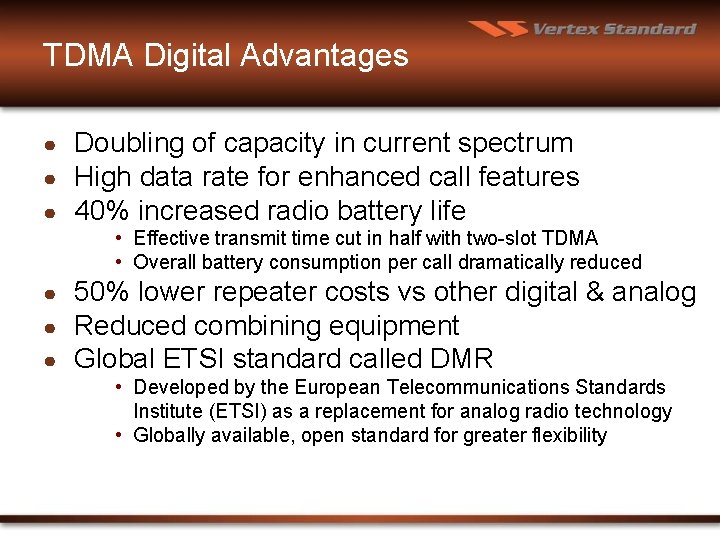
TDMA Digital Advantages ● ● ● Doubling of capacity in current spectrum High data rate for enhanced call features 40% increased radio battery life • Effective transmit time cut in half with two-slot TDMA • Overall battery consumption per call dramatically reduced ● ● ● 50% lower repeater costs vs other digital & analog Reduced combining equipment Global ETSI standard called DMR • Developed by the European Telecommunications Standards Institute (ETSI) as a replacement for analog radio technology • Globally available, open standard for greater flexibility
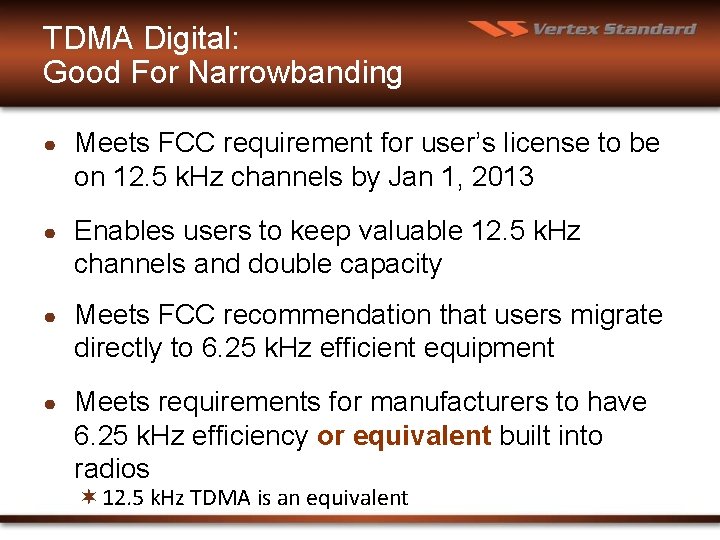
TDMA Digital: Good For Narrowbanding ● Meets FCC requirement for user’s license to be on 12. 5 k. Hz channels by Jan 1, 2013 ● Enables users to keep valuable 12. 5 k. Hz channels and double capacity ● Meets FCC recommendation that users migrate directly to 6. 25 k. Hz efficient equipment ● Meets requirements for manufacturers to have 6. 25 k. Hz efficiency or equivalent built into radios ¬ 12. 5 k. Hz TDMA is an equivalent
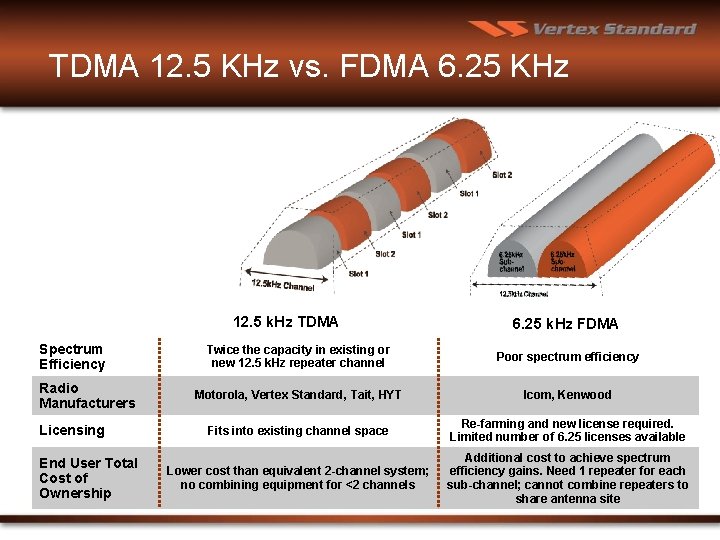
TDMA 12. 5 KHz vs. FDMA 6. 25 KHz 12. 5 k. Hz TDMA Spectrum Efficiency Radio Manufacturers Licensing End User Total Cost of Ownership 6. 25 k. Hz FDMA Twice the capacity in existing or new 12. 5 k. Hz repeater channel Poor spectrum efficiency Motorola, Vertex Standard, Tait, HYT Icom, Kenwood Fits into existing channel space Re-farming and new license required. Limited number of 6. 25 licenses available Lower cost than equivalent 2 -channel system; no combining equipment for <2 channels Additional cost to achieve spectrum efficiency gains. Need 1 repeater for each sub-channel; cannot combine repeaters to share antenna site
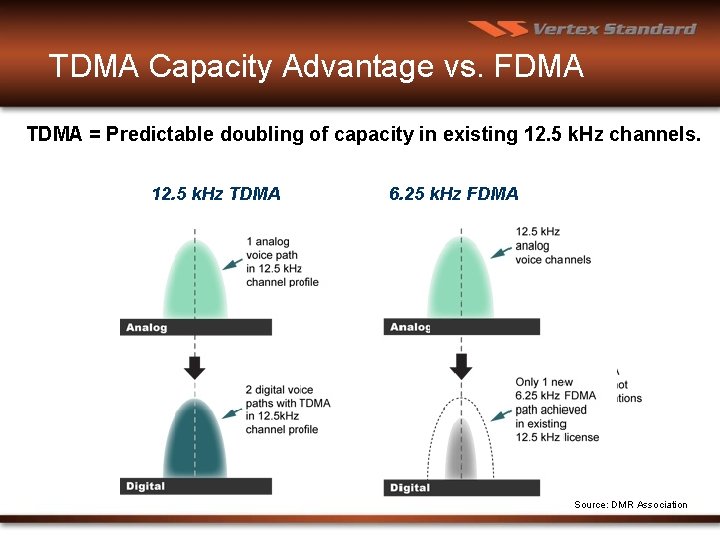
TDMA Capacity Advantage vs. FDMA TDMA = Predictable doubling of capacity in existing 12. 5 k. Hz channels. 12. 5 k. Hz TDMA 6. 25 k. Hz FDMA Source: DMR Association
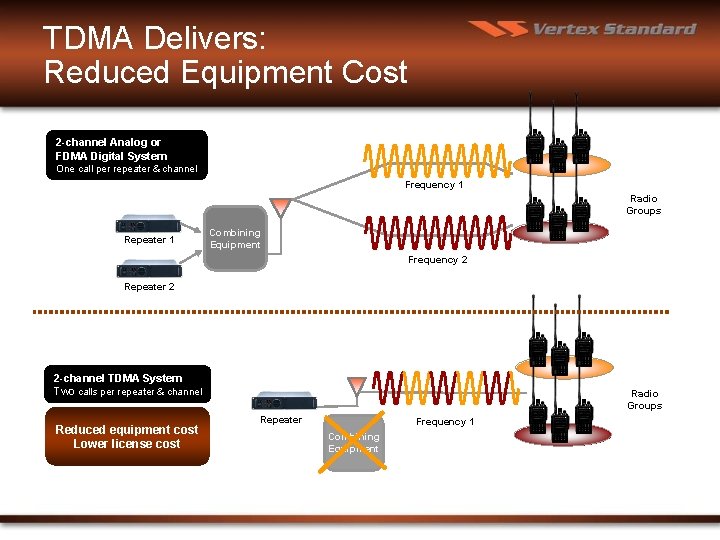
TDMA Delivers: Reduced Equipment Cost 2 -channel Analog or FDMA Digital System One call per repeater & channel Frequency 1 Radio Groups Repeater 1 Combining Equipment Frequency 2 Repeater 2 2 -channel TDMA System Two calls per repeater & channel Reduced equipment cost Lower license cost Radio Groups Repeater Frequency 1 Combining Equipment
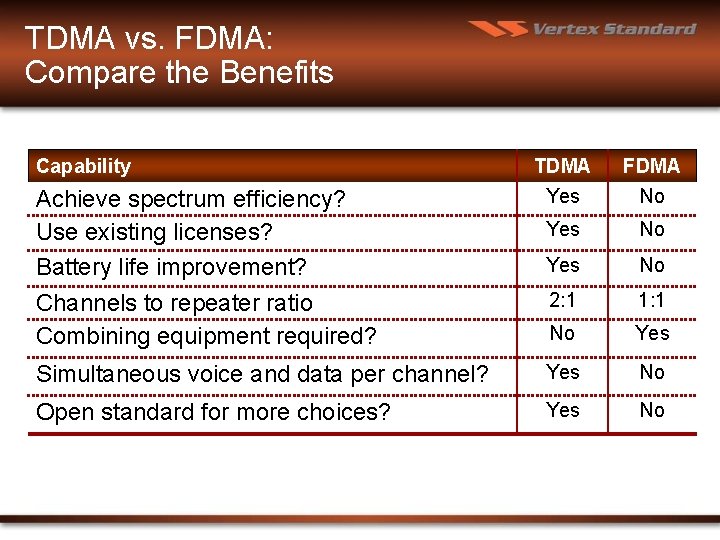
TDMA vs. FDMA: Compare the Benefits Capability TDMA FDMA Achieve spectrum efficiency? Use existing licenses? Battery life improvement? Channels to repeater ratio Combining equipment required? Yes No 2: 1 1: 1 No Yes Simultaneous voice and data per channel? Yes No Open standard for more choices? Yes No
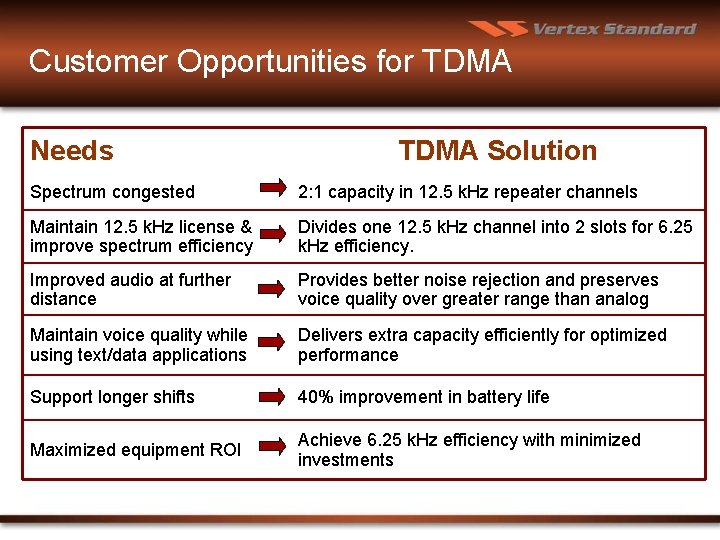
Customer Opportunities for TDMA Needs TDMA Solution Spectrum congested 2: 1 capacity in 12. 5 k. Hz repeater channels Maintain 12. 5 k. Hz license & improve spectrum efficiency Divides one 12. 5 k. Hz channel into 2 slots for 6. 25 k. Hz efficiency. Improved audio at further distance Provides better noise rejection and preserves voice quality over greater range than analog Maintain voice quality while using text/data applications Delivers extra capacity efficiently for optimized performance Support longer shifts 40% improvement in battery life Maximized equipment ROI Achieve 6. 25 k. Hz efficiency with minimized investments
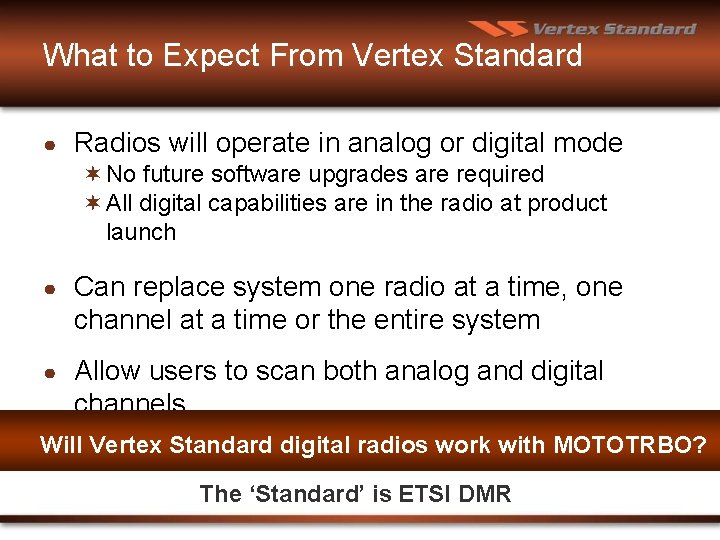
What to Expect From Vertex Standard ● Radios will operate in analog or digital mode ¬ No future software upgrades are required ¬ All digital capabilities are in the radio at product launch ● Can replace system one radio at a time, one channel at a time or the entire system ● Allow users to scan both analog and digital channels Will Vertex Standard digital radios work with MOTOTRBO? The ‘Standard’ is ETSI DMR
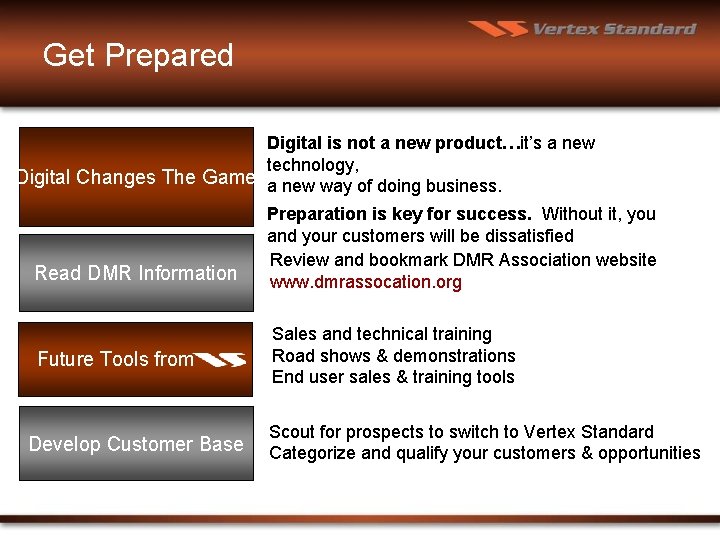
Get Prepared Digital is not a new product…it’s a new technology, Digital Changes The Game a new way of doing business. Read DMR Information Future Tools from Develop Customer Base Preparation is key for success. Without it, you and your customers will be dissatisfied Review and bookmark DMR Association website www. dmrassocation. org Sales and technical training Road shows & demonstrations End user sales & training tools Scout for prospects to switch to Vertex Standard Categorize and qualify your customers & opportunities