Digital Image Processing 3 rd ed Gonzalez Woods

- Slides: 22
Digital Image Processing, 3 rd ed. Gonzalez & Woods www. Image. Processing. Place. com Chapter 11 Representation and Description • Representation – The segmentation techniques yield data in the form of pixels along a boundary or pixels contained in a region. – It is standard practice to use schemes that compact the segmented data into representations that facilitate the computation of descriptors. © 1992– 2008 R. C. Gonzalez & R. E. Woods
Digital Image Processing, 3 rd ed. Gonzalez & Woods www. Image. Processing. Place. com Chapter 11 Representation and Description • Boundary Following: – We assume • (1) that we are working with binary images in which object and background points are labeled 1 and 0, respectively • (2) the images are padded with a border of 0 s to eliminate the possibility of an object merging with the image border. © 1992– 2008 R. C. Gonzalez & R. E. Woods
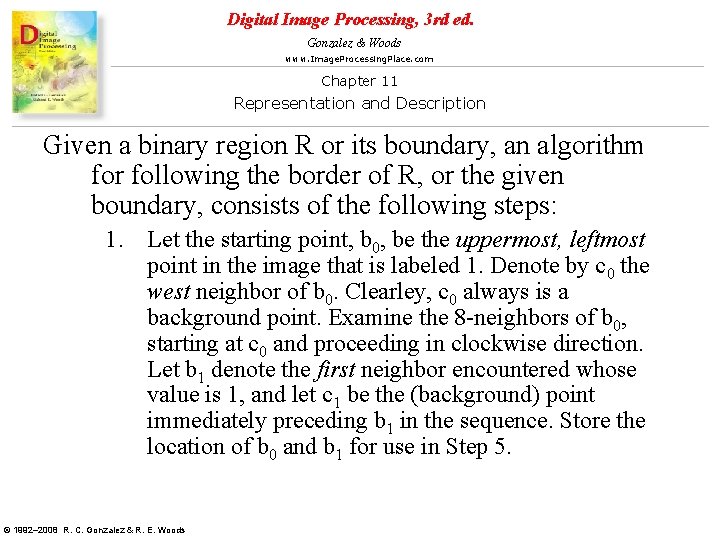
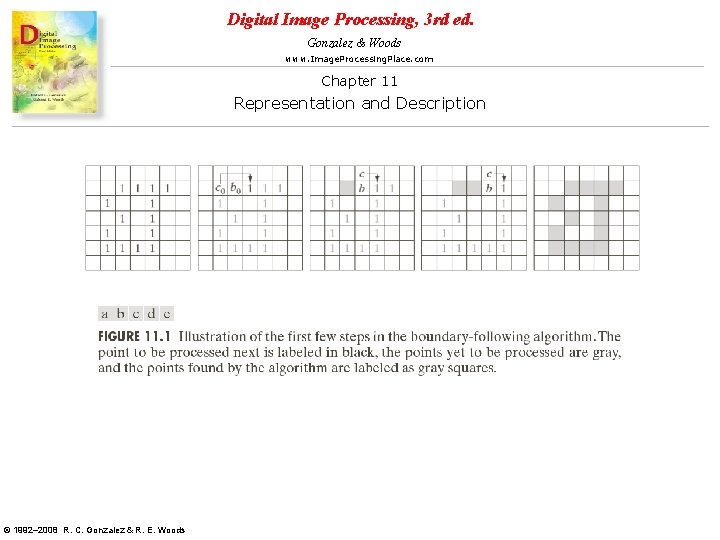
Digital Image Processing, 3 rd ed. Gonzalez & Woods www. Image. Processing. Place. com Chapter 11 Representation and Description Given a binary region R or its boundary, an algorithm for following the border of R, or the given boundary, consists of the following steps: 1. Let the starting point, b 0, be the uppermost, leftmost point in the image that is labeled 1. Denote by c 0 the west neighbor of b 0. Clearley, c 0 always is a background point. Examine the 8 -neighbors of b 0, starting at c 0 and proceeding in clockwise direction. Let b 1 denote the first neighbor encountered whose value is 1, and let c 1 be the (background) point immediately preceding b 1 in the sequence. Store the location of b 0 and b 1 for use in Step 5. © 1992– 2008 R. C. Gonzalez & R. E. Woods
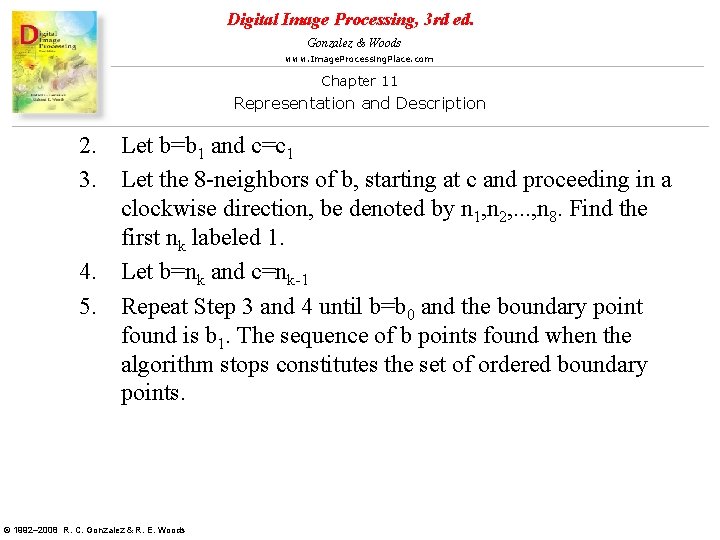
Digital Image Processing, 3 rd ed. Gonzalez & Woods www. Image. Processing. Place. com Chapter 11 Representation and Description 2. Let b=b 1 and c=c 1 3. Let the 8 -neighbors of b, starting at c and proceeding in a clockwise direction, be denoted by n 1, n 2, . . . , n 8. Find the first nk labeled 1. 4. Let b=nk and c=nk-1 5. Repeat Step 3 and 4 until b=b 0 and the boundary point found is b 1. The sequence of b points found when the algorithm stops constitutes the set of ordered boundary points. © 1992– 2008 R. C. Gonzalez & R. E. Woods
Digital Image Processing, 3 rd ed. Gonzalez & Woods www. Image. Processing. Place. com Chapter 11 Representation and Description © 1992– 2008 R. C. Gonzalez & R. E. Woods
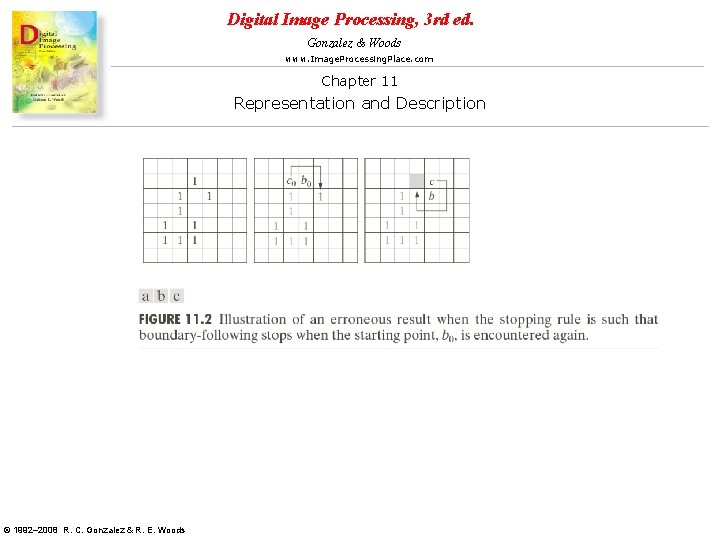
Digital Image Processing, 3 rd ed. Gonzalez & Woods www. Image. Processing. Place. com Chapter 11 Representation and Description • The boundary-following algorithm works equally well if a region, rather than its boundary, is given in Fig. 11. 2 • That is, procedure extracts the outer boundary of a binary region. If the objective is to find the boundaries of holes in a region(these are called the inner boundaries of the region), a simple approach is to extract the holes, a simple approach is to extract and treat them as 1 -valued region on a background of 0 s. © 1992– 2008 R. C. Gonzalez & R. E. Woods
Digital Image Processing, 3 rd ed. Gonzalez & Woods www. Image. Processing. Place. com Chapter 11 Representation and Description © 1992– 2008 R. C. Gonzalez & R. E. Woods
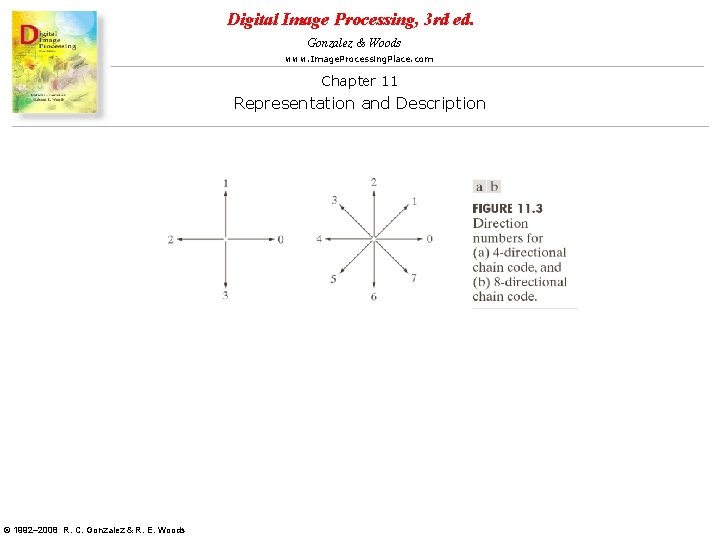
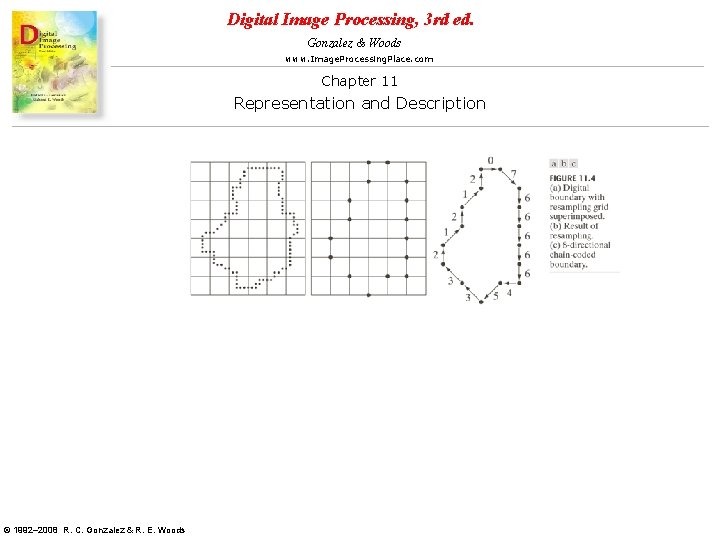
Digital Image Processing, 3 rd ed. Gonzalez & Woods www. Image. Processing. Place. com Chapter 11 Representation and Description • Chain Codes: – Chain codes are used to represent a boundary by a connected sequence of straight-line segments of specified length and direction. – Typically, this representation is based on 4 - or 8 connectivity of the segments. The direction of each segment is coded by using a numbering scheme, as in Fig. 11. 3 © 1992– 2008 R. C. Gonzalez & R. E. Woods
Digital Image Processing, 3 rd ed. Gonzalez & Woods www. Image. Processing. Place. com Chapter 11 Representation and Description © 1992– 2008 R. C. Gonzalez & R. E. Woods
Digital Image Processing, 3 rd ed. Gonzalez & Woods www. Image. Processing. Place. com Chapter 11 Representation and Description © 1992– 2008 R. C. Gonzalez & R. E. Woods
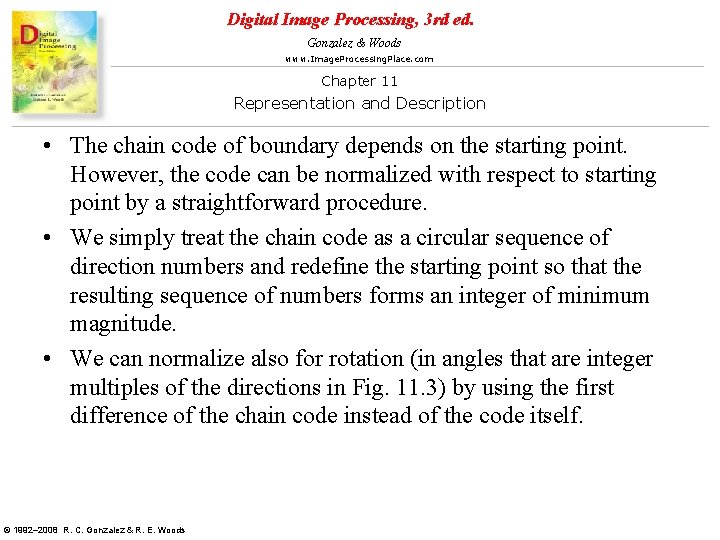
Digital Image Processing, 3 rd ed. Gonzalez & Woods www. Image. Processing. Place. com Chapter 11 Representation and Description • The chain code of boundary depends on the starting point. However, the code can be normalized with respect to starting point by a straightforward procedure. • We simply treat the chain code as a circular sequence of direction numbers and redefine the starting point so that the resulting sequence of numbers forms an integer of minimum magnitude. • We can normalize also for rotation (in angles that are integer multiples of the directions in Fig. 11. 3) by using the first difference of the chain code instead of the code itself. © 1992– 2008 R. C. Gonzalez & R. E. Woods
Digital Image Processing, 3 rd ed. Gonzalez & Woods www. Image. Processing. Place. com Chapter 11 Representation and Description © 1992– 2008 R. C. Gonzalez & R. E. Woods
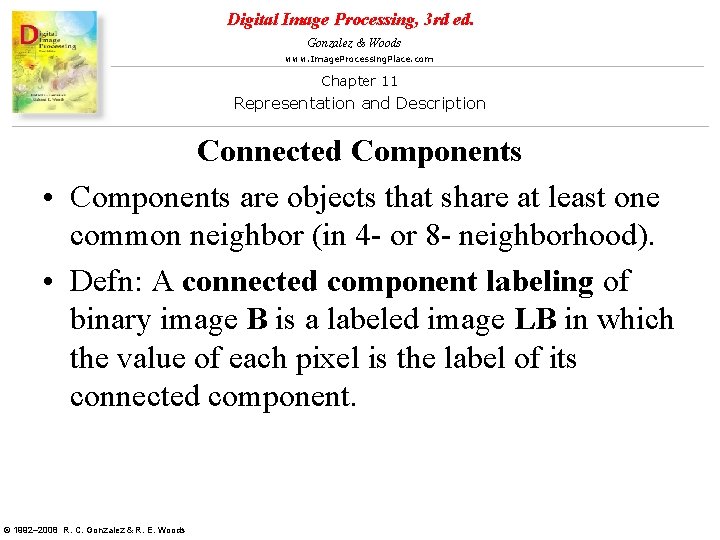
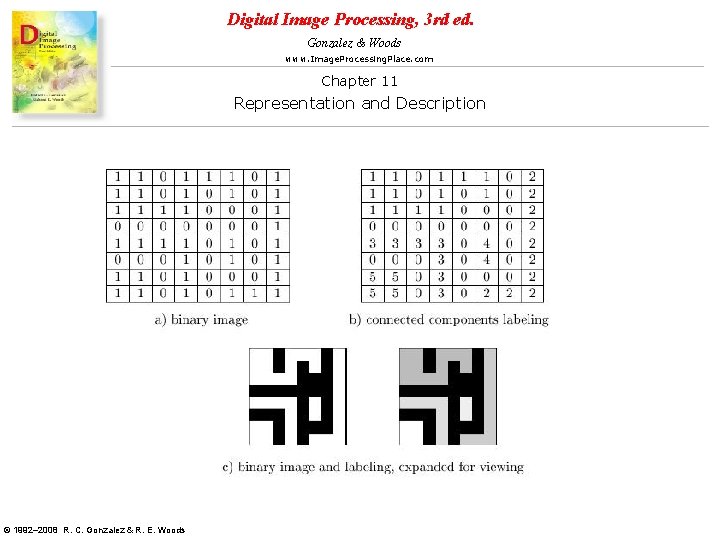
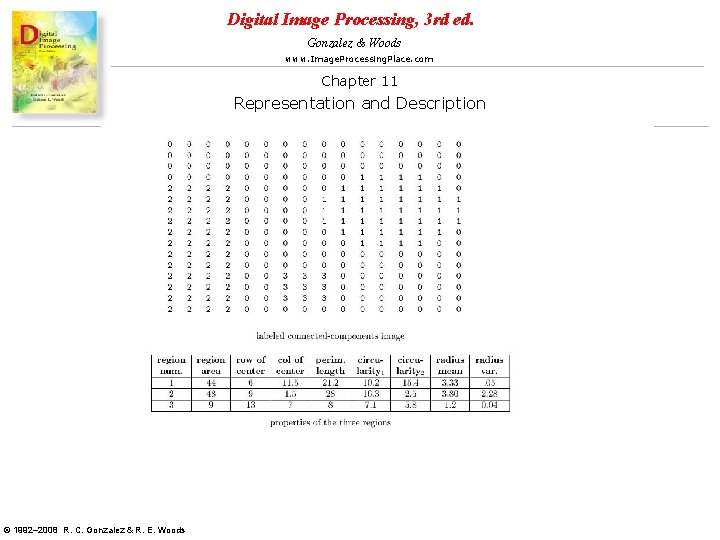
Digital Image Processing, 3 rd ed. Gonzalez & Woods www. Image. Processing. Place. com Chapter 11 Representation and Description Connected Components • Components are objects that share at least one common neighbor (in 4 - or 8 - neighborhood). • Defn: A connected component labeling of binary image B is a labeled image LB in which the value of each pixel is the label of its connected component. © 1992– 2008 R. C. Gonzalez & R. E. Woods
Digital Image Processing, 3 rd ed. Gonzalez & Woods www. Image. Processing. Place. com Chapter 11 Representation and Description © 1992– 2008 R. C. Gonzalez & R. E. Woods
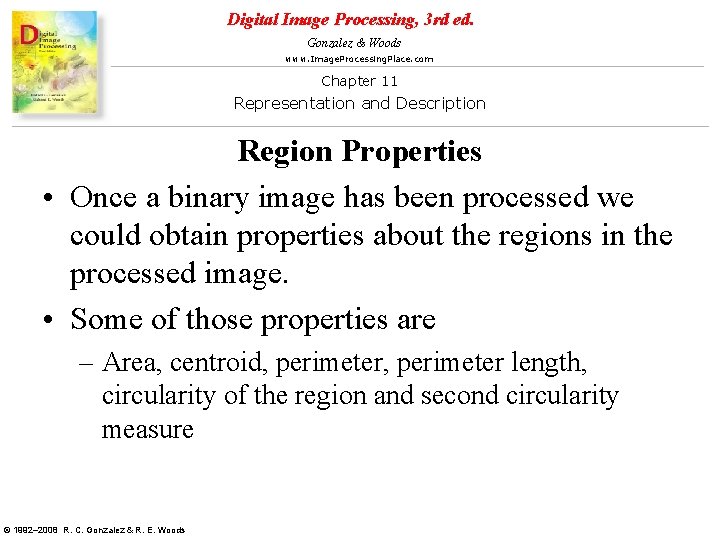
Digital Image Processing, 3 rd ed. Gonzalez & Woods www. Image. Processing. Place. com Chapter 11 Representation and Description Region Properties • Once a binary image has been processed we could obtain properties about the regions in the processed image. • Some of those properties are – Area, centroid, perimeter length, circularity of the region and second circularity measure © 1992– 2008 R. C. Gonzalez & R. E. Woods
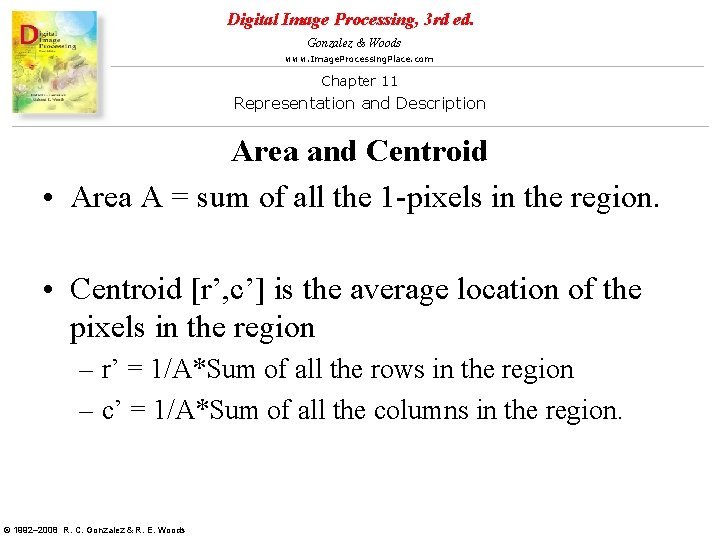
Digital Image Processing, 3 rd ed. Gonzalez & Woods www. Image. Processing. Place. com Chapter 11 Representation and Description Area and Centroid • Area A = sum of all the 1 -pixels in the region. • Centroid [r’, c’] is the average location of the pixels in the region – r’ = 1/A*Sum of all the rows in the region – c’ = 1/A*Sum of all the columns in the region. © 1992– 2008 R. C. Gonzalez & R. E. Woods
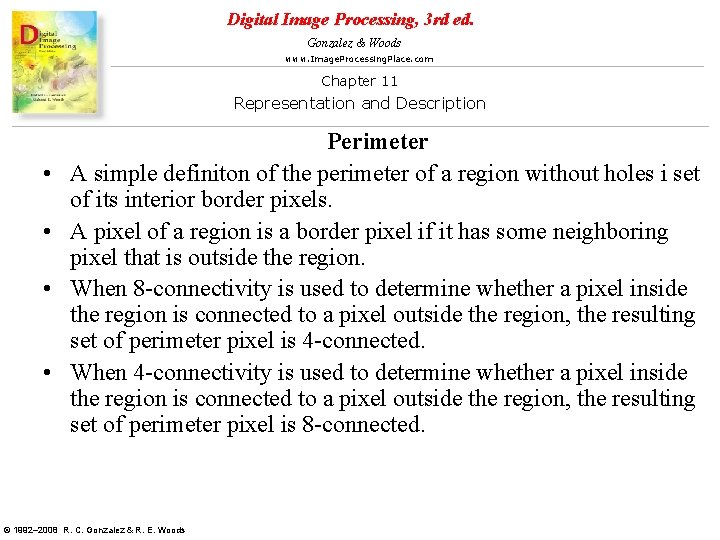
Digital Image Processing, 3 rd ed. Gonzalez & Woods www. Image. Processing. Place. com Chapter 11 Representation and Description • • Perimeter A simple definiton of the perimeter of a region without holes i set of its interior border pixels. A pixel of a region is a border pixel if it has some neighboring pixel that is outside the region. When 8 -connectivity is used to determine whether a pixel inside the region is connected to a pixel outside the region, the resulting set of perimeter pixel is 4 -connected. When 4 -connectivity is used to determine whether a pixel inside the region is connected to a pixel outside the region, the resulting set of perimeter pixel is 8 -connected. © 1992– 2008 R. C. Gonzalez & R. E. Woods
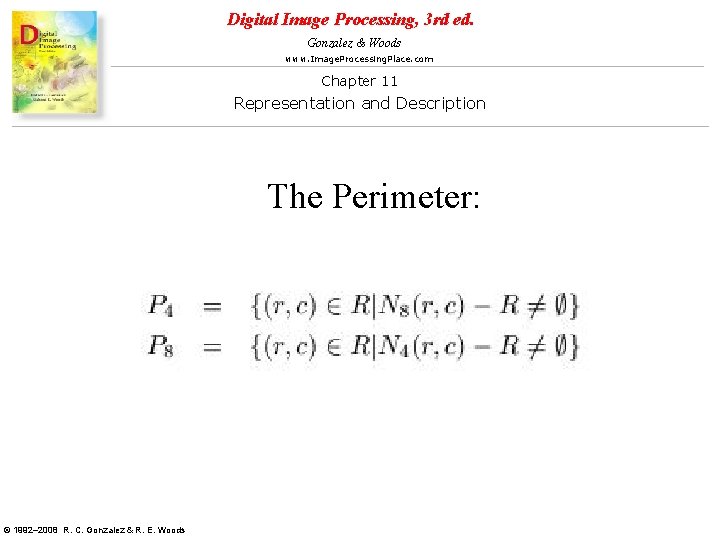
Digital Image Processing, 3 rd ed. Gonzalez & Woods www. Image. Processing. Place. com Chapter 11 Representation and Description The Perimeter: © 1992– 2008 R. C. Gonzalez & R. E. Woods
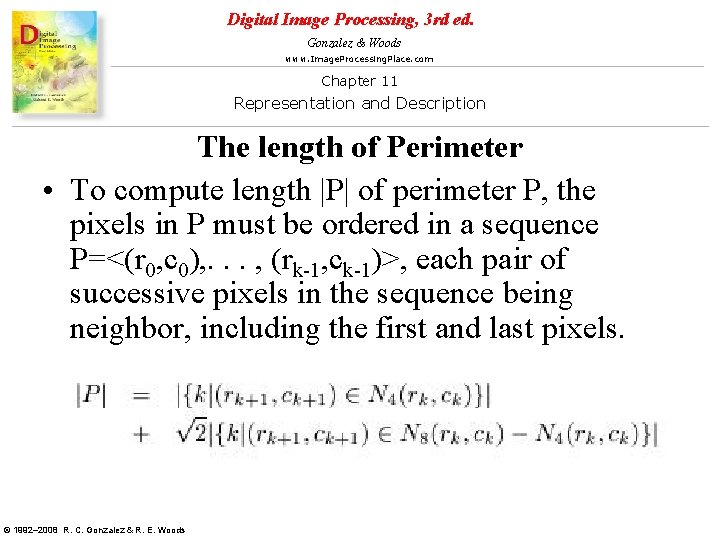
Digital Image Processing, 3 rd ed. Gonzalez & Woods www. Image. Processing. Place. com Chapter 11 Representation and Description The length of Perimeter • To compute length |P| of perimeter P, the pixels in P must be ordered in a sequence P=<(r 0, c 0), . . . , (rk-1, ck-1)>, each pair of successive pixels in the sequence being neighbor, including the first and last pixels. © 1992– 2008 R. C. Gonzalez & R. E. Woods
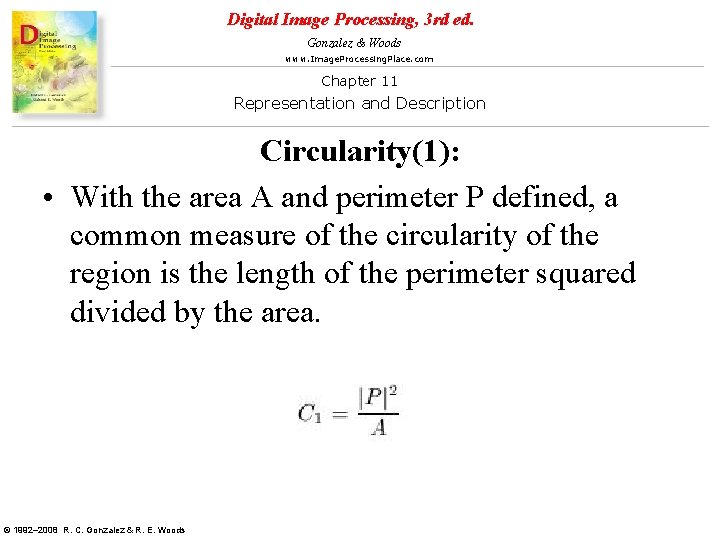
Digital Image Processing, 3 rd ed. Gonzalez & Woods www. Image. Processing. Place. com Chapter 11 Representation and Description Circularity(1): • With the area A and perimeter P defined, a common measure of the circularity of the region is the length of the perimeter squared divided by the area. © 1992– 2008 R. C. Gonzalez & R. E. Woods
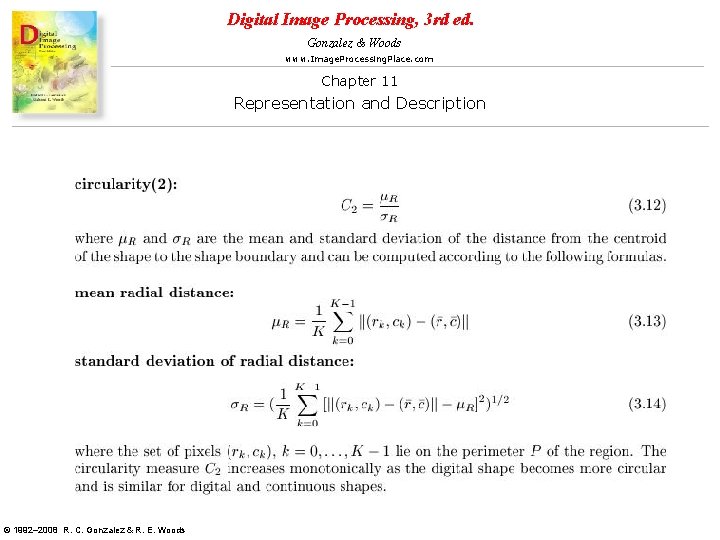
Digital Image Processing, 3 rd ed. Gonzalez & Woods www. Image. Processing. Place. com Chapter 11 Representation and Description © 1992– 2008 R. C. Gonzalez & R. E. Woods
Digital Image Processing, 3 rd ed. Gonzalez & Woods www. Image. Processing. Place. com Chapter 11 Representation and Description © 1992– 2008 R. C. Gonzalez & R. E. Woods