DESE UPDATES HEALTH PHYSICAL EDUCATION SCHOOL WELLNESS Laura


- Slides: 41
DESE UPDATES HEALTH, PHYSICAL EDUCATION & SCHOOL WELLNESS Laura Beckmann laura. beckmann@dese. mo. gov 573 -751 -7613 January 22, 2018 Missouri Department of Elementary and Secondary Education
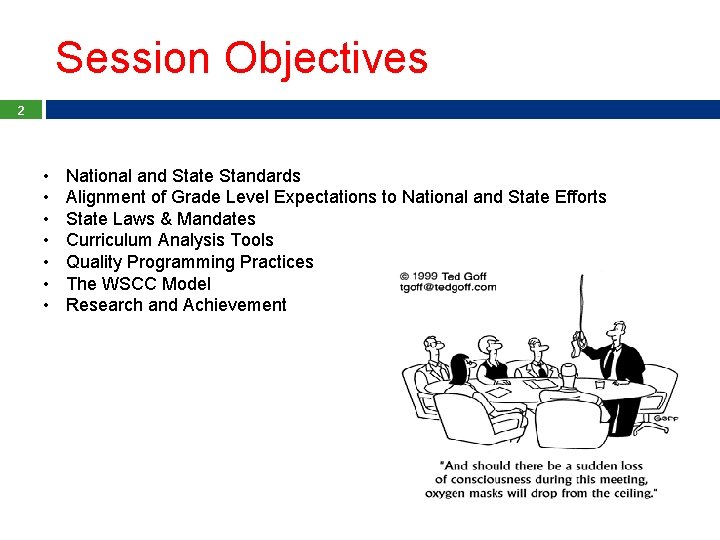
Session Objectives 2 • • National and State Standards Alignment of Grade Level Expectations to National and State Efforts State Laws & Mandates Curriculum Analysis Tools Quality Programming Practices The WSCC Model Research and Achievement
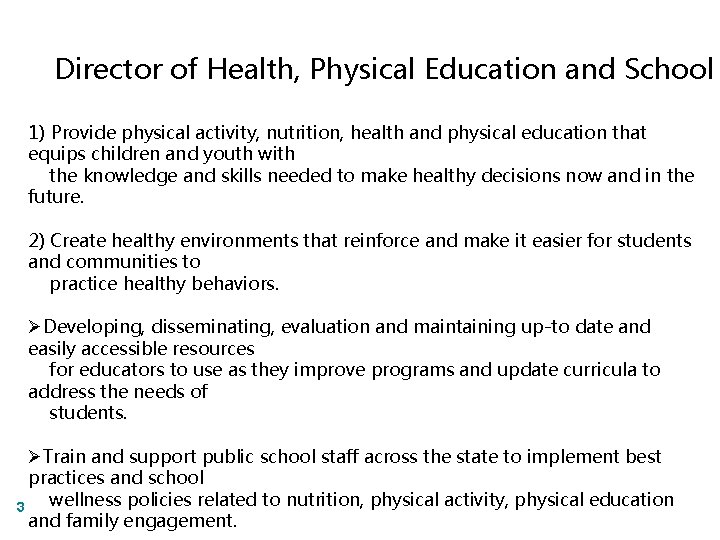
Director of Health, Physical Education and School 1) Provide physical activity, nutrition, health and physical education that equips children and youth with the knowledge and skills needed to make healthy decisions now and in the future. 2) Create healthy environments that reinforce and make it easier for students and communities to practice healthy behaviors. ØDeveloping, disseminating, evaluation and maintaining up-to date and easily accessible resources for educators to use as they improve programs and update curricula to address the needs of students. ØTrain and support public school staff across the state to implement best practices and school wellness policies related to nutrition, physical activity, physical education 3 and family engagement.
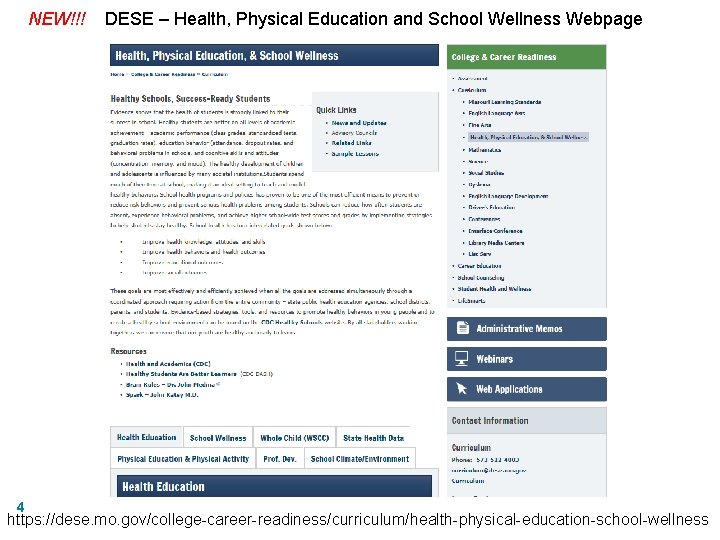
NEW!!! 4 DESE – Health, Physical Education and School Wellness Webpage https: //dese. mo. gov/college-career-readiness/curriculum/health-physical-education-school-wellness
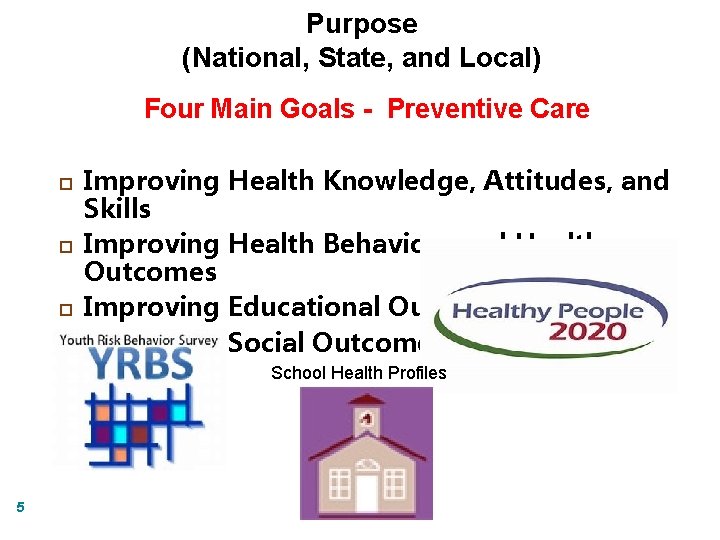
Purpose (National, State, and Local) Four Main Goals - Preventive Care Improving Health Knowledge, Attitudes, and Skills Improving Health Behaviors and Health Outcomes Improving Educational Outcomes Improving Social Outcomes School Health Profiles 5
Why is School Health Important for School Reform? Ø Ø Ø 6 Now more than ever, educational policymakers are under pressure to improve academic achievement and reduce achievement disparities. Addressing health barriers to learning is necessary for effective and efficient school reform. Evidence demonstrates that specific health problems influence motivation and ability to learn, and have powerful effects on academic performance and upward social mobility. Ø Health barriers to learning jeopardize other investments in school reform. Ø The rising healthcare costs that threaten America’s economic security, 23 and low levels of fitness and high
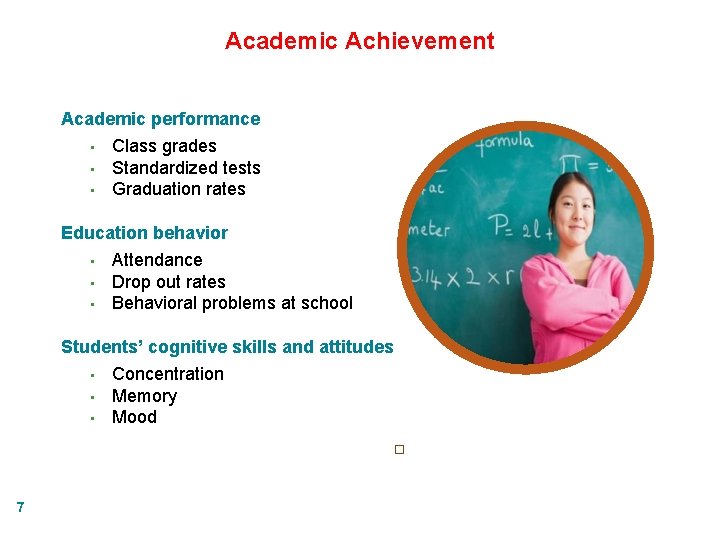
Academic Achievement Academic performance • • • Class grades Standardized tests Graduation rates Education behavior • • • Attendance Drop out rates Behavioral problems at school Students’ cognitive skills and attitudes • • • Concentration Memory Mood 7
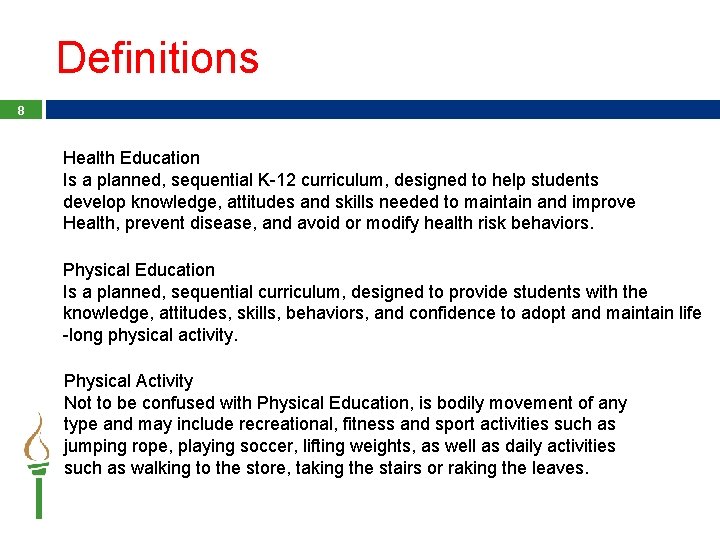
Definitions 8 Health Education Is a planned, sequential K-12 curriculum, designed to help students develop knowledge, attitudes and skills needed to maintain and improve Health, prevent disease, and avoid or modify health risk behaviors. Physical Education Is a planned, sequential curriculum, designed to provide students with the knowledge, attitudes, skills, behaviors, and confidence to adopt and maintain life -long physical activity. Physical Activity Not to be confused with Physical Education, is bodily movement of any type and may include recreational, fitness and sport activities such as jumping rope, playing soccer, lifting weights, as well as daily activities such as walking to the store, taking the stairs or raking the leaves.
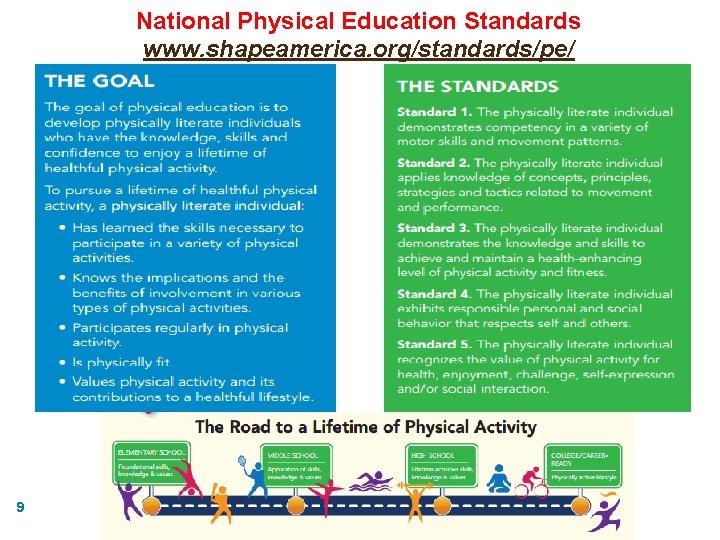
National Physical Education Standards www. shapeamerica. org/standards/pe/ 9
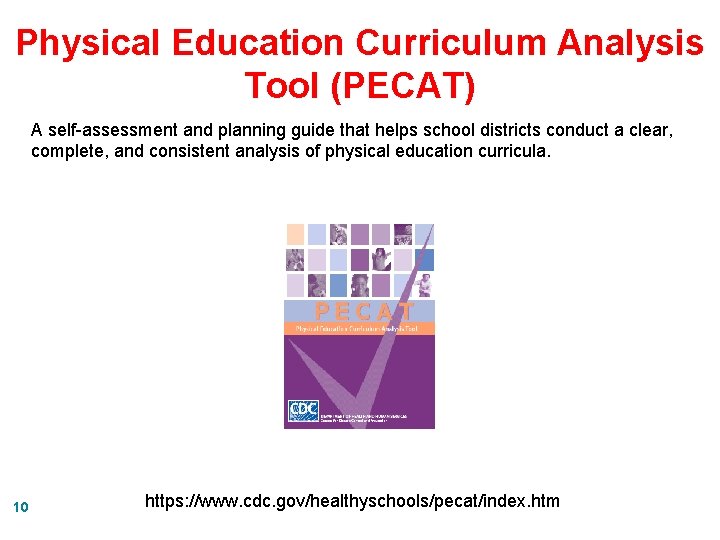
Physical Education Curriculum Analysis Tool (PECAT) A self-assessment and planning guide that helps school districts conduct a clear, complete, and consistent analysis of physical education curricula. 10 https: //www. cdc. gov/healthyschools/pecat/index. htm
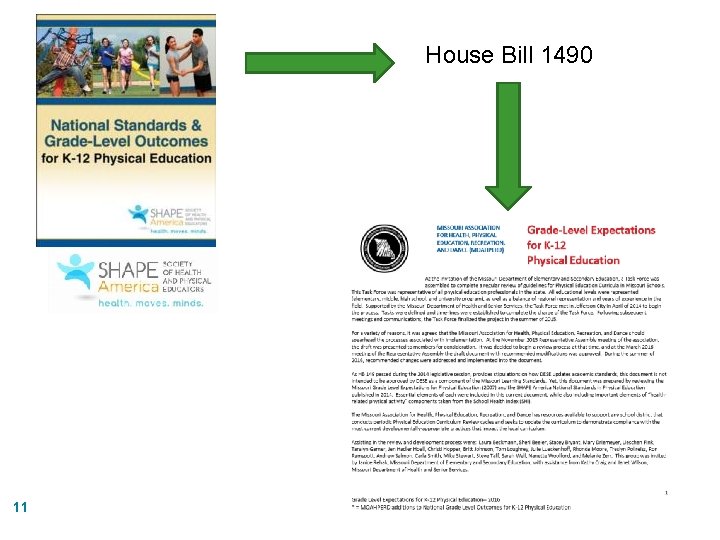
House Bill 1490 11
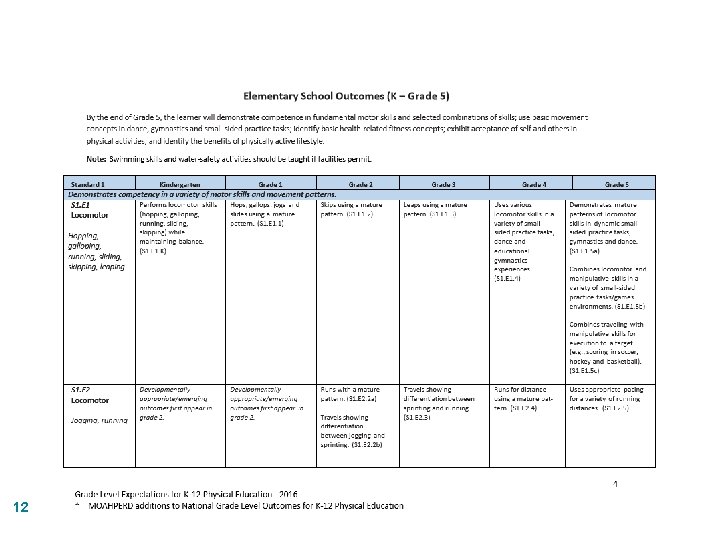
12
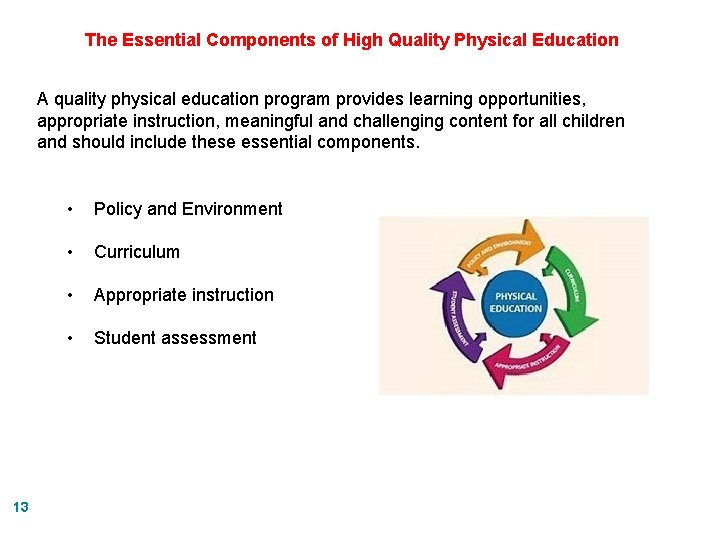
The Essential Components of High Quality Physical Education A quality physical education program provides learning opportunities, appropriate instruction, meaningful and challenging content for all children and should include these essential components. 13 • Policy and Environment • Curriculum • Appropriate instruction • Student assessment
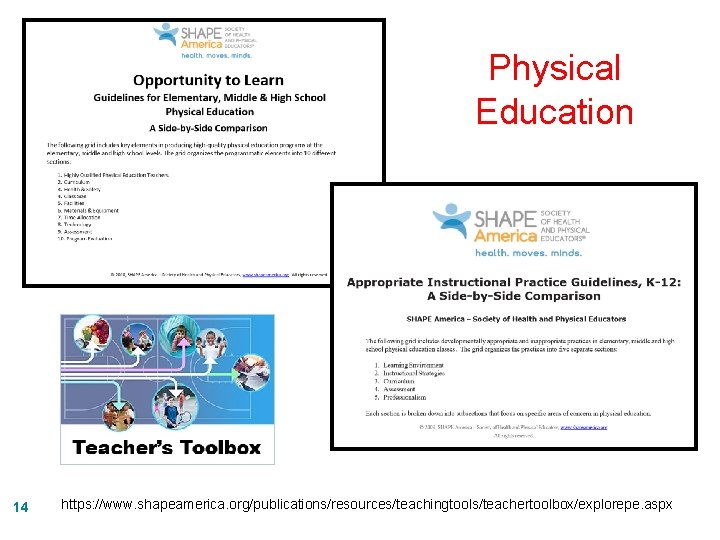
Physical Education 14 https: //www. shapeamerica. org/publications/resources/teachingtools/teachertoolbox/explorepe. aspx
Cade’s Law • Schools will now provide fitness test data for 5 th, 7 th and 9 th grade. • Beginning June 2015 schools were required to report fitness scores for one middle school grade level. • Schools should use Fitnessgram as their basis for testing protocol. – All free resources found on the Presidential Youth Fitness Program Website. 15
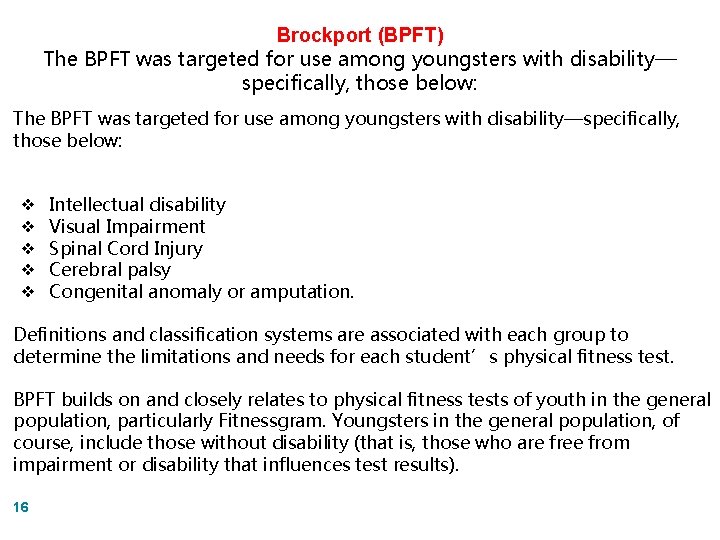
Brockport (BPFT) The BPFT was targeted for use among youngsters with disability— specifically, those below: The BPFT was targeted for use among youngsters with disability—specifically, those below: ❖ ❖ ❖ Intellectual disability Visual Impairment Spinal Cord Injury Cerebral palsy Congenital anomaly or amputation. Definitions and classification systems are associated with each group to determine the limitations and needs for each student’s physical fitness test. BPFT builds on and closely relates to physical fitness tests of youth in the general population, particularly Fitnessgram. Youngsters in the general population, of course, include those without disability (that is, those who are free from impairment or disability that influences test results). 16
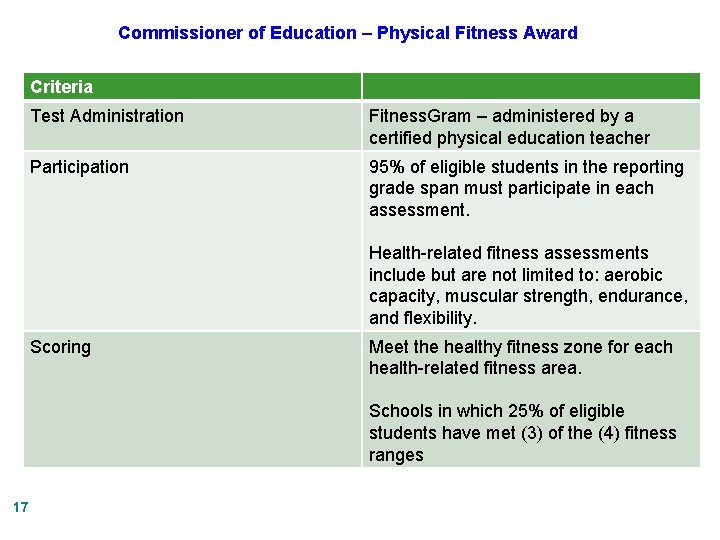
Commissioner of Education – Physical Fitness Award Criteria Test Administration Fitness. Gram – administered by a certified physical education teacher Participation 95% of eligible students in the reporting grade span must participate in each assessment. Health-related fitness assessments include but are not limited to: aerobic capacity, muscular strength, endurance, and flexibility. Scoring Meet the healthy fitness zone for each health-related fitness area. Schools in which 25% of eligible students have met (3) of the (4) fitness ranges 17
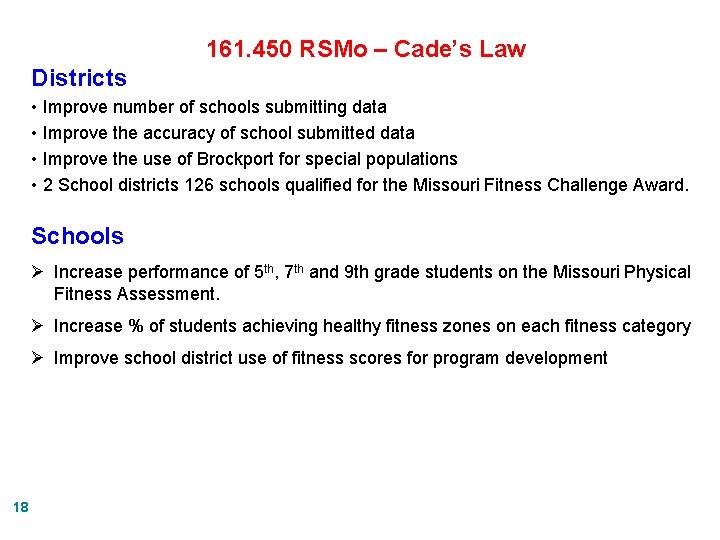
161. 450 RSMo – Cade’s Law Districts • Improve number of schools submitting data • Improve the accuracy of school submitted data • Improve the use of Brockport for special populations • 2 School districts 126 schools qualified for the Missouri Fitness Challenge Award. Schools Ø Increase performance of 5 th, 7 th and 9 th grade students on the Missouri Physical Fitness Assessment. Ø Increase % of students achieving healthy fitness zones on each fitness category Ø Improve school district use of fitness scores for program development 18
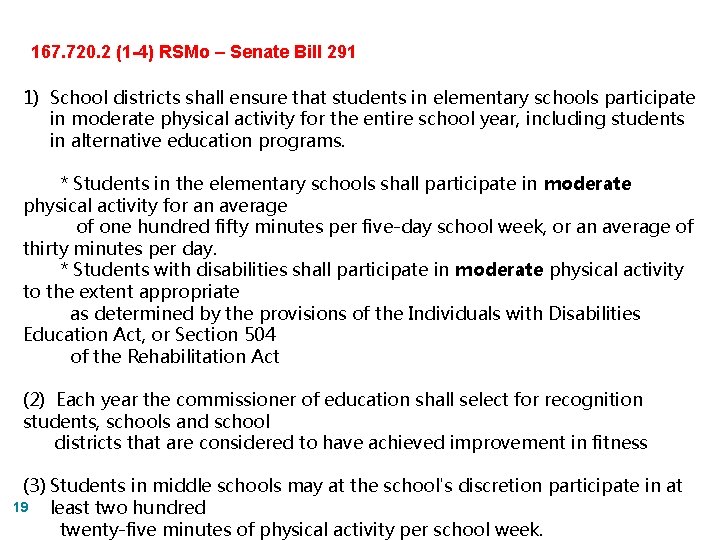
167. 720. 2 (1 -4) RSMo – Senate Bill 291 1) School districts shall ensure that students in elementary schools participate in moderate physical activity for the entire school year, including students in alternative education programs. * Students in the elementary schools shall participate in moderate physical activity for an average of one hundred fifty minutes per five-day school week, or an average of thirty minutes per day. * Students with disabilities shall participate in moderate physical activity to the extent appropriate as determined by the provisions of the Individuals with Disabilities Education Act, or Section 504 of the Rehabilitation Act (2) Each year the commissioner of education shall select for recognition students, schools and school districts that are considered to have achieved improvement in fitness (3) Students in middle schools may at the school's discretion participate in at 19 least two hundred twenty-five minutes of physical activity per school week.
Comprehensive School Physical Activity Program (CSPAP) A multi-component approach by which school districts and schools provide multiple opportunities to accumulate 60 minutes of physical activity before, during and after the school day. 1. To provide a variety of school-based physical activities to enable all students to participate in 60 minutes of moderate-to-vigorous physical activity each day. 2. To provide coordination among the CSPAP Components to maximize understanding, application, and practice of the knowledge and skills learned in physical education. 20
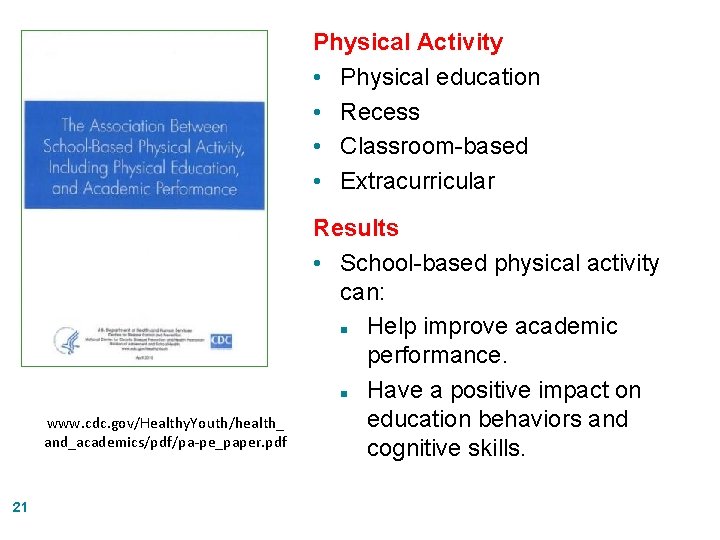
Physical Activity • Physical education • Recess • Classroom-based • Extracurricular www. cdc. gov/Healthy. Youth/health_ and_academics/pdf/pa-pe_paper. pdf 21 Results • School-based physical activity can: n Help improve academic performance. n Have a positive impact on education behaviors and cognitive skills.
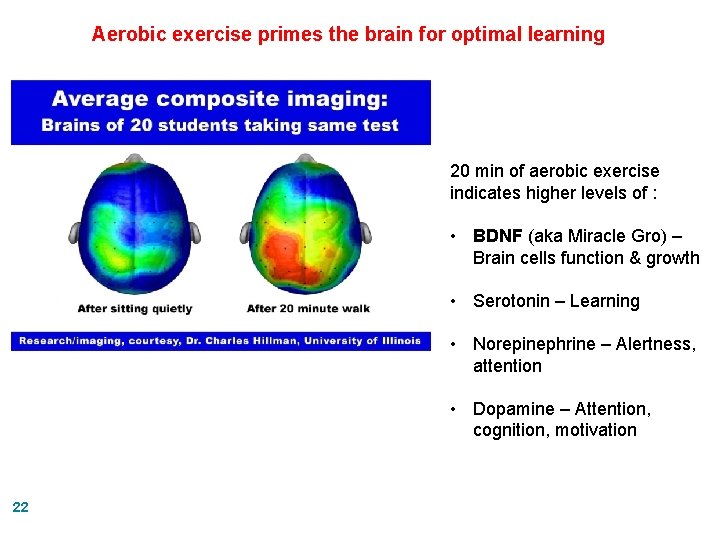
Aerobic exercise primes the brain for optimal learning 20 min of aerobic exercise indicates higher levels of : • BDNF (aka Miracle Gro) – Brain cells function & growth • Serotonin – Learning • Norepinephrine – Alertness, attention • Dopamine – Attention, cognition, motivation 22
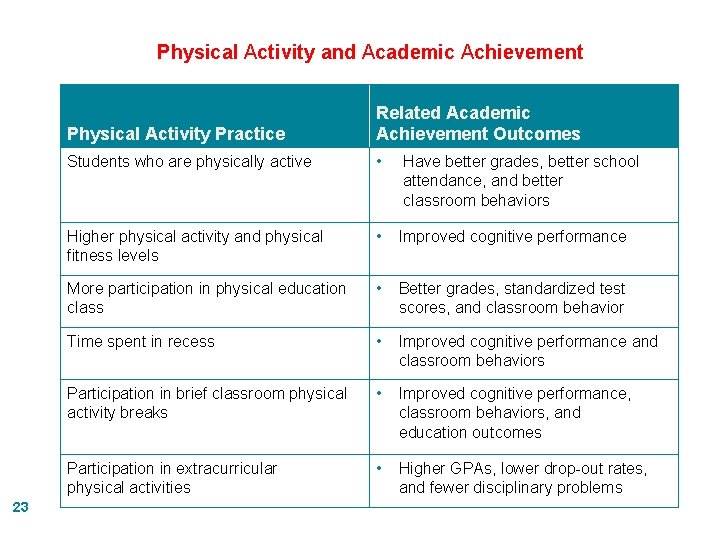
Physical Activity and Academic Achievement 23 Physical Activity Practice Related Academic Achievement Outcomes Students who are physically active • Have better grades, better school attendance, and better classroom behaviors Higher physical activity and physical fitness levels • Improved cognitive performance More participation in physical education class • Better grades, standardized test scores, and classroom behavior Time spent in recess • Improved cognitive performance and classroom behaviors Participation in brief classroom physical activity breaks • Improved cognitive performance, classroom behaviors, and education outcomes Participation in extracurricular physical activities • Higher GPAs, lower drop-out rates, and fewer disciplinary problems
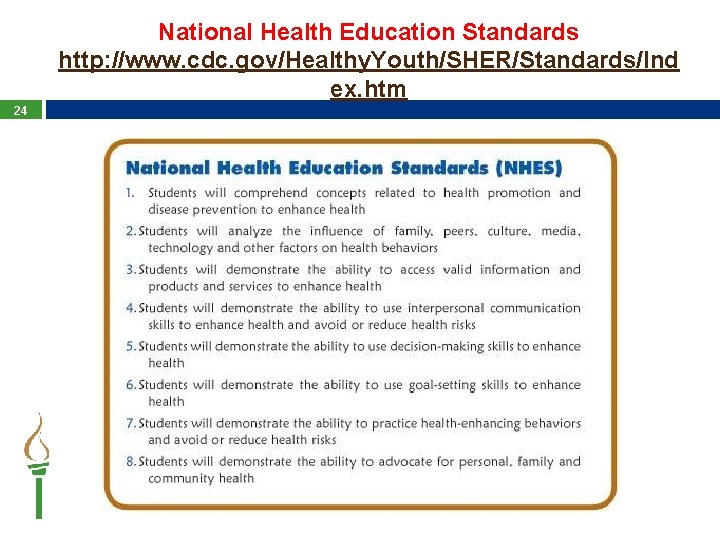
National Health Education Standards http: //www. cdc. gov/Healthy. Youth/SHER/Standards/Ind ex. htm 24
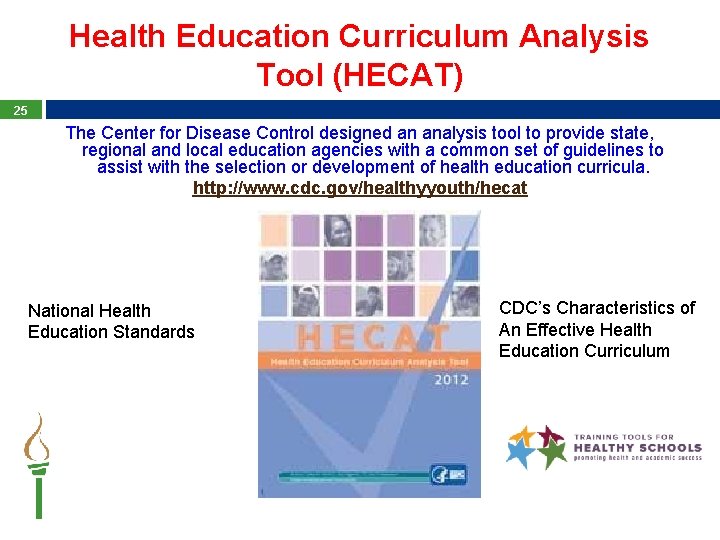
Health Education Curriculum Analysis Tool (HECAT) 25 The Center for Disease Control designed an analysis tool to provide state, regional and local education agencies with a common set of guidelines to assist with the selection or development of health education curricula. http: //www. cdc. gov/healthyyouth/hecat National Health Education Standards CDC’s Characteristics of An Effective Health Education Curriculum
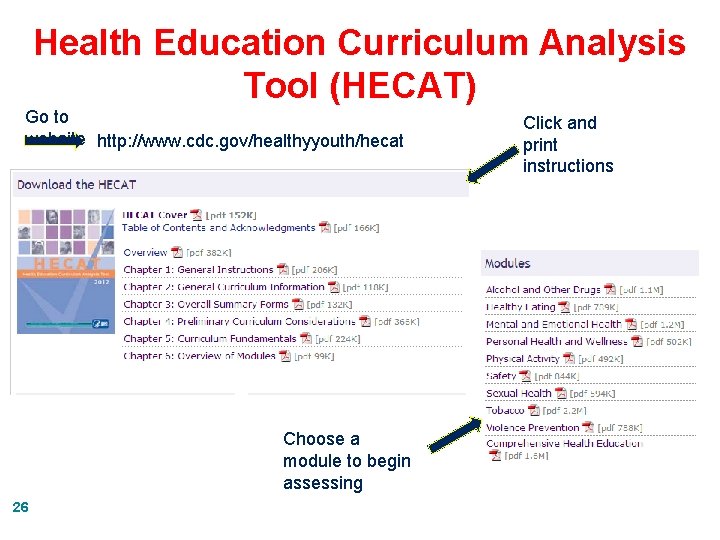
Health Education Curriculum Analysis Tool (HECAT) Go to website http: //www. cdc. gov/healthyyouth/hecat Choose a module to begin assessing 26 Click and print instructions
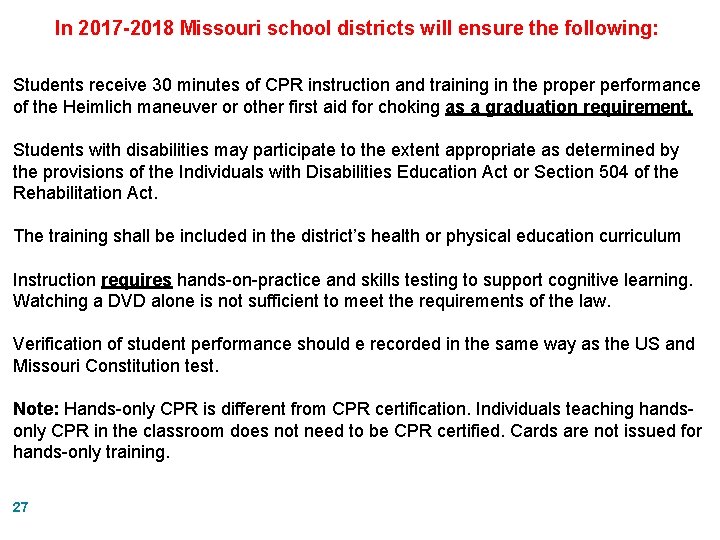
In 2017 -2018 Missouri school districts will ensure the following: Students receive 30 minutes of CPR instruction and training in the proper performance of the Heimlich maneuver or other first aid for choking as a graduation requirement. Students with disabilities may participate to the extent appropriate as determined by the provisions of the Individuals with Disabilities Education Act or Section 504 of the Rehabilitation Act. The training shall be included in the district’s health or physical education curriculum Instruction requires hands-on-practice and skills testing to support cognitive learning. Watching a DVD alone is not sufficient to meet the requirements of the law. Verification of student performance should e recorded in the same way as the US and Missouri Constitution test. Note: Hands-only CPR is different from CPR certification. Individuals teaching handsonly CPR in the classroom does not need to be CPR certified. Cards are not issued for hands-only training. 27
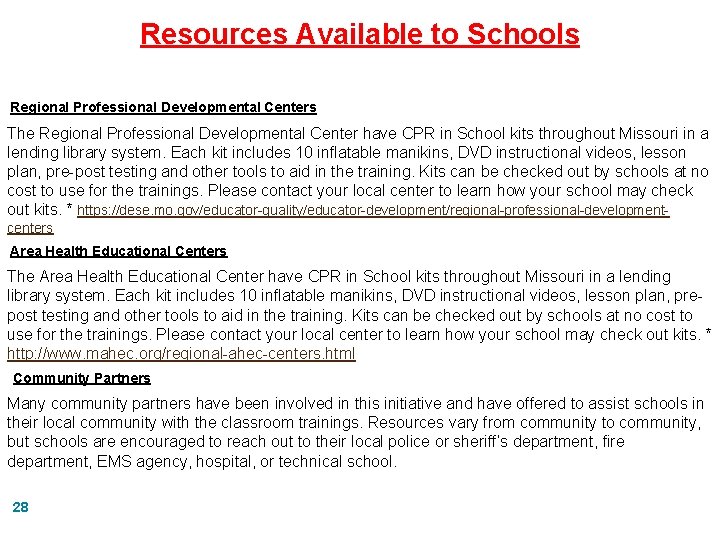
Resources Available to Schools Regional Professional Developmental Centers The Regional Professional Developmental Center have CPR in School kits throughout Missouri in a lending library system. Each kit includes 10 inflatable manikins, DVD instructional videos, lesson plan, pre-post testing and other tools to aid in the training. Kits can be checked out by schools at no cost to use for the trainings. Please contact your local center to learn how your school may check out kits. * https: //dese. mo. gov/educator-quality/educator-development/regional-professional-developmentcenters Area Health Educational Centers The Area Health Educational Center have CPR in School kits throughout Missouri in a lending library system. Each kit includes 10 inflatable manikins, DVD instructional videos, lesson plan, prepost testing and other tools to aid in the training. Kits can be checked out by schools at no cost to use for the trainings. Please contact your local center to learn how your school may check out kits. * http: //www. mahec. org/regional-ahec-centers. html Community Partners Many community partners have been involved in this initiative and have offered to assist schools in their local community with the classroom trainings. Resources vary from community to community, but schools are encouraged to reach out to their local police or sheriff’s department, fire department, EMS agency, hospital, or technical school. 28
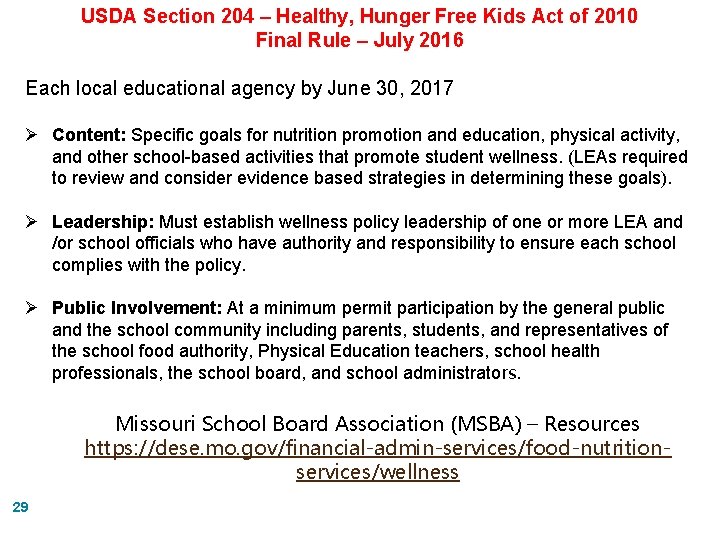
USDA Section 204 – Healthy, Hunger Free Kids Act of 2010 Final Rule – July 2016 Each local educational agency by June 30, 2017 Ø Content: Specific goals for nutrition promotion and education, physical activity, and other school-based activities that promote student wellness. (LEAs required to review and consider evidence based strategies in determining these goals). Ø Leadership: Must establish wellness policy leadership of one or more LEA and /or school officials who have authority and responsibility to ensure each school complies with the policy. Ø Public Involvement: At a minimum permit participation by the general public and the school community including parents, students, and representatives of the school food authority, Physical Education teachers, school health professionals, the school board, and school administrators. Missouri School Board Association (MSBA) – Resources https: //dese. mo. gov/financial-admin-services/food-nutritionservices/wellness 29
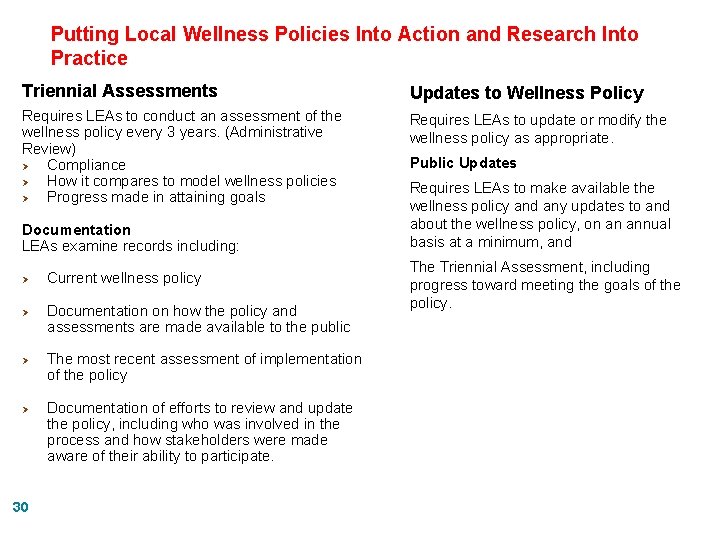
Putting Local Wellness Policies Into Action and Research Into Practice Triennial Assessments Updates to Wellness Policy Requires LEAs to conduct an assessment of the wellness policy every 3 years. (Administrative Review) Ø Compliance Ø How it compares to model wellness policies Ø Progress made in attaining goals Requires LEAs to update or modify the wellness policy as appropriate. Documentation LEAs examine records including: Ø Ø 30 Current wellness policy Documentation on how the policy and assessments are made available to the public The most recent assessment of implementation of the policy Documentation of efforts to review and update the policy, including who was involved in the process and how stakeholders were made aware of their ability to participate. Public Updates Requires LEAs to make available the wellness policy and any updates to and about the wellness policy, on an annual basis at a minimum, and The Triennial Assessment, including progress toward meeting the goals of the policy.
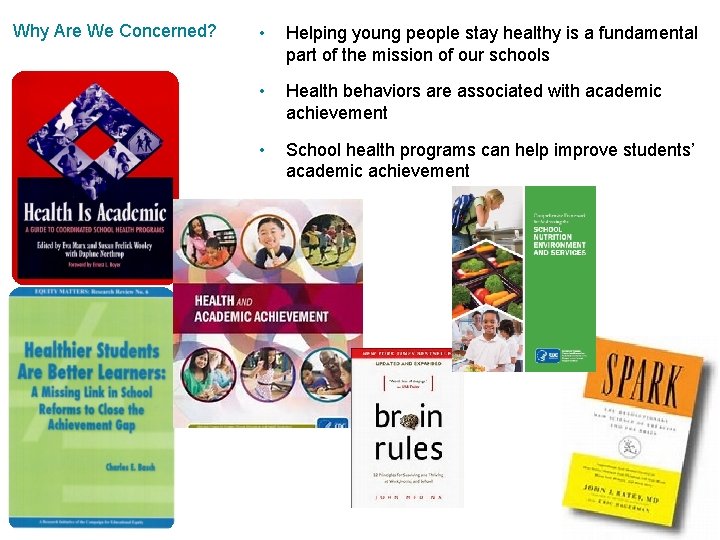
Why Are We Concerned? 31 • Helping young people stay healthy is a fundamental part of the mission of our schools • Health behaviors are associated with academic achievement • School health programs can help improve students’ academic achievement
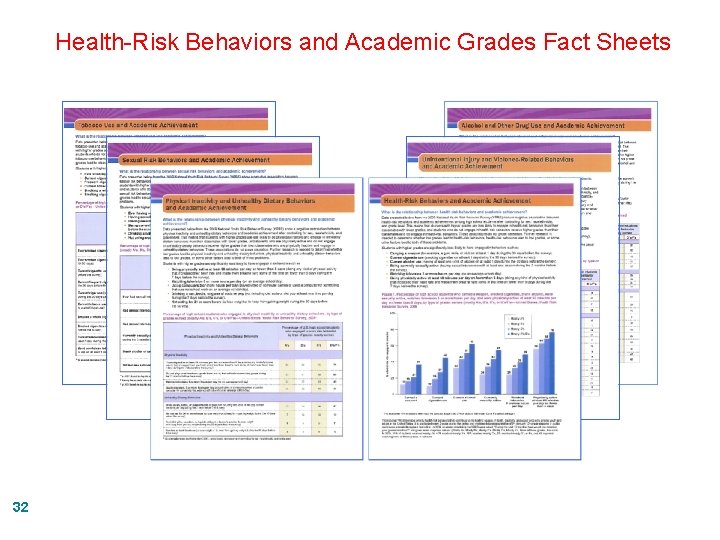
Health-Risk Behaviors and Academic Grades Fact Sheets 32
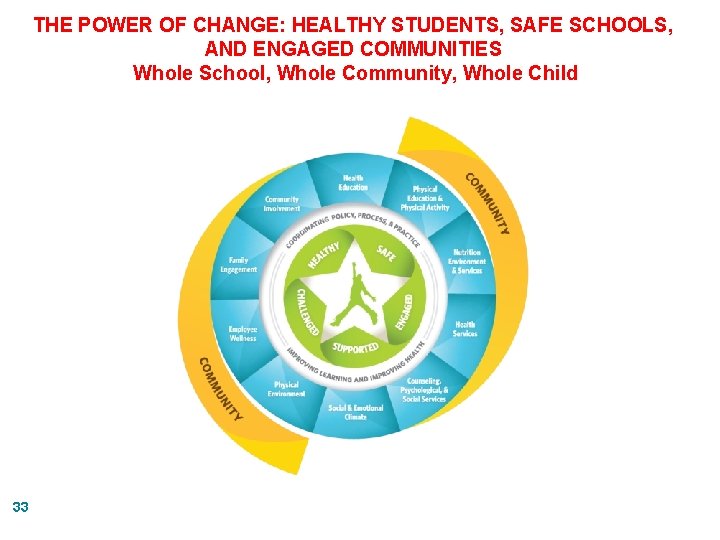
THE POWER OF CHANGE: HEALTHY STUDENTS, SAFE SCHOOLS, AND ENGAGED COMMUNITIES Whole School, Whole Community, Whole Child 33
ASCD Whole Child Policy Recommendations Change the conversation about education from a focus on a narrowly defined academic achievement to one that encompasses a broader definition of accountability. 1) Increase awareness and understanding among educators, families policy makers, and local community members about a whole child approach to learning. 2) Promote engagement between and among our members, our partners and whole child supporters. 3) Advocate action at local, state, and national level that advances a whole child approach to learning. States hold the authority and leverage to effect significant change. Recognize both the need for enhanced core academic standards and a different infrastructure supporting the education system. We must find ways to better coordinate resources and services from institutions and agencies that affect young people and their 34 families.
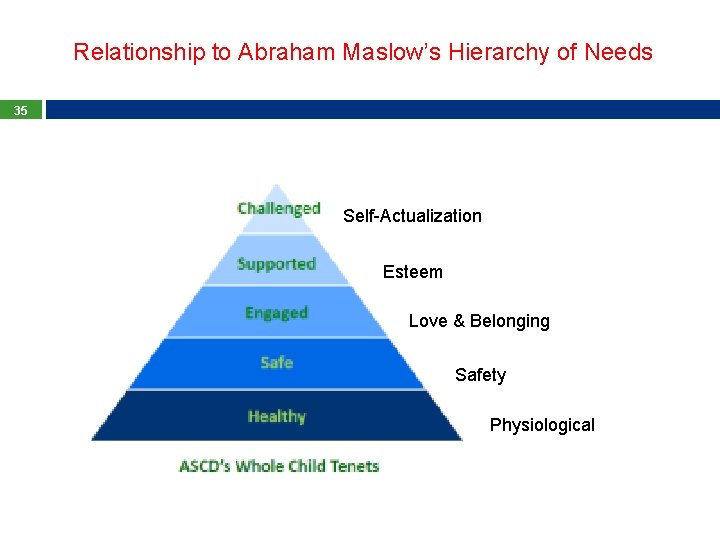
Relationship to Abraham Maslow’s Hierarchy of Needs 35 Self-Actualization Esteem Love & Belonging Safety Physiological
ASCD Whole Child Tenets 1. Each student enters school healthy and learns about and practices a healthy lifestyle. 2. Each student learns in an environment that is physically and emotionally safe for students and adults. 3. Each student is actively engaged in learning and is connected to the school and broader community. 4. Each student has access to personalized learning and is supported by qualified, caring adults. 5. Each student is challenged academically and prepared for success in college or further study and for employment and participation in a global environment. 36
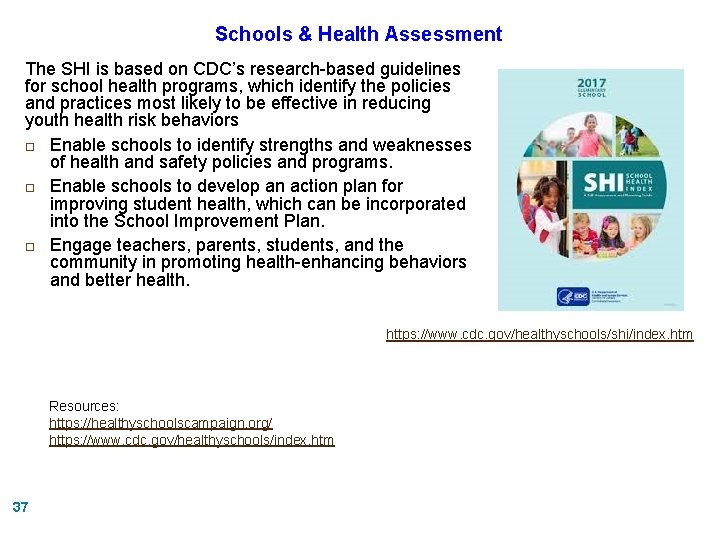
Schools & Health Assessment The SHI is based on CDC’s research-based guidelines for school health programs, which identify the policies and practices most likely to be effective in reducing youth health risk behaviors Enable schools to identify strengths and weaknesses of health and safety policies and programs. Enable schools to develop an action plan for improving student health, which can be incorporated into the School Improvement Plan. Engage teachers, parents, students, and the community in promoting health-enhancing behaviors and better health. https: //www. cdc. gov/healthyschools/shi/index. htm Resources: https: //healthyschoolscampaign. org/ https: //www. cdc. gov/healthyschools/index. htm 37
What’s In the Works? Increases developmentally appropriate understanding, appreciation, and application of regular physical fitness, proper nutrition, and healthy lifestyle components that promote lifelong personal fitness and healthy habits. Healthy Lifestyle Development Model Curriculum Units * Curriculum MAP * 4 Instructional Units per grade level aligned to Missouri Learning Standards - Physical Activity - Nutrition/Healthy Eating - Personal/Social/Emotional Development - Fundamental Movement Concepts (Self-Efficacy) Development and assessment of essential knowledge and behavioral skills related to development of active and healthy lifestyles Relationship of knowledge and skill expectations to career readiness Development of personal and social skills related to self-confidence 38
“No matter how well teachers are prepared to teach, no matter what accountability measures are put in place, no matter what governing structures are established for schools, educational progress will be profoundly limited if students are not motivated and able to learn. Health related problems play a major role in limiting the motivation and ability to learn…” ~Charles Basch 39 http: //www. equitycampaign. org/i/a/document/12557_equitymattersvol 6_web 03082010. pdf
40 Questions?
THANK YOU! Laura Beckmann laura. beckmann@dese. mo. gov 573 -751 -7613 January, 2018 Missouri Department of Elementary and Secondary Education